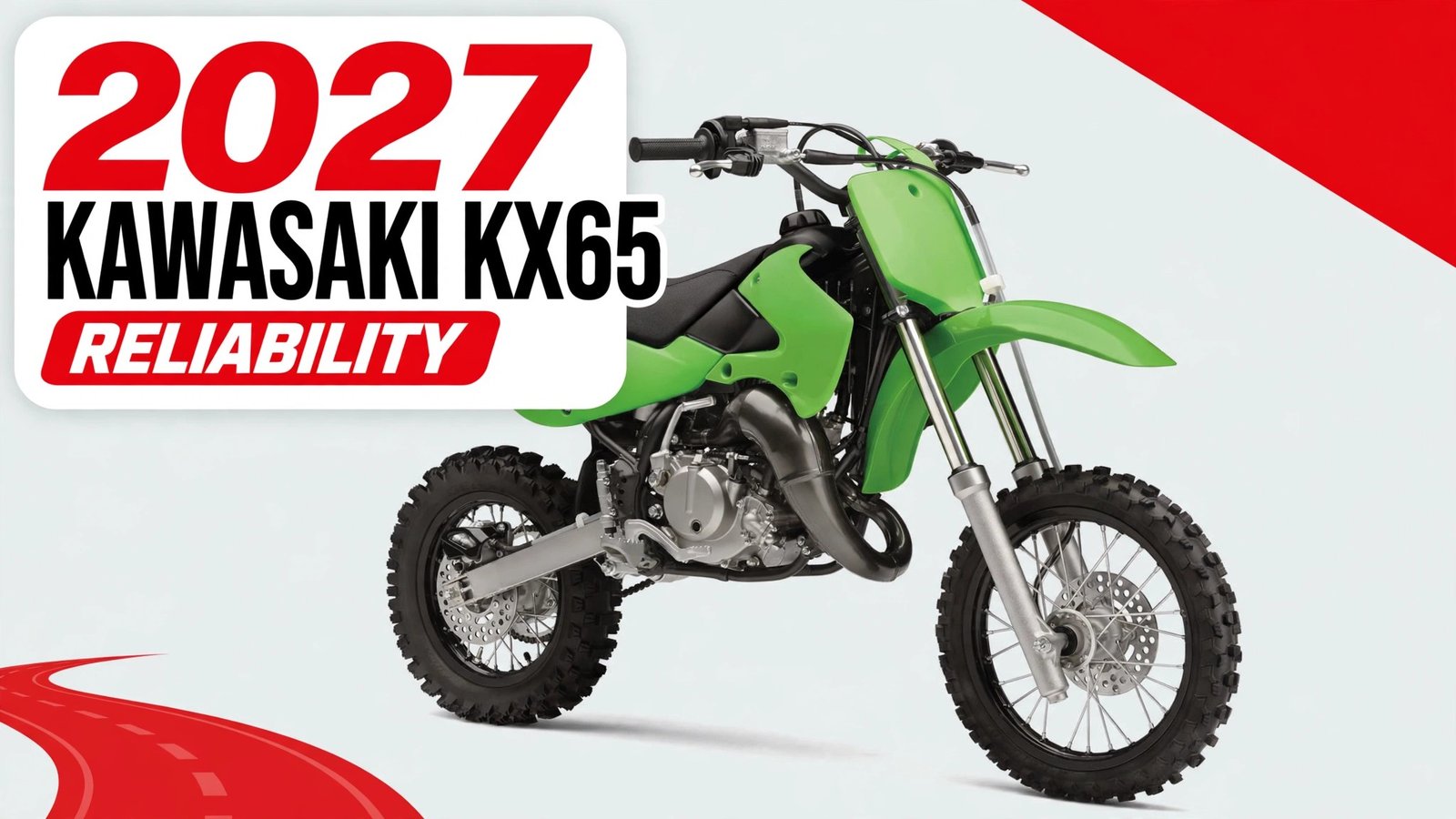
The 2027 Kawasaki KX65 is a simple machine with a long memory: the same 64cc two-stroke single that Kawasaki has sold, fundamentally unchanged since the 2002 revision, still asks its owner for a piston check every 12.5 hours and fresh transmission oil every 7.5. That is the honest starting point for this Kawasaki KX65 reliability guide — the bike is durable precisely because its maintenance is short, regular and impossible to ignore.
What follows is built on Kawasaki’s own manuals and the two CPSC recall records, not on forum rumour. This Kawasaki KX65 reliability guide covers the two recalls (both more than 25 years old), the wear items a used bike hides, the full service schedule, and what the parts actually cost in November 2026 — and our Kawasaki KX65 performance guide covers the 13.77 hp dyno and the power gap in full.
Kawasaki KX65 Reliability Overview
On paper, the KX65’s reliability record is short: two CPSC recalls from 2000 and 2001, and none since. This Kawasaki KX65 reliability guide rates the bike as fundamentally sound — a carburetted two-stroke with no electronics to fail — with one condition attached: its reliability is earned in hours, not miles, and a neglected service interval shows up fast.
Two CPSC Recalls, Both Old
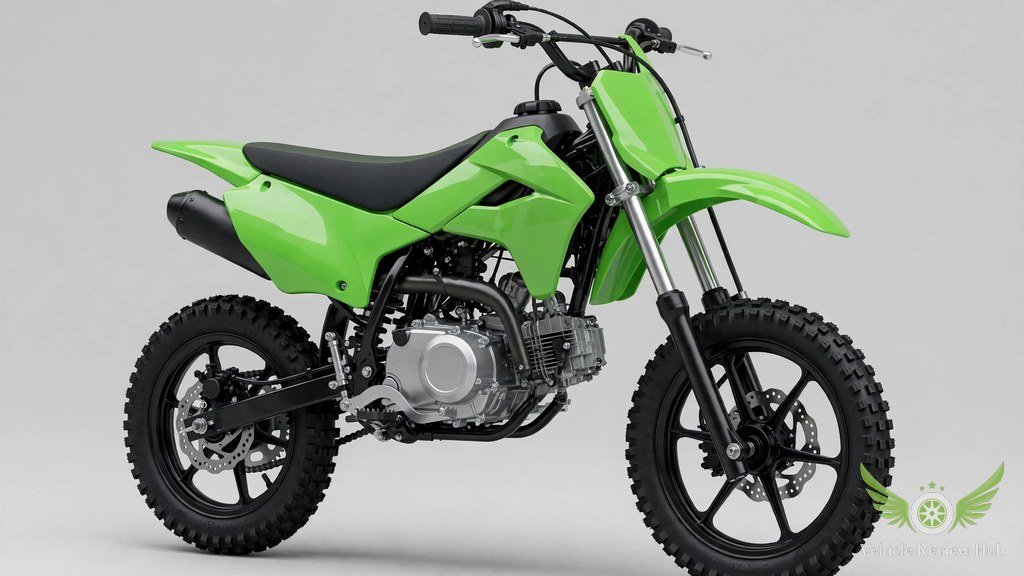
The KX65 has been recalled twice, and both recalls are more than 25 years old. The first, CPSC 01-037, was announced on November 21, 2000, and covered about 4,000 model-year-2000 bikes: a frame down tube could crack below the steering head, and CPSC recorded 60 cracking reports, three of which ended with the down tube failing and the rider crashing. The second, CPSC 01-065, was announced on January 11, 2001, and covered about 18,000 bikes across all 2001 KX models — the KX65 was one of six models in the campaign, and its slice was never broken out. Its rear brakes could fail; no injuries were reported, and the recall was preventive. Both recalls are CPSC records, not NHTSA ones: NHTSA returns zero for every KX65 search because competition bikes sit outside its system, and that zero proves nothing — this Kawasaki KX65 reliability guide states both recalls as CPSC records, and records that no KX65 recall has been issued since 2001.
How Mileage, Storage and Previous Care Affect Reliability
A KX65 has no odometer, no hour meter and no service history on its face, so a used bike’s reliability is really a question about its previous owner. Dirt Bike Magazine’s 2004 teardown of a used KX65 project bike is the clearest published example: the engine had a cracked piston skirt and metal debris in the bottom end, the fork and shock internals were used up — seals, bushings and oil — and the bike needed new wheel bearings and spokes. None of that was a design fault; it was deferred maintenance, and that is why this Kawasaki KX65 reliability guide treats a service log as the first thing to ask for when buying used. Storage matters the same way: a bike left with old premix in the tank and a dirty air filter will foul its plug and gum its carburettor, while a bike stored drained and clean starts the season the way it ended it. The practical test this Kawasaki KX65 reliability guide recommends before buying used is simple — ask for the service log, check the frame joints for cracking, and ride the bike long enough to feel whether the clutch slips or the engine rattles. A KX65 that has been serviced on its hours is a reliable bike; one that has not will tell you within a moto.
Kawasaki KX65 Common Problems and Wear Items
The KX65’s common problems are wear items, not surprises: the parts that wear are the parts the manual schedules. This Kawasaki KX65 reliability guide lists them from the owner’s manual troubleshooting guide and the published teardown record, with no forum invention.
2000: Frame Down-Tube Cracks
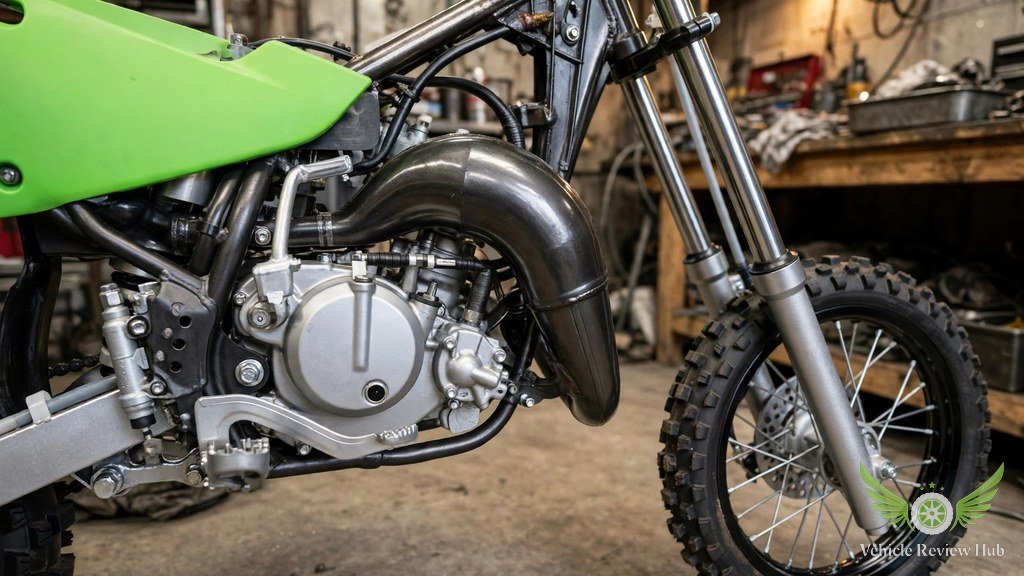
The first recall is the one that still matters when buying a 2000 bike. CPSC 01-037 covered model-year-2000 KX65s whose frame down tube could crack below the steering head; a cracked tube could fail, and three of the 60 reported cases ended in a crash with broken bones and abrasions. The remedy was a free dealer inspection and repair, and CPSC lists the affected bikes by the last four digits of the VIN — 0001 through 6668 — with the VIN stamped on the frame behind the front fork. Any 2000 KX65 still in use should have had the inspection decades ago, but a buyer checking a 26-year-old bike today should still look at the frame joints around the steering head for cracking, because that is where the failure started. The 2002 revision changed the frame geometry, and no frame-crack recall has touched any KX65 since — a point this Kawasaki KX65 reliability guide records plainly.
2001: Rear Brakes Can Fail
The second recall is simpler and less serious. CPSC 01-065, announced January 11, 2001, warned that the rear brakes on 2001 KX models could fail and cause a rider to lose control. About 18,000 bikes were covered across the whole 2001 KX range — the KX65, KX85, KX100, KX125, KX250 and KX500 — and the KX65’s share was never published, so no one should quote 18,000 as a KX65 figure. No failures or injuries were reported, and this Kawasaki KX65 reliability guide counts the recall as preventive rather than serious, and the remedy was a free repair kit mailed to owners, fitted at home or free at a dealer. A 2001 bike that never received the kit is still worth checking, but the practical risk today is ordinary brake wear, not the 2001 defect: the KX65’s 180 mm rear disc and single-piston caliper are the smallest brakes in the class, and pads, fluid and hoses age whether the bike is raced or stored — which is why this Kawasaki KX65 reliability guide treats the brake checks as a routine item, not a recall item.
Kawasaki KX65 Maintenance Schedule and Servicing
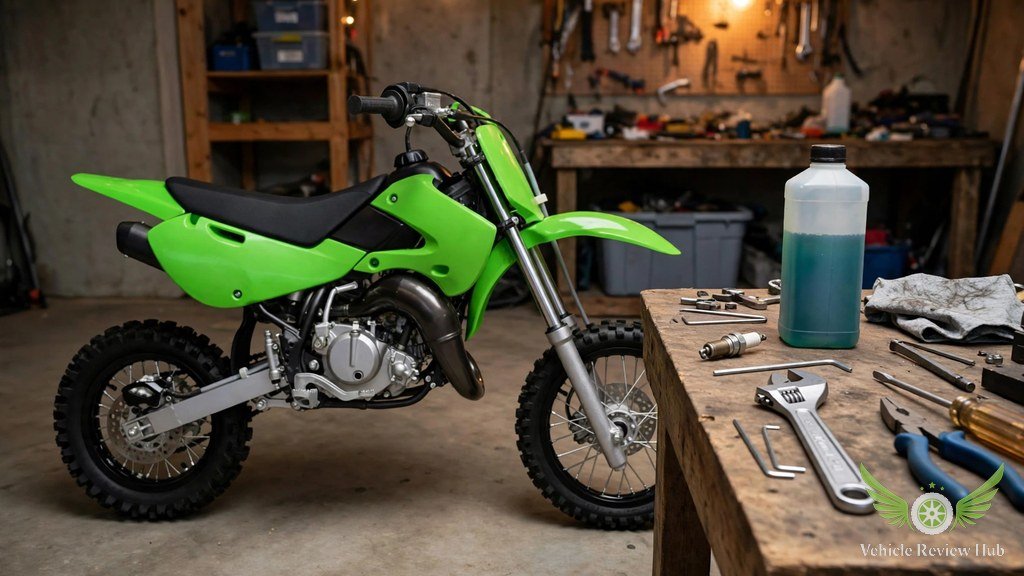
The service schedule is the heart of this Kawasaki KX65 reliability guide, and it comes straight from Kawasaki’s maintenance chart: everything is measured in races and hours, not miles, because a race bike’s life is counted in motos.
| Item | Interval | Detail |
|---|---|---|
| Piston and rings — check | Every 5 races (12.5 hours) | Clean and check; measure ring end gap and clearances |
| Piston and rings — replace | Every 10 races (25 hours) | Replace piston and rings as a set |
| Transmission oil | Every 3 races (7.5 hours) | SAE 10W-40, API SG–SM / JASO MA, 0.5 L; drain bolt 20 N·m |
| Spark plug | Replace every 3 races | NGK BR10EG; clean and regap after each race |
| Air cleaner | Clean after each race | Wash and re-oil the element |
| Coolant | Check each race; replace at 25 hours | 50% ethylene-glycol, 1:1 mix, 0.4 L total |
| Brake fluid | Check level every 3 races; change every 2 years | Hoses every 4 years; seals every 2 years |
| Chain | Adjust and lubricate after each race | Wear check every 5 races |
| Fork and shock oil | First after 2 races, then every 5 races | Both ends; seals and bushings inspected at the same time |
Note: Intervals are from Kawasaki’s maintenance chart in the owner’s and service manuals (2013 editions). One race is treated as 2.5 hours of running time, so five races is 12.5 hours and three races is 7.5 hours. This Kawasaki KX65 reliability guide uses the manual’s figures throughout.
Piston Check Every 12.5 Hours
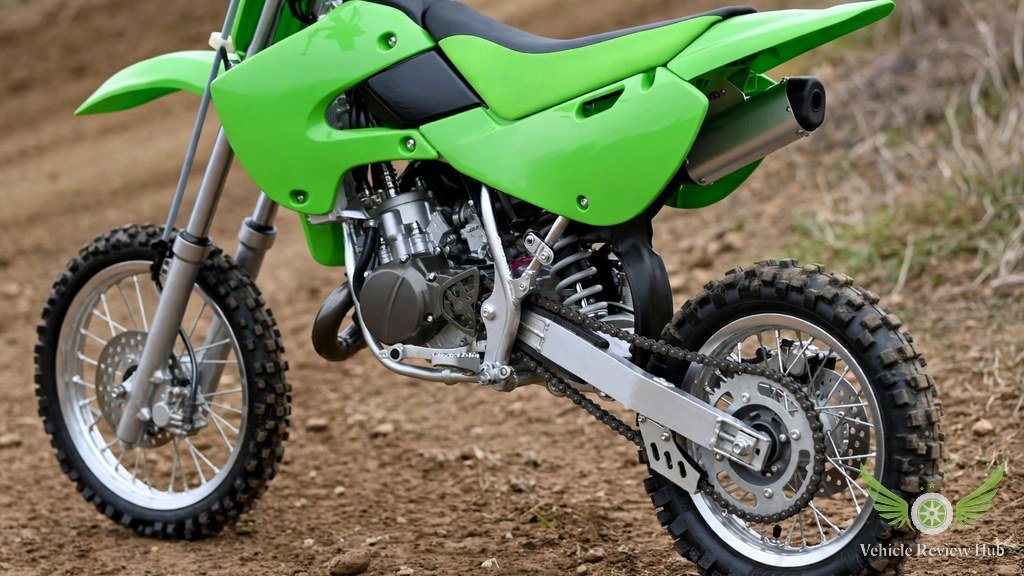
The piston and rings are the KX65’s shortest-lived wear items, and the manual is blunt about them: clean and check the piston and rings every five races, or 12.5 hours, and replace them at ten races, or 25 hours. A two-stroke piston works harder than a four-stroke’s — it carries the combustion load on every revolution and its rings seal against a ported cylinder wall — so the check is not optional, and this Kawasaki KX65 reliability guide treats the 12.5-hour check as the bike’s most important interval. The owner’s manual troubleshooting guide lists worn, weak, broken or sticking piston rings and low compression among the first things to check when the bike loses power, and Dirt Bike Magazine’s 2004 teardown found a cracked piston skirt on a used bike that had plainly missed its intervals. The check itself is straightforward for a home mechanic: pull the cylinder, measure the ring end gap and piston-to-cylinder clearance against the manual’s limits, and replace anything out of spec.
Oil Every 7.5 Hours
Transmission oil changes every three races, or 7.5 hours, and the specification is narrow: SAE 10W-40 meeting API SG to SM and JASO MA, 0.5 litres in the gearbox, with the drain bolt torqued to 20 N·m. The same three-race interval applies to the spark plug — NGK BR10EG, cleaned and regapped after each race, replaced every three — and the air cleaner is cleaned after every race — the cheapest insurance this Kawasaki KX65 reliability guide knows. The rest of the chart is just as regular: coolant checked each race and replaced at 25 hours (a 50/50 ethylene-glycol mix, 0.4 litres total), brake fluid level checked every three races and changed every two years, the chain adjusted and lubricated after each race with a wear check every five, and fork and shock oil changed first after two races and then every five. None of it is difficult; all of it is frequent — and this Kawasaki KX65 reliability guide is blunt about why: that frequency is the price of a 126 lb race bike, and it is also why the KX65 stays reliable, because the schedule catches wear before wear catches the rider.
Kawasaki KX65 Tires, Brakes and Suspension Maintenance
Tyres, brakes and suspension are where a used KX65 shows its history first, and this Kawasaki KX65 reliability guide checks them the way a buyer would: by size, by wear and by what the manual schedules.
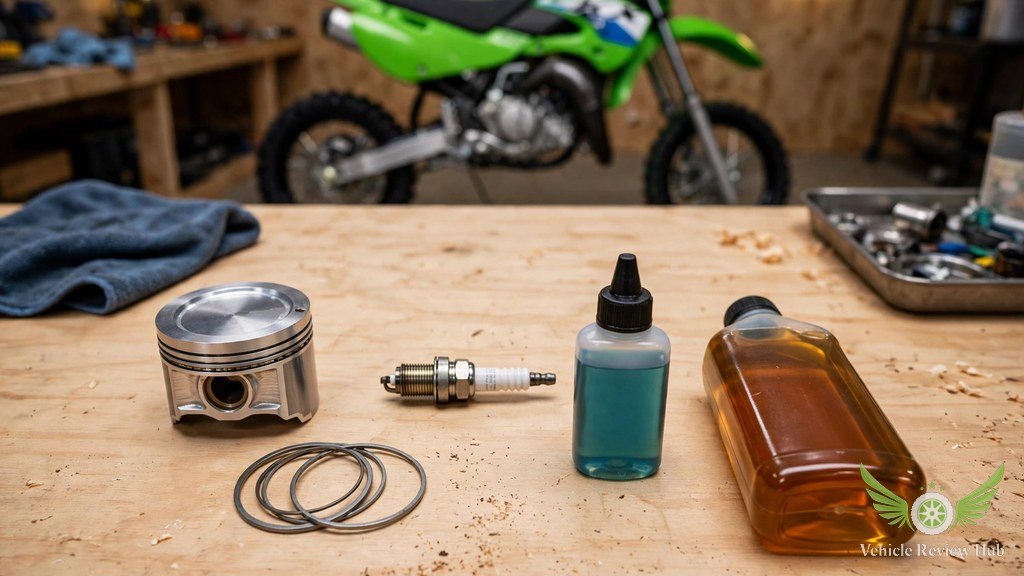
Piston $88.76, Rings $42.23
The heading is the document’s figure, and it could not be verified: no checked source shows a piston at $88.76 or a ring set at $42.23. The part numbers are verified — piston 13001-0040 and ring set 13008-1199 appear on Kawasaki’s official 2027 parts diagram, the source this Kawasaki KX65 reliability guide trusts for part numbers — but the current prices are higher. Partzilla, checked on November 25, 2026, lists the piston at $96.83 and the ring set at $46.06, both in stock, which puts a piston-and-rings service at $142.89 in parts before any labour. That is the figure a buyer should budget for, not the document’s. The gap is small — about eight dollars on the piston and four on the rings — but it is the difference between a price that was once true and a price that is true now, and this Kawasaki KX65 reliability guide prints the current one.
Tire, Brake and Suspension Checks That Matter
Start with the tyres: 60/100-14 on the front and 80/100-12 on the rear, and a race bike’s tyres wear faster than a trail bike’s because the knobs work hard on a prepared track. Check the tread depth, the sidewalls for cracking and the pressures before every ride — a soft rear tyre on a 65 will spin before it hooks up. The brakes are the smallest in the class, a 180 mm disc and a single-piston caliper at each end, so pad wear shows quickly; check the pads, the disc surfaces and the fluid level every three races, and change the fluid every two years, the seals every two years and the hoses every four. The suspension is the bike’s one chassis advantage and its most neglected item: the Uni-Trak linkage rear shock and the 33 mm conventional fork both need their oil changed — first after two races, then every five — and the Dirt Bike teardown found both ends with their internal wear items used up on a bike that had skipped it. A fork seal weeps before it fails, and a linkage bearing seizes before it snaps; both announce themselves to anyone who looks, which is why this Kawasaki KX65 reliability guide puts the suspension oil on the same must-do list as the piston.
Kawasaki KX65 Maintenance and Ownership Costs
The KX65 is the cheapest 65cc motocrosser to buy and one of the cheapest to keep, and this Kawasaki KX65 reliability guide puts the numbers in one place so a parent can budget the season before buying the bike.
| Item | Verified figure | Source |
|---|---|---|
| 2027 MSRP | $4,249 | Kawasaki USA spec sheet |
| Destination charge | $315 | Dealer / motorcycle.com (not Kawasaki-published) |
| 2027 delivered price | $4,564 | MSRP + destination |
| Piston (13001-0040) | $96.83 | Partzilla, Nov 25, 2026 |
| Ring set (13008-1199) | $46.06 | Partzilla, Nov 25, 2026 |
| Piston + rings together | $142.89 | Partzilla, Nov 25, 2026 |
| Fuel | Premix 32:1, 4 fl oz oil per gallon | Owner’s manual (90 AKI min) |
| Spark plug (NGK BR10EG) | Replace every 3 races | Owner’s manual (price varies by dealer) |
Note: Prices are Partzilla’s, checked November 25, 2026, and Kawasaki USA’s 2027 spec sheet; the destination charge is dealer- and motorcycle.com-sourced, never a Kawasaki-published figure. Labour is not included — most KX65 owners do the scheduled work at home, and dealer labour rates vary too widely to print as a single figure — and this Kawasaki KX65 reliability guide does not print a labour figure for that reason.
Fuel, Routine Servicing, Tires and Replacement Parts
Fuel is the cheapest running cost and the easiest to get wrong, and this Kawasaki KX65 reliability guide starts with it for that reason. The KX65 runs premix at 32:1 — about 31 mL of two-stroke oil per litre of petrol, or four fluid ounces per gallon — on unleaded petrol with a minimum of 90 AKI in the United States, and there is no oil injection and no separate oil tank. The 1.0-gallon tank means fuel is carried to the track in a can, and a race day is measured in sessions rather than miles. Routine servicing is the piston and rings every 25 hours, the oil every 7.5, the plug every three races and the air filter after every race — small jobs, done often, with parts that cost tens of dollars rather than hundreds, and this Kawasaki KX65 reliability guide prices them that way because the parts are the whole cost for most owners. The price has been flat for years — $4,249 since 2024, with the 2027 bike at $4,249 plus a $315 destination charge, $4,564 delivered — and a footnote is owed to the $4,199 figure that some guides print for 2024: Kawasaki’s own 2024 spec sheet says $4,249, and the manufacturer governs. Compared with the Yamaha YZ65 at $4,819 delivered or the KTM 65 SX at $6,324, the KX65’s ownership case is the same as its purchase case — the cheapest bike in the class, with the simplest service schedule — and the full price comparison is in our Kawasaki KX65 comparison guide. Our Kawasaki KX65 review covers the price and ownership case in full.
Oil Interval Prints Conflict
The heading is accurate, and the conflict is in the secondary sources, not in Kawasaki’s manuals. Every Kawasaki manual prints the same interval: transmission oil every three races, 7.5 hours. One secondary summary — ownersmanuals2.com’s 2017 summary — prints 2.5 hours instead, and the same summary also misstates the spark-plug and air-cleaner intervals, which is why this Kawasaki KX65 reliability guide does not trust it. The site’s own 2019 summary prints the correct 7.5 hours, and the 2017 manual PDF itself could not be read to settle the question. The rule for an owner is simple: follow the manual’s 7.5 hours, and treat any shorter interval printed on a summary site as a misreading until a Kawasaki document says otherwise. Changing oil early wastes a little money; changing it late costs a gearbox.
How to Keep a Kawasaki KX65 Reliable
Keeping a KX65 reliable is a routine, not a repair: hours, records and inspections, repeated every race. This Kawasaki KX65 reliability guide closes with the routine itself.
Preventive Maintenance, Records and Regular Inspections
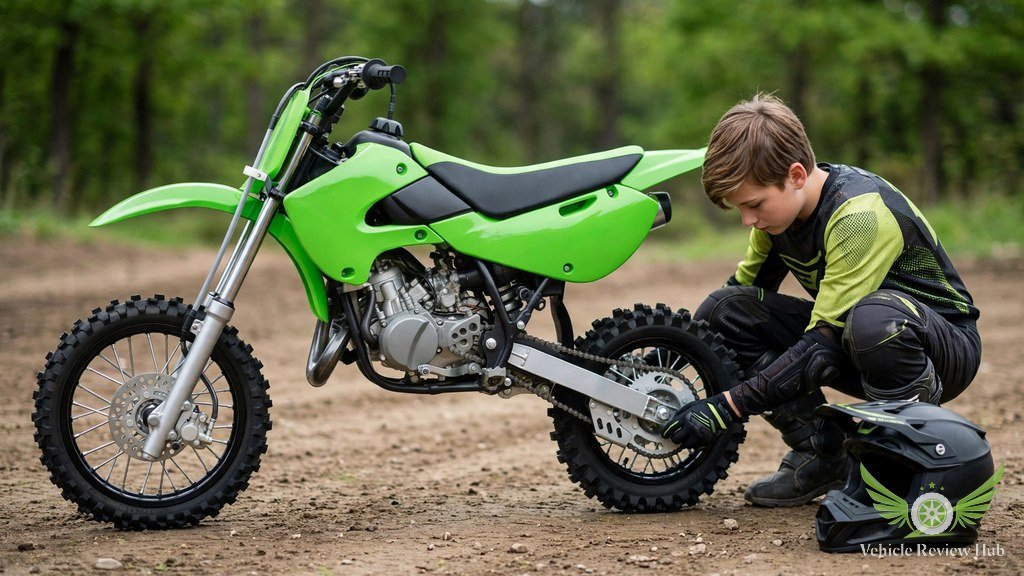
The single most useful habit is an hour log. The manual’s intervals are counted in races and hours, and a bike with no hour meter needs its owner to keep the count: write down the hours after every ride, and service the piston at 12.5, the oil at 7.5 and the plug at three races. Records matter twice over — they keep the schedule honest, and they are the first thing a buyer asks for when the bike is sold — and this Kawasaki KX65 reliability guide treats a written log as the cheapest reliability upgrade there is. Inspections are the third leg: before every race, check the chain tension and lubrication, the brake pads and fluid, the tyre pressures, the fork seals for weeping and the frame joints for cracking. The owner’s manual troubleshooting guide is the right reference when something feels wrong — low compression points at the piston and rings, a slipping clutch at worn plates, a rattling engine at the reed valve or the piston itself — and it is written for an owner with basic tools.
Check the 2000 VIN Range
The last check is specific to the oldest bikes. Any 2000 KX65 should be checked against CPSC 01-037’s VIN range — the last four digits 0001 through 6668, stamped on the frame behind the front fork — and any bike in that range should have had its free dealer inspection and repair decades ago. The check costs nothing and takes a minute, and it is worth doing even now, because a 2000 bike that missed the recall is still riding on a frame that was never inspected. If the frame shows cracking below the steering head, stop riding it: that is exactly the failure the recall described, and a cracked down tube can fail without further warning — the one warning this Kawasaki KX65 reliability guide never softens. For any other year, the same inspection habit applies — look at the frame joints, the steering head and the swingarm pivot every time the bike is washed — but only the 2000 bikes carry a recall behind the check, and this Kawasaki KX65 reliability guide names that range because it is the one VIN check that matters.
To close plainly: the KX65 is reliable in the way a simple race bike is reliable — not because it never wears, but because everything that wears is scheduled, cheap and visible. Two recalls, both more than 25 years old, and none since; a piston check every 12.5 hours and oil every 7.5; parts that cost $96.83 and $46.06 rather than hundreds. That is the whole case for this Kawasaki KX65 reliability guide’s verdict: buy the bike, keep the hours, and it will keep running.
Kawasaki KX65 Reliability FAQs
These are the questions US buyers ask about the 2027 KX65’s recalls, service intervals and costs, answered from the verified facts in this Kawasaki KX65 reliability guide.
Has the Kawasaki KX65 been recalled?
Yes, twice, both over 25 years ago, both CPSC recalls (not NHTSA): 01-037 in 2000 (frame down-tube cracks, about 4,000 model-year-2000 bikes) and 01-065 in 2001 (rear brakes can fail, about 18,000 bikes across all 2001 KX models). No KX65 recall since, and this Kawasaki KX65 reliability guide records both recalls as CPSC records.
How do I check if my 2000 KX65 is affected by the frame recall?
CPSC lists the affected VINs by last four digits, 0001–6668 (the VIN is stamped on the frame behind the front fork). A free dealer inspection and repair was the remedy — and this Kawasaki KX65 reliability guide says any 2000 bike should still be checked for frame-joint cracking today.
How often does the piston need attention?
Check the piston and rings every 5 races (12.5 hours) and replace them at 10 races (25 hours), per Kawasaki’s maintenance chart, and this Kawasaki KX65 reliability guide follows the chart exactly. Transmission oil changes every 3 races (7.5 hours).
What do a piston and rings cost?
Current Partzilla prices (checked November 25, 2026): piston 13001-0040 $96.83, ring set 13008-1199 $46.06 — $142.89 together, and this Kawasaki KX65 reliability guide prints the current prices. The $88.76 / $42.23 figures have no source; do not use them as current prices.
Is the oil-change interval really 2.5 hours?
No. Kawasaki’s manuals all say 7.5 hours (every 3 races). One secondary summary prints 2.5 hours and also misstates other intervals — and this Kawasaki KX65 reliability guide does not trust it.
Does the KX65 have any NHTSA recalls or complaints?
NHTSA returns zero for every KX65 search — but that proves nothing: competition bikes sit outside NHTSA’s system (the 2025 KX450, which has a real CPSC recall, also returns NHTSA zero). The KX65’s recalls are CPSC records, and this Kawasaki KX65 reliability guide says so plainly.