The short answer in this Suzuki Boulevard C50 comparison is that the C50 is the cheapest shaft-drive bike in its class and the easiest to live with, but it is not the cheapest bike here and it is not the only one still sold new. The 2025 C50 costs $9,299 plus $600 destination, $9,899 in total — between the $8,334 Vulcan S and the $10,439 Vulcan 900 Classic, with the $9,299 Shadow Phantom undercutting it by $600. This Suzuki Boulevard C50 comparison puts all four side by side on price, specs, ABS, final drive and value.
Suzuki Boulevard C50 Overview and Its Closest Rivals
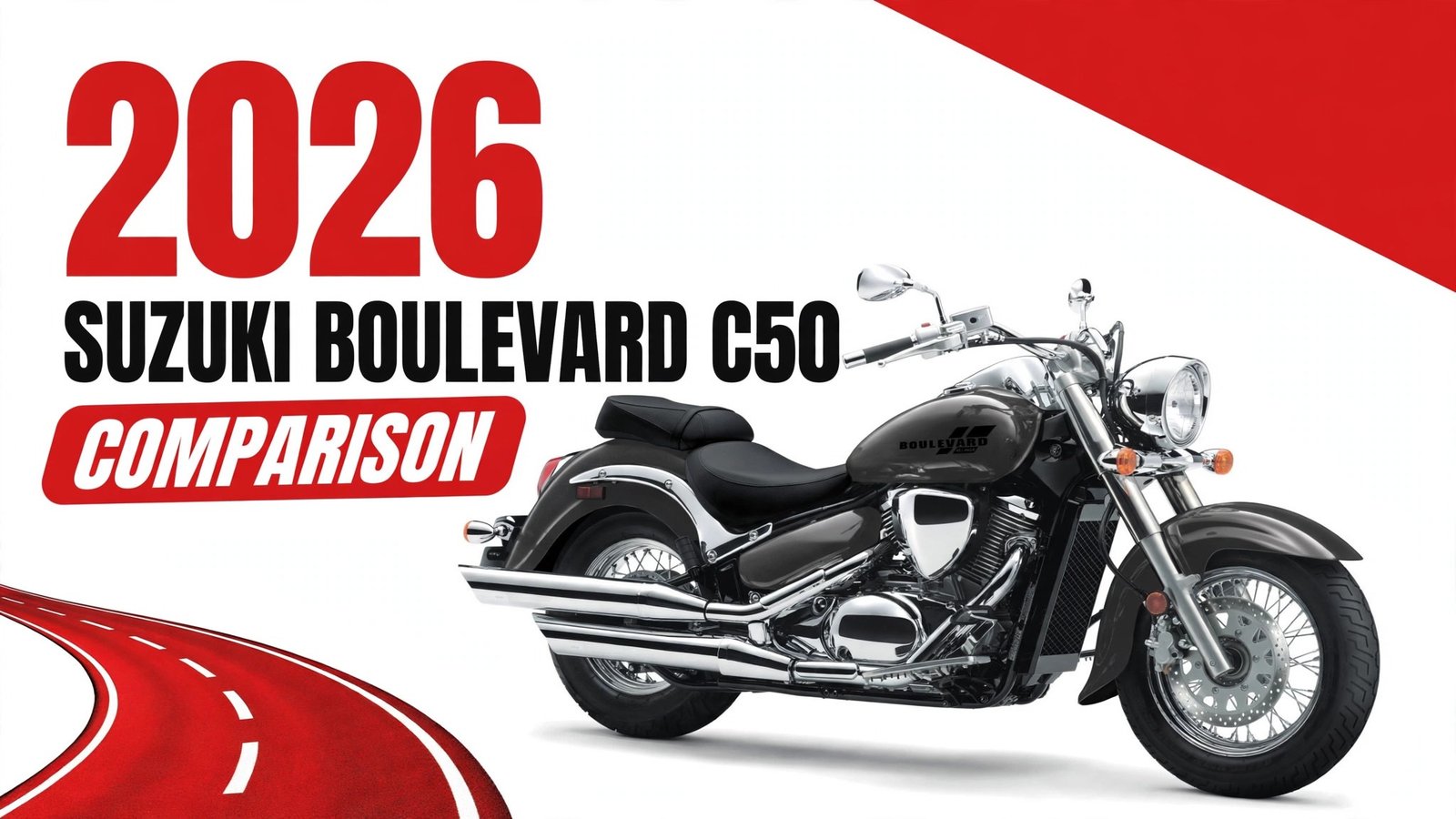
The C50 is a 2025-model cruiser with an 805cc liquid-cooled 45-degree V-twin, a five-speed gearbox and a shaft final drive — the oldest design here, in production since 2005, with 2025 as the latest US year and no 2026 model. Its three rivals are the bikes a buyer cross-shops at the same dealerships: the Kawasaki Vulcan 900 Classic, the Honda Shadow Phantom and the Kawasaki Vulcan S — all middleweight cruisers for the same rider. Suzuki’s own specification table lists the 805cc engine, shaft drive and 27.6-inch seat.

The video below is Rider XP’s English first-cruiser comparison covering the C50, the Shadow Phantom and the Vulcan S — the Vulcan 900 Classic is not in it.
Why These Three Rivals: Same Class, Same Job
These three rivals were picked for this Suzuki Boulevard C50 comparison because they do the same job as the C50 at a similar price, not because they look alike. The Vulcan 900 Classic is the closest match on size and style — a big-bore V-twin cruiser with a low seat and a classic look, at $10,439. The Shadow Phantom is the closest match on philosophy — a simple shaft-drive V-twin with almost nothing electronic, at $9,299. The Vulcan S is the closest match on price — a 649cc parallel twin with a chain and six speeds, at $8,334, for riders who want a lighter, sportier cruiser. No other bike belongs in this Suzuki Boulevard C50 comparison: the Rebel 1100, Yamaha Bolt and Indian Scout Sixty are different classes or prices, and the C50T is the C50’s own touring trim, not a rival.
How the Four Bikes Differ at a Glance
The four bikes in this Suzuki Boulevard C50 comparison differ most in final drive and braking, and those two choices shape ownership more than any horsepower number. The table below sets out the four bikes in this Suzuki Boulevard C50 comparison on the figures that matter, with power shown on the basis each figure was measured.
| Bike | Engine | Power | Final drive | ABS | Tank | Total price |
|---|---|---|---|---|---|---|
| Suzuki Boulevard C50 (2025) | 805cc V-twin | 46.4 hp (Rider dyno) | Shaft | None, any year | 4.1 gal | $9,899 |
| Kawasaki Vulcan 900 Classic (2026) | 903cc V-twin | 51 hp @ 5,500 rpm (factory) | Belt | Non-ABS | 5.3 gal | $10,439 |
| Honda Shadow Phantom (2025) | 745cc V-twin | ~44.6–44.9 hp (independent testing) | Shaft | Standard | 3.9 gal | $9,299 |
| Kawasaki Vulcan S (2026) | 649cc parallel twin | 60 hp @ 7,500 rpm (factory) | Chain | Separate trim ($8,149) | 3.7 gal | $8,334 |
Suzuki Boulevard C50 vs Kawasaki Vulcan 900 Classic
The Vulcan 900 Classic is the C50’s most direct rival in this Suzuki Boulevard C50 comparison: two V-twin cruisers, both low-slung, both aimed at riders who want a big-bike feel without a big-bike price. The 900 is the bigger bike where it matters — 903cc against 805cc, 58.3 lb-ft against the C50’s 45.4 lb-ft on Rider’s dyno, and a 5.3-gallon tank against 4.1 — and it costs $540 more, $10,439 against $9,899. The C50 answers with a shaft drive where the 900 uses a belt, and a twenty-year production run behind it. The Boulevard C50 review covers the 2025 model in detail.

Engine, Specs and Performance Side by Side
The Vulcan 900’s engine is a 903cc V-twin, 88.0 by 74.2 mm with 9.5:1 compression, and Kawasaki publishes 51 hp at 5,500 rpm and 58.3 lb-ft at 3,500 rpm. The C50’s engine is an 805cc V-twin, 83.0 by 74.4 mm with 9.4:1 compression, and Suzuki publishes no horsepower or torque — the only measured number is Rider’s dyno test, which put a 2013 C50 SE at 46.4 hp at 6,000 rpm and 45.4 lb-ft at the rear wheel. Those two numbers were measured on different bases — factory crank against rear-wheel dyno — so this Suzuki Boulevard C50 comparison does not rank them head to head. The 900 is also the lower bike, with a 26.8-inch seat against the C50’s 27.6, and the heavier one at 619.6 lb against 611 lb. Neither bike has ABS: the 2026 Vulcan 900 Classic is Non-ABS, and the C50 has never had ABS in any US year.
Price, Equipment and Which Suits Which Rider
The Vulcan 900 Classic costs $9,599 plus $840 destination, $10,439 in total — $540 more than the C50’s $9,899. For that the buyer gets the bigger engine, the bigger tank, a 41mm Showa fork and a 180mm rear tyre, in Metallic Ocean Blue or Pearl Stardust White. For this Suzuki Boulevard C50 comparison, the C50 buyer keeps $540 and gets a shaft drive instead of the 900’s Kevlar-reinforced belt — no belt to tension or replace — and a bike whose parts have been in production for twenty years. Kawasaki’s own 2026 Vulcan 900 Classic page lists the $9,599 price and the full specification. The 900 suits the rider who wants the bigger engine and longer range and does not mind a belt; the C50 suits the rider who wants the simplest ownership — shaft drive, cheap parts, nothing to adjust — and is happy to stop for fuel sooner.
Suzuki Boulevard C50 vs Honda Shadow Phantom
The Shadow Phantom is the C50’s closest philosophical rival: another simple shaft-drive V-twin with almost nothing electronic, and the only bike here with standard ABS. The Phantom is also the cheapest bike here — $8,699 plus $600 destination, $9,299 in total, $600 less than the C50’s $9,899 — and the smallest-engined, at 745cc against 805cc. Its latest US version is the 2025 model, the same as the C50’s latest year. The choice comes down to two things: the Phantom’s ABS against the C50’s bigger engine and longer production record.

Engine, Specs and Performance Side by Side
The Phantom’s engine is a 745cc 52-degree V-twin with SOHC, three valves per cylinder, dual spark plugs and 9.6:1 compression, fed by a 34mm throttle body through a five-speed gearbox to a shaft final drive. Honda publishes no horsepower or torque for it; independent testing puts it at roughly 44.6 to 44.9 hp and 47.9 lb-ft, close to the C50’s Rider dyno figure of 46.4 hp and 45.4 lb-ft — though measured by different outlets on different bikes, so this Suzuki Boulevard C50 comparison treats them as a rough match rather than a ranking. The Phantom’s brakes are its clear advantage: a 296mm front disc and a 276mm rear disc with dual-channel ABS standard, against the C50’s single front disc and rear drum with no ABS. The Phantom also has a 41mm fork, twin rear shocks with five-position preload, a 64.6-inch wheelbase against the C50’s 65.2, and a 34-degree rake, and its colours are Deep Pearl Gray and Flare Orange Metallic. The Phantom’s seat height and weight were not verified — Honda’s own page would not load them — so this guide prints neither, rather than guessing.
Price, Equipment and Which Suits Which Rider
The Phantom costs $8,699 plus $600 destination, $9,299 in total — $600 less than the C50, and the only bike here that undercuts it. For $600 less the buyer gets standard ABS on both wheels and a rear disc instead of a drum; what the buyer gives up is 60cc of engine, the C50’s twenty-year parts record, and its slightly larger tank. The Phantom suits the rider who puts braking first — a new rider, a rider who rides in the rain, or anyone who will not buy a bike without ABS. The C50 suits the rider who wants the bigger engine, the shaft drive with the longer service history, and a deep, cheap used market.
Suzuki Boulevard C50 vs Kawasaki Vulcan S
The Vulcan S is the odd one out here, and that is exactly why it belongs: the cheapest bike in the group, the lightest by a wide margin, and the only one with a parallel-twin engine and a chain. At $7,649 plus $685 destination, $8,334 in total, it undercuts the C50 by $1,565 — and even the ABS trim, at $8,149 plus $685, $8,834 in total, is $1,065 cheaper. But the Vulcan S is a different kind of cruiser: a 649cc parallel twin with six speeds, a sealed chain and Kawasaki’s ERGO-FIT adjustable ergonomics, built for riders who want a sportier, lighter bike rather than a traditional V-twin.

Engine, Specs and Performance Side by Side
The Vulcan S engine is a 649cc parallel twin, 83.0 by 60.0 mm with 10.8:1 compression, and Kawasaki publishes 60 hp at 7,500 rpm and 46.5 lb-ft at 6,600 rpm — the highest horsepower figure in this Suzuki Boulevard C50 comparison, but also the highest-revving one, with peak power nearly 1,500 rpm above the C50’s dyno peak. The weight difference is the Vulcan S’s biggest advantage: 491.7 lb against the C50’s 611 lb — 119.3 lb lighter — and that lightness changes everything about low-speed handling and parking-lot manoeuvres. Rider’s dyno test put the 2013 C50 SE at 46.4 hp at the rear wheel, and the Rider 2013 C50 SE review is the source for that figure and the 41.4 mpg average in this guide — but a factory crank figure and a rear-wheel dyno figure are not directly comparable, so the honest reading is that the Vulcan S is the quicker-revving bike and the C50 the lazier, lower-stress one.
Price, Equipment and Which Suits Which Rider
The Vulcan S costs $7,649 non-ABS or $8,149 with ABS, plus $685 destination — $8,334 or $8,834 in total. The $500 ABS option is the choice that matters most: the base bike has no ABS, exactly like the C50, while the ABS trim gives the buyer the safety net the C50 cannot offer at any price. ERGO-FIT lets the rider adjust the handlebar, seat and footpegs, which the C50’s fixed ergonomics cannot match. What the Vulcan S buyer gives up is the V-twin character, the shaft drive and the C50’s twenty-year record — a chain needs cleaning and adjusting, and a 649cc parallel twin does not sound or feel like an 805cc V-twin. The Vulcan S suits the rider who wants the lightest, cheapest, most modern bike in this Suzuki Boulevard C50 comparison and is happy with a chain; the C50 suits the rider who wants the traditional V-twin cruiser experience, a shaft drive and the lowest maintenance burden.
Suzuki Boulevard C50 Price and Value Compared
On price alone the C50 sits second from the bottom in this Suzuki Boulevard C50 comparison: the Vulcan S is cheapest, then the Phantom, then the C50, then the Vulcan 900 Classic. But the purchase price is only the first number — destination charges, running costs and resale shape the real cost of ownership. The table below sets out the four bikes on new price.

| Bike | MSRP | Destination | Total | Gap vs C50 |
|---|---|---|---|---|
| Kawasaki Vulcan S (2026, non-ABS) | $7,649 | $685 | $8,334 | $1,565 less |
| Kawasaki Vulcan S ABS (2026) | $8,149 | $685 | $8,834 | $1,065 less |
| Honda Shadow Phantom (2025) | $8,699 | $600 | $9,299 | $600 less |
| Suzuki Boulevard C50 (2025) | $9,299 | $600 | $9,899 | — |
| Kawasaki Vulcan 900 Classic (2026) | $9,599 | $840 | $10,439 | $540 more |
New Prices Across the Four Bikes in the USA
The spread in this Suzuki Boulevard C50 comparison runs from cheapest to dearest at $2,105 — from the Vulcan S at $8,334 to the Vulcan 900 Classic at $10,439 — and the C50 sits $1,565 above the bottom and $540 below the top. The C50’s own touring trim, the C50T Special at $9,779 MSRP — $480 more than the base C50 — adds a windscreen, soft saddlebags, studded seats and a passenger backrest, but its destination charge was not verified, so this Suzuki Boulevard C50 comparison prints its MSRP only and asserts no total. For completeness, the Vulcan 900 Classic LT — the 900 Classic with a windscreen, saddlebags and a passenger backrest — costs $10,599 plus an $840 destination charge, $11,439 in total, and sits $1,000 above the base Vulcan 900 Classic.
Running Costs and Resale Value Compared
Running costs in this Suzuki Boulevard C50 comparison favour the C50 and the Phantom, because shaft drive removes the most expensive wear item in the group. The C50’s schedule is light — engine oil at every column, valve checks every 7,500 miles, final-gear oil changed just once at 600 miles — and the Boulevard C50 reliability guide sets out the full schedule. On fuel, Rider’s tested figures for the C50 are 41.4 mpg on average for a 2013 C50 SE, 51.2 mpg for a 2014 C50T and 41.7 mpg for a 2007 C50T, with the 4.1-gallon tank giving roughly 170 to 210 miles — the Boulevard C50 performance guide covers them in full. No comparable tested MPG figures were verified for the three rivals, so this Suzuki Boulevard C50 comparison does not rank them on fuel.
Suzuki Boulevard C50 Comparison Verdict and US Alternatives
The verdict of this Suzuki Boulevard C50 comparison depends on the rider, because no bike here wins on every count. The C50 is the best buy for the simplest, lowest-maintenance traditional cruiser: shaft drive, no chain or belt, and a price $540 below the Vulcan 900. The Phantom is the best buy for the rider who will not ride without ABS — $600 cheaper than the C50 and the only bike here with standard ABS. The Vulcan 900 Classic is the best buy for the rider who wants the biggest engine and the longest range and will pay $540 more and live with a belt. The Vulcan S is the best buy for the rider who wants the lightest and cheapest bike and the most modern feel. The Road Runner C50T review calls the same 805cc platform “surprisingly capable” at 644 lb.

The Vulcan 900 and Vulcan S Are Still Sold New
Two of the three rivals in this Suzuki Boulevard C50 comparison are still sold new: the 2026 Vulcan 900 Classic and the 2026 Vulcan S are both current models, at $10,439 and $8,334 respectively. The Shadow Phantom is the exception — its latest US version is the 2025 model, with no 2026 model found, so a Phantom bought new is a 2025 leftover. The C50 is in the same position: 2025 is its latest US year and no 2026 model exists, so a new C50 is also a 2025 leftover.
The Phantom Is the Only Rival With Standard ABS
The Phantom is the only rival with standard ABS — dual-channel ABS on both wheels, fitted to every Shadow Phantom. The C50 has never had ABS in any US year, the 2026 Vulcan 900 Classic is Non-ABS, and ABS on the Vulcan S is a separate $8,149 trim, $500 more than the base bike. That single fact is the strongest argument for the Phantom in this whole Suzuki Boulevard C50 comparison: for $600 less than the C50, the buyer gets the one safety feature none of the others offers as standard, plus a rear disc instead of the C50’s rear drum. The counter-argument is the C50’s: a bigger engine, a longer production record, a deeper used market, and a shaft drive with a service schedule that asks for almost nothing. A rider who rides in the rain or is new to braking should take the Phantom; a rider who values simplicity and the V-twin character should take the C50 — and a rider who wants both ABS and the lowest price should look at the Vulcan S ABS at $8,834, $1,065 cheaper than the C50 and $465 cheaper than the Phantom.
Suzuki Boulevard C50 Comparison: Frequently Asked Questions
Direct answers to the questions riders ask about the Suzuki Boulevard C50 comparison.
Which is better, the Suzuki Boulevard C50 or the Kawasaki Vulcan 900 Classic?
Neither wins outright in this Suzuki Boulevard C50 comparison. The Vulcan 900 Classic has the bigger engine (903cc vs 805cc), more published torque (58.3 lb-ft vs the C50’s 45.4 lb-ft on Rider’s dyno) and a bigger tank (5.3 gal vs 4.1 gal), but it costs $540 more and uses a belt where the C50 uses a shaft. Pick the 900 for power and range; pick the C50 for simpler ownership.
Is the Suzuki Boulevard C50 cheaper than the Honda Shadow Phantom?
No. The Shadow Phantom costs $8,699 plus $600 destination, $9,299 in total, which is $600 less than the C50’s $9,899. The Phantom is also the only bike here with standard ABS, while the C50 has never had ABS in any US year.
Is the Kawasaki Vulcan S cheaper than the Boulevard C50?
Yes, by a wide margin. The Vulcan S costs $7,649 plus $685 destination, $8,334 in total — $1,565 less. Even the ABS trim, at $8,834, is $1,065 cheaper. The Vulcan S is also 119.3 lb lighter, but it has a chain and a 649cc parallel twin instead of the C50’s shaft drive and 805cc V-twin.
Which bike in this comparison has ABS?
Only the Honda Shadow Phantom has ABS as standard, on both wheels. The C50 has never had ABS, the 2026 Vulcan 900 Classic is a Non-ABS model, and ABS on the Vulcan S is a separate $8,149 trim, $500 more than the base $7,649 bike.
Which bikes in this comparison have shaft drive?
Two: the Suzuki Boulevard C50 and the Honda Shadow Phantom. The Vulcan 900 Classic uses a Kevlar-reinforced belt and the Vulcan S a sealed chain. Shaft drive means no chain to clean or belt to tension — the C50’s main ownership advantage in this Suzuki Boulevard C50 comparison.
How much horsepower does the Boulevard C50 make compared to its rivals?
Suzuki publishes no horsepower figure for the C50. The only measured number is Rider’s dyno test: 46.4 hp at 6,000 rpm for a 2013 C50 SE. Kawasaki publishes 51 hp for the Vulcan 900 Classic and 60 hp for the Vulcan S; Honda publishes no figure for the Phantom — independent testing puts it at roughly 44.6 to 44.9 hp. Factory figures and rear-wheel dyno figures are not directly comparable, so this Suzuki Boulevard C50 comparison does not rank them head to head.
Which bike is best for a beginner rider?
The Shadow Phantom, because it is the only one with standard ABS in this Suzuki Boulevard C50 comparison — and ABS matters most for a new rider. The Vulcan S ABS at $8,834 is the next best beginner choice: light and cheap, with ABS. The C50 is easy to ride thanks to its low 27.6-inch seat and gentle torque, but it has no ABS and a rear drum brake, so a beginner must learn proper braking.
Is the Boulevard C50 still sold new?
Yes, as a 2025 leftover: 2025 is the latest US year and no 2026 C50 exists, but no discontinuation announcement has been found. The same is true of the Shadow Phantom. The Vulcan 900 Classic and the Vulcan S are both sold new as 2026 models.
What is the cheapest bike in this comparison?
The Kawasaki Vulcan S is the cheapest bike in this Suzuki Boulevard C50 comparison, at $8,334 in total ($7,649 plus $685 destination). The Shadow Phantom is next at $9,299, then the C50 at $9,899, then the Vulcan 900 Classic at $10,439.
Which bike has the biggest fuel tank?
The Kawasaki Vulcan 900 Classic, at 5.3 gallons — 1.2 gallons more than the C50’s 4.1. Rider tested the C50 at 41.4 mpg on average, giving roughly 170 miles of range; no comparable tested MPG figures were verified for the rivals.
Should I buy a used Boulevard C50 instead of a new rival?
Often yes. Clean used C50s routinely change hands for $2,000 to $3,500 — an author’s observation of the market, not a price guide — less than half the price of a new Vulcan S. Before paying, check the VIN against the C50’s two recalls (05V-566 and 11V-108) and ask for service records showing the 7,500-mile valve checks.
What is the best alternative to the Boulevard C50?
It depends on the priority. For ABS and the lowest price among the V-twins, the Shadow Phantom at $9,299. For the biggest engine and longest range, the Vulcan 900 Classic at $10,439. For the lightest, cheapest and most modern bike, the Vulcan S at $8,334, or $8,834 with ABS.