The short answer in this Suzuki Boulevard C50 performance guide is that the C50 is not fast, and it was never meant to be: the only measured power figure is Rider magazine’s dyno test of a 2013 C50 SE, 46.4 hp at the rear wheel, and no instrumented top-speed or 0–60 test of the C50 exists anywhere. What the bike does well is deliver its modest torque low in the rev range, return 41 to 51 mpg in Rider’s tests, and cruise at 80 mph without strain. This Suzuki Boulevard C50 performance guide sets out every measured number, names the figures that do not exist, and corrects the estimates that roundups keep printing as facts.
Suzuki Boulevard C50 Engine Performance and Power Delivery
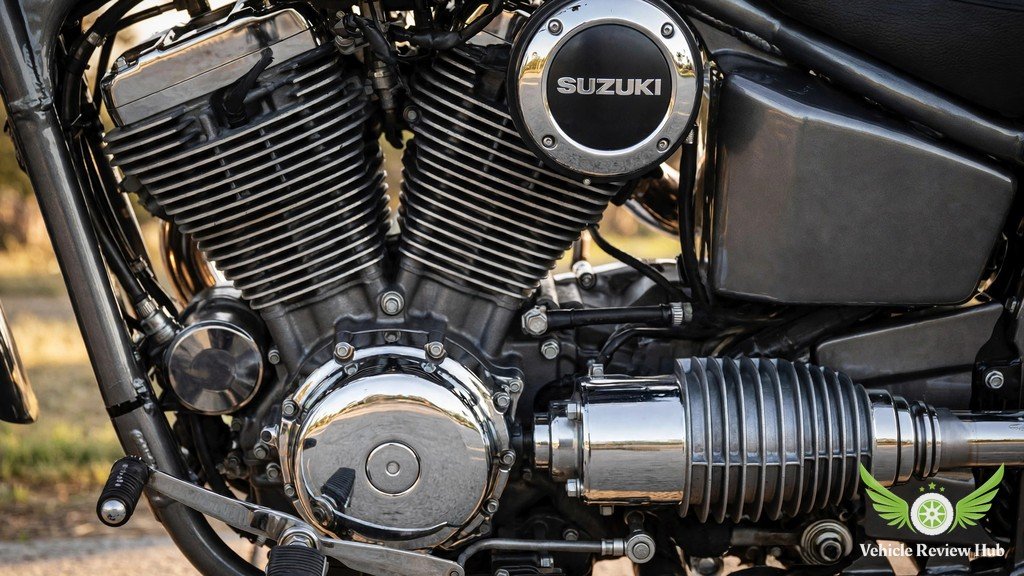
The C50’s engine is an 805cc liquid-cooled 45-degree V-twin, and for Suzuki Boulevard C50 performance its character matters more than its output: it makes its torque low, pulls cleanly from idle, and runs through a five-speed gearbox to a shaft final drive. Suzuki publishes no horsepower, torque or fuel-economy figure for the bike at all, so the only numbers in this Suzuki Boulevard C50 performance guide come from Rider magazine’s dyno tests. Two numbers need correcting before anything else: some pages list 819cc — just 50 cubic inches converted — and Rider’s own 2013 review printed 803cc, a typo. Suzuki’s figure is 805cc, from an 83.0 mm bore and a 74.4 mm stroke, at 9.4:1 compression.
The video below is Ray Bowden’s 2025 review and ride of the Boulevard — the trim is not named in the title, so watch it as a ride of the current Boulevard range.
Rider Dyno 2013: 46.4 HP at 6,000 RPM
Rider magazine put a 2013 C50 SE on a Jett Tuning dyno for its June 2013 “Main Street Middleweights” test, and the result is the single best-measured power figure the C50 has: 46.4 hp at 6,000 rpm at the rear wheel, with 45.4 lb-ft of peak torque and more than 40 lb-ft available from 2,600 to 6,000 rpm. That broad, flat torque curve is the whole story of Suzuki Boulevard C50 performance — the pull is there from just above idle and never falls away sharply. The SE tested at $8,799, and Rider’s fuel figure for the same bike was 41.4 mpg on average. Aggregator pages print “52 hp” or “claimed 53 hp and 52 lb-ft” for the C50, but those are editorial estimates, not Suzuki figures — Suzuki has never published a horsepower or torque claim for this bike. The Rider 2013 C50 SE review is the source for the dyno run and the fuel figure.
The 2015 C50T Dynoed Lower at 42.8 HP
The second measured figure comes from Rider’s January 2015 “Touring Twins” test, a four-bike comparison that put a 2014 C50T on the same Jett Tuning dyno: 42.8 hp at 6,200 rpm and 44.3 lb-ft at 3,300 rpm. Rider noted plainly that with the smallest engine in the group, the Suzuki made the least horsepower of the four. The gap is not a model-year change — the engine is the same 805cc V-twin; the difference is dyno-day variation and the C50T’s extra weight. The C50T’s own figures are still useful for Suzuki Boulevard C50 performance comparisons — the touring bike is the same motorcycle with a windscreen and bags bolted on — and its 51.2 mpg average was the best fuel economy of the four. For the full price and equipment picture, the Boulevard C50 review covers the 2025 model at $9,299 plus $600 destination.
| Bike and test | Rear-wheel hp | Torque | Dyno and outlet |
|---|---|---|---|
| 2013 Boulevard C50 SE | 46.4 hp @ 6,000 rpm | 45.4 lb-ft peak | Jett Tuning, Rider June 2013 |
| 2014 Boulevard C50T | 42.8 hp @ 6,200 rpm | 44.3 lb-ft @ 3,300 rpm | Jett Tuning, Rider Jan 2015 |
| Boulevard M50 (same engine) | 45.1 hp @ 5,900 rpm | 44.8 lb-ft @ 3,400 rpm | Borla dyno, Rider Aug 2005 |
| Aggregator “claimed” figures | 52–53 hp (estimate) | 51–52 lb-ft (estimate) | Editorial estimates, not Suzuki |
Suzuki Boulevard C50 Top Speed and Acceleration
There is no honest top-speed number for the C50, and this guide says so plainly rather than filling the gap with a guess. No magazine or test outlet has published an instrumented top-speed run or a timed 0–60 run for the Boulevard C50 in any model year. Roundups that print a “95–110 mph consensus” top speed are inventing figures — no test backs them, and this guide does not repeat them.
No Instrumented Test Exists From Any Outlet
A search of the usual test outlets turns up nothing instrumented for the C50: no top-speed run, no 0–60 time, no quarter-mile pass. The aggregator site zeroto60times lists the “2026 Suzuki Boulevard C50/T 0-60 To Be Released” — which is its way of saying it has no data at all. That absence is itself informative: no outlet has spent dyno or track time timing a bike that was never a performance story. What the published road tests do say, consistently, is that the bike holds freeway speed without strain — the practical question most buyers actually have. The honest answer on Suzuki Boulevard C50 performance at the top end is therefore a range of rider experience, not a number: it cruises at 80 mph comfortably, and nobody has measured what happens beyond that.
The 5.4-Second Figure Belongs to the M50
One number does circulate with the C50’s name attached, and it needs correcting: a 5.4-second 0–60 time with a 14.0-second quarter mile. That figure belongs to the Boulevard M50, the C50’s sportier sibling with the same 805cc engine but different styling and gearing, per zeroto60times. It must never be presented as the C50’s time. The M50 ran from 2005 to 2019 and its own Rider dyno figures — 45.1 hp at 5,900 rpm and 44.8 lb-ft at 3,400 rpm on a Borla dyno in August 2005 — sit between the two C50 results, as expected from the same engine in a lighter, differently geared bike. Using the M50’s acceleration time for the C50 would overstate the C50’s performance and mislead a buyer comparing the two. The C50 has no 0–60 figure of its own, and this Suzuki Boulevard C50 performance guide leaves that box empty rather than borrowing a sibling’s number.
Suzuki Boulevard C50 Mileage and Fuel Economy
Fuel economy is the one area where the C50 genuinely impresses, and it has the best-tested data: Rider magazine measured the bike’s mileage in three separate tests, and the numbers are consistent. This section of the Suzuki Boulevard C50 performance guide uses only those tested figures — the “around 50 mpg” claims on aggregator pages are estimates, not tests.

Rider Tested 41.4 MPG Average in 2013
In the June 2013 “Main Street Middleweights” test, Rider’s 2013 C50 SE returned 41.4 mpg on average, with a low of 36.4 mpg and a high of 57.1 mpg across the test riding. With the 4.1-gallon tank, that average gives a range of about 170 miles — the last gallon is the warning-light reserve. The spread between the low and the high tells its own story about Suzuki Boulevard C50 performance: ridden gently on back roads, the C50 sips fuel; ridden hard, it drinks like any 805cc V-twin. The 41.4 mpg average is the Suzuki Boulevard C50 performance number to quote, because it is the tested average, not a best-case highway figure. Suzuki publishes no MPG claim for the C50, so there is no factory number to compare it against — the Rider test is the record.
The C50T Averaged 51.2 MPG, Best in Its Test
The best-tested figure comes from Rider’s January 2015 “Touring Twins” comparison, where the 2014 C50T averaged 51.2 mpg — the best fuel economy of the four bikes in the test — with a low of 47.5 mpg and a high of 54.6 mpg. Rider’s own words were that it had the best fuel economy but, with the smallest gas tank at 4.1 gallons, the lowest range in the group at 210 miles. The 2007 C50T did nearly as well in Rider’s earlier road test, averaging 41.7 mpg, which the magazine called “decent” fuel economy. The C50T’s 51.2 mpg is the standout Suzuki Boulevard C50 performance figure for fuel economy, but it is a touring-test result — steady-speed touring riding, not city commuting — so a buyer should expect something between the 41.4 and 51.2 mpg averages in mixed use.
| Test | MPG low / avg / high | Range |
|---|---|---|
| 2013 C50 SE, Rider June 2013 | 36.4 / 41.4 / 57.1 | 170 miles |
| 2014 C50T, Rider Jan 2015 | 47.5 / 51.2 / 54.6 | 210 miles |
| 2007 C50T, Rider road test | — / 41.7 / — | — |
Suzuki Boulevard C50 Real-World Riding Experience
On the road, the C50 feels stronger than its dyno numbers suggest, because the torque arrives early and the bike is geared short. Reviewers across two decades describe the same picture: a calm, unstressed cruiser, happy at freeway speed and happiest on back roads. This section of the Suzuki Boulevard C50 performance guide draws on those published road tests rather than on any claimed figure.

Performance in Reserve at 80 MPH, Said Cruiser
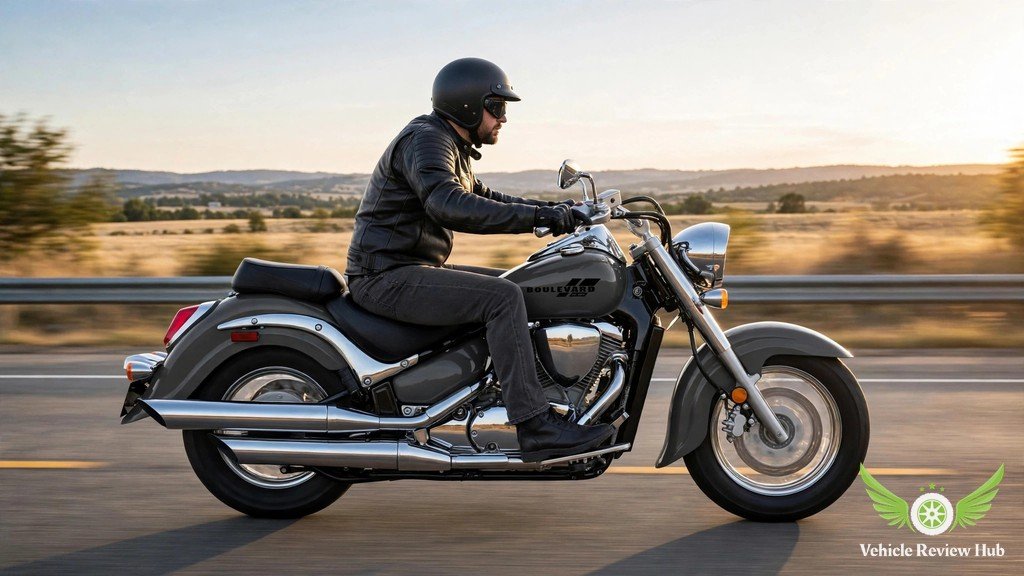
The road tests agree that the C50 has power in reserve at freeway speed. Women Riders Now’s 2007 C50T road test found the bike did not strain when taken up to 80 mph, and Ultimate Motorcycling’s 2013 review of the C50 SE — published as a Motorcycle Cruiser test — described the motor as having enough power to handle freeway duties without strain. That is the substance of the heading above, and the heart of Suzuki Boulevard C50 performance on the highway: the bike is not working hard at 80 mph, even though it has only five gears and no sixth to drop into. Rider’s 2007 road test added the other side: the engine feels a bit busy at highway speeds, with the rider often wishing for a sixth gear, though offset crankpins keep vibration down. In town, the low-down torque and the 27.6-inch seat make the 611-lb bike feel lighter than it is.
Suzuki Publishes No Power or MPG Figures
It is worth stating plainly, because it shapes everything else in this guide: Suzuki publishes no horsepower figure, no torque figure and no fuel-economy figure for the Boulevard C50. Suzuki’s own specification table lists displacement, bore and stroke, compression, gearing and dimensions — but the power and economy lines are simply absent. That silence is why aggregator estimates like “52 hp” spread so easily: with no factory number to check against, any roundup can print one. The only honest numbers are the Rider dyno tests and the Rider fuel tests, and this Suzuki Boulevard C50 performance guide uses nothing else. A buyer comparing the C50 against a rival that does publish power figures — Kawasaki prints 51 hp for the Vulcan 900 Classic — should remember the comparison is uneven: one side is a factory claim, the other is a rear-wheel dyno result, and rear-wheel figures always read lower than crank claims.
Suzuki Boulevard C50 Handling, Braking and Stability
Handling is the C50’s weakest performance area and its most honest one: steady and unhurried in a straight line, vague when the road turns twisty, and limited by brakes from an earlier era. This section of the Suzuki Boulevard C50 performance guide covers the chassis as the road tests found it, and the wear items that keep it working.

Front Disc, Rear Drum: Handling the Brakes
The C50 stops with a single disc brake at the front and a drum brake at the rear, and that combination has been unchanged across the whole production run. The front disc does most of the work; the rear drum is simple and cheap but fades sooner under hard use and gives less feel at the lever. Rider’s 2007 C50T road test said the bike could benefit from stronger brakes, and that still holds. The deeper point for Suzuki Boulevard C50 performance is that no US-market C50 has ever had ABS, in any model year — the rider does all the braking work, and a new rider must learn proper braking technique. Every rival now offers ABS somewhere: the Honda Shadow Phantom has it as standard, and Kawasaki offers it as a separate trim on the Vulcan S. The upside of the drum is that very little can go wrong — no ABS modulator, no sensors — and the rear brake is a job any home mechanic can do. Road Runner’s 2023 C50T review called the bike “surprisingly capable”, but capability here means stability and comfort, not stopping power.
Final Drive, Tires, Fork Seals, Brakes and Electrical Checks
The C50 has no chain and no sprockets — it is shaft drive — so the wear-item list is different from most cruisers at this price. The final drive needs its gear oil replaced once, at the 600-mile first service, and then only inspected at 7,500 and 14,500 miles; owners often change it every 7,500 miles or two years, but that is forum practice, not Suzuki’s schedule. Suzuki never schedules spline greasing, whatever forums suggest. Tires are 130/90-16 front and 170/80-15 rear, and the fat rear tire helps the bike feel planted in a straight line. Fork seals, brake fluid and brake hoses are the other regular checks: brake fluid is replaced every two years and brake hoses every four years, and the engine oil interval is 4,000 miles — not 3,750, which is the GSX-8 family’s interval and is sometimes misprinted for the C50. Valve clearances are inspected every 7,500 miles — the checks that keep Suzuki Boulevard C50 performance consistent over twenty years. The full schedule, with recalls and ownership costs, is covered in the Boulevard C50 reliability guide.
Suzuki Boulevard C50 Performance Compared With Other Middleweight Cruisers
Against its rivals, the C50 is the slowest bike in the group on paper and the cheapest to buy and run — and that trade is the whole point of the bike. This section of the Suzuki Boulevard C50 performance guide puts the measured C50 numbers next to the rival that matters most, the Kawasaki Vulcan 900 Classic, and then answers the beginner question directly.
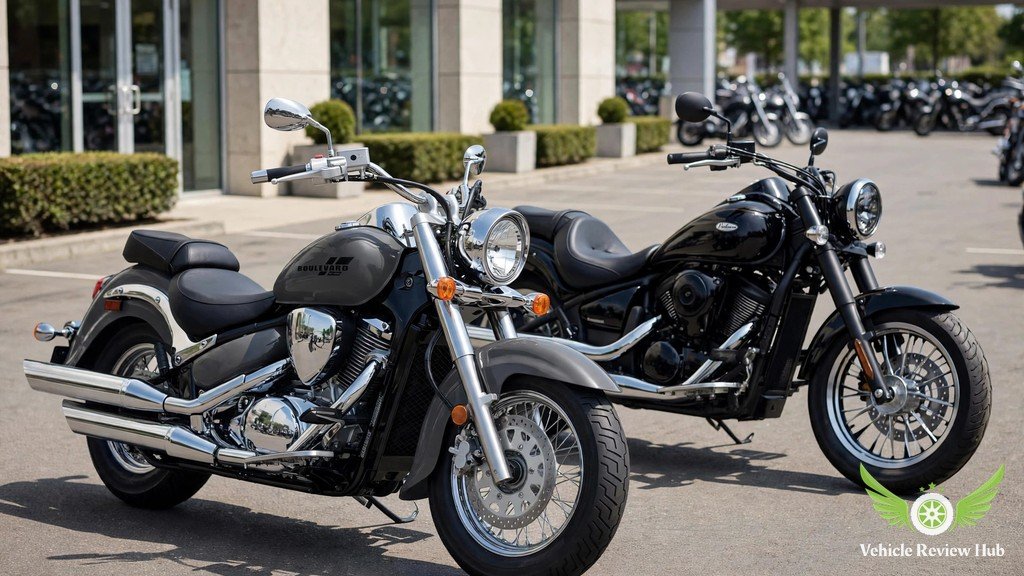
Suzuki Boulevard C50 vs Kawasaki Vulcan 900 Classic
The Vulcan 900 Classic is the C50’s closest rival and the fairest performance comparison, because both are V-twin middleweight cruisers at a similar price. The 2026 Vulcan 900 Classic costs $9,599 plus an $840 destination charge — $10,439 in total, $540 more than the C50’s $9,899 — and Kawasaki publishes what Suzuki does not: 51 hp at 5,500 rpm and 58.3 lb-ft at 3,500 rpm from its 903cc V-twin, driving through a five-speed gearbox and a Kevlar-reinforced belt. Against the C50’s measured 46.4 rear-wheel horsepower, the Vulcan’s factory 51 hp is a crank figure, so the real gap is smaller than the numbers suggest — but the Vulcan is still the stronger bike. It is heavier at 619.6 lb against the C50’s 611 lb, and carries a bigger 5.3-gallon tank against the C50’s 4.1 gallons. On Suzuki Boulevard C50 performance terms, the C50 trades outright power for price and simplicity. The Vulcan has no ABS either, so the braking comparison is honest: both bikes ask the rider to do the work. The C50’s advantages are the shaft drive — no belt to adjust or replace — and the lower price. The full four-bike comparison is in the Boulevard C50 comparison. The Kawasaki 2026 Vulcan 900 Classic page is the source for the Vulcan’s figures.
Is the Suzuki Boulevard C50 Suitable for Beginner Riders? Yes
Yes — with one reservation, and it is a braking reservation, not a power one. The low 27.6-inch seat, the low centre of gravity and the gentle low-down torque make the C50 an easy first big bike: most riders can flat-foot it at traffic lights, the throttle response is forgiving, and the bike never surprises its rider with a surge of power. Rider’s 2015 comparison called its seat the most universally comfortable saddle of the four bikes tested, and the bike has been a popular first big bike for twenty years. The reservation is the brakes: no ABS and a rear drum mean a new rider must learn proper braking technique from the start, and the five-speed gearbox means the engine feels busy on the highway. For a beginner who accepts those two points, Suzuki Boulevard C50 performance is exactly right — modest, predictable and cheap to own. For a beginner who wants ABS, the Honda Shadow Phantom is the rival to look at.
Suzuki Boulevard C50 Performance: Frequently Asked Questions
Direct answers to the questions riders ask about Suzuki Boulevard C50 performance.
How much horsepower does the Suzuki Boulevard C50 make?
Suzuki publishes no horsepower figure. The only measured number for Suzuki Boulevard C50 performance is Rider magazine’s dyno test: a 2013 C50 SE made 46.4 hp at 6,000 rpm at the rear wheel, with 45.4 lb-ft of peak torque. Any “52 hp” figure in roundups is an editorial estimate, not a factory claim.
What is the top speed of the Suzuki Boulevard C50?
There is no instrumented top-speed test for the C50, so no honest Suzuki Boulevard C50 performance figure exists at the top end. The bike cruises at 80 mph without strain according to published road tests, but “95–110 mph consensus” figures in roundups are invented estimates with no test behind them.
What is the 0–60 time of the Suzuki Boulevard C50?
There is no 0–60 test for the C50. The 5.4-second figure sometimes attached to the C50 belongs to the Boulevard M50, the sportier sibling with the same 805cc engine, and must not be presented as the C50’s time.
How many miles per gallon does the Boulevard C50 get?
Rider magazine tested 41.4 mpg on average for a 2013 C50 SE, 41.7 mpg for a 2007 C50T, and 51.2 mpg on average for a 2014 C50T — the best fuel economy in its four-bike test. With the 4.1-gallon tank, range is roughly 170 to 210 miles.
Is the Boulevard C50 fast?
No — Suzuki Boulevard C50 performance was never meant to be about speed. Its measured 46.4 rear-wheel horsepower is modest for an 805cc engine, and it has no sixth gear. What it does well is deliver its torque low in the rev range, so it feels stronger around town than its numbers suggest.
Does the Suzuki Boulevard C50 have ABS?
No. No US-market Boulevard C50 has ever had ABS in any model year. The bike stops with a single front disc and a rear drum brake, and the rider does all the braking work.
What engine does the Suzuki Boulevard C50 have?
An 805cc liquid-cooled 45-degree V-twin, with an 83.0 mm bore, a 74.4 mm stroke and 9.4:1 compression — single overhead cams, four valves per cylinder, fuel injection and a five-speed gearbox with shaft final drive.
Is the Boulevard C50 shaft drive?
Yes. The C50 has a shaft final drive — no chain to clean, adjust or replace. The final-gear oil is replaced once at the 600-mile first service, then inspected only.
How does the C50 compare to the Vulcan 900 Classic?
The 2026 Vulcan 900 Classic is stronger on Suzuki Boulevard C50 performance terms — Kawasaki publishes 51 hp at 5,500 rpm and 58.3 lb-ft from its 903cc V-twin — and costs $540 more than the C50 at $10,439 in total. The C50 counters with shaft drive, a lower price and a lighter feel at 611 lb.
What is the seat height of the Boulevard C50?
The seat is 27.6 inches high (700 mm), suiting shorter riders — most can flat-foot it at traffic lights. Rider’s 2015 comparison called it the most universally comfortable saddle of the four bikes tested.
How often does the Boulevard C50 need servicing?
Engine oil is replaced at every scheduled column — 600 miles, then every 4,000 miles. Valve clearances are inspected every 7,500 miles. Final-gear oil is replaced once at 600 miles. Brake fluid is replaced every two years and brake hoses every four years.
Is the Suzuki Boulevard C50 good for beginners?
Yes, with one reservation: the brakes. The low seat, low centre of gravity and gentle torque make it an easy first big bike, but no ABS and a rear drum mean a new rider must learn proper braking technique. Check any used bike by its VIN on the NHTSA recalls page before buying.