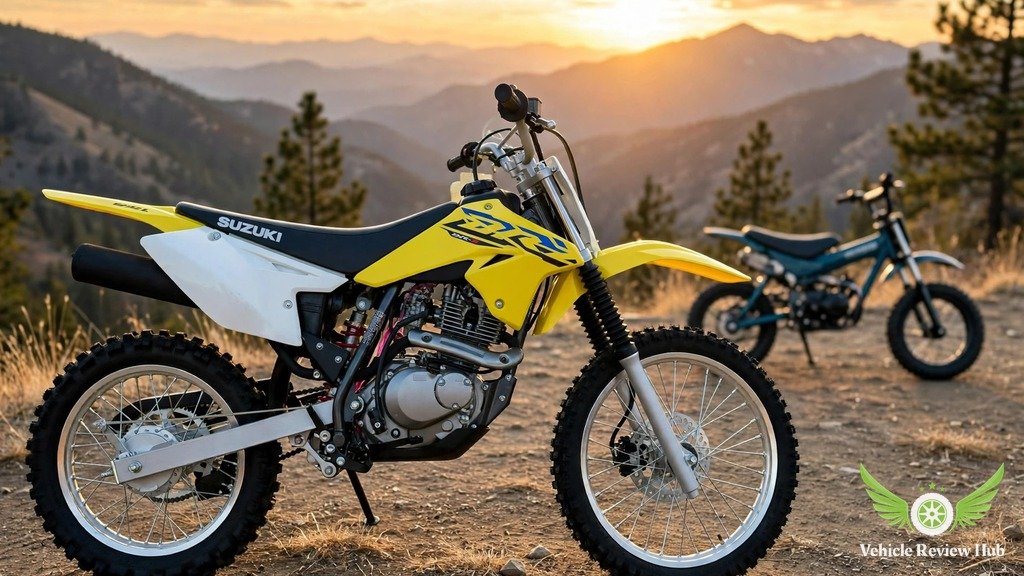
The short answer first: the 2026 Suzuki DR-Z125L is not fast, and that is not the point. Its 124cc air-cooled single makes a claimed figure somewhere between 7 and 15 horsepower depending on which database you ask, no dyno test has ever measured it, and owner estimates put the top speed at 45 to 50 mph. What this Suzuki DR-Z125L performance guide measures instead is what the bike does on the trail: a midrange engine, short gears for learning, a 196 lb weight a teen can pick up, and handling Dirt Rider’s testers called middle of the road.
Suzuki DR-Z125L Engine Performance and Power Delivery
The DR-Z125L’s engine is a 124cc air-cooled single-cylinder four-stroke with a Mikuni VM20SS carburettor, a five-speed constant-mesh gearbox and a wet multi-plate clutch, driving the rear wheel by chain. Two valves, a single overhead cam, CDI ignition, a wet sump, bore and stroke of 57.0 by 48.8 mm, and 9.5:1 compression — the same engine the bike launched with in 2003. Suzuki publishes no horsepower or torque figure, so the honest way to write about this Suzuki DR-Z125L performance is to name every claimed figure with its source.

No Dyno Test Exists From Any Named Outlet
No dyno test of the DR-Z125L exists from any named outlet. Not one magazine, not one test lab, not one database has published a rear-wheel horsepower or torque curve for this bike — so every horsepower number in circulation is a claim, not a measurement. The Suzuki DR-Z125L review states the same gap for the whole bike. The engine’s character is better described by what the testers who actually rode it wrote, and this Suzuki DR-Z125L performance guide quotes them directly. Dirt Rider’s 2008 testers found that “the bulk of the 125L’s power is strung in the middle of the curve, yet good torque and average top-end pull bookend the practical midrange” — a midrange engine that pulls hardest where a learner spends their time and runs out of breath at the top. A simple carburetted single with no radiator and no electronics is easy to service and hard to break.
Database Power Figures Conflict: 10, 12 and 15 HP
The claimed-power picture is a genuine conflict across four named sources, and this Suzuki DR-Z125L performance guide lists all four rather than picking a winner. The table below sets them out with their rpm points — merging the rpm points would invent a figure no source prints.
| Source | Claimed figure | What it is |
|---|---|---|
| 1000PS | 10 HP at 7,500 rpm | Database spec for the 2020 DR-Z 125 L |
| CycleChaos / autoevolution | 12 HP at 9,500 rpm, 12 Nm at 8,600 rpm | Most widely repeated claimed figure |
| MotorcycleDB | 15 HP | Labelled an editorial estimate, not a claim |
| Motocross Hideout | About 7 HP | Owner-guide table figure |
The 12 HP at 9,500 rpm figure, with 12 Nm (8.85 lb-ft) of torque at 8,600 rpm, is the most widely repeated claimed figure — CycleChaos prints it, autoevolution prints it, and the CycleChaos DR-Z125 page is the source for both the 12 HP figure and the 57.0 by 48.8 mm bore and stroke. The 15 HP figure from MotorcycleDB is labelled on its own pages as an editorial estimate. For scale, the Suzuki DR-Z400S review covers the family’s 398cc big bike — a different machine, and no DR-Z400 figure belongs in this guide.
Suzuki DR-Z125L Top Speed and Acceleration
There is no tested top speed for the DR-Z125L, and no acceleration figure of any kind — no 0 to 60, no quarter-mile, nothing. What exists is an owner-estimate band of 45 to 50 mph, a single owner’s dirt top-speed run on video, and a gearing setup that explains why the bike tops out where it does. A play bike with no test data is where invented numbers creep in.

The video below is an owner’s dirt top-speed test of a DRZ 125 — Tristan Armani’s run on dirt, not an instrumented test and not a magazine run. He notes the road would be a few mph faster on the smoother surface: a dirt run is the slower case.
No Instrumented Top-Speed Test Exists
No GPS top-speed test and no magazine acceleration test of the DR-Z125L was found in any named source — and no 0 to 60, quarter-mile or trap speed exists for this bike. Dirt Rider’s 2008 midsize playbike comparison — the bike’s only named press test — was a riding comparison, not an instrumented test. The DR-Z125L’s own record is empty of tests, and the guide that admits that is more useful than the one that fills the gap with a borrowed number.
Owner Estimates Put Top Speed at 45 to 50 MPH
The owner-estimate band is 45 to 50 mph, and both ends are named. Motocross Hideout puts it at about 45 mph on flat ground with stock gearing. The Motocross Hideout DRZ125 review is the source for that estimate. Reference.com puts it at approximately 50 mph for a 2010 DR-Z125. The gearing explains the shape of the band, and it is the whole top-speed story in this Suzuki DR-Z125L performance guide: a five-speed box with short first and second gears for learning, a DID 428HG chain and 14/57 sprockets for a 4.071 final drive — short gearing built for trail work, not for speed. The L’s final drive is 14/57, 4.071 — not the 3.64 motorcycle.com misfiles under the L. On the trail the bike spends its life between 10 and 35 mph, where the midrange lives.
Suzuki DR-Z125L Mileage and Fuel Economy
There is no official MPG figure for the DR-Z125L, because off-road bikes carry no EPA rating, and no magazine test-loop MPG exists either. What the bike does have is a small 4.8-litre tank — 1.3 US gallons — and a thrifty carburetted single that sips fuel at trail pace. This section of the Suzuki DR-Z125L performance guide explains the missing MPG, the tank-size confusion, and the range a rider can roughly expect — labelled as an estimate, never as a tested figure.

No Official MPG: Off-Road Bikes Carry No EPA Figure
Suzuki publishes no MPG for the DR-Z125L, and no magazine has published a test-loop MPG for it either. Off-road-only bikes are not EPA-rated, so there is no official number to quote and no owner MPG band with a usable sample in any named source. That leaves range as a derived estimate, and this guide labels it as one: a 1.3-gallon tank at trail pace gives roughly 60 to 90 miles depending on how the bike is ridden — gentle trail riding at the top of that range, hard riding with the throttle open at the bottom. The tank is small, so a long trail day needs a fuel plan. No one writing a Suzuki DR-Z125L performance guide should quote a miles-per-gallon figure for this bike as if it were tested, because it has not been.
The 1.3-Gallon Tank Was Listed as 1.1 Before
The tank is 4.8 litres, 1.3 US gallons — and the reason older listings say 1.1 is a unit error, not a different tank. Suzuki’s own spec format is “4.8 L (1.3/1.1 US/Imp gal)”: 1.3 US gallons, 1.1 Imperial gallons. Older listings copied the Imperial figure as if it were US gallons — motorcycle.com’s spec database, CycleChaos and AutoTrader.ca all print 1.1, and Suzuki’s own 2014 EDGE brochure made the same error. The tank never changed; the listing unit did. This Suzuki DR-Z125L performance guide prints 4.8 L (1.3 US gal) and never prints the 1.1 figure as a US-gallon capacity. The four bikes carry very different tanks — the Honda smallest at 1.0 gallon, the Kawasaki 1.5, the Yamaha largest at 1.6 — and the DR-Z’s sits in the middle, not the smallest as some summaries claim.
| Bike | Fuel tank | Fuel system |
|---|---|---|
| Suzuki DR-Z125L | 4.8 L (1.3 US gal) | Mikuni VM20SS carburettor |
| Kawasaki KLX140R L | 5.8 L (1.5 gal) | Carburettor |
| Honda CRF125F Big Wheel | 1.0 gal | PGM-FI fuel injection |
| Yamaha TT-R125LE | 6.0 L (1.6 gal) | Mikuni VM20 carburettor |
On a short trail loop the difference does not matter; on a long day it is one more reason to top up. The Suzuki DR-Z125L comparison guide sets the four bikes against each other on price, start type, brakes, seat height and value, for buyers who want the full side-by-side picture.
Suzuki DR-Z125L Real-World Riding Experience
On the trail, the DR-Z125L is a light, small, forgiving bike: 196 lb, a 32.0-inch seat, short first and second gears for learning, and a midrange engine that pulls where a new rider needs it. Dirt Rider’s 2008 midsize playbike comparison, the only named press test of the bike, is the backbone of this section, and its verdict still stands: the bike is capable and friendly, not fast and not sharp.

Dirt Rider 2008: Middle of the Road, Beginner-Friendly
Dirt Rider’s 2008 midsize playbike comparison tested five bikes with podium-level National riders as testers, and the Yamaha TT-R125 was the testers’ pick. On the DR-Z125L, the verdict was plain: “This bike is a very middle-of-the road machine in nearly every aspect. The power is average, the suspension is sufficient and the handling is nothing to write home about.” The Dirt Rider 2008 midsize playbike comparison is the source for that verdict. “Middle of the road” sounds like faint praise, and on a shootout scoreboard it is — the DR-Z125L did not win. But for the bike’s actual buyer, a teen or a smaller adult learning to ride, middle of the road is the right place to be: the power never surprises a learner, the suspension copes with trail riding without punishing mistakes, and the handling is predictable. The testers added the line that sums up the Suzuki DR-Z125L performance in one sentence: “The DR-Z125L isn’t going to win any shootouts, but Suzuki knows this.” Australasian Dirt Bike Magazine’s reviewer called the bike “light, nimble and agile”, and Ultimate Motorcycling’s testers found the five-speed shifts “flawlessly with no gaps”.
Cold-Blooded Starting and Deep-Sand Weakness
The DR-Z125L has two honest weaknesses on the trail, and both come from the same simple carburetted engine. The first is cold starting. Ultimate Motorcycling’s 2016 review found the bike “a bit on the cold-blooded side” at starting, though it added that the DR-Z “was a reliable starter for the entire test”. A carburetted single with a choke needs a minute to warm up. The Ultimate Motorcycling 2016 review is the source for the cold-blooded starting note. The second weakness is deep sand. Ultimate Motorcycling called deep sand the bike’s biggest weakness: “The DR-Z’s biggest weakness is in deep sand washes as, again, you have to aggressively keep the revs up (and weight back) to avoid plowing the front wheel into the soft stuff.” A 19-inch front wheel and modest power are not a sand setup. The fix is technique — revs up, weight back. The third weakness is the kick starter: the DR-Z125L is the only bike in its segment without electric start, and a lighter rider can find it hard to restart after a stall. A Cycle Insider owner wrote that his 5-foot-3, 120 lb wife “loves the bike but hates everytime she needs to start it… it is very hard for her to restart it.” The Suzuki DR-Z125L reliability guide covers the service chart and the carb storage issues behind the no-start complaints.
Suzuki DR-Z125L Handling, Braking and Stability
The DR-Z125L handles the way a 196 lb play bike with 19/16 wheels should: light, narrow and easy to place, with a 50.0-inch wheelbase and 11.4 inches of ground clearance that let it pick through trail ruts without drama. The suspension is basic and the brakes are a single front disc with a rear drum, average rather than excellent. This section covers what the chassis does well, where it runs out, and the checks that keep it working.
Front Disc Is Average, Rear Brake Is a Drum
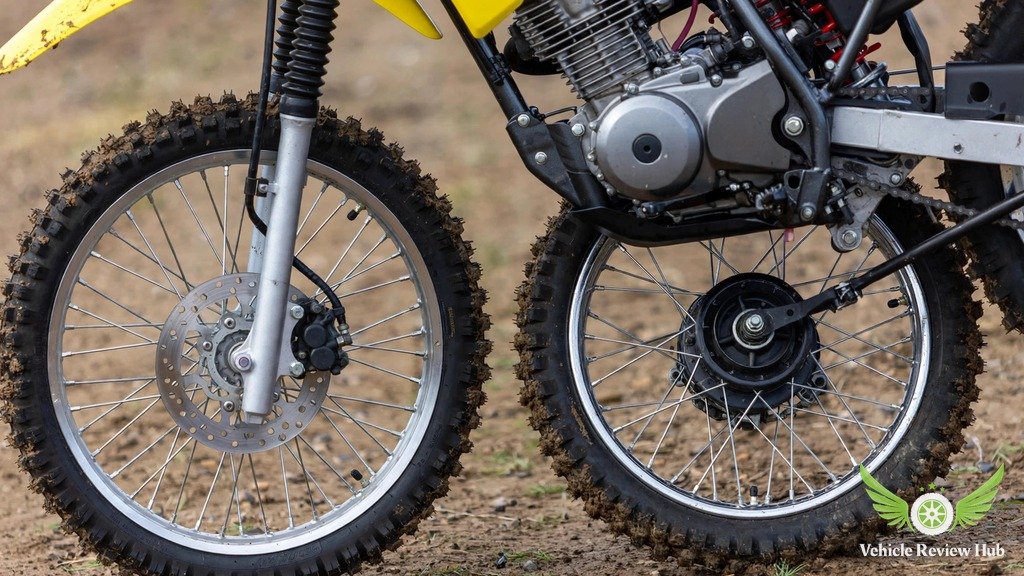
The front brake is a single 220 mm disc with a two-piston caliper on post-2007 L models, and the rear brake is a drum — never a rear disc. The 220 mm figure comes from dealer and spec listings, not from Suzuki’s own spec table. The verdict of this Suzuki DR-Z125L performance guide is that the setup is adequate and no more: the front disc stops the light bike well enough, the rear drum is there for balance and low-speed control, and there is no ABS — there never has been on this bike. The 30 mm conventional telescopic fork — not inverted — carries 180 mm of travel, and the link-type rear shock carries 170 mm with fully adjustable spring preload; those travel figures come from 1000PS’s database, not from Suzuki. Dirt Rider’s testers called the suspension “sufficient” — it copes with trail riding, it does not flatter it. A heavier adult will find the limits sooner than a teen will — set the rear preload for the rider’s weight before judging the bike.
Tire, Brake and Suspension Checks That Matter
A play bike ridden hard by learners and stored for months needs its running gear checked more than its engine does, and this Suzuki DR-Z125L performance guide keeps the checks simple. Tyres first: 70/100-19 front and 90/100-16 rear knobby tube-type tyres, wearing unevenly on a learner bike — check the knobs for chunking, the tubes for air, and the pressures before every ride, Brakes second: the front disc and pads wear slowly, but the rear drum needs its shoes and adjustment checked, and the brake fluid is replaced every two years. The manual also says the spokes are inspected every ride. Suspension third: the fork oil and seals, the rear preload, and the chassis bolts. The chain is cleaned, oiled and inspected every ride — a DID 428HG with 130 links, sprockets 14/57 — and a dry chain is the most common source of the notchy shifting owners complain about. The Suzuki DR-Z125L reliability guide covers the full service chart.
Suzuki DR-Z125L Performance Compared With Other Play Bikes
The DR-Z125L does not compete on power — no figure is settled, no dyno exists, and the most repeated claim is 12 HP. It competes on simplicity, price and size: $3,649 plus $300 destination, $3,949 in total, a 196 lb curb weight, a 32.0-inch seat, and the only kick-only starting setup in the segment. This section of the Suzuki DR-Z125L performance guide puts the bike against its closest rival on the numbers that are verified, and then answers the question every buyer asks.
| Bike | Engine | Start | Seat | Published total |
|---|---|---|---|---|
| Suzuki DR-Z125L | 124cc, carburettor | Kick only | 32.0 in | $3,949 |
| Kawasaki KLX140R L | 144cc, carburettor | Electric | 31.5 in | $4,414 |
| Honda CRF125F Big Wheel | 124cc, fuel injection | Electric + kick | 30.9 in | $4,299 |
| Yamaha TT-R125LE | 124cc, carburettor | Electric + kick | 31.7 in | $3,939 |
Suzuki DR-Z125L vs Kawasaki KLX140R L
The Kawasaki KLX140R L is the DR-Z125L’s closest rival on paper and the hardest one to beat on equipment. Its 144cc single is 20cc bigger, it has electric start where the Suzuki has kick only, it carries discs at both ends where the Suzuki has a front disc and a rear drum, and its suspension travel is 180 mm front and rear against the Suzuki’s 180/170 mm. The Kawasaki is heavier at 209 lb against the Suzuki’s 196 lb, and its seat is lower at 31.5 inches against 32.0. The price gap is real: the KLX140R L is $4,099 plus $315 destination, $4,414 in total — $465 more than the DR-Z125L’s $3,949 with destination. Kawasaki publishes no horsepower figure for the KLX140R L either, so the 20cc advantage cannot be turned into a claimed power gap — the Suzuki DR-Z125L performance figures stay claimed, not measured. What the Kawasaki buys is convenience and equipment: push-button starting, a rear disc, and a bigger engine for $465 more. What the Suzuki buys is simplicity: 13 lb lighter, no battery, and a carburettor a home mechanic can clean. For a buyer who values the button and the rear disc, the Kawasaki is worth the extra money; for a buyer who values the lightest, simplest bike in the segment, the Suzuki holds its own. For a sense of how the little 125L compares with the family’s big bike, the Suzuki DR-Z400SM review covers the 398cc supermoto — a very different machine for a very different rider.
Is the Suzuki DR-Z125L Suitable for Beginner Riders? Yes
Yes — with one caveat, and the caveat is the kick starter. The DR-Z125L is a proper learning bike: a true manual clutch, a five-speed gearbox with short first and second gears, light weight, a low seat, and power that is average by every account. Motocross Hideout puts the sizing plainly: the 31.7-inch seat “is better if you’re 5’0″-5’4″”. The caveat is that every rival has electric start and the DR-Z125L does not. A lighter rider who stalls on a hill has to kick the bike back to life. That is the one genuine drawback for a beginner. The Suzuki DR-Z125L comparison guide sets the bike against all three rivals on price, start type, brakes, seat height and value.
Suzuki DR-Z125L Performance: Frequently Asked Questions
Direct answers to the questions riders ask about this Suzuki DR-Z125L performance guide.
How much horsepower does the Suzuki DR-Z125L have?
Suzuki publishes no horsepower figure, and no dyno test exists. The databases conflict: 10 HP at 7,500 rpm (1000PS), 12 HP at 9,500 rpm (CycleChaos, autoevolution), 15 HP (MotorcycleDB, an editorial estimate) and about 7 HP (Motocross Hideout). The most widely repeated claim is 12 HP at 9,500 rpm.
What is the top speed of the DR-Z125L?
There is no instrumented top-speed test. Owner estimates put it at 45 to 50 mph on flat ground with stock gearing — about 45 mph per Motocross Hideout, approximately 50 mph per reference.com.
Does the DR-Z125L have a dyno test?
No. No dyno test exists from any named outlet, so no rear-wheel horsepower or torque figure has ever been measured.
What is the 0 to 60 time of the DR-Z125L?
There is none. No 0 to 60 time, no quarter-mile time and no acceleration figure exists for this bike, and this guide prints none.
What MPG does the DR-Z125L get?
There is no official MPG figure. Off-road bikes carry no EPA rating, Suzuki publishes no MPG, and no magazine test-loop MPG exists. A 1.3-gallon tank at trail pace gives roughly 60 to 90 miles — a rough derived estimate, never a tested figure.
How big is the DR-Z125L fuel tank?
4.8 litres, 1.3 US gallons. Older listings printed 1.1 because they copied the Imperial-gallon figure as if it were US gallons.
Is the DR-Z125L fast?
No, and it is not meant to be. Dirt Rider’s 2008 testers called it “a very middle-of-the road machine in nearly every aspect” with average power and sufficient suspension. It is a learner’s trail bike, and its strengths are lightness, simplicity and reliability.
Does the DR-Z125L have electric start?
No. It is kick-start only, with no battery and no starter button — the only kick-only bike among its current rivals. All three rivals have electric start.
What is the final drive ratio of the DR-Z125L?
14/57, or 4.071, on a DID 428HG chain with 130 links. Motorcycle.com prints 3.64 under the L, but that is the small wheel’s 14/51 ratio, misfiled under the wrong bike.
How does the DR-Z125L compare with the KLX140R L?
The Kawasaki has a 144cc engine against the Suzuki’s 124cc, electric start against kick only, and discs at both ends against the Suzuki’s front disc and rear drum. The Suzuki is 13 lb lighter and $465 cheaper with destination — $3,949 against $4,414. Neither bike has a published horsepower figure.
Is the DR-Z125L good in deep sand?
It is the bike’s biggest weakness. Ultimate Motorcycling found the DR-Z struggles in deep sand washes, where the rider has to keep the revs up and the weight back.
Is the DR-Z125L suitable for beginner riders?
Yes, with one caveat. It is a proper learning bike — a true manual clutch, a five-speed gearbox, short first and second gears, light weight and a low seat. The caveat is the kick start: lighter riders can find it hard to restart.