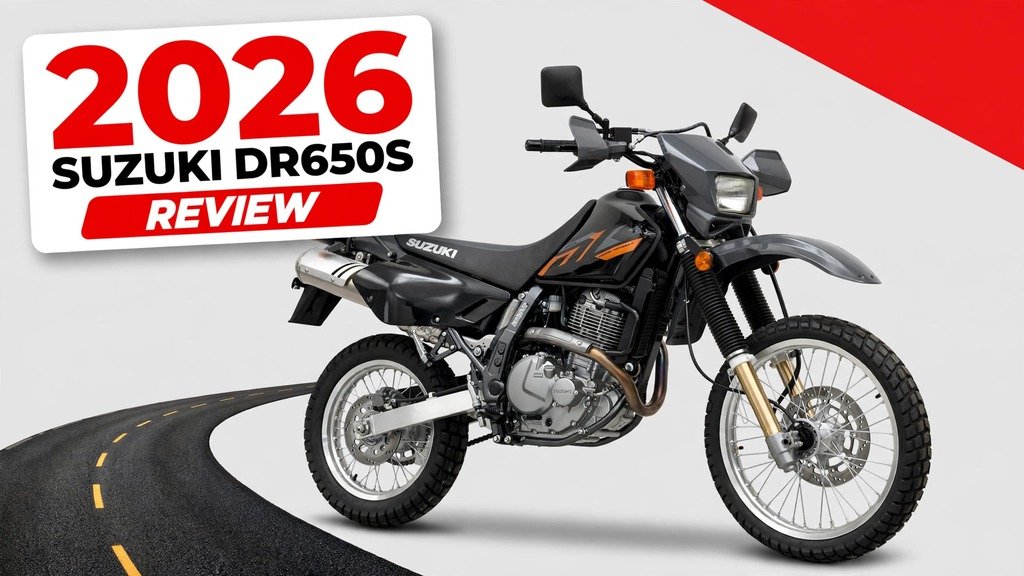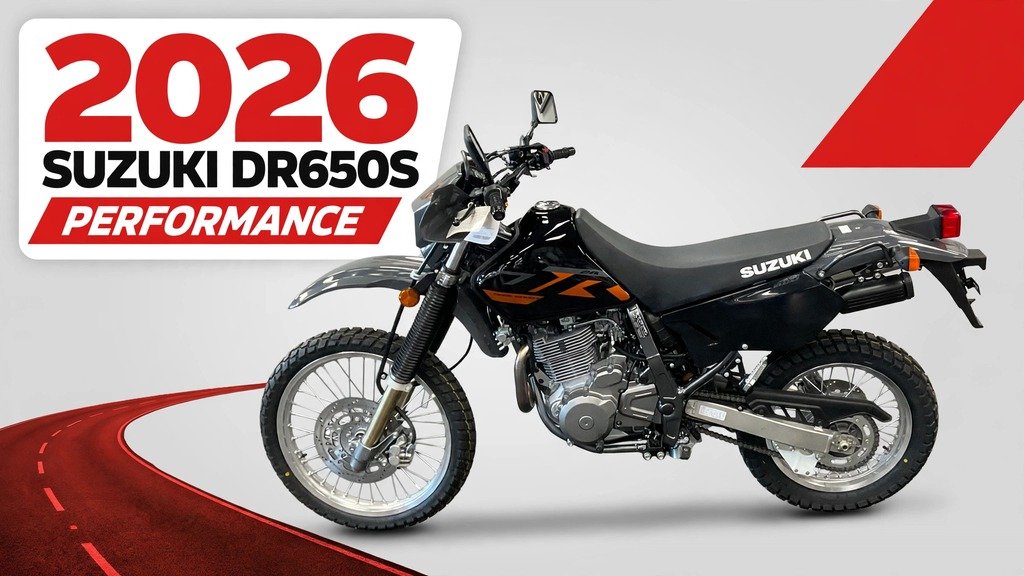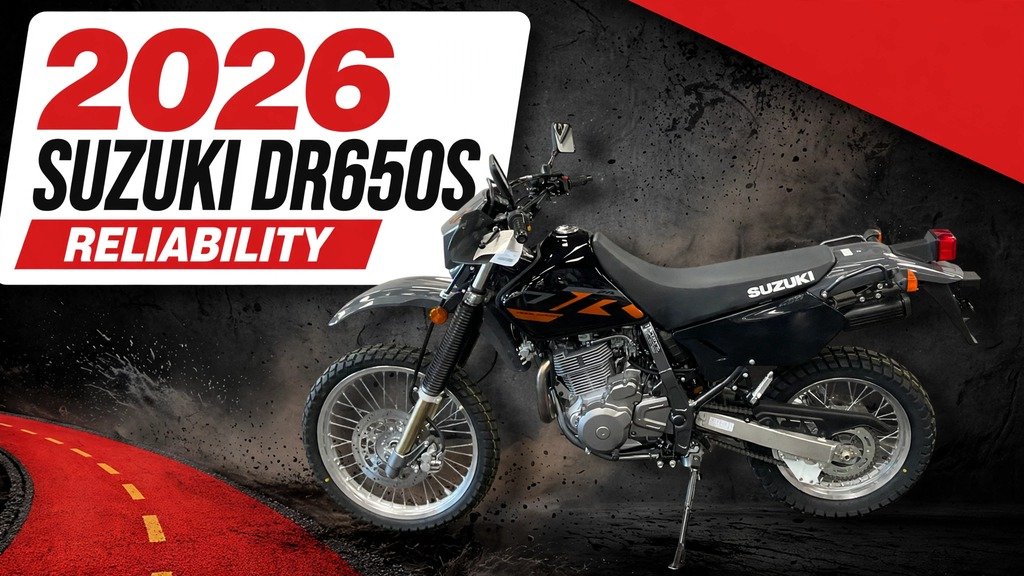
The short answer first: the Suzuki DR650S is one of the most reliable dual-sports you can buy, because there is so little on it to break. A 644cc air/oil-cooled single with a carburettor, no ABS and no electronics has survived unchanged since 1996 — one documented 2005 bike covered 145,000 miles with no major engine work. The weak points are real but small and well known: the NSU screws, the early paper base gasket, and a spark-plug listing on Suzuki’s own page that is simply wrong. This Suzuki DR650S reliability guide covers the maintenance schedule, the common problems with their year ranges, the ownership costs, and that no recall has ever been found for this bike.
Suzuki DR650S Reliability Overview
The DR650S earns its reputation the slow way: by not changing. The current SP46 generation has been in production since 1996 with the same engine, gearbox and carburettor. That sameness is the reliability story — every weak point has been found, documented by owners, and given a fix. The Suzuki DR650S review covers the bike itself; this Suzuki DR650S reliability guide covers what it costs to keep running and what goes wrong.

No MCN Owner Rating Exists for the DR650
There is no MCN owner rating for the DR650. A search of motorcyclenews.com returns MCN pages for the DL650 V-Strom and the DRZ400S, but no DR650 review or owner-ratings page exists, so this guide invents no star rating and quotes none. What does exist is the Bikez owner rating, and the largest sample is the 2005 DR650SE at 77.0 out of 100 from 39 raters, with value for money at 88.7 and repair and maintenance at 80.8. Smaller samples run lower — the 2015 DR650S at 66.8 from 3 raters, the 2021 DR650SE at 70.4 from 3 raters — and Cycle Insider reviews across the 2000–2009 model years are mostly four and five stars, with the stock seat the recurring complaint.
How Mileage, Storage and Previous Care Affect Reliability
Mileage matters less on a DR650S than on most bikes, because the engine is understressed. Florida rider Erv Daley put 145,000 miles on a 2005 DR650 with no major engine work, a story Motorcyclist Magazine featured in 2016, and South African overland travellers Michnus and Elsebie Olivier each put more than 100,000 kilometres on their DR650s. A 2010 DR650SE owner kept his bike for 15 years and 29,607 kilometres and still rated it a great 50/50 dual-sport. These are bikes ridden hard and far, and the engine keeps going.
What matters more than the odometer is storage and care: a DR650S parked wet in a damp garage will have a rusted chain, a gummed-up carburettor and perished rubber. A high-mileage bike with a service book is a better buy than a low-mileage bike with no records, because the DR650S rewards maintenance and forgives mileage.
Suzuki DR650S Common Problems and Wear Items
The DR650S has a short list of known problems, and this Suzuki DR650S reliability guide takes them in turn — every one of them is documented by owners rather than by Suzuki. None of them is a recall, and all of them have a cheap fix.
NSU Screws: Serious, but Owner-Evidence Only
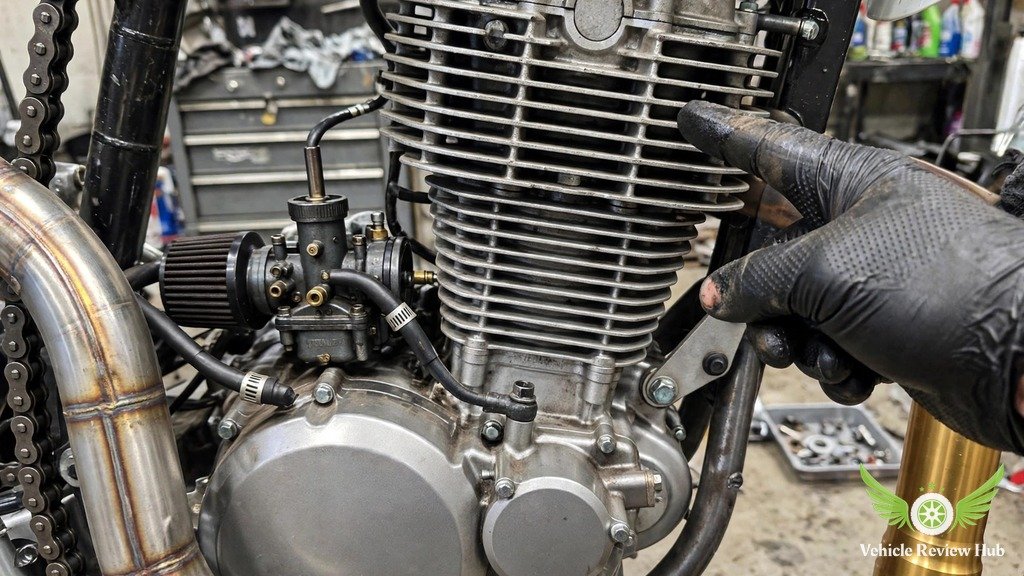
The neutral sending unit — the NSU — is the DR650S’s best-known problem, and it is serious in the way it can end: the screws that hold the NSU switch can loosen, fall out, and drop into the engine. ProCycle explains the mechanism: the screws are tightened against the switch’s plastic body, which shrinks in hot engine oil, and the screws loosen. The warning sign is unmistakable: if the neutral light stops working, even intermittently, shut the bike down until the cause is found.
Two things must be said clearly. First, it is owner evidence only: no NHTSA campaign and no Suzuki service bulletin names the NSU screws, and this guide never calls it a recall. Second, Suzuki started using threadlocker on these screws from 2017, so the risk is highest on pre-2017 bikes. The fix is cheap and permanent: remove the screws, apply threadlocker and re-tighten, or fit a safety-wire kit. The ProCycle NSU safety-wire guide walks through the job.
Paper Base Gasket Ended in Late 2003
The second dated problem is the cylinder base gasket. Bikes built from 1996 to late 2003 used a paper base gasket that leaks, and in late 2003 Suzuki changed to a steel laminated gasket, identifiable by a small tab with a rivet at the front right corner, below the oil cooler. A 1996–2003 bike with a weeping base gasket needs a gasket change to the steel part.
The rest of the owner-issue list is smaller and older. The DR650 wiki documents a countershaft seal that can be pushed out and dump all the oil, an upper drive chain roller that can break off and take the frame boss with it, a crank nut that can loosen, a blob of weld inside the header pipe, dry steering-head bearings, and wire-harness chafing at the right steering head. Third-gear whine and failure was documented in about 30 cases as of February 2012, on bikes from 1999 to 2009. The gear’s part number changed in 2006 and 2008, and 1998 and early-1999 bikes were missing a starter-clutch torque limiter, fixed mid-1999 after VIN X2100561. None of these is a recall — they are the documented owner issues of a bike ridden hard for thirty years, listed with their year ranges on the DR650 wiki’s potential-problems page.
Suzuki DR650S Maintenance Schedule and Servicing
The DR650S service schedule is short, simple and cheap — the reason the bike’s reliability record is as good as it is. Oil every 3,500 miles, valves every 7,500 miles, and everything else on a calendar the owner’s manual spells out. There are no shims to buy, no radiator to flush and no diagnostic computer to plug in.

| Service item | 6,000 km / 4,000 mi | 12,000 km / 7,500 mi | 18,000 km / 11,000 mi | 24,000 km / 14,500 mi |
|---|---|---|---|---|
| Engine oil — replace (10W-40) | Yes | Yes | Yes | Yes |
| Oil filter — replace (HF137) | No | Yes | No | Yes |
| Valve clearances — check / adjust | No | Yes | No | Yes |
| Spark plugs — replace (NGK CR10E) | No | Yes | No | Yes |
The maintenanceschedule.com service chart, transcribed from the owner’s manual, sets out the full schedule behind this Suzuki DR650S reliability guide’s service table. One trap: an auto-generated FAQ on manua.ls prints oil every 6,000 km as “approximately 4,000 miles” and the filter at every 6,000 km. Both are wrong — 6,000 km is about 3,728 miles, and the filter is every second oil change.
Oil Every 3,500 Miles, Filter Every Second Change
Engine oil is replaced every 3,500 miles, or 6,000 kilometres, with SAE 10W-40, and the drain plug is torqued to 24 Nm. The oil filter is replaced every second oil change, at the 12,000 km and 24,000 km columns — not at every change. The filter is the HF137 type and the oil capacity is about 2.6 litres.
Between services, the air filter is cleaned or replaced every 3,000 kilometres, and general lubrication — cables, pivots, levers — is done every 1,000 kilometres or 600 miles. Brake fluid is replaced every two years and brake hoses every four years. The exhaust bolts are tightened and the fuel valve strainer cleaned at the same columns.
Valve Checks Every 7,500 Miles, Screw and Locknut
Valve clearances are checked every 7,500 miles, or 12,000 kilometres, and the adjustment is screw-and-locknut — no shims, no special tools, no dealer visit required. The clearances are intake 0.08 to 0.13 mm and exhaust 0.17 to 0.22 mm, measured cold. Compare that with the DR-Z400S, whose valves are checked only every 15,000 miles but need shims when they move.
The valve interval is also the schedule’s natural inspection point. At 7,500 miles the steering bearing is checked and adjusted, the front fork and rear suspension are checked for leaks, and the spark plugs are replaced. At 14,500 miles the same items come round again. An owner who follows the 7,500-mile column is doing the whole inspection in one session.
Suzuki DR650S Tires, Brakes and Suspension Maintenance
The running gear on the DR650S is as simple as the engine, and its maintenance is mostly about pressures, pads and seals — the practical side of Suzuki DR650S reliability. The tyres are tube-type, the brakes are two discs with no ABS, and the suspension is a conventional fork and a link-type rear shock.

Twin Plugs: Suzuki’s Own Page Lists the Wrong One
The DR650S has twin spark plugs, two of them, and the correct plug is NGK CR10E, with a gap of 0.7 to 0.8 mm and a hot type of NGK CR9E. The plugs are checked at 6,000 kilometres and replaced at 12,000 kilometres. Here is the trap: Suzuki’s own 2026 specification table prints NGK DR8EA, or DENSO X24ESR-U, as the spark plug. That is wrong — DR8EA is the DR-Z125L’s plug, not this bike’s. This guide prints CR10E, with the gap, and names Suzuki’s DR8EA listing as the error.
The twin-plug design itself is worth a sentence. Two plugs per cylinder give a cleaner burn and easier cold starts, and they are the reason the DR650S starts reliably on the button even after sitting. The only thing an owner must remember is the part number: CR10E, not DR8EA. The DR-Z125L reliability guide covers the bike the DR8EA plug actually belongs to.
Chain Lube Every 600 Miles, No Coolant to Change
The drive chain is cleaned and lubricated every 600 miles, or 1,000 kilometres, and more often when riding off-road. The chain is a DID525V9 with 110 links, the slack is 30 to 45 mm, and the 20-link service limit is 319.4 mm. A chain lubed every 600 miles lasts; an ignored one does not. The rear axle nut is torqued to 100 Nm and the rear sprocket nuts to 27 Nm.
There is no coolant to change, because there is no coolant. The DR650S is air and oil cooled, and the small finned unit in front of the engine is an oil cooler, not a radiator. The air filter is cleaned every 3,000 kilometres between services, and the idle is set at 1,400 to 1,600 rpm.
Suzuki DR650S Maintenance and Ownership Costs
Ownership costs on the DR650S are low, and the reason is the same as this Suzuki DR650S reliability guide’s central point: a simple bike with cheap parts and short, easy service intervals. The 2026 bike costs $7,299 plus $600 destination, $7,899 in total before tax and dealer fees, with no surcharge amount published — Suzuki’s footnote confirms a surcharge exists for certain MY25 and MY26 models, but no amount is printed anywhere.

| Known issue | Bikes affected | What to do |
|---|---|---|
| NSU screws loosening | All years; highest risk pre-2017 | Threadlock and re-tighten, or safety-wire kit |
| Paper base gasket leak | 1996 to late 2003 | Replace with steel laminated gasket |
| Countershaft seal pushed out | All years | Fit seal retainer P/N 24751-32E00 |
| Upper chain roller breaks off | All years | Remove it; fill hole with Loctited set screw |
Fuel, Routine Servicing, Tires and Replacement Parts
Fuel is the biggest running cost, and it is modest. Owners report 45 to 55 mpg in US gallons, labelled as owner-reported, and on the standard 3.4-gallon tank that gives a derived range of about 155 to 190 miles before reserve — derived estimates, never tested. A long-term owner averaged 59 mpg over 15 years, which stretches the same tank to about 200 miles. The small tank is the bike’s biggest touring weakness and the reason so many owners fit a 4.9-gallon aftermarket tank.
Routine servicing is the cheapest part of ownership. An oil change is about 2.6 litres of 10W-40 and an HF137 filter every second change. The valve check needs a feeler gauge and no parts at all unless a clearance has moved. Two NGK CR10E plugs, a DID525V9 chain, Trail Wing tyres in 90/90-21 front and 120/90-17 rear, and DOT 4 brake fluid every two years — that is the whole consumables list, and every item is cheap and widely available. The Suzuki DR650S performance guide covers the dyno result and the fuel-economy band in full, and the Suzuki DR650S comparison puts the $7,899 total against the Kawasaki KLR650, the Honda XR650L and the KTM 690 Enduro R.
Replacement parts follow the same pattern. The DR650S has been in production since 1996, so pattern parts exist for everything and genuine parts are still available from Suzuki. A used buyer should budget for the known fixes rather than for surprises: the NSU safety-wire kit, the countershaft seal retainer, and a fresh chain and sprockets if the bike was ridden hard. On the used market, clean DR650Ss typically list at $3,500 to $6,500 depending on year and condition, at drafting time. The 12-month, unlimited-mileage limited warranty on a new bike is short by modern standards, but the unlimited mileage is genuinely generous.
No Recalls Found: V-Strom 650 Recalls Are Not This Bike
No recall has been found for the DR650S. NHTSA recalls API queries for model years 2026, 2024 and 2015 returned zero recalls in all three, and Suzuki’s published recall letters contain no DR650 letter. This guide phrases it exactly that way, and never as a guarantee that no recall will ever be issued. The NHTSA recalls page is the source any owner can check for themselves.
The confusion to prevent is with the V-Strom 650, the DL650, which does have recalls. The fuel-pump O-ring recall 18V694 covered 2017–2018 DL650 bikes, 6,928 of them, and the alternator stator recall 16V878 covered 2012–2016 DL650 bikes, 8,613 of them. Both are DL650 recalls, not DR650 recalls. The DR-Z4 recall 25V873 is also not this bike’s. The Suzuki V-Strom 650 reliability guide covers the adventure sibling’s own record, including its recalls.
How to Keep a Suzuki DR650S Reliable
Keeping a DR650S reliable is mostly a matter of doing the short service schedule on time and dealing with the known issues once — the whole point of this Suzuki DR650S reliability guide. The bike asks for little — oil, valves, chain, plugs — and rewards the attention with decades of service.

The video below is an essential-mods and tips walkthrough for a first DR650.
Preventive Maintenance, Records and Regular Inspections
Preventive maintenance on the DR650S means following the 7,500-mile column in this Suzuki DR650S reliability guide’s service table and keeping records. Oil every 3,500 miles, filter every second change, valves every 7,500 miles, chain lubed every 600 miles, brake fluid every two years, and the air filter cleaned every 3,000 kilometres. A service book with those intervals stamped in it is worth more than low mileage.
Regular inspections between services matter just as much. Check the chain slack at 30 to 45 mm and the tyre pressures — 22 psi front and 25 psi rear solo, 25 and 29 two-up — before a long ride. Look at the fork seals, because a leaking seal coats the front brake disc in oil. Listen for third-gear whine on a test ride, and check the neutral light every time the bike is started, because a neutral light that stops working is the NSU warning sign. The honest counter-voice is worth hearing once: two owners who rode DR650s round the world, two-up, lost steering bearings at 45,000 kilometres on both bikes and a camshaft and follower at 42,000 kilometres. They rode hard, loaded, and far.
Countershaft Seal Retainer and Chain Roller Checks
Two checks deserve their own paragraph, because both are cheap to do and expensive to ignore. The countershaft seal can be pushed out and dump all the oil, and Suzuki later fitted a seal retainer to stop it. The retrofit part is P/N 24751-32E00, it fits all 1996 to current bikes, and it is a small, cheap part that prevents a catastrophic oil loss. Any owner who has not fitted it should.
The upper drive chain roller is the second check. It can break off, taking the frame boss with it, and the fix is to remove it and fill the hole with a Loctited 8 mm set screw or silicone. While the bike is apart, check the primary reduction gear crank nut too — a left-hand thread torqued to 72.5 ft-lb that can loosen — and the header weld, where Suzuki leaves a large blob of weld just inside the pipe. None of these is a reason to avoid the bike. They are the known checks of a known machine, and a DR650S that has had them done is a bike that will run for decades.
Suzuki DR650S Reliability: Frequently Asked Questions
Direct answers to the questions riders ask about Suzuki DR650S reliability, maintenance intervals, common problems and recalls.
Is the Suzuki DR650S reliable?
Yes. The DR650S is one of the most reliable dual-sports on sale, because it is a simple air/oil-cooled single with a carburettor and no electronics. One documented 2005 bike covered 145,000 miles with no major engine work. This Suzuki DR650S reliability guide’s verdict is that the bike’s weak points are small, known and cheap to fix.
Has the DR650S had any recalls?
No recall has been found for the DR650S in NHTSA API queries for model years 2026, 2024 and 2015, and Suzuki’s published recall letters contain no DR650 letter. The V-Strom 650 and DR-Z4 recalls are for those bikes, not this one.
What is the NSU screw problem?
The neutral sending unit screws can loosen and fall into the engine, because they are tightened against a plastic switch body that shrinks in hot oil. It is owner evidence only — no recall and no Suzuki bulletin names it. The warning sign is a neutral light that stops working, even intermittently. The fix is threadlock and re-tightening, or a safety-wire kit. Suzuki started using threadlocker on these screws from 2017.
How often does the DR650S need an oil change?
Every 3,500 miles, or 6,000 kilometres, with SAE 10W-40. The oil filter is replaced every second oil change, at the 12,000 and 24,000 kilometre columns.
How often do the valves need checking?
Every 7,500 miles, or 12,000 kilometres. The adjustment is screw-and-locknut, with no shims and no special tools: intake 0.08 to 0.13 mm, exhaust 0.17 to 0.22 mm, measured cold.
What is the correct spark plug for the DR650S?
NGK CR10E, two of them, gap 0.7 to 0.8 mm; hot type CR9E. Suzuki’s own 2026 page prints DR8EA, which is wrong — that is the DR-Z125L’s plug.
How often should the chain be lubricated?
Every 600 miles, or 1,000 kilometres, and more often when riding off-road. The chain is a DID525V9 with 110 links, and the slack is 30 to 45 mm.
Does the DR650S need coolant?
No. The DR650S is air and oil cooled, with a small finned oil cooler in front of the engine and no radiator. There is no coolant circuit and no coolant change in the service schedule.
What years had the paper base gasket?
Bikes built from 1996 to late 2003 used a paper cylinder base gasket that leaks. In late 2003 Suzuki changed to a steel laminated gasket, identifiable by a small tab with a rivet at the front right corner below the oil cooler.
How much does it cost to maintain a DR650S?
Very little, which is why Suzuki DR650S reliability is also cheap ownership. Routine servicing is oil, a filter every second change, two CR10E plugs, a chain and sprockets, Trail Wing tyres and DOT 4 brake fluid every two years — all cheap and widely available. Fuel is the biggest running cost, at an owner-reported 45 to 55 mpg. The 2026 bike costs $7,899 in total.
What should I check when buying a used DR650S?
Ask whether the NSU screws have been threadlocked, check the base gasket on 1996 to 2003 bikes, ask whether the countershaft seal retainer has been fitted, and look at the service book. A bike with records is worth more than a bike with low miles and no records.
Is the DR650S good for long-distance touring?
Yes, with preparation. The engine is proven over 100,000 miles, but the 3.4-gallon tank gives a derived range of about 155 to 190 miles, the stock seat is the universal complaint, and there is no windscreen. Most long-distance owners fit a larger tank, a better seat and the NSU fix before they leave.