The short answer first: the Suzuki DR-Z400SM makes about 33 horsepower at the rear wheel, has no instrumented top-speed test on record, and averages about 54 mpg according to owners — every figure in this Suzuki DR-Z400SM performance guide comes with its label attached. This Suzuki DR-Z400SM performance guide separates the one SM-specific dyno test from the dual-sport’s figures, labels the 93 mph top speed as the estimate it is, and sets the owner-reported fuel economy against the hard-riding range.
Suzuki DR-Z400SM Engine Performance and Power Delivery
The SM’s engine is the DR-Z400S’s engine — a 398cc liquid-cooled single with a Mikuni BSR36 carburettor and a five-speed gearbox — so the power delivery is the same flat, predictable single, and this Suzuki DR-Z400SM performance guide measures it with the magazines’ own figures.

The Only SM Dyno: 34.65 HP, Motorcycle.com 2005
The only published US dyno test of the DR-Z400SM, and the headline figure of this Suzuki DR-Z400SM performance guide, comes from Motorcycle.com’s 2005 road test, quoted again in its 2014 track review of the returning SM: the bike put down 34.65 hp and 25.91 lb-ft of torque. That is the headline number for this Suzuki DR-Z400SM performance guide. Motorcyclist’s 2021 MC Commute review measured 32 horsepower at the rear Dunlop, and Ultimate Motorcycling’s 2016 review estimated “around 33 horsepower and about 25 ft/lbs of torque”. The three figures agree within three horsepower, which is the story: the SM’s engine is consistent and modest. The claimed-power figures in circulation are a different matter, and this Suzuki DR-Z400SM performance guide presents them as the split they are: the databases claim 39.7 hp at 8,500 rpm and 39 Nm at 6,600 rpm, while Suzuki’s 2000 global specification says 40 hp at 7,600 rpm. Suzuki USA publishes no horsepower or torque figure for the bike at all. Never merge them into one “40 hp at 8,500 rpm” line — they come from different sources at different rpm points. One figure to never quote at all is autoevolution’s “24 Nm” of torque: a unit error, since 24 is the pound-feet figure and 39 Nm converts to 28.8 lb-ft. The Motorcycle.com 2014 track review is the source for the 2005 dyno figure and the SM’s return after its three-year gap.
S-Model Dynos Are Platform Data, Labelled as Such
The dual-sport S has been dyno-tested more often than the SM, and those figures are useful — as long as they are labelled as S-model dynos and never presented as SM measurements. Cycle World’s 2001 test of the S recorded 32.3 hp; Dirt Rider’s 2022 test measured 31.8 hp at 8,400 rpm and 24.3 lb-ft at 5,800 rpm; Motorcycle.com’s 2012 test recorded 31.2 hp and 23.5 lb-ft. The same engine on a dyno is platform data, and the SM’s own 34.65 hp sits a little above the S’s numbers — the runs were different bikes on different days. One more SM-specific dyno exists outside the United States: Visordown’s long-term SM review records a stock UK bike making 29 rear-wheel hp on BSD’s dyno in Peterborough, before tuning took it to 44.5 bhp. That is why this Suzuki DR-Z400SM performance guide phrases the 2005 figure as “the only published US dyno test” — the Visordown run is a second SM-specific data point. The Suzuki DR-Z400S performance guide covers the S-model dyno figures in full.
| Source | Bike tested | Horsepower | Torque |
|---|---|---|---|
| Motorcycle.com 2005 | DR-Z400SM | 34.65 hp | 25.91 lb-ft |
| Motorcyclist 2021 | DR-Z400SM | 32 hp (rear wheel) | Not measured |
| Visordown BSD dyno | DR-Z400SM (UK, stock) | 29 hp (rear wheel) | Not published |
| Dirt Rider 2022 | DR-Z400S (platform) | 31.8 hp @ 8,400 rpm | 24.3 lb-ft @ 5,800 rpm |
Suzuki DR-Z400SM Top Speed and Acceleration
There is no instrumented top-speed test for the DR-Z400SM — no magazine ever ran one, and no GPS figure exists in any named source. What exists instead is a cluster of estimates and claims, each printed in this Suzuki DR-Z400SM performance guide with its label.

The video below is riding footage of a DRZ400SM with supermoto rider Stephan Chambon — not a top-speed test and not an instrumented run. It shows the bike being ridden hard on the road.
No Instrumented Top-Speed Test Exists for the SM
No magazine, test house or owner with a GPS has published an instrumented top-speed run for the DR-Z400SM. That absence matters, because the figures that circulate are easy to mistake for test results: aggregator sites print 0–60 times, databases print top speeds, and none of them is a test. The nearest measured acceleration figure for the family is Cycle World’s 2001 test of the S — 0–60 mph in 5.2 seconds and a quarter mile in 14.34 seconds at 88.29 mph — but that is the dual-sport’s test, never the SM’s. From named reviewers, the picture is consistent: RevZilla’s Lemmy found it “happy at or below 70-ish miles per hour”, and Ultimate Motorcycling’s 2016 review warned that “above 70 miles an hour, you’re asking a lot of the little DR-Z400SM”. A buyer who plans regular freeway miles should know that before buying.
93 MPH Is a Rider Estimate, Not a Measurement
The 93 mph figure traces to motoplanete, citing Moto-Journal: “Max speed: approximately 150 km/h (93.20 mph)” — an estimate. It is not a measurement, and it is not the S’s Cycle World 2001 measured 93 mph — the two 93s are a coincidence, not the same test. The other figures, each with its label: Suzuki claims 94 mph; MCN’s database prints 95.6 mph; the databases print 90 mph or 145 km/h; 1000PS’s database prints 140 km/h, about 87 mph; and one 2009 SM owner reported reaching 90 mph. Motoplanete also estimates 0–100 km/h in 5.2 seconds — an estimate, never Cycle World’s instrumented 0–60 of 5.2 seconds for the S. Aggregator figures are worse: TopSpeed’s 4.5-second 0–60 comes from zeroto60times, and an AI-generated page prints a 100 mph top speed — none of it tested. Nobody measured it; the estimates cluster around 90 to 95 mph, and the bike is happiest well below that. The Ultimate Motorcycling 2016 review is the source for Suzuki’s 94 mph claim and for the hard-riding range figure used later in this guide.
Suzuki DR-Z400SM Mileage and Fuel Economy
There is no tested US MPG figure for the DR-Z400SM, but the owner-reported picture is unusually consistent, and this Suzuki DR-Z400SM performance guide sets it against the hard-riding figure.

No Tested US MPG for the Supermoto
No magazine test-loop MPG exists for the SM. The one tested figure that circulates in this bike’s orbit belongs to the S: Cycle World’s 2001 test loop returned 35 mpg for the dual-sport, and this Suzuki DR-Z400SM performance guide never presents it as an SM result. What the SM does have is owner data at scale. The tank is the same 2.6-gallon unit as the S, so the range question is entirely a fuel-economy question — every range figure in this Suzuki DR-Z400SM performance guide is derived and labelled as derived, never presented as a tested range. The successor DR-Z4SM carries a smaller 2.3-gallon tank but fuel injection, and its reviewers report 48 to 65 mpg for roughly 110 to 150 miles per tank.
Owners Average About 54 MPG, per RevZilla and Fuelly
RevZilla’s 2015 review of the SM states it directly, and this Suzuki DR-Z400SM performance guide quotes it verbatim: “Fuelly reports an average fuel economy of 54 mpg.” That is the headline figure for this Suzuki DR-Z400SM performance guide — an owner-reported average across Fuelly’s logged fill-ups, not a test result. Bennetts’ SM owner reports run 40 to 50 mpg with an average of 49 mpg, and Ultimate Motorcycling’s 2016 review found the 2.6-gallon tank gave “about a 90-mile range when in flogging mode” — about 35 mpg when the bike is ridden hard. A supermoto ridden gently returns mid-50s mpg, ridden normally returns high-40s, and ridden hard returns mid-30s. The RevZilla 2015 review is the source for the Fuelly average and the 321 lb full-of-fuel weight. At the owner average the SM needs fuel roughly every 140 miles, and at the hard-riding figure roughly every 90 miles. The Suzuki DR-Z400SM review covers the price and the ownership picture.
| Riding style | Fuel economy | Range on 2.6 gal (derived) |
|---|---|---|
| Owner average (Fuelly, via RevZilla) | 54 mpg | About 140 miles |
| Owner band (Bennetts) | 40–50 mpg (avg 49) | About 104–130 miles |
| Hard riding (Ultimate Motorcycling) | About 35 mpg | About 90 miles |
Suzuki DR-Z400SM Real-World Riding Experience
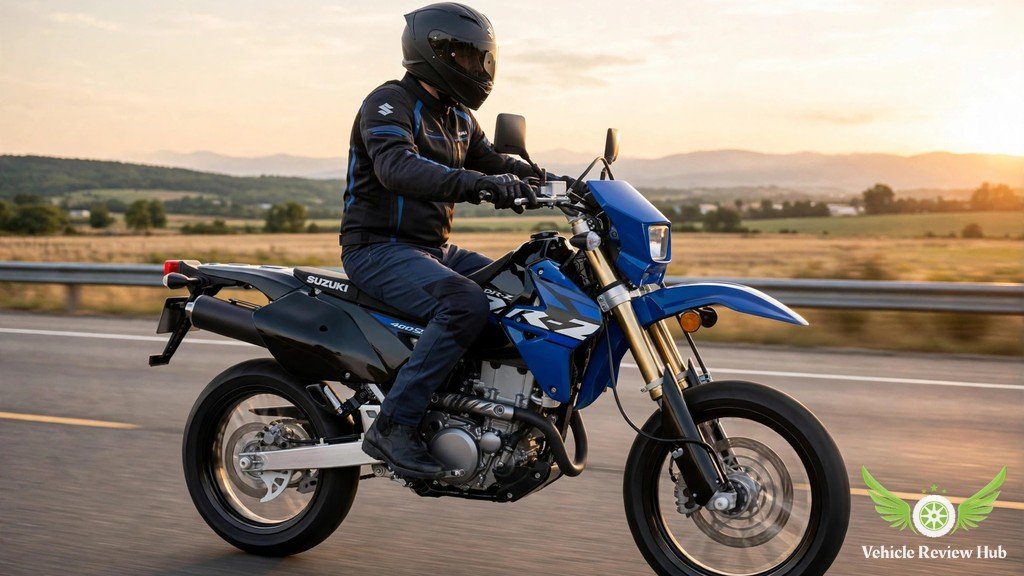
The SM’s real-world performance is the reason the bike survived nineteen years without an update: on the street it is, in RevZilla’s words, the most nimble thing on the road — upright, light, flickable, and happy at or below 70-ish mph.
The Most Nimble Thing on the Road, RevZilla 2015
RevZilla’s 2015 review is the fullest named-source ride account of the old SM: “it’s literally the most nimble thing on the road.” Lemmy rode the little bike on the Aether Urban Adventure and found it “danced and shimmied around the bigger bikes participating in the day” — the 322 lb curb weight and the wide bars put the rider over the front wheel, and the 17-inch street tyres give far more grip on tarmac than the S’s knobbies. The gearing helps: 15/41 sprockets for a 2.733 final drive, against the S’s 15/44 and 2.933, on the same five gear ratios — 2.285, 1.733, 1.375, 1.090 and 0.863. At 65 mph the bike is comfortable; at 80 mph it is wishing for a sixth gear it never got — the successor DR-Z4SM kept the same five speeds. Low-speed work is where the SM earns its keep: U-turns, filtering and tight corners are all easier than on any full-size street bike. The Suzuki DR-Z400SM reliability guide covers the service chart that keeps this performance intact.
A Carbureted Throwback in an EFI World, Cycle World
Cycle World’s 2018 buyer’s guide verdict captures both sides of this bike in one sentence: “A carbureted throwback in an EFI world, the DR-Z400SM is still a good value and plenty likable.” The carburettor is the point — a Mikuni BSR36 that can be cleaned on a bench and jetted by hand — and the limitation, because the fuelling is never as clean as the successor’s ride-by-wire injection. Ultimate Motorcycling’s 2016 review says the bike “isn’t sophisticated” and “isn’t even fuel injected”, and recommends it anyway, because “power delivery is predictable and snappy all the way up to freeway speeds”. Cycle World’s dislikes are the same ones every reviewer names: “The carbureted engine is relatively low tech today, and the tall seat can be challenging for smaller riders.” At 35.0 inches the seat is 1.8 inches lower than the S’s, but it is still a tall, narrow saddle, and Motorcycle.com warned that “the narrow saddle gets irritating” on the open road. Motorcyclist’s 2021 MC Commute review found the same balance: “Budget-minded riders that want to have urban fun, without breaking the bank will appreciate Suzuki’s DR-Z400SM”, and measured 32 horsepower at the rear Dunlop. The Suzuki DR-Z400S review covers the dual-sport sibling’s riding experience.
Suzuki DR-Z400SM Handling, Braking and Stability
The SM’s handling is its strongest suit in this Suzuki DR-Z400SM performance guide, and its brakes are its most honest upgrade over the S — a 300 mm floating front disc where the dual-sport has 250 mm, and fully adjustable suspension at both ends.

300mm Front Disc and Fully Adjustable Suspension
The front brake is the SM’s most concrete performance upgrade: a 300 mm floating disc with a dual-piston caliper, against the S’s 250 mm disc, and a 240 mm rear disc against the S’s 220 mm. Suzuki Global’s own SM page says so — the successor DR-Z4SM’s front disc is 310 mm, and that 10 mm is the trap, because one first-ride article prints “310mm disc on the front instead of 250mm” for the old SM. The old SM never had a 310 mm disc, never made 38 hp and never weighed 340 lb — those are the new bike’s figures. There is no ABS in any year, so the braking is entirely the rider’s. The fork is a 47 mm inverted Showa unit, RM250-derived, with adjustable compression and rebound — not the 49 mm figure some databases print, which is the S’s conventional-fork diameter — and the rear shock is fully adjustable too. Suzuki never published the travel, rake, trail or power figures, so the travel numbers here come from dealer spec sheets and MotorcycleDB, attributed that way.
Tire, Brake and Suspension Checks That Matter
Three checks matter more than any other before a buyer trusts a used SM at speed. First, the tyres: 120/70-17 front and 140/70-17 rear, sport radials — a bike wearing knobbies or a 21-inch front wheel is not an SM at all, it is a converted S. Second, the brakes: the 300 mm floating front disc should run true with no pulsing at the lever, the pads should have life left, and the brake fluid should have been changed every two years per the chart. Third, the suspension: the 47 mm inverted fork and the rear shock are both fully adjustable, so a buyer should check that the adjusters turn freely and the fork seals are dry — a weeping seal on an inverted fork is a rebuild, not a wipe. The chain deserves the same attention: an RK520KZ0 chain of 110 links on 15/41 sprockets, slack 40 to 50 mm, cleaned and lubricated every 600 miles — a dry, stretched chain is the most common performance loss on a used SM. The Suzuki DR-Z400SM reliability guide covers the full service chart and the only recall — 18V441 from 2018, covering 191 units for a rear brake stop-lamp switch — which a buyer can confirm by VIN on the NHTSA recall search.
Suzuki DR-Z400SM Performance Compared With Other Supermotos
The SM’s performance only makes sense against its rivals, and this Suzuki DR-Z400SM performance guide confronts the gap directly — the newest rival is cheaper, more powerful and better equipped than the old bike.

Suzuki DR-Z400SM vs KTM 690 SMC R
The KTM 690 SMC R is the premium rival, and on paper it is not close: the 2026 bike costs $13,399 plus $800 destination, which is $14,199 — $5,840 more than the old SM’s $8,359 total — for a 692.7cc LC4 single making 79 hp and 73 Nm, a six-speed gearbox and a 13.3-litre tank, at 357 lb fully fueled. Against that, the SM offers about 33 measured horsepower, five gears, a carburettor and no electronics at all. The KTM is nearly double the price and double the power. What the SM answers with is weight and price — 322 lb against 357, and a used-market band of $3,500 to $6,500. A rider who wants the fastest supermoto should buy the KTM; a rider who wants the cheapest way into the class should buy the SM. The Suzuki DR-Z400SM comparison guide sets the old SM against the DR-Z4SM and both KTM supermotos in full.
Is the Suzuki DR-Z400SM Suitable for Beginner Riders?
Yes, with a height caveat — and the figures in this Suzuki DR-Z400SM performance guide are the reason why. About 33 measured horsepower in a 322 lb bike is enough to be fun and not enough to be frightening, the throttle response is predictable through the whole rev range, and the upright position gives a new rider time to see and react. Ultimate Motorcycling’s 2016 review says the SM can teach the fundamentals of riding while taking the abuse a beginning rider dishes out. The caveats are real: the 35.0-inch seat is tall, and a rider under six feet should sit on one before buying; there is no ABS in any year, so a new rider must learn braking without a safety net; and the five-speed gearbox means high revs on the highway, which is tiring rather than dangerous but worth knowing. The disruptor rival makes the question harder: the KTM 390 SMC R costs $6,074 in total — $2,285 less than the old SM — for 44 hp, a six-speed gearbox, a TFT display and cornering ABS. On paper the KTM is the better beginner bike and the cheaper one. What the SM still offers a beginner is the simplest machine in the class — a carburettor, no electronics, and nineteen years of aftermarket parts and owner knowledge. The Jalopnik price piece from February 2025 is the source for the old SM’s $7,899 price and the successor’s $8,999 — the DR-Z4SM costs $9,599 in total, $1,240 more than the old SM.
| Bike | Claimed power | Weight | Price + destination |
|---|---|---|---|
| Suzuki DR-Z400SM (2024) | ~39.7 hp claimed; 34.65 hp dyno | 322 lb curb | $7,899 + $460 = $8,359 |
| Suzuki DR-Z4SM (2025) | 38 hp @ 8,000 rpm | 340 lb curb | $8,999 + $600 = $9,599 |
| KTM 690 SMC R (2026) | 79 hp | 357 lb fueled | $13,399 + $800 = $14,199 |
| KTM 390 SMC R (2025) | 44 hp @ 8,500 rpm | 354 lb wet | $5,499 + $575 = $6,074 |
Suzuki DR-Z400SM Performance: Frequently Asked Questions
Direct answers to the questions riders ask about this Suzuki DR-Z400SM performance guide.
How much horsepower does the Suzuki DR-Z400SM make?
The only published US dyno test in this Suzuki DR-Z400SM performance guide, Motorcycle.com’s 2005 run, recorded 34.65 hp and 25.91 lb-ft, and Motorcyclist’s 2021 review measured 32 horsepower at the rear wheel. Suzuki USA publishes no power figure; the databases claim about 39.7 hp.
What is the top speed of the Suzuki DR-Z400SM?
No instrumented top-speed test exists for the SM. The 93 mph figure is a rider estimate from motoplanete, not a measurement, and Suzuki claims 94 mph — never treat 93 mph as a tested figure.
What is the 0-60 time of the Suzuki DR-Z400SM?
No instrumented 0–60 test exists for the SM, and this Suzuki DR-Z400SM performance guide prints no aggregator figure as a test. One 2009 owner reported five to six seconds, and motoplanete estimates 0–100 km/h in 5.2 seconds — both estimates, not tests.
What MPG does the Suzuki DR-Z400SM get?
Owners average about 54 mpg according to Fuelly, via RevZilla’s 2015 review, and this Suzuki DR-Z400SM performance guide presents it as an owner-reported average, not a test result. Bennetts’ owner reports run 40 to 50 mpg with an average of 49 mpg, and hard riding returns about 35 mpg — roughly 90 miles per tank.
How far can the Suzuki DR-Z400SM go on a tank?
About 140 miles at the 54 mpg owner average, about 104 to 130 miles at 40 to 50 mpg, and about 90 miles when ridden hard — all derived from the 2.6-gallon tank, never tested as a range figure.
Is the Suzuki DR-Z400SM faster than the DR-Z400S?
On the dyno, slightly — and this Suzuki DR-Z400SM performance guide keeps the two dyno sets apart: the SM’s only US test recorded 34.65 hp against the S’s 31.2 to 32.3 hp. On the road the SM feels quicker, because of its taller gearing and street tyres.
Does the Suzuki DR-Z400SM have a sixth gear?
No. Every DR-Z400SM ever sold has a five-speed gearbox, with gear ratios 2.285, 1.733, 1.375, 1.090 and 0.863 and a 15/41 final drive. The successor DR-Z4SM also kept five speeds.
Is the Suzuki DR-Z400SM good on the highway?
It holds highway speed, but five gears mean high revs and a buzzy single above 70 mph. RevZilla calls it happy at or below 70-ish mph.
What is the difference between the DR-Z400SM and the DR-Z4SM?
The DR-Z4SM is the 2025 successor: fuel injection, three ride modes, traction control, switchable ABS, 38 hp at 8,000 rpm, a 310 mm front disc, 340 lb and a 2.3-gallon tank, at $9,599 in total. The old SM is carburetted, has no electronics, makes about 33 measured horsepower, weighs 322 lb and costs $8,359 as last sold.
How does the Suzuki DR-Z400SM compare to the KTM 690 SMC R?
The 2026 KTM 690 SMC R costs $14,199 in total — $5,840 more than the old SM — for 79 hp, a six-speed gearbox and 357 lb fueled. The SM answers with 322 lb and a used-market band of $3,500 to $6,500, and this Suzuki DR-Z400SM performance guide calls that the value case.
Is the Suzuki DR-Z400SM suitable for beginner riders?
Yes, with a height caveat. About 33 measured horsepower in a 322 lb bike is enough to be fun and not enough to be frightening. The 35.0-inch seat is tall, there is no ABS in any year, and a rider under six feet should sit on one before buying.
Should I buy a DR-Z400SM or a KTM 390 SMC R?
The KTM 390 SMC R costs $6,074 in total — $2,285 less than the old SM’s last price — for 44 hp, a six-speed gearbox, a TFT display and cornering ABS. Buy the KTM for more power, more gears and more equipment at a lower price; buy the SM for the simplest machine in the class.