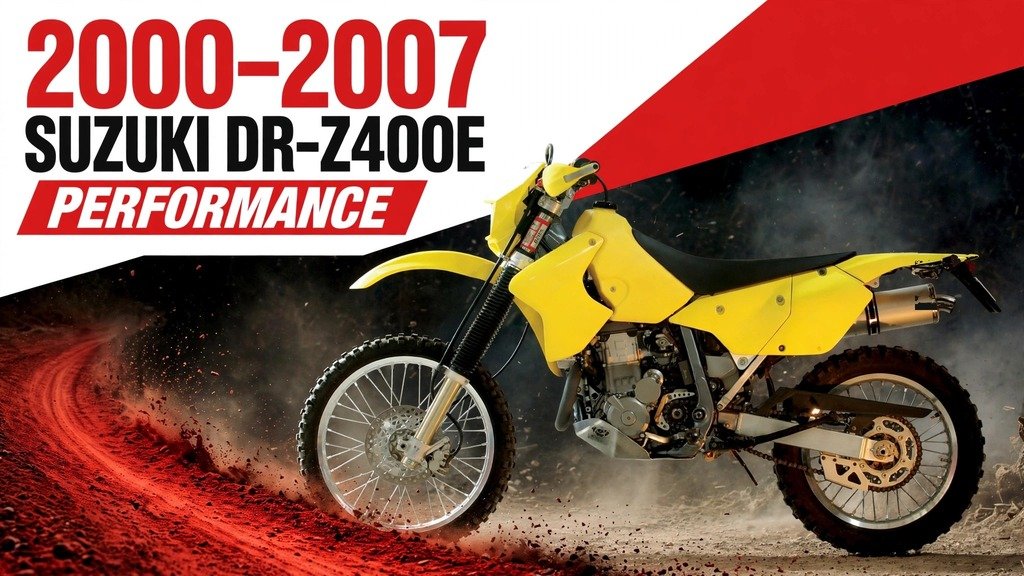
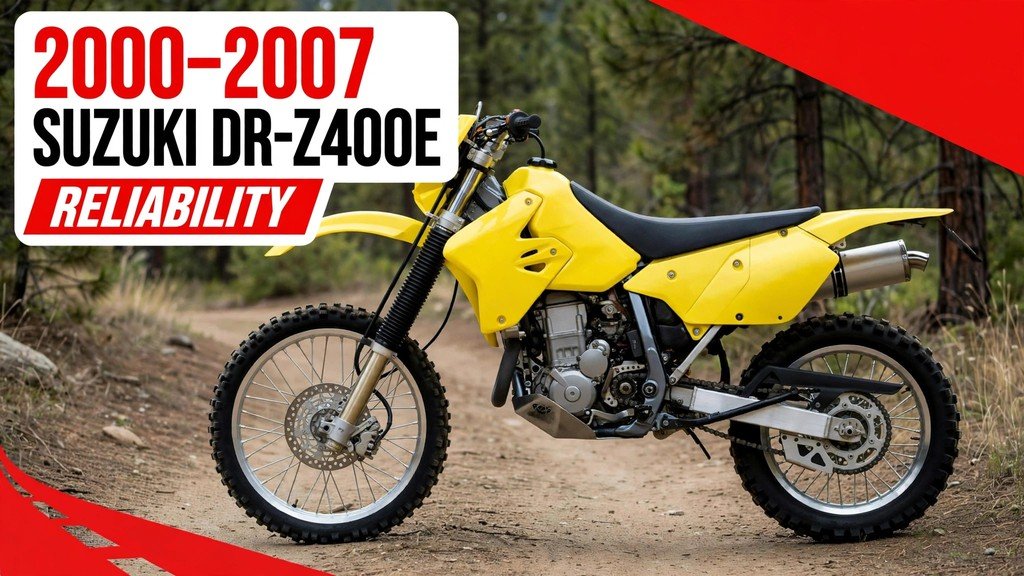
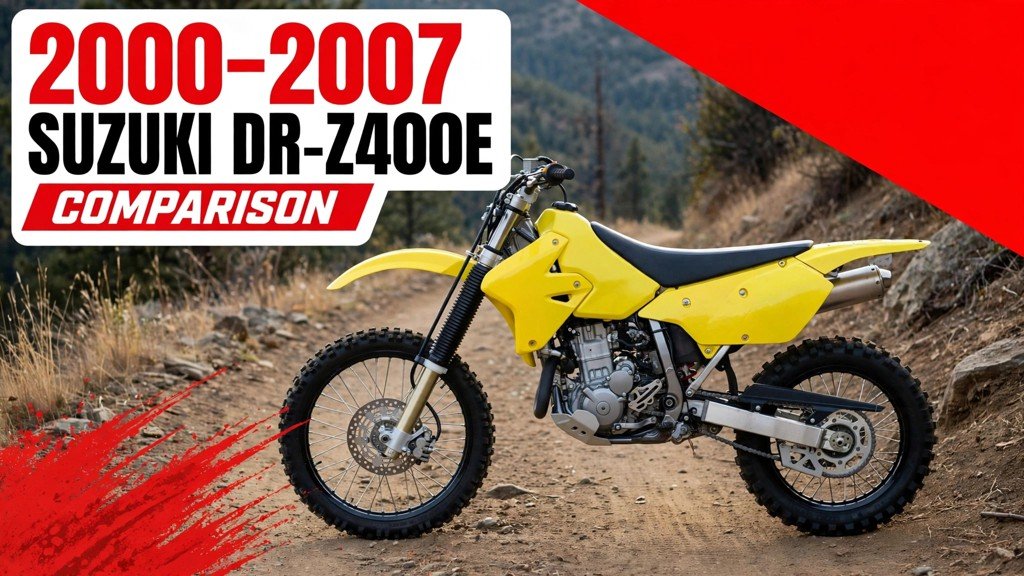
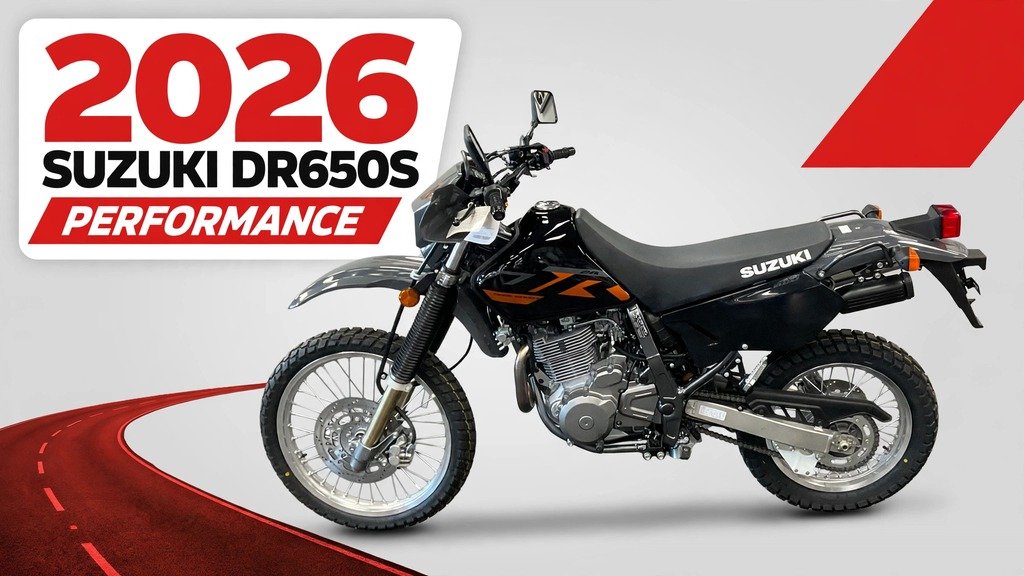
The short answer first: this Suzuki DR-Z400S performance guide puts the numbers on the table — a 93 mph tested top speed, 0–60 in 5.2 seconds and a 14.34-second quarter mile at 88.29 mph, all from Cycle World’s 2001 full test, the only full instrumented test of the old bike ever published. The dyno peak is 32.3 hp from that same test, and three different magazine dynos land within about one horsepower of each other. Fuel economy is where the numbers split: 35 mpg on Cycle World’s test loop against an owner-reported 50 to 58 mpg — two different kinds of riding, and this guide labels them as such rather than picking one.
Suzuki DR-Z400S Engine Performance and Power Delivery
The engine is a 398cc liquid-cooled single-cylinder, four-stroke, DOHC, four-valve unit with a Mikuni BSR36 carburettor, a five-speed gearbox and a chain final drive. It makes its power low and mid-range, pulls cleanly from just off idle, and never feels stressed — because it never was. Suzuki USA publishes no horsepower or torque figure for the bike, so every claimed number comes from somewhere else, and this Suzuki DR-Z400S performance guide names each source rather than merging them into one figure.

Dyno Peak Is 32.3 HP, Cycle World 2001
Cycle World’s 2001 test recorded a 32.3 hp dyno peak for the DR-Z400S — the headline number for Suzuki DR-Z400S performance, and the only full instrumented test behind it. The original Cycle World 2001 article text could not be re-verified directly from the magazine’s current site, so this Suzuki DR-Z400S performance guide carries the figure exactly as the doc attributes it to Cycle World’s 2001 test and never presents it as freshly re-verified. The claimed figures sit well above it: the databases print 39.7 hp at 8,500 rpm, while Suzuki’s 2000 global specification says 40 hp at 7,600 rpm — two different rpm points that must never be merged into “40 hp at 8,500”. One trap to avoid: autoevolution prints “24 Nm” for the torque, which is a unit error — 24 is the pound-feet figure, and 39 Nm equals 28.8 lb-ft. The databases also print 39 Nm at 6,600 rpm, which is the correct claimed torque.
| Source | Year | Horsepower | Torque |
|---|---|---|---|
| Cycle World | 2001 | 32.3 hp | Not published |
| Dirt Rider | 2022 | 31.8 hp @ 8,400 rpm | 24.3 lb-ft @ 5,800 rpm |
| Motorcycle.com | 2012 | 31.2 hp | 23.5 lb-ft |
Dirt Rider 2022: 31.8 HP, Wet Weight 324 Pounds
Dirt Rider’s 2022 ride review is the most recent named-source ride review of the old bike, and it measured 31.8 hp at 8,400 rpm and 24.3 lb-ft at 5,800 rpm on its own dyno — within about half a horsepower of Cycle World’s 2001 figure, twenty-one years later. Dirt Rider also measured the wet weight at 324 lb on its own scales, against Suzuki USA’s 317 lb and the owner’s manual’s 322 lb — the split this guide names plainly, since no single weight figure is the only figure. Motorcycle.com’s 2012 Church of MO test measured 31.2 hp and 23.5 lb-ft, the third of the three dynos. These are three different bikes on three different dynos in three different years, so this Suzuki DR-Z400S performance guide never ranks them against each other. What matters is the band: roughly 31 to 32 hp at the wheel, with torque in the low twenties — enough to lift the front wheel with a little clutch work, as Dirt Rider noted, and enough to keep up with traffic without feeling fast.
Suzuki DR-Z400S Top Speed and Acceleration
Top speed and acceleration are the two numbers every buyer asks about first, and for this bike there is exactly one full instrumented test behind them: Cycle World’s 2001 test. No GPS top-speed test exists in any named source beyond it, and no other magazine ran a full acceleration test on the S. This Suzuki DR-Z400S performance guide prints the Cycle World figures with the attribution in the sentence, and never swaps in a look-alike number from a database, an aggregator or the supermoto sibling.

The video below is a rider’s own top-speed run on a DRZ400 — not the Cycle World 2001 test. The test figures in this guide stay attributed to Cycle World in the text.
Tested Top Speed 93 MPH in the Only Full Test
Cycle World’s 2001 test recorded a 93 mph top speed for the DR-Z400S — the only tested top speed in the record, carried exactly as the doc attributes it to that test. The look-alike numbers must not be substituted: the databases print 94 mph (152 km/h), which is a database figure, not a test; owner anecdotes claim “about 100 mph”, which is an owner claim, not a test result; and the supermoto sibling’s figures — 94.1 mph and 95.6 mph from owner and magazine SM tests — belong to the SM, not the S. Five gears and a 2.6-gallon tank shape Suzuki DR-Z400S performance as much as the engine does: the bike will get to 93 mph, but it was never built to live there, and the successor kept the same five-speed gearbox on purpose, in the name of cost and weight.
0-60 in 5.2, Quarter Mile 14.34 at 88.29 MPH
Cycle World’s 2001 test recorded 0–60 in 5.2 seconds and a quarter mile of 14.34 seconds at 88.29 mph — again, the only full-test figures, carried exactly as attributed. The substitutes are easy to find and must be avoided: zeroto60times, the aggregator, lists 0–60 in 6.3 seconds and a 14.5-second quarter for the 2000 S; the databases print a 13.9-second quarter; and TopSpeed’s “0–60 in 4.5 seconds” is the SM’s figure — its own FAQ says the 4.5 seconds comes from zeroto60times data for the DR-Z400SM. None of those belongs in a sentence about the S. What the 5.2-second figure means for Suzuki DR-Z400S performance is a bike that is quick off the line for a dual-sport, with enough low-end torque to pull away from traffic cleanly and to lift the front wheel with a little clutch work, as Dirt Rider found. It is not a fast bike by street standards, and it never pretended to be — the engine’s job is tractable, unstressed pull, not a headline acceleration number.
Suzuki DR-Z400S Mileage and Fuel Economy
Fuel economy is the one place where this bike’s numbers openly disagree — and the disagreement is the story. One test loop says 35 mpg; owners say 50 to 58 mpg; the database average says 51.1 mpg. All three can be true at once, because they measure different riding. This Suzuki DR-Z400S performance guide labels each figure with its source and never presents one as the other.

Cycle World Tested 35 MPG on Its Test Loop
Cycle World’s 2001 test recorded 35 mpg on its test loop — the test-loop figure, carried exactly as the doc attributes it to that test. A test loop is hard riding: full-throttle acceleration runs, top-speed work and repeated stops, all on a carburetted single being ridden like a test bike. It is not a commuting figure and it is not a trail figure, and presenting it as either would be wrong. The EPA lab estimate of 74.7 mpg for the 2019 S is even further from real riding — a gentle laboratory test that the database itself warns most riders will beat by 10 to 30 percent in fuel use — and this Suzuki DR-Z400S performance guide never prints 74.7 mpg as what owners get. The honest way to use the 35 mpg figure in Suzuki DR-Z400S performance terms is as the floor: ride the bike hard, and this is roughly what the tank gives you.
| Source | MPG | Range on 2.6 gal |
|---|---|---|
| Cycle World test loop (2001) | 35 mpg | ~91 miles |
| Database average | 51.1 mpg | ~133 miles |
| Owner-reported band | 50–58 mpg | ~130–151 miles |
Owners Average 50 to 58 MPG: Label the Split
Owners report 50 to 58 mpg in ordinary riding — the owner-reported band, attributed to owner reports, not to a test. The database average of 51.1 mpg sits inside that band, and casual dual-sport riding reports of 40 to 50 mpg sit just below it. The split matters for Suzuki DR-Z400S performance because the tank is only 2.6 gallons: at the owner-reported 50 mpg, range works out to about 130 miles, derived rather than tested; at the test-loop 35 mpg it is about 91 miles. That is a 40-mile planning gap, and a rider who plans fuel stops on the owner figure and rides at test-loop pace will run dry. One correction for the record: Cycle News writes that the successor holds 2.3 gallons “compared to the previous 2.5 gallons” — the old tank is 10.0 litres, or 2.6 US gallons, not 2.5, and this Suzuki DR-Z400S performance guide never prints “2.5 gallons” for the old bike. The successor’s smaller 2.3-gallon tank still claims up to 155 miles, because fuel injection is more efficient than the old carburettor — not because the tank is bigger.
Suzuki DR-Z400S Real-World Riding Experience
On paper the DR-Z400S is a 24-year-old carburetted single with five gears and no electronics. On the road and the trail it is a bike that does its job without fuss — and its limits show up in exactly the places the spec sheet predicts. The Suzuki DR-Z400S review covers the price, specs and riding impressions in full, and the Suzuki DR-Z400S reliability guide covers what wears out and what it costs to keep.

Highway Manners With Five Speeds and a Carb
Five gears is the most-discussed limit in Suzuki DR-Z400S performance, and the testers agree on it. The gearbox is a five-speed with no overdrive, so highway cruising means high revs and a buzzy single working hard — and the successor kept the same five-speed, Suzuki deciding a sixth gear was not worth the cost and weight. The Suzuki V-Strom 800DE review covers Suzuki’s modern dual-sport with fuel injection and a sixth gear for riders who want more road comfort, but the DR-Z400S is the simpler machine. The carburettor adds its own character: choke and warm-up on cold mornings, and a slight richness at altitude that fuel injection would correct automatically. None of it stops the bike from holding highway speed — it will, at 93 mph tested — but it is happiest at 55 to 65 mph, where the engine is not working at its limit and the wind is not yet punishing the upright riding position.
Cold Starts, Seat Comfort and Trail Manners
Cold starts are the carburettor’s daily reminder: choke on, a minute of warm-up, and the bike settles into its 1,400–1,600 rpm warm idle. The seat is the weak point for comfort — thin and firm, it goes numb after about an hour, and owners report the same in MCN’s owner reviews. On the trail, where Suzuki DR-Z400S performance matters most, the bike is at home: the upright, narrow riding position with wide bars and footpegs set for standing, the supple 49 mm Showa conventional fork and Showa shock that Dirt Rider called extremely plush and comfortable, and the low-end torque that lets the front wheel lift with a little clutch work. At 324 pounds wet as Dirt Rider measured it, the bike weighs significantly more than a true motocrosser, and the weight shows on the bigger jumps and in long descents — but it turns tightly, the clutch is light, and the steering is quick without being nervous. That is the trade this Suzuki DR-Z400S performance guide keeps coming back to: a bike that is easy to ride slowly and honestly limited when ridden fast.
Suzuki DR-Z400S Handling, Braking and Stability
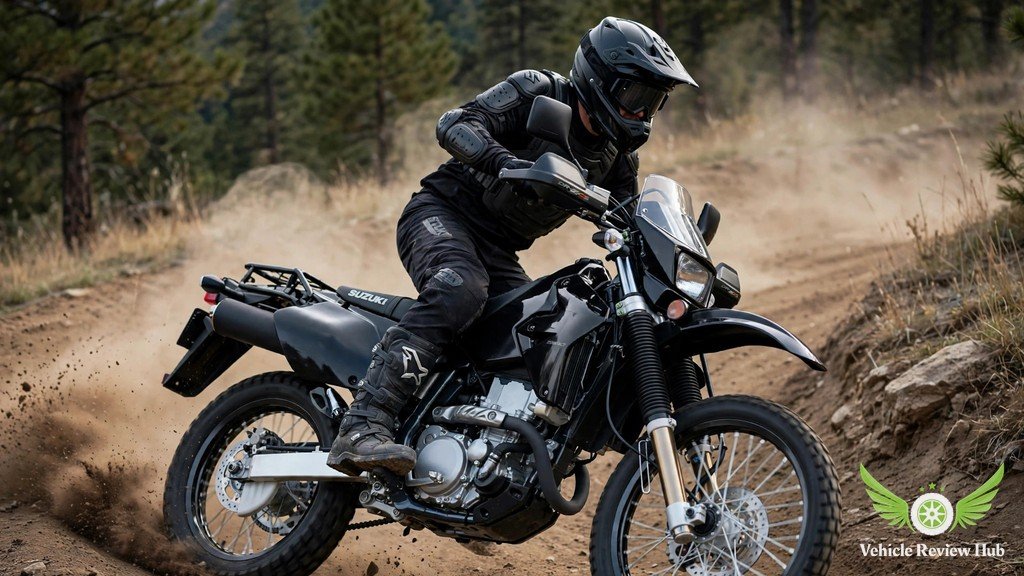
Handling is where the DR-Z400S earns its keep: a 21-inch front wheel, long-travel suspension and a narrow, upright chassis that turns tightly and forgives mistakes. Braking is the honest weak spot — a single 250 mm front disc with no ABS — and stability is a matter of knowing what the bike is and is not built for. This Suzuki DR-Z400S performance guide treats all three together, because on a dual-sport they are one riding experience.
Braking and Stability On and Off Road
The brakes are a 250 mm front disc with a two-piston caliper and a 220 mm rear disc with a single-piston caliper — and no ABS in any year, on road or trail. That is a deliberate choice on a dual-sport: off road, ABS can be a liability, and the old bike’s riders lock the rear wheel on purpose. On the road it means the rider is the ABS, and the single front disc needs a firm pull where a modern twin-disc setup would need two fingers. Stability is good at the speeds Suzuki DR-Z400S performance is built for: the 1,485 mm wheelbase and 27°10′ caster keep the steering calm on gravel and pavement alike, and the 300 mm of ground clearance means the bike clears ruts that would stop a street bike. At highway speed the tall, narrow shape catches the wind, and the knobby tyres — 80/100-21 front, 120/90-18 rear, tube type, on Bridgestone Trail Wing rubber — hum and wander slightly on grooved pavement. None of that is a defect; it is the price of a bike that can leave the pavement whenever the rider wants.
Tire, Brake and Suspension Checks That Matter
The checks that matter most for Suzuki DR-Z400S performance are the ones the manual prints: tyre pressures cold at 18 psi front and 22 psi solo (25 psi dual) rear, chain slack 40–50 mm at the loosest point with the chain cleaned and lubricated every 600 miles, and the 49 mm Showa fork’s compression, rebound and preload set for the rider’s weight. Dirt Rider’s 2022 tester, at 125 pounds, found the fork and shock extremely plush — a heavier rider will want more preload and compression, and the suspension is externally adjustable from 2002 onward, which is the only verified running change in the bike’s 24-year run. Brake pads wear faster off road, where the rear brake does real work in the dirt, and the fork seals are a wear item on a bike that sees trail use. These are cheap, simple checks on a simple bike — and they are the difference between the plush ride Dirt Rider praised and a bike that feels tired and vague. The Suzuki DR-Z400S reliability guide covers the full maintenance schedule, including the 15,000-mile valve check and the oil-filter rule.
Suzuki DR-Z400S Performance Compared With Other Dual-Sports
The field moved on while the DR-Z400S stood still — and that is exactly why the comparison matters. The successor makes more power with fuel injection and ride modes, the KTM makes more power still and costs less than the old bike’s last price, and the Honda costs less and sips fuel. This Suzuki DR-Z400S performance guide sets the old bike against those three and asks what its numbers still buy. The Suzuki DR-Z400S comparison guide covers the full side-by-side prices, weights and equipment in detail.

| Bike | MSRP | Claimed power | Weight |
|---|---|---|---|
| Suzuki DR-Z400S (2024) | $7,199 | ~39.7 hp claimed; 31–32 hp dyno | 317–324 lb |
| Suzuki DR-Z4S (2025) | $8,999 | 38 hp @ 8,000 rpm | 333 lb |
| KTM 390 Enduro R (2025) | $5,499 | 44 hp @ 8,500 rpm | 351 lb wet |
| Honda CRF300L (2026) | $5,749 | 27 hp @ 8,500 rpm | 313 lb wet |
Suzuki DR-Z400S vs Suzuki DR-Z4S
The successor is the honest benchmark for Suzuki DR-Z400S performance: Cycle News’ June 2025 review called the DR-Z4S “significantly improved over the previous DR-Z400S in nearly every way… it still felt like a DR-Z, only better”. The new bike claims 38 hp at 8,000 rpm and 27.3 lb-ft at 6,500 rpm, against the old bike’s claimed ~39.7 hp and measured 31–32 hp — and its dynos (Cycle World 33.5 hp, Motorcycle.com 32.2 hp) sit just above the old bike’s 31–32 hp band, on different dynos in different years. It costs $8,999 plus $600 destination, or $9,599 — $1,800 more than the old S before destination — and weighs 333 lb, about 16 lb heavier, with a lower 36.2-inch seat and a smaller 2.3-gallon tank. What the extra money buys is fuel injection, three ride modes, traction control with a Gravel mode, switchable ABS and a slipper clutch — everything the old bike lacked. What it does not buy is a sixth gear: the five-speed was kept on purpose. One warning: TopSpeed’s February 2026 comparison table labels its Suzuki column “DR-Z400S” but prints the DR-Z4S’s 38 hp, 27.3 lb-ft and 333 lb in it — never cite that column as the old S.
Is the Suzuki DR-Z400S Suitable for Beginner Riders?
Yes — with one honest condition: the 36.8-inch seat. The bike’s power is friendly, the delivery is smooth and tractable, the clutch is light, the steering is quick without being nervous, and the engine’s low-end torque makes low-speed work easy. A beginner can pick the bike up after a low-speed spill off road, and the aftermarket is enormous after 24 years of the same bike. The condition is height: at 36.8 inches the seat is tall by any standard, taller than the successor’s 36.2 inches and far taller than the Honda CRF300L’s 34.7 inches, and a shorter rider will struggle to touch the ground. The KTM 390 Enduro R makes 44 hp and costs $5,499 — cheaper than the old S’s last price and more powerful on paper — but it is a new bike that still has to prove itself against the DR-Z’s reputation for friendliness and legendary reliability. The Honda CRF300L makes 27 hp, weighs 313 lb wet and costs $5,749, and its performance is brisk enough on the tarmac, though it starts to feel stretched at 70 mph. For a tall beginner who wants the simplest, cheapest proper dual-sport with the biggest aftermarket, Suzuki DR-Z400S performance still makes its case — and the Boulevard M109R review covers the shaft-drive contrast for riders comparing the chain-drive S with Suzuki’s bigger cruiser. Buy the old S for simplicity and value; buy the DR-Z4S for fuel injection, ABS and ride modes, at $1,800 more.
Suzuki DR-Z400S Performance: Frequently Asked Questions
Direct answers to the questions riders ask about this Suzuki DR-Z400S performance guide.
What is the top speed of the Suzuki DR-Z400S?
Cycle World’s 2001 test recorded 93 mph — the only full instrumented test of the old bike. No other tested top speed exists in a named source.
How fast is the Suzuki DR-Z400S from 0 to 60?
Cycle World’s 2001 test recorded 0–60 in 5.2 seconds and a quarter mile of 14.34 seconds at 88.29 mph. TopSpeed’s 4.5-second figure belongs to the supermoto SM, not the S.
How much horsepower does the Suzuki DR-Z400S make?
Three magazine dynos measured 31.2 to 32.3 hp. Suzuki USA publishes no figure; databases claim about 39.7 hp and Suzuki’s 2000 global spec says 40 hp at 7,600 rpm.
What is the real-world fuel economy of the Suzuki DR-Z400S?
Owners report 50 to 58 mpg in ordinary riding, against 35 mpg on Cycle World’s 2001 test loop. The database average is 51.1 mpg. Never present one figure as the other.
How far can the Suzuki DR-Z400S go on a tank?
The tank holds 2.6 US gallons. At the owner-reported 50 mpg that works out to about 130 miles, derived rather than tested; at the test-loop 35 mpg it is about 91 miles.
Does the Suzuki DR-Z400S have fuel injection?
No. Every DR-Z400S ever sold has a Mikuni BSR36 carburettor. Fuel injection arrived only with the 2025 DR-Z4S successor.
Does the Suzuki DR-Z400S have ABS?
No. ABS was never offered on any DR-Z400S in any year. The DR-Z4S successor has switchable ABS.
How much does the Suzuki DR-Z400S weigh?
The figures split: Suzuki USA prints 144 kg (317 lb), the owner’s manual and Global Suzuki print 146 kg (322 lb), and Dirt Rider measured 324 lb wet on its own scales.
Is the Suzuki DR-Z400S good on the highway?
It holds highway speed — 93 mph tested — but five gears mean high revs and a buzzy single. It is happiest at 55 to 65 mph, where the engine is not working at its limit.
Is the Suzuki DR-Z400S faster than the DR-Z4S?
No. The DR-Z4S claims 38 hp at 8,000 rpm and its dynos read 32.2 to 33.5 hp, just above the old bike’s 31.2 to 32.3 hp band — and it adds fuel injection, ride modes and switchable ABS.
Is the Suzuki DR-Z400S suitable for beginner riders?
Yes, if the rider can reach the ground — the power is friendly and the clutch is light, but the 36.8-inch seat is tall by any standard and taller than the CRF300L’s 34.7 inches.
Which is better value, the DR-Z400S or the KTM 390 Enduro R?
On paper the KTM wins: 44 hp and $5,499, cheaper than the old S’s last price of $7,199. The old S answers with 24 years of proven reliability, the biggest aftermarket and the simplest maintenance.