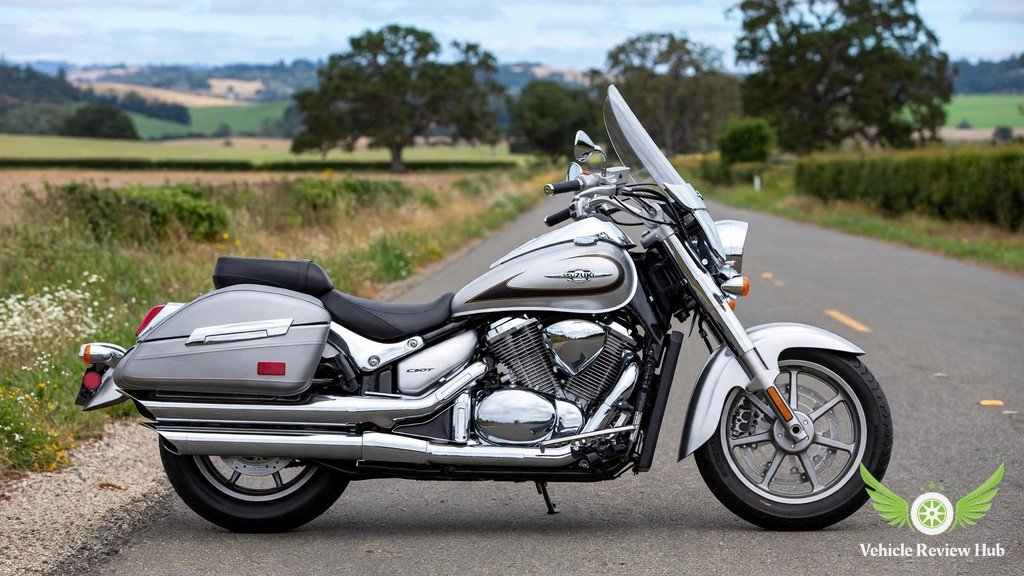
The Suzuki Boulevard C90T performance story has a short answer first: the touring trim is no slower and no faster than the base C90, because it is the same bike with a windscreen and hard cases bolted on. The only measured power figure is 68.7 hp and 85.3 lb-ft, from a Motorcycle Cruiser dyno video of a 2017 C90T, and there is no instrumented 0–60, quarter-mile or top-speed test for either generation in any named US source. This Suzuki Boulevard C90T performance guide works through what is measured, what the factory claims, and what the numbers mean on the road.
Suzuki Boulevard C90T Engine Performance and Power Delivery
The C90T’s engine is the C90’s engine, in both generations, so this Suzuki Boulevard C90T performance guide starts with the same 1,462cc V-twin the base bike carries. The first generation runs the air/oil-cooled 45-degree V-twin with three valves per cylinder and hydraulic lifters; the second runs the liquid-cooled 54-degree V-twin from the M90, with four valves per cylinder and dual spark plugs. Both make their torque low, both use a five-speed gearbox and shaft final drive, and neither ever had a ride mode, traction control or ABS. The touring kit adds 42 lb over the base 2019 C90 — 800 lb at the curb against 758 lb — and that weight, not the engine, is what separates the C90T’s performance from the base bike’s.
Dyno-Tested on the T: 68.7 HP and 85.3 lb-ft
The only dyno figure ever published for the C90T itself comes from a short Motorcycle Cruiser video, “How Much Power Does The 2017 Suzuki Boulevard C90T Make?” — verified by watching, its on-screen results card reads 68.7HP and 85.3 TQ for the 2017 C90T. Three qualifications: no rpm values are shown, so there is no peak-rpm figure; no plotted dyno curve is shown — the card is a single pair of numbers, not a chart; and the on-screen label is “TQ”, not “lb-ft” spelled out, so this guide presents the torque as 85.3 lb-ft on the understanding that TQ means pound-feet. The video is a 34-second clip, not a full test, and it is not embedded here — the supporting video below is a separate 2006 test ride.
The 68.7 hp figure is worth reading next to the closest measured dyno of the same engine family: the M90, which shares the gen-2 C90T’s engine, made 69.6 hp at 5,100 rpm and 82.7 lb-ft at 2,900 rpm on a Motorcycle.com dyno in 2009. The two agree closely — 68.7 against 69.6 hp, 85.3 against 82.7 lb-ft — the strongest evidence available that the C90T’s real rear-wheel output sits in the high sixties for horsepower and the low-to-mid eighties for torque. The two were recorded eight years apart, so they should not be ranked against the brochure numbers.
Factory Claims Conflict: 77.8 HP vs 81.8 HP
Suzuki USA publishes no horsepower or torque figure for the C90T, so every claimed number comes from a brochure, a magazine or a database — and they disagree. This Suzuki Boulevard C90T performance guide lays out the four-way split plainly.
| Source | Claimed power | Claimed torque |
|---|---|---|
| Suzuki brochure | 79.9 hp @ 4,800 rpm | 131.4 Nm (96.9 lb-ft) @ 2,600 |
| Women Riders Now | 77.8 hp @ 4,800 rpm | 96.6 lb-ft @ 2,600 |
| Rider Magazine | 81.8 hp @ 4,800 rpm | 93.3 lb-ft @ 2,800 |
| Spec databases | 67 hp | 114 Nm |
| Ultimate Motorcycling | 78 hp @ 4,800 rpm | 97 lb-ft @ 2,600 |
The heading’s two numbers — 77.8 hp and 81.8 hp — are both sourced: Women Riders Now prints 77.8 horsepower at 4,800 rpm and 96.6 ft-lb torque at 2,600, “according to Suzuki”, while Rider Magazine prints 81.8 horsepower at 4,800 rpm as Suzuki’s claim. They differ by 4 hp at the same rpm, so at least one carries a rounded or regional variant. The brochure’s 79.9 hp sits between them, and Ultimate Motorcycling’s 2019 review prints 78 hp and 97 lb-ft. The databases’ 67 hp is the outlier, reading like a rear-wheel figure copied into a claimed-power slot — this Suzuki Boulevard C90T performance guide treats it as database-circulated only, never as a factory claim.
The practical point is the torque: every source puts peak torque between 2,600 and 2,800 rpm, and every measured dyno puts it in the low eighties . The Suzuki Boulevard C90 performance guide covers the same split for the base bike — the numbers are identical.
Suzuki Boulevard C90T Top Speed and Acceleration
There is no instrumented top-speed figure for the C90T, and this Suzuki Boulevard C90T performance guide says so plainly. No magazine ran a GPS top-speed test on either generation in any named US source, and no owner test with a verified method exists. What exists instead is a handful of unattributed database figures, one aggregator estimate and a reviewer’s impression.

No Instrumented Acceleration Test Exists for the T
No 0–60, quarter-mile or top-speed test was ever run on the C90T by a named US publication. Launched in 2005 as a touring version of an already-old platform, the C90T was reviewed as a value tourer by 2013, not timed as a performance bike. The only acceleration figures for the gen-2 bike are aggregator estimates — zeroto60times lists 0–60 in 4.5 seconds and the quarter mile in 13.5 seconds — labelled here as aggregator figures, never as tested results.
The Suzuki Boulevard C90 review records the same gap for the base bike, because the gap belongs to the whole C90 family, not to the touring trim alone.
The 15.0-Second Quarter in Databases Is Unattributed
The 15.0-second quarter mile does appear in spec databases — motorcyclespecifications.com prints 15.0 seconds at a 138 km/h (85.7 mph) trap speed for the gen-1 C90 — but without any named test behind it. No magazine, no date, no track and no method are attached, which is why this Suzuki Boulevard C90T performance guide calls it unattributed rather than wrong. The same table’s “top speed 138 km/h” is really the quarter-mile trap speed wearing a top-speed label.
The gen-1 figure is also the only one that exists: no database prints a gen-2 quarter mile from a test, and the 13.5-second aggregator figure sits a full 1.5 seconds quicker. Neither generation was ever properly timed.
Suzuki Boulevard C90T Mileage and Fuel Economy
There is no US fuel-economy test for the C90T or the C90, and this Suzuki Boulevard C90T performance guide does not pretend otherwise. No EPA figure exists, and no US magazine ran a measured mileage loop on either generation. The only consumption figure in any named source is an Australian one, and the only other numbers are owner bands.

No US MPG Test: Only an Australian Figure Exists
The single published consumption figure comes from webBikeWorld’s Australian review of the C90T: about 6.5 litres per 100 km — roughly 36 mpg in US gallons — and “about 250+ km” of range from the 18-litre (4.8-gallon) tank. That is the whole of the published evidence, and this Suzuki Boulevard C90T performance guide presents it exactly as it is: one Australian test, one figure, no US test to confirm it. The 36 mpg figure is plausible — it sits in the same band as the owner reports — but plausible is not verified.
The gen-1 owner band of 36–41 mpg cross-checks the Australian figure — its low end matches the webBikeWorld number exactly — and no separate gen-2 owner band is published, so this guide does not invent one. The conclusion is mid-thirties to low forties.
Real-World Range on the 4.8-Gallon Gen 2 Tank
The gen-2 C90T carries 4.8 gallons (18 litres), and at the Australian figure of about 36 mpg that works out to roughly 173 miles — 36 multiplied by 4.8 is 172.8. This Suzuki Boulevard C90T performance guide labels that number as derived, never as tested: it is arithmetic on a single published figure, not a measured tank-to-tank run. The webBikeWorld review’s own “about 250+ km” — about 155 miles — sits below the derived 173, which suggests a reserve margin or a heavier hand, so plan fuel stops at 150 miles.
The gen-1 bike’s smaller 3.7-gallon tank gives 133–152 miles on the owner band of 36–41 mpg, and the 142-mile figure in some databases is not printed in this Suzuki Boulevard C90T performance guide as a tested range, because no test stands behind it. The gen-2 bike’s extra 1.1 gallons is the real touring advantage — about 40 more miles between stops. The Suzuki Boulevard C90T review covers the tank sizes in full.
Suzuki Boulevard C90T Real-World Riding Experience
On the road, the C90T is a simple proposition: a big, low, torquey cruiser that does its best work at legal speeds. This Suzuki Boulevard C90T performance guide draws the riding picture from the two named-source reviews — Rider Magazine’s 2013 test and Ultimate Motorcycling’s 2019 review.
The video below is Srkcycles’ 11-minute test drive of a 2006 C90 — a first-generation bike, not the 2019 model. It is the supporting test-ride video for this Suzuki Boulevard C90T performance guide, not the dyno clip — the 68.7 hp and 85.3 lb-ft figures come from the Motorcycle Cruiser video of a 2017 C90T, named in the engine section.
Rider 2013: Engine Praised, Suspension the Big Weakness
Rider Magazine’s 2013 verdict on the C90 platform is the clearest single sentence ever written about this bike: the engine is praised, and the suspension is the weakness. The magazine’s suspension verdict — the “45mm fork does a decent job up front… just plain bouncy over larger bumps” — is the line every later review echoes. Ultimate Motorcycling’s 2019 review says the same thing in blunter language — the suspension is “unsophisticated… nary an adjustment”, and “to get to the $13,049 price point, something had to give, and the result is 20th century cruiser suspension action”. Two magazines, six years apart, one conclusion.
Ultimate Motorcycling agrees: the engine is “decisively linear” and “The motor is excellent, and the chassis is likely good enough to keep most budget-conscious buyers happy.”
Single Front Disc Takes Plenty of Pressure to Stop
The gen-2 C90T stops with a single 330 mm front disc and a 275 mm rear disc, both two-piston calipers, and no ABS in any year — and braking is where the 800 lb curb weight shows most. Ultimate Motorcycling’s 2019 review puts it in so many words: “be prepared to add some extra pressure to the front brake lever. There’s only a single disc up front, and you’ll notice that at higher speeds, and especially when two-up. Fortunately, the rear brake and the 200mm rear tire will assist in deceleration duties, as needed.” The gen-1 bike had dual front discs, so the second generation is a step backwards on paper.
The rear brake matters more here than on a modern ABS cruiser, and the 200 mm rear tyre gives it real grip — but there is no electronic safety net if the lever is grabbed in the wet.
Suzuki Boulevard C90T Handling, Braking and Stability
At 800 lb at the curb, the C90T is a heavy bike that carries its weight low — the central handling fact of this Suzuki Boulevard C90T performance guide. The low seat — 28.3 inches on the gen-2 bike — and the low-slung V-twin put the mass near the ground, so the bike feels lighter at a stop than the number suggests. But 800 lb is 800 lb: at parking speeds, in a tight turn and under hard braking, the weight is always there.
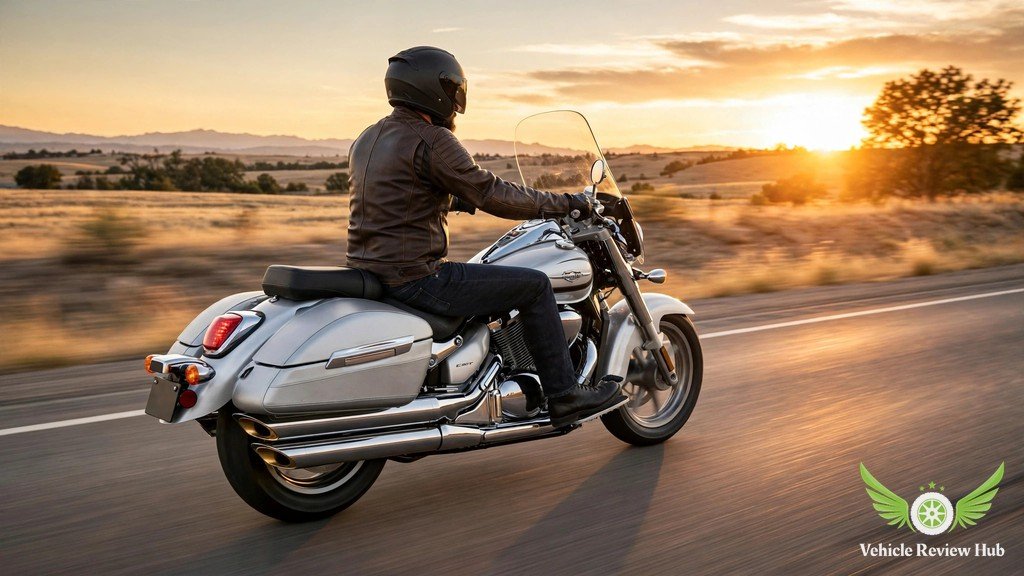
Braking and Stability at 800 Pounds Curb
The C90T’s stability, as this Suzuki Boulevard C90T performance guide reads it, comes from its geometry, not its equipment. The long wheelbase — 65.9 inches on the gen-2 bike — and the wide 200 mm rear tyre give the bike a planted, straight-line feel at highway speed, and Ultimate Motorcycling notes the rider “can zip it up to triple-digit speeds if you like without misbehavior”. The wide 7/8-inch handlebar flexes quite a bit, giving “a vague front end feeling” in the same review’s words.
Two-up and loaded, the difference grows — the passenger and the luggage sit over the rear wheel, the front disc works harder, and the unadjustable rear suspension sags further.
Tire, Brake and Suspension Checks That Matter
Before any performance judgment of a used C90T, the tyres, brakes and suspension need checking — and this Suzuki Boulevard C90T performance guide names the numbers, because the service chart gives them. Tyre pressures are 33 psi front and 36 psi rear solo, rising to 41 psi rear two-up, and the gen-2 bike runs a 130/80-17 front and a 200/60-16 rear Bridgestone Exedra. The gen-1 front size is unresolved — Total Motorcycle prints 150/80-16, maintenanceschedule.com prints 130/70-16 — so check the size moulded into the tyre actually fitted. Brake fluid is DOT 4, replaced every two years; brake hoses every four years; forks and rear suspension inspected at 7,500 and 14,500 miles; steering at 600, 7,500 and 14,500 miles. The oil filter is replaced only at 600 and 11,000 miles, and the final-gear oil at 600 miles and then inspected. A used C90T with a soft front brake lever, a weeping fork seal or a rear shock that has lost its damping will feel vague and bouncy in exactly the way the reviews describe. The Suzuki Boulevard C90 reliability guide covers the same service chart in full, and the Suzuki Boulevard C90T reliability guide covers the touring kit’s wear in full.
Suzuki Boulevard C90T Performance Compared With Other Factory Tourers
The C90T’s performance only makes sense against the other factory-dressed big cruisers, and this Suzuki Boulevard C90T performance guide compares it with the closest one — the Kawasaki Vulcan 1700 Nomad. The full comparison with the Vaquero and the Heritage Classic is in the Suzuki Boulevard C90 comparison guide.

| Item | Suzuki Boulevard C90T (2019) | Kawasaki Vulcan 1700 Nomad (2014) |
|---|---|---|
| Engine | 1,462cc liquid-cooled 54° V-twin | 1,700cc liquid-cooled 52° V-twin |
| Claimed power | 79.9 hp (brochure); 68.7 hp measured | No hp published by Kawasaki |
| Claimed torque | 131.4 Nm; 85.3 lb-ft measured | 108 lb-ft (Kawasaki); 100.3 lb-ft (manual) |
| Gearbox / final drive | 5-speed, shaft | 6-speed with overdrive, belt |
| Brakes / ABS | Single 330 mm front disc; no ABS | Dual 300 mm front discs; K-ACT II ABS |
Suzuki Boulevard C90T vs Kawasaki Vulcan 1700 Nomad
The Nomad is the bigger, newer and better-equipped bike on paper, and the C90T is the lighter, simpler and cheaper one — and the performance gap is smaller than the spec sheet suggests. The Nomad’s 1,700cc engine makes 108 lb-ft at 2,750 rpm by Kawasaki’s own figure, against the C90T’s 96.9 lb-ft brochure claim and 85.3 lb-ft measured figure — but the Nomad also carries 42 lb more weight, and its service manual prints 136 Nm (100.3 lb-ft), so the torque advantage is real but not dramatic. The Nomad’s sixth gear with overdrive is the genuine performance advantage: at highway speed the Kawasaki cruises at lower revs, with less vibration and less fuel burn, while the C90T’s five-speed box spins faster. The Nomad’s brakes are the other real advantage — dual 300 mm front discs with K-ACT II ABS on both ends, against the C90T’s single disc and no ABS — a safety gap, not just a spec gap. The Kawasaki Vaquero page shows the line’s next step: the Vaquero carries the same 1,700cc platform forward at $19,999 for 2026. On the used market, the C90T’s case is its price — commonly listed under $7,000, against the Nomad’s $17,499 last-new MSRP — and for a buyer who wants a factory tourer rather than a new bike, the C90T gives up a gear, a disc and ABS for thousands of dollars less. The Boulevard M109R review covers the bigger Boulevard for riders who want more power than either of these tourers offers.
Is the Suzuki Boulevard C90T Suitable for Beginner Riders? No
No — and this Suzuki Boulevard C90T performance guide answers directly. An 800 lb motorcycle with a 1,462cc engine, no ABS, no traction control, no ride modes and a single front disc is not a beginner bike, and no amount of low seat height changes that. The 28.3-inch seat lets a shorter rider flat-foot the bike at a stop, but flat-footing is only the first five seconds of riding: the weight shows at parking speeds, under braking, and wherever the bike needs to be caught or held up. A beginner who wants a Boulevard should start with the smaller C50 or the S40 and move up when the 800 lb feels normal. The C90T is a good second or third bike; it is a poor first one.
Suzuki Boulevard C90T Performance: Frequently Asked Questions
Direct answers to the questions riders ask about this Suzuki Boulevard C90T performance guide.
How much horsepower does the Suzuki Boulevard C90T make?
The only measured figure is 68.7 hp from a Motorcycle Cruiser dyno video of a 2017 C90T. Suzuki’s brochure claims 79.9 hp, Women Riders Now 77.8 hp and Rider Magazine 81.8 hp, all attributed to Suzuki — and Suzuki USA publishes no figure of its own.
What is the Suzuki Boulevard C90T top speed?
There is no instrumented top-speed test for either generation in any named US source, so this guide prints no figure. Ultimate Motorcycling’s reviewer says the bike will run “up to triple-digit speeds… without misbehavior”, which is an impression, not a measured maximum.
What is the Suzuki Boulevard C90T 0–60 time?
No instrumented 0–60 test exists, and this Suzuki Boulevard C90T performance guide prints none. The aggregator zeroto60times lists 4.5 seconds for the gen-2 bike — an aggregator estimate, never a tested result.
What is the Suzuki Boulevard C90T quarter-mile time?
The databases print 15.0 seconds at a 138 km/h trap speed for the gen-1 bike, with no named test behind it — unattributed, not verified. The gen-2 aggregator figure is 13.5 seconds, also untested.
What is the Suzuki Boulevard C90T MPG?
There is no US MPG test for this Suzuki Boulevard C90T performance guide to cite. The only published figure is webBikeWorld’s Australian test: about 6.5 litres per 100 km, roughly 36 mpg in US gallons. Gen-1 owners report 36–41 mpg.
How far can the Suzuki Boulevard C90T go on a tank?
About 173 miles on the gen-2 bike’s 4.8-gallon tank at 36 mpg — derived, not tested, so plan fuel stops at 150 miles. The gen-1 bike’s 3.7-gallon tank gives 133–152 miles on the owner band of 36–41 mpg.
Does the Suzuki Boulevard C90T have ABS?
No. ABS was never offered on any US C90T in either generation. The gen-2 bike stops with a single 330 mm front disc and a 275 mm rear disc, both two-piston calipers, — and the reviewer warning is to add “some extra pressure to the front brake lever”.
Is the Suzuki Boulevard C90T fast?
It is strong rather than fast. The 1,462cc V-twin makes its torque at 2,600 rpm and pulls cleanly from low revs, but 68.7 hp measured and 800 lb at the curb make it a relaxed highway cruiser, not a quick bike.
How does the Suzuki Boulevard C90T compare with the Vulcan 1700 Nomad?
The Nomad has a bigger engine (1,700cc), a sixth gear with overdrive, dual front discs with ABS, and a $17,499 last-new MSRP. The C90T is 42 lb lighter, simpler and far cheaper used — commonly under $7,000 — but gives up a gear, a disc and ABS.
Is the Suzuki Boulevard C90T good for beginners?
No. At 800 lb with a 1,462cc engine and no ABS, traction control or ride modes, it is not a beginner bike. The low 28.3-inch seat helps at a stop, but it does not cancel the weight or the braking demands.
What tyres does the Suzuki Boulevard C90T use?
The gen-2 bike runs a 130/80-17 front and a 200/60-16 rear. The gen-1 front size is unresolved — Total Motorcycle prints 150/80-16, maintenanceschedule.com prints 130/70-16 — so check the size moulded into the tyre fitted.
Does the Suzuki Boulevard C90T have a sixth gear?
No. Both generations use a five-speed gearbox with shaft final drive. The Nomad’s six-speed overdrive is one of the genuine performance advantages the Kawasaki holds over the C90T.