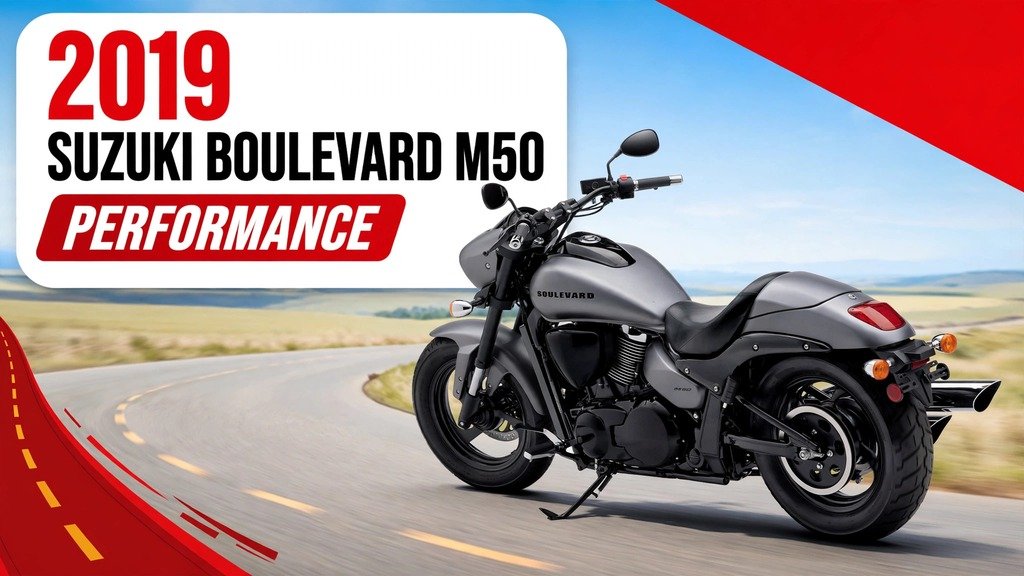
The Suzuki Boulevard M50 looks like a muscle cruiser and is priced like one, but its performance tells a different story: mid-40s horsepower at the rear wheel, a tested 42.8 MPG, no instrumented top-speed test anywhere, and a 5.4-second 0–60 claim that traces only to an aggregator. This Suzuki Boulevard M50 performance guide covers the only two dyno runs ever published for the bike, the mileage figure that actually exists, and what owners and testers found on the road.
Suzuki Boulevard M50 Engine Performance and Power Delivery
The M50’s engine is a known quantity: an 805cc liquid-cooled 45-degree V-twin with SDTV fuel injection, a five-speed gearbox and a shaft final drive, essentially unchanged from 2005 to 2019. Suzuki USA never published a horsepower or torque figure for it, so the honest picture of Suzuki Boulevard M50 performance comes from two magazine dyno runs ten years apart.
Dynojet 2005: 44.09 HP and 42.83 lb-ft
The first instrumented figure comes from Motorcycle.com’s 2005 test of the brand-new M50. The magazine strapped the bike to its own Dynojet and reported that the liquid-cooled, four-valve-per-cylinder motor “pumps out 44.09 hp and 42.83 foot-pounds of torque” at the rear wheel. The run belongs to Motorcycle.com’s 2005 M50 test, not to Rider, which never dyno-tested an M50. One caution: the same article also printed “The C50 and M50 are 819 cubic centimeters”, a magazine mistake — the true displacement is 805cc.
The 2015 Shootout Found 43.5 HP at 6,100 RPM
Ten years later, Motorcycle.com ran the M50 again in its “Strange Bedfellows” shootout against the Yamaha Star Bolt C-Spec: 43.5 hp at 6,100 rpm and 43.0 lb-ft at 3,200 rpm on a MotoGP Werks Dynojet — almost exactly where the first run landed. The Bolt made 49.1 hp at 5,300 rpm with 57.3 lb-ft at 3,100 rpm — the quicker bike on the dyno, as the magazine said. The two M50 runs must never be ranked against each other — different bikes, different years, different dyno days — but together they prove consistency: roughly 43 to 44 rear-wheel horsepower, year after year. Spec databases claim more: 50 hp at 6,500 rpm with 65 Nm (47.9 lb-ft) at 5,000 rpm for 2005–08 bikes, and 52 hp at 6,000 rpm with 69 Nm (51 lb-ft) at 3,200 rpm for 2009 and later bikes, the change tied to dual spark plugs per cylinder. Those are global database claims, not Suzuki USA figures and not dyno results — this Suzuki Boulevard M50 performance guide treats them as claims and the two Dynojet runs as the evidence. The Motorcycle.com 2015 shootout is the source for the later figure and for the tested 42.8 MPG covered below.
| Figure | Value | Source and status |
|---|---|---|
| Dyno, 2005 | 44.09 hp / 42.83 lb-ft | Motorcycle.com Dynojet, rear wheel |
| Dyno, 2015 | 43.5 hp @ 6,100 rpm / 43.0 lb-ft @ 3,200 rpm | Motorcycle.com shootout, MotoGP Werks Dynojet |
| Database claim, 2005–08 | 50 hp @ 6,500 rpm / 65 Nm @ 5,000 rpm | Spec databases, global claim only |
| Database claim, 2009+ | 52 hp @ 6,000 rpm / 69 Nm @ 3,200 rpm | Spec databases, global claim only |
Suzuki Boulevard M50 Top Speed and Acceleration
Top speed and acceleration are where Suzuki Boulevard M50 performance gets murky: exactly one acceleration figure exists, from an aggregator with no named test source, and no instrumented top-speed test from any named outlet at all.

The 5.4-Second Claim Traces Only to an Aggregator
The number every buying guide quotes is 0–60 mph in 5.4 seconds with a 14.0-second quarter mile, and it comes from zeroto60times, an aggregator that lists the figures with no named test source. The same lineage shows up in spec databases — marhijoz’s table prints 0–100 km/h in 5.39 seconds — but neither is a magazine instrumented test, and no magazine ever published a timed M50 acceleration run. That does not make 5.4 seconds wrong; it makes it unverifiable, and a buyer should treat it as a rough guide rather than a tested fact. The figure is plausible for a 593-pound bike with roughly 44 rear-wheel horsepower, but plausible is not tested — the zeroto60times Suzuki listing is the only source for the number, so this Suzuki Boulevard M50 performance guide prints it with the aggregator label attached.
No Instrumented Top Speed From a Named Outlet
No instrumented or GPS top-speed test was ever published for the M50 by any named outlet. What exists instead is a cluster of estimates: VikingBags writes that “it is estimated this bike can go up to 100 mph”, shabupc lists “Top Speed: 100 mph (est)”, and marhijoz’s database table prints 172 km/h, about 107 mph, as a database figure rather than a test result. Two figures must never be printed as facts here: the Alibaba AI guides’ “105–110 mph” estimates are unsourced AI content, and the speedometer’s 200 km/h top reading is a dial marking, not a measured speed. The honest answer on Suzuki Boulevard M50 performance at the top end is that nobody with a timing device ever published the number, the estimates cluster around 100 mph, and sustained high-speed running was never the bike’s job — the 2015 testers were already hunting for a sixth gear at 80 mph.
Suzuki Boulevard M50 Mileage and Fuel Economy
Fuel economy is the one area where Suzuki Boulevard M50 performance has a single clean, tested number: Motorcycle.com measured 42.8 MPG in its 2015 shootout, and that figure, with the 4.1-gallon tank, is the whole tested story.

Motorcycle.com Tested 42.8 MPG in 2015
The 2015 shootout’s spec sheet prints “Tested Fuel Economy 45.1 MPG” for the Star Bolt and “42.8 MPG” for the M50 — a measured figure from a real test loop, not a manufacturer estimate. On the 4.1-gallon tank that works out to roughly 175 miles between fill-ups (4.1 × 42.8 = 175.5). Owners sometimes report better — a 2009 M50 owner on Cycle Insider wrote that “fuel consumption is exactly 50 mpg”, and a 2006 owner reported averaging about 45 mpg on a mix of commuting and weekend riding — but those are owner-reported figures, and this Suzuki Boulevard M50 performance guide keeps them labelled as owner reports rather than tested results. The 42.8 MPG figure stands alone as the tested number.
Suzuki Never Published Power or MPG Figures
Suzuki USA’s spec table for the M50 carries no horsepower figure, no torque figure and no MPG figure — not for 2019, not for any US model year. That absence is why every power and economy number in this Suzuki Boulevard M50 performance guide carries a label: the 50 and 52 hp figures are database and global claims, the 44.09 and 43.5 hp figures are magazine dyno runs, and the 42.8 MPG figure is a single magazine test. None of them is “Suzuki claims”, and a buying guide that writes “Suzuki claims 52 hp” is wrong on its face. The same gap applies to the Suzuki Boulevard M50 history, which records the model years, the 2010 redesign and the 2019 end of production without adding any factory power figure — because Suzuki never published one for the US market. The full specification table is in the Suzuki Boulevard M50 review, which covers the bike’s prices, specs and riding experience in full.
| Measure | Figure | Status |
|---|---|---|
| 0–60 mph | 5.4 seconds | Aggregator figure only, no named test |
| Quarter mile | 14.0 seconds | Aggregator figure only, no named test |
| Top speed | No instrumented test exists | Estimates cluster around 100 mph |
| Tested fuel economy | 42.8 MPG | Motorcycle.com 2015 shootout, tested |
| Range | About 175 miles | 4.1 gal tank × 42.8 MPG |
Suzuki Boulevard M50 Real-World Riding Experience
On the road, the M50 is a relaxed, easy motorcycle that flatters a new rider and never intimidates one, and the magazine verdicts agree with the owners. The complaints are just as consistent: the brakes and the exhaust note underwhelm, and the five-speed gearbox runs out of ratios on the freeway. That combination — comfortable, unhurried, a little soft — is the real-world Suzuki Boulevard M50 performance picture.

Bland Brakes and Bland Sound, Said the 2015 Test
Motorcycle.com’s 2015 shootout listed the M50’s “Sighs” as three words: “Bland styling / Bland sound / Bland brakes”. The braking verdict was blunt: both bikes ran single front discs with twin-piston calipers, and “both leave something to be desired in the braking department”, with the Suzuki’s rear drum rather than a disc at the back. Against those sighs, the same test listed the M50’s “Highs” as “Sportier than it looks / Daylong comfortable riding position / Passenger pegs included” — the bike’s strengths are comfort and ease, not drama. Owners echo the split: YouMotorcycle’s review, written by a rider who owns three M50s, calls the bike “known to be bulletproof” and “one of the most low maintenance motorcycles you can get”, while being equally direct that it “isn’t a real muscle cruiser, the performance just isn’t there”. Both verdicts belong in any honest account of Suzuki Boulevard M50 performance, attributed to their sources rather than presented as this guide’s own ride impression.
Owners Report Hunting for a Sixth Gear at 75-80
The most repeated riding complaint about the M50 is the missing sixth gear. In the 2015 shootout, the testers wrote that “both bikes utilize a 5-speed transmission — Evans and I were looking for a sixth gear on either bike when running down the freeway at 80 mph”. Owners say the same: a 2006 M50 owner wrote “Wish it had 6 speed but can’t complain”, and another noted the bike cruises comfortably at 70 mph but “you will feel a little vibration and wish you had a 6th gear” once past 80 mph. It is a small complaint against a bike that costs so little used, but in Suzuki Boulevard M50 performance terms it is the complaint that comes up most often, and a buyer who plans regular freeway miles should weigh it alongside the missing ABS.
The video below is Nomad Adventure Biker’s “2008 Suzuki Boulevard M50 review” — an owner’s review of a 2008 M50, not a magazine test, and a useful look at how the bike rides in real hands.
Suzuki Boulevard M50 Handling, Braking and Stability
Handling is where the M50’s signature hardware earns its keep: the inverted 41mm fork is the only one in its class, and the low seat and low centre of gravity make a 593-pound bike easy to manage. Braking is where the bike shows its age — a single front disc, a rear drum, and no ABS in any year.

Front Disc, Rear Drum and No ABS
The braking hardware never changed across the M50’s whole 2005–2019 run: a single front disc with a twin-piston caliper and a rear drum brake, with no ABS offered in any US model year. The 2015 shootout confirmed the same setup while calling the brakes bland, and YouMotorcycle’s review states it plainly: the M50 “doesn’t have ABS, traction control, ride-by-wire modes, or tire pressure monitoring systems”. A buyer should never pay extra for a bike advertised as an “ABS model” — no such M50 exists. The handling side of Suzuki Boulevard M50 performance is stronger: the inverted 41mm fork with black outer tubes gives the front end a planted feel, the link-style solo rear shock hides inside the frame for the hard-tail look, and the low 27.6-inch seat puts most riders flat-footed at a stop. Cycle World’s 2005 budget test praised the bike’s fit for full-size riders while noting “squishy suspension” and a shortage of footpeg clearance — the M50 handles well for a middleweight cruiser, but its cornering clearance and soft suspension set the limit. The Boulevard S40 performance guide covers the lightest Boulevard at 381 pounds — and the S40, like the M50, has no ABS, so the braking compromise is a family trait.
Final Drive, Tires, Fork Seals, Brakes and Electrical Checks
Keeping Suzuki Boulevard M50 performance up is mostly a matter of following the manual’s chart, and the chart is simple. The final drive is a shaft, so there is no chain to clean and no belt to adjust: the manual calls for final-gear oil replaced at the 600-mile break-in service and inspected afterwards, and owner practice from YouMotorcycle’s shaft-drive guide is a change every 12,000 km (7,500 miles) or at least every two years with 200–220 mL of SAE 90 hypoid gear oil, GL-5. The full service schedule is in the M50 service schedule from the manual: engine oil replaced at every 600, 4,000, 7,500, 11,000 and 14,500-mile interval, the oil filter replaced only at 600 and 11,000 miles, and valve clearances inspected every 7,500 miles. Tires are 130/90-16 up front and 170/80-15 at the rear on cast aluminum wheels — not spoked — at 29 psi front and 36 psi rear, and the fork seals deserve a check on any used bike, since the inverted fork is the bike’s signature part and a leaking seal is its most common wear item. Electrical checks matter on a bike that may be twenty years old — the one recall that applies to the M50 is the 2005–06 ignition-switch recall, campaign 05V-566, covering 23,839 VL800 and VZ800 motorcycles combined, and any used bike’s VIN should be run through the NHTSA recalls lookup before buying. The C50 reliability guide covers the sibling bike’s shared service chart, including the same filter rule and the same ignition-switch recall.
Suzuki Boulevard M50 Performance Compared With Other Muscle Cruisers
Stacked against its rivals, Suzuki Boulevard M50 performance lands where it always has: middleweight numbers, muscle-cruiser styling, and a used price no new rival can touch. The closest current rival is the Kawasaki Vulcan 900 Custom, still sold new in 2026.

Suzuki Boulevard M50 vs Kawasaki Vulcan 900 Custom
The Vulcan 900 Custom is the M50’s natural rival: a middleweight cruiser with drag bars, slash-cut exhaust and custom styling, sold new for 2026 at $9,999 plus an $840 destination charge, a $10,839 total. Its 903cc liquid-cooled 55-degree V-twin is bigger than the M50’s 805cc, and Kawasaki publishes what Suzuki never did — 51 hp at 5,500 rpm and 58.3 lb-ft at 3,500 rpm. Against the M50’s dyno-measured 43.5 rear-wheel horsepower, the Kawasaki’s claimed 51 hp looks stronger, but the two numbers are not the same kind of figure: the Vulcan’s is a manufacturer crank claim and the M50’s is a rear-wheel dyno run, so the gap on paper overstates the gap on the road. The Custom is also heavier at 610.8 pounds against the M50’s 593, carries a bigger 5.3-gallon tank, and rides on a 21-inch front wheel with a belt final drive where the M50 uses a shaft. Both bikes are non-ABS — Kawasaki labels the Custom “Non-ABS” on its own page. The 2026 Kawasaki Vulcan 900 Custom page confirms the $9,999 price, the $840 destination charge and the full specification table. The price gap tells the real story: the M50’s last new price was $8,699 plus $395, a $9,094 total — $1,745 less than the Custom’s $10,839 — and today the M50 is only available used, commonly listed in the $2,500–$8,500 range, so the Suzuki Boulevard M50 performance-per-dollar case is strong even though the Kawasaki is the stronger bike on paper. The Boulevard M109R performance guide covers the other end of the family, a 1,783cc V-twin with a dyno-measured 106.4 horsepower.
Is the Suzuki Boulevard M50 Suitable for Beginner Riders? Mostly
Mostly, yes — with two honest caveats. The case for the M50 as a first big bike is strong: a low 27.6-inch seat that lets most riders flat-foot it, a narrow profile, manageable power at roughly 44 rear-wheel horsepower, predictable handling, a shaft drive with no chain to maintain, and low used prices. The case against is just as real: 593 pounds is a lot of motorcycle for a new rider to manage in a parking lot or after a tip-over, there is no ABS to catch a panicked grab at the front brake, and the brakes are the weakest part of the package. A beginner who buys an M50 should budget for a riding course, practice low-speed manoeuvres, and go in knowing the bike rewards a calm hand rather than a fast one. The verdict in this Suzuki Boulevard M50 performance guide is “mostly” — the bike suits a careful beginner who respects its weight and its missing ABS, and it does not suit a rider who wants the safety net of modern rider aids. That matches the YouMotorcycle M50 review, written by a rider who owns three of them.
Suzuki Boulevard M50 Performance: Frequently Asked Questions
Direct answers to the questions riders ask about the M50’s speed, mileage and power.
How much horsepower does the Suzuki Boulevard M50 make?
Suzuki USA never published a horsepower figure. The evidence in this Suzuki Boulevard M50 performance guide is two magazine dyno runs: 44.09 hp at the rear wheel in 2005 and 43.5 hp at 6,100 rpm in 2015. Spec databases claim 50 hp for 2005–08 bikes and 52 hp for 2009 and later — global claims, not Suzuki figures.
What is the top speed of the Suzuki Boulevard M50?
No instrumented or GPS top-speed test was ever published for the M50. Owner and database estimates in this Suzuki Boulevard M50 performance guide cluster around 100 mph, but those are estimates, not facts.
What is the 0-60 time of the Suzuki Boulevard M50?
The only figure is 0–60 mph in 5.4 seconds with a 14.0-second quarter mile, listed by the aggregator zeroto60times with no named test source — the single acceleration number in this Suzuki Boulevard M50 performance guide. No magazine ever published a timed M50 test, so 5.4 seconds is a rough guide, not a tested result.
What is the fuel economy of the Suzuki Boulevard M50?
The only named, tested figure in this Suzuki Boulevard M50 performance guide is 42.8 MPG, measured by Motorcycle.com in its 2015 shootout, implying roughly 175 miles of range from the 4.1-gallon tank. Suzuki USA published no MPG figure.
Is the Suzuki Boulevard M50 fast?
Not by muscle-cruiser standards. With roughly 44 rear-wheel horsepower and a 593-pound curb weight, the M50 is a relaxed middleweight: strong low-end torque for town riding, but the 2015 shootout’s Yamaha Star Bolt made 49.1 hp. It feels quick in traffic and unhurried everywhere else — the honest summary of Suzuki Boulevard M50 performance.
Does the Suzuki Boulevard M50 have ABS?
No. ABS was never offered on any US-market M50 in any year. The bike has a single front disc with a twin-piston caliper and a rear drum brake, and any listing advertising an “ABS model” M50 is wrong.
Is the Suzuki Boulevard M50 shaft drive?
Yes. The M50 is shaft drive in every model year, with a five-speed gearbox and no chain or belt anywhere. Final-gear oil is replaced at the 600-mile break-in service and inspected afterwards.
What engine does the Suzuki Boulevard M50 have?
An 805cc liquid-cooled SOHC 45-degree V-twin — the engine at the heart of Suzuki Boulevard M50 performance — with an 83.0mm bore and a 74.4mm stroke, a 9.4:1 compression ratio, SDTV fuel injection, a five-speed gearbox and a shaft final drive. The “819cc” figure in some guides is a magazine error, not a Suzuki specification.
How does the M50 compare with the Kawasaki Vulcan 900 Custom?
The Vulcan 900 Custom is bigger and stronger on paper — 903cc, a claimed 51 hp at 5,500 rpm and 58.3 lb-ft, $9,999 plus $840 for 2026 — but heavier at 610.8 pounds and belt-driven where the M50 is shaft-driven. The M50’s last new price was $8,699 plus $395, and today it is only available used, so it wins on price while the Kawasaki wins on paper.
Is the Suzuki Boulevard M50 good for beginners?
Mostly, and Suzuki Boulevard M50 performance suits a careful beginner: the low 27.6-inch seat, manageable power and shaft drive suit a new rider, but the bike weighs 593 pounds and has no ABS, and the brakes are the weakest part of the package. A careful beginner who takes a riding course will be fine.
What is the seat height and weight of the Suzuki Boulevard M50?
The seat height is 27.6 inches and the curb weight is 593 pounds, both from Suzuki’s own 2019 spec table — the numbers that shape Suzuki Boulevard M50 performance most. The 2015 shootout measured 590 pounds — a measured weight, not the 593-pound curb weight.
What should I check before buying a used Suzuki Boulevard M50?
Run the VIN through the NHTSA recalls lookup for the 2005–06 ignition-switch recall, campaign 05V-566. Then check the inverted fork seals, the shaft-drive oil, the brakes and the tires, and ask for service records. And remember no 2010 US model exists — a bike advertised as a 2010 is a mislisted 2009 or 2011.