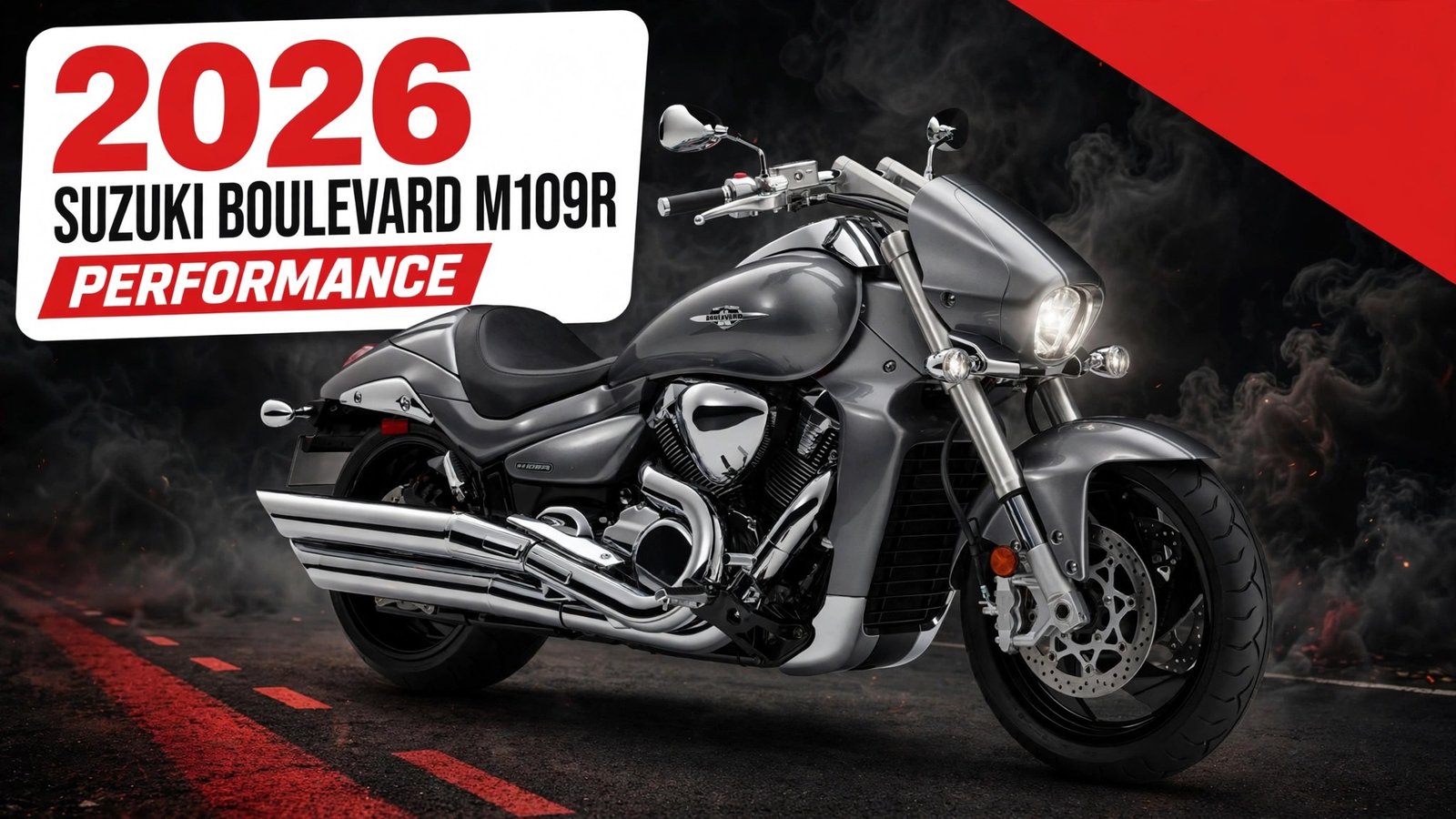
The short answer on this Suzuki Boulevard M109R performance guide: the big Suzuki is genuinely fast — 106.4 hp at the rear wheel on Motorcycle.com’s Dynojet, a 12.08-second quarter mile and 0–60 in 3.89 seconds, all from 2006–07 tests — and no tested top speed exists. Suzuki claims 123 hp, the US launch claim was 127 hp, and Rider’s 36.4 mpg is the only tested economy figure. This Suzuki Boulevard M109R performance guide separates tested numbers from estimates and claims from dyno.
Suzuki Boulevard M109R Engine Performance and Power Delivery
The M109R’s performance starts with its engine: a 1,783cc liquid-cooled, DOHC, 54-degree V-twin, 112.0 × 90.5 mm, 10.5:1, dual 56mm throttle bodies and the biggest pistons of any gasoline-burning production motor (112mm, forged aluminium). It drives a five-speed gearbox and a shaft final drive, putting power through the widest rear tire ever fitted to a Suzuki, a 240/40R18. This section of the Suzuki Boulevard M109R performance guide looks at the dyno result and the claimed figures.

Godzilla Shootout Dyno 2007: 106.4 HP at the Wheel
The only instrumented dyno figure for the M109R comes from Motorcycle.com’s 2007 Godzilla Cruisers Shootout, which strapped five giant cruisers to the magazine’s Dynojet. The M109R made 106.4 hp and 101.3 lb-ft at the rear wheel, with what the testers called “a remarkably linear horsepower curve” — “as close to a 45-degree angle as anything we’ve seen come out of our Dynojet dynamometer.” That is the number to trust, and the figure this Suzuki Boulevard M109R performance guide uses throughout. Motorcycle.com’s own 2011 M109R review corroborates the scale — “127 crankshaft hp (about 106 horses at the wheel).” No Rider or Cycle World dyno exists for the M109R, so never rank the Godzilla run against figures from a different dyno or magazine.
The 127 HP Figure Is a Crank Claim From 2006
Three horsepower figures circulate for the M109R — three different kinds of claim, not three measurements. Suzuki’s global specification — 123 hp (92 kW) at 6,200 rpm — is the headline figure. The 127 hp figure is Suzuki’s US launch claim from 2006 — Motorcyclist’s May 2006 first ride quotes “127 claimed peak horsepower (at 6200 rpm)” — a crankshaft claim, before drivetrain loss. Some market spec sheets print 125 hp, a variant of the same claim. The gap between the 127 hp crank claim and the 106.4 hp rear-wheel figure is normal drivetrain loss, not a contradiction, and this Suzuki Boulevard M109R performance guide labels each figure for what it is. TopSpeed prints 128 hp in several articles — that is TopSpeed’s figure, never Suzuki’s. The table below puts the claims and the dyno side by side.
| Figure | Value | Source |
|---|---|---|
| Suzuki global claim | 123 hp @ 6,200 rpm; 118 lb-ft @ 3,200 rpm | Suzuki global spec (160 Nm) |
| Suzuki US 2006 claim | 127 hp @ 6,200 rpm (crank) | Motorcyclist, May 2006 first ride |
| Some Suzuki market specs | 125 hp | Suzuki market spec sheets |
| Dyno, at the rear wheel | 106.4 hp / 101.3 lb-ft | Motorcycle.com Godzilla 2007, Dynojet |
| Dyno corroboration | About 106 hp at the wheel | Motorcycle.com 2011 M109R review |
| TopSpeed figure | 128 hp | TopSpeed’s figure |
Suzuki Boulevard M109R Top Speed and Acceleration
The M109R’s acceleration is documented by one 2006 instrumented test, and its top speed by nothing at all: a quarter-mile time and a 0–60 time that are real and tested, and a top speed every aggregator claims and no magazine ever measured. This Suzuki Boulevard M109R performance guide prints the tested figures, labels the estimates, and says where the record ends.

The video below is Jon’s Moto Garage taking the M109R out for a 0-60 run with his impressions — an owner’s run, not the instrumented 3.89-second test from Popular Mechanics in 2006. Do not take the video’s run as the verified figure; the tested number is in the section below.
Quarter Mile 12.08 Seconds at 110.53 MPH, 2006
The only instrumented acceleration figures for the M109R come from a Popular Mechanics shootout in 2006, reported in Canadian Biker in 2010: 12.08 seconds at 110.53 mph, 0–60 mph in 3.89 seconds. The test ran at 2,800 feet with Danny Coe riding, alongside the Rocket III (11.99 seconds at 111 mph; 0–60 in 3.66 seconds), the Night Rod Special, the VTX1800F, the Vulcan 2000, the Victory Hammer S and the Road Star Warrior. These are the only instrumented acceleration figures that exist for the M109R, and this Suzuki Boulevard M109R performance guide uses them as the record. The 3.89-second 0–60 is quick for a 764 lb shaft-drive cruiser, and it explains the muscle-bike label: torque arrives low, the gearbox is precise, and the fat rear tire puts the power down.
No Named GPS Top-Speed Test Was Ever Published
No named GPS or instrumented top-speed test for the M109R was ever published — not by Rider, Cycle World or Motorcycle.com, not by any magazine. Every top-speed number attached to the bike is an estimate, and this Suzuki Boulevard M109R performance guide prints none as a fact. HotCars estimates 128 mph with an estimated 0–60 of 3.65 seconds — that conflicts with the instrumented 3.89 seconds, which governs. CycleChaos prints “139 mph” with no source, and AI buying guides print 125, 130 and 135–140 mph with 0–60 times of 3.6 and 4.5 seconds — mutually contradictory numbers with no test behind them. If a top-speed number is mentioned at all, it must carry the label “estimate — no instrumented test exists.” The honest answer to “how fast does the M109R go?” is the quarter mile: 12.08 seconds at 110.53 mph, tested in 2006 at altitude.
Suzuki Boulevard M109R Mileage and Fuel Economy
Fuel economy is the thinnest part of the M109R’s performance record: one tested figure exists, from 2006, and Suzuki has never published one. That gap cannot be filled by guessing — the honest version is the one tested number, the range it implies, and why no newer number exists.
Rider Tested 36.4 MPG Back in 2006
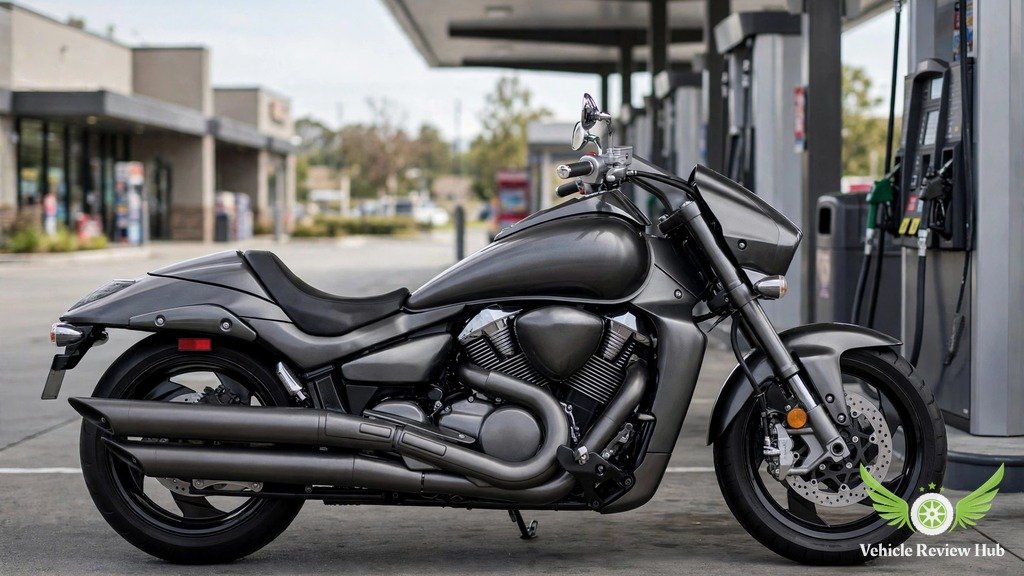
Rider Magazine’s June 2006 road test is the only named, tested fuel-economy figure for the M109R: “our test bike averaged 36.4 miles per gallon.” With the 5.2-gallon tank that implies roughly 189 miles of range — the only range figure this Suzuki Boulevard M109R performance guide prints. The figure is twenty years old, but it is a real test — bike, magazine and number all named. No other magazine MPG test was found, and no owner survey replaces a tested figure — owner reports vary too widely by riding style. Treat 36.4 mpg as the tested average and expect less when the bike is ridden hard.
Suzuki USA Publishes No MPG Figure at All
Suzuki USA publishes no MPG figure for the M109R at all — the 2025 spec table lists the 5.2-gallon tank and no economy number. That silence is why aggregator sites print 30–40 mpg ranges with no source: no official number contradicts them. This Suzuki Boulevard M109R performance guide does not print those ranges, because an unsourced range is not a fact. The only number with a name behind it is Rider’s 36.4 mpg from 2006. A buyer comparing the M109R with a rival should ask for the rival’s tested figure too — if that number is also an aggregator range, the comparison is not a comparison.
Suzuki Boulevard M109R Real-World Riding Experience
On the road, the M109R’s performance is about torque delivery and stability more than peak numbers. The 2006–07 testers praised a linear power curve, a precise gearbox and a chassis that handles better than a 764 lb cruiser should — and complained about the shaft drive’s lash and the hard suspension. This section of the Suzuki Boulevard M109R performance guide puts the dyno numbers next to the riding verdicts.

It Beat the VTX1800 and Vulcan 2000 on the Dyno
On the same Dynojet in the 2007 Godzilla shootout, the M109R made 106.4 hp and 101.3 lb-ft, the Honda VTX1800C made 89.1 hp and 102.25 lb-ft, and the Harley-Davidson CVO Springer made 81.46 hp and 95.58 lb-ft. The Suzuki beat the Honda on horsepower by 17.3 hp — the Honda made slightly more torque, by 0.95 lb-ft — and it beat the Harley on both. The Vulcan 2000 half needs an honest note: the Godzilla article’s dyno chart, where the Vulcan’s and the Roadliner’s figures sit, did not survive text extraction, so the chart itself could not be read. What could be verified is Motorcycle.com’s own earlier Dynojet run of the same bike — the magazine’s 2004 Vulcan 2000 teaser records “a linear and broad 96.4hp and 122.9LbFt” on the MO Dynojet. Against that published figure, the M109R beat the Vulcan 2000 on horsepower by 10 hp (106.4 against 96.4), while the Vulcan made 21.6 lb-ft more torque — the long-stroke 2,053cc engine’s character. So the heading is true on horsepower, and this Suzuki Boulevard M109R performance guide says the torque half plainly too: the Suzuki won on power, the Kawasaki on torque, and neither number came from a different dyno. The Godzilla testers picked the M109R as the bike they would buy — “a real monster” — and it finished a close third overall, behind the Harley and the Kawasaki, on styling and detail rather than performance.
Torque Claims Split: 118, 119 and 120 lb-ft
The M109R’s torque figure comes in three versions — 118, 119 and 120 lb-ft — all Suzuki’s own numbers from different sources, not three different measurements. The 118 lb-ft figure is Suzuki’s specification — 160 Nm converts to 118.02 lb-ft at 3,200 rpm — and the headline figure this Suzuki Boulevard M109R performance guide uses. The 119 lb-ft figure comes from Motorcyclist’s May 2006 first ride, quoting Suzuki’s claim as a “119-lb.-ft. torque peak (claimed).” The 120 lb-ft figure is Wikipedia’s “120 lbf⋅ft (160 N⋅m)” — a loose rounding of the same 160 Nm, not a separate measurement. None of the three is an error; the split is a rounding and sourcing difference, and the honest way to print it is to name all three and use 118 lb-ft at 3,200 rpm as the headline. The dyno torque — 101.3 lb-ft at the rear wheel — is different again: measured after drivetrain loss, not a claim, never to be set beside a claimed figure as though the two were comparable.
Suzuki Boulevard M109R Handling, Braking and Stability
Performance is not only the engine: the M109R’s handling and braking surprised the period testers, and its maintenance schedule is part of the performance story too. This section of the Suzuki Boulevard M109R performance guide covers the brakes the period tests praised, and the checks that keep performance where Suzuki built it.

Period Tests: Radial Four-Piston Front Brakes
The M109R’s brakes are serious hardware: radial-mounted four-piston Tokico calipers on dual 310mm floating front discs, a 275mm rear disc and a dual-piston caliper, behind 46mm inverted front forks with 5.1 inches of travel. The Godzilla testers found the brakes had “more than enough power to overwhelm the front tire,” with only a slightly “wooden” feel at the lever — the long wheelbase and rearward weight bias limit the feel of any brake on a cruiser this heavy. TopSpeed independently confirms the hardware, describing “dual 310 mm discs, and radially mounted monobloc calipers.” One caution: Suzuki’s own 2025 page contradicts itself on the brakes — the marketing copy calls them “radial-mounted”, the features text “dual-piston calipers” — and this Suzuki Boulevard M109R performance guide prints the hardware, radial four-piston, not one side of Suzuki’s copy. There is no ABS on the M109R in any US year — no anti-lock backup on a wet road, a fact a buyer must know before relying on the brakes at their limit. The Suzuki Boulevard M109R review covers the brake contradiction and the missing ABS in full.
Final Drive, Tires, Fork Seals, Brakes and Electrical Checks
Keeping the M109R’s performance where Suzuki built it is mostly about the final drive and the tires. The bike is shaft drive — no chain, no sprockets, nothing to adjust, lubricate or replace on that side. Final-gear oil is replaced once at 600 miles and inspected at 7,500, 11,000 and 14,500 miles, per the service manual chart. The tires are the real performance consumable: owners report 5,000–7,000 miles per rear tire, an owner-forum range, because 106 horsepower at the wheel and a 240-section tire wear quickly together — check pressures (36 psi front, 42 psi rear, cold) and tread before any fast ride. Fork seals deserve a look at every service, brake fluid is replaced every two years and hoses every four, and the electrical checks — charging, starter, lights — are the same inspect-at-every-service items as on any bike. The full service picture, including the oil filter’s 600- and 11,000-mile-only replacement, is in the C50T reliability guide‘s coverage of the line’s maintenance habits.
Suzuki Boulevard M109R Performance Compared With Other Power Cruisers
Against its rivals, the M109R’s performance case is simple: more horsepower for less money, older equipment. The 2025 bike costs $15,799 plus $600 destination, thousands less than the Breakout and the Rocket 3 Storm, and its 123 hp claim outguns the Breakout’s 103 hp — while the Breakout answers with more torque, six speeds and ABS. This section of the Suzuki Boulevard M109R performance guide makes the closest comparison, then asks who the bike is actually for.

| Item | M109R (2025) | Breakout (2026) |
|---|---|---|
| MSRP | $15,799 | $22,999 |
| Destination | $600 | $895 |
| Engine | 1,783cc 54° V-twin, liquid-cooled | 1,923cc Milwaukee-Eight 117 |
| Claimed power | 123 hp @ 6,200 rpm | 103 hp @ 4,800 rpm |
| Claimed torque | 118 lb-ft @ 3,200 rpm | 126 lb-ft @ 3,000 rpm |
| Transmission / drive | 5-speed, shaft | 6-speed, belt |
| Curb weight | 764 lb | 681 lb |
| Seat height | 27.8 in | 25.6 in |
| Rear tire | 240/40R18 | 240/40R18 |
| ABS | None, in any year | Standard |
Suzuki Boulevard M109R vs Harley-Davidson Breakout
The Breakout is the M109R’s closest modern rival, and the comparison is closer than the price gap suggests. The 2026 Breakout costs $22,999 plus $895 destination — $7,200 more than the M109R on MSRP, before the Suzuki’s $600 destination — for a 1,923cc Milwaukee-Eight 117 Custom with 103 hp at 4,800 rpm and 126 lb-ft at 3,000 rpm. On claimed power the Suzuki wins: 123 hp against 103 hp, and the M109R’s only instrumented dyno (106.4 hp at the wheel) beats the Breakout’s claimed crank figure. On torque the Harley wins: 126 lb-ft against 118 lb-ft, and it carries 83 lb less weight (681 lb against 764 lb), with a six-speed gearbox, belt drive and standard ABS where the Suzuki has five speeds, a shaft and no ABS. The two bikes even share the signature detail — both run a 240mm rear tire, the Breakout’s 240/40R18 matching the Suzuki’s exactly, per Harley’s own Breakout page. The Boulevard C50 comparison makes the same value argument at the smaller end of the line. The verdict of this Suzuki Boulevard M109R performance guide: the Suzuki is faster on paper and cheaper by a wide margin, while the Harley is the more modern and more complete motorcycle — and a buyer who wants ABS should not have to think twice.
Is the Suzuki Boulevard M109R Suitable for Beginner Riders? No
No — the M109R is not a beginner’s bike, and this Suzuki Boulevard M109R performance guide says so without hedging. A 764 lb motorcycle with 123 hp claimed and 106.4 hp at the rear wheel, a 240-section rear tire, no ABS, no traction control, no ride modes and a touchy throttle is the wrong machine to learn on. The low 27.8-inch seat flatters shorter riders, but the weight is what a new rider feels at a standstill and in a parking lot, and the shaft drive’s lash and the engine’s instant thrust punish ham-fisted inputs. A beginner who wants the Boulevard look should start with the smaller C50 — the Boulevard C50T review covers the 805cc touring version — and come back with experience. The M109R is for a rider who already knows what 106 horsepower at the wheel feels like and wants it cheap.
Suzuki Boulevard M109R Performance: Frequently Asked Questions
Direct answers to the questions riders ask about Suzuki Boulevard M109R performance — power, speed, mileage and what the numbers mean.
How much horsepower does the Suzuki Boulevard M109R make?
Suzuki’s global claim is 123 hp at 6,200 rpm; the US launch claim in 2006 was 127 hp at the crank. The only instrumented dyno run, Motorcycle.com’s 2007 Godzilla shootout, measured 106.4 hp and 101.3 lb-ft at the rear wheel. TopSpeed prints 128 hp — TopSpeed’s figure, not Suzuki’s.
What is the 0-60 time of the Suzuki Boulevard M109R?
3.89 seconds — the figure this Suzuki Boulevard M109R performance guide uses — from the only instrumented acceleration test — a Popular Mechanics shootout in 2006, reported in Canadian Biker, at 2,800 feet with Danny Coe riding. HotCars estimates 3.65 seconds, but that is an estimate — the instrumented 3.89 seconds governs.
What is the top speed of the Suzuki Boulevard M109R?
No tested top speed exists in this Suzuki Boulevard M109R performance guide’s record — no named GPS or instrumented test was ever published. HotCars estimates 128 mph and aggregators print 125–140 mph, but none of those numbers comes from a test. The only instrumented speed figures are the 2006 quarter mile: 12.08 seconds at 110.53 mph.
What is the quarter-mile time of the Suzuki Boulevard M109R?
12.08 seconds at 110.53 mph — the acceleration record in this Suzuki Boulevard M109R performance guide — from the Popular Mechanics shootout in 2006. In the same test the Rocket III ran 11.99 seconds at 111 mph, and the Night Rod Special’s 4.26-second 0–60 was third-best in the group.
What MPG does the Suzuki Boulevard M109R get?
Rider Magazine’s June 2006 road test averaged 36.4 mpg — the only named, tested economy figure in this Suzuki Boulevard M109R performance guide. Suzuki USA publishes no MPG figure at all, and aggregator ranges of 30–40 mpg have no source behind them.
How far can the Suzuki Boulevard M109R go on a tank?
Roughly 189 miles: the 5.2-gallon tank multiplied by Rider’s tested 36.4 mpg. Expect less when the bike is ridden hard.
Did the Suzuki Boulevard M109R beat the VTX1800 and Vulcan 2000 on the dyno?
On horsepower, yes. On the same Dynojet in the 2007 Godzilla shootout, the M109R made 106.4 hp against the VTX1800C’s 89.1 hp and the CVO Springer’s 81.46 hp. Against the Vulcan 2000, Motorcycle.com’s own Dynojet figure for the same bike is 96.4 hp — the M109R beat it by 10 hp, while the Vulcan made more torque, 122.9 lb-ft against 101.3 lb-ft. Note: the Godzilla article’s dyno chart itself could not be read, so the Vulcan comparison uses Motorcycle.com’s published Dynojet figure, not a chart reading.
Why do torque figures for the Suzuki Boulevard M109R say 118, 119 and 120 lb-ft?
All three are Suzuki’s own numbers from different sources. 118 lb-ft is the specification (160 Nm at 3,200 rpm) and the headline figure. 119 lb-ft is Motorcyclist’s May 2006 quote of Suzuki’s claim. 120 lb-ft is Wikipedia’s loose rounding of the same 160 Nm. None is an error.
Does the Suzuki Boulevard M109R have ABS?
No — and this Suzuki Boulevard M109R performance guide is blunt about it: no ABS was ever offered on the US M109R, in any model year. The bike stops with dual 310mm front discs and a 275mm rear disc, with no anti-lock backup. Any guide claiming ABS was standard or optional after 2012 is wrong.
Is the Suzuki Boulevard M109R faster than the Harley-Davidson Breakout?
On claimed power, yes: the M109R claims 123 hp against the Breakout’s 103 hp, and its only instrumented dyno (106.4 hp at the wheel) is higher than the Breakout’s claimed crank figure. On torque the Breakout wins, 126 lb-ft against 118 lb-ft, and it is 83 lb lighter with a six-speed gearbox and standard ABS. The Suzuki costs $7,200 less on MSRP.
Is the Suzuki Boulevard M109R good for beginners?
No. This Suzuki Boulevard M109R performance guide is blunt: at 764 lb with 123 hp claimed, no ABS, no traction control and no ride modes, it is too much bike to learn on. The low 27.8-inch seat is inviting, but the weight and the instant thrust are not. Start with the smaller Boulevard C50 and come back to the M109R with experience.
How often does the Suzuki Boulevard M109R need an oil change?
Engine oil is replaced at 600, 4,000, 7,500, 11,000 and 14,500 miles, per the service manual chart this Suzuki Boulevard M109R performance guide follows. The oil filter is replaced ONLY at 600 and 11,000 miles — not with every oil change. Valves are inspected only at 14,500 miles, plugs are replaced at 7,500 and 14,500 miles, and final-gear oil is replaced once at 600 miles and inspected after that.