The short answer to this Suzuki Burgman 400 reliability question is that the bike is a proven long-distance design with a short list of known faults: a 2007 clutch squeal that Suzuki fixed for 2008, a regulator/rectifier recalled twice, and a drive belt that must be replaced every 14,500 miles. Five NHTSA recalls cover three generations, and the 2026 bike is affected by none of them. The rest of this Suzuki Burgman 400 reliability guide is the schedule, the wear items and the checks that keep one running.
Suzuki Burgman 400 Reliability Overview
Suzuki has sold the Burgman 400 in three generations since 2003, and the basic design has barely changed: a liquid-cooled 399cc single, a CVT with a V-belt, and a steel frame. Parts knowledge is deep and most of what goes wrong is already known. This Suzuki Burgman 400 reliability overview starts with the honest picture: a long-lived scooter with a short list of faults, a belt that is the big wear item, and a service chart that rewards owners who follow it.
A 90,000-Mile Original Engine Exists
Owners on forums sometimes mention a Burgman 400 with 90,000 miles on its original engine, and the story gets repeated as proof the bike lasts forever. No named source confirms it. Searches for a 90,000-mile Burgman 400 original-engine story return no magazine test, no dealer record and no owner post with a verifiable bike behind it — so this Suzuki Burgman 400 reliability guide treats the figure as unverified forum lore, not a fact. Verified longevity is the design itself: the same layout has run since 2003. The honest evidence is the service record, not a round number from a forum thread.
How Mileage, Storage and Previous Care Affect Reliability
Mileage alone tells you little about a used Burgman 400. A 30,000-mile bike with a belt changed at 14,500 miles and oil changed every 4,000 is a better buy than a 12,000-mile bike that sat in a garage for three years with old fuel and a flat battery. Storage matters too: a bike stored dry with a battery tender ages far better than one left outside. Previous care matters most — ask for the service records and check the belt change and the recall history. Mileage, storage and previous care are the three variables this Suzuki Burgman 400 reliability guide checks first.
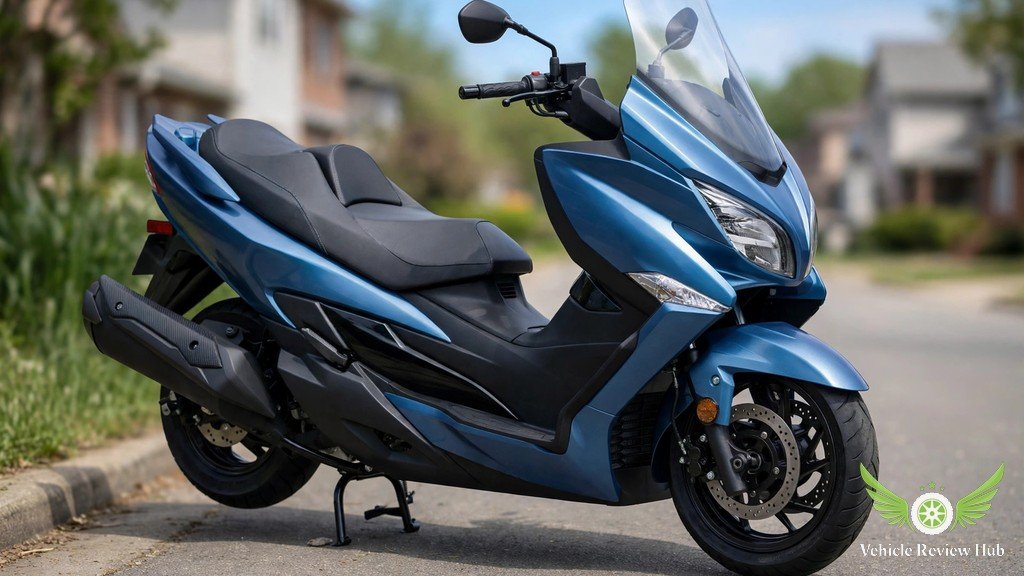
Suzuki Burgman 400 Common Problems and Wear Items
The Burgman 400’s fault list is short, and that is the point of this Suzuki Burgman 400 reliability section: most of what can go wrong is one of three things — the 2007 clutch, the regulator/rectifier, or the drive belt. The rest is routine wear.
The 2007 Clutch Squeal, Fixed for 2008
The 2007 Burgman 400 had a clutch problem owners knew by sound: a loud squeal on take-off, and a clutch that sometimes grabbed. NHTSA complaint ODI 10221197 records the clutch “loudly squealed upon start” and “grabbed”, and notes Suzuki “has replaced the clutch for the 2008 model” with different part numbers for 2007, “clearly indicating a redesign.” The updated parts are clutch housing 21220-05H02 and clutch assembly 21501-05H10. No recall was ever issued — it was a running change. The buyer check is simple: a 2007 bike that still squeals probably still has the original clutch. That is the whole clutch story in this Suzuki Burgman 400 reliability guide: a 2007 fault, a 2008 fix, no recall.
Rollers Are Inspected, Not Scheduled
The variator rollers — the CVT weights that control how the belt rides — have no replacement interval in the factory chart. That surprises owners who expect a mileage number, but it is how Suzuki wrote the chart: rollers are inspected during CVT work and replaced on condition — wear, flat spots or noise. There is no “replace rollers every X miles” row to follow. Aftermarket rollers exist — Dr Pulley sliders are a popular replacement, shown being fitted in the video below — but they are an owner modification, not a factory schedule item. The roller rule in this Suzuki Burgman 400 reliability guide is simple: inspect during CVT work, replace on condition.
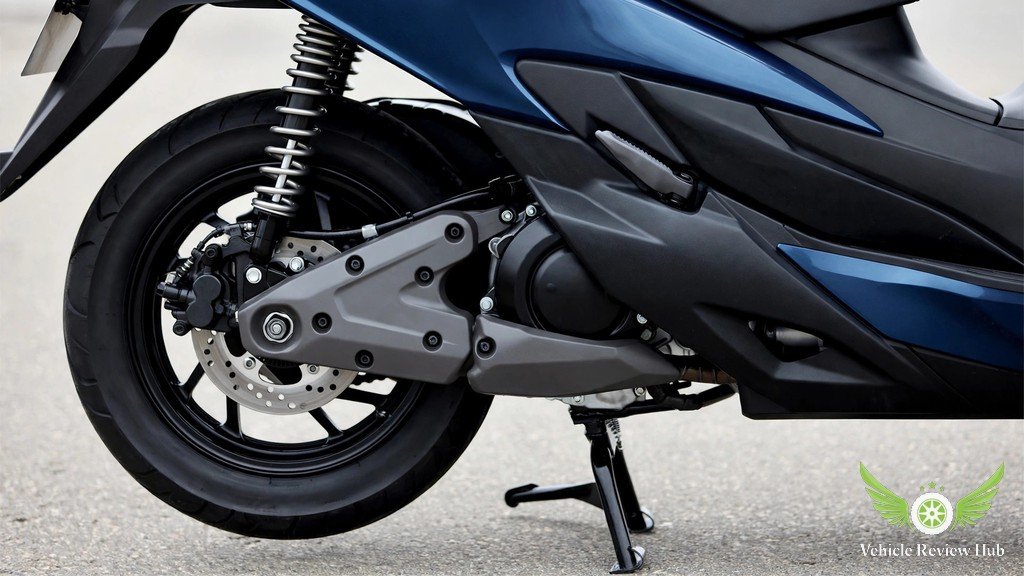
Suzuki Burgman 400 Maintenance Schedule and Servicing
The Burgman 400’s service schedule comes from the factory periodic-maintenance chart, and this Suzuki Burgman 400 reliability section prints it as Suzuki wrote it — intervals at 600, 4,000, 7,500, 11,000 and 14,500 miles. One caveat: it is the 2003 factory manual’s chart, and the 2018-and-later chart was not directly obtained. The interval structure is corroborated across generations, so the chart is presented as the factory schedule whose intervals carried across generations, with any 2018-specific change flagged as unverified.
The video below is a US owner-service video from Mitch’s Scooter Stuff, showing the drive belt and CVT parts being inspected on a Burgman 400, plus a Dr Pulley sliders and Malossi clutch upgrade. The sliders and clutch parts are aftermarket upgrades, not factory parts — the belt inspection is the part that matches this guide.
Belt Replacement Every 14,500 Miles
The drive V-belt is the Burgman 400’s big wear item, and the factory chart is unambiguous: inspect it at 7,500 miles and replace it at 14,500 miles. A belt that snaps strands the bike; a worn belt slips and costs performance. The 14,500-mile service is the expensive one in this bike’s life, and the first thing to check on any used bike. Do not carry the Burgman 200’s belt part number into a 400 service — the 200’s belt is a different part. The belt is the single most important wear item in this Suzuki Burgman 400 reliability guide — miss it and the bike strands you.
Valve Inspection at the Same Interval
Valve clearance is inspected at every service interval — initially at 600 miles and every 4,000 miles after that — so 14,500 miles is also a valve-inspection point, but it is not the only one. That is the point of this heading: the valve is checked every 4,000 miles, not only at the belt change. The cold clearances are 0.08–0.13 mm on the intake valves and 0.17–0.22 mm on the exhaust valves. It is a labour-heavy job — the throttle body and airbox come off — which is why it is often the most expensive line on a routine service. The valve check is the service this Suzuki Burgman 400 reliability guide flags as the labour-heavy one.
| Item | Interval |
|---|---|
| Drive V-belt | Inspect at 7,500 miles; replace at 14,500 miles |
| Valve clearance | Inspect every 4,000 miles (first at 600 miles) |
| Engine oil | Replace every 4,000 miles (first at 600 miles) |
| Oil filter | Replace at 600 miles, then every 11,000 miles |
| Final-drive oil | Replace every 7,500 miles |
| Spark plug | Inspect at 4,000 miles; replace 7,000 miles (manual text) / 7,500 miles (chart) — conflict, both printed |
| Air cleaner | Clean every 1,800 miles |
| Coolant and brake fluid | Replace every 2 years |
| Fuel, radiator and brake hoses | Replace every 4 years |
Notes for this Suzuki Burgman 400 reliability table: the intervals are from the 2003 factory service manual’s periodic-maintenance chart, whose interval structure is corroborated across generations; the 2018-and-later owner’s-manual chart was not directly obtained. The spark-plug replacement interval conflicts inside the manual itself — the text says 7,000 miles, the chart shows replacement at 7,500 miles — so both figures are printed and neither is settled here. Valve clearance is inspected every 4,000 miles, not only at 14,500 miles. The standard plug is NGK CR7E, gap 0.7–0.8 mm; idle speed is 1,400 ± 100 rpm.
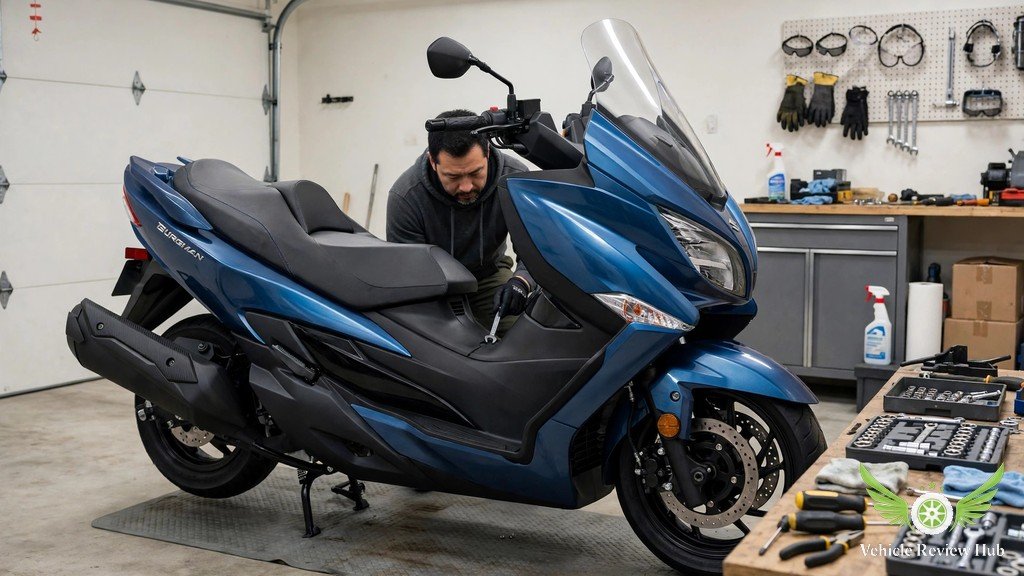
Suzuki Burgman 400 Tires, Brakes and Suspension Maintenance
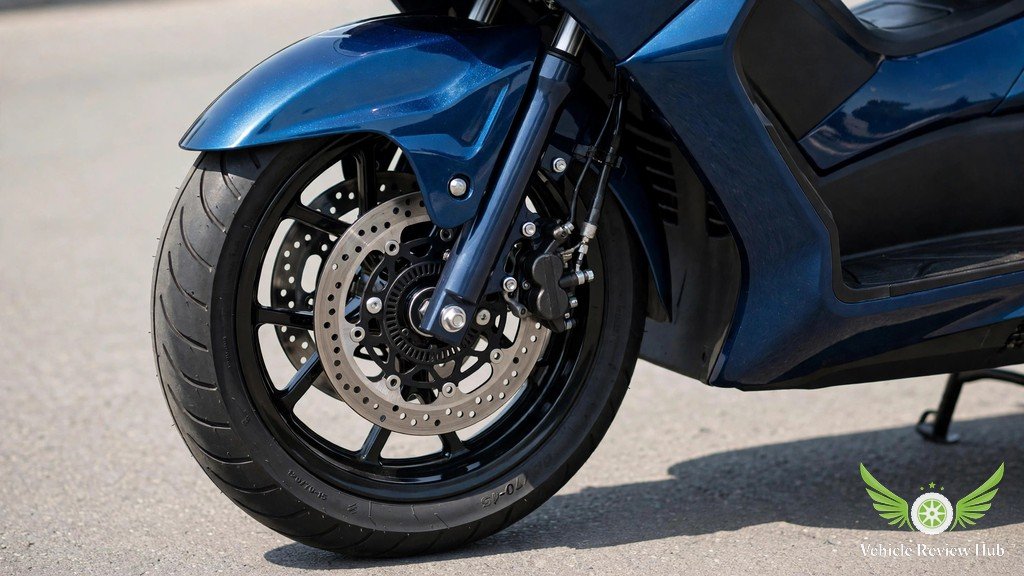
Tyres, brakes and suspension are the routine side of Burgman 400 ownership — inspected at every service, replaced on condition, and cheap compared with the belt service. Tyres are 120/70-15 front and 150/70-13 rear, with no factory tyre-life figure — check date codes and tread. Brakes are twin 260 mm front discs and a single 210 mm rear disc with ABS; fluid every two years, hoses every four, pads on condition. Suspension is a telescopic fork (4.3 inches of travel) and a link-type single rear shock, inspected at 7,500 and 14,500 miles. This Suzuki Burgman 400 reliability section covers the three items the headings call out: the oil and filter rhythm, and the final-drive oil that owners most often forget.
Oil Every 4,000 Miles, Filter Every Third
Engine oil is replaced every 4,000 miles from 600 miles — the simplest interval on the chart. The oil filter is not replaced at every oil change: the chart shows it replaced at 600 miles and then every 11,000 miles, which is the first and fourth oil changes. The heading’s “every third” is loose shorthand — this guide prints the chart rows instead: filter at 600 miles, then every 11,000 miles. Oil capacity is about 1,900 ml for a change, about 2,000 ml with a filter, and about 2,300 ml for an overhaul (API SF or SG SAE 10W-40). That 11,000-mile filter rhythm is the detail this Suzuki Burgman 400 reliability guide prints instead of the shorthand.
Final-Drive Oil Every 7,500 Miles
Final-drive oil is replaced every 7,500 miles (12,000 km or 12 months). It is a small job: about 190 ml of SAE 10W-40 SF or SG for an oil change, about 200 ml for an overhaul. It is also the job owners forget, because the final drive sits out of sight and gives no warning when its oil is old. Final-drive oil is the forgotten service in this Suzuki Burgman 400 reliability guide — small, cheap and easy to skip.
Suzuki Burgman 400 Maintenance and Ownership Costs
The Burgman 400 is a cheap bike to run and an expensive bike to buy — that is the ownership-cost story in one sentence. Fuel is the smallest cost, the belt service is the biggest. This Suzuki Burgman 400 reliability section puts numbers on what can be numbered and says plainly what cannot: no verified US parts prices were found for the belt, filter, plug, tyres or pads, so none are printed here.
Fuel, Routine Servicing, Tires and Replacement Parts
Fuel costs about 50 mpg in real-world riding — Rider Magazine averaged 50.2 mpg over three fill-ups — about 180 miles from the 3.6-gallon tank. Routine servicing follows the chart: oil every 4,000 miles, filter every 11,000, final-drive oil every 7,500, valves every 4,000, fluids every two years, hoses every four. The belt service at 14,500 miles is the big-ticket item, and the valve check is the labour-heavy one. No dealer service price was verified for this guide, so budget by the schedule — and get a quote before the 14,500-mile service, not after it. Fuel and routine servicing are the cheap half of this Suzuki Burgman 400 reliability guide’s ownership picture.
Five Recalls Across Three Generations
Five NHTSA recalls cover three generations, filed under the model code AN400 — a search for “Burgman 400” returns nothing, which is how they get missed. The 2004 bike had an ignition-switch recall (05V372000): a switch base that could arc and melt, stalling the engine and killing the lights. The 2008–2010 bikes were recalled for the regulator/rectifier (11V108000), then the 2008–2012 bikes were recalled for the same component again (16V018000) — so 2008–2010 bikes were recalled twice for the rectifier, not double-counted. The 2012 brake-light-switch recall (12V038000) carries a date typo in the NHTSA text: it says the recall began February 13, 2011, but the report was received February 3, 2012. The newest recall is the fuel-hose recall (24V923000) for 2023–2025 bikes — the fuel supply hose can contact the fuel vapor hose, a fire risk. The 2026 bike is affected by none of them (NHTSA Count:0). Five recalls is a lot to remember, and this Suzuki Burgman 400 reliability guide keeps them in the table below so a buyer can check a bike by its year.
| Recall | Years | Subject |
|---|---|---|
| 05V372000 | 2004 | Ignition switch — arcing/melting base; stall and lights out |
| 11V108000 | 2008–2010 | Regulator/rectifier — insufficient adhesion; battery discharge and stall |
| 16V018000 | 2008–2012 | Regulator/rectifier again — overlaps 11V108000 for 2008–2010 bikes |
| 12V038000 | 2012 | Brake-light switch — NHTSA date typo in the recall text |
| 24V923000 | 2023–2025 | Fuel supply hose contacting fuel vapor hose — fire risk |
Notes for this Suzuki Burgman 400 reliability table: the recalls are filed under the model code AN400 — a search for “Burgman 400” returns nothing. The 2026 bike is affected by none of them (NHTSA Count:0 for 2026). Recall unit counts were not in the NHTSA responses, so none are printed here.
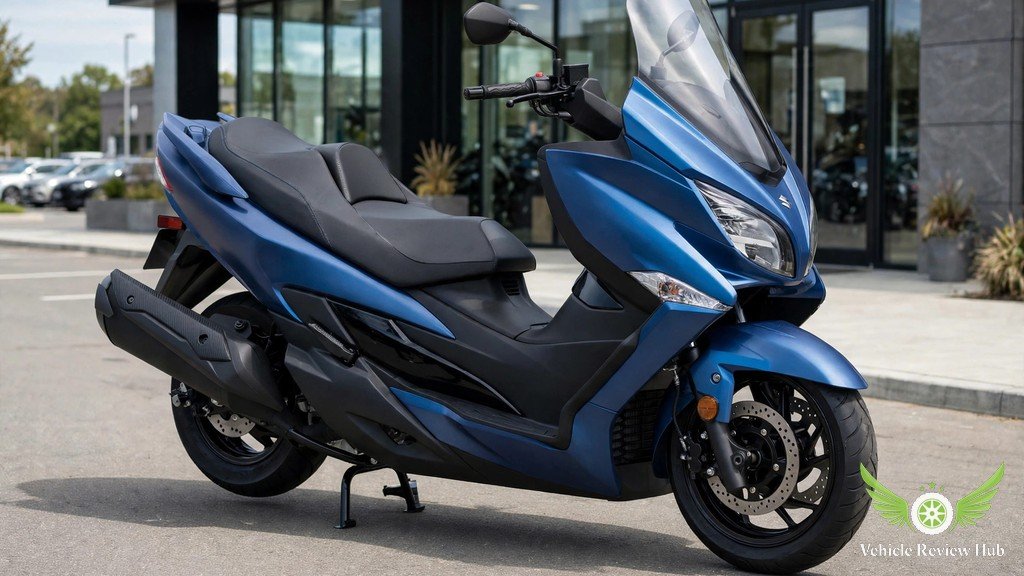
How to Keep a Suzuki Burgman 400 Reliable
Keeping a Burgman 400 reliable is mostly following the chart and keeping the paperwork. This Suzuki Burgman 400 reliability section is the short version: the schedule, the records, and the fuel-pump extension mix-up that catches buyers out.
Preventive Maintenance, Records and Regular Inspections
Preventive maintenance means three things: follow the chart, keep the records, inspect regularly. Keep the records — a stamped service book or a folder of receipts is worth money at sale time, and the only way a buyer can tell whether the belt was actually changed. Inspect regularly — check the belt at 7,500 miles, listen for the 2007 clutch squeal, watch for a battery that will not hold charge, and check the tyres’ date codes as well as their tread. That is the preventive-maintenance rule in this Suzuki Burgman 400 reliability guide: follow the chart, keep the records, inspect regularly.
Fuel-Pump Extension Belongs to the 200
The fuel-pump warranty extension belongs to the Burgman 200, not the 400 — the easiest mistake in this bike’s paperwork. Campaign 2M99, under Suzuki bulletin GV/AN/UH No. 059, covers the 2014–2022 Burgman 200 for ten years with unlimited mileage, for a fuel-pump leak. It does not cover the Burgman 400 at all. The 400’s fuel-system issue is different: the 24V923000 recall for 2023–2025 bikes, where the fuel supply hose can contact the fuel vapor hose — a recall, not an extension, and a hose, not a pump. The extension mix-up is the paperwork trap this Suzuki Burgman 400 reliability guide warns buyers about most.
| Year | Complaints | Detail |
|---|---|---|
| 2006 | 7 | Valve stem detached at 70 mph; cracked front and rear rotors; fuel squirting from tank cap; engine smoking |
| 2007 | 1 on record | Clutch squeal (ODI 10221197) — the complaints API shows 0, but the complaint exists |
| 2012 | 2 | Recall-notice delay; speedometer 8–10% error, GPS-verified |
| All other years 2003–2026 | 0 | Per the NHTSA complaints API |
Notes for this Suzuki Burgman 400 reliability table: the NHTSA complaints API shows zero complaints for 2007, but a 2007 clutch complaint (ODI 10221197) is on record via the ODI database — so this guide does not claim zero 2007 complaints. One 2006 complaint about a Guang Dong Tayo “Omicron” was misfiled under the Burgman and is excluded here.

Suzuki Burgman 400 Reliability: Frequently Asked Questions
Direct answers to the Suzuki Burgman 400 reliability questions buyers ask most.
How reliable is the Suzuki Burgman 400?
Very, with a short list of known faults. The design has run since 2003, complaints are low — seven in 2006, two in 2012, zero in most years — and the 2026 bike has no recall. The faults to know are the 2007 clutch squeal, the twice-recalled regulator/rectifier and the drive belt, which is a wear item rather than a fault. This Suzuki Burgman 400 reliability guide calls it a long-lived scooter that rewards owners who follow the service chart — and the full Burgman 400 review covers the price and riding experience behind that verdict.
When should the drive belt be replaced?
Every 14,500 miles, with an inspection at 7,500 miles — the factory chart’s interval, and the big-ticket service in this bike’s life. A belt that snaps strands the bike, so a used bike at 14,000 miles without a belt change is about to need one. This Suzuki Burgman 400 reliability guide treats the belt as the first thing to check on any used example, and the interval is straight from the 2003 factory service manual chart.
How often should the oil be changed?
Every 4,000 miles from 600 miles, about 1,900 ml of API SF or SG SAE 10W-40 (about 2,000 ml with a filter change). The filter is replaced at 600 miles and then every 11,000 miles, not at every oil change — the interval this Suzuki Burgman 400 reliability guide prints.
Does the Burgman 400 have any recalls?
Five, across three generations, filed under AN400: 2004 ignition switch, two regulator/rectifier recalls (2008–2012), 2012 brake-light switch and 2023–2025 fuel hose. The 2008–2010 bikes were recalled twice for the rectifier. This Suzuki Burgman 400 reliability guide lists all five in the recalls table above.
Is the 2026 Burgman 400 affected by any recall?
No. NHTSA shows Count:0 for 2026, and the newest recall (24V923000, fuel hose) covers 2023–2025 bikes only. A 2026 buyer should still check the bike’s own history, but there is no open recall on the model year — one of the strongest points in this Suzuki Burgman 400 reliability guide. The Suzuki USA page lists the 2026 bike’s full specification and its 12-month limited warranty.
What is the 2007 clutch squeal?
A loud squeal on take-off, sometimes with the clutch grabbing, on the 2007 bike (NHTSA complaint ODI 10221197). Suzuki fixed it for 2008 with updated parts (housing 21220-05H02, assembly 21501-05H10). No recall was issued. A 2007 bike that still squeals probably still has the original clutch — the check this Suzuki Burgman 400 reliability guide puts first on a 2007.
How often do the valves need checking?
Every 4,000 miles from 600 miles — not only at the 14,500-mile belt change, though 14,500 miles is also a valve-inspection point. Cold clearances are 0.08–0.13 mm intake and 0.17–0.22 mm exhaust. The throttle body and airbox come off, so it is the costliest line on a routine service in this Suzuki Burgman 400 reliability guide’s schedule.
Does the fuel-pump warranty extension cover the Burgman 400?
No. Campaign 2M99 covers the 2014–2022 Burgman 200 only, for ten years with unlimited mileage. The 400’s issue is the 24V923000 fuel-hose recall for 2023–2025 bikes — a recall, not an extension, and a hose, not a pump. Anyone citing the extension for a 400 is confusing the two bikes, and this Suzuki Burgman 400 reliability guide keeps the two apart for exactly that reason.
What tyres does the Burgman 400 use?
120/70-15 front and 150/70-13 rear, inspected at every service. There is no factory tyre-life figure, so check the date codes as well as the tread — a tyre with plenty of tread but a 2019 date code is one to replace. This Suzuki Burgman 400 reliability guide treats date codes as part of every used-bike check.
How much does it cost to maintain a Burgman 400?
Fuel is the smallest cost — about 50 mpg, roughly 180 miles per tank. Routine servicing follows the chart, and the belt service at 14,500 miles is the big-ticket item. No verified US parts prices were found, so this Suzuki Burgman 400 reliability guide prints none — get a quote before the 14,500-mile service, not after it. The 2026 bike costs $8,949 plus $600 destination, or $9,549 delivered, according to the TotalMotorcycle 2026 guide.
Is a used Burgman 400 a good buy?
Yes, with records. The design is long-lived, the faults are known and mostly fixed, and complaints are low. The checks are the belt, the clutch on a 2007, the rectifier recalls on a 2008–2012 bike and the fuel-hose recall on a 2023–2025 bike. A bike with records and a fresh belt is the one to buy in this Suzuki Burgman 400 reliability guide’s judgement — and the performance guide covers the 90 mph indicated top speed and 50.2 mpg economy behind that judgement.
What should I check before buying a used Burgman 400?
Service records first — belt at 14,500 miles, oil and valves every 4,000. Then the recalls: ignition switch (2004), rectifier (2008–2012), brake-light switch (2012), fuel hose (2023–2025). Then the bike itself: clutch squeal on a 2007, a battery that will not hold charge, tyre date codes, and whether the bike actually has traction control — 2018–2021 bikes have ABS but no traction control, and listings still get that wrong. The smaller Burgman 200 has its own fault list, covered in the Burgman 200 reliability guide — the year check this Suzuki Burgman 400 reliability guide repeats because it costs buyers money.