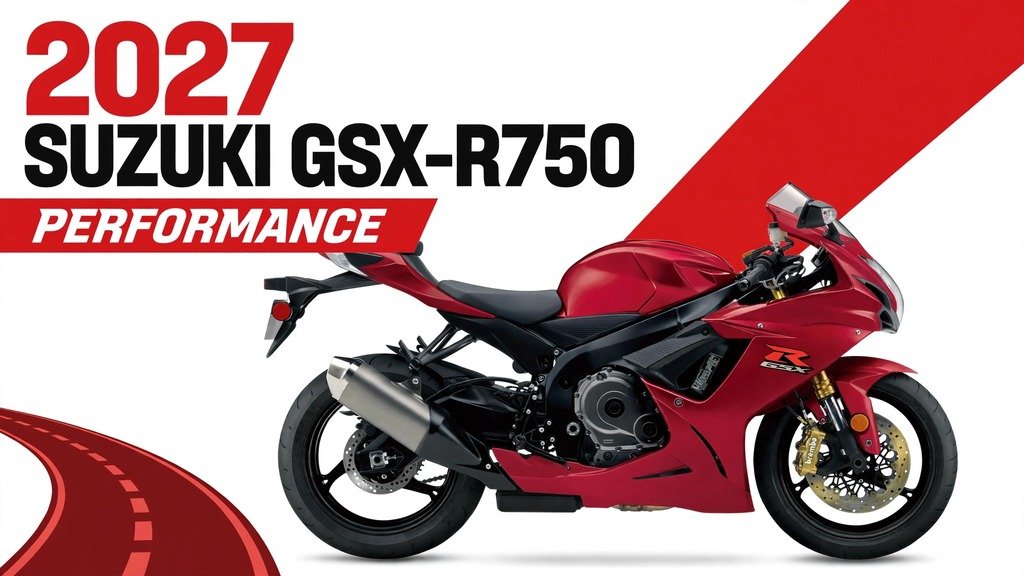
The short answer first: the 2027 Suzuki GSX-R750 makes 120.5 to 127 horsepower at the rear wheel on named dyno tests, tops out at a GPS-confirmed 181 mph on a UK test, returns about 39 miles per gallon on MCN’s long-term test, and runs a compiled 10.58-second quarter-mile at 138 mph. Those numbers come from a bike mechanically unchanged since 2011 — no ABS, no traction control, no quickshifter — that still costs $14,299 delivered. This Suzuki GSX-R750 performance guide says plainly which figures are measured and which are compiled, and explains why the most powerful bike in its shootouts still finished third in the 2025 Next Gen test.
Suzuki GSX-R750 Engine Performance and Power Delivery
The engine is a 749cc liquid-cooled inline-four, 70.0 mm by 48.7 mm, 12.5:1 compression, with titanium valves, a close-ratio six-speed gearbox and a wet multi-plate slipper clutch. Suzuki publishes no horsepower or torque figure for it — nothing in the 2027 brochure — so every power number in this Suzuki GSX-R750 performance guide comes from a named dyno test, labelled with the year and the bike it was measured on.
The video below is Chaseontwowheels’ first ride of the 2022 bike — not a dyno test and not a top-speed run. It shows what the 750 feels like on the road: the midrange pull, the light steering and the analogue character no dyno chart can show.
Cycle World Dynos: 127, 125.9 and 121.5 HP
Three Cycle World dyno runs, on three different years of the same bike, tell the whole story. The August 2011 “Big Mids” comparison measured 127 hp on a Dynojet, just under 13,000 rpm, with a flat plateau from about 5,000 rpm to the 14,500 rpm limiter. The 2014 bike measured 125.9 hp at 12,700 rpm and 55.2 lb-ft at 11,050 rpm. The most recent named run, on a 2022-model bike, measured 121.5 hp at 12,560 rpm and 53.0 lb-ft at 10,840 rpm — call it the 2022-model dyno run, never “the 2023 re-test”, because no 2023 date is confirmed for it. Other named tests sit in the same band: Cycle News 126.65 hp in 2013, Motorcycle.com 120.5 hp in 2011, 121.2 hp with 52.8 lb-ft in its 2013 Oddball test, and 121.7 hp in the 2025 Next Gen test. The honest rear-wheel range is roughly 120 to 127 hp. The 2011 launch release quoted 147.9 crankshaft horsepower at 13,200 rpm, and spec databases list about 86.3 Nm, roughly 64 lb-ft, at 11,200 rpm — both crank figures, never rear-wheel measurements.
| Test | Bike | Rear-wheel horsepower | Rear-wheel torque |
|---|---|---|---|
| Cycle World “Big Mids” | 2011 | 127 hp | Not stated |
| Cycle World dyno run | 2014 | 125.9 hp @ 12,700 rpm | 55.2 lb-ft @ 11,050 rpm |
| Cycle World dyno test | 2022 model | 121.5 hp @ 12,560 rpm | 53.0 lb-ft @ 10,840 rpm |
| Cycle News shootout dyno | 2013 | 126.65 hp @ 12,600 rpm | 55.52 lb-ft |
| Motorcycle.com track shootout | 2011 | 120.5 hp | Not stated |
| Motorcycle.com Next Gen shootout | 2025 | 121.7 hp @ 11,900 rpm | 55.8 lb-ft @ 10,400 rpm |
MCN’s UK Figure Near 135 Conflicts: Label It
MCN’s 2011–2018 review says to “expect to see around 135bhp at the back wheel” — and that number conflicts with every named measurement, so it has to be labelled for what it is: an expectation, not a test result. MCN’s own measured figures sit inside the same 120 to 127 hp band — a K8 bike measured 133 bhp at the rear wheel. The 2011 launch release’s 147.9 hp at 13,200 rpm is a Suzuki-quoted crankshaft number; TopSpeed’s “around 150 hp” is its own estimate, never printed here as a Suzuki claim.
Suzuki GSX-R750 Top Speed and Acceleration
Top speed is the figure buyers ask about most and the one with the thinnest evidence: exactly one instrumented top-speed figure exists for the 2011-on bike, recorded in Italy, not the USA, and no instrumented quarter-mile test exists at all. This Suzuki GSX-R750 performance guide keeps measured and compiled figures separate, because mixing them is how the 750 ends up credited with speeds it never measured.

No US Instrumented Quarter-Mile Test Exists
No US instrumented quarter-mile or top-speed test of the 2011-on GSX-R750 was found in searches of Motorcycle.com’s 2011 shootouts, Cycle World’s August 2011 comparison and general web search — and that absence is stated as a search result, not as proof that no test was ever conducted. The only instrumented quarter-mile of any GSX-R750 is Cycle World’s 1998 bike: 10.61 seconds at 131.61 mph, with a 167.7 mph top speed — a different generation, not a number that belongs on the 2011-on bike. What the 2011-on bike does have is a compiled figure: MotoStatz lists 10.58 seconds at 138 mph, updated in October 2024, and that is an aggregator compilation, not a test. Other aggregators disagree — 10.7 seconds in one place, 10.39 seconds at 136.38 mph in another. HotCars’ “2.9 second” 0–60 mph is a compiled claim in the same way, never a test result.
181 MPH Was a UK Bike at Nardò, Not a US Test
The 181 mph figure is real and specific: MCN, summer 2013, at the Nardò bowl in Italy, GPS-confirmed 181 mph on a bone-stock GSX-R750, with the tester holding full throttle for seven miles around the eight-mile bowl. It was a UK bike, on an Italian test track, and it beat the MV Agusta F3 800 and the Ducati 848 Evo Corse SE in the same test. MCN’s own spec box lists a generic 175 mph, and MCN’s 2025 retrospective says 182 mph — the original GPS figure is 181. Reddit reports of up to 186 mph are speedo-indicated, not GPS. Compiled top speeds sit lower: 168 mph from motorcyclespecs.co.za, 173 mph from Devitt, 170 mph from Bennetts.
| Figure | Value | Basis |
|---|---|---|
| Top speed | 181 mph | MCN Nardò GPS run, 2013, UK bike |
| Top speed, compiled | 168–175 mph | Aggregator band, not a test |
| Quarter-mile | 10.58 sec @ 138 mph | MotoStatz compilation, not a test |
| Quarter-mile, other aggregators | 10.39–10.7 sec | Aggregator band, not a test |
| 0–60 mph | 2.9 sec (compiled claim) | HotCars compilation, not a test |
Suzuki GSX-R750 Mileage and Fuel Economy
Fuel economy is the 750’s least-tested number: Suzuki publishes no MPG figure for the bike, and motorcycles are exempt from EPA fuel-economy testing. Every MPG number in this Suzuki GSX-R750 performance guide is third-party, and each one is labelled with whose it is and what kind of gallon it uses, because the Imperial-gallon figures look 20 percent better than the US-gallon ones and the two get mixed up constantly.
MCN Long-Term MPG: 39
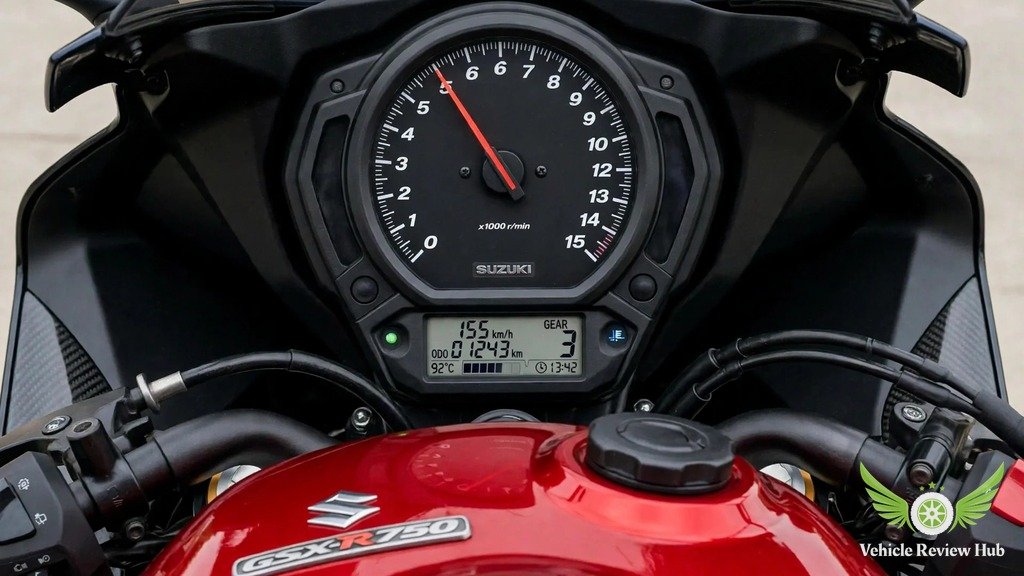
The only long-term fuel figure with a real test behind it comes from MCN. Senior Road Tester Michael Neeves lived with a GSX-R750 L1 for most of 2011, covering more than 10,000 miles, and MCN’s spec box lists average fuel consumption of 39 mpg with a 147-mile tank range. That 39 is Imperial gallons — about 32.5 US mpg — and it has to be labelled that way, because the heading that once read “Motorcyclist Long-Term MPG: 33” named the wrong magazine entirely: no Motorcyclist long-term GSX-R750 test exists. The “33” was most plausibly a US-gallon conversion of MCN’s 39 Imperial mpg. Other labelled figures sit in the same band: Ultimate MotorCycling averaged about 40 mpg, Bennetts lists 41 mpg, and Devitt lists 51 mpg Imperial, with owners reporting 36 to 65 mpg.
Suzuki Publishes No MPG Figure
Suzuki publishes no MPG figure for the GSX-R750 — the 2027 brochure and the Suzuki USA specs page list no horsepower, no torque and no fuel economy. The closest thing to an official figure is an EPA estimate of 41.5 US mpg for the 2016–2019 bikes, 42.5 for 2013, carried by MotorcycleDB — an estimate, not a rating. That leaves the buyer with the third-party band: roughly 39 mpg Imperial from MCN, about 40 mpg from Ultimate MotorCycling, and 41 mpg from Bennetts — three independent sources landing within two mpg of each other. None of those figures promises a range: read them as “about 150 to 180 miles between fill-ups”.
Suzuki GSX-R750 Real-World Riding Experience
On the road, the 750’s performance is defined by one thing: midrange. The 600 needs revs to make power; the 750 makes its power everywhere. That is the difference a rider feels in the first mile. The numbers below explain the feeling — the measured power gap over the 600, the compiled acceleration figures, and the shootout results.

20 HP Over the 600 for $400 More, in 2011
The “20 HP” figure is a measured rear-wheel gap, and the year matters as much as the number. Motorcycle.com’s 2011 dyno pair put the 750 at 120.5 hp against the 600’s 102.2 hp at 13,700 rpm — 18.3 hp, rounded in the magazine’s own words to “nearly 20 hp and 9 ft-lbs more than the GSX-R600”. The claimed crankshaft gap is bigger — 148 hp against 123 hp — but crank figures are not what reaches the road. In 2011 that measured 20 hp cost $400: the 750 launched at $11,999 against the 600’s $11,599, and Motorcycle.com called the 750 “a stupid-good deal”. Sixteen years later the same 20 hp costs $1,050 delivered — the 2027 750 is $14,299 against the 2027 600’s $13,149 — and that is the 750’s value problem in one sentence. The GSX-R600 performance guide works through the smaller bike’s dyno numbers in full.
Compiled Figures: 10.58 at 138, Labelled Compiled
The quarter-mile figure that follows this bike around is 10.58 seconds at 138 mph, a MotoStatz compilation from July 2021, updated in October 2024 — not a test result, and it has to be labelled that way every time it appears. Other aggregators list 10.39 to 10.7 seconds, and MCN’s 2000–2003 page lists 10.8 seconds for a different generation entirely. The same labelling applies to the 0–60 mph claim: HotCars’ 2.9 seconds is a compiled claim, never a test result. What is measured is the shootout evidence: the 750 won the 2011 Motorcycle.com track shootout, won Cycle World’s August 2011 “Big Mids” comparison with the fastest lap, and won the 2013 Oddball power contest at 121.2 hp against the ZX-6R’s 113.3 and the Daytona 675R’s 110.8.
Suzuki GSX-R750 Handling, Braking and Stability
The 750 handles like a 600 and stops like a litre bike — the reason it won shootouts it had no business winning on paper. The chassis is the 600’s, the brakes are Brembo monoblocs shared with the 600, and the suspension is a fully adjustable Showa Big Piston Fork with a fully adjustable single Showa shock. The one honest weakness is the brake lines: the 750 is the only bike in its 2011 shootout trio with rubber lines instead of steel-braided ones.

Brembo Monoblocs Shared With the 600
The brakes are fully floating 310 mm twin discs with radial-mount four-piston Brembo Monobloc calipers up front and a Nissin single-piston caliper at the rear — the same front setup as the GSX-R600, and the same Showa Big Piston Fork, which is why the two bikes feel so alike at the lever and the bars. Motorcycle.com called the Brembos “nothing less than faultless on the street” in 2011, and the 750’s braking was judged just about equal to the ZX-6R’s. The weakness is not the calipers but the hoses: the 750 was the only bike in the 2011 trio with rubber brake lines. Fourteen years later the 2025 Next Gen testers found the same thing — a mushy lever with fade on track. Steel-braided lines are the first upgrade most owners make. The electronically controlled steering damper is the one piece of electronics the 750 does carry. The 750 has no ABS in any year.
Tire, Brake and Suspension Checks That Matter
The tyres are 120/70ZR17 front and 180/55ZR17 rear, tubeless, on 17-inch three-spoke cast aluminium wheels — black on the base bike, blue on the Z. The suspension is fully adjustable at both ends, which matters because the 2025 testers found the 750 the most firmly sprung and damped bike in the Next Gen test — a track-friendly setup that can feel harsh on rough roads. The drive chain is an RK525ROZ5Y with 116 links, cleaned and lubricated every 600 miles, with 20 to 30 mm of slack, and the GSX-R600 reliability guide works through the shared service chart in full. MCN’s 2016 revisit timed a 1m 11.53s lap at Racamulto and called it “a few per cent more chassis than engine. It’s the perfect sportsbike.” Cycle World found the 750 handled slightly better than the 600, and Kevin Schwantz said he liked the 750 best. The checks that matter for Suzuki GSX-R750 performance are simple: fresh tyres, steel-braided lines if the bike will see a track, and suspension set up for the rider’s weight.
Suzuki GSX-R750 Performance Compared With Other Supersports
Against its rivals, the 750’s performance is a contradiction: it makes the most peak power in every shootout it entered, and it still finished third in the 2025 Next Gen test. The explanation is not the engine — it is everything around it: no quickshifter, no traction control, no TFT, rubber brake lines, and a sixteen-year-old chassis. This Suzuki GSX-R750 performance guide compares the 750 with the 600 and the two modern rivals that beat it in 2025, on measured figures only.

Suzuki GSX-R750 vs Suzuki GSX-R600
The 600 is the 750’s closest relative and its hardest argument to beat. The 600 makes 102.2 hp at the rear wheel on Motorcycle.com’s 2011 dyno and 103.3 hp with 44.2 lb-ft on Cycle World’s, against the 750’s 120.5 to 127 hp — about 20 hp more, measured, for $1,050 more delivered in 2027. The 600 is 7 lb lighter at 412 lb curb against 419 lb, and it shares the 750’s Brembos, Showa Big Piston Fork and steering damper, so the two bikes feel nearly identical at the bars. The difference is entirely in the engine: the 750’s midrange fills the gap the 600 leaves below 8,000 rpm. The GSX-R600 review covers the smaller bike’s full specification sheet, and the GSX-R600 comparison shows the same trade-offs.
| Bike | Rear-wheel power | Weight | 2027 delivered price |
|---|---|---|---|
| 2027 Suzuki GSX-R750 | 120.5–127 hp (named dynos) | 419 lb curb | $14,299 |
| 2027 Suzuki GSX-R600 | 102.2 hp (Motorcycle.com) | 412 lb curb | $13,149 |
| 2027 Kawasaki Ninja ZX-6R | 121.5 hp (Motorcycle.com 2018 dyno) | 432.2 lb curb | $12,284 |
| 2026 Yamaha YZF-R9 | 104.9 hp (Motorcycle.com 2025) | 431 lb wet | $13,199 |
Is the Suzuki GSX-R750 Suitable for Beginner Riders? No
No. The 750 makes around 120 hp at the rear wheel, needs revs to make power, and has no ABS or traction control to catch a mistake. A new rider should start on something like the SV650 and work up to a supersport. That is the same answer for every 600 and above in this class, but the 750’s case is sharper: the bike that forgives nothing has no electronic safety net. The riding position is a proper supersport crouch, and the 2025 testers called it the most aggressive in the Next Gen test. The right first supersport has the electronics to cover a beginner’s mistakes, and the 750 has none of them. Buy the SV650, ride it for a year — the 750 will still be there.
Suzuki GSX-R750 Performance: Frequently Asked Questions
Direct answers to the performance questions riders ask about the Suzuki GSX-R750.
How much horsepower does the Suzuki GSX-R750 make?
Between 120.5 and 127 hp at the rear wheel: Cycle World measured 127 hp on the 2011 bike, 125.9 hp at 12,700 rpm on a 2014 bike, and 121.5 hp at 12,560 rpm on a 2022-model bike. Suzuki publishes no horsepower figure; the 147.9 hp launch-release figure is a claimed crankshaft number.
What is the top speed of the Suzuki GSX-R750?
The only instrumented figure is MCN’s GPS-confirmed 181 mph run at Nardò, Italy, in 2013, on a bone-stock UK bike. There is no US instrumented top-speed test of the 2011-on bike; aggregators compile 168 to 175 mph. MCN’s 2025 retrospective says 182 mph.
What is the quarter-mile time of the Suzuki GSX-R750?
There is no instrumented quarter-mile test of the 2011-on bike. The quoted 10.58 seconds at 138 mph is a MotoStatz aggregator compilation, not a test result; other aggregators list 10.39 to 10.7 seconds. The only instrumented quarter-mile of any GSX-R750 is Cycle World’s 1998 bike at 10.61 seconds — a different generation.
What MPG does the Suzuki GSX-R750 get?
Suzuki publishes no MPG figure. MCN’s long-term test averaged 39 mpg Imperial, about 32.5 US mpg, over 10,000-plus miles; Ultimate MotorCycling averaged about 40 mpg and Bennetts lists 41 mpg. With the 4.5-gallon tank, 40 mpg works out to about 180 miles of range — a labelled estimate, not a tested figure.
Does the Suzuki GSX-R750 have ABS or traction control?
No. The GSX-R750 has no ABS in any year, not even as an option, and no traction control, quickshifter, IMU or TFT display. Its only rider aids are the two S-DMS engine maps and a slipper clutch.
Is the Suzuki GSX-R750 faster than the GSX-R600?
Yes, by about 20 hp at the rear wheel — 120.5 hp against the 600’s 102.2 hp on Motorcycle.com’s 2011 dyno pair — in a bike only 7 lb heavier. The 750 costs $1,050 more delivered in 2027: $14,299 against the 600’s $13,149. Both share the same 2011 platform, Brembo brakes and Showa fork.
Is the Suzuki GSX-R750 faster than the ZX-6R?
On measured power, roughly even: the 750’s dynos read 120.5 to 127 hp at the rear wheel, and the ZX-6R measured 121.5 hp at 12,800 rpm on Motorcycle.com’s 2018 dyno. The ZX-6R claims 127 hp at 13,000 rpm, but that is a claimed crank figure. The ZX-6R is $865 cheaper delivered in 2027 and carries traction control, a quickshifter and a TFT dash the 750 does not have.
How does the GSX-R750 compare to the Yamaha YZF-R9?
The 750 makes more peak power — 121.7 hp at 11,900 rpm against the R9’s 104.9 hp at 9,500 rpm on the 2025 Next Gen dyno — but the R9 makes far more torque, 64.9 lb-ft at 6,700 rpm against the 750’s 55.8 lb-ft at 10,400 rpm, and it finished second in that shootout while the 750 finished third. The R9 is $1,100 cheaper delivered on 2026 pricing, with a six-axis IMU, lean-sensitive electronics and a quickshifter.
Is the Suzuki GSX-R750 good for beginners?
No. It makes around 120 hp at the rear wheel, needs revs to make power, and has no ABS or traction control. A new rider should start on something like the SV650 and work up to a supersport.
How much does the 2027 Suzuki GSX-R750 cost?
The 2027 GSX-R750 is $13,549 MSRP plus a $750 destination charge, $14,299 delivered; the 40th Anniversary Z is $13,749 plus $750, $14,499 delivered, both before tax, title, registration and dealer fees. The destination charge is $750, not the 600’s $650.
Why did the GSX-R750 finish third in the 2025 Next Gen shootout?
Because the class moved on around it. The 750 won the engine scorecard on peak power, but finished last on technology and instruments — no quickshifter, no traction control, no TFT dash — and the testers found its brake lever going mushy with fade on track from its rubber brake lines. It was the most firmly sprung and damped bike in the test, with the most aggressive riding position and the oldest design by fourteen years.
What is the fuel range of the Suzuki GSX-R750?
About 150 to 180 miles between fill-ups. MCN’s spec box lists a 147-mile tank range at its 39 mpg Imperial average, Bennetts lists 149 miles at 41 mpg, and 4.5 gallons at about 40 mpg works out to roughly 180 miles. All three are derived arithmetic, not tested figures, and the California model’s 4.2-gallon tank gives about 168 miles on the same arithmetic.