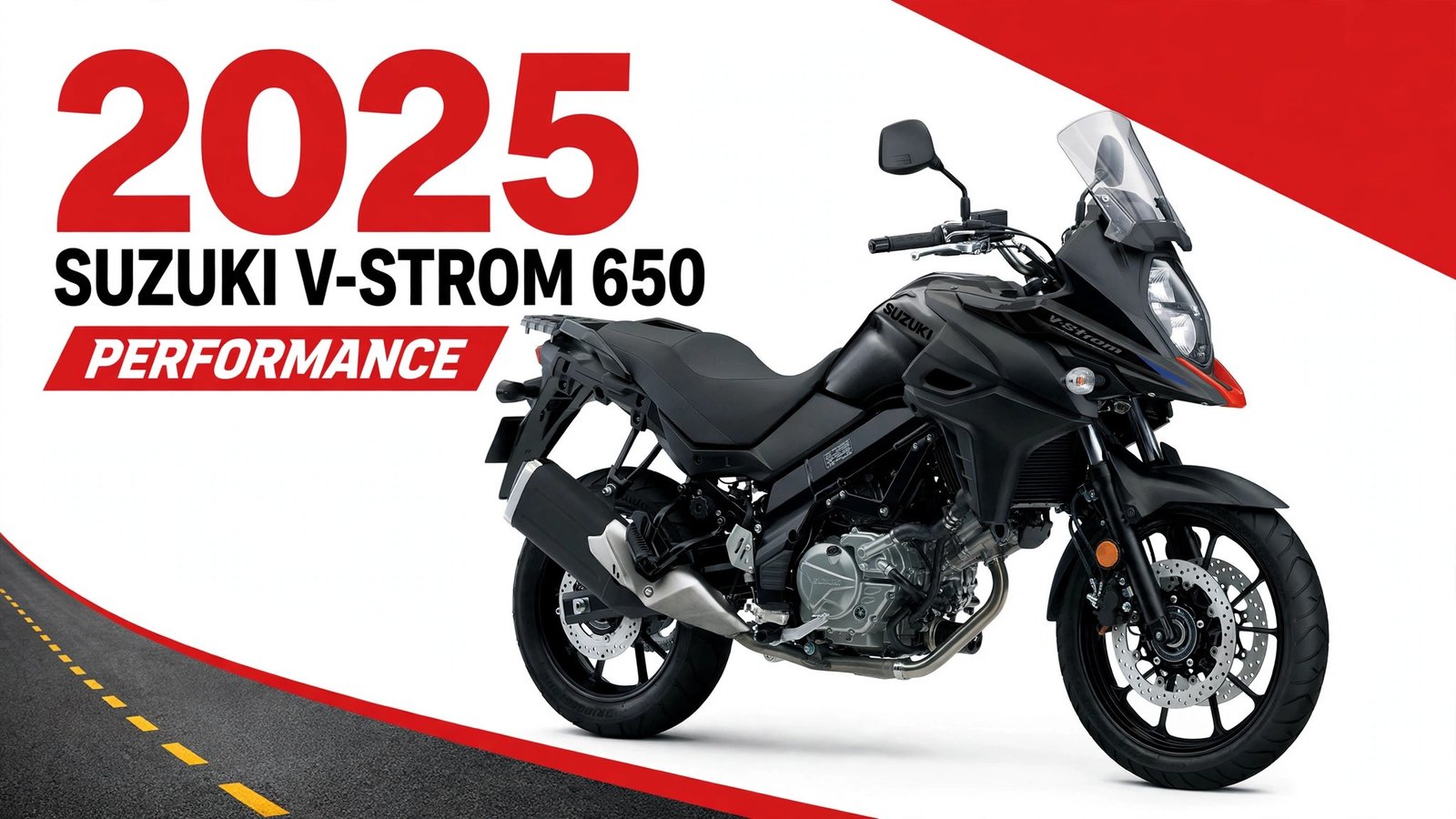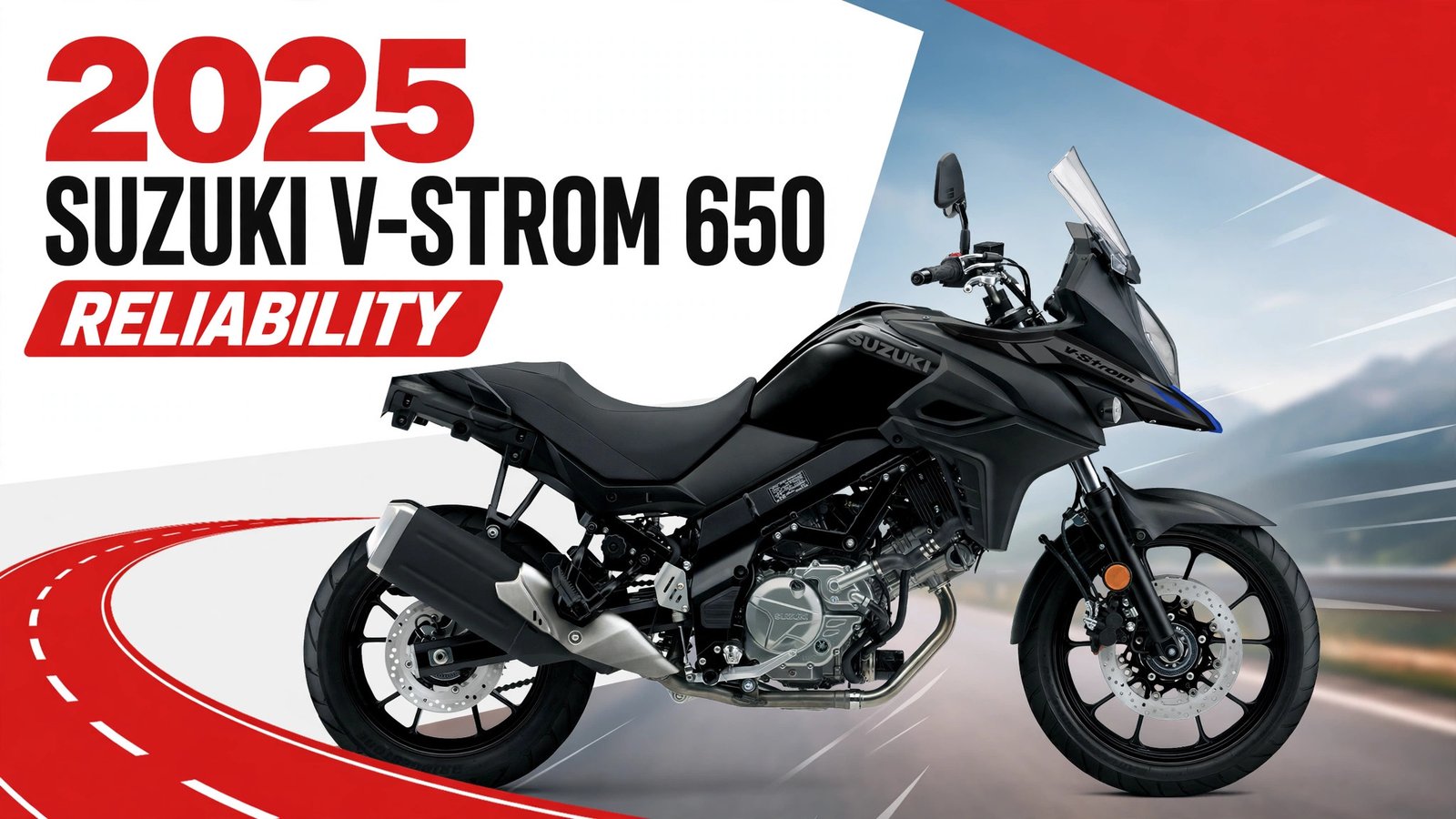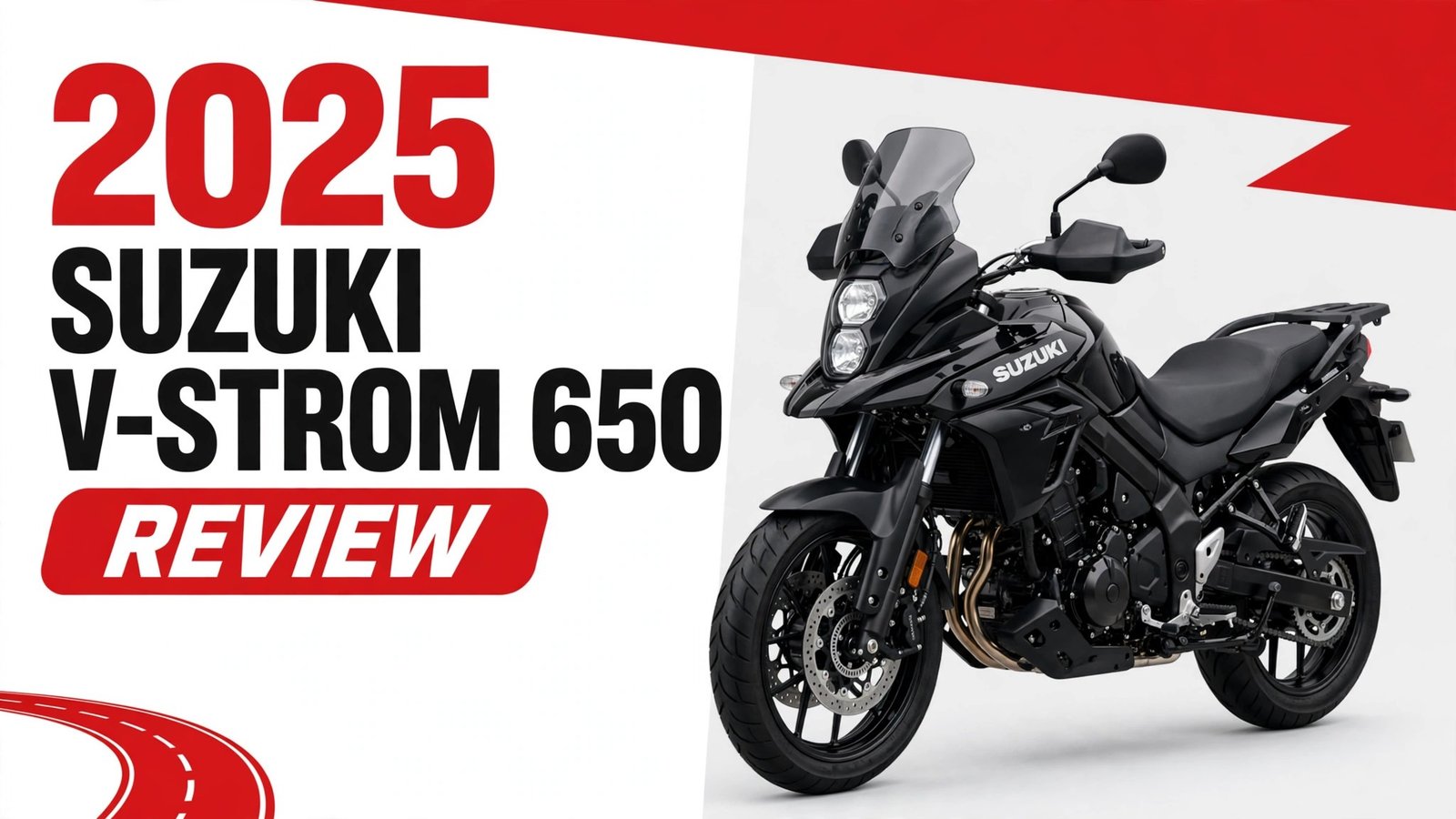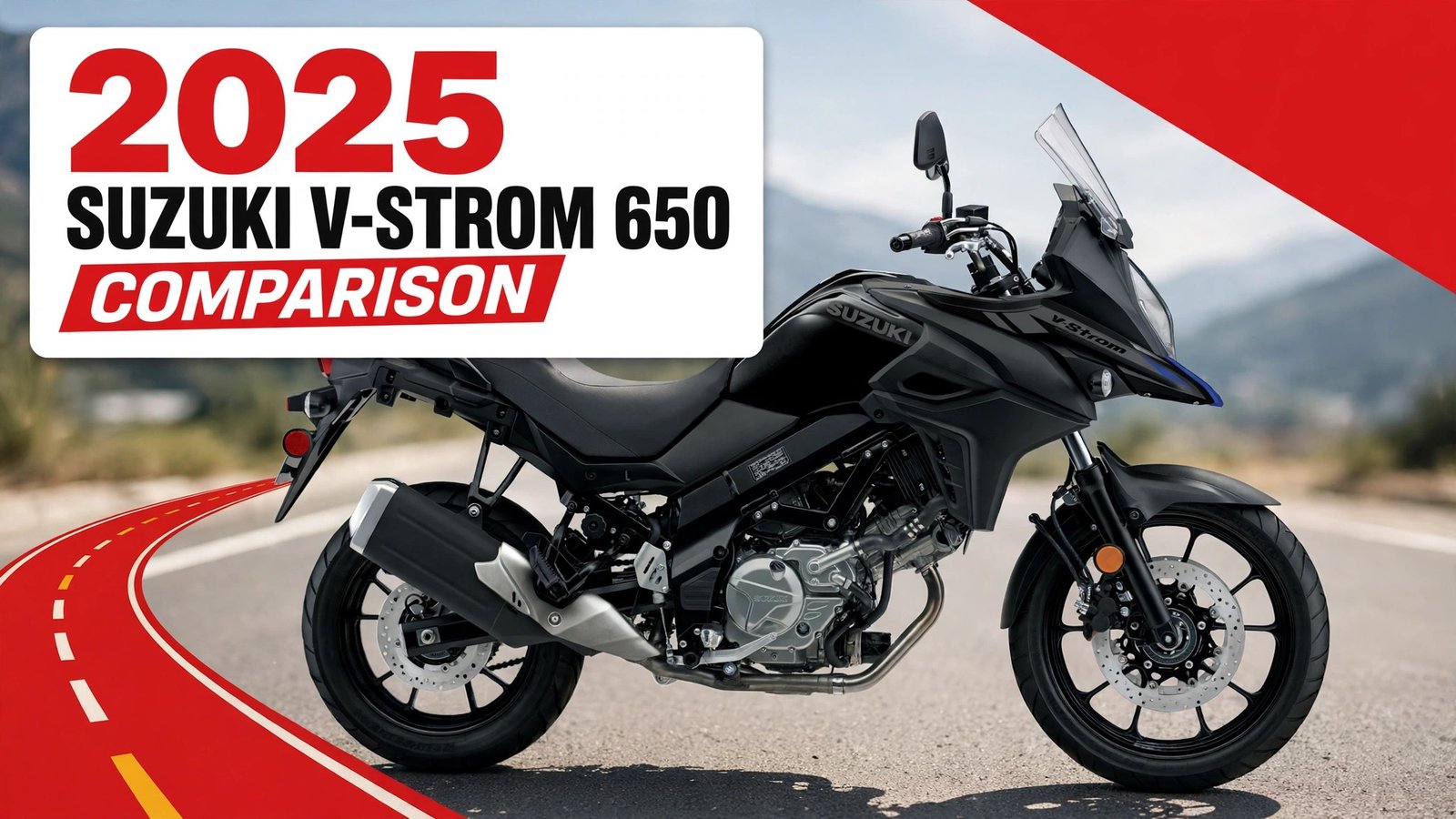
The Suzuki V-Strom 650 is the cheapest bike in this group by a clear margin, and that fact shapes everything else in this Suzuki V-Strom 650 comparison. At $9,299, it undercuts the Honda Transalp by $700, the Kawasaki Versys 650 LT by $1,100, and the Yamaha Ténéré 700 by $1,700. The question this Suzuki V-Strom 650 comparison answers is whether that price gap is a bargain or a warning. This Suzuki V-Strom 650 comparison tests it against all three rivals on 2025 US prices and measured dyno figures.
Suzuki V-Strom 650 Overview and Its Closest Rivals
Four bikes, one job in this Suzuki V-Strom 650 comparison: a middleweight adventure bike for commuting and touring.
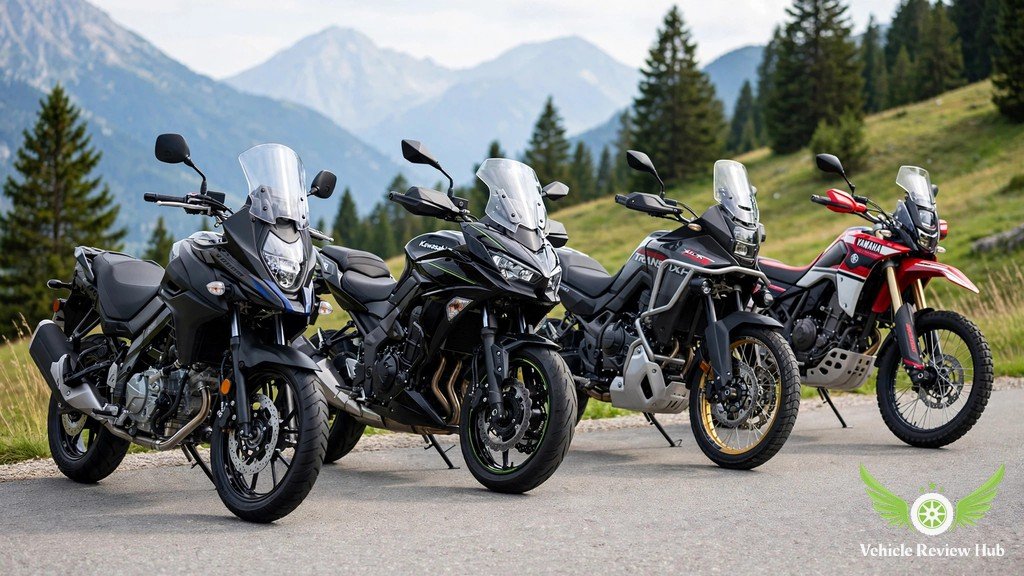
Why These Three Rivals: Same Class, Same Job
The Versys 650 is the direct road rival, the Transalp is the newer all-rounder, and the Ténéré 700 is the dirt-first alternative. This Suzuki V-Strom 650 comparison does neither: every price is a 2025 US MSRP, every dyno figure is measured at the rear wheel. The classic head-to-head is Rider Magazine’s 2017 comparison of the V-Strom 650 against the Versys 650 LT, which the Suzuki won — Rider’s 2017 Versys 650 LT vs V-Strom 650 comparo is the test this Suzuki V-Strom 650 comparison builds on, extended to all three rivals with 2025 models.
How the Four Bikes Differ at a Glance
The table below is the whole Suzuki V-Strom 650 comparison in one view. Two things stand out. First, the V-Strom 650 is the only bike in this Suzuki V-Strom 650 comparison whose maker publishes no horsepower or torque figure at all, so its row is measured dyno only. Second, the claimed-power order and the measured-power order are not the same.
| Bike | Engine | Claimed power | Measured dyno (rear wheel) | Curb weight | Seat height |
|---|---|---|---|---|---|
| Suzuki V-Strom 650 | 645cc V-twin | No figure published | 66.85 hp / 43.04 lb-ft (Cycle World) | 470 lb | 32.9 in |
| Kawasaki Versys 650 LT | 649cc parallel twin | 66 hp @ 8,500 rpm | 61.2 hp / 42 lb-ft (Rider, same dyno) | 482.9 lb | 33.3 in |
| Honda Transalp XL750 | 755cc parallel twin | 90.5 hp global / ~83 hp US reported | 70.58 hp / 47.01 lb-ft (Cycle World) | 463 lb | 33.7 in |
| Yamaha Ténéré 700 | 689cc parallel twin | 72.4 hp @ 9,000 rpm | 61.68 hp (Cycle World, torque n/a) | 459 lb | 34.4 in |
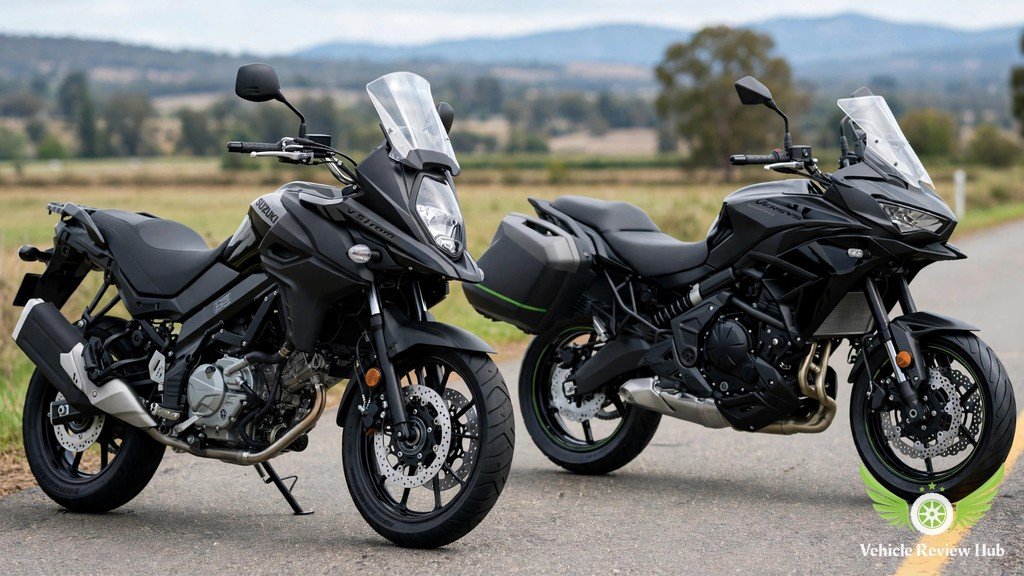
Suzuki V-Strom 650 vs Kawasaki Versys 650
This Suzuki V-Strom 650 comparison checks whether that verdict still holds for 2025 bikes.
Engine, Specs and Performance Side by Side
The engine story is the cleanest in this Suzuki V-Strom 650 comparison because both bikes were measured on the same dyno in the same test. Rider Magazine’s 2017 session put the V-Strom 650 at 68.7 hp at 9,100 rpm and 44.2 lb-ft at 6,500 rpm, against the Versys 650 at 61.2 hp at 8,300 rpm and 42 lb-ft at 7,300 rpm. Same dyno, same day — the Suzuki makes more power and its peak torque arrives 800 rpm sooner. Cycle World’s later dyno of a 2023 V-Strom 650 XT Adventure confirms the band at 66.85 hp at 9,210 rpm and 43.04 lb-ft at 6,560 rpm. The chassis split is just as clear: the V-Strom runs 19/17-inch wheels on a 61.4-inch wheelbase, the Versys 17/17-inch cast wheels on a 55.7-inch wheelbase. Fuel economy is close and honestly tested: Rider’s 2017 comparo recorded 41.0 low, 46.9 average, and 58.5 high mpg for the Suzuki and 40.5 low, 51.3 average, and 56.0 high mpg for the Kawasaki. The Versys wins the average and, with its 5.5-gallon tank, goes about 282 miles against the V-Strom’s 248 miles from 5.3 gallons. Where the Versys clearly leads is the dash: a 4.3-inch TFT with smartphone connectivity against the V-Strom’s analog-plus-LCD panel. Neither bike has an instrumented top-speed test for the current generation, so the aggregator figure of about 124 mph for the Versys stays an estimate. The Versys 650 performance figures and the Versys 650 comparison cover the Kawasaki side in more depth.
Price, Equipment and Which Suits Which Rider
The price gap is $1,100 before destination: $9,299 for the base V-Strom 650 against $10,399 for the Versys 650 LT, the only version sold in the US. There is no verified 2025 non-LT base price, so this Suzuki V-Strom 650 comparison compares the LT and says so plainly. The LT earns some of that gap back with color-matched hard saddlebags (28 liters each side) and handguards as standard, plus a 24-month limited warranty against the Suzuki’s 12-month limited warranty. Destination adds $530 to the Suzuki and $685 to the Kawasaki. Which suits which rider comes down to the job: the Versys LT suits the road tourer who wants luggage included, a modern TFT, and the longer warranty in one purchase, while the V-Strom suits the rider who wants the lower price, the V-twin character, and the option to add luggage later. The Versys 650 review and the V-Strom 650 review land on the same split: the Kawasaki is the better equipped road bike, the Suzuki is the better value.
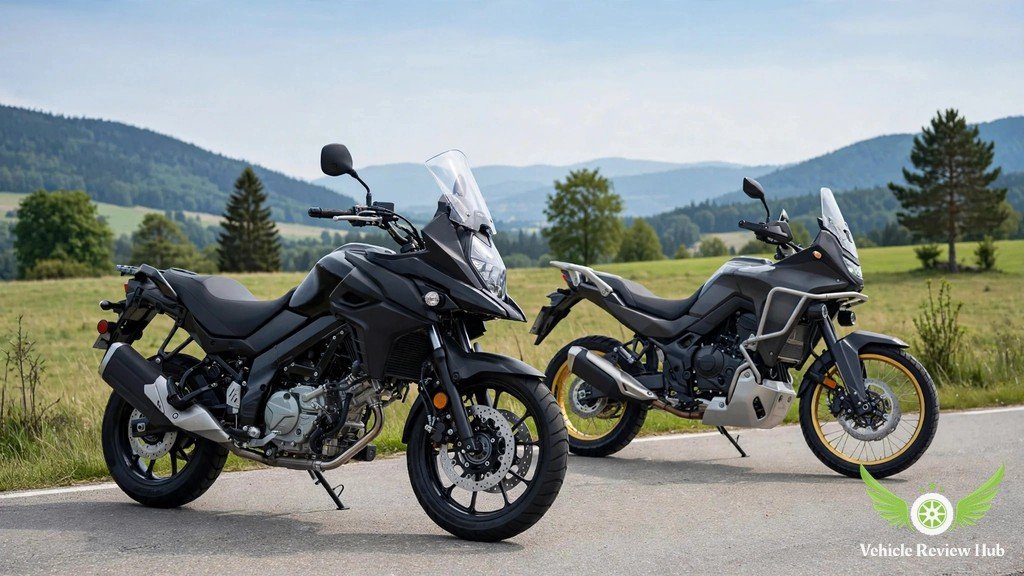
Suzuki V-Strom 650 vs Honda Transalp
This Suzuki V-Strom 650 comparison treats its headline figures with care.
Engine, Specs and Performance Side by Side
The Transalp’s 755cc parallel twin is the biggest engine in this Suzuki V-Strom 650 comparison, and its global claim of 90.5 hp at 9,500 rpm and 55.2 lb-ft at 7,250 rpm is the biggest claim too — but it is not the US figure. US bikes take a reported hit of about 7 hp from sound regulations, putting the US figure near 83 hp. The measured truth is closer than the claims suggest: Cycle World’s dyno of the 2024 Transalp recorded 70.58 hp at 8,530 rpm and 47.01 lb-ft at 7,270 rpm at the rear wheel, against the V-Strom’s 66.85 hp and 43.04 lb-ft. The real gap at the wheel is about 4 hp, not 24. The Transalp is also 7 lb lighter for 2025 at 463 lb against the V-Strom’s 470 lb — do not use the 459 lb figure, which is the 2024 weight. Off the pavement the Honda pulls further ahead: 21/18-inch tube-type spoked wheels, 8.3 inches of ground clearance, and a Showa 43 mm fork with 7.9 inches of travel, against the Suzuki’s 19/17-inch wheels, 6.7 inches of clearance, and 5.9 inches of fork travel. The electronics gap is just as wide: five ride modes, five-level traction control with wheelie control, three ABS levels including rear-off, and a 5-inch TFT, against the V-Strom’s two traction-control modes plus Off, non-switchable ABS, and analog-plus-LCD dash. Fuel economy flips the story: the Transalp’s 54.7 mpg is a manufacturer-claimed WMTC figure, not a tested one, while the V-Strom’s 46.9 mpg average is measured — and with a 4.4-gallon tank against 5.3, the Honda’s theoretical range of about 240 miles is no better than the Suzuki’s tested 248 miles. The V-Strom 650 performance guide has the full dyno and MPG detail behind these numbers.
Price, Equipment and Which Suits Which Rider
The Transalp costs $9,999 plus $600 destination against the V-Strom’s $9,299 plus $530 — a $700 gap on MSRP, $770 with destination. What the $700 buys is real: a TFT dash, five ride modes, switchable ABS, a 21-inch front wheel, and an optional bidirectional quickshifter. What the V-Strom keeps is also real: the lower price, the smooth V-twin, tubeless spoked wheels on the XT trim, and a reliability record of four NHTSA recalls with none naming any 2019–2025 bike. This Suzuki V-Strom 650 comparison calls the Transalp the better bike for the rider who wants modern electronics and genuine dirt ability, and the V-Strom the better buy for the rider who rides mostly on the road and would rather keep $700. One thing to know before shopping: the E-Clutch version is a 2026 addition from $10,199, not a 2025 feature. The warranty split favors Honda on paper — a one-year transferable unlimited-mileage limited warranty against Suzuki’s 12-month limited warranty, which does not use the words “unlimited mileage.” Check the V-Strom 650 reliability and maintenance record before deciding.
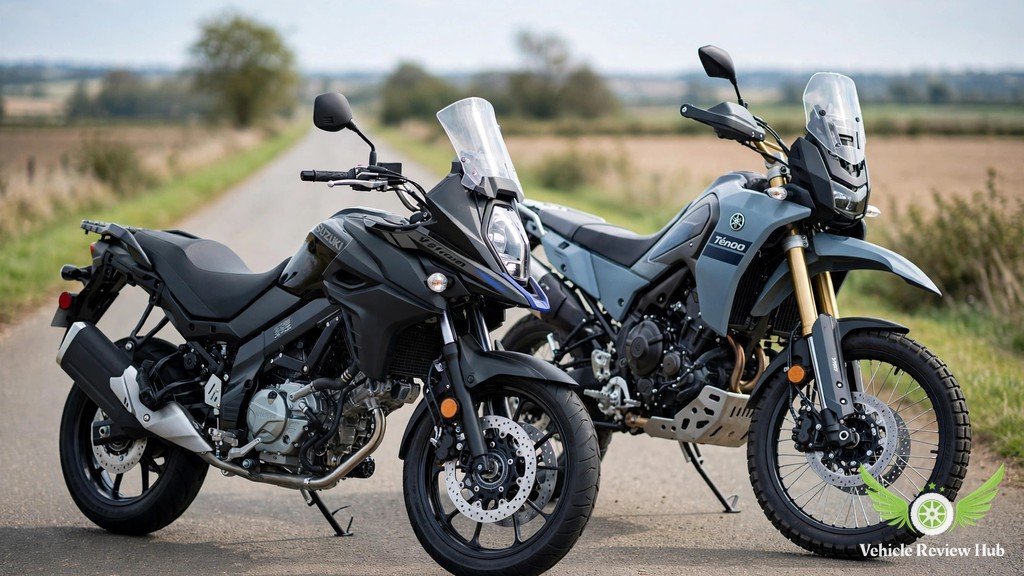
Suzuki V-Strom 650 vs Yamaha Ténéré 700
The Ténéré 700 is the outlier in this Suzuki V-Strom 650 comparison: a dirt-first bike that happens to be road-legal. In this Suzuki V-Strom 650 comparison, these two bikes answer different questions.
Engine, Specs and Performance Side by Side
The Ténéré 700’s 689cc CP2 parallel twin claims 72.4 hp at 9,000 rpm and 50.2 lb-ft at 6,500 rpm. At the rear wheel, Cycle World measured 61.68 hp for the Yamaha, below the V-Strom’s 66.85 hp, so the Suzuki makes more measured power in this Suzuki V-Strom 650 comparison despite the smaller claimed gap. The real difference is the chassis: the T7 carries 21/18-inch tube-type spoked wheels, 9.4 inches of ground clearance, and a fully adjustable KYB fork, against the V-Strom’s 19/17-inch wheels, 6.7 inches of clearance, and preload-only fork. The 2025 T7 adds ride-by-wire, two power maps, traction control, and a 6.3-inch vertical TFT. One recall note matters: the 2023–2024 clutch recall does not apply to 2025 bikes, which use a revised clutch, and the 2022 front brake caliper bolt recall covers 2022 units only. ADV Pulse’s 2025 Ténéré 700 review covers the updated bike in full.
Price, Equipment and Which Suits Which Rider
The Ténéré 700 costs $10,999 plus about $675 destination against the V-Strom’s $9,299 plus $530 — a $1,700 gap on MSRP, about $1,845 with destination. That is the largest gap in this Suzuki V-Strom 650 comparison, and it buys the most dirt ability: the 21-inch front wheel, the long-travel adjustable suspension, and an ABS system with three modes including Off, plus traction control that switches fully off. So the choice in this Suzuki V-Strom 650 comparison is simple: the T7 suits the rider who rides dirt seriously, while the V-Strom suits the rider who rides roads and gravel and keeps $1,700.
Suzuki V-Strom 650 Price and Value Compared
Prices are only the first line of the bill. This Suzuki V-Strom 650 comparison adds destination charges, running costs, and warranty.
New Prices Across the Four Bikes in the USA
The table below uses 2025 US MSRP for all four bikes, with destination added so the totals compare like-for-like. In this Suzuki V-Strom 650 comparison, the V-Strom 650 is the cheapest by $700 against the Transalp, $1,100 against the Versys 650 LT, and $1,700 against the Ténéré 700. The 2026 figures stay out of this table: Versys 650 LT $10,599, Transalp E-Clutch from $10,199, V-Strom 800DE $11,799. Do not mix them into this Suzuki V-Strom 650 comparison, and do not use the $10,099 figure — that is the 2024 price.
| Bike (2025, US) | MSRP | Destination | Total before tax |
|---|---|---|---|
| Suzuki V-Strom 650 (base) | $9,299 | $530 | $9,829 |
| Honda Transalp XL750 | $9,999 | $600 | $10,599 |
| Kawasaki Versys 650 LT | $10,399 | $685 | $11,084 |
| Yamaha Ténéré 700 | $10,999 | ~$675 | ~$11,674 |
Running Costs and Resale Value Compared
Running costs narrow the gaps in this Suzuki V-Strom 650 comparison but do not close them. The V-Strom 650 runs on regular unleaded fuel and averaged 46.9 mpg in Rider’s tested 2017 comparison, with a second test of the 2018 XT recording 50.5 mpg average — two separate tests, two separate sets, never merged. The Versys 650 recorded the best tested average of the group at 51.3 mpg in the same 2017 comparison, while the Transalp’s 54.7 mpg is manufacturer-claimed WMTC, not tested, and the Ténéré 700’s 57 mpg is a single real-world report. Warranty length favors the Versys LT at 24 months and the Transalp’s one-year transferable unlimited-mileage cover; the V-Strom and the T7 both carry one-year limited warranties. On resale, this Suzuki V-Strom 650 comparison prints no specific figures: no verified 2025-model numbers exist yet. On recalls, the V-Strom’s record is four recalls with none naming 2019–2025 bikes; for the Versys 650 and the Transalp, no recall was found in this research pass — check the NHTSA recalls database by VIN before buying.
Suzuki V-Strom 650 Comparison Verdict and US Alternatives
Four bikes, four answers. This Suzuki V-Strom 650 comparison ends with a verdict for each kind of rider.
Which Bike Wins for Which Rider
The verdict of this Suzuki V-Strom 650 comparison depends on the rider, not the spec sheet. The V-Strom 650 wins for the road rider who wants the lowest price, the lowest seat at 32.9 inches, and a forgiving V-twin with Low RPM Assist — also the best beginner pick of the four. The Versys 650 LT wins for the road tourer who wants luggage, a TFT dash, and a 24-month warranty included in the purchase. The Transalp wins for the rider who wants the most modern electronics and real dirt ability for $700 more than the Suzuki. The Ténéré 700 wins for the rider who rides dirt seriously and will pay $1,700 for it.
Also Consider: V-Strom 800, 800DE and Ibex 800
Three alternatives sit just above the V-Strom 650’s price, and this Suzuki V-Strom 650 comparison would be incomplete without them. The road-going V-Strom 800 costs $10,109 for 2025 and adds what the 650 lacks: a 776cc parallel twin with about 83 hp claimed, a TFT dash, ride-by-wire, a quickshifter, and ride modes. The V-Strom 800DE costs $11,709 for 2025 (2026: $11,799) and is Suzuki’s dirt answer in this Suzuki V-Strom 650 comparison: a 21-inch front wheel, 220 mm of fully adjustable Showa suspension, 8.7 inches of ground clearance, a Gravel mode, switchable rear ABS, and a Cycle World dyno figure of 72.21 hp. The CFMoto Ibex 800 E costs $10,299 and is the wildcard: a 799cc KTM-derived parallel twin claiming 94 hp at 9,000 rpm and 56.8 lb-ft at 6,500 rpm, 509 lb, six ride modes, a TFT dash, and a two-year unlimited-mileage warranty — the longest here — though Rider’s Ibex 800 E review tested only 43.8 mpg and about 219 miles of range, and its three-piece aluminum luggage costs $1,699 extra. The video below is a genuine gen-3 Suzuki V-Strom 650 comparison: MotorBeam put the 650XT head-to-head with the Versys 650 (and a Triumph Tiger 660) in 2022, and the bike is unchanged since, so the verdict still holds.
Suzuki V-Strom 650 Comparison FAQs
These are the questions riders ask most often about this Suzuki V-Strom 650 comparison, answered from the tested figures in this Suzuki V-Strom 650 comparison.
Which is better, the V-Strom 650 or the Versys 650?
Rider Magazine’s 2017 comparison picked the V-Strom, and this Suzuki V-Strom 650 comparison agrees for 2025: the Suzuki is $1,100 cheaper. The Versys answers with a TFT dash, included saddlebags, and a 24-month warranty.
Is the V-Strom 650 faster than the Versys 650?
On the same dyno in 2017, the V-Strom made 68.7 hp against the Versys’ 61.2 hp, with peak torque 800 rpm sooner. In this Suzuki V-Strom 650 comparison, the V-Strom is the quicker of the two, though no current-generation 0–60 test exists for either bike.
V-Strom 650 vs Transalp: which is the better value?
The V-Strom 650 is the better value for road riders in this Suzuki V-Strom 650 comparison: $700 cheaper, a smooth V-twin, and tested fuel economy. In this Suzuki V-Strom 650 comparison, the Transalp earns its $700 with a TFT dash, five ride modes, switchable ABS, and a 21-inch front wheel.
Is the Transalp more powerful than the V-Strom 650?
Yes, but by less than the claims suggest. The Transalp’s global claim is 90.5 hp against a reported US figure near 83 hp, and at the rear wheel the dyno gap is about 4 hp: 70.58 hp against the V-Strom’s 66.85 hp in this Suzuki V-Strom 650 comparison.
V-Strom 650 vs Ténéré 700: which is better off-road?
The Ténéré 700, clearly. It has 21/18-inch wheels, 9.4 inches of ground clearance, fully adjustable suspension, and ABS that switches fully off. In this Suzuki V-Strom 650 comparison, the V-Strom is a road bike that tolerates dirt, not a dirt bike.
Which of the four is best for beginners?
The V-Strom 650: the lowest seat at 32.9 inches, 470 lb, Low RPM Assist, and a forgiving V-twin. In this Suzuki V-Strom 650 comparison, the Ténéré 700 is the hardest first bike, with the tallest seat at 34.4 inches and a dirt-first setup.
Which has the lowest seat height?
The V-Strom 650 at 32.9 inches in this Suzuki V-Strom 650 comparison. Next comes the Versys 650 at 33.3 inches, then the Transalp at 33.7 inches (an optional low seat drops it to 32.6 inches), and the Ténéré 700 is tallest at 34.4 inches.
Which bike goes furthest on a tank?
The Versys 650 LT, at about 282 miles from its 5.5-gallon tank at the tested 51.3 mpg average in this Suzuki V-Strom 650 comparison. The V-Strom 650 manages about 248 miles, the Transalp about 240 miles on its claimed figure, and the Ténéré 700 about 239 miles in theory.
Which is cheapest to buy — and cheapest to run?
Cheapest to buy is the V-Strom 650 at $9,299. Cheapest to run is close: the V-Strom takes regular fuel and averaged a tested 46.9 mpg, while the Versys recorded the best tested average at 51.3 mpg in this Suzuki V-Strom 650 comparison.
Should I buy the V-Strom 650 or spend more on the 800DE or Ibex 800?
Buy the 800DE at $11,709 if you ride dirt seriously. Buy the Ibex 800 E at $10,299 for its 94 hp claim and two-year warranty. Otherwise, the V-Strom 650’s road value wins this Suzuki V-Strom 650 comparison.
Is the V-Strom 650 discontinued?
No discontinuation has been announced for the USA, and this Suzuki V-Strom 650 comparison does not call it discontinued. No 2026 US model has been announced, and the SV-7GX successor revealed at EICMA is not a confirmed US model.
Which of the four has cruise control?
None of them. The V-Strom 650, Versys 650, Transalp, and Ténéré 700 all ship without cruise control in this Suzuki V-Strom 650 comparison.