The John Deere 5GV Series is built for one job above all else: working productively in vineyard rows too narrow for a standard tractor. With 75 or 90 horsepower and a minimum working width of about 42.8 inches, it covers spraying, mowing, undervine work, and transport without the bulk or crop damage of a bigger machine. For vineyard buyers, John Deere 5GV Series performance comes down to usable power in a narrow frame: the 5090GV’s extra 15 horsepower matters most on steep ground and with heavy sprayers, while the 5075GV’s larger tank and lower price suit flatter blocks. The John Deere 5GV Series review covers specifications and used prices; this guide looks at how John Deere 5GV Series performance holds up day to day.
John Deere 5GV Series Fuel Consumption and Operating Efficiency
Fuel is where a small specialty tractor quietly earns its keep. A vineyard tractor spends most of its life at steady PTO speed in low gears, not pulling hard at full draft load, so its hourly burn stays far below that of a big row-crop machine. That duty cycle shapes John Deere 5GV Series performance more than any single specification. Deere does not publish an official gallons-per-hour figure for this series, so the numbers below are planning estimates from engine size, tank capacity, and typical duty cycles, not factory test data.
Fuel Use During Vineyard Spraying, Mowing and Transport
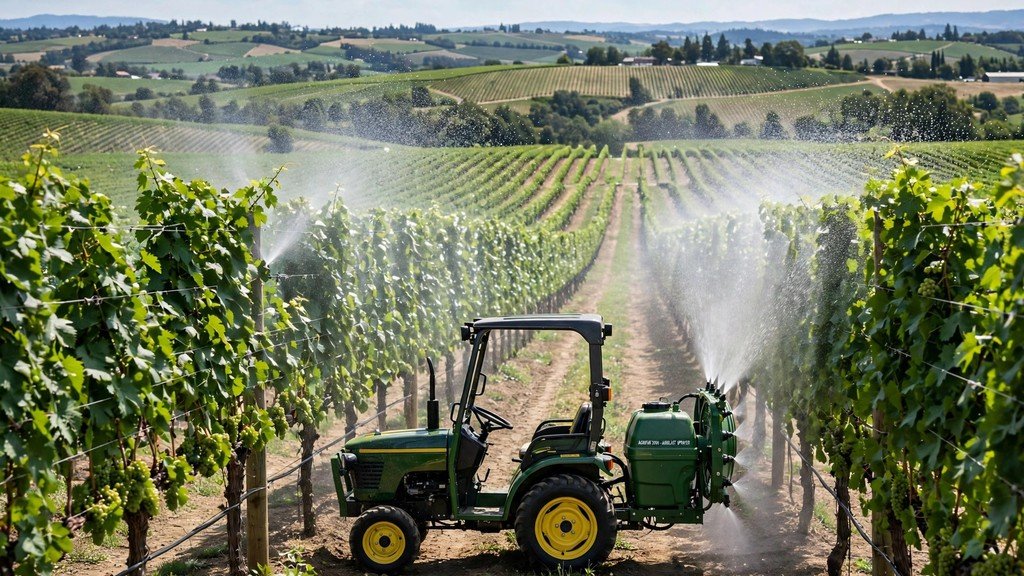
Spraying is the thirstiest routine vineyard job because the PTO runs constantly to drive the sprayer fan and pump while the tractor creeps down the row. For John Deere 5GV Series performance in spraying work, plan on roughly 2.5 to 3.0 gallons per hour with a typical airblast sprayer on rolling ground. That puts a 5090GV, with its 19.3-gallon tank, at about six to seven hours of spraying between fills, while the 5075GV’s 22.7-gallon tank stretches the same job toward eight or nine hours.
Mowing is lighter on fuel than spraying because the PTO load is steadier and ground speed is higher: roughly 2.0 to 2.5 gallons per hour with a rear rotary or flail mower in row middles. Transport and yard work are the cheapest hours on the machine, about 1.5 to 2.0 gallons per hour with the PTO off. The contrast with big tractors is stark — a large track tractor can burn several times as much per hour, as the John Deere 9RX 590 performance and fuel figures show — and that gap is the economic core of John Deere 5GV Series performance, often decided by how long the tractor can stay in the row, not by how fast it goes.
| Typical vineyard job | Estimated fuel use (gal/hr) | What drives it |
|---|---|---|
| Airblast spraying | 2.5–3.0 | Constant PTO fan load, creep speeds |
| Row-middle mowing | 2.0–2.5 | Steady PTO load, faster ground speed |
| Undervine mowing and trimming | 2.5–3.0 | Slow, stop-start passes |
| Transport and yard work | 1.5–2.0 | PTO off, engine below rated speed |
| Planning average, mixed season | About 2.5 | Budget figure only — log your own hours and fills |
How Engine Load, Implements and Field Conditions Affect Fuel Economy
Three things move the needle most. Engine load comes first: a PTO sprayer at full fan speed is a near-constant load, while a mower in light grass is not, which is why spraying costs more per hour than mowing at similar ground speeds. Implement sizing comes second: an oversized sprayer that lugs the engine below rated PTO speed burns more fuel and does worse work than a correctly sized unit. Match the sprayer to the tractor’s 61 or roughly 78 PTO horsepower. Field conditions come third: soft ground, steep slopes, and tight headlands all add load and idle time.
The 5GV gives the operator two built-in tools for managing this. Economy PTO is standard across the series and cuts engine speed by about 15 percent at the same 540 PTO rpm, trimming fuel use on any job that does not need full engine power. On the 5090GV, optional Intelligent Power Management adds about 5.5 percent power for PTO and transport work. Getting these three factors right is the cheapest way to protect John Deere 5GV Series performance across a season, and managing them well is part of everyday John Deere 5GV Series performance. The TriGreen Equipment 5090GV specification page lists the transmissions and PTO options behind those choices.
John Deere 5GV Series Performance in Narrow Vineyards
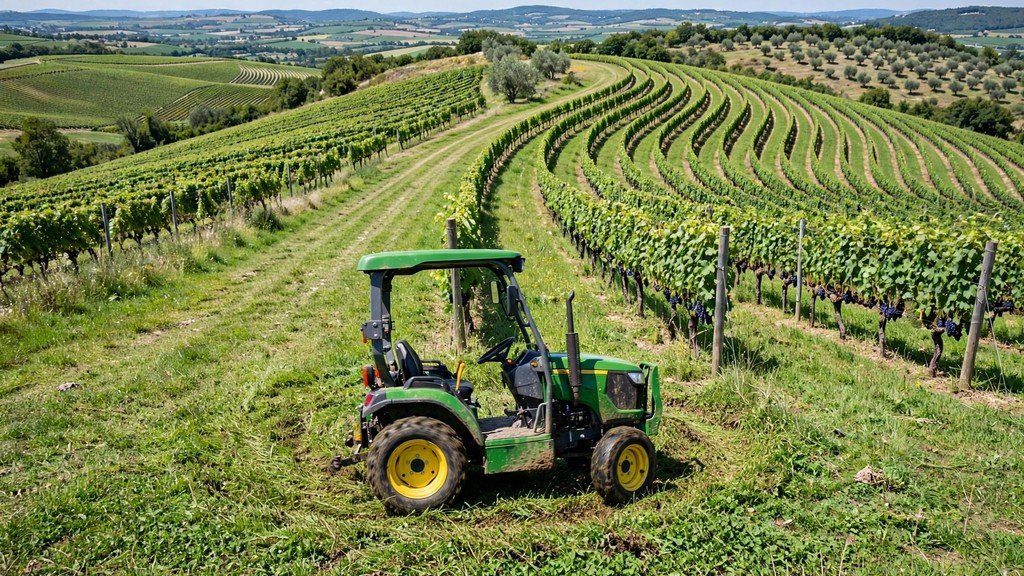
In the row, the 5GV’s job is to do full-size vineyard work without touching the crop: hold a straight line between trellis wires, keep PTO speed steady, and run hydraulic implements with precise control. At roughly 5,577 pounds open-station and 6,051 pounds with a cab, it holds traction on slopes while limiting compaction in row middles. That balance is what John Deere 5GV Series performance looks like in practice — not a single headline number, but a machine shaped around the row.
Spraying, Mowing, Undervine Work and Crop Maintenance
Spraying is the 5GV’s signature job, and it is where John Deere 5GV Series performance is judged most harshly by owners. A vineyard spray program runs on a tight calendar, and a missed fungicide window costs the crop. The tractor must hold a steady creep speed for an even spray rate and keep the fan at rated PTO speed all day. The creeper option on the 24F/12R PowrReverser transmission exists for exactly this: very slow, controlled ground speeds that let the operator match forward speed to canopy density and label rate. For most growers, spraying is the benchmark for John Deere 5GV Series performance.
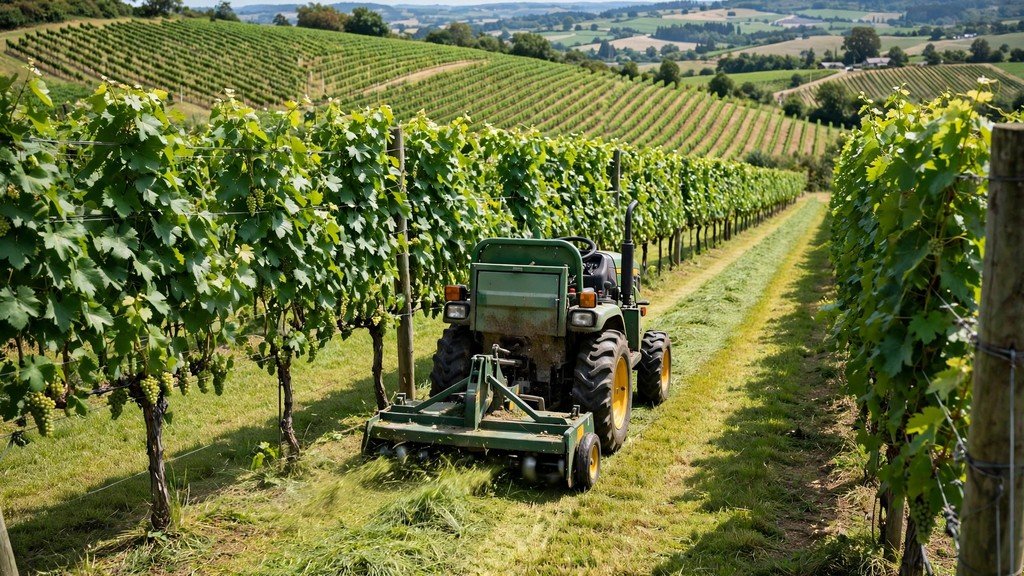
Mowing splits into two jobs. Row-middle mowing is straightforward work for either model. Undervine mowing and trimming is slower, closer work around posts and trunks, where the narrow width and tight turning radius matter more than horsepower. Beyond spraying and mowing, the 5GV runs leaf removers, trimmers, and light tillage tools, and factory mid-mount couplers support front implements too. The video below shows a narrow tractor running an airblast sprayer through vineyard rows:
Traction, PTO Performance and Hydraulic Implement Operation
Traction comes from the combination of standard 4WD and the machine’s weight over its narrow footprint. On dry, firm row middles, either model pulls a loaded sprayer without drama. On wet slopes, the limits show up sooner than on a bigger tractor: narrower tires mean a smaller contact patch, so tire choice and ballast matter more here than on a standard machine. Operators on steep blocks should spec the widest tires their row spacing allows. Traction is the quiet half of John Deere 5GV Series performance.
PTO performance is straightforward: 540 and 540E are standard, reached at 1,938 and 1,648 engine rpm, with an optional 1,000-rpm PTO. The 5075GV delivers 61 PTO horsepower and the 5090GV about 78, and the torque behind those ratings — roughly 228 lb-ft for the 5075GV and 270 lb-ft for the 5090GV — explains why the bigger model holds fan speed better when a sprayer loads up on a grade. Hydraulically, the standard pump delivers 25.5 gallons per minute, rising to 33.4 with the optional third pump, with about 11 gallons per minute at a single rear SCV. The United Ag & Turf 5075GV page summarizes the narrow-series weights and widths that shape these limits, and they are central to John Deere 5GV Series performance in real vineyard conditions.
John Deere 5GV Series Maneuverability and Operator Comfort
If fuel is the 5GV’s quiet advantage, maneuverability is its loud one. Vineyard work is mostly turning: every row ends, every block has a headland, and every pass has posts, wires, and trunks to avoid. Maneuverability is the most visible part of John Deere 5GV Series performance, and comfort matters here too, because spray days are long days. That combination is why John Deere 5GV Series performance is so often judged at the headland, not in the row.
Working Width, Turning Radius and Row-End Maneuvering
The headline numbers are small, and that is the point. Minimum working width is 42.8 inches from rear tire to rear tire, the cab is 42.6 inches wide, and the narrowest configurations get near 40.5 inches depending on tires. That fits tight-spaced vineyards where a standard tractor would brush canopies or clip posts. The turning radius without brakes is 11.9 feet, which lets the tractor swing around at the headland and enter the next row without multi-point shuffling in most layouts. Where headlands are very tight, the left-hand reverser on the PowrReverser transmission turns direction changes into a lever flick.
Row-end technique matters as much as the turning circle. The most productive pattern is to finish the row, lift the implement, turn on the headland without dropping a wheel into the row middle, and enter the next row already lined up on the trellis wire. The 5GV’s short 82.5-inch wheelbase helps here, but jerky steering inputs can swing the rear implement into the end posts. Strong John Deere 5GV Series performance at the headland comes from the combination of tight radius, short wheelbase, and reverser — the turning circle alone does not explain how fast the row changes actually go.
Cab Visibility, Controls and Operator Safety in Tight Rows
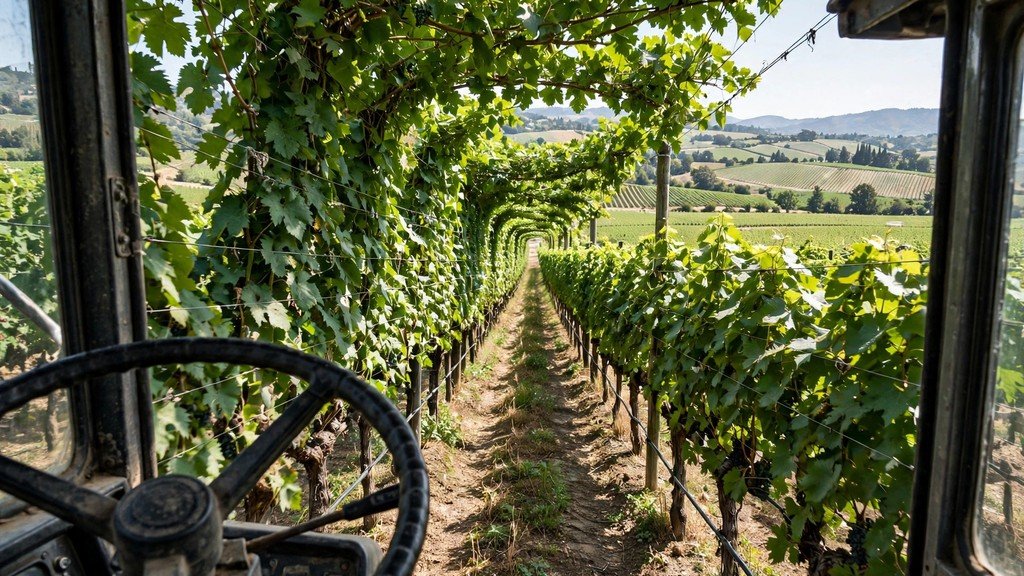
Visibility is a safety issue in a vineyard, not a comfort extra. The operator needs to see both row edges, the trellis wires, and the implement behind, all while watching for posts and low wires. The 5GV cab is a two-door design, so the operator can enter and exit from either side, and the glass area is generous for a cab only 42.6 inches wide. Between the consoles there is 22.1 inches of room, and 11.2 inches between seat and steering wheel. Open-station versions trade weather protection for unobstructed sightlines and fast hop-on, hop-off work, and many growers prefer them for summer canopy jobs.
The left-hand reverser is the key ergonomic feature: it keeps direction changes off the gear lever and lets the operator manage sprayer pressure or mower height without stopping. Safety equipment includes a rollover structure or cab, hydrostatic power steering, wet-disc brakes, and a differential lock. Spraying adds its own safety layer, since cab filtration matters when the operator sits in the spray cloud all day — buyers who spray heavily should check the filtration option on the specific machine they are buying rather than assuming it. Good visibility is not a luxury extra in John Deere 5GV Series performance; it is what keeps the vines safe. The Hay & Forage report on the 5G launch describes the cab and transmission choices that define this operator environment.
John Deere 5GV Series Real-World Owner Experience
Owner experience splits along one line: growers whose rows fit the machine love it, and growers who wanted general farm work wish they had bought bigger. Judged as an all-round farm tractor, its narrow tires, modest hitch lift, and small tanks are real constraints. Buying right means being honest about which job dominates, and that honesty is the starting point for any fair verdict on John Deere 5GV Series performance.

Benefits and Limitations for Vineyard and Orchard Operators
The benefits stack up in daily use. Fuel costs stay low because the engine is small and the work is steady. Vine damage drops because the tractor fits the row instead of forcing the row to fit the tractor. Turning is fast, which shortens spray days. Servicing is simple relative to a big tractor, with an engine oil interval of 500 hours in earlier manuals (the current 5G service table lists 750 hours — follow your own manual) and widely available filters and parts. Shared components with the wider 5GN and 5GL models also help parts availability. Those everyday savings are why owners rate John Deere 5GV Series performance so highly for vineyard work.
The limitations are equally concrete. The Category 1 hitch, with maximum lift of about 5,620 pounds behind the lift points, handles vineyard implements well but rules out heavy tillage tools and big loaders. The fuel tanks are small: the 5090GV’s 19.3 gallons means more frequent fills, and no factory auxiliary tank is listed for the GV as there is for the wider 5GN. And the machine’s light weight, an advantage for compaction, becomes a limit on steep, wet ground where a heavier tractor holds its line better. The John Deere 5GV Series ownership cost guide and the John Deere 5GV Series maintenance guide cover running costs, service intervals, and used-buying checks in detail.
Choosing the Right Model and Equipment for Your Property
Start with row spacing, not horsepower. If your rows are at the tight end of the scale, the 5GV is the right chassis regardless of model; if your rows are wider, the 5GN’s roomier cab may be the better buy for the same money. Then match the model to the work: the 5075GV suits flat to rolling blocks and lighter sprayers, and its 22.7-gallon tank is a genuine advantage on long days. The 5090GV suits steep blocks, heavy airblast sprayers, and growers who want the Intelligent Power Management boost and the extra PTO headroom; its 19.3-gallon tank is the price of that power. For transmissions, the 12F/12R box is simpler and cheaper, while the 24F/12R PowrReverser with creeper is the pick for spray-led operations. Getting these choices right is what turns good specifications into good John Deere 5GV Series performance on your own blocks. The table below is the quickest way to compare the two models on the figures that shape John Deere 5GV Series performance.
| Specification | 5075GV | 5090GV |
|---|---|---|
| Engine | FPT F34 3.4 L turbo | FPT F34 3.4 L turbo |
| Rated engine power @ 2,300 rpm | 75 hp | 90 hp |
| PTO power | 61 hp | About 78 hp (dealer pages list 76–79 hp) |
| Peak torque | About 228 lb-ft (309 Nm) | About 270 lb-ft (366 Nm) |
| Fuel tank | 22.7 gal | 19.3 gal (one Deere price page lists 19.9 gal) |
| Transmissions | 12F/12R or 24F/12R PowrReverser | 12F/12R or 24F/12R PowrReverser |
| Base weight (cab) | 6,051 lb | 6,051 lb |
| Best fit | Flat to rolling blocks, longest range | Steep blocks, heavy sprayers |
Equipment choices deserve the same care. Spec the three-pump hydraulic system if you run sprayers with heavy hydraulic demand or want four SCVs; the standard two-pump setup is fine for basic spraying and mowing. And on the used market, condition beats model year: recent observed listings include a 2019 5090GV with 923 hours at $57,600 Canadian and a low-hour 2023 narrow-series machine near $59,000. The Deere base-machine specification document is a useful cross-check for engine, fuel, and hitch figures when comparing a used listing against the factory build.
John Deere 5GV Series Performance FAQs
These are the questions buyers ask most often about John Deere 5GV Series performance in the field.
How much fuel does a John Deere 5GV use per hour?
Deere does not publish an official figure, but planning estimates run about 2.5 to 3.0 gallons per hour for airblast spraying, 2.0 to 2.5 for mowing, and 1.5 to 2.0 for transport. Heavy PTO work on steep ground can reach about 3.5.
What is Economy PTO and how much fuel does it save?
Economy PTO is standard and delivers 540 PTO rpm at about 15 percent lower engine speed — 1,648 rpm instead of 1,938 rpm. On lighter PTO jobs, that lower speed cuts fuel use and noise noticeably.
Can a 5GV run a vineyard airblast sprayer?
Yes, that is its primary job. Spraying is the job where John Deere 5GV Series performance matters most: the 5075GV’s 61 PTO horsepower handles most vineyard sprayers, and the 5090GV’s roughly 78 covers larger fans and steep ground. Match the sprayer to the PTO rating and use the creeper gears for slow, even passes.
How narrow a vineyard row can a 5GV enter?
The minimum working width is 42.8 inches from rear tire to rear tire, with the cab 42.6 inches wide and the narrowest tire configurations near 40.5 inches overall. Measure your tightest rows, including posts and wires, before buying.
What is the turning radius of the 5GV?
The turning radius without brakes is 11.9 feet (3,627 mm). That tight turning is a big part of John Deere 5GV Series performance in narrow blocks, and with the short 82.5-inch wheelbase and left-hand reverser, it makes fast row-end turns possible on most headlands.
Is the 5090GV worth the extra money over the 5075GV?
It is worth it for steep blocks, heavy sprayers, and growers who want the optional Intelligent Power Management boost. For flat to rolling blocks with lighter implements, the 5075GV does the same work, costs less, and goes further on a tank. Buy the power you need for your steepest block.
How does John Deere 5GV Series performance hold up on hills and slopes?
Reasonably, with limits. Standard 4WD, the differential lock, and the machine’s weight give good traction on slopes, and the 5090GV’s extra torque holds PTO speed better on grades. On steep, wet ground the narrow tires are the limiting factor, so spec the widest tires your rows allow. That traction limit is the main thing that holds back John Deere 5GV Series performance on steep, wet ground.
How much hydraulic flow does the 5GV have?
The standard pump delivers 25.5 gallons per minute, rising to 33.4 with the optional third pump, with about 11 gallons per minute at a single rear SCV. Two rear SCVs are standard and up to four are optional. Hydraulic capacity is often the overlooked half of John Deere 5GV Series performance, so check any implement with a large continuous hydraulic motor against these figures before purchase.
How does John Deere 5GV Series performance compare with a big tractor?
The difference is large: the 5GV burns roughly 2 to 3 gallons per hour doing vineyard work, while a large row-crop or track tractor can burn several times that per hour on heavy work. That gap is the economic core of John Deere 5GV Series performance — vineyard-scale work at vineyard-scale running cost, with a machine sized to the job instead of oversized for it.