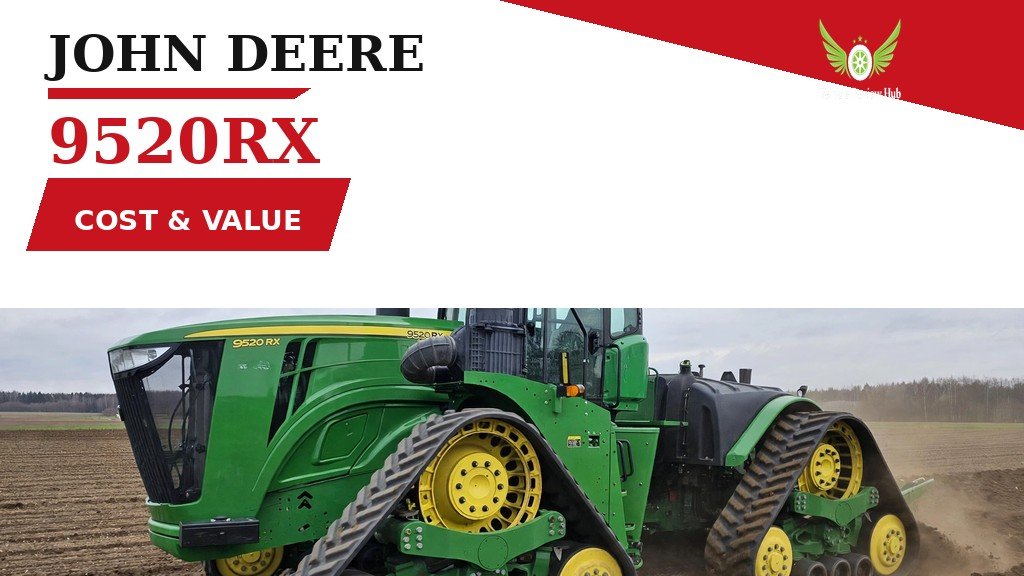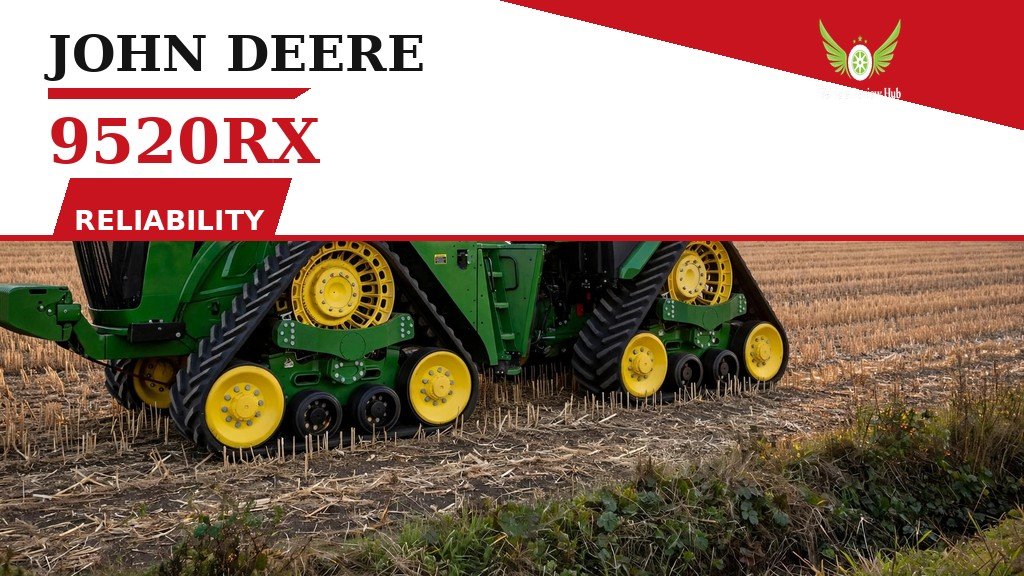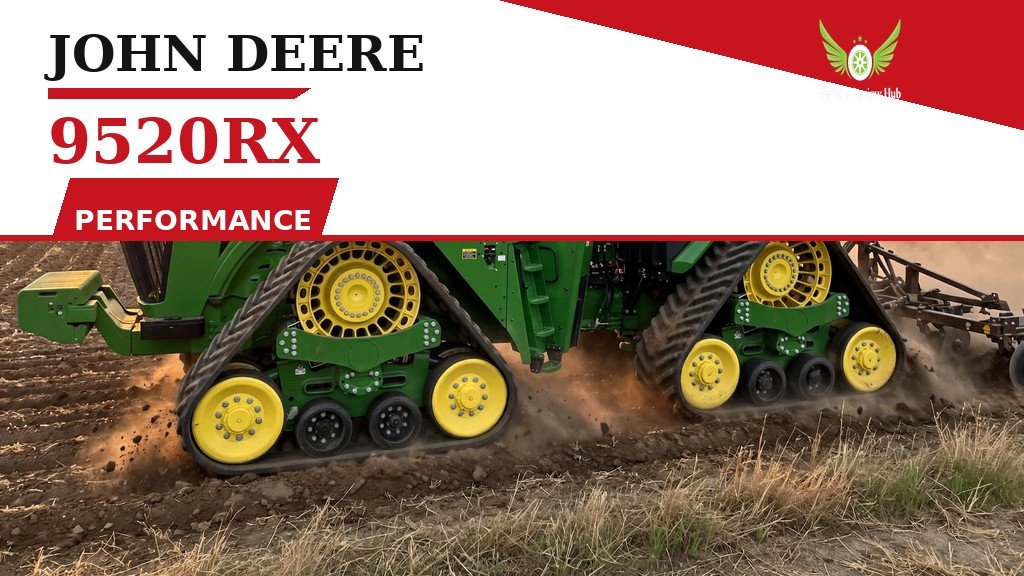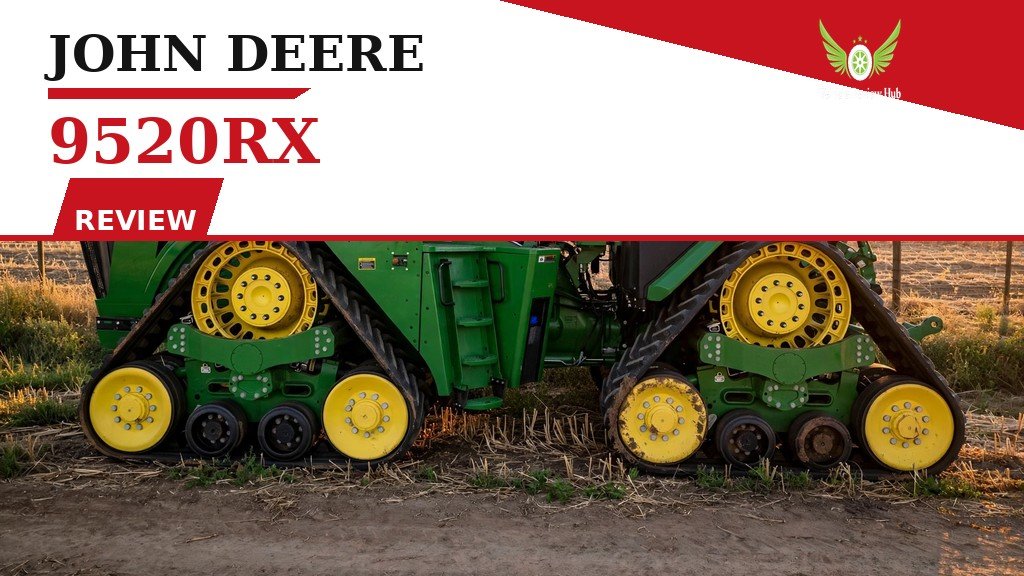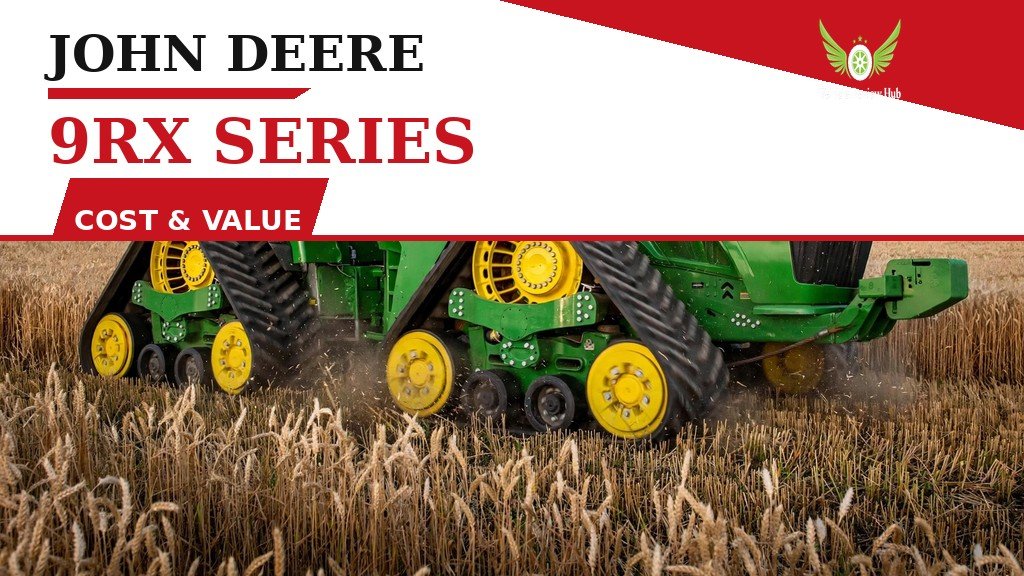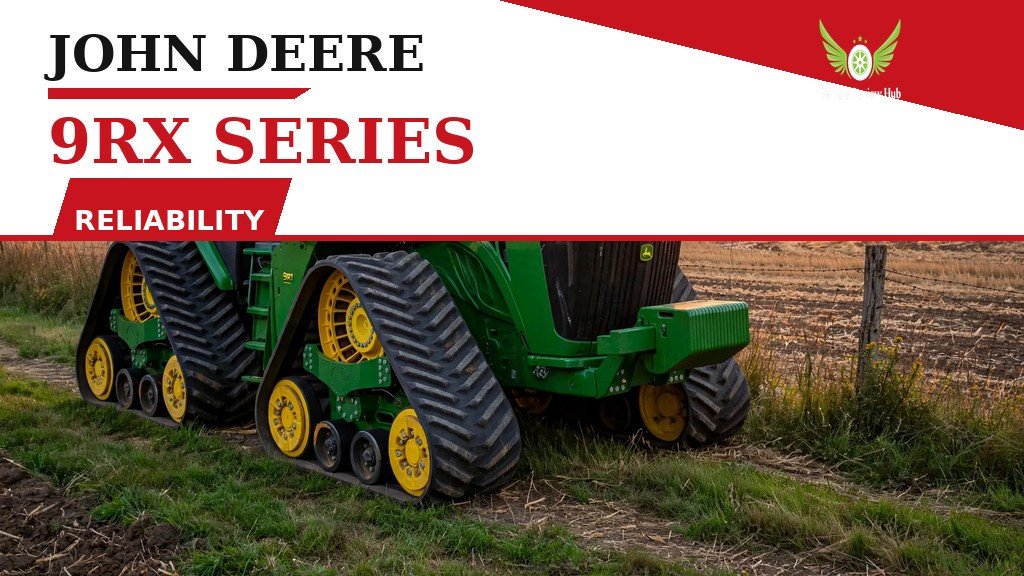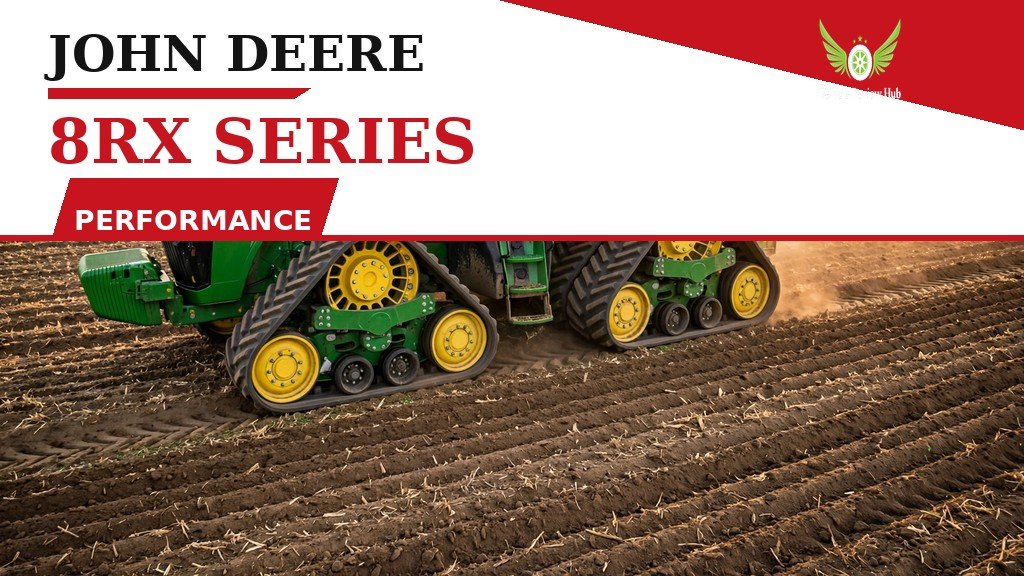
The John Deere 8RX Series performance story starts with a simple fact: four rubber belt tracks put more of the 9.0L engine’s power into the ground than any wheeled tractor in the 310–410 hp class. Across the 8RX 310, 340, 370, and 410, John Deere pairs the PowerTech 9.0L six-cylinder with an e23 PowerShift or AutoPowr IVT, 60–84 gpm hydraulics, and a 244-gallon fuel tank — and the four-track chassis routinely holds slip at 5% or less where a wheeled tractor would be spinning.
This guide breaks down John Deere 8RX Series performance by real work: fuel consumption in fieldwork, PTO operation, and transport; how the tracks handle tillage, planting, and heavy draft; cab comfort and operating limits; and what owners report after thousands of hours. Figures come from Deere spec sheets, dealer listings, and owner reports — labeled where owner-reported.
John Deere 8RX Series Fuel Consumption and Runtime
Fuel is the biggest line in any 8RX budget, so John Deere 8RX Series performance must be judged in gallons per hour as well as drawbar pull. The 9.0L runs cleaner than the 8RT it replaced, and the tracks waste less energy on slip — which shows up directly in per-acre fuel numbers.
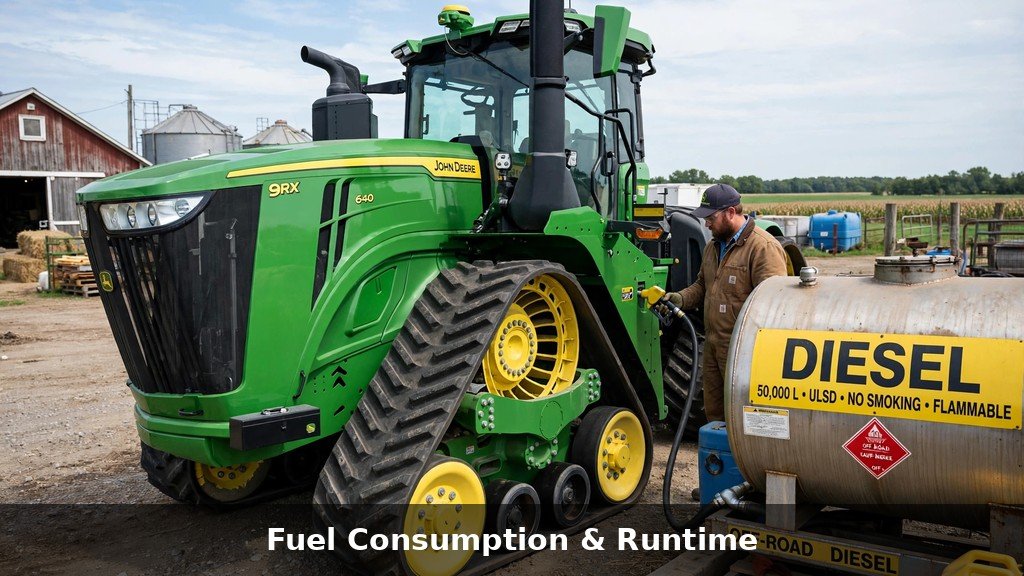
Fuel Use During Fieldwork, PTO Operation and Transport
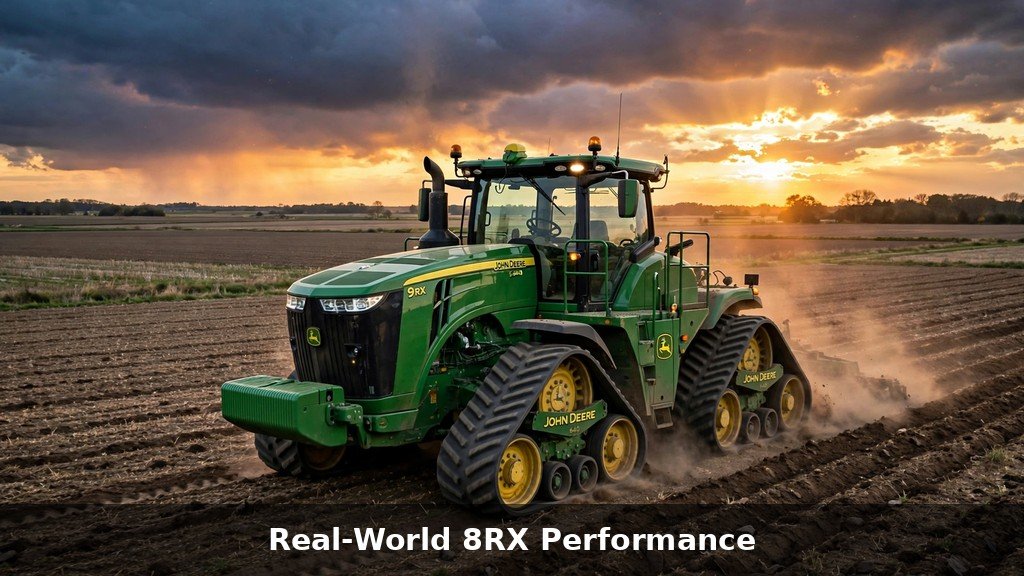
Start with the heaviest work. A Farmers Weekly driver’s view of an 8RX 370 pulling a 6-meter Vaderstad TopDown on cultivations recorded about 60 liters per hour — roughly 16 gph — in sustained heavy draft. That owner-reported figure matches John Deere 8RX Series performance at full load: the 9.0L working hard, the tracks hooked up, and fuel burn the price of moving that much soil — the reality of John Deere 8RX Series performance at full draft.
For PTO work, expect less. Mowing, tedding, and running a grain auger or large manure spreader typically land in the 8–12 gph band on the 8RX 310–370, based on owner reports from US row-crop operations. The 1,000-rpm rear PTO reaches rated speed at 1,995 engine rpm, and the 1,000E economy setting drops that to 1,590 rpm — running light PTO loads in economy mode trims fuel with no other changes.
Transport is the 8RX’s weakest fuel chapter. The e23 PowerShift 40K tops out at 24.9 mph, and hauling 43,300 lb down the road burns roughly 6–9 gph owner-reported — more than a wheeled 8R of the same horsepower, because four tracks have more rolling resistance than tires.
The 244-gallon fuel tank stretches runtime meaningfully. At a heavy-draft burn of 14–16 gph, an 8RX will work a 15–17 hour day before refueling; at a blended 10–11 gph doing mixed fieldwork, you’re looking at 22–24 hours. DEF consumption runs about 2.5% of diesel use from the 9.8-gallon DEF tank. The 244-gallon tank stretches John Deere 8RX Series performance across long working days.
How Model, Workload and Transmission Affect Fuel Economy
Model choice matters less than workload, but it matters. The 8RX 310–340 sip less at light loads than the 370–410 simply because they move less air and fuel through the same 549-cu-in. block at partial load. Owner-reported bands: 6–9 gph for light work, 8–12 gph for fieldwork and PTO operation, 12–18 gph for heavy draft — a realistic envelope for John Deere 8RX Series performance.
Transmission choice is the bigger lever on fuel economy. The e23 PowerShift with Efficiency Manager shifts automatically under load, and the AutoPowr IVT goes further — infinite ratios hold the engine at peak-torque 1,600 rpm while ground speed varies. IVT owners consistently report 5–10% better fuel economy than powershift owners doing the same work, which is why the IVT option earns its keep on high-hour machines.
Intelligent Power Management (IPM) adds up to 35 hp on the FT4/Stage V models during transport above 14 mph and mobile PTO work. IPM lets a smaller 8RX — say the 340 — punch above its weight in bursts without the constant fuel penalty of running a 410 all day. For farms whose heaviest loads are intermittent (grain cart during harvest, occasional deep ripping), sizing to the 310 or 340 and letting IPM cover the peaks is the fuel-smart play for John Deere 8RX Series performance.
John Deere 8RX Series Performance for Farm Work
This is where the four-track design earns its premium. John Deere 8RX Series performance in the field rests on two track advantages: a larger footprint that cuts ground pressure and compaction, and grip in conditions where wheeled tractors slip — wet headlands, hillsides, and heavy residue.
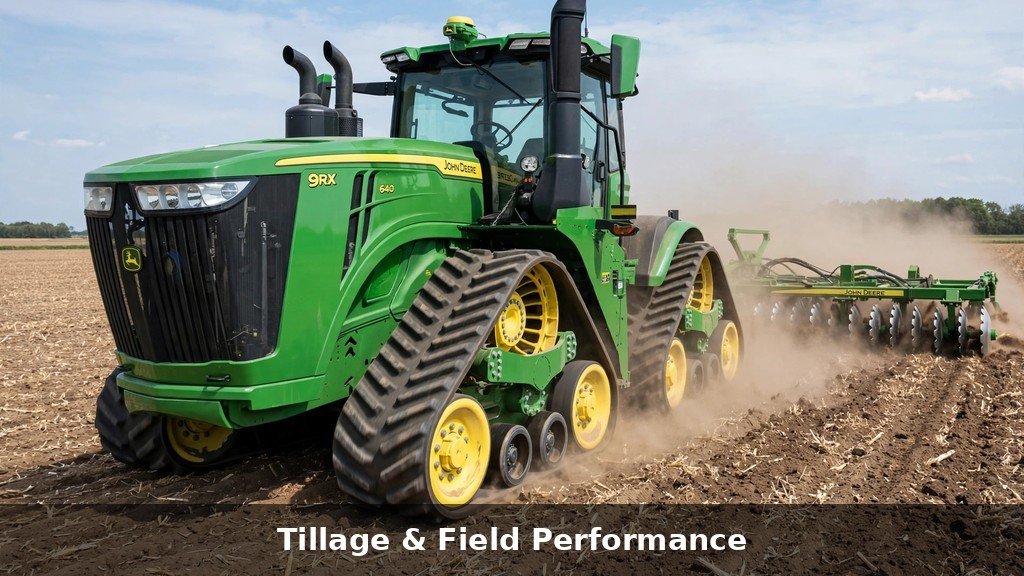
Tillage, Planting, Seeding and Heavy Implement Operation
In primary tillage, the 8RX is in its element. The 40% PTO torque rise and 10% power bulge mean the 9.0L pulls down to 1,600 rpm and keeps digging instead of forcing a downshift, and the tracks convert that torque into forward motion — the Farmers Weekly 8RX 370 held slip around 5% or less pulling heavy cultivations, without front weights. That traction lets an 8RX 370 run a 6-meter TopDown at 12 kph on light land and hold 10 kph on heavy ground. That traction defines John Deere 8RX Series performance where it counts most.
For planting and seeding, the story is precision rather than brute force. The 60 gpm standard (84 gpm optional) closed-center PFC hydraulic system — spec’d on TriGreen’s 8RX 370 listing — runs modern planters’ vacuum fans, hydraulic drives, and downforce systems with flow to spare; the Cat 4N/3 rear hitch lifts 15,000 lb standard (20,000 lb optional, 26,729 lb max behind the lift points). John Deere 8RX Series performance shows in the crop: owners report more even emergence and fuller headlands without deep wheelings, and the Soanes Farming operation noted compaction was “far less of a problem” than with a wheeled 8R on 900-series tires at low pressure.
Our John Deere 8RX Series review covers the model-by-model spec table. The performance takeaway: the 310 and 340 cover most 2,000–4,000-acre row-crop operations, the 370 is the heavy-tillage volume seller, and the 410 runs the biggest air seeders and high-speed tillage tools. The video below shows John Deere 8RX Series performance in real field conditions:
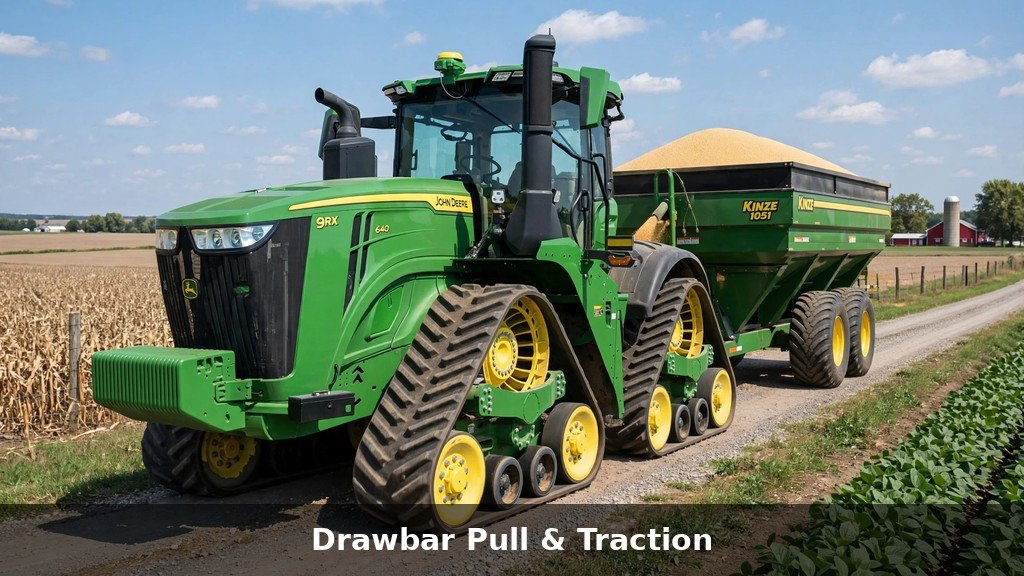
Drawbar Pull, Traction and High-Load Performance
Drawbar work is the signature of John Deere 8RX Series performance. The Cat 4 drawbar (11,000 lb max vertical load with heavy-duty support) anchors grain carts, manure tankers, and tile plows, and the four-track footprint transfers power instead of churning. Compared with the two-track 8RT it replaced, owners report noticeably less scuffing on headland turns — the four independently suspended track units steer more like a wheeled tractor than the old two-track machines did.
High-load performance on the bigger models is genuinely impressive. The 8RX 410 makes 410 rated hp, 443 max, with 1,365 lb-ft at 1,600 rpm — and the tracks let it use all of it. In heavy draft, implement size becomes the limit rather than traction, which is the opposite of the wheeled-tractor problem. If your operation is short on traction rather than horsepower, the 8RX chassis is worth more than the next 40 hp up the model ladder.
Ballast strategy differs from wheeled tractors. The 8RX starts at 43,300 lb base (e23, 18-inch tracks, 120-inch tread) and can be ballasted to 44,100 lb max, with a 53,000-lb maximum permissible weight. Because the tracks distribute weight so well, most 8RX owners run less added ballast than they did on wheels — fundamental to John Deere 8RX Series performance.
John Deere 8RX Series Handling, Comfort and Operating Limits
John Deere 8RX Series performance over a 14-hour planting day lives or dies on the cab, the ride, and the controls. The 8RX shares the CommandView III cab with the 8R (114 cubic feet, 70+ square feet of glass), but the AirCushion suspension on all four track units absorbs the sharp bumps that beat up wheeled tractors in rough fields.
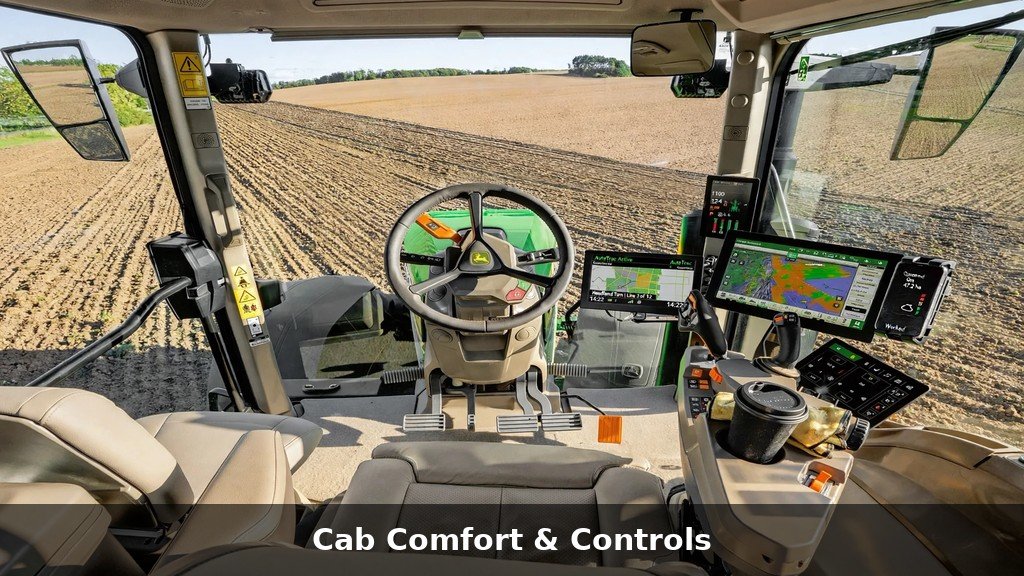
Cab Comfort, Suspension, Controls and Visibility
The cab is a strong point for John Deere 8RX Series performance. The standard air-suspension seat swivels 25 degrees left and 40 degrees right, the 10-inch Generation 4 CommandCenter (4600) runs AutoTrac and implement control, and the optional ActiveSeat II adds fore-aft and vertical suspension on top of the air ride. On IVT models, CommandPRO — the joystick driving control — manages speed, direction, and implement functions from one hand.
Ride quality surprises first-time operators. The AirCushion suspension gives each track unit independent vertical travel, so the cab stays level over terraces, pivot ruts, and rough headlands. Road transport at 24.9 mph is composed — far better than the two-track 8RT generation. Visibility is excellent: the cab sits high, the glass area is huge, and row-crop configurations (16.5–30-inch belt widths, 76–120-inch treads) keep the row in sight.
Track Performance, Soil Conditions and Turning Limitations
Every design has limits. Turning is tighter than a wheeled 8R thanks to the four independently steering track modules, but tight turns on hard surfaces accelerate belt wear, so pavement and tight yards still need planning. On pavement, the tracks are louder and wear faster than tires, so long road moves cost more in belt life than tire life. Soil conditions are the home turf of John Deere 8RX Series performance: in wet springs, the 8RX works ground that would mire a wheeled tractor, and the wide stance (up to 120-inch tread) holds steep sidehills that narrow duals can’t.
The condition to respect is rocky ground — sharp rocks are the enemy of rubber belts. The mid-rollers (two front, three rear per track) are built tough, but rock damage is the most expensive track repair there is. Belt life is the number owners watch: 4,000–6,000 hours owner-reported on row-crop duty, shorter on abrasive soils or with frequent road travel. Budget belt replacement as a known cost. Belt life is the limit owners watch when running John Deere 8RX Series performance hard, and our John Deere 8RX Series maintenance guide covers undercarriage inspection and track care in detail.
John Deere 8RX Series Real-World Owner Experience
Spec sheets tell you what John Deere 8RX Series performance can do; owners tell you what it’s like to live with. The theme across owner reports: the four-track chassis changes daily workflow more than the horsepower number suggests — fewer stuck days, less compaction anxiety, and implements running at designed width and speed instead of being sized down for traction.
Owner-Reported Benefits, Complaints and Operating Trade-Offs
The benefits owners cite most: traction in marginal conditions, dramatically reduced compaction, and wider implements. The Soanes Farming operation upgraded from a 5-meter to a 6-meter Vaderstad TopDown because the tracks put more power down than their old RT or wheeled R-series — the machine grew the implement. Multiple owners describe the 8RX as the tractor that “just keeps going” in wet autumns when everything on tires is parked — the ultimate John Deere 8RX Series performance endorsement.
Complaints about John Deere 8RX Series performance are real but manageable. Road transport is the most common gripe — slower, louder, harder on belts than tires. Turning in tight yards needs planning. A few owners mention the headland-management learning curve and belt-replacement sticker shock. The e23 PowerShift’s shift quality under heavy load draws occasional criticism, which is part of why the IVT take-rate is high on 8RX orders.
The trade-off summary from the owner community: if your farm’s binding constraint is traction, compaction, or timeliness in wet conditions, the 8RX pays for itself. If your work is mostly transport, loader duty, and light fieldwork, the wheeled 8R’s performance profile fits better and costs less to run. Match the chassis to the constraint — the practical rule for judging John Deere 8RX Series performance against the alternatives.
Choosing the Right Model and Track Setup for Your Work
Model selection is where John Deere 8RX Series performance meets the budget. The 310 and 340 suit large mixed operations where flotation beats raw power — wet-soil regions and controlled-traffic systems. The 370 and 410 handle the biggest tillage tools, large air seeders, and heavy grain-cart duty at scale. Remember the IPM boost: a 340 with 35 extra hp on tap covers most 370 jobs at a lower purchase price and slightly lower fuel burn.
Track setup is the second decision. Belt widths run 16.5, 18, 24, and 30 inches; treads run 76, 80, 88, and 120 inches — Papé’s 8RX 340 spec sheet lays out the full configuration range. Row-crop work wants narrow belts on the right tread for the row spacing; heavy tillage wants wide belts for maximum footprint. The 18-inch belt on 120-inch tread is the most common US configuration. Changing belt width later is possible but expensive, so spec it right at order time.
Transmission choice rounds out the setup. The e23 PowerShift is proven, cheaper, and familiar — fine for steady draft work. The AutoPowr IVT costs more upfront but pays back in fuel savings and operator ease on varied work. For 1,000+ hours a year of mixed tillage, planting, and cart duty, the IVT is what most experienced 8RX owners recommend — it squeezes the most from John Deere 8RX Series performance. Our John Deere 8RX Series ownership cost guide runs the new-vs-used math with these configurations.
Frequently Asked Questions About John Deere 8RX Series Performance
Quick answers on 8RX fuel, traction, transmissions, and how the four-track chassis compares with wheels.
How much fuel does a John Deere 8RX use per hour?
Owner-reported: 6–9 gph for light work, 8–12 gph for general fieldwork and PTO operation, and 12–18 gph for heavy draft on the bigger models (one 8RX 370 case: ~16 gph). The 244-gallon tank gives 15–24 hours of runtime depending on load. These owner-reported figures define real-world John Deere 8RX Series performance fuel expectations.
Is the 8RX better than the wheeled 8R for traction?
Yes — traction is the core of John Deere 8RX Series performance. Four rubber belt tracks spread 43,300+ lb over a far larger contact area than tires, holding slip at 5% or less where a wheeled tractor would spin. The trade-off is higher rolling resistance on roads: more transport fuel and faster belt wear on pavement.
Which 8RX transmission is better: e23 PowerShift or IVT?
For fuel economy and operator ease, the AutoPowr IVT wins — infinite ratios hold peak-torque rpm as ground speed varies, and owners report 5–10% better fuel economy than with the powershift. The e23 PowerShift with Efficiency Manager is proven and cheaper for steady draft work. On high-hour machines, the IVT usually earns back its premium.
What does IPM do on the 8RX?
Intelligent Power Management adds up to 35 hp on the Final Tier 4/Stage V models during transport above 14 mph and mobile PTO work. It lets a smaller 8RX — like the 310 or 340 — handle brief peak loads without the constant fuel and purchase cost of a bigger model. Think of it as a reserve, not a replacement for proper sizing.
How long do 8RX track belts last?
Owner-reported belt life on row-crop duty is typically 4,000–6,000 hours with good maintenance; abrasive soils, frequent road travel, and tight turning shorten it. Sharp rocks are the biggest threat. Inspect the undercarriage — mid-rollers, idlers, alignment — at every service, because catching wear early beats a catastrophic belt failure.
Does the 8RX need DEF?
Yes. The US Final Tier 4 9.0L engine uses DOC + DPF + SCR with DEF — the 9.8-gallon DEF tank needs refilling roughly every two to three diesel fills, at about 2.5% of diesel use. The DPF regenerates automatically; parked cleaning is available if a cycle gets interrupted. Keep DEF fresh — stale DEF is one of the most common causes of derate codes owners report.