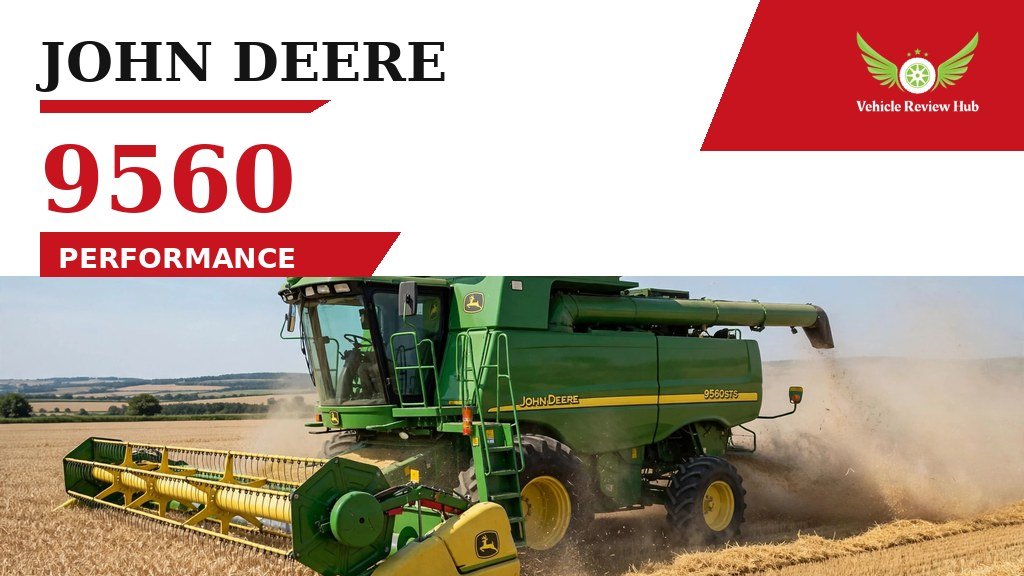
If you are shopping for a used Class 6 combine, John Deere 9560 combine performance is the first thing to get honest about. The 9560 badge covers two different machines: the conventional straw-walker 9560 and the 9560 STS with its single-rotor separation system. They share a name and a cab, but not an engine, a grain tank, or a threshing system, so any fair account of John Deere 9560 combine performance must say which machine it means, and this guide does that throughout.
The short answer: John Deere 9560 combine performance means solid mid-size capacity with a small grain tank by modern standards. The 9560 STS, with its 8.1-liter engine at about 265 horsepower, is strong in soybeans, shells corn capably when set correctly, and can struggle in hard-threshing small grains if the rotor is not dialed in. The walker 9560, with its 6.8-liter engine at 220 or 240 horsepower, is gentler and simpler, and some owners report a cleaner corn sample from it. No Nebraska or OECD test covers combines, so no tested throughput figures are quoted here.
John Deere 9560 Combine Fuel Consumption and Harvesting Efficiency
Fuel is where John Deere 9560 combine performance hits the farm budget hardest, because a combine burns its heaviest fuel exactly when the harvest window is shortest. The STS carries a 200-gallon tank, which sounds generous until a 265-horsepower engine works a full threshing load all day. In practice, John Deere 9560 combine performance on fuel depends far more on crop, moisture, and ground speed than on the badge.
Fuel Use Under Different Crop and Field Conditions
No factory fuel rating exists for the 9560, and no laboratory publishes a gallons-per-hour figure for it, so the numbers here are planning estimates from engine size and typical Class 6 workloads, not measured results. In dry small grains with a 25-foot platform, a reasonable planning band for John Deere 9560 combine performance is roughly 7 to 10 gallons per hour. In corn and soybeans, where threshing works harder and grain volume is much higher, plan on roughly 9 to 13 gallons per hour. In green, tough, or high-moisture material, the band rises to roughly 11 to 15 gallons per hour. A full 200-gallon STS tank realistically covers about a long day and a half of steady harvesting.
How Crop Moisture, Yield, Header Width and Ground Speed Affect Fuel Demand
Four variables drive John Deere 9560 combine performance on fuel. Crop moisture comes first: wet grain and green straw are heavier and harder to separate, and corn at 25 percent moisture can burn 20 percent more fuel per acre than the same field at 18 percent. Yield is second: 240-bushel corn puts roughly twice the grain through the shoe as 120-bushel corn. Header width is third: wider platforms cover more acres per hour but feed more material per second, so fuel per hour rises even as fuel per acre falls. Ground speed is fourth and operator-controlled: pushing from 4 mph to 5 mph raises throughput by a quarter but can raise fuel burn by more.
The practical rule for John Deere 9560 combine performance is to let the machine tell you when it is full. If the rotor groans, tailings climb, and loss monitors flicker, slowing half a mile per hour usually saves fuel and grain. The optional HarvestSmart feed-rate system, introduced for 2005 models, does this automatically, and a used STS fitted with it deserves a look.
John Deere 9560 Combine Harvesting Performance
When farmers ask about John Deere 9560 combine performance, they usually mean how much crop it puts in the tank per hour and how much grain it leaves behind. The answer depends on separation, where walker and STS genuinely diverge. The STS uses a single tine separator rotor with a three-step cage that lets material expand as it accelerates, freeing trapped grain. The walker uses a conventional cylinder and straw walkers. Both do good work, but John Deere 9560 combine performance in each crop rewards a different setup.
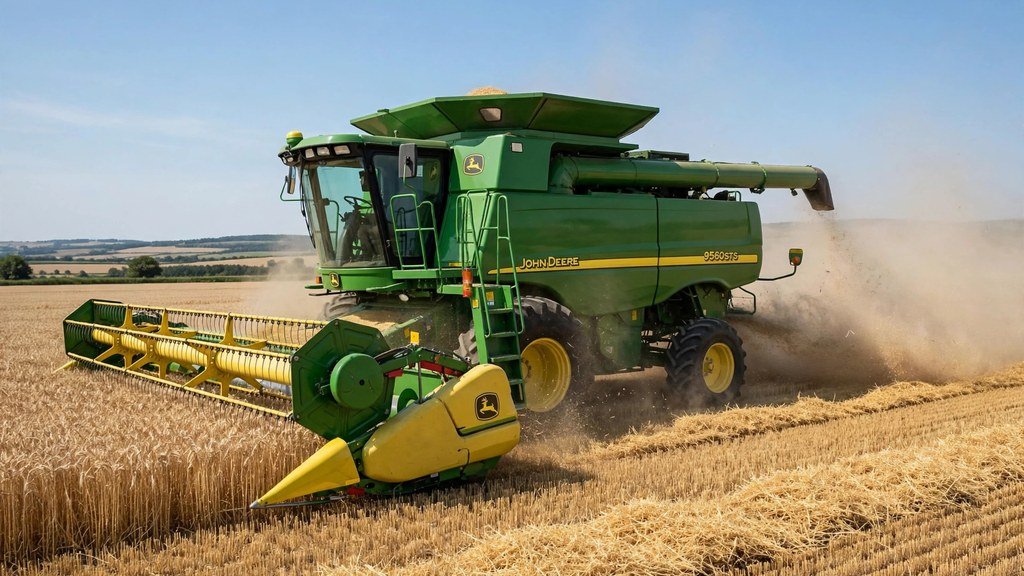
The video below shows a John Deere 9560 STS combine with a 30-foot 630F head harvesting wheat near Greenfield, Indiana — the same machine this guide covers, at work in the field.
Grain Throughput, Grain Loss and Cleaning Performance
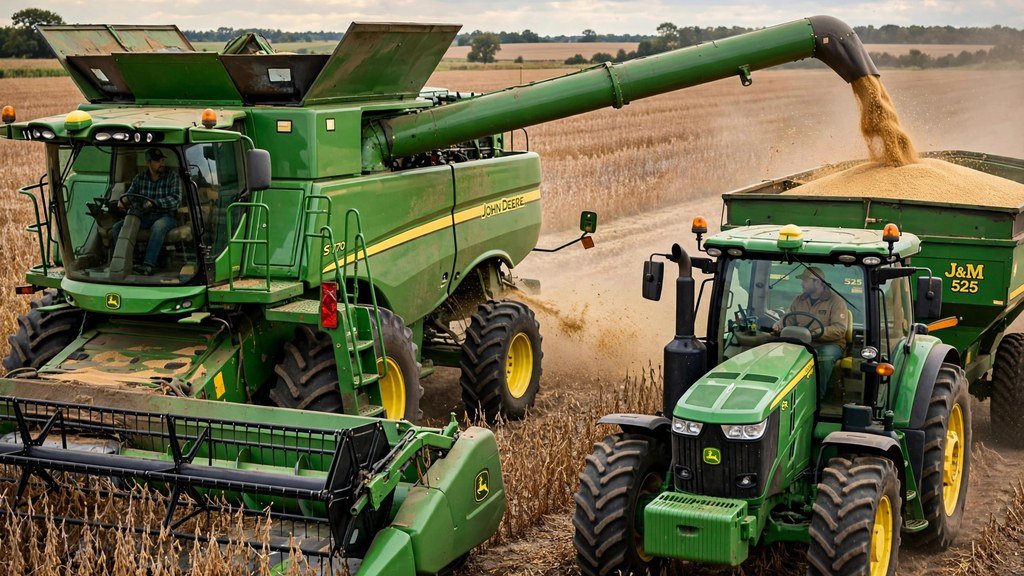
Throughput is the uncomfortable topic in John Deere 9560 combine performance, because no standardized test number exists: Deere never published a bushels-per-hour rating for the 9560, so any precise tested figure is invented. Honest planning math still works. A 25-foot platform at 4 mph covers about 12 acres per hour before field efficiency, or roughly 8 to 10 acres per hour at a realistic 70 to 80 percent efficiency. In 60-bushel wheat that is roughly 500 to 600 bushels per hour, so the 220-bushel STS tank fills about every 20 to 25 minutes. In 200-bushel corn with a 20-foot, 8-row head at 4 mph, the same math gives roughly 1,900 bushels per hour, and the tank fills in about seven minutes. That small tank is the biggest practical limit on John Deere 9560 combine performance in high-yield corn, and it is why a grain cart is part of the system, not a luxury.
Grain loss and cleaning quality are where John Deere 9560 combine performance is won or lost, more than on horsepower. The 60 Series STS gained a larger fan housing and redesigned chaffer that Deere said cut tailings return by as much as half. The practical check is the same on both: stop, look behind the machine, and count kernels. A loss monitor never replaces a physical check at the start of each field. For John Deere 9560 combine performance, the gap between a well-set machine and a poorly set one is routinely larger than the gap between walker and rotor.
Walker vs. STS Separation in Corn, Soybeans and Small Grains
In soybeans, John Deere 9560 combine performance favors the STS. Owner reports describe the rotor as strong in soybeans, where easy threshing keeps the sample clean at good speeds. In corn, John Deere 9560 combine performance is more mixed. The STS shells corn fine in most conditions, but its aggressive pre-rotor beater can damage kernels, worse with high tailings. Beater kits for sensitive crops can cost capacity and plug in soybeans, so a corn-and-soybean farm must compromise. Some owners report a better corn sample from a well-tuned walker — worth weighing if corn quality is your top priority.
In small grains, John Deere 9560 combine performance depends on how hard the crop threshes. In easy-threshing wheat both do well; one documented 2024 harvest ran a 9560 STS with a 630F head in Indiana wheat. In hard-threshing cereals, owner reports say the STS can struggle on separating capacity. For John Deere 9560 combine performance in tough straw, the walker is more forgiving but gives up capacity. The 2004 factory lineup states the split plainly: the 60 Series range offered the 9560 as a 220- or 240-horsepower walker with a 204-bushel tank and the 9560 STS as a 265-horsepower rotor machine with a 220-bushel tank, and that gap is the simplest summary of the two machines’ characters.
| Specification | 9560 Walker | 9560 STS |
|---|---|---|
| Engine | 6.8 L PowerTech, 6-cylinder | 8.1 L PowerTech 6081HH, 6-cylinder |
| Rated power | 220 or 240 hp | 265 hp, 284.3 hp with boost |
| Separation | Cylinder and straw walkers | Single tine separator (STS) rotor |
| Grain tank | 204 bushels | 220 bushels |
| Unloading rate | Standard rate, confirm on the machine | 2.2 bushels per second |
| Separator speed (STS) | Not applicable | Dual-range: 480–1,300 rpm high, 230–600 rpm low |
| Best-fit strength | Gentle corn sample, tough straw | Soybeans, high-capacity small grains |
Variance to know: later Bullet Rotor STS machines, including some 2007 models, are reported by owners to carry the 6.8-liter engine, not the 8.1-liter unit. Check the engine plate; John Deere 9560 combine performance figures from the early STS do not automatically apply to later Bullet Rotor machines.
John Deere 9560 Combine Grain Handling and Field Operation
Grain handling is where John Deere 9560 combine performance either keeps a harvest crew moving or stops it every few minutes. The STS unloads at 2.2 bushels per second — a full 220-bushel tank in about 100 seconds — and unloading on the go is standard practice. That speed matters because in high-yield corn the operator unloads constantly. The walker’s unloading rate was not separately published in the sources used here, so confirm it on the machine. The working rule for John Deere 9560 combine performance is simple: pair it with a grain cart, keep the cart close, and never let it sit full while trucks catch up.
Grain Tank Capacity, Unloading Rate and Header Setup
Header setup is the other half of grain handling, and John Deere 9560 combine performance rewards getting it right before the season. The 60 Series launched alongside 600 Series Grain Platforms — HydraFlex flex from 15 to 35 feet, rigid from 18 to 30 feet — with a fore/aft tilt-frame feederhouse keeping the cutterbar parallel to the ground. For soybeans, a flex platform following the ground is worth more than extra horsepower, picking up low pods otherwise left behind. For corn, the 693 and 694 heads are period-correct, with deck plates set to the cob: too wide damages kernels, too narrow drags stalks. The single-point header hookup joins electrics, hydraulics, and the feederhouse latch in one lever motion, cutting changeover time.
Tank extensions deserve a mention in John Deere 9560 combine performance: many used machines carry a bin extension above 220 bushels — a convenience for time between stops, not threshing capacity, so check for leakage.
Cab Visibility, Controls and Long Harvesting Days
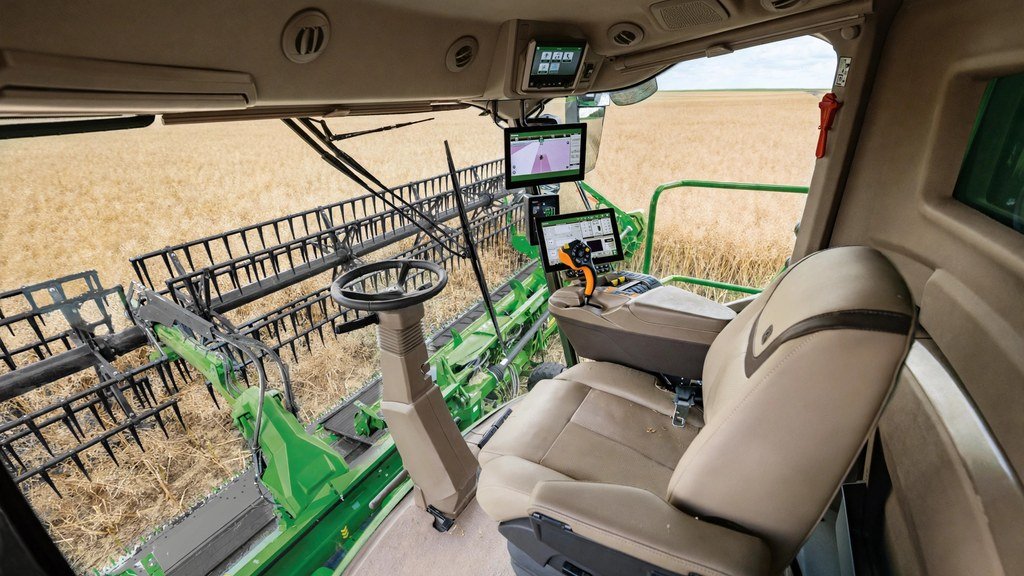
Long days are harvest reality, and John Deere 9560 combine performance includes how the operator feels at hour twelve. The 60 Series premium cab is quiet and well laid out, with separator, header, and unloading controls on the armrest console and optional TouchSet holding 16 crop presets on STS machines. That matters for John Deere 9560 combine performance: a tired operator at dusk is when settings drift and loss climbs, and a one-touch preset restoring a known-good configuration is worth real bushels. GreenStar yield monitoring and optional AutoTrac steering, offered from September 2004, cut fatigue by holding full width and reducing overlap. Forward visibility is good; keep glass clean and filters serviced so the combine holds capacity through the evening.
John Deere 9560 Combine Real-World Owner Experience
Owner experience is where John Deere 9560 combine performance stops being a specification sheet. The consistent story: the STS is a dependable, right-sized mid-size grain farm combine, strong in soybeans, acceptable in corn, rewarding careful setup and punishing neglect. The walker draws a loyal following among owners valuing simplicity, a gentler sample, and lower repair complexity. Neither is a flagship: the 9660 and 9760 STS sit above them in the lineup. Understanding that position is the key to judging John Deere 9560 combine performance fairly.
Strengths and Limitations for Different Farm Sizes
For roughly 500 to 1,500 acres of grain, John Deere 9560 combine performance is a natural fit — planning guidelines, not rules. Below about 500 acres, John Deere 9560 combine performance value thins: fixed costs spread over few acres, and a smaller combine or custom work may pencil out better. Above about 1,500 acres, the small tank and mid-size capacity cost time: more unloads, more coordination, a longer window risking weather. For a larger farm, carts, trucks, and drying capacity must keep it fed and emptied.
Hours shape John Deere 9560 combine performance value as much as acres. A 2005 STS listed by an Illinois dealer at $44,900 showed 4,049 engine hours and 2,576 separator hours — much of its life traveling or idling. A 2006 STS at a North Carolina auction drew a $25,000 bid with 4,480 engine hours and 3,234 thresher hours — a tighter ratio, and a bid is not a sale. The dealer listing with its engine and separator hours and the auction record with its own hours and bid both show why John Deere 9560 combine performance value depends on asking for both hour meters, not just the engine figure. The maintenance checks for a used 9560 and the ownership-cost analysis belong in the same buying decision.
Matching Combine Capacity to Acres and Harvest Conditions
Matching machine to farm comes down to three questions, and John Deere 9560 combine performance answers each one plainly. First, your peak week: if your whole wheat crop ripens in seven days, you need capacity for that week, possibly a second machine or crew. Second, grain handling: a 220-bushel tank only limits you if carts and trucks cannot keep up — a farm with a 1,000-bushel cart out-harvests a bigger combine with no cart. Third, crops: soybean-heavy plays to STS strength; corn-heavy selling on sample quality may prefer the walker or a set STS with the beater kit; tough straw needs extra setup time. Answer those three questions honestly and John Deere 9560 combine performance will either fit your farm or tell you it does not. The 9560 review covers walker-versus-STS differences, specifications, and used prices.
Frequently Asked Questions About the John Deere 9560 Combine
These are the questions buyers and owners ask most often about John Deere 9560 combine performance. For a specific machine’s John Deere 9560 combine performance, check walker or STS, engine, and separator hours.
What is the difference between the 9560 walker and the 9560 STS?
The walker uses a cylinder and straw walkers with a 6.8-liter engine at 220 or 240 horsepower and a 204-bushel tank; the STS uses a single-rotor tine separator with an 8.1-liter engine at 265 horsepower (284.3 with boost) and a 220-bushel tank. That difference shapes John Deere 9560 combine performance in every crop: more STS capacity and soybean strength versus walker simplicity and a gentler corn sample.
How much fuel does a John Deere 9560 combine use per hour?
No factory or tested gallons-per-hour figure exists, so use planning estimates: roughly 7 to 10 gallons per hour in dry small grains, 9 to 13 in corn and soybeans, 11 to 15 in green or high-moisture material. Actual burn depends on moisture, yield, header width, and ground speed, and John Deere 9560 combine performance on fuel rewards slowing slightly in tough patches over holding speed on boost.
Is there a Nebraska test for the John Deere 9560 combine?
No. Nebraska Tractor Tests cover tractors, not combines, and no OECD result for the 9560 was retrievable for this article. That is why this guide quotes no tested figures for John Deere 9560 combine performance.
How big is the grain tank on a 9560 STS, and how fast does it unload?
The STS tank holds 220 bushels against 204 on the walker, unloading at 2.2 bushels per second — a full tank in about 100 seconds. In high-yield corn that small tank fills in roughly seven minutes, which is why John Deere 9560 combine performance in corn depends so heavily on a grain cart alongside.
Which crops does the 9560 STS handle best?
For John Deere 9560 combine performance, soybeans are the STS’s strongest crop according to owner reports: easy threshing, clean sample, good ground speeds. It shells corn well mostly but can damage kernels via its aggressive pre-rotor beater, and can be short on separating capacity in hard-threshing cereals. For John Deere 9560 combine performance in tough conditions, the walker is more forgiving in tough straw and often kinder to the corn sample.
What header sizes fit the John Deere 9560 combine?
For John Deere 9560 combine performance, the period-correct pairing is 600 Series Grain Platforms — HydraFlex flex from 15 to 35 feet, rigid from 18 to 30 feet — plus 693 and 694 corn heads. A documented 2024 wheat harvest ran a 9560 STS with a 30-foot 630F head. For John Deere 9560 combine performance, match the header to the crop and never exceed what the threshing system can feed cleanly.
What should separator hours tell me that engine hours do not?
Separator hours count only threshing time for John Deere 9560 combine performance; engine hours count everything including road travel and idling. A machine with 4,049 engine hours and 2,576 separator hours spent much of its life outside threshing — healthier than the same engine hours with 3,500 separator hours. Always ask for both meters when judging John Deere 9560 combine performance, and treat a machine reporting only engine hours as incompletely described.
Does the later Bullet Rotor 9560 STS have the same engine?
Not necessarily. Early STS machines carry the 8.1-liter 6081HH engine, but owners report later Bullet Rotor machines, including some 2007 models, carry a 6.8-liter engine instead. Check the engine plate, because John Deere 9560 combine performance figures from the early STS do not automatically transfer to the later version.
How many acres can a 9560 combine realistically cover?
As a planning guide, a 25-foot platform at 4 mph covers roughly 8 to 10 acres per hour at realistic efficiency, or roughly 80 to 100 acres in a long day before unloading, turning, and moving. That makes John Deere 9560 combine performance a natural fit for roughly 500 to 1,500 acres, depending on harvest window, grain-cart setup, and whether crops ripen all at once.
Is the 9560 STS a good used combine buy in 2026?
For a mid-size grain farm valuing a proven, repairable machine that can live with a 220-bushel tank plus a grain cart, yes — recent anchors: a 2005 STS listed at $44,900 with 4,049 engine hours, and a $25,000 bid on a higher-hour 2006 machine. For a farm needing flagship capacity or a very large tank, the 9660 STS or a newer class is better, and John Deere 9560 combine performance should be judged against that honest alternative, not machines twice its size.