
John Deere 9570RX maintenance is the difference between a four-track tractor that earns for another decade and one that eats its purchase price in track and repair bills. The 9570RX is a used-only machine now — the original 2015-launch 9RX family member with a 570-horsepower Cummins engine, an 18-speed PowerShift, and four rubber belt tracks. This guide covers the full John Deere 9570RX maintenance schedule, what each service costs, how reliable the tractor is over the long term, the common problems to watch for, and exactly how to inspect a used machine before money changes hands.
The short version of John Deere 9570RX maintenance: engine oil and filters every 500 hours, transmission and hydraulic oil every 1,500 hours, coolant at 6,000 hours, and track inspection every single day you run it. Tracks are the big-ticket item — a full set of belts can cost more than a good used row-crop tractor — so track discipline matters more on this machine than on any wheeled tractor.
John Deere 9570RX Maintenance Schedule and Service Costs
The John Deere 9570RX maintenance schedule follows the same service logic as the rest of Deere’s 9 family: short daily checks, a 500-hour engine service, a 1,500-hour transmission and hydraulic service, and a 6,000-hour coolant service. Because these tractors now carry anywhere from 1,000 to 6,000-plus hours, the schedule below is written for the used buyer — what to do at purchase, what to do every season, and what each visit typically costs at the dealer versus in your own shop. Estimates come from dealer quotes and owner reports.
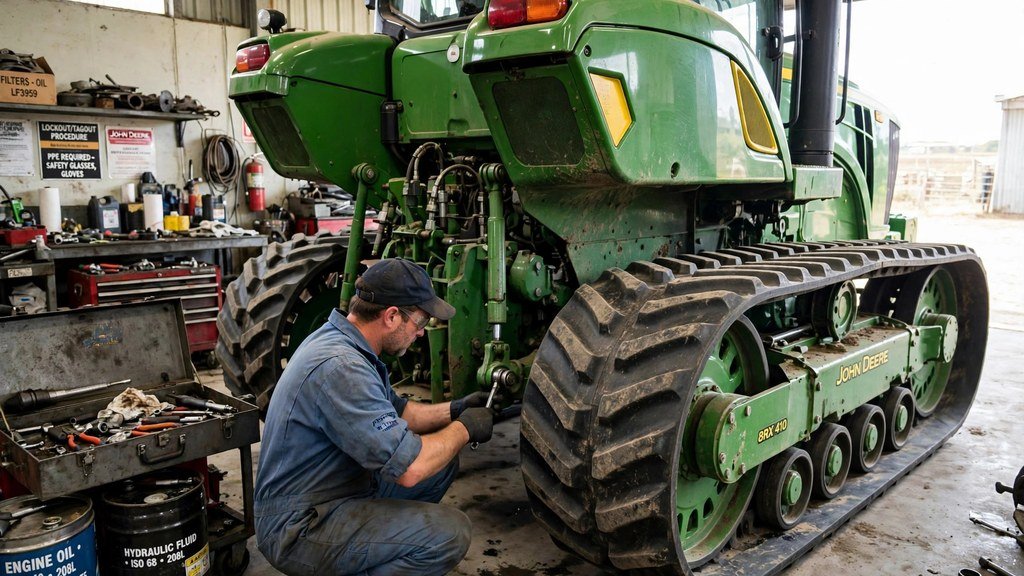
Engine Oil, Fuel Filters, Air Filters and Cooling System
John Deere 9570RX maintenance starts with engine oil and filter service every 500 hours when using John Deere Plus-50 II oil; with other CJ-4 oils the interval drops to 250 hours, which is why most owners stick with the factory oil. Change both fuel filters at the same 500-hour visit, drain the water separator daily, and treat fuel quality as maintenance: the Cummins QSX15 runs a high-pressure fuel system that does not forgive dirty diesel or water contamination. A dealer 500-hour service typically runs $1,800–$3,000 (estimate), while a do-it-yourself service with factory filters and oil lands around $700–$1,200 (estimate). The air filter is a dual-stage unit with exhaust aspiration; inspect it annually and in dusty conditions far more often, because a restricted filter costs power and fuel long before it triggers a warning. The cooling system runs a 6,000-hour coolant drain interval with COOL-GARD II coolant and extender — check the coolant level and the radiator core daily in harvest dust, since a plugged core is the most common cause of load-related overheating on these tractors. If you are comparing service demands across the range, our 9570RX review and specs guide lays out the full machine specification, and the 9570RX performance and fuel usage guide covers what the engine drinks under load.
Transmission, Hydraulic Oil, Tracks and Lubrication
In the John Deere 9570RX maintenance schedule, transmission and hydraulic oil plus filters go every 1,500 hours — a dealer visit that typically costs $3,000–$5,000 (estimate) because of the oil volume involved: the system holds 58 gallons without a hitch and PTO, or 60 gallons with them. Grease on schedule, not on memory: hinge pins and track hardware get attention at 50 hours, and brakes, the neutral-start system, the park brake, and driveshafts are checked at 250 hours. Tracks get a daily walk-around — tension, guide lugs, tread bars, cuts, and debris packed between the belt and the wheels — because catching a failing belt early is worth thousands. The table below summarizes the schedule and the typical costs.
| Service item | Interval | Typical cost (est.) |
|---|---|---|
| Daily checks (fluids, tracks, leaks, belts, hoses) | Daily / 10 hours | Operator time only |
| Engine oil + filter (Plus-50 II) | 500 hours | $1,800–$3,000 dealer / $700–$1,200 DIY |
| Fuel filters + water separator | 500 hours | Included in 500-hour service |
| Track + hinge-pin service | 50 hours | Shop time + grease |
| Brakes, neutral start, park, driveshafts | 250 hours | Inspection labor |
| Transmission + hydraulic oil + filter | 1,500 hours | $3,000–$5,000 dealer (est.) |
| Coolant drain + COOL-GARD II | 6,000 hours | Dealer service (est.) |
| Replacement track belt (each, installed) | As needed | $10,000–$15,000+ per belt (est.) |
Keep this John Deere 9570RX maintenance table with the machine’s service book so every interval is visible at a glance.
John Deere 9570RX Reliability and Long-Term Durability
The record on John Deere 9570RX maintenance is genuinely strong where it counts — engine, transmission, and frame — and expensive exactly where you would expect on a four-track machine: the undercarriage. These tractors were built for the heaviest draft work in North American agriculture, and well-kept examples routinely pass 5,000 hours with their original major components. The weak points are not mysterious: tracks and their running gear, the aftertreatment system, and the electronics that manage both.
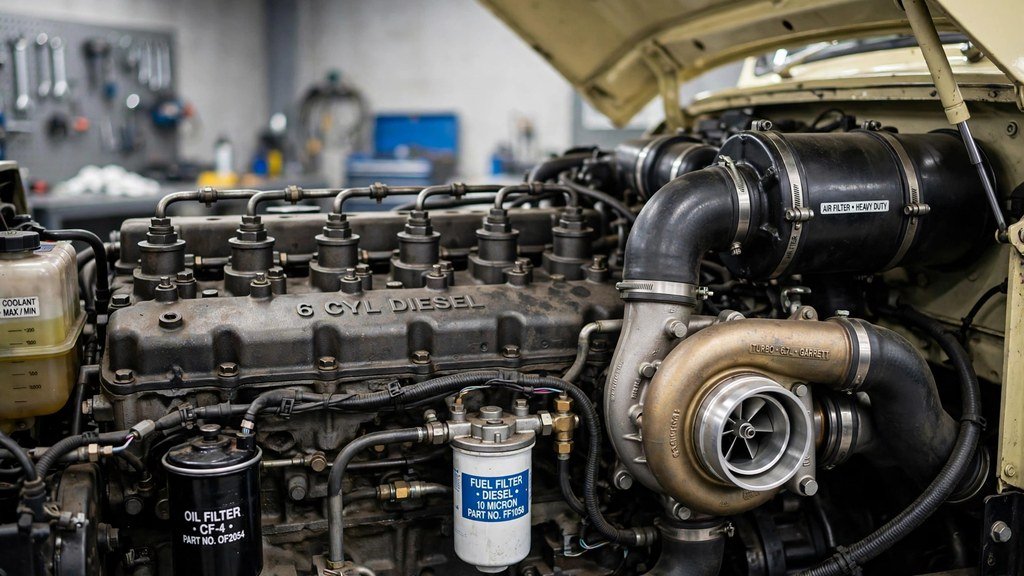
Cummins Engine, PowerShift Transmission and Hydraulic System
Here the John Deere 9570RX maintenance record needs to be set straight, because the 9RX engine story is widely confused. The smaller original 9RX models — the 9470RX and 9520RX — used John Deere’s own PowerTech PSS 13.5L engine. The 9570RX and 9620RX did not: they used the Cummins QSX15, a 14.9-liter (912 cu in) inline six with a single variable-geometry turbo, air-to-air aftercooling, cooled EGR, and DOC, DPF, and SCR aftertreatment meeting Final Tier 4. Rated output is 570 hp at 2,100 rpm with a maximum of about 628 hp, peak torque of 1,941 lb-ft at 1,600 rpm, 38 percent torque rise, and 335 hp at the PTO. Any source that calls the 9570RX a 13.5L PowerTech machine has mixed it up with its smaller siblings — check the engine badge and the serial plate on the machine itself, because that distinction drives parts, filters, and service procedures. The dealer spec sheet for the 9570RX confirms the Cummins QSX15, the 570 hp rating, and the hydraulic figures used here.
Factors Affecting Service Life, Downtime and Repair Costs
Three things decide John Deere 9570RX maintenance outcomes — how long a 9570RX lasts and what it costs to keep: hours, track history, and software. Hours alone mislead — a 3,000-hour tractor that spent its life on road transport and scraper work can need tracks sooner than a 5,000-hour tillage machine that never left the field. The second factor is electronics: owner reports consistently put software and sensor faults — code cascades, guidance gremlins, and aftertreatment sensors — ahead of hard mechanical failures as the most common surprise-repair category, and dealer diagnostic time is expensive. The third is simply parts scale: everything on a 570-horsepower four-track machine costs more than the same job on a row-crop tractor, from the 60-gallon transmission service to a single track belt. Budget a track reserve from day one. For the ownership-cost math behind these reserves, see our 9570RX ownership cost and resale guide.
John Deere 9570RX Common Problems and Warning Signs
No used 9570RX is problem-free, and John Deere 9570RX maintenance is mostly about catching problems early — read this section as a checklist, not a warning against the model. Most issues on these tractors announce themselves early — a code on the CommandCenter, a slow hydraulic function, a belt that starts to chunk — and the expensive failures are almost always the ones that were ignored for a season.

Engine, Electrical, Hydraulic and Transmission Symptoms
In John Deere 9570RX maintenance, the engine-side watch list starts with lost power, hard cold starts, and repeated DPF regeneration problems. Diagnostic cases on Deere Final Tier 4 machines show how a single failed sensor — for example, a DOC inlet temperature sensor reading out of range — can inhibit exhaust filter cleaning entirely, leaving the operator with a clogged filter and a dashboard full of codes; the fix is a sensor, but the symptom looks like a major engine failure. Electrical complaints usually start small: warning lights that stay lit, slow cranking, or a sensor that drops out intermittently — check batteries, grounds, and harness connectors before assuming a module has failed, since corrosion and loose connections cause a large share of nuisance faults. Hydraulic symptoms are slow or unresponsive functions, visible leaks at lines and couplers, and pressure that fades under load; on a machine with up to 115 gpm and eight SCVs, a weak pump or a bypassing valve shows up first on the most demanding implement. Transmission symptoms on the e18 include slipping, harsh or missed shifts, and unusual vibration — a recalibration sometimes cures shift-quality complaints, but slipping under load is a stop-and-diagnose fault, not a setting. Overheating under load usually traces back to a plugged radiator core or a tired fan drive before it traces to the engine itself.
Track Wear, Alignment and Undercarriage Inspection
Track problems are the signature expense in John Deere 9570RX maintenance, and they are also the most inspectable. Walk each belt end to end: look for tread-bar chunking, cuts, exposed cables, and guide-lug wear, and check that all four belts track straight with even tension. Misalignment shows as one-sided wear on the guide lugs and as belts that creep sideways; it usually traces to worn idlers, mid-rollers, or a bent component rather than to the belt itself. Measure remaining tread depth and compare corners — a machine with one fresh belt and three worn ones is telling you about an incident, not about maintenance. Check the drive sprockets for hooked or chipped teeth, the mid-rollers for flat spots and seal leaks, and the undercarriage frame for cracks at the pivot points. Owner-reported belt life runs 3,000 to 5,000-plus hours depending on roading, ballast, and tension discipline, and Camso — the maker of the Duradrive 3500 and 6500 belts fitted to the 9RX — backs agricultural belts with a 4-year/2,000-hour warranty. The video below from Deere’s MachineFinder shows how to precondition new belts and protect belt life from day one.
John Deere 9570RX Safety Checks and Used-Tractor Inspection
Buying a used 9570RX is a six-figure decision, and John Deere 9570RX maintenance begins with the inspection below — the minimum that decision deserves. It takes about an hour with a flashlight, a tread-depth gauge, and a test drive — and it has saved buyers far more than that in track and transmission surprises. See also our 9520RX maintenance and problems guide for the smaller sibling.
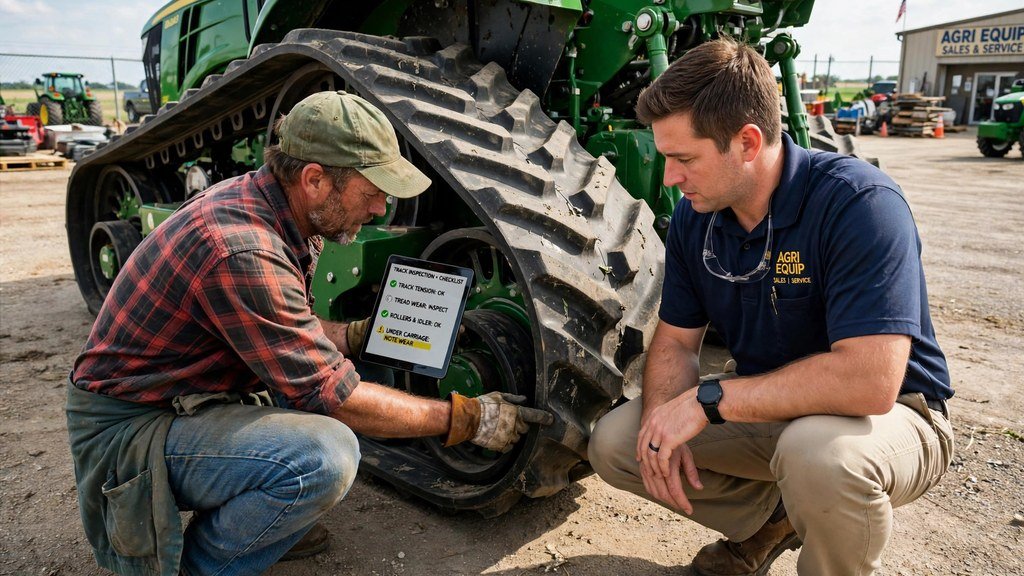
Checking Service History, Repairs and Applicable Recalls
John Deere 9570RX maintenance checks start with the complete service history — ask for it before anything else: the 500-hour engine services, the 1,500-hour transmission service, any track replacement with dates and hours, and every software update. Verify hours against the machine’s electronic records, not just the dash, and match the engine serial number to the Cummins QSX15 plate — a swapped or misrepresented engine is a deal-breaker. On recalls, no 9570RX-specific CPSC safety recall could be verified for this guide, so treat any recall claim as reported rather than confirmed: run the serial number through your Deere dealer or check Deere’s recall information page, or call Deere at 800-537-8233, before buying.
Inspecting Tracks, Steering, Hydraulics and Transmission Operation
A John Deere 9570RX maintenance inspection starts cold: check engine oil, coolant, and transmission-hydraulic oil levels, look for leaks under the machine, and inspect every belt, idler, and mid-roller as described above. Test the park brake and the neutral-start system — the tractor must not start in gear — and check the seat belt, lights, and backup alarm. Drive it: steering on a 9570RX is articulated, with optional ActiveCommand Steering, so test full articulation both ways at low speed and listen for binding or uneven effort, which points to steering-cylinder or pivot trouble. Run every SCV through its full stroke with an implement or a test load, watching for slow, jerky, or drifting functions. Shift the e18 through its ranges in AUTO and manual modes, noting any slip, flare, or harsh engagement, and run the PTO if fitted, listening for bearing noise. Check the CommandCenter for stored or active codes and confirm the guidance hardware, receiver, and JDLink telematics match what the listing claims. Replacement track options for the 9RX are worth pricing before the test drive, so a worn set becomes a negotiating number rather than a surprise.
Frequently Asked Questions About John Deere 9570RX Maintenance
These are the questions John Deere 9570RX maintenance raises for owners and used buyers, answered directly from the service schedule, the verified specifications, and owner-reported experience.
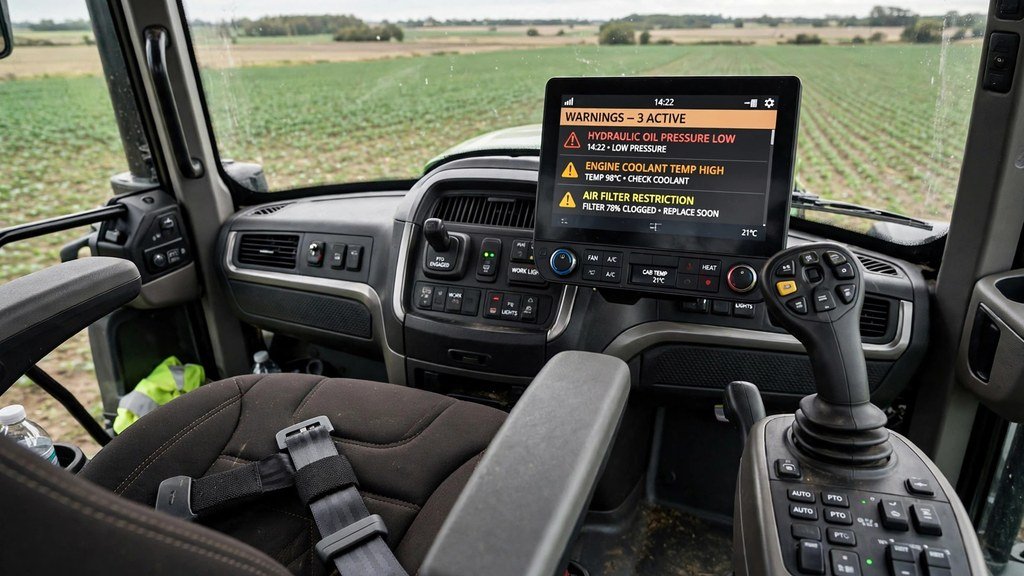
How often does a John Deere 9570RX need an oil change?
In John Deere 9570RX maintenance, oil changes fall every 500 hours with John Deere Plus-50 II oil and a factory filter, or every 250 hours with other CJ-4 oils. Change the fuel filters at the same 500-hour visit and drain the water separator daily.
What engine is in the John Deere 9570RX?
John Deere 9570RX maintenance centers on a Cummins QSX15, a 14.9-liter inline six rated at 570 hp at 2,100 rpm with a maximum of about 628 hp and 335 hp at the PTO. The smaller 9470RX and 9520RX used Deere’s PowerTech 13.5L, but the 9570RX and 9620RX used the Cummins — do not order 13.5L parts for a 9570RX.
How often should the transmission and hydraulic oil be changed?
John Deere 9570RX maintenance sets transmission and hydraulic oil every 1,500 hours, including the filter. The system holds 58 gallons without a hitch and PTO, or 60 gallons with them, so budget a dealer visit of roughly $3,000–$5,000 (estimate) for this service.
How long do 9570RX tracks last?
In John Deere 9570RX maintenance, owner-reported belt life runs 3,000 to 5,000-plus hours, depending on how much road travel the machine does, how it is ballasted, and how carefully tension is maintained. Roading wears belts far faster than field work.
How much does it cost to replace a 9570RX track?
For John Deere 9570RX maintenance budgeting, dealer quotes commonly run $10,000–$15,000 or more per belt installed (estimate), so a full four-corner set can exceed $50,000 at dealer rates. Camso remanufactured tracks cost roughly 40 percent less than new and are worth pricing.
What is the track warranty on a 9570RX?
Camso backs its agricultural belts with a 4-year/2,000-hour warranty. The tractor’s original factory warranty has expired on all used 9570RX machines, but paid PowerGard extended coverage may be available.
Does the 9570RX use DEF?
Yes — John Deere 9570RX maintenance includes DEF, because the Cummins QSX15 meets Final Tier 4 with DOC, DPF, and SCR aftertreatment, so it uses diesel exhaust fluid — unlike the newer JD18 engine, which runs without DEF. Keep the DEF tank filled and use only approved fluid.
What causes DPF problems on a 9570RX?
In John Deere 9570RX maintenance, frequent short runs, extended idling, and failed sensors are the usual causes. A faulty DOC inlet temperature sensor can inhibit regeneration entirely, so a persistent emissions code deserves a same-week dealer visit rather than being cleared and ignored.
How do you precondition new 9570RX track belts?
John Deere 9570RX maintenance for new belts means exposing new or clean belts to dry, dusty soil as soon as possible, and avoid road travel, wet soil, and frozen ground until the belts are conditioned. Preconditioning early in a belt’s life has a measurable effect on how long it lasts.
What should I check first when inspecting a used 9570RX?
John Deere 9570RX maintenance inspections start with tracks: tread depth, chunking, cuts, guide-lug wear, alignment, and tension on all four corners, plus idlers, mid-rollers, and sprockets. Then service records, verified electronic hours, and a full operating test of steering, hydraulics, and the e18 transmission.
Are there any recalls on the John Deere 9570RX?
For John Deere 9570RX maintenance records, no 9570RX-specific CPSC safety recall could be verified for this guide. Run the serial number through your Deere dealer or Deere’s recall information page, or call 800-537-8233, before buying — and treat any recall claim you hear as reported, not confirmed, until it is checked.
What transmission does the 9570RX use?
John Deere 9570RX maintenance covers the John Deere e18 18-speed PowerShift with Efficiency Manager, offering full AUTO, custom, and manual modes and a 25 mph top road speed. Shift-quality complaints sometimes respond to a recalibration, but slipping under load is a stop-and-diagnose fault.
How much hydraulic flow does the 9570RX have?
John Deere 9570RX maintenance specs list 58 gallons per minute standard, or 115 gallons per minute with the optional high-flow pump, through a closed-center pressure-flow-compensated system with four to six rear SCVs standard and up to eight field-installed.
What does a 500-hour service cost on a 9570RX?
John Deere 9570RX maintenance at the 500-hour visit typically runs $1,800–$3,000 at the dealer (estimate), or about $700–$1,200 doing it yourself with factory filters and oil (estimate). The 500-hour visit covers engine oil and filter plus both fuel filters.
Is the 9570RX reliable for long-term ownership?
Yes — John Deere 9570RX maintenance keeps these tractors reliable long-term, with one condition: the engine, transmission, and frame are durable and routinely pass 5,000 hours when serviced, but the undercarriage is a consumable. Buy on track condition and service records, keep software current, and budget a track reserve from day one.
Can I service a 9570RX myself?
John Deere 9570RX maintenance you can do yourself includes routine work — oil, filters, grease, daily checks, and belt inspection — well within a capable owner-operator’s reach with the operator manual. Transmission service, diagnostics, software updates, and track replacement are dealer jobs for most owners because of oil volume, tooling, and calibration needs.