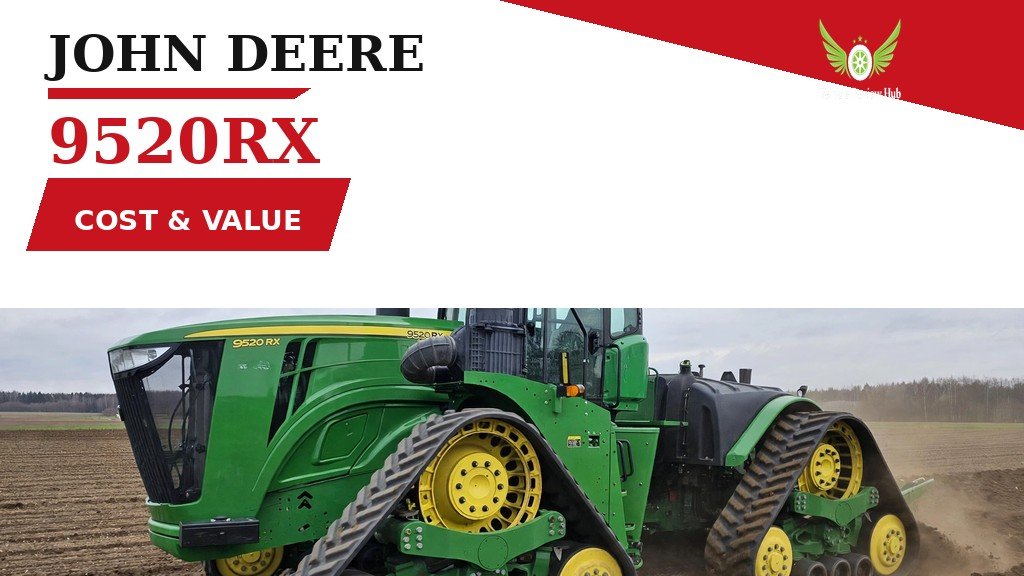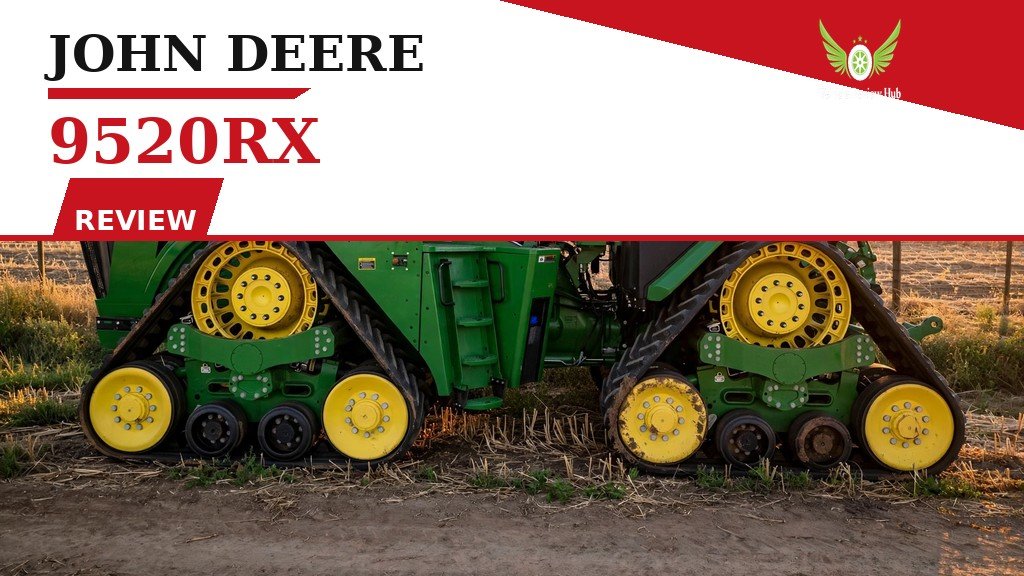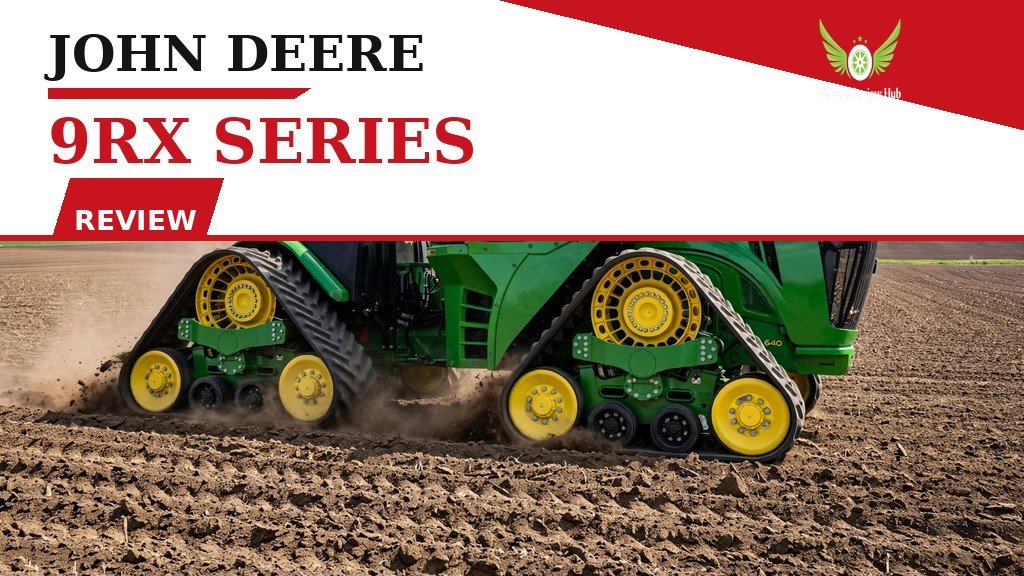
The John Deere 9RX Series is the most powerful series tractor John Deere has ever built. Launched in February 2024 at Commodity Classic in Houston, the 9RX 710, 770 and 830 ride on four rubber belt tracks and are powered by the new 18-liter JD18 engine — the flagship 830 is rated at 830 hp and maxes out at 913. For large-scale US row-crop operations, this John Deere 9RX Series review lays out every spec, price and configuration detail you need.
Every figure in this John Deere 9RX Series review comes from John Deere’s own US sales brochure, current dealer spec sheets and verified used listings — nothing is guessed. The sections below cover models, pricing, the JD18 engine, the e21 transmission, hydraulics, tracks and how the three models compare.
John Deere 9RX Series Review, Models and Price
The 9RX Series replaces the previous-generation four-track lineup (the 9RX 470–620, which ran Cummins QSX15 15-liter engines) with three all-new models built around Deere’s own JD18 18-liter engine and a fully mechanical e21 PowerShift. This John Deere 9RX Series review treats the 913 max horsepower figure as the defining fact of the lineup — everything else exists to put it to the ground.
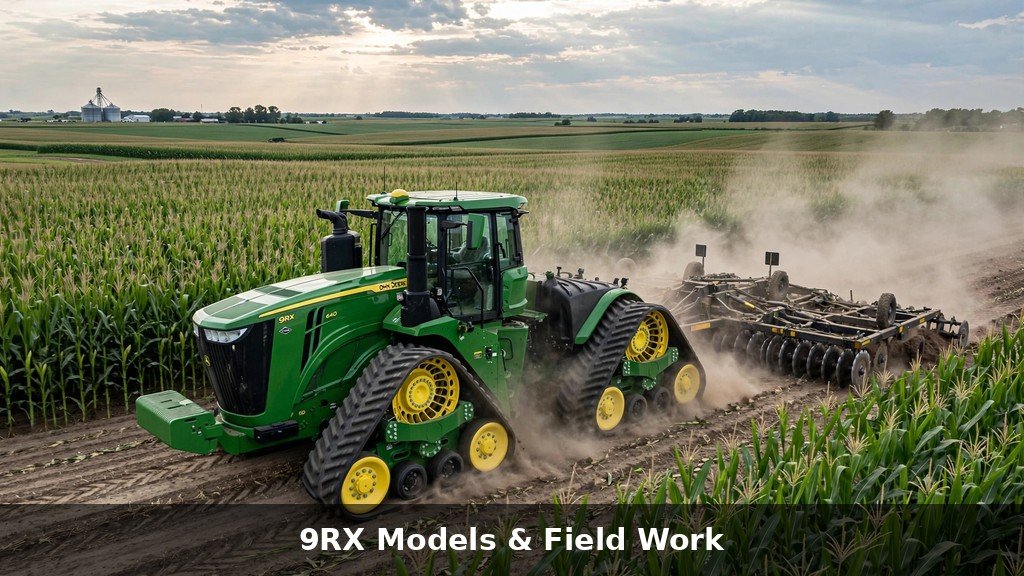
9RX 710, 770 and 830 Features and Intended Uses
The 9RX 710 is the entry point: 710 rated hp, 781 max hp, and 3,622 Nm (2,672 lb-ft) of torque. It suits large grain operations running 40-foot tillage tools and mid-size air seeders on 3,000 to 5,000 acres — plenty of tractor where the 9R wheeled line tops out. In this John Deere 9RX Series review, the 710 emerges as the value play for operations that need four-track traction without paying the flagship price. The 9RX 770 steps up to 770 rated hp (847 max) and 3,928 Nm (2,897 lb-ft) — the model this John Deere 9RX Series review expects to see most often on US farms, the volume seller for operations that need serious draft capability without quite needing the flagship. The 9RX 830 delivers 830 rated hp (913 max) and 4,234 Nm (3,123 lb-ft) for the heaviest draft work in US agriculture: deep rippers, 60-foot air seeding trains and 40-foot discs on 6,000-plus-acre operations.
All three models in this John Deere 9RX Series review share the same core hardware: the JD18 inline-six, the 21-speed e21 PowerShift, the CommandView 4 Plus cab, up to 168 gpm of hydraulic flow and four Camso belt tracks. Deere also offers 9RX 710 and 770 Scraper Special variants for large scraper and earthmoving duty. If you are comparing tracked versus wheeled power, our 9R Series review and specs guide covers the wheeled 9R 390 through 9R 640 (Waterloo-built, topping out at 640 hp). The video below — John Deere’s own walkaround of the new 9RX, the world’s most powerful production tractor:
New and Used Prices by Model, Year and Configuration
New pricing in this John Deere 9RX Series review starts with a sobering number. The 9RX 830 carries a base machine price of $1,226,908 on John Deere’s build-and-price configurator (as reported by The Drive at launch), with typical new prices between $1,191,900 and $1,265,700 depending on configuration. A working build with triple-pump hydraulics, 36-inch tracks and full precision-ag hardware pushes well past base price before freight and setup.
Used listings give the first real price anchors for this young lineup. A 2025 9RX 830 with 550 hours listed at $944,900 (Van Wall, Mason City, IA); a second 2025 unit with 707 hours listed at $925,000 — both fully loaded. The 9RX 710 trades in a similar band: a 2025 listed at $1,053,642 USD (Brandt, Vulcan AB), another at $933,976 USD (Brandt, Saskatoon SK), with a typical $1,070,800–$1,114,500 range for the 710. What moves a used 9RX’s price most, according to the listings surveyed for this John Deere 9RX Series review: hours (500-hour machines carry a big premium over 1,000-hour ones), the hydraulic pump option, track width and condition, and whether precision-ag hardware and an active PowerGard plan transfer with the tractor.
John Deere 9RX Series Engine, Horsepower and Specifications
The JD18 is the story of this John Deere 9RX Series review. Where rivals still juggle DEF tanks and regen cycles, the EGR-only JD18 is the headline engineering story: Deere developed the 18.0-liter engine in-house for these machines, and it meets Final Tier 4 and Stage V emissions with cooled exhaust gas recirculation (EGR) alone — no DEF, no DPF, no SCR. The tractor runs on diesel fuel only (“all power, one fluid”), so there are no parked regenerations, no DEF tank to fill, and no DEF purchase, storage or handling costs.
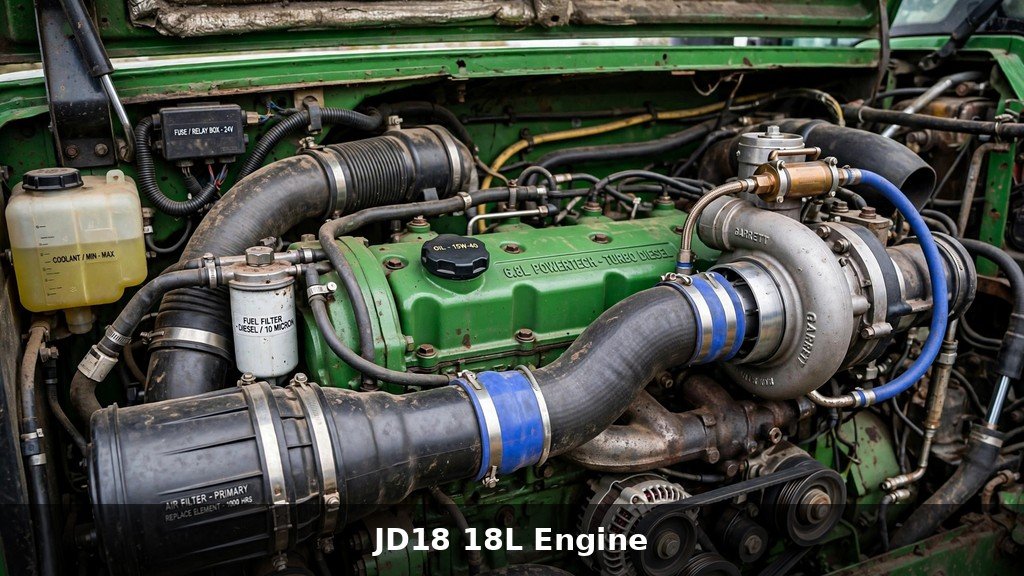
Rated HP, Maximum HP, JD18 Engine and PTO Power
Here is the power breakdown this John Deere 9RX Series review uses, from Deere’s US sales brochure:
| Spec | 9RX 710 | 9RX 770 | 9RX 830 |
|---|---|---|---|
| Rated engine power | 710 hp | 770 hp | 830 hp |
| Maximum engine power | 781 hp | 847 hp | 913 hp |
| Peak torque @ 1,400 rpm | 3,622 Nm (2,672 lb-ft) | 3,928 Nm (2,897 lb-ft) | 4,234 Nm (3,123 lb-ft) |
| Rated PTO power (SAE) | 335 hp | 335 hp | 335 hp |
The engine itself: JD18 inline six, wet-sleeve liners, 4 valves per head, 1,098 cu in (18.0 L), 5.82 x 6.85-inch bore and stroke, 16.11:1 compression. Aspiration is dual turbos in series (fixed primary, wastegated secondary) with air-to-air aftercooling and cooled EGR. Rated speed is a low 1,900 rpm. Deere quotes 38% torque rise and 10% power bulge, so the engine lugs rather than downshifts when draft load spikes. A hydraulic Intelligent Power Management option adds up to 40 hp for implement hydraulics. Engine oil changes run at 500-hour intervals with two replaceable spin-on oil filters; Cross Implement’s 9RX 710 spec page adds hydraulic oil at 4,000 hours (filters at 2,000), transmission oil and filters at 2,000 hours, and coolant at 6,000 hours or 6 years. That 500-hour oil interval is one of the more owner-friendly numbers in this John Deere 9RX Series review.
One practical note from this John Deere 9RX Series review: rated PTO power is capped at 335 hp on all three models — normal for articulated four-tracks, where the extra engine power goes to the tracks for drawbar work.
Dimensions, Hydraulic Flow, Fuel Capacity and Track Options
The 9RX is a big machine: roughly 29 feet long, 12.5 feet tall, and — a genuine packaging achievement — under 10 feet wide, which matters for transport. Base weight is 73,855 lb (33,500 kg), and the reinforced frame can ballast all the way to 84,000 lb (38,100 kg) — the ballasting range this John Deere 9RX Series review considers essential for using the full 913 hp. Despite the weight, Deere claims minimum ground pressure of just 0.58 kg/cm² (about 8.25 psi) — comparable to the smaller previous-generation 9RX models, thanks to the long four-track footprint. For a machine this heavy, the flotation figures are a standout finding in this John Deere 9RX Series review.
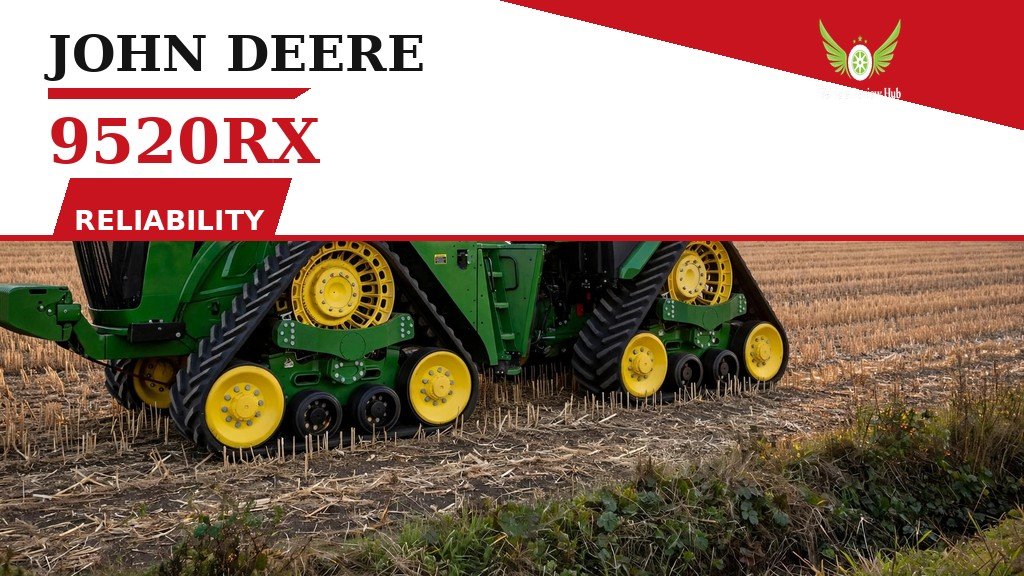
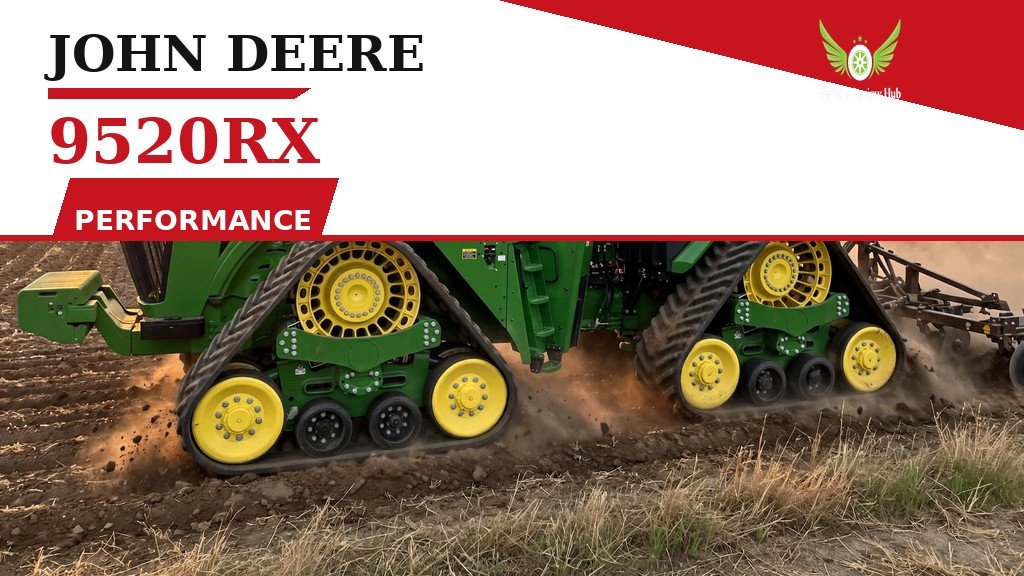
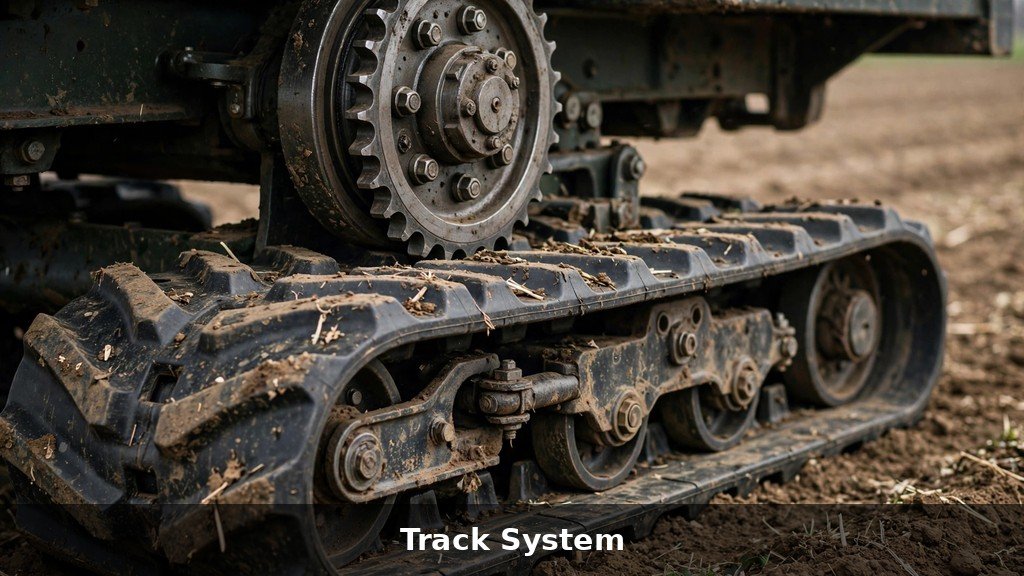
The four track assemblies run Camso 4500/6500 belts in 30- or 36-inch widths, with 88- or 120-inch spacings to match row-crop setups. The new undercarriage uses 47.2-inch (1,200 mm) drive sprockets with 7.5-lug engagement and a 110-degree wrap angle for positive drive, as detailed in Farmers Weekly’s 9RX launch coverage. Hydraulics are closed-center, pressure/flow-compensated: 56 gpm standard, 112 gpm with the dual pump, or 168 gpm with the triple pump, at 2,900 psi, with 4 to 8 SCV couplers. The fuel tank holds 515 gallons (1,952 liters), and the optional Fast Fill System fills it in under four minutes at 150 gpm. Electrical: 330-amp alternator, five 925-CCA batteries (4,625 CCA total), two 12-volt starters — sized for the machine’s full drive-by-wire load, as this John Deere 9RX Series review notes.
John Deere 9RX Series Transmission and Implement Compatibility
Moving 913 horsepower through four tracks without destroying drivelines takes more than raw strength — it takes gear spacing. Deere replaced the previous generation’s e18 with a new e21 21-speed PowerShift built specifically for this power class. The e21’s close gear spacing is one of the key technical details in this John Deere 9RX Series review.
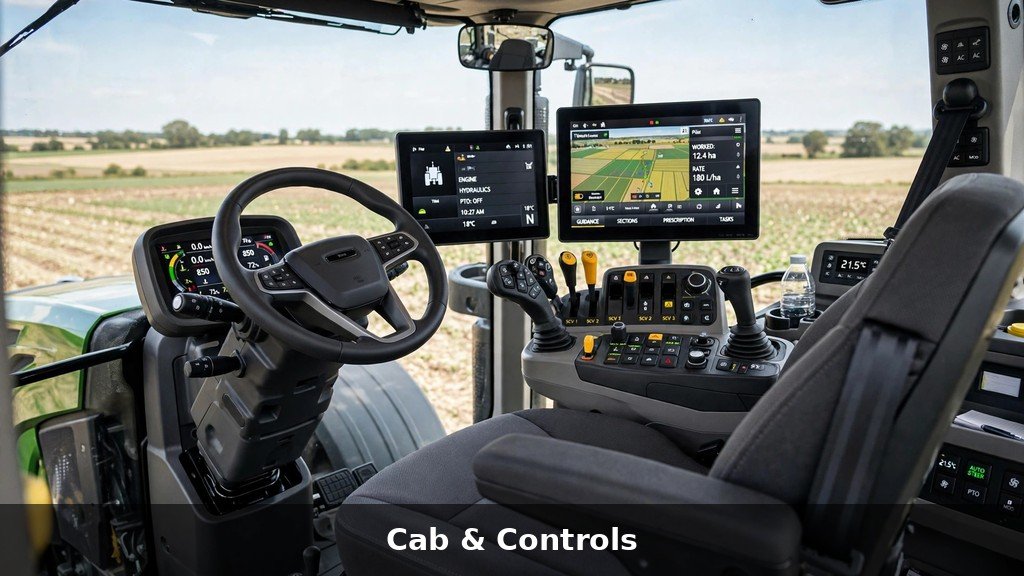
e21 PowerShift Transmission and Available Configurations
The e21 is a fully mechanical PowerShift: 21 forward, 11 reverse, 25 mph top speed, Efficiency Manager standard — the system automatically holds the most economical gear for the target speed. The automation logic carries over from the e23 transmission in the 8R line. Brakes are hydraulic wet-disc, self-adjusting, on both axles. ActiveCommand Steering (ACS) is standard with speed-sensitive effort, plus a full-locking electrohydraulic diff lock on both axles with AutoMode for soft spots. Our 9RX Series performance and fuel usage guide covers the e21’s real field efficiency in depth.
PTO, Hydraulic Connections, Track Spacing and Implement Compatibility
The rear PTO is independent, 1,000 rpm, 45 mm 20-spline — but note: the new 9RX has no rear three-point hitch; it is drawbar-only, with a Cat 5 clevis rated for 19,000 lb of vertical load. That is the right call for this class — nobody puts a three-point implement behind 830 hp — but buyers moving up from a 9RT should plan implement fleets accordingly.
Hydraulic connections run 4 to 8 SCVs, and the 168-gpm triple-pump option exists for modern air seeding trains, where fan motors and section control can starve a smaller system. Deere’s own field-test claim: roughly 100 extra acres per day in corn stalks versus the old 9RX 640 — a marketing figure, but it illustrates the use case: wider implements, faster speed, fewer passes. Precision ag is fully integrated as standard: AutoTrac, JDLink, ISOBUS, the G5Plus display and a StarFire 7500 receiver, with Autonomy Ready hardware available. The standard precision-ag package is one of the strongest value arguments in this John Deere 9RX Series review.
John Deere 9RX 710 vs. 770 vs. 830
The three models share the cab, transmission, undercarriage architecture and hydraulic options — the differences are power, ballast rating and the scale of work each is built for. This section of the John Deere 9RX Series review compares them head to head.
Differences in Power, Hydraulic Capacity and Operating Scale
| Model | Rated / max hp | Peak torque | Best-fit scale |
|---|---|---|---|
| 9RX 710 | 710 / 781 | 3,622 Nm | 3,000–5,000 acres, 40-ft tillage, mid-size air seeders |
| 9RX 770 | 770 / 847 | 3,928 Nm | 4,000–7,000 acres, heavy tillage, large air seeders |
| 9RX 830 | 830 / 913 | 4,234 Nm | 6,000+ acres, deep rippers, 60-ft seeding trains, custom work |
Hydraulic capacity is configurable across all three — you can order a 710 with the triple pump or an 830 with the base system — but in practice the bigger the implement, the more likely the triple-pump 168-gpm system earns its keep. Track width follows the job: 30-inch belts for transport and controlled traffic, 36-inch for maximum flotation on soft ground. For a deeper dive on running costs per model, see our 9RX Series ownership cost and resale guide.
Which Model Fits Your Farm Size and Heavy-Duty Work?
The honest buying logic in this John Deere 9RX Series review: buy the smallest 9RX that handles your heaviest implement at your target speed. The 710 covers most large-scale tillage and seeding on 3,000 to 5,000 acres and costs meaningfully less to buy and ballast. The 770 is the sweet spot for big air seeders or 13-plus-shank rippers where the 710 would be at its limit. The 830 is for operations where time is the constraint — short planting windows, custom fleets, or soils where only maximum draft power keeps a 60-foot train moving.
One more consideration from this John Deere 9RX Series review: the previous-generation 9RX 620 (Cummins power) remains a strong used buy for operations that don’t need 700-plus horsepower. If your work includes significant roading or you prefer tires, the wheeled 9R 640 and two-track 9RT deserve a look before committing to four tracks. Service and reliability detail lives in our 9RX Series maintenance and common problems guide.
Frequently Asked Questions About the John Deere 9RX Series
Quick answers to the questions US buyers ask most about the 9RX 710, 770 and 830, based on the verified specs in this John Deere 9RX Series review.

How much does a new John Deere 9RX 830 cost?
The 9RX 830 has a base machine price of $1,226,908 on John Deere’s configurator, with typical new prices of $1,191,900 to $1,265,700 depending on configuration. Used 2025 models with 550–700 hours are listing around $925,000 to $945,000 at US dealers. Those are the verified figures this John Deere 9RX Series review could confirm — always confirm current pricing with your dealer.
Does the 9RX need DEF (diesel exhaust fluid)?
No. The JD18 meets Final Tier 4 and Stage V emissions via cooled EGR only — no DEF, no DPF, no SCR — so the 9RX runs on diesel fuel alone (“all power, one fluid”). There are no parked regens and no DEF costs at all.
What transmission does the 9RX use?
The new e21 PowerShift: 21 forward and 11 reverse gears, fully mechanical, with a 25 mph top speed and Efficiency Manager as standard. It was designed specifically for the 710–830 hp class this John Deere 9RX Series review covers.
How much fuel does the 9RX hold?
The fuel tank holds 515 gallons (1,952 liters). The optional Fast Fill System fills it in under four minutes at 150 gpm — in this John Deere 9RX Series review’s judgment, the option to tick for a machine that can empty the tank in a long day of heavy tillage.
Where is the John Deere 9RX built?
The 9RX Series is built at John Deere’s Waterloo, Iowa factory, alongside the 7R, 8R, 8RT and 8RX lines.
Should I buy a 9RX or a wheeled 9R?
Choose the 9RX for traction, flotation and low ground pressure — four tracks put down far more usable drawbar pull in soft conditions and compact less soil. Choose the wheeled 9R if you road the tractor frequently, prefer tires, or want to stay under roughly 640 hp. Compare both in our 9R Series review and the 8RX Series review for the smaller four-track line.