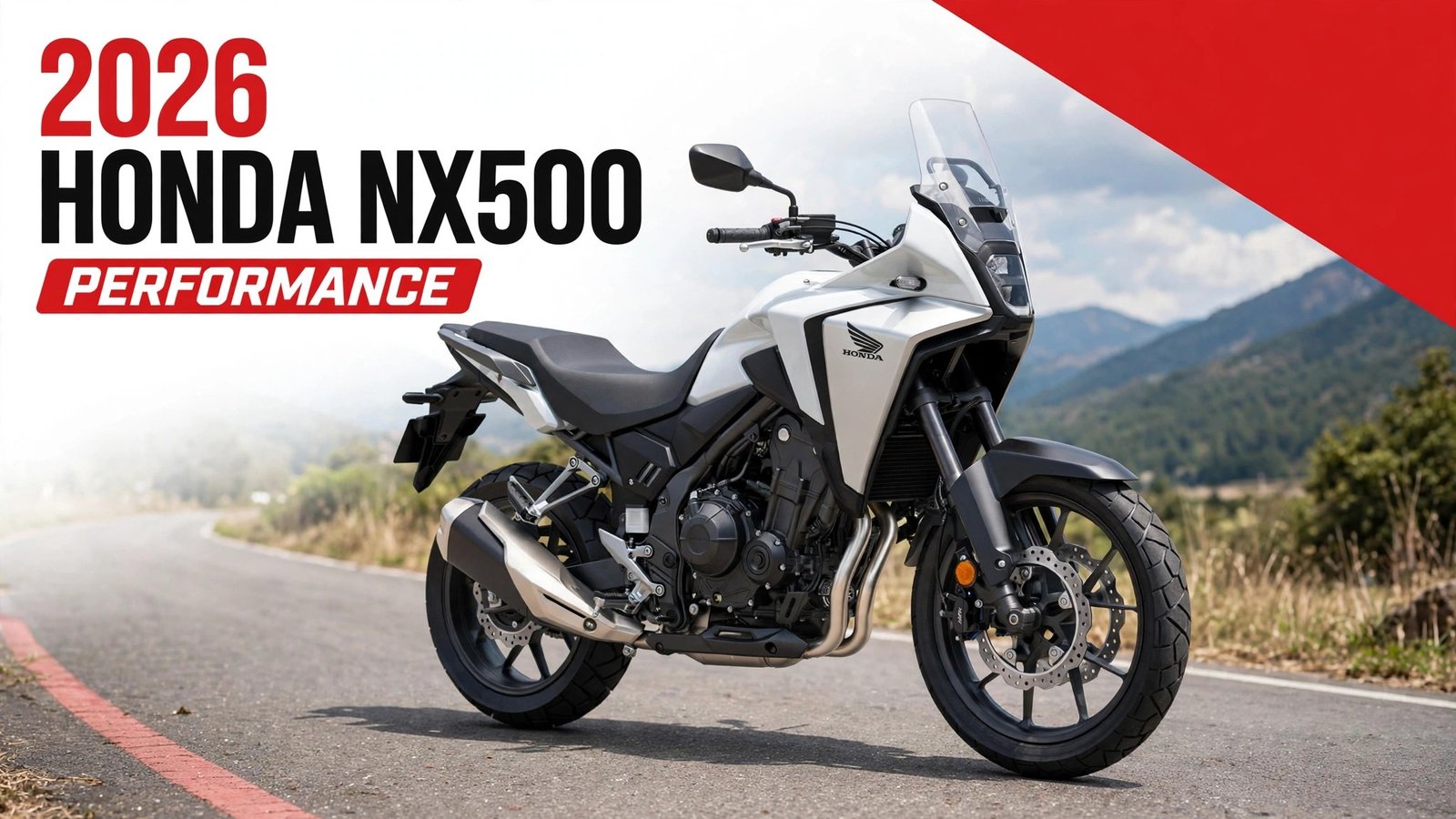
If one idea sums up Honda NX500 performance, it is this: a smooth, unstressed 471cc twin that trades outright speed for real-world usability. Honda NX500 performance is not about horsepower records. Honda USA publishes no horsepower or MPG figure for this bike, so this article separates verified facts from estimates at every step, and labels every estimate as one.
The headline Honda NX500 performance facts: the proven 471cc parallel twin from Honda’s 500 range, tuned for midrange torque; around 47 horsepower per European publications, with the only independent rear-wheel dyno figures from the predecessor CB500X; and 64 miles per gallon over 677 miles in the best documented US fuel test, roughly 300 miles from the 4.7-gallon tank.
Honda NX500 Engine Performance and Power Delivery
Honda NX500 performance starts with an engine in production for over a decade, refined year by year, with linear, predictable power delivery.
EU Claim Around 47 HP Explained and Honda USA Publishes No Power Figure
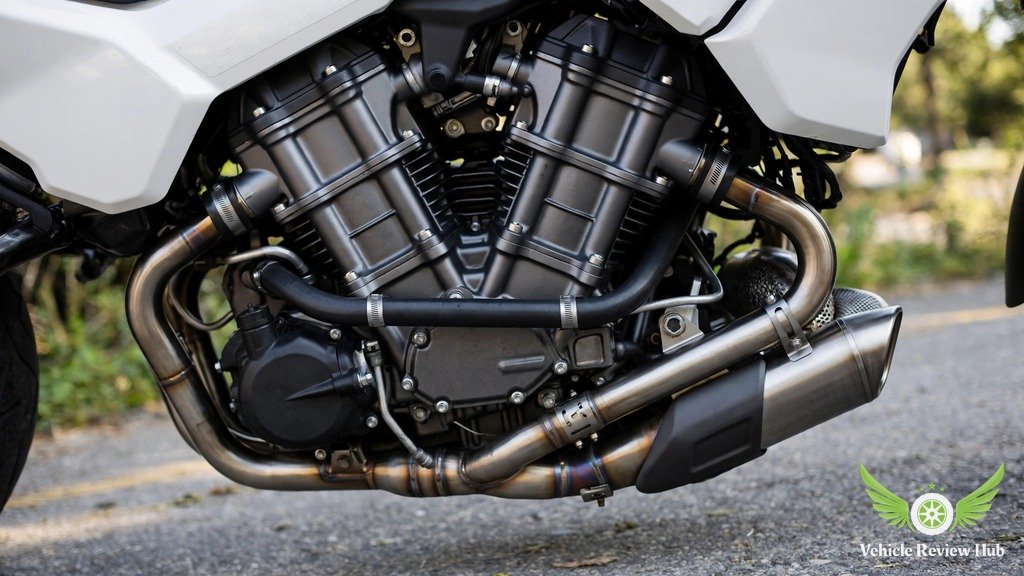
Honda USA’s specification page for the 2026 NX500 lists a 471cc liquid-cooled parallel twin, then stops: no horsepower figure, no torque figure, no Honda NX500 performance claim of any kind. Honda USA routinely omits power figures for smaller motorcycles, and any article quoting a US horsepower figure as if Honda USA released one is inventing a source. The European claim is around 47 horsepower, or 35 kW, at about 8,500 rpm, with 43 Nm (roughly 32 lb-ft) of torque at 6,500 rpm. The 47 hp figure matters because 35 kW is exactly the European A2 licence limit, and Honda NX500 performance is clearly tuned to sit right on that line. The full engine specification behind Honda NX500 performance, verified from Honda USA’s 2026 NX500 page, is a 471cc liquid-cooled parallel twin, 67.0 x 66.8mm bore and stroke, 10.7:1 compression, DOHC four-valve head, 34mm fuel injection.
Six-Speed Gearbox, Cable Throttle and Power Delivery
The NX500 sends power through a six-speed manual gearbox and an assist-and-slipper clutch, with a #520 O-ring-sealed chain running 15T/41T sprockets. RevZilla’s test rider found the shifts light and precise, with a light clutch pull. For newer riders and daily commuters, a slick gearbox and a forgiving clutch are genuine Honda NX500 performance features, not footnotes. The cable-operated throttle, not ride-by-wire, explains much of the bike’s character: no ride modes, no quickshifter option on the US bike. What you get is a direct, predictable connection between hand and engine, with fueling RevZilla described as uniformly good, apart from a tiny hint of abruptness moving from fully closed to barely cracked open throttle. Most of the torque behind Honda NX500 performance arrives between 3,000 and 7,000 rpm, so the bike pulls willingly from low revs without constant downshifts. The redline sits at 8,500 rpm with no high-rev rush at the top.
Honda NX500 Top Speed and Acceleration
Top speed and acceleration are where Honda NX500 performance coverage most often goes wrong, because the numbers people want do not exist from a trustworthy instrumented test.
Why No NX500 Dyno or Instrumented Test Exists From a Major US Outlet
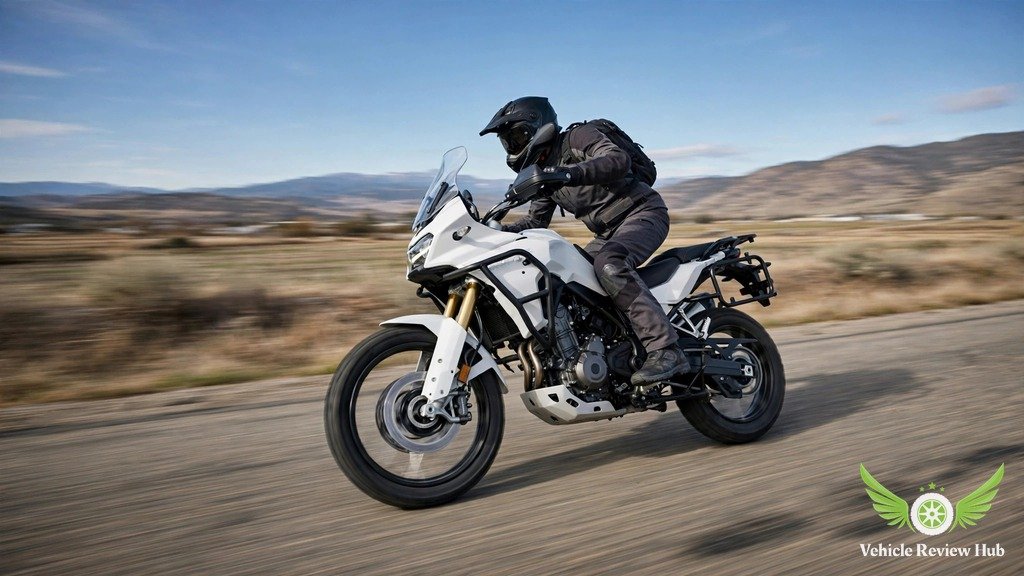
No major US outlet has published an instrumented NX500 test with a rear-wheel dyno run, a measured 0-60 mph time, or a verified top speed. Cycle World, Motorcyclist, and RevZilla have all ridden and reviewed the NX500, but none has published a Honda NX500 performance dyno run or timed acceleration figures. That gap matters for Honda NX500 performance, because every NX500-specific acceleration or top-speed number online is either an estimate, a conversion from the European claim, or a figure borrowed from the CB500X. Until then, treat all Honda NX500 performance acceleration claims as estimates.
CB500X Dyno 42.62 HP as Labelled Predecessor Data and Top Speed Estimates
The closest verified rear-wheel figure comes from Cycle World’s dyno test of the 2022 CB500X, the direct predecessor sharing the NX500’s engine architecture. On Cycle World’s Dynojet 250i, the 2022 CB500X produced 42.62 hp at 8,430 rpm and 29.26 lb-ft of torque at 6,520 rpm. These are predecessor figures, not NX500 figures: the NX500’s revised fuel-injection settings mean its curve will differ slightly. If Honda NX500 performance at the rear wheel lands in the same low-40s range, as the shared engine strongly suggests, the bike’s character follows: quick enough to be fun, never intimidating. Secondary Honda NX500 performance estimates for top speed cluster around 105 to 110 mph, and 0-60 mph estimates sit in the mid-five-second range, but both are estimates only, not measured results. What is verified is the gearing: at an indicated 70 mph in sixth gear the engine turns roughly 5,800 rpm, so Honda NX500 performance at American highway speeds is unstressed.
Honda NX500 Mileage and Fuel Economy
Fuel economy is where Honda NX500 performance shines, with real-world MPG figures from several independent testers that agree closely enough to trust.
Honda USA Publishes No MPG Figure and the 4.7-Gallon Tank
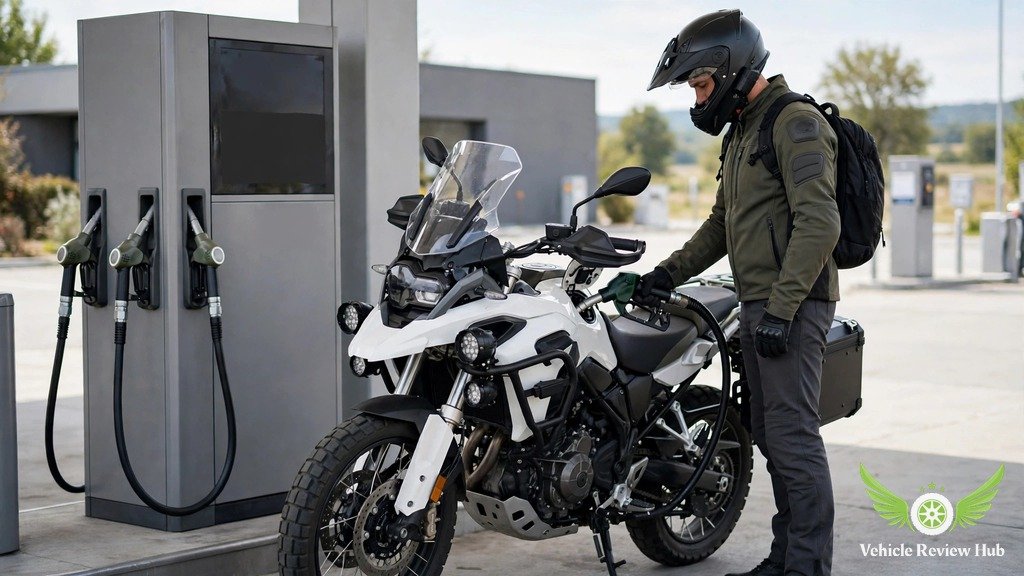
Honda USA publishes no MPG figure for the NX500, just as it publishes no horsepower figure; the US page lists 4.7 gallons and nothing about consumption. The only official economy figure in circulation is the European WMTC test result of 65.4 mpg, listed in Motorcycle.com’s 2024 specification table. That laboratory figure is an upper bound, not a real-world promise. The 4.7-gallon tank is small by adventure-bike standards, but Honda NX500 performance efficiency makes it work: at 60 mpg a full tank is 282 miles, and at 64 mpg just over 300 miles. Those are arithmetic results, not tested range claims, and real range depends on speed, load, and terrain. For Honda NX500 performance, the tank size is a non-issue because the economy is so strong.
RevZilla Tested 64 MPG Over 677 Miles and Around 280 to 300 Mile Range
The strongest real-world figure comes from RevZilla’s 2025 first ride review: 677 miles at 64 miles per gallon on 87-octane fuel, despite the test bike having only 47 miles on it when picked up, meaning it was still in its break-in period. That documented, attributed result anchors the Honda NX500 performance economy story. Other testers agree: Ultimate Motorcycling’s test recorded close to 60 mpg despite hard riding, Motorcyclist 49 mpg aggressively and mid-50s figures modestly. Put together: gentle commuting and back-road riding returns roughly 60 to 64 mpg, giving a theoretical 282 to 301 miles from the 4.7-gallon tank, and a realistic 280 to 300 miles with a small reserve. Sustained 80 mph highway riding drops economy into the 50s and range toward 230 to 250 miles, so the 280 to 300 mile band is a mixed-riding figure for Honda NX500 performance, not a highway guarantee.
Honda NX500 Real-World Riding Performance
On paper, Honda NX500 performance looks modest. On the road, it feels like more, because torque arrives early and the bike weighs only 432 pounds wet. Note: the review bike is a UK-market machine, and part of the video covers the E-Clutch option the US bike does not get; the riding sections show the same engine, chassis, and braking performance as the manual US model.
City Riding, Traffic Performance and Everyday Acceleration
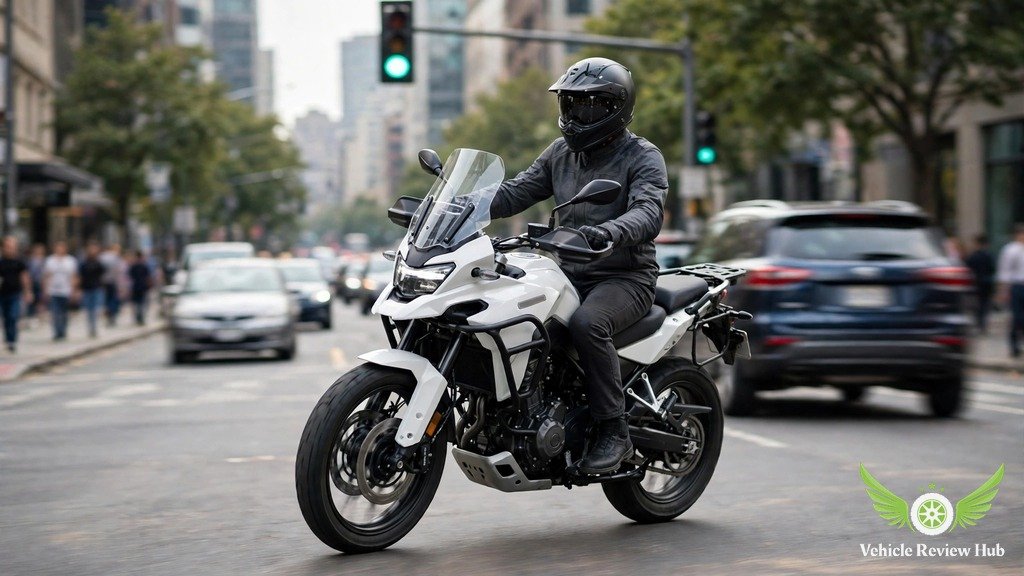
In city traffic, Honda NX500 performance is in its element. The 471cc twin pulls cleanly from low revs, the clutch is light, and the 32.8-inch seat and 432-pound curb weight make the bike easy to paddle through parking lots and filter through slow traffic. RevZilla’s tester found it easy to accelerate away from car traffic at stoplights, and the flat torque curve means second gear covers a huge range of urban speeds. Everyday acceleration is adequate-plus: the bike never feels overwhelmed, merging or climbing happens without drama, and for new riders that predictability is a safety feature. For experienced riders downsizing, the adjustment is that Honda NX500 performance rewards smooth inputs rather than aggressive ones.
Highway Riding, Overtaking Ability and Long-Distance Limitations
On the highway, Honda NX500 performance is comfortable at American cruising speeds but honest about its limits. RevZilla’s tester would have no hesitation doing long days on the highway. The tall windscreen gives chest and helmet wind protection, though the same tester found it noisy at five feet eleven inches, and noted that unlike the CB500X, the NX500’s screen is no longer adjustable. Overtaking at highway speed is where modest output shows: a pass from 70 to 85 mph takes planning and usually a downshift to fifth, because sixth gear is tall. That is the key difference between the NX500 and the next step up Honda’s range: riders who regularly cruise at 80 mph or ride two-up with luggage will eventually want the extra capacity of something like the Transalp XL750, while occasional highway riders will find Honda NX500 performance perfectly sufficient. Long-distance limits are comfort and capacity rather than reliability. The seat had RevZilla’s tester wanting a break after about an hour. The 4.7-gallon tank means fuel stops every 230 to 300 miles, and the firm suspension transmits sharp bumps on rough roads.
Honda NX500 Handling, Braking and Stability
Handling is the other half of Honda NX500 performance, and arguably the stronger half. Light weight, sensible geometry, and quality suspension hardware give it road manners that embarrass heavier adventure bikes.
Showa SFF-BP Fork Travel Conflict, Chassis, Tires and Cornering
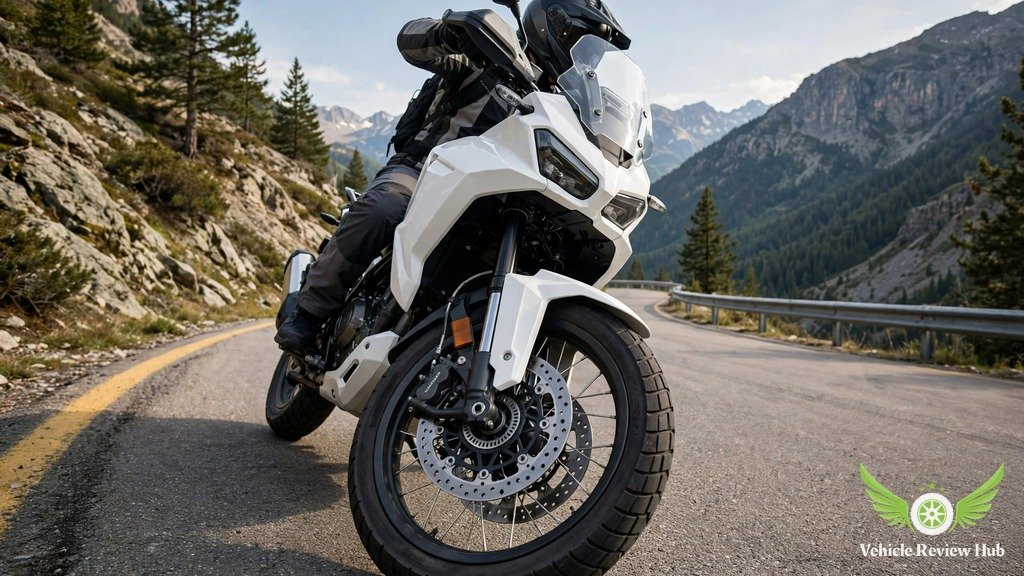
The doc outline flags a fork travel conflict, resolved honestly here rather than by picking a number silently. Honda USA’s specification pages for the 2025 and 2026 NX500 agree: a 41mm inverted Showa SFF-BP fork with 5.9 inches of travel up front, and a single shock with 5.3 inches at the rear, repeated in Honda’s own news release. This article follows Honda USA: the manufacturer’s spec page outranks secondary tables. The conflict comes from dealer-compiled and aggregator tables listing different front travel numbers, including one showing 133mm (about 5.2 inches). Honda lists no front preload adjustment: the fork is non-adjustable, with five-stage rear shock preload the only suspension adjustment. The verified figures are 5.9 inches front and 5.3 inches rear, and that is what Honda NX500 performance coverage uses throughout. Underneath is a steel diamond frame, the same proven layout as the CB500X, with a 56.8-inch wheelbase, 27.0 degrees of rake, and 4.3 inches of trail. Wheels are 19-inch front and 17-inch rear cast aluminium, 3.3 pounds lighter unsprung than the CB500X’s per Ultimate Motorcycling. Tires are 110/80-19 front and 160/60-17 rear, Dunlop Trailmax Mixtour on RevZilla’s test bike. On smooth, curvy pavement the bike handles like the lightweight street bike it mostly is, planted and precise; on battered asphalt and rippled dirt the firm suspension transmits more jolts than it soaks up.
Dual 296mm Front Discs and Non-Switchable ABS Features
Braking hardware is generous for this class: dual 296mm front discs with four-piston calipers, a single 240mm rear disc, and two-channel ABS, all verified from Honda USA’s 2026 specification page. The dual front discs are a meaningful upgrade over single-disc setups on many rivals, giving strong, fade-free stopping power for its weight. The important limitation is that the ABS cannot be switched off. For road riding that is no drawback. But for a rider who wants to slide the rear on loose surfaces or ride proper trails, non-switchable ABS is a real constraint, and one more sign of a street-biased adventure bike. Traction control, by contrast, is switchable: Honda’s basic single-level HSTC system turns off with a dedicated button on the left switchgear. That button sits where the Transalp’s ride-mode button sits, a neat reminder that Honda NX500 performance electronics amount to traction control and nothing else to switch. That is the braking side of Honda NX500 performance: strong hardware, one deliberate limitation.
Honda NX500 Performance Compared With Other Lightweight ADV Bikes
Comparison is where Honda NX500 performance makes its case, because the bike’s rivals each beat it somewhere and lose to it somewhere else.
Honda NX500 vs KTM 390 Adventure and Royal Enfield Himalayan 450
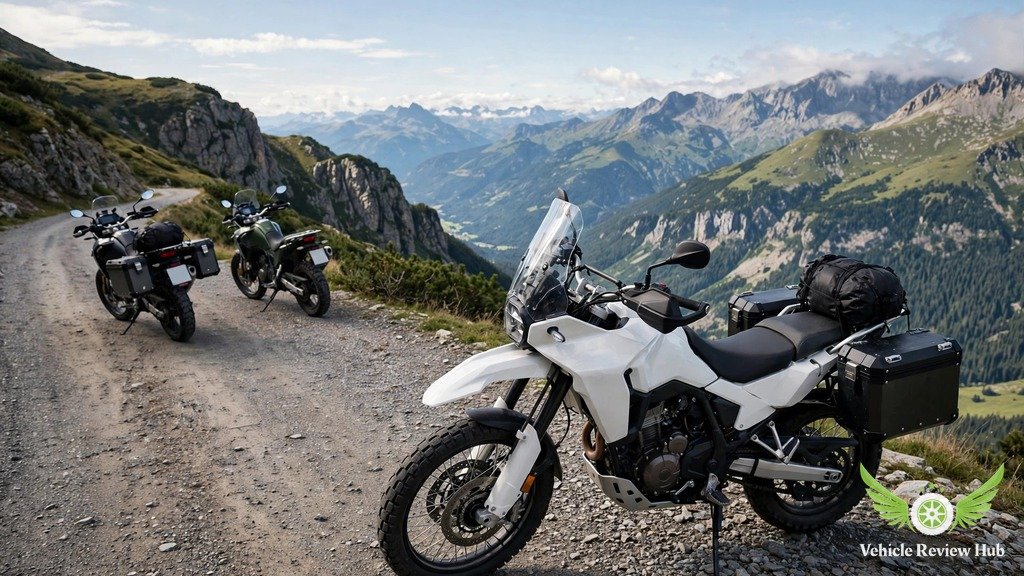
Against the KTM 390 Adventure, the NX500 trades sharpness for smoothness. The 2026 KTM 390 Adventure X costs $6,499 plus a $600 destination charge, undercutting the NX500’s $6,899 plus $600, and its 398.7cc single makes a claimed 45 hp with 39 Nm in a package weighing 388 pounds wet. The KTM is lighter, cheaper, and more off-road capable, but its single brings more vibration and a smaller 3.7-gallon tank. For Honda NX500 performance, the twin is smoother at highway speed, its fuel range is longer, and Honda’s dealer network is easier to live with. Dirt capability and price favour the KTM; smoothness and commuting comfort favour the Honda. Against the Royal Enfield Himalayan 450, the comparison flips. The 2026 Himalayan 450 starts at $5,999, a full $900 below the NX500, and its 452cc Sherpa single makes 40 hp at 8,000 rpm and 40 Nm at 5,500 rpm. It carries a 4.5-gallon tank, weighs the same 432 pounds wet, and brings a 21-inch front wheel, 7.9 inches of suspension travel, switchable ABS, and two ride modes. For genuine trail riders the Himalayan probably is the better adventure bike, but the NX500’s twin is smoother, its 64 mpg real-world economy beats the Himalayan’s mid-40s to mid-50s observed range, and its highway manners are calmer. The Himalayan is the better dirt bike; the NX500 is the better everyday motorcycle, and that verdict is the heart of Honda NX500 performance comparison.
| Model | Engine | Claimed power | Wet weight | Tank | 2026 US MSRP |
|---|---|---|---|---|---|
| Honda NX500 | 471cc twin | About 47 hp (EU claim) | 432 lb | 4.7 gal | $6,899 |
| KTM 390 Adventure X | 398.7cc single | 45 hp | 388 lb | 3.7 gal | $6,499 |
| Royal Enfield Himalayan 450 | 452cc single | 40 hp | 432 lb | 4.5 gal | $5,999 |
Riders wanting more can step up to the Africa Twin or the commuter-focused NC750X.
Is the Honda NX500 Suitable for A2-Style Riders and Daily Riding?
Yes, and this is the bike’s strongest use case. In Europe the NX500 is built to the A2 licence limit of 35 kW, capping power for new and returning riders. The United States has no tiered licence, but the same logic applies: the NX500’s gentle power delivery, light clutch, low 32.8-inch seat, and forgiving handling make it one of the best first big bikes on the American market, and one of the best daily riders for anyone who values ease over excitement. For daily riding, the economics seal the deal: at 60 to 64 mpg, a 50-mile-a-day commuter spends far less on fuel than on almost any other motorcycle, and 8,000-mile oil-change intervals keep servicing cheap. The NX500 will not thrill a rider who wants maximum speed, but for A2-style riders and daily commuters, Honda NX500 performance is exactly right: enough everywhere it matters, never too much anywhere it could hurt.
Honda NX500 Performance FAQs
These are the questions riders actually ask about Honda NX500 performance, answered from the verified figures in this article. Where a number is an estimate, the answer says so.
How much horsepower does the Honda NX500 have?
Honda USA publishes no horsepower figure for the NX500. The European claim is around 47 horsepower (35 kW) at about 8,500 rpm, with 43 Nm of torque at 6,500 rpm. The only independent rear-wheel dyno figure comes from the predecessor CB500X: 42.62 hp at 8,430 rpm on Cycle World’s dyno. Expect Honda NX500 performance at the rear wheel to land in the low 40s.
What is the Honda NX500 top speed?
No instrumented top-speed test for the NX500 exists from a major outlet, so any figure is an estimate. Secondary estimates cluster around 105 to 110 mph. Verified Honda NX500 performance cruising: 70 mph in sixth gear at roughly 5,800 rpm, with revs in reserve for passing.
What MPG does the Honda NX500 get?
Honda USA publishes no MPG figure. RevZilla recorded 64 mpg over 677 miles on 87-octane fuel, Ultimate Motorcycling close to 60 mpg despite hard riding, and Motorcyclist 49 mpg aggressively and mid-50s figures modestly. Realistically, Honda NX500 performance economy is 55 to 64 mpg in mixed use, dropping into the 50s at sustained highway speed.
How far can the Honda NX500 go on a tank?
The tank holds 4.7 gallons. At 60 to 64 mpg, labelled arithmetic gives a theoretical 282 to 301 miles, and a realistic 280 to 300 miles with a small reserve. Sustained high-speed highway riding pulls Honda NX500 performance range back toward 230 to 250 miles.
Does the Honda NX500 have ride modes?
No. The NX500 has a cable throttle rather than ride-by-wire, so there are no ride modes. Its only electronic rider aid beyond ABS is Honda Selectable Torque Control (HSTC), a basic single-level traction control system switched off with a dedicated handlebar button, keeping Honda NX500 performance electronics simple.
Can you turn off ABS on the Honda NX500?
No. The two-channel ABS on the dual 296mm front discs and single 240mm rear disc cannot be switched off. This is a real limitation for serious off-road riding, though the calibration is forgiving enough for graded dirt roads, and Honda NX500 performance on the road does not suffer.
Is the Honda NX500 good on the highway?
Yes, with a caveat. The bike cruises smoothly at 70 mph, the windscreen gives chest and helmet protection, and the engine is unstressed. Overtaking from 70 mph takes planning and usually a downshift, and the firm seat becomes uncomfortable after about an hour. It is a capable highway bike, not a dedicated tourer, and that balance defines Honda NX500 performance for touring riders.
Is the Honda NX500 faster than the KTM 390 Adventure?
On claimed power the two are close (about 47 hp against 45 hp), but the KTM weighs 44 pounds less, so it will feel quicker. The Honda answers with a smoother twin, a longer fuel range, and calmer highway manners. Neither bike has a verified instrumented acceleration test, so Honda NX500 performance against the KTM comes down to smoothness and range versus lightness and price.