Short answer: a used Honda Rebel 1100 is one of the strongest big-cruiser buys in America right now, provided you buy the right transmission, check two recalls by VIN, and pay for condition over low mileage alone. Clean 2022–2024 DCT bikes commonly ask $7,250–$9,000, while low-mileage 2025 bikes push toward $10,000. This Honda Rebel 1100 buying guide covers prices, insurance, inspection, model years, and rivals.
The Rebel 1100’s appeal is simple: a 1,084cc liquid-cooled parallel twin, a 27.5-inch seat, and 487 pounds curb for the manual bike or 509 for the DCT (2021–2025 figures; Honda’s 2026 pages list 27.9 inches and 497/518 pounds). That combination keeps used demand high in this Honda Rebel 1100 buying guide’s assessment — so do not expect a bargain because a bike is a few years old.
Honda Rebel 1100 Price and Market Availability
New Rebel 1100 prices have climbed since the 2021 launch, and the used market follows the new-bike ladder. Use the tables below as your anchor: check MSRP, then year, trim, and transmission, before judging any asking price in this Honda Rebel 1100 buying guide.
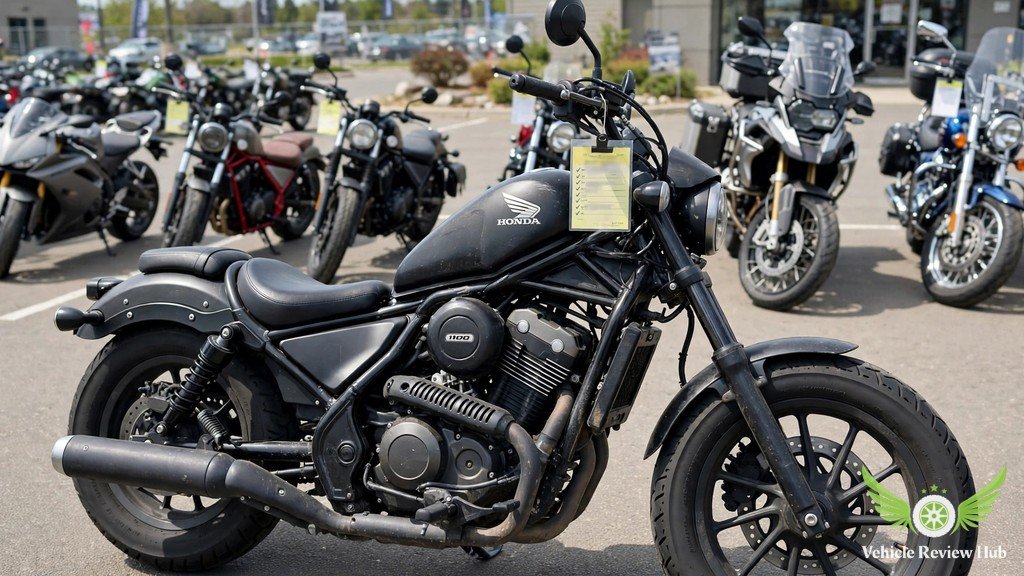
What Does a Used Honda Rebel 1100 Cost in the USA by Year and Trim?
That ladder is the baseline for this Honda Rebel 1100 buying guide. The walk below covers the standard bike; 2021–2022 MSRPs were not re-verified here, so those years are judged on listings.
| Model year | Base manual MSRP | DCT MSRP | DCT SE MSRP |
|---|---|---|---|
| 2023 | — | $10,099 | — |
| 2024 | $9,549 | $10,149 | — |
| 2025 | $9,599 | $10,299 | $11,099 |
| 2026 | $9,699 | $10,399 | $11,199 |
All figures exclude the $775 destination charge. Touring T versions sit above the standard bike: the 2025 1100T DCT listed at $11,499, and the 2026 1100T at $10,899 with the 1100T DCT at $11,599. Below are real asking prices from a November 2026 Cycle Trader search recorded for this Honda Rebel 1100 buying guide — asks, not completed sales.
| Listing (November 2026) | Miles | Ask |
|---|---|---|
| Used 2024 Rebel 1100 DCT — Riverside Harley-Davidson, Riverside, CA | — | $7,944 |
| Used 2024 Rebel 1100 DCT — private seller, Scottsdale, AZ | — | $7,250 |
| Used 2023 Rebel 1100 DCT | 12,821 | $8,788 |
| Used 2022 Rebel 1100 DCT, 3,700 miles — private seller | 3,700 | $7,500 |
| Used 2025 Rebel 1100 base, 1,560 miles — reduced from $11,099 | 1,560 | $9,999 |
The pattern is consistent in this Honda Rebel 1100 buying guide’s sample: 2021–2022 bikes cluster around $7,250–$9,000, 2023–2024 bikes around $7,500–$9,000, and low-mileage 2025 bikes push toward $10,000. The cheapest asks are usually higher-mileage DCT bikes — the automatic holds no premium once used.
Is the Honda Rebel 1100 Available Through Official US Dealers?
Yes — the Rebel 1100 is a regular Honda USA model sold through franchised Honda Powersports dealers in all 50 states. That matters for a used buyer in this Honda Rebel 1100 buying guide. Third, parts availability is strong — the twin is shared with the Africa Twin family. One caution: dealer asks routinely exclude destination, freight, setup, and documentation fees, so compare out-the-door totals — a $7,944 ask with no fees can beat a $7,499 ask carrying $600 in fees.
Honda Rebel 1100 Insurance and Ownership Costs
Insurance surprises big-cruiser buyers both ways: some owners report cheap coverage for a 1,100cc bike, others report sportbike-like quotes. The honest position of this Honda Rebel 1100 buying guide is that there is no single number to quote — and any guide that gives you one without its method is guessing.
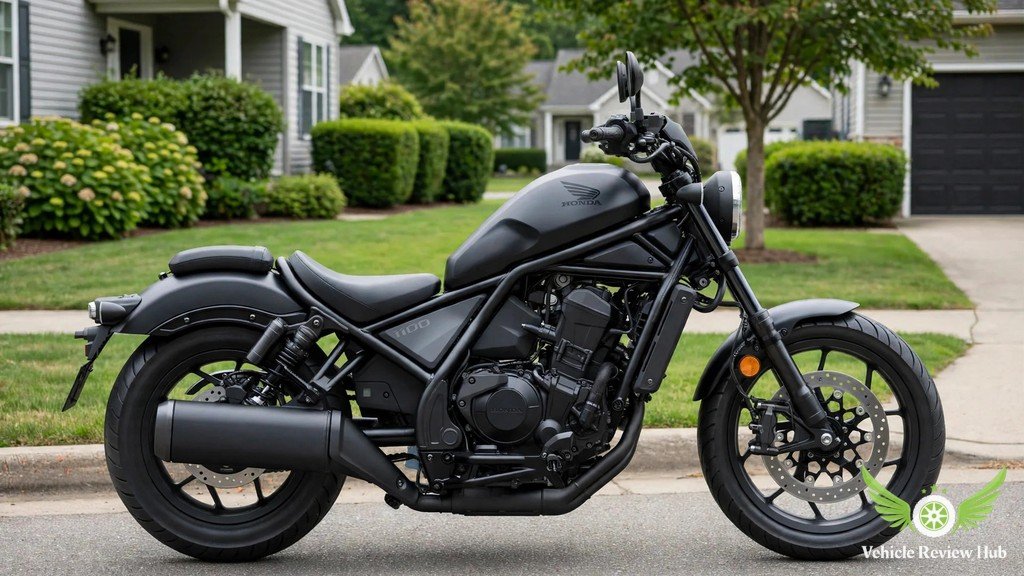
Owner Anecdotes From $250 to $1,200 a Year and No Official Average
Owner anecdotes for the Rebel 1100 run from about $250 to about $1,200 a year for full coverage, and this Honda Rebel 1100 buying guide presents that range as what it is: anecdotes, not a measured average. No publisher offers a verified model-specific US average, so none is claimed here. Garaged, clean-record riders land near the bottom; others land near the top. What moves the quote most is age, location, record, mileage, and deductible — not DCT versus manual. This Honda Rebel 1100 buying guide recommends VIN-specific quotes from at least three insurers on the exact bike before you agree a price.
How to Estimate Fuel, Maintenance, Parts and Other Ownership Expenses
Build the annual budget in this Honda Rebel 1100 buying guide from four lines. Fuel: the 3.6-gallon tank at a 40-mpg planning figure gives roughly 144 miles — plan stops at 130. Servicing follows the manual: first service 600 miles, oil 8,000, valves and DCT filter 16,000, air cleaner 12,000, brake fluid two years, chain 600. Wear items: common-size cruiser tires, and chain and sprockets lasting roughly 15,000–20,000 miles. A realistic first-year budget, excluding purchase price, runs $800–$1,400 in this Honda Rebel 1100 buying guide’s planning estimate. Most 2021–2023 bikes are out of warranty now.
How to Inspect a Used Honda Rebel 1100
Inspect in this order: paperwork and recalls, then transmission and service records, then chassis and crash evidence, then cosmetics. This Honda Rebel 1100 buying guide’s inspection order is deliberate — a pretty bike with an open recall or skipped DCT service is a worse buy than a scruffy bike with clean paperwork.
Checking VIN Recall Status, DCT Filter Records and Service History
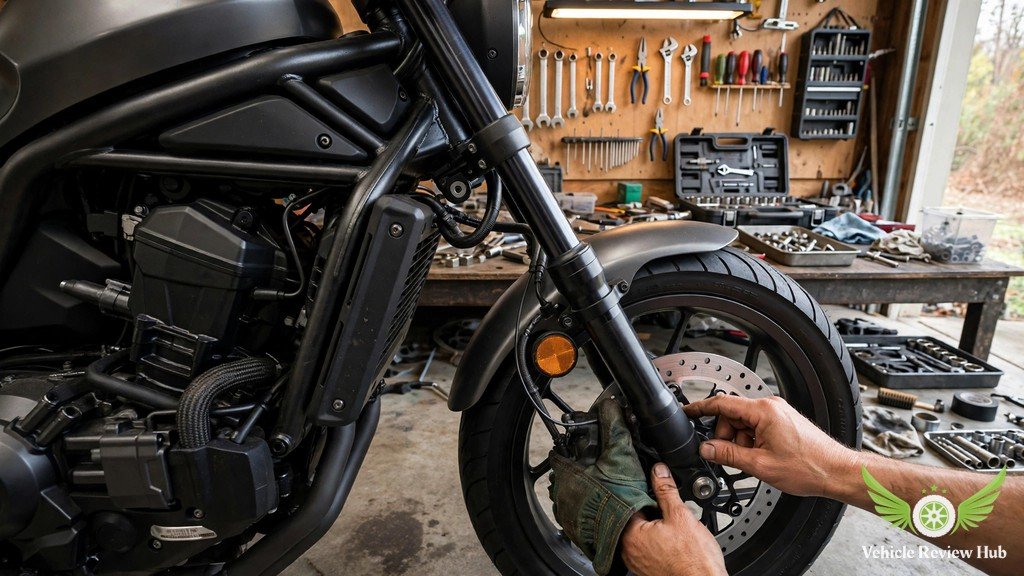
Start with the VIN, before you fall in love with the bike — the first rule of this Honda Rebel 1100 buying guide. The Rebel 1100’s model code is CMX1100; the VIN plate and model-code sticker give the exact trim and year, decoded in the next section. Run the VIN through Honda’s recall lookup and NHTSA’s recall lookup for two campaigns naming the CMX1100. The first, radiator cap 21V987 (Honda KN1), covers certain 2021 bikes built April 10 to July 22, 2021 — 1,022 units — where the cap may leak or spray hot coolant; dealers replace it free, per RideApart. The second, sealing bolt 25V358 (Honda KS2), is the one buyers most often misunderstand, so this Honda Rebel 1100 buying guide states its scope precisely: Honda’s June 2025 stop-sale update covers certain manual-transmission 2025 CMX1100 Rebels — plus certain 2024 XL750 Transalps and 2025 CRF1100 Africa Twins in the same multi-model campaign — where an improperly machined sealing bolt can leak oil, potentially onto the rear tire. The multi-model total is about 1,016 units, not an 1100-only figure, and dealers must not sell an affected new or used bike until it is repaired, per RideApart’s coverage of the sealing-bolt recall. Two consequences: DCT bikes sit outside the 25V358 manual scope as Honda wrote it, but check every bike by VIN anyway; and a 2024 manual deserves the same check as a 2025 manual as a matter of caution, because the reported bolt production window starts in late 2024 — even though no 2024 model-year Rebel 1100 is named in the recall. Then ask for service records, especially the DCT clutch-filter record on DCT bikes: the filter falls every 16,000 miles, it is DCT-only, and a missing record is a price point. See the companion Rebel 1100 reliability picture for more depth.
| Recall | Rebel 1100 scope (verified) | Defect and remedy |
|---|---|---|
| 21V987 (KN1) | Certain 2021, built Apr 10 – Jul 22, 2021 | Radiator cap may not seal, can leak or spray hot coolant; free cap replacement + coolant refill; 1,022 units |
| 25V358 (KS2) | Certain 2025 manual-transmission CMX1100 | Sealing bolt may leak oil onto rear tire; free bolt replacement; ~1,016-unit multi-model total; stop sale until repaired |
Inspecting 1100T Bags, Frame, Tires, Brakes, Chain and Trim Codes
Drop damage shows in predictable places: scraped bar ends, bent levers, scuffed housings, rashed heat shields, scratched fork lowers, and cracked lenses. Damage on several points, or a bent bar, tweaked fork, or dented tank, points to a crash — check the frame and alignment. Check chain, tire date codes and tread, and brake feel. On an 1100T, check the touring kit: both 35-litre bags should latch and seal, fairing mounts tight with no stress cracks, and the short screen crack-free — bag and fairing parts cost far more than their size suggests. Verify trim from the model code. Honda’s code pattern: CMX1100 is manual, D means DCT, D3 means SE, T means touring bagger, TD means touring DCT, plus a year letter. Verified examples: 2021 DCT CMX1100DM; 2023 DCT CMX1100DP; 2024 DCT CMX1100DR; 2026 DCT SE CMX1100D3T. The SE kit is also visible: fork boots, bar-end mirrors, headlight cowl, short front fender, and custom seat — 2025 pairs bronze wheels with Flare Orange Metallic paint, 2026 wears Deep Pearl Gray. If the code says base but the bike wears SE parts, someone added accessories; if it says SE but the cowl and seat are missing, price it as a base bike in this Honda Rebel 1100 buying guide.
Honda Rebel 1100 Model Years and Features to Compare
Three steps matter: 2021–2024 originals, the 2025 TFT update, and the 2026 five-trim lineup. The engine never changed character, but year matters more than mileage in this Honda Rebel 1100 buying guide.
Comparing 2021-2024 Models With 2025 TFT and Ergonomics Versions
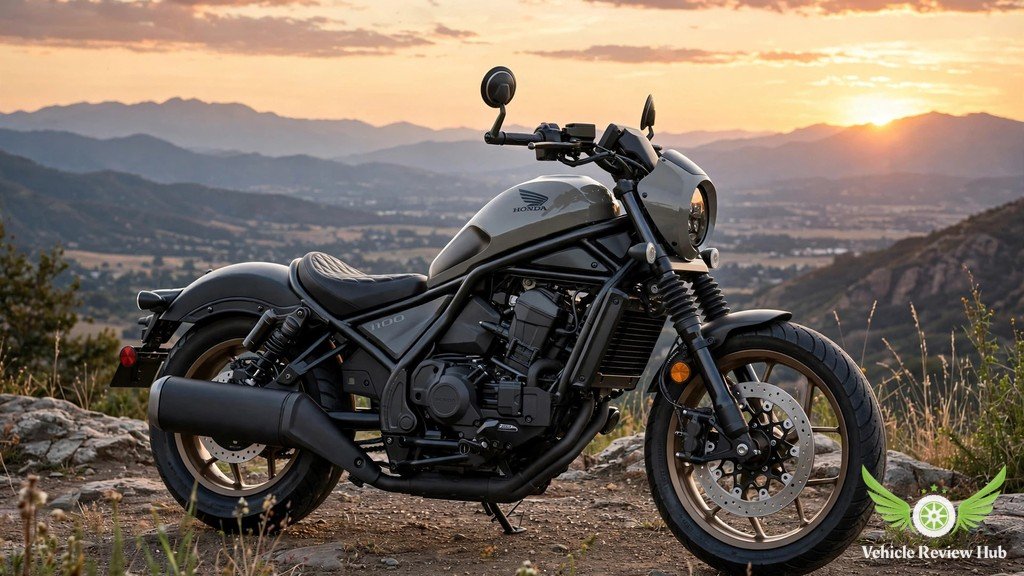
The 2021–2024 originals are honest, simple big cruisers: the same 1,084cc twin, 27.5-inch seat, standard cruise control, and monochrome LCD. The 2025 update is the one worth paying for in this Honda Rebel 1100 buying guide: a 5-inch TFT display with Honda RoadSync, a USB-C socket, a more cushioned seat, a more laid-back riding position, and a retuned engine with sharper throttle response. Honda’s 2025 spec pages confirm the weights that matter: manual 487 pounds curb, DCT 509, 1100T manual 520, 1100T DCT 542, all with a 3.6-gallon tank and 59.8-inch wheelbase, per Honda’s 2025 Rebel 1100 DCT specifications — and this Honda Rebel 1100 buying guide uses Honda’s 27.5-inch spec figure for 2021–2025 bikes (Cycle World measured 27.9 inches on its 2022 DCT test bike, and Honda’s 2026 pages list 27.9).
Which Features Matter Most: DCT, SE Equipment and 1100T Luggage?
Rank the features in this order, as this Honda Rebel 1100 buying guide does. First, DCT: a $700–$800 option when new, free once used — worth it for traffic or touring, but verify the filter service. Second, the 2025 TFT and ergonomics package — the single biggest year-to-year improvement, worth a premium over a 2024 bike. Third, SE equipment: custom seat, fork boots, bar-end mirrors, headlight cowl, and short fender — but SE trim adds no performance, so pay for it only if you love the look, per Rider’s 2025 DCT SE review. Fourth, 1100T luggage: the lockable 35-litre bags and batwing fairing explain the T’s roughly $1,200 premium — but add 33 pounds over the standard DCT. See the Rebel 1100T buying guide for the bagger’s market.
Honda Rebel 1100 vs Indian Scout: Which One to Buy in the USA
Two new bikes, $2,600 apart — and the cheaper one is the Honda. The math below is the verified 2026 math.
Rebel 1100 DCT at $10,399 Against the Scout Bobber From $12,999
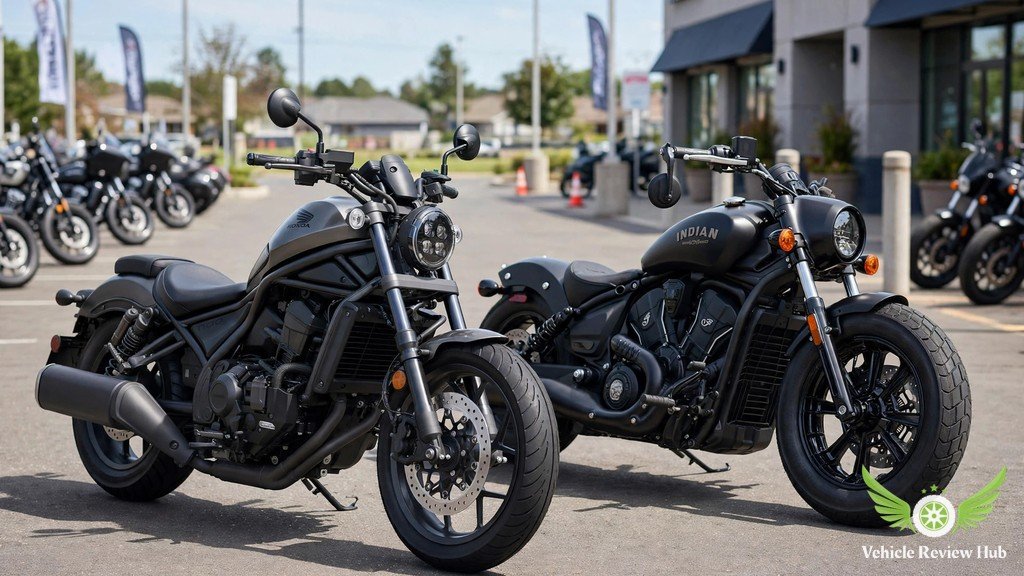
For 2026, the maths is clean. The Rebel 1100 DCT costs $10,399 plus $775 destination, and the Indian Scout Bobber starts at $12,999 plus $725 destination — a $2,600 gap before taxes and fees, per Motorcycle.com’s 2026 Scout Bobber specifications. The Honda gives you a 1,084cc parallel twin, a 27.5-inch seat, and a 509-pound DCT curb weight; the Indian counters with a 1,250cc SpeedPlus V-twin making 105 horsepower. Buy the Honda for seat, weight, DCT, and dealer network; buy the Scout for V-twin character and the bigger engine. For a used buyer the gap narrows: a used Rebel 1100 DCT at $7,500–$9,000 competes with a new Scout Sixty Bobber at $9,999, and the Honda usually wins that fight in this Honda Rebel 1100 buying guide’s judgment. See the companion Rebel 1100 review for riding character.
When a Nightster From $9,999 or a Triumph Bobber Makes More Sense
The Harley-Davidson Nightster, at $9,999 for 2026, uses a 975cc Revolution Max V-twin making 91 horsepower at 481 pounds — lighter and punchier than the Rebel. It makes sense when the badge and lighter chassis matter most. The Triumph Bonneville Speedmaster, at $14,795 for 2026 with a 1,200cc twin making 77 horsepower, costs nearly $5,000 more than the Nightster and about $4,400 more than the Rebel DCT before destination — it makes sense when classic styling and torque matter more than price. Neither rival offers a DCT-style automatic — the Honda’s quiet trump card.
Is Buying a Used Honda Rebel 1100 Worth It?
Yes, with two conditions: the bike passes the VIN and cold-start checks, and the price reflects its true trim, transmission, and service history, not just its odometer. A used Rebel 1100 is a mainstream Honda with a deep parts bin and dealers nearby — which is why this Honda Rebel 1100 buying guide rates it a strong buy.
Benefits and Risks: DCT Listings Outnumber Manuals in the Used Market
The benefits are concrete: a proven 1,084cc twin, a low seat, manageable weight, strong resale, and a DCT option no rival offers at this price. The biggest risk is not mechanical — it is buying the wrong transmission for your riding. DCT bikes dominate the used market, and this Honda Rebel 1100 buying guide counted the sample rather than repeating the claim: in the five Cycle Trader listings tabled above, four are DCT and one is a base-trim bike. That split is a sample finding. Price catch-up work first: tires, battery, fluid, and service can absorb $700–$1,100. Ask when the brake fluid, tires, battery, and — on a DCT — the clutch filter were last changed, and budget a $100–$200 dealer inspection over $8,000. The video below asks the same should-you-buy question.
US-Market Alternatives: Vulcan S, Speedmaster and Rebel 500
The Kawasaki Vulcan S, at $7,649 without ABS and $8,149 with ABS plus $685 destination for 2026, brings a 649cc twin — cheaper new than most used Rebel 1100s, but giving up pace and DCT. The Triumph Speedmaster, covered above at $14,795, offers classic style at higher money. The Honda Rebel 500, at $6,799 base and $6,999 SE plus $600 destination for 2026, is the step down for newer riders — a 471cc twin at 414 pounds; see the companion Rebel 500 buying guide. Nothing else at its used price gives you 1,084cc, a 27.5-inch seat, and an automatic gearbox in one bike — which is why this Honda Rebel 1100 buying guide calls a checked used Rebel 1100, preferably a 2025-on TFT bike and DCT for traffic, a strong buy.
Honda Rebel 1100 Buying Guide: Frequently Asked Questions
These direct answers in this Honda Rebel 1100 buying guide cover prices, insurance, inspection, model years, and rivals — the questions this Honda Rebel 1100 buying guide hears most.
How much does a used Honda Rebel 1100 cost in the USA?
Clean 2022–2024 bikes run $7,250–$9,000 and low-mileage 2025 bikes toward $10,000; this Honda Rebel 1100 buying guide says pay for transmission and condition first — that is this Honda Rebel 1100 buying guide’s price rule.
Is the Rebel 1100 available through official US dealers?
Yes: this Honda Rebel 1100 buying guide confirms the Rebel 1100 is a regular Honda USA model sold through franchised dealers, so use a dealer for VIN and recall checks.
Is $250 to $1,200 a year realistic for Rebel 1100 insurance?
As an anecdote range, yes: this Honda Rebel 1100 buying guide found no verified model-specific average, so this Honda Rebel 1100 buying guide says get VIN-specific quotes from three insurers.
Which recalls should I check before buying?
Check 21V987 and 25V358 by VIN: this Honda Rebel 1100 buying guide notes 25V358 covers certain manual 2025 bikes, so check every bike.
Should I buy a manual or a DCT Rebel 1100?
Buy DCT for traffic and touring, manual for control and 22 fewer pounds: this Honda Rebel 1100 buying guide counted DCT ahead 4 to 1 in its sample, so choose by riding, not fashion.
Is the 2025 TFT update worth paying extra for?
For most buyers, yes: this Honda Rebel 1100 buying guide confirms the 5-inch TFT, RoadSync, USB-C, and comfier seat, so seek a 2025-or-newer bike.
What is the difference between the Rebel 1100 and the Rebel 1100T?
Luggage and fairing: this Honda Rebel 1100 buying guide states the T adds lockable 35-litre hard bags and a batwing fairing — the touring version of the same bike.
How do I verify DCT, SE, and T trim by model code?
Check the model-code sticker: this Honda Rebel 1100 buying guide decodes CMX1100 as manual, D as DCT, D3 as SE, and T as touring, so this Honda Rebel 1100 buying guide says never trust ads alone.
Does the Rebel 1100 have a DCT clutch filter service?
Yes, on DCT bikes only: this Honda Rebel 1100 buying guide confirms the DCT clutch filter falls every 16,000 miles with the valve inspection, so ask for that record.
Used Rebel 1100 DCT or new Indian Scout Bobber?
Take the used Honda for value: this Honda Rebel 1100 buying guide notes the $2,600 new-bike gap and the Honda’s DCT option, so this Honda Rebel 1100 buying guide usually picks the used Rebel.
What does sitting neglect cost to fix?
Budget $700–$1,100 for tires, a battery, brake fluid, and a service: this Honda Rebel 1100 buying guide calls sitting neglect the key used risk, so price it first.
Is a used Honda Rebel 1100 a good first big motorcycle?
Yes, with respect: this Honda Rebel 1100 buying guide rates the low seat, manageable weight, and predictable twin ideal for a confident step-up rider, so this Honda Rebel 1100 buying guide calls a checked used 1100 a strong first big buy.
Buy the cleanest 2025-on TFT bike your budget allows, verify it by VIN and code, and choose DCT for traffic. That is the verdict of this Honda Rebel 1100 buying guide, and this Honda Rebel 1100 buying guide rates a checked used Rebel 1100 a strong buy.