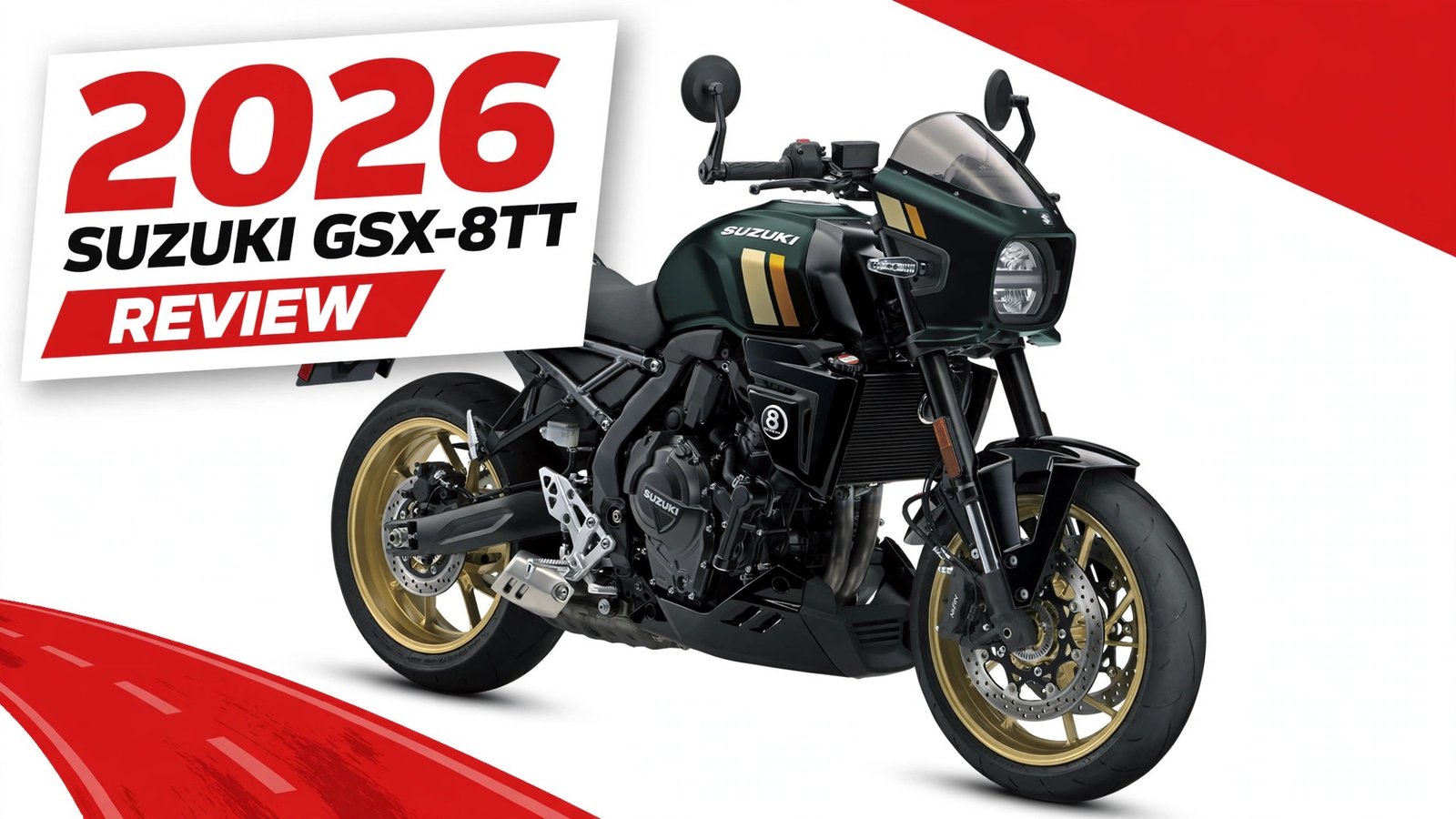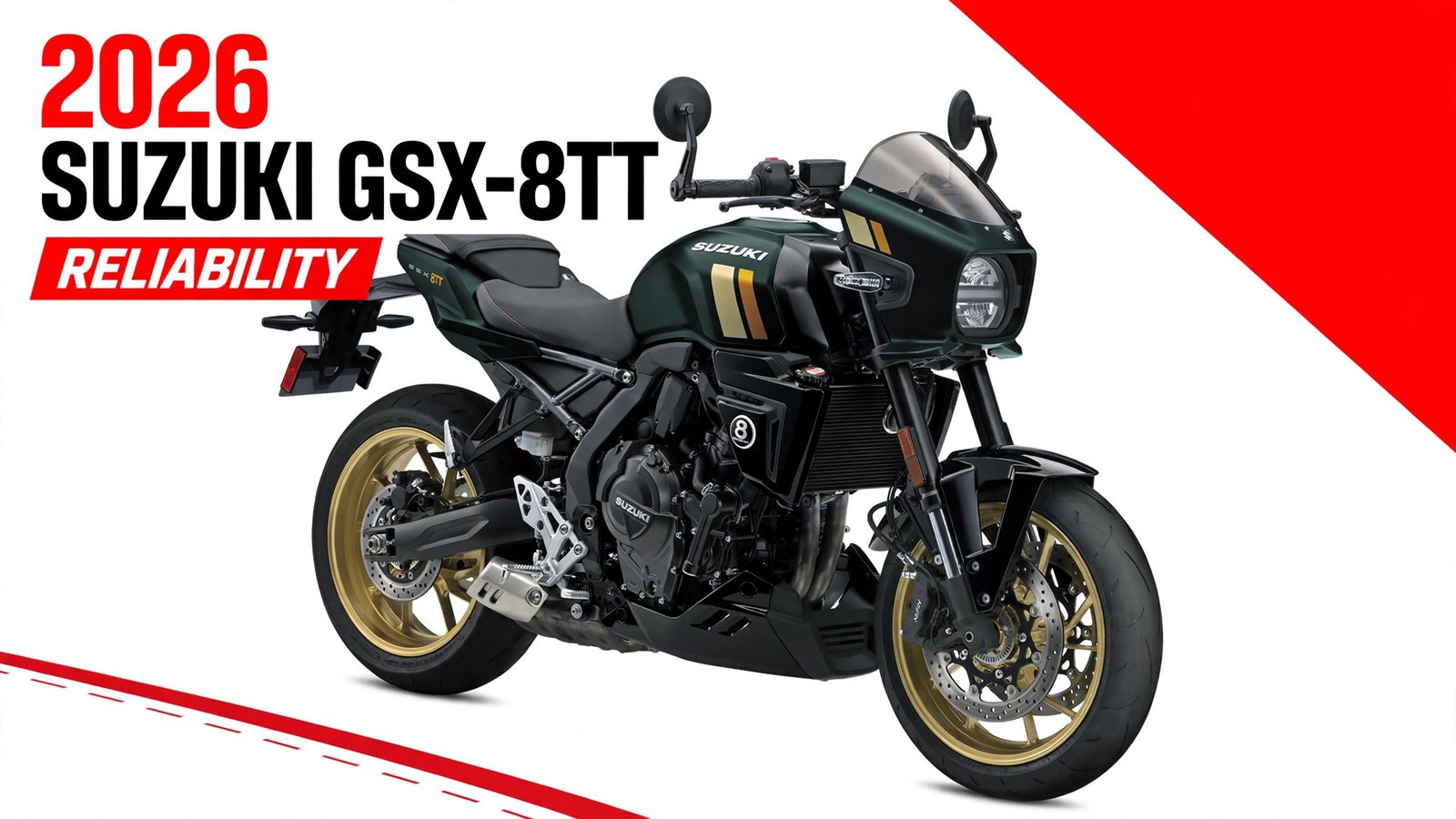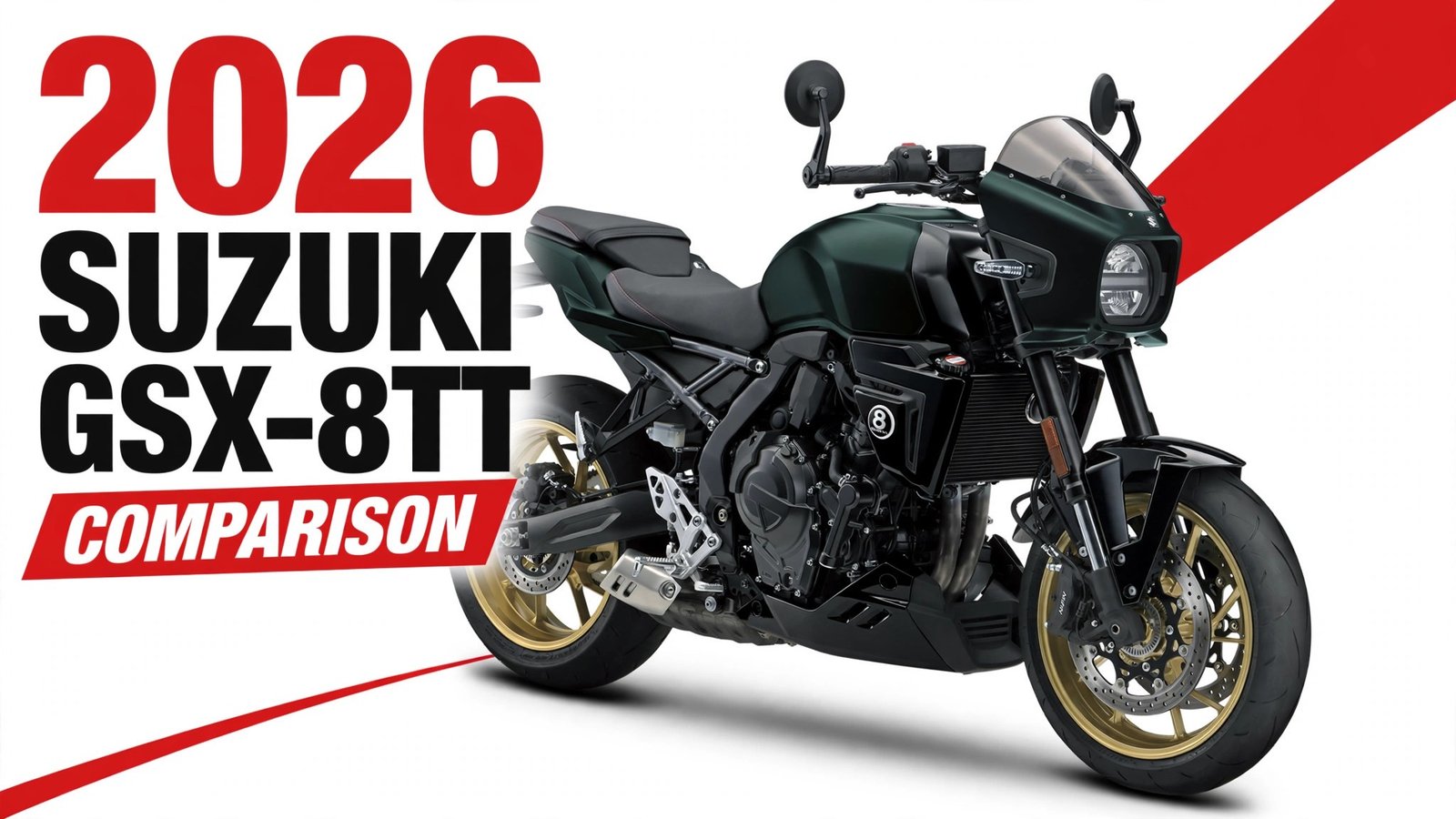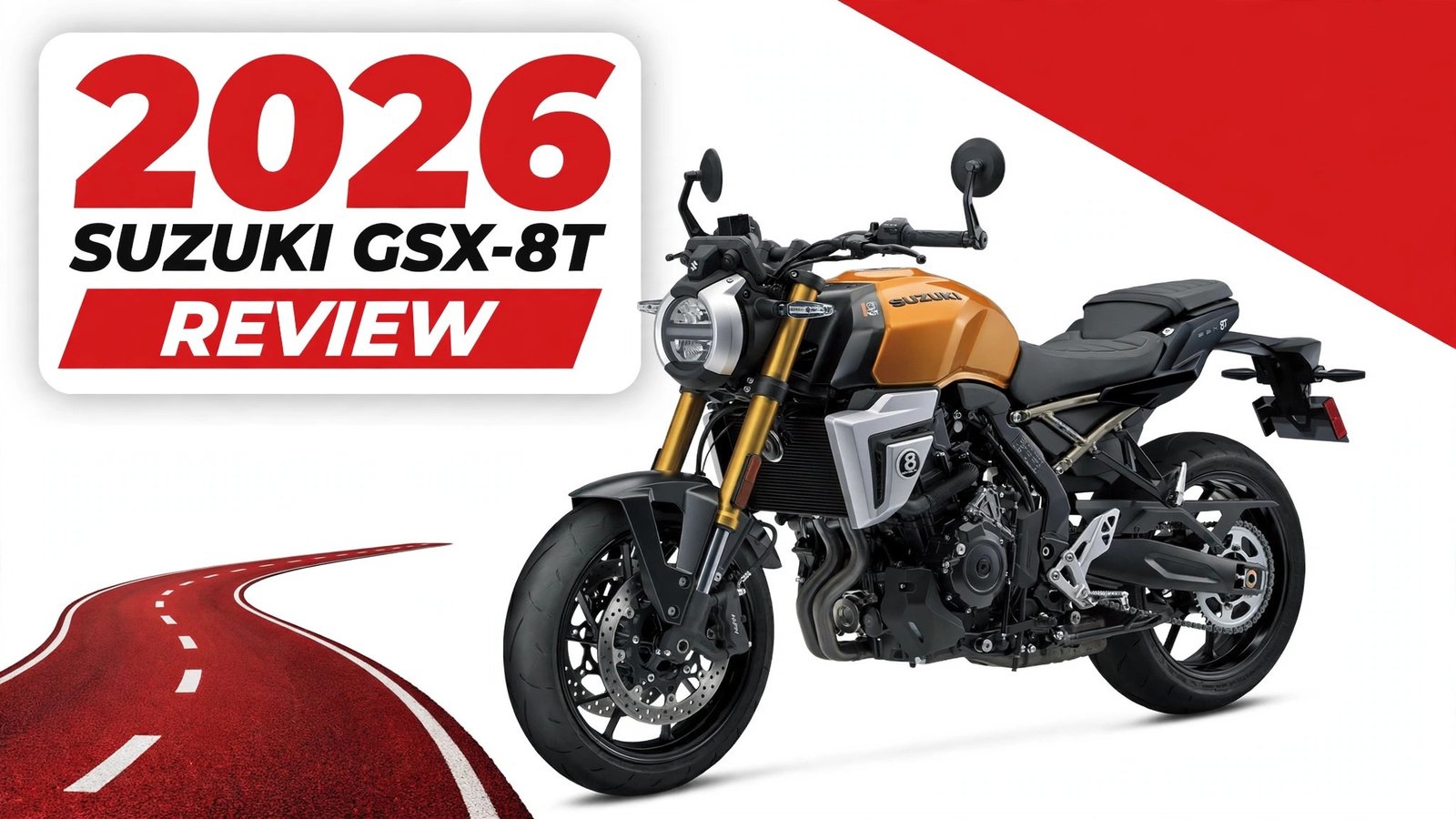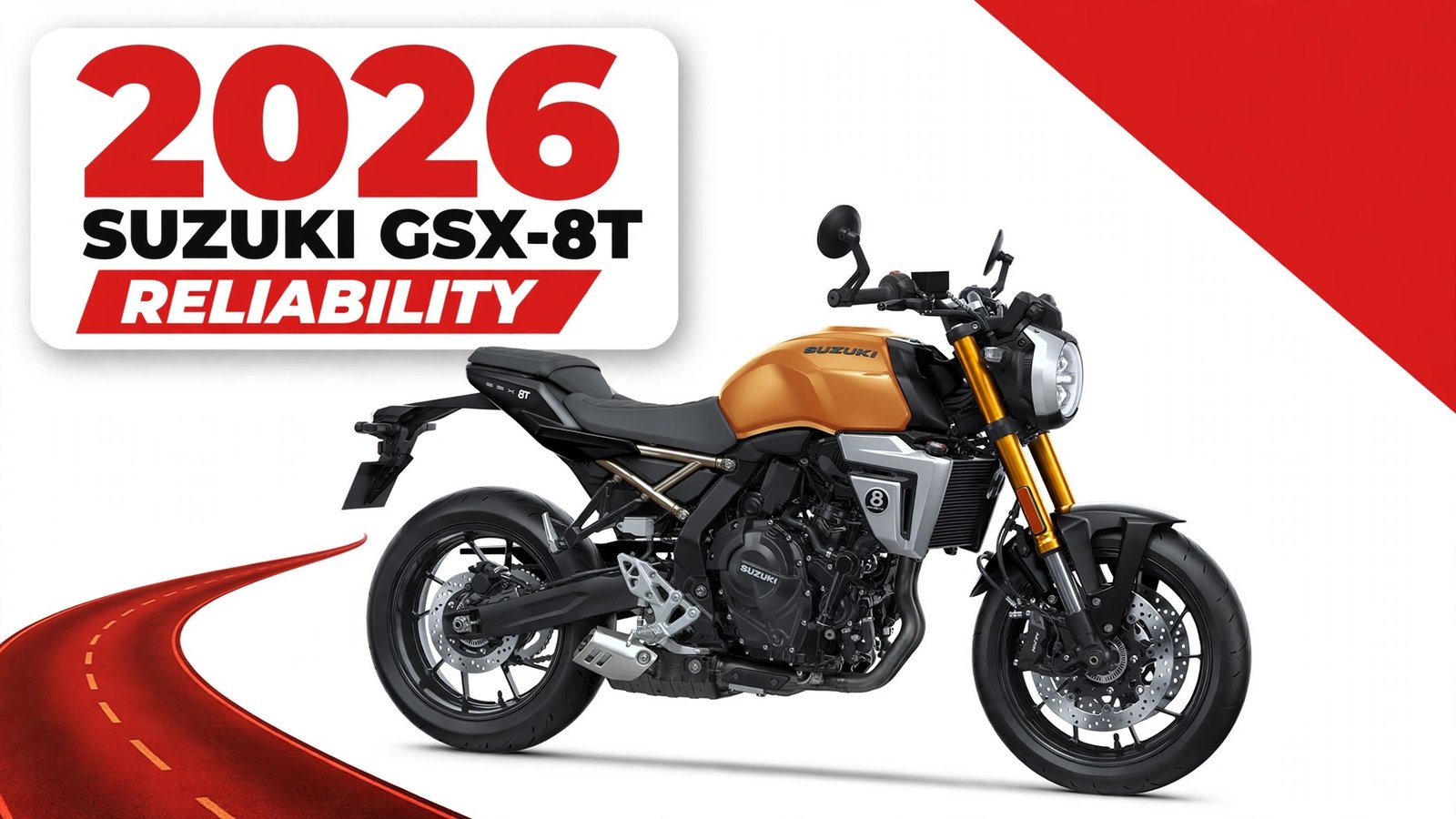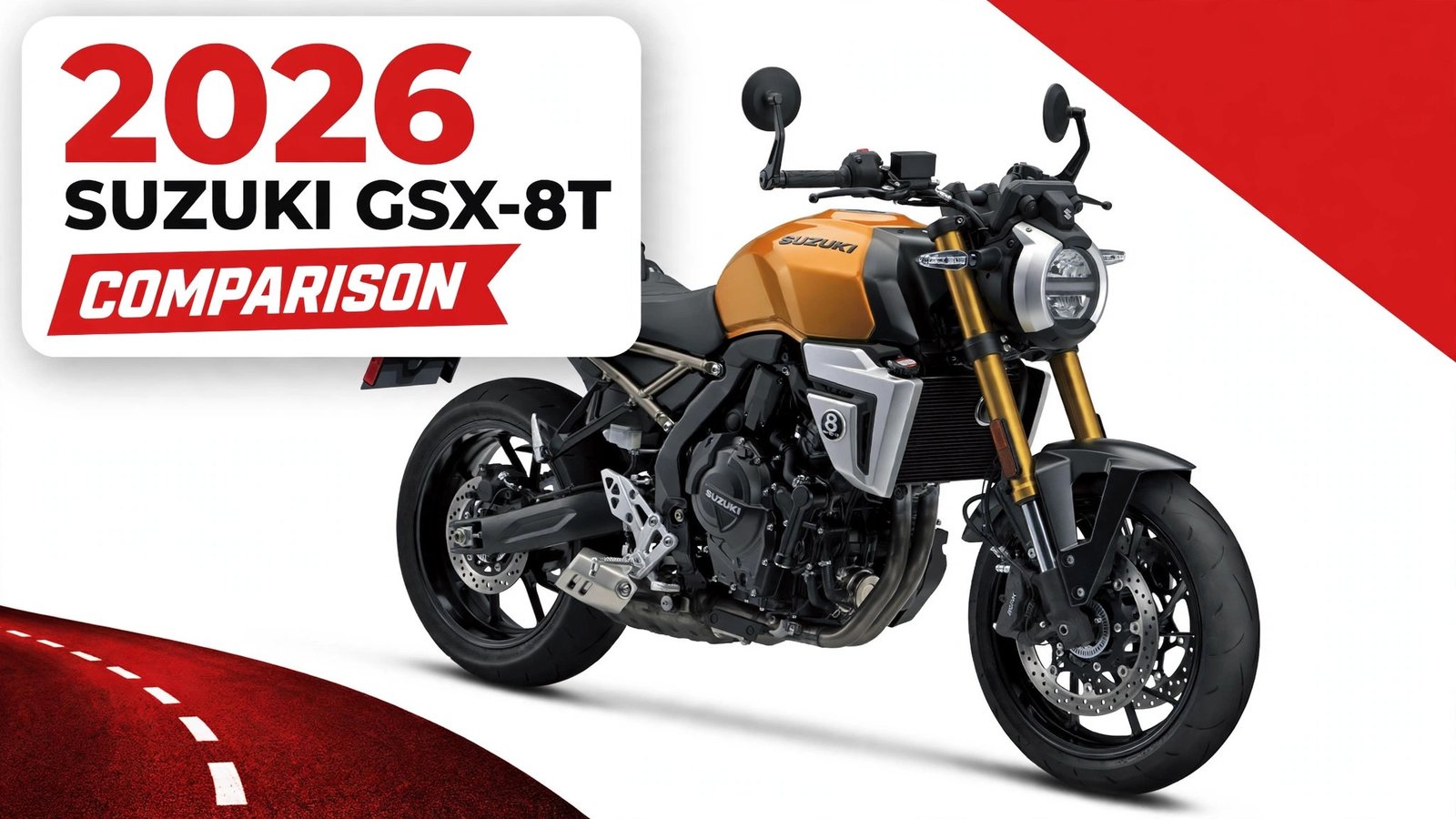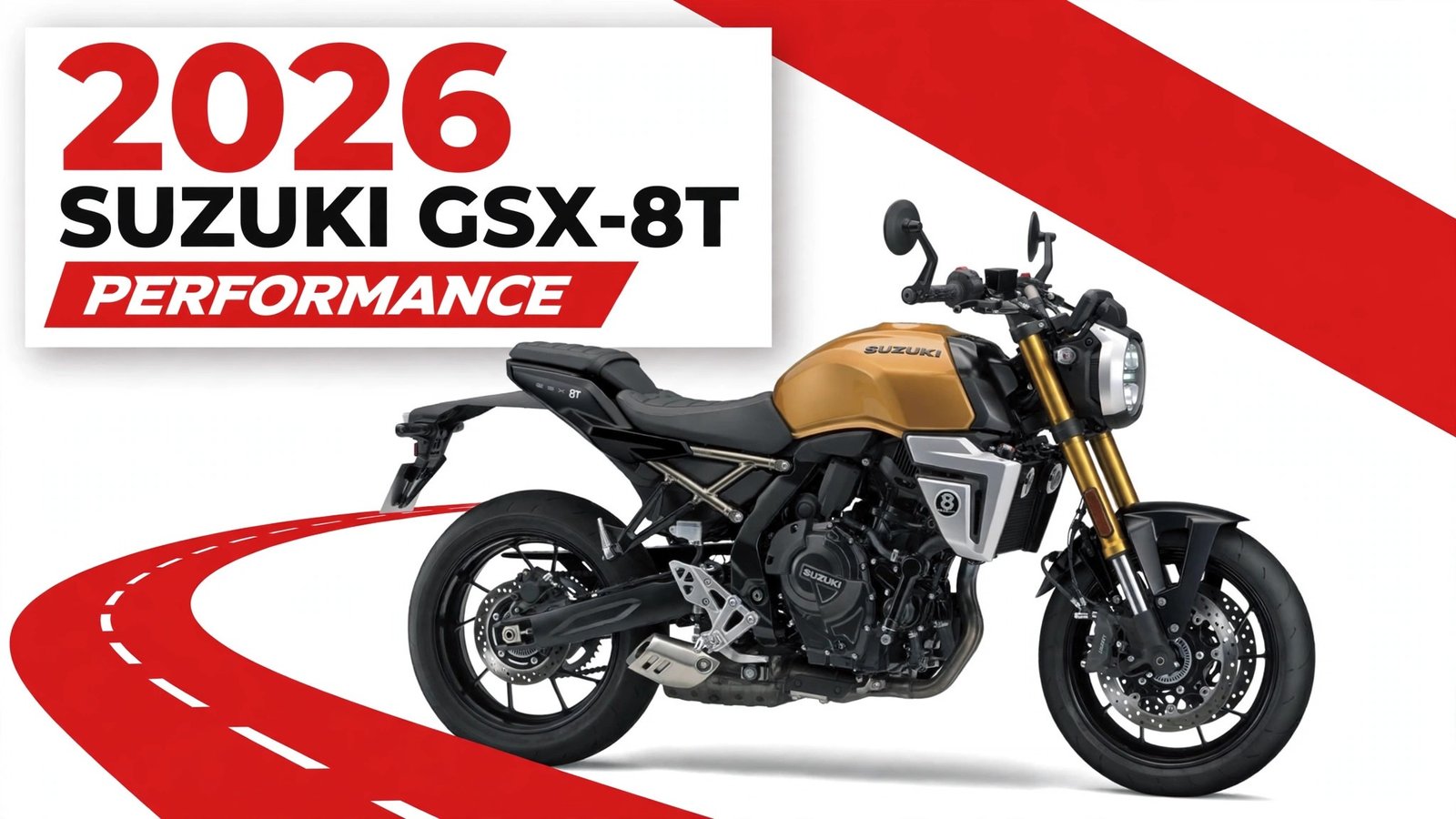
The short answer in this Suzuki GSX-8T performance guide is that the bike goes exactly as well as a GSX-8S, because it is a GSX-8S underneath: the same 776cc parallel twin, the same tune, the same suspension, the same ergonomics. Suzuki’s global claimed output is 82.9 PS — 81.8 hp — at 8,500 rpm, with 78 Nm — 57.5 lb-ft — at 6,800 rpm, and Suzuki USA publishes no horsepower or torque figures of its own. There is no instrumented top-speed test of an 8T yet, no 0–60 test, and no 8T dyno run — every measured number in this Suzuki GSX-8T performance guide is labelled GSX-8S sibling data. What is measured is the fuel economy: 56 mpg in US gallons from the WMTC figure.
Suzuki GSX-8T Engine Performance and Power Delivery
The engine is the known quantity in this Suzuki GSX-8T performance guide. It is the 776cc liquid-cooled parallel twin that debuted in the GSX-8S in 2023, carried into the 8T with no changes to the tune, the suspension or even the ergonomics, according to RevZilla. That sameness is the whole performance story: nothing about the way the 8T makes power is new.
Same Tune as the GSX-8S, Say Every Tester
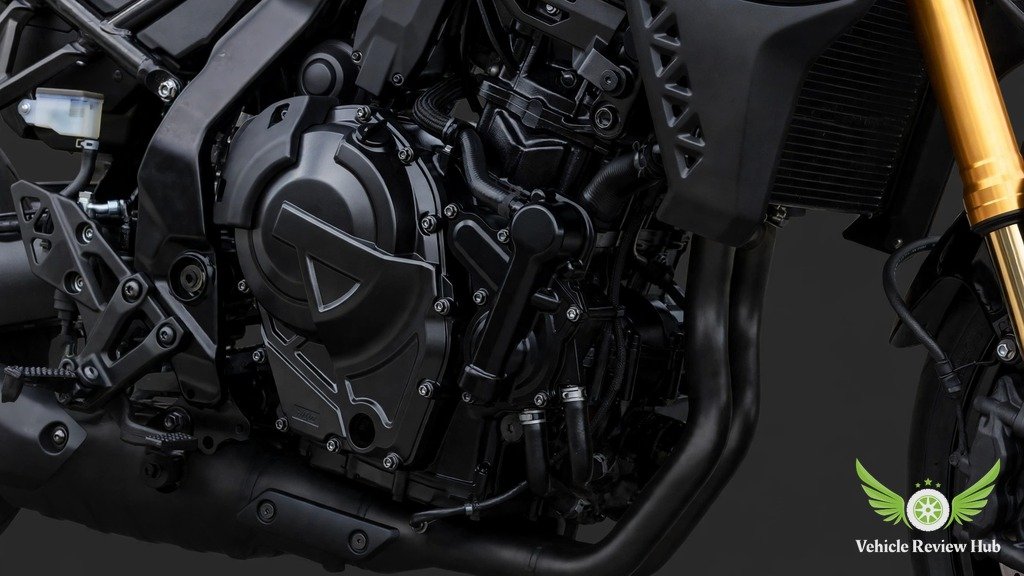
Every tester who has ridden the 8T says the same thing: the tune is the GSX-8S tune. RevZilla’s first ride states it plainly — no changes to the engine tune, suspension, or even the ergonomics against the 8S — and Rider, BikeReview and Bennetts all agree. The engine is a 776cc liquid-cooled DOHC 8-valve parallel twin with an 84.0 by 70.0 mm bore and stroke, a 12.8:1 compression ratio and a 270-degree crank. The 270-degree crank gives the twin a V-twin-like character and strong midrange torque — the heart of Suzuki GSX-8T performance. The RevZilla first ride review is the clearest single source for the no-changes verdict, and the GSX-8T review covers the same engine in the full review context. The top end is the weak point: NastyNils names a top end that “runs out of breath before the redline” as one of the two recurring reservations about the platform.
GSX-8S Dynos: 74 HP Cycle World, Labelled Sibling Data
No dyno run of an 8T exists yet, so the only measured power figures for this engine family come from the GSX-8S — labelled sibling data, every time they appear in this Suzuki GSX-8T performance guide. The numbers differ by dyno and by day, which is exactly why they must never be ranked against each other. Cycle World ran the 8S on its Dynojet 250i and measured 74 hp at 8,380 rpm and 52.3 lb-ft at 5,580 rpm. Rider, on Jett Tuning’s dyno, recorded 75.9 hp at 8,300 rpm and 53.3 lb-ft at 6,700 rpm. Motorcycle.com’s comparo run produced 73.5 hp at 7,900 rpm and 53.4 lb-ft at 5,400 rpm, and MCN’s run of the GSX-8R — the same tune again — gave 76 hp at 8,300 rpm.
| Dyno run (GSX-8S sibling data) | Horsepower | Torque |
|---|---|---|
| Cycle World, Dynojet 250i | 74 hp @ 8,380 rpm | 52.3 lb-ft @ 5,580 rpm |
| Rider / Jett Tuning | 75.9 hp @ 8,300 rpm | 53.3 lb-ft @ 6,700 rpm |
| motorcycle.com comparo | 73.5 hp @ 7,900 rpm | 53.4 lb-ft @ 5,400 rpm |
| MCN, GSX-8R (same tune) | 76 hp @ 8,300 rpm | Not published |
Suzuki GSX-8T Top Speed and Acceleration
The honest position in this Suzuki GSX-8T performance guide is that there is no top-speed number to print and no 0–60 number to print, because no instrumented test of an 8T exists yet. Any website that prints an 8T top speed without naming a test is estimating, and this Suzuki GSX-8T performance guide does not repeat estimates as facts.
No Instrumented Test of an 8T Exists Yet
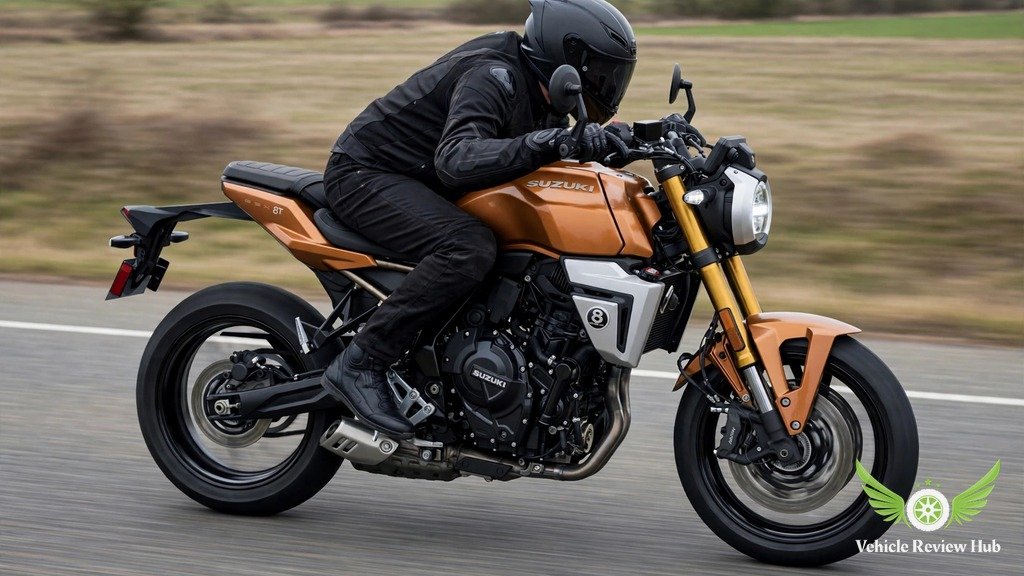
As of this writing, no magazine, website or YouTube channel has published an instrumented top-speed run or a timed 0–60 run of a GSX-8T. That is not unusual for a model in its first year — the bike only reached American dealers in the summer of 2025 — but it means the two numbers buyers most often ask for do not exist in any form this Suzuki GSX-8T performance guide can stand behind. The closest evidence is indirect: Rider’s test of the faired 8TT at Brea, California, in September 2025 reports that at 75 mph the bike “hums along smoothly with enough power in reserve”. The 8T’s 0–60 time, if a test ever publishes one, will almost certainly land in the low-to-mid three-second range — but that is an inference from sibling data, and this Suzuki GSX-8T performance guide labels it as such rather than printing it as a result. The one figure floating around online — an estimated “approx. 190 km/h” — is invented, with no test behind it.
European Claim Is 81.8 HP: a Factory Figure
The only official power figure for the 8T is the European factory claim: 82.9 PS — 81.8 hp — at 8,500 rpm, with 78 Nm — 57.5 lb-ft — at 6,800 rpm. Suzuki USA publishes no horsepower or torque figures at all, so American outlets paraphrase the output as “about 80 hp and 57 lb-ft”. One figure deserves care: the torque peak is at 6,800 rpm, not 6,500 — RevZilla’s spec table prints 6,500 rpm, and that is RevZilla’s error, not Suzuki’s. The Bennetts technical review confirms the same 82.9 PS and 78 Nm at 6,800 rpm figures from Suzuki’s global data. The 57.5 lb-ft at 6,800 rpm is the number that defines Suzuki GSX-8T performance: strong, flexible and forgiving, and available without revving the engine hard. For the full picture of what that output costs, the GSX-8T comparison works through the rivals one by one.
Suzuki GSX-8T Mileage and Fuel Economy
Fuel economy is the one performance area where the 8T has hard, measured numbers — and the one area where a single figure causes the most confusion. The headline number, 67.23 mpg, is imperial gallons. In US gallons it is 56 mpg. This Suzuki GSX-8T performance guide uses the 56 mpg US figure throughout.

Europe Quotes 67 MPG Imperial, Not US MPG
The WMTC type-approval consumption figure for the 8T is 4.2 litres per 100 km, which converts to 23.8 km per litre — 67.23 mpg in imperial gallons and 56 mpg in US gallons. Bennetts, a British publication, prints “67.23mpg (est)” because it works in imperial gallons; Ultimate Motorcycling’s US spec table prints “Estimated fuel consumption: 56 mpg” because it works in US gallons. Both are the same figure, converted. The confusion starts when a reader takes the British 67.23 and reads it as American — an easy mistake, and one this Suzuki GSX-8T performance guide is careful not to make. The WMTC range from the 16.5-litre tank is 392 to 393 km. The Suzuki USA GSX-8T page lists the 16.5-litre capacity, and the 4.3 US gallon figure is Suzuki USA’s own conversion — not the 4.4 gallons one buyer’s guide prints by rounding error.
Suzuki USA Publishes No MPG Figure at All
Suzuki USA publishes no MPG figure for the 8T, so every fuel-economy number in this Suzuki GSX-8T performance guide comes from type-approval data or from named real-world tests, and each is labelled as such. BikeReview’s week-long Australian test returned 4.17 litres per 100 km for the 8T and 4.3 for the 8TT, with a range of 320-plus kilometres from the 16.5-litre tank. 1000PS recorded 4.5 litres per 100 km in everyday riding and 5.1 litres per 100 km when ridden hard, with a WMTC range of 393 km. The spread is narrow: 4.17 to 5.1 litres per 100 km covers everything from a careful cruise to a spirited ride. For a middleweight naked, that is good economy — and good enough that fuel stops are an afterthought on a day ride.
| Source | Consumption | Range from 16.5 L tank |
|---|---|---|
| WMTC type approval | 4.2 L/100 km = 56 mpg US (67.23 mpg imperial) | 392–393 km |
| BikeReview AU, real world | 4.17 L/100 km (8T), 4.3 L/100 km (8TT) | 320+ km |
| 1000PS, everyday riding | 4.5 L/100 km | About 367 km |
| 1000PS, spirited riding | 5.1 L/100 km | About 324 km |
Suzuki GSX-8T Real-World Riding Experience
On the road, the 8T is balanced, nimble and compact — RevZilla’s words, and the most consistent verdict across every first ride. The riding experience in this Suzuki GSX-8T performance guide is not about numbers; it is about what the testers who have ridden the bike in the United States say about it.
The video below is Carole Nash Insidebikes’ review of the GSX-8T and the GSX-8TT together — it covers both bikes, so look for the naked bike with the round headlight for the 8T.
Rider and RevZilla Have Ridden It in the US
Two American outlets have ridden the platform in the United States, and the distinction between them matters. RevZilla rode the 8T itself — its first ride, by Zack Courts and a second rider, is an 8T test, and it is the source for most of the verdicts in this Suzuki GSX-8T performance guide: “balanced, nimble, and compact”, “functionally, it’s an SV650 for the modern era”, and “it doesn’t take any body language to bank into a corner”. Rider Magazine’s published US test, by contrast, is of the faired 8TT, ridden at Brea, California, on September 11, 2025 — the 8TT is the bike Rider published a test of, not the 8T, and this Suzuki GSX-8T performance guide does not claim otherwise. Rider’s 8TT verdicts still transfer, because the two bikes share the engine, frame, chassis and suspension: at 75 mph the bike “hums along smoothly with enough power in reserve”, and as an everyday streetbike — commuting, Sunday getaways — “the GSX-8TT excels”. The service schedule behind that everyday usability, including the 3,750-mile oil interval and the 15,000-mile valve check, is covered in the GSX-8T reliability guide.
Quickshifter Downshifts Arrive With a Delay
The one performance complaint that every tester mentions is the quickshifter. It is standard equipment on the 8T — a bi-directional unit, up and down — and the upshifts are fine. The downshifts are not. RevZilla’s verdict is the clearest: the downshifts are delayed and do not rev-match sufficiently, so a rider asking for a quick downshift before a corner gets a pause and then a clunk. It is the single most consistent performance criticism in this Suzuki GSX-8T performance guide, and a buyer should test it on a demo ride. The rest of the electronics are straightforward: three S-DMS drive modes (A, B and C), four-mode traction control, Easy Start, Low RPM Assist and a 5-inch colour TFT. What the electronics do not include is just as important: no cruise control, no IMU and no lean-sensitive ABS.
Suzuki GSX-8T Handling, Braking and Stability
Handling is where the 8T earns its keep. At 443 lb with a full tank, a 32.0-inch seat and a 57.7-inch wheelbase, it is a light, compact middleweight, and every tester describes it in the same terms: stable and responsive. This Suzuki GSX-8T performance guide treats the chassis as the bike’s strongest suit — and the suspension as the ceiling on it.

ABS Is Not Lean-Sensitive: There Is No IMU
The 8T’s ABS is standard, two-channel ABS — it is not lean-sensitive, because there is no IMU on the bike at all. That is a deliberate omission, not an oversight: the 8T has the rider aids a 2026 middleweight is expected to have, and none of the ones that cost real money. The brakes themselves are good hardware: Nissin radial-mount 4-piston front calipers on twin discs, with a single-piston rear caliper, and testers call the brakes excellent. One correction worth making: Rider wrote “Roadsmart 2” in its test, and that is Rider’s error — the tyre is the Dunlop Roadsport 2. The MCN 8TT review carries the same chassis discussion for the faired sibling, and the Cycle News 8TT review adds that the 8TT’s seat is wider and plusher than the 8R’s. For a rider comparing the 8T with the adventure version of the same engine, the V-Strom 800DE performance guide shows how the same 776cc twin behaves with longer travel and a taller stance. What the 8T gives up is cornering ABS and the lean-angle-aware traction control that comes with an IMU — and for most road riding, that is a paper loss rather than a felt one. That is the honest limit of Suzuki GSX-8T performance electronics.
Basic Suspension Sets the Ceiling, Say Testers
The suspension is the weakest link in Suzuki GSX-8T performance, and the testers agree on why. The front is a KYB inverted 41 mm fork with 5.1 inches of travel and no adjustment at all — NastyNils states it flatly: the front fork “takes no adjustment at all”. The rear is a link-type mono-shock with the same 5.1 inches of travel and preload adjustment only. RevZilla’s verdict is the one that matters most: the suspension is “more than adequate, assuming you don’t weigh more than 190 to 200 pounds”. Heavier riders will find the limits sooner, because a non-adjustable fork cannot be tuned to a rider’s weight or to a bumpy road. The ceiling is real but high enough for the bike’s job: commuting, Sunday rides, and the occasional fast road.
Suzuki GSX-8T Performance Compared With Other Retro Roadsters
Against its rivals, the 8T’s performance is a story of more power and more equipment for more money. The claimed 81.8 hp is the strongest in the Japanese retro class — the Yamaha XSR700 claims 73 hp and the Kawasaki Z650RS claims 67 hp — and the 57.5 lb-ft of torque is the biggest number in the group. The price tells the other side: at $10,649 the 8T is the priciest Japanese retro in its class, $1,400 over the mechanically identical GSX-8S. This Suzuki GSX-8T performance guide does not settle that argument — the comparison blog does, rival by rival.

Suzuki GSX-8T vs the GSX-8S It Is Based On
Against the GSX-8S, the performance comparison is a dead heat — because it is the same bike underneath. The same 776cc engine, the same tune, the same suspension, the same ergonomics, the same 443 lb curb weight, the same claimed output. RevZilla’s verdict is that there are no changes to the engine tune, suspension, or even the ergonomics, and the dyno band from the 8S applies to the 8T without adjustment. What differs is not performance but the package: the bigger 16.5-litre tank against the 8S’s 14 litres, the lithium-ion battery, the USB-C socket, the bar-end mirrors and the retro styling. The 8S is $1,400 cheaper at $9,249, and for a buyer who does not care about the retro look, the 8S is the faster way to the same performance. The 8T’s case, as this Suzuki GSX-8T performance guide sees it, is that the styling, the tank, the battery and the socket are worth the premium.
Is the Suzuki GSX-8T Suitable for Beginner Riders? Mostly
Mostly, yes — and this Suzuki GSX-8T performance guide would not upgrade that to a full recommendation. The case for beginners is strong: approachable power that does not intimidate, a low 32.0-inch seat, a light clutch feel, and Low RPM Assist, which keeps the engine from stalling at walking pace. The case against is threefold: the weight is about 443 lb, which is manageable but not light; the quickshifter’s delayed downshifts can catch a new rider out; and there is no lean-sensitive ABS, because there is no IMU. The verdict is “mostly” because the 8T is a good second bike and a capable first big bike for a careful new rider — but a nervous beginner would be better served by something lighter and simpler, or by the same engine in the cheaper 8S with the money saved spent on training.
Suzuki GSX-8T Performance: Frequently Asked Questions
Direct answers to the questions riders ask about Suzuki GSX-8T performance.
How much horsepower does the Suzuki GSX-8T make?
Suzuki’s global claimed output is 82.9 PS — 81.8 hp — at 8,500 rpm, with 78 Nm — 57.5 lb-ft — at 6,800 rpm. Suzuki USA publishes no horsepower or torque figures. The only measured figures in this Suzuki GSX-8T performance guide are GSX-8S sibling dyno data: Cycle World measured 74 hp at 8,380 rpm.
What is the top speed of the Suzuki GSX-8T?
No instrumented top-speed test of an 8T exists yet, so this Suzuki GSX-8T performance guide prints no top-speed figure. Any website printing one without naming a test is estimating. The claimed 81.8 hp and 443 lb suggest a top speed in the 130 mph region — but that is an inference, not a measurement.
How fast is the Suzuki GSX-8T 0–60?
No timed 0–60 test of an 8T exists yet, so this Suzuki GSX-8T performance guide prints no figure. The GSX-8S sibling dyno band of 73.5 to 76 hp at the wheel suggests a time in the low-to-mid three-second range — but that is an inference, not a test result.
What MPG does the Suzuki GSX-8T get?
The WMTC figure is 4.2 litres per 100 km — 56 mpg in US gallons, 67.23 mpg imperial. The 67 mpg figure is imperial, never US, and Suzuki USA publishes no MPG figure at all. This Suzuki GSX-8T performance guide uses the 56 mpg US figure throughout. Real-world tests return 4.17 to 5.1 litres per 100 km, with a range of 320-plus kilometres.
Does the Suzuki GSX-8T have a quickshifter?
Yes — a bi-directional quickshifter is standard equipment. The upshifts are fine, but the downshifts arrive delayed and do not rev-match sufficiently, according to RevZilla. It is the most consistent complaint about Suzuki GSX-8T performance, and a buyer should test it on a demo ride.
Does the Suzuki GSX-8T have cruise control?
No. The 8T has no cruise control, no IMU and no lean-sensitive ABS. Its electronics are ride-by-wire, three S-DMS drive modes, four-mode traction control, a bi-directional quickshifter, Easy Start, Low RPM Assist and a 5-inch colour TFT. Riders who want cruise control should look at a bike that offers it as standard.
Is the Suzuki GSX-8T faster than the GSX-8S?
No — as this Suzuki GSX-8T performance guide explains, they are the same bike underneath, with the same engine, tune, suspension and ergonomics. The 8T’s only measured advantages are the bigger 16.5-litre tank and the lighter lithium-ion battery, which keeps the weight at the same 443 lb. The $1,400 premium buys styling and equipment, not speed.
What dyno numbers exist for the 8T engine?
No 8T dyno exists yet. The only measured figures are GSX-8S sibling data: Cycle World 74 hp at 8,380 rpm and 52.3 lb-ft at 5,580 rpm; Rider and Jett Tuning 75.9 hp at 8,300 rpm; motorcycle.com 73.5 hp at 7,900 rpm; MCN’s GSX-8R run 76 hp at 8,300 rpm. Never rank them — different dynos, different days.
Is the Suzuki GSX-8T good for beginners?
Mostly, yes — but this Suzuki GSX-8T performance guide would not upgrade that to a full recommendation. The approachable power, low 32.0-inch seat, light clutch and Low RPM Assist argue for it; the 443 lb weight, the delayed quickshifter downshifts and the absence of lean-sensitive ABS argue against it. It is a good second bike and a capable first big bike for a careful new rider.
Does the Suzuki GSX-8T have lean-sensitive ABS?
No. The ABS is standard two-channel ABS, and it is not lean-sensitive because there is no IMU on the bike. The brakes are good hardware — Nissin radial-mount 4-piston front calipers on twin discs — and testers call them excellent, but the cornering-aware braking that an IMU enables is not part of Suzuki GSX-8T performance at any price.
How far can the Suzuki GSX-8T go on a tank?
The WMTC range is 392 to 393 km from the 16.5-litre tank, and real-world tests return 320-plus kilometres — BikeReview recorded 4.17 litres per 100 km, and 1000PS recorded 4.5 in everyday riding and 5.1 when ridden hard.
Is the Suzuki GSX-8T good on the highway?
Yes. Rider’s 8TT test reports that at 75 mph the bike “hums along smoothly with enough power in reserve”, MoreBikes’ long-termer says sitting at 70 mph “never felt so easy”, and the 16.5-litre tank gives a real-world range of 320-plus kilometres. The only highway weakness is the lack of cruise control and wind protection — the 8T is a naked bike.