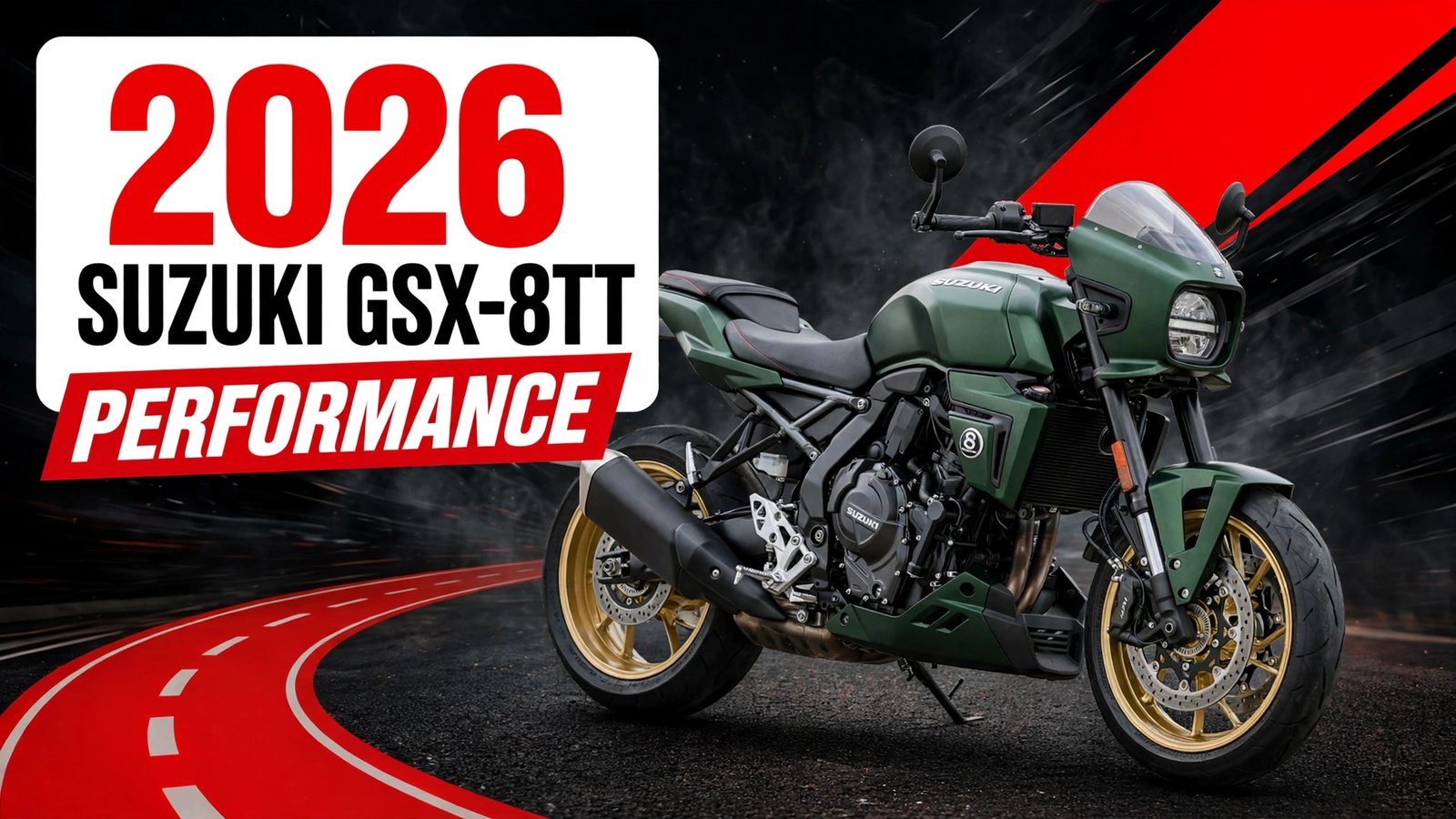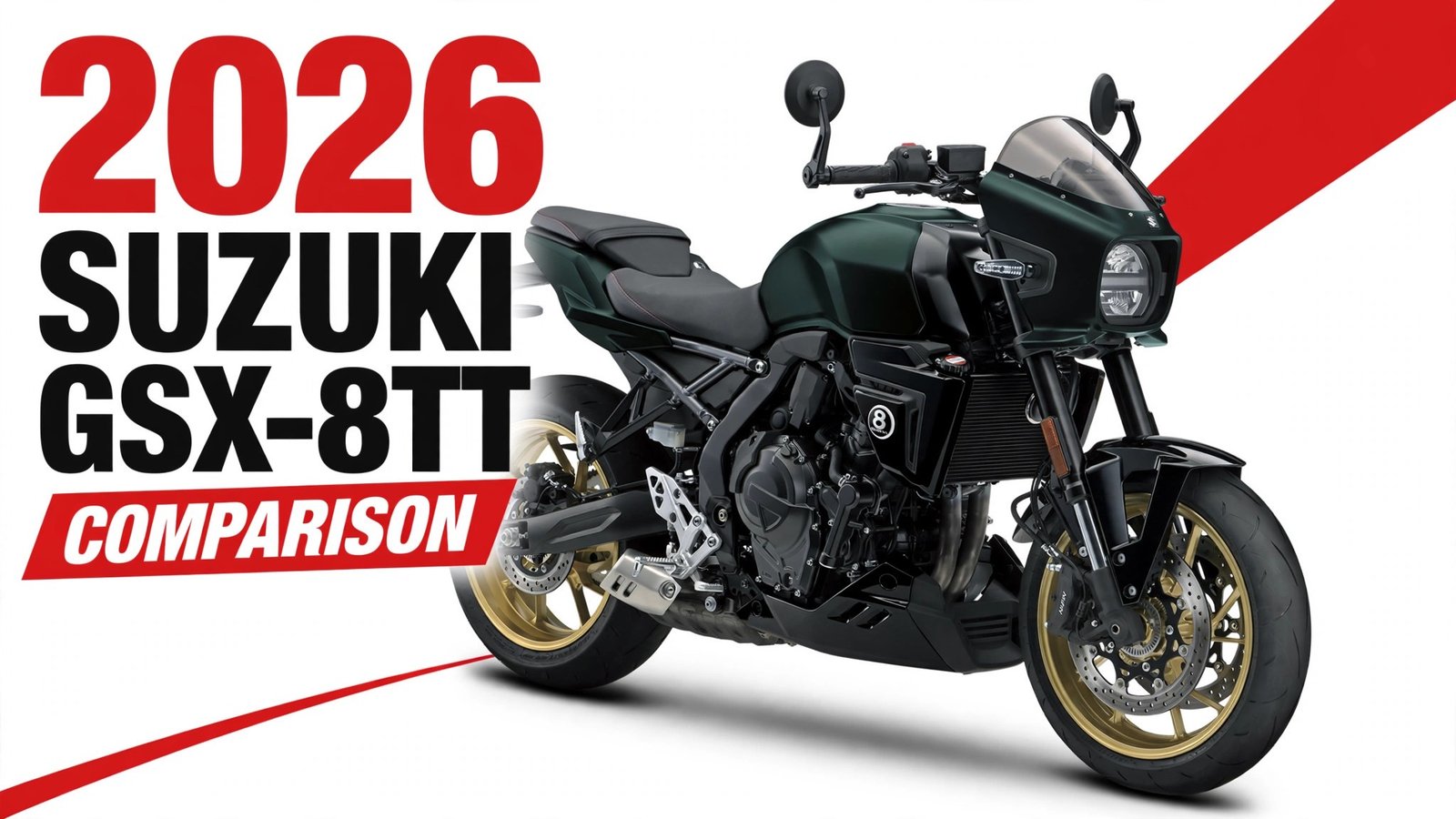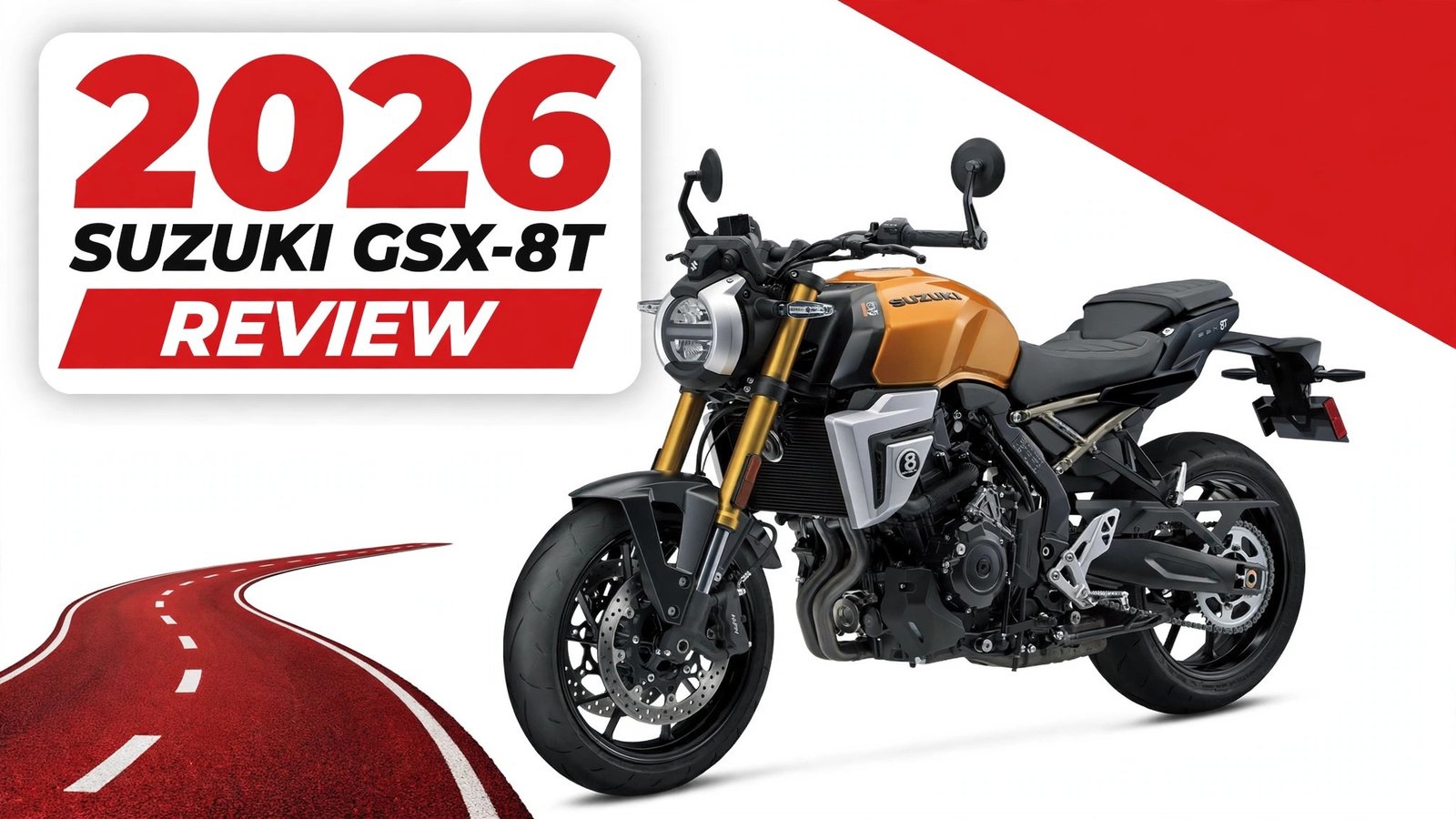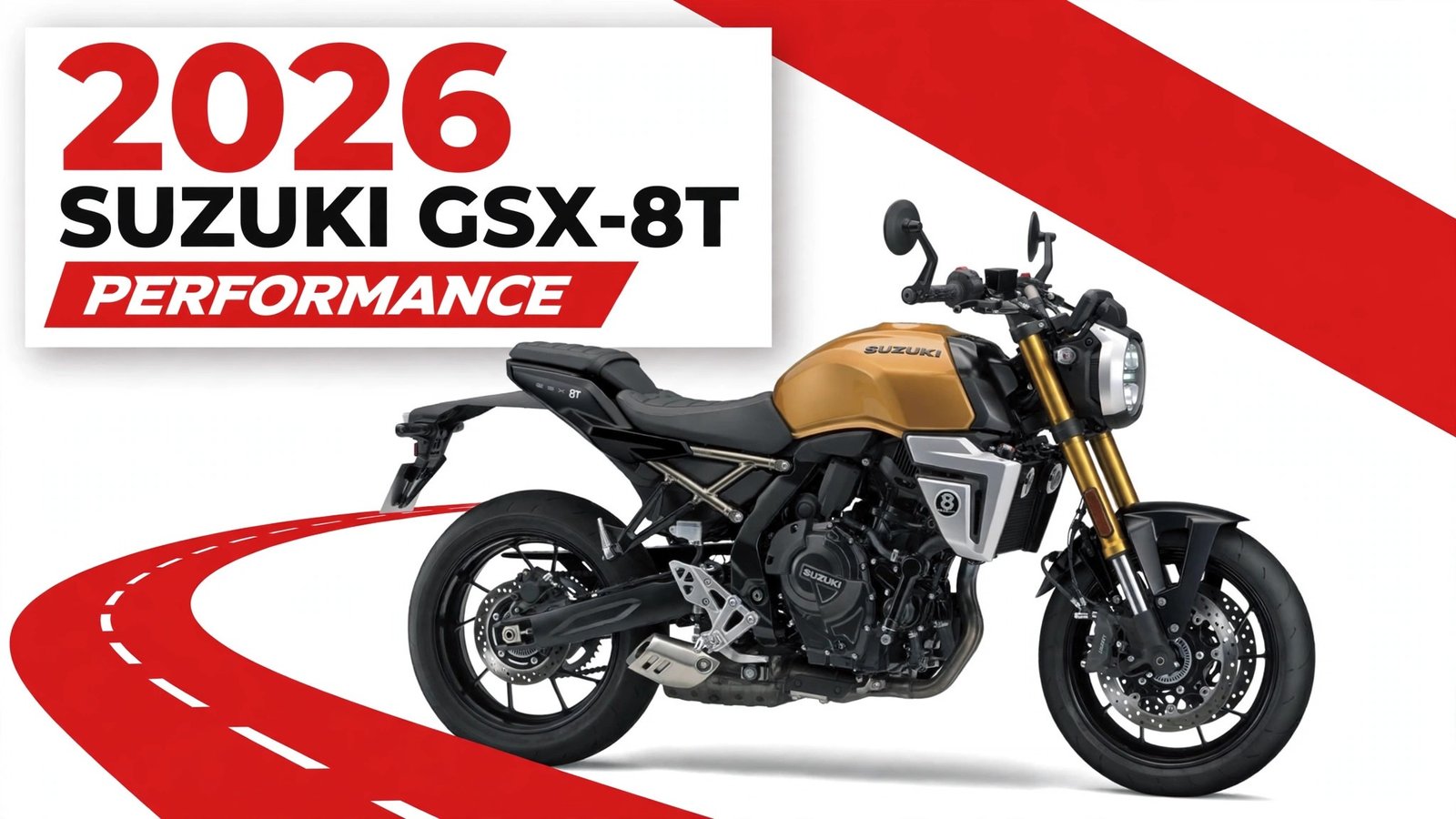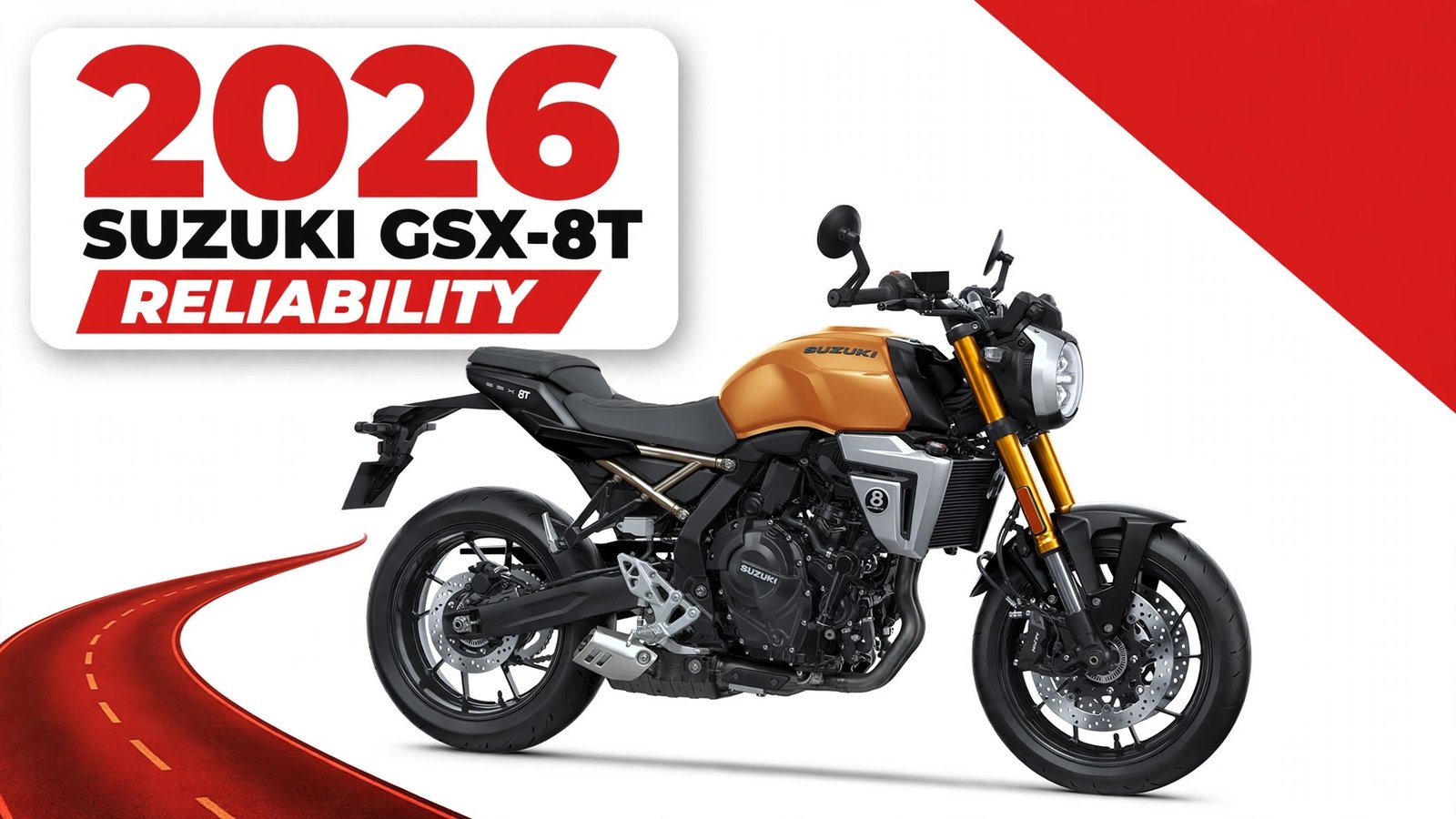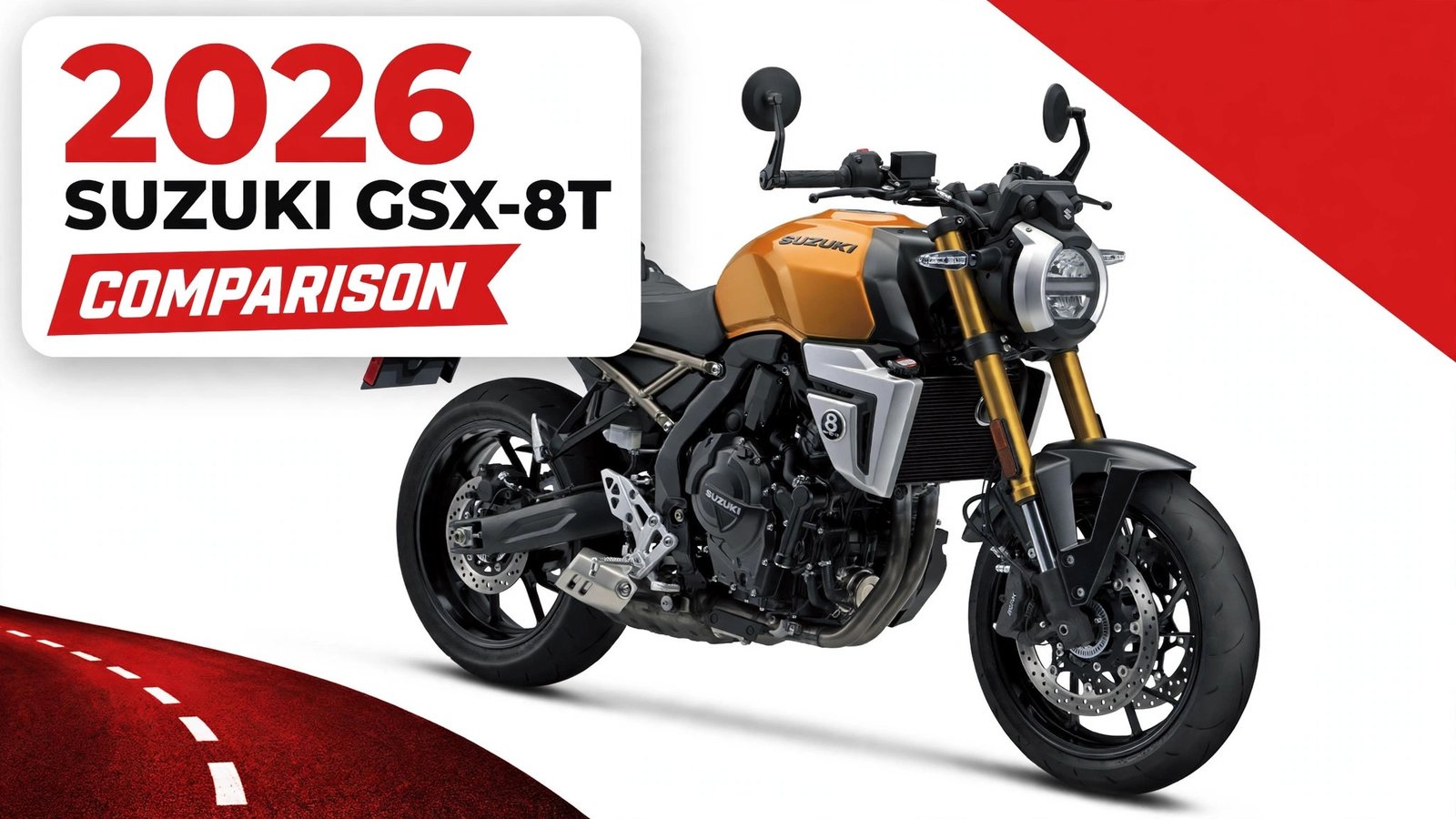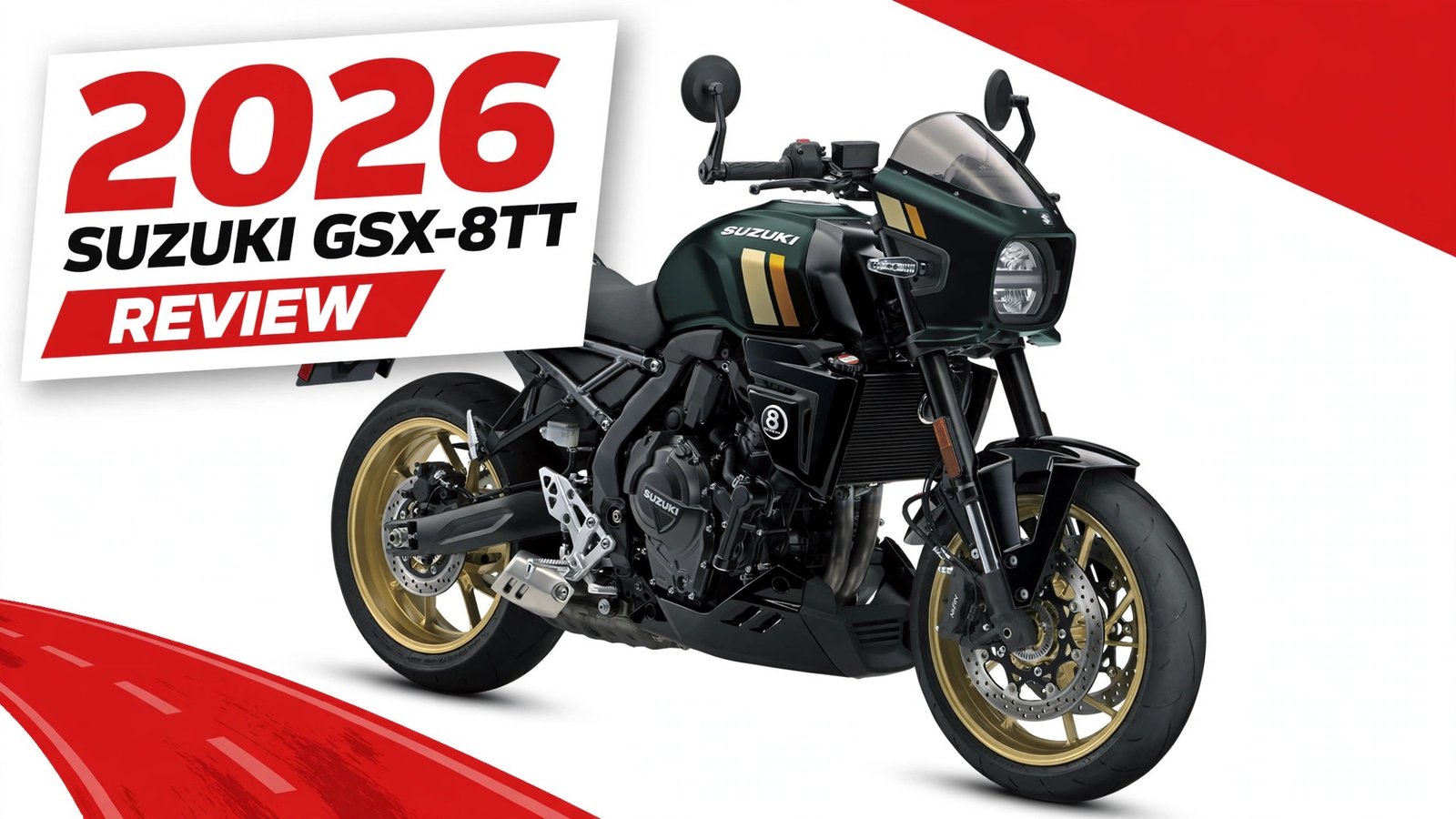
The short answer in this Suzuki GSX-8TT review is that the TT is the GSX-8T with a quarter fairing, a stitched seat and $500 added to the price — and that is nearly the whole story. At $11,149 plus $700 destination, $11,849 in total, it costs $500 more than the naked 8T and $1,900 more than the mechanically identical GSX-8S, for the same 776cc twin, frame and suspension. What the extra money buys is retro styling: the cowl, the under-cowl, wheels to match the paint, and a tribute to the 1979 GS1000S. This Suzuki GSX-8TT review works through the price, the specs, the riding experience and the verdict, keeping the TT-only differences separate from the parts the two bikes share.
Suzuki GSX-8TT Overview and Model-Year Updates
The 8TT is Suzuki’s faired retro roadster, announced on July 4, 2025 alongside the naked 8T, on sale in the USA as a 2026 model. It is the one that has drawn the most attention — testers keep calling it the styling winner of the pair. This Suzuki GSX-8TT review starts with what it is and what it is not.

On Sale in the USA as a 2026 Model
The GSX-8TT is on sale in the USA as a 2026 model, though some launch-era material calls it a 2025. Adam Waheed’s video review is titled “2025 Suzuki GSX-8TT Review”, and at least one article writes “2025 Suzuki GSX-8TT” — both are launch-era mislabels. In the USA it is a 2026 model, full stop — a point this Suzuki GSX-8TT review states plainly. It reached American dealers in late 2025, after its world launch in Slovenia in August 2025. The GSX-8T review covers the naked twin in full; this Suzuki GSX-8TT review covers the faired one, and the two should be read together.
TT Means the 8T Plus Timeless, Says Suzuki
TT means the 8T plus Timeless, says Suzuki — the second T stands for “Timeless”, not touring or twin. That is the naming in a nutshell, and it points at the bike’s job: the 8T is the modern retro roadster, and the TT adds the look of Suzuki’s late-1970s superbikes to it. The heritage the TT cites is the 1979 GS1000S, the Wes Cooley superbike, which the cowl, round headlight and stitched seat are drawn from. Do not swap the heritage: the naked 8T cites the T500 Titan two-stroke of 1968–1975. One warning: Suzuki USA’s own TT page intro copy says “Drawing inspiration from the beloved Suzuki T500 ‘Titan’…” — boilerplate shared with the 8T page, not the TT’s heritage. The TT also won a Red Dot Award for Product Design 2026, alongside the 8T — a design prize, not a performance one.
Suzuki GSX-8TT Engine and Specifications
The TT’s engine is the 776cc parallel twin from the GSX-8S, unchanged in tune. The specs below are the global claimed figures, because Suzuki USA publishes no horsepower or torque figures of its own — this Suzuki GSX-8TT review says so plainly.
776cc Liquid-Cooled Parallel Twin at 84.0 by 70.0mm
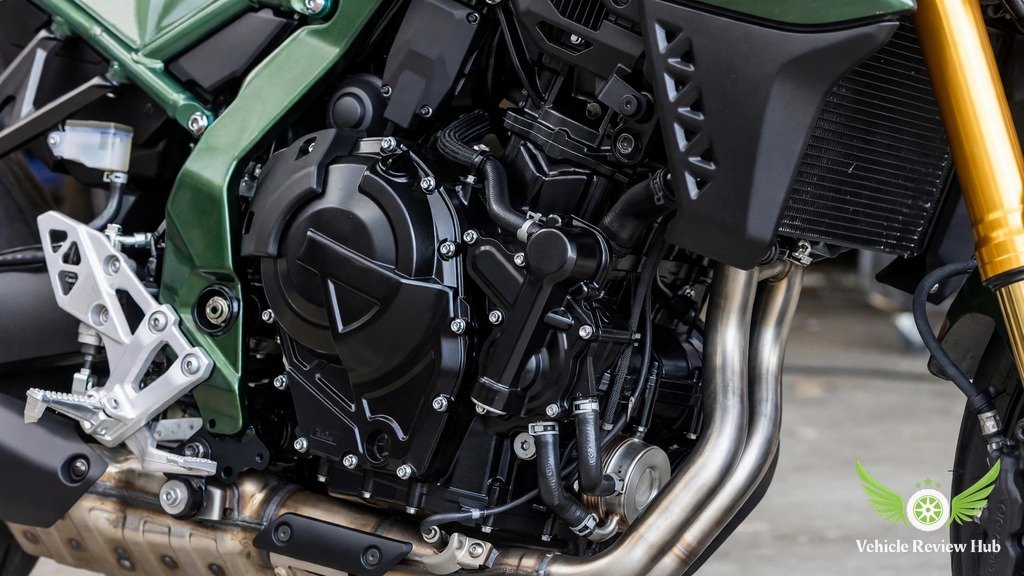
The TT’s engine is a 776cc liquid-cooled parallel twin, 84.0 by 70.0 mm, with a 12.8:1 compression ratio and a 270-degree crank, kept smooth by Suzuki’s Cross Balancer with its dual balancer shafts. The claimed output is 82.9 PS — 81.8 hp at 8,500 rpm — with 78 Nm, or 57.5 lb-ft, of torque, fed through two 42 mm throttle bodies with ride-by-wire. Those are the European and global claimed figures; Suzuki USA prints no hp or torque. One figure needs care: the torque peak. Suzuki’s global data, Bennetts and BikeReview all print 57.5 lb-ft at 6,800 rpm, and this Suzuki GSX-8TT review uses 6,800 rpm — but Suzuki Philippines’ own site prints 78 Nm at 6,500 rpm, and so does RevZilla’s spec table, so the two figures split across Suzuki’s own regional sites. There is no TT dyno and no instrumented TT top-speed or 0–60 test for this Suzuki GSX-8TT review to print; the only measured power figures are GSX-8S sibling dyno runs, such as Cycle World’s 74 hp at 8,380 rpm, labelled as 8S data. The GSX-8T performance guide covers the dyno figures in full.
Suzuki Prints 445 Pounds for a 203kg Bike
Suzuki prints 445 pounds for a 203 kg bike, and the two numbers do not agree — 203 kg converts to 447.5 lb, while 445 lb converts to 201.8 kg. Suzuki USA’s spec page prints “Curb Weight 203 kg (445 lb.)”, and this Suzuki GSX-8TT review uses the printed 445 lb while flagging the mismatch. Global listings print 203 kg with 448 lb, and Rider’s test figure is “448 lb with a full tank” — a measured figure, not the spec figure. The naked 8T is 443 lb on Suzuki USA’s printed figures, so the TT is 2 lb heavier on the printed pounds, 5 lb heavier on the kilograms. Two pounds for a quarter fairing, an under-cowl and a stitched seat is not a difference a rider will feel. The rest of the chassis matches the 8T exactly: a 1,465 mm wheelbase, 145 mm of ground clearance, a KYB inverted 41 mm fork with no front adjustment, a preload-adjustable rear mono-shock, Nissin radial-mount four-piston front calipers on twin 310 mm discs, and Dunlop Roadsport 2 tyres.
Suzuki GSX-8TT Price and Market Availability
Price is where this Suzuki GSX-8TT review gets interesting, because the sticker price and the street price are already far apart: $11,149 plus $700 destination, $11,849 in total — and dealer asking prices have already fallen to $8,999. Both numbers are verified.

Suzuki GSX-8TT Price in the USA: $11,149 Plus $700
The Suzuki GSX-8TT price in the USA is $11,149 plus $700 destination, $11,849 in total. The destination charge is confirmed three ways: motorcycle.com’s compare tool lists $700, Montgomeryville Cycle Center’s listing shows MSRP $11,149 with freight $700, and Sun & Fun Motorsports lists a $700 destination charge — so the $700 is confirmed, not presumed. Suzuki USA’s own page shows “Price: 11149.00 USD” with no destination printed on the page itself. The gaps frame the whole bike: the naked 8T is $10,649, so the TT costs $500 more for the fairing and colours; the mechanically identical GSX-8S is $9,249, so the TT costs $1,900 more — a 20 percent upcharge, as Rider puts it — for styling and equipment, not performance. Suzuki’s footnote says a freight surcharge applies to certain 2025 and 2026 models shipped on or after September 17, 2025; the amount is unpublished and whether it applies to the 8TT is not stated, so no surcharge amount is printed here. The Suzuki USA GSX-8TT page lists the $11,149 MSRP, the figure this Suzuki GSX-8TT review uses.
Dealer Asking Prices Already Start at $8,999
Dealer asking prices already start at $8,999, verified at four dealers: Green Mount Road Motorsports in O’Fallon, Illinois, Xtreme Machines in New Jersey, Powersports of Carol Stream in Illinois and Naults in New Hampshire. Lower still, Full Throttle in North Carolina lists $8,799 and Thrill Point in Ohio lists $8,749 for a new bike. That is $2,150 under MSRP within months of launch — at $8,999 the TT undercuts the 8T’s $10,649 sticker by $1,650. Two cautions: Green Mount’s own listing also says “CASH PRICE $9399”, a conflict with its $8,999 headline that this Suzuki GSX-8TT review notes without resolving. And dealer totals vary — Vetesnik in Wisconsin lists $9,478 with an $895 destination charge and a $399 doc fee, while Sun & Fun in Iowa lists $10,149 including $700 freight and $450 setup — so the $8,999 figures are asking prices, not out-the-door totals. The GSX-8T comparison works through the 8T’s rivals and prices the same way.
| Bike | MSRP | Destination | Total |
|---|---|---|---|
| Suzuki GSX-8TT | $11,149 | $700 | $11,849 |
| Suzuki GSX-8T | $10,649 | $700 | $11,349 |
| Suzuki GSX-8S | $9,249 | $460 | $9,709 |
| Dealer asking price (8TT) | $8,999 | Varies by dealer | Before setup + doc fees |
Suzuki GSX-8TT Design, Features and Technology
The TT’s design is the reason it exists. Everything underneath is the 8T’s, so the cowl, the colours, the seat and the details are the whole difference. This Suzuki GSX-8TT review looks at what the $500 buys, and at the electronics that come with it.

Wheels Match the Paint: Gold With Green, Red With Black
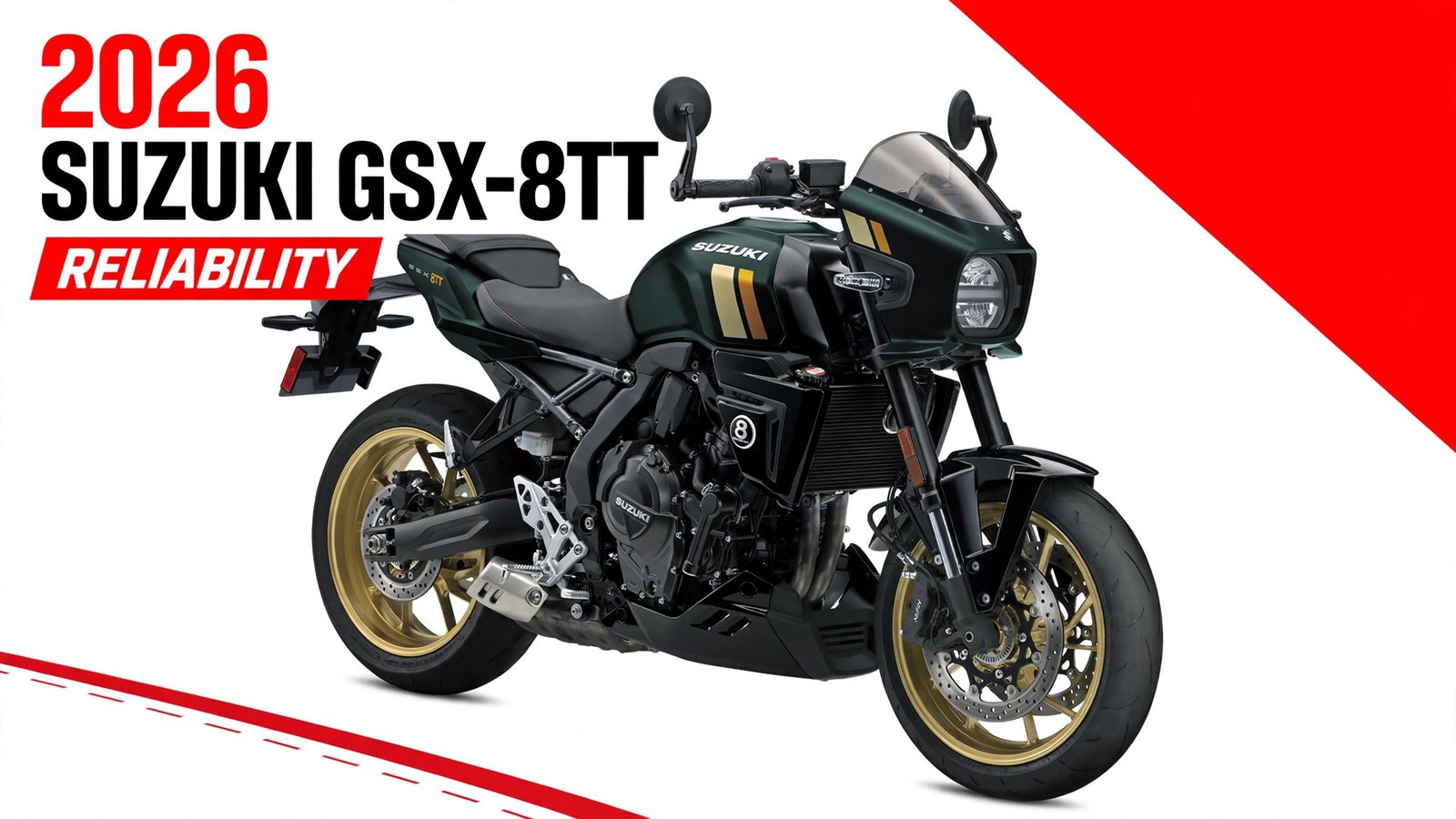
The wheels match the paint: gold with green, red with black. The TT comes in two US colours only — Pearl Matte Shadow Green with gold wheels, and Glass Sparkle Black with red wheels and a red tank stripe. That pairing is the bike’s signature, and it is worth getting right: Total Motorcycle lists the TT in Candy Burnt Gold and Metallic Matte Black, but those are the naked 8T’s colours, not the TT’s. The UK gets a third colour, Metallic Matte Steel Green, which is also the 8T’s, not the TT’s. Drawn in Italy by Arthur Vidal and sculpted in Japan, the design carries the 1979 GS1000S tribute: the round headlight, the sculpted 16.5-litre tank with 1960s and 70s-style weld seams, raised lettering, a stitched seat, blacked-out covers and 3-D 8-ball badges. The TT-only parts are the headlight cowl, the under-cowl chin spoiler, black fork legs and shrouds, the stitched seat, the dedicated colours and the 8-ball badges. The bar-end mirrors are a first for a modern Suzuki, paying homage to the 1980 GS450S. Electronics match the 8T: ride-by-wire, three S-DMS drive modes, four-mode traction control, a standard bi-directional quickshifter, an assist-and-slipper clutch, Easy Start, Low RPM Assist, a 5-inch colour TFT and a USB Type-C socket. What it does not have matters just as much: no cruise control, no IMU and no lean-sensitive ABS. The traction control is four-mode — one, two, three and off — not the seven levels of the GSX-S1000GX+.
Suzuki’s Own Height Figures: 1,160 vs 1,105mm
Suzuki’s own height figures are 1,160 versus 1,105 mm, and they cannot both be right. Suzuki USA prints an overall height of 1,105 mm (43.5 in.) for the TT — the same figure as the naked 8T — while Suzuki Global and Total Motorcycle print 1,160 mm (45.7 in.). Bennetts’ spec table prints 2115 by 775 by 1105 mm, siding with the US figure. This Suzuki GSX-8TT review presents both figures unresolved. The 1,160 mm figure is the plausible one — the cowl adds height — and the 1,105 mm figure looks like an 8T figure copied across, but that is a guess, not a fact. The seat height is settled: 810 mm, or 31.9 inches, 5 mm lower than the 8T’s 815 mm. One source, BikeReview Australia, claims the TT seat is “around 5mm taller” than the 8T’s — that is wrong, and it is not used here. The lower seat and the narrow tank-to-seat junction help shorter riders: Annick Magac, a 5-foot-2 rider, found she could touch down on the balls of her feet on the TT.
Suzuki GSX-8TT Riding Experience and Comfort
On the road the TT feels like the 8T with a cowl — because that is what it is. Testers split on whether the fairing helps or hurts the handling, and they agree on the comfort. This Suzuki GSX-8TT review reports what they found, each verdict attributed to its tester.

The video below is Adam Waheed’s garage review of the GSX-8TT. Its title says “2025”, but the bike is a 2026 US model — the title is a launch-era label, and the bike in the video is the same 2026 machine this Suzuki GSX-8TT review covers.
Riding Position, Handling and Low-Speed Maneuverability
The riding position is upright and neutral, with lower footpegs than the GSX-8S — a comfort gain that costs ground clearance, proved by motorcycle.com’s tester destroying the pegs at Chuckwalla. The same tester gave the TT an 84.0 percent editors’ score and called it “my favorite bike in the GSX-8 family”, so the peg-scraping is a track-day note. On handling, the testers split. MCN says the extra mass on the steered components dulls the TT’s rate of turn just slightly, while the 8T is “more sprightly for B-road fun”, and the TT “feels even more stable… at the cost of a little agility”. BikeReview Australia’s three testers agreed the 8T “felt livelier and sportier than the GSX-8TT, despite identical suspension settings”, while the TT was “universally agreed to be the nicer, more comfortable ride”. The hardware is identical, so the difference is feel, not fact. At low speed the bike is easy: a 31.9-inch seat, a light clutch feel, Low RPM Assist to stop stalls, and a narrow waist. Bennetts found the cowl does very little for weather protection after a chilly February test, but Visordown found its aero-vent “noticeably reducing helmet buffeting at higher speeds”, and Cycle News agrees the fairing “takes most of the wind blast out but doesn’t eliminate it entirely”. The Cycle News GSX-8TT review calls the engine “lively without being frantic, and smooth without being sterile”.
The Stitched Seat: Good, but the 8T’s Is Better
The stitched seat is good, but the 8T’s is better — that is the honest reading of the testers’ notes. The TT’s seat is wider and plusher than the GSX-8R’s, per Cycle News, and 5 mm lower than the 8T’s at 810 mm. But the 8T’s “tuck and roll” cover earned the bigger praise: MCN notes the 8T’s seat “comes out 5mm higher (815mm) due to the difference in the ‘tuck and roll’ style cover”, and BikeReview Australia gave it “our biggest tick of approval” — the two seats can be swapped. Visordown agrees the TT’s seat, “while not quite as luxurious, feels like an improvement over the 8S”. So the TT’s seat is a step up from the 8S, a small step down from the 8T, and swappable if it matters. Comfort is fine up to about 6-foot-1, per Cycle News, and the lower pegs give more legroom than the 8S. One 8T carry-over: RevZilla’s 8T test found the quickshifter’s downshifts delayed and not rev-matching sufficiently, and the suspension “more than adequate, assuming you don’t weigh more than 190 to 200 pounds” — the TT shares both. The RevZilla first ride review covers the 8T’s riding experience.
Suzuki GSX-8TT Review: Pros, Cons and Verdict
The verdict in this Suzuki GSX-8TT review is simple: it is the best-looking bike in the GSX-8 family, the most comfortable of the three, and the hardest to justify at full price — but at dealer prices it becomes the easy pick.

Main Advantages and Limitations of the Suzuki GSX-8TT
The advantages start with the looks: the TT was “the clear styling winner” in BikeReview Australia’s week-long test, and motorcycle.com’s tester called it “my favorite bike in the GSX-8 family” at 84.0 percent. It is the most comfortable of the three GSX-8 bikes. The equipment list is full: a standard quickshifter, a 5-inch TFT, three ride modes, four-mode traction control, a USB-C socket and a lithium-ion battery. The MCN GSX-8TT review records three real owner reviews behind a 5-out-of-5 reliability rating. The limitations are just as clear. The price is the first: $1,900 over the mechanically identical 8S buys appearance, not hardware, and NastyNils’ buyers’ guide gives the TT 4 out of 5, with price the main reservation. The front fork takes no adjustment at all, there is no cruise control, and the top end “runs out of breath before the redline”, in NastyNils’ words. The quickshifter’s downshifts are delayed, the suspension is “a tad stiff” at first, and the rear shock “becomes the limiting factor once you start riding at around eight-tenths and beyond”, per BikeReview Australia. Bennetts gives the bike 3.5 out of 5 overall. Buy the TT, in this Suzuki GSX-8TT review’s verdict, if you want the retro look and the comfort; buy the 8T if you want the same bike for $500 less; buy the 8S if you only want the engine. At $8,999 from a dealer, the TT’s case answers itself.
Twelve-Month Unlimited-Mileage Warranty in the USA
The warranty is twelve months, unlimited mileage, in the USA — the same cover as the 8T, the 8S and the 8R. The UK gets two years plus a third year at an authorised dealer, but that does not apply to American buyers. No recall in published notices names the 8TT: 24V081 covers the 2024 GSX-8R’s drive chain only, 360 units, and 24V535 covers the 2023–2024 V-Strom 800DE’s rear tyre only, 1,688 units, with a do-not-ride warning. Same engine family does not mean same recall. The service schedule is the GSX-8S platform schedule — the TT’s own manual is not public yet: oil and filter every 3,750 miles, spark plugs at 7,500 miles and a valve check at 15,000 miles. The GSX-8T reliability guide covers the same schedule and recall boundaries in detail.
| Specification | Suzuki GSX-8TT (2026 US) |
|---|
Suzuki GSX-8TT Review: Frequently Asked Questions
Direct answers to the questions riders ask about the Suzuki GSX-8TT review.
How much does the Suzuki GSX-8TT cost?
$11,149 plus $700 destination, $11,849 in total. Dealer asking prices have already fallen to $8,999 at several dealers, the lowest found $8,749 — before setup and doc fees, which vary by dealer, as this Suzuki GSX-8TT review notes.
What is the difference between the GSX-8TT and the GSX-8T?
The TT is the 8T plus a quarter fairing, an under-cowl, black fork legs, a stitched seat, dedicated colours and 3-D 8-ball badges, for $500 more — same engine, frame, suspension and electronics, so the differences are appearance only, as this Suzuki GSX-8TT review shows.
How much horsepower does the GSX-8TT have?
Suzuki’s global claimed output is 81.8 hp at 8,500 rpm with 57.5 lb-ft at 6,800 rpm; Suzuki USA publishes no horsepower or torque figures, and there is no TT dyno, so no measured figure exists for this Suzuki GSX-8TT review to print.
What does TT mean on the Suzuki GSX-8TT?
TT means the 8T plus “Timeless”. The bike is a tribute to the 1979 GS1000S superbike, not to the T500 Titan — the T500 is the naked 8T’s heritage, and Suzuki USA’s T500 wording on the TT page is shared boilerplate, as this Suzuki GSX-8TT review explains.
How much does the GSX-8TT weigh?
Suzuki USA prints 445 lb (203 kg) — the two numbers do not convert cleanly, since 203 kg is 447.5 lb. This Suzuki GSX-8TT review uses the printed 445 lb. The naked 8T is 443 lb, so the TT is 2 lb heavier on the printed figures.
What colours does the GSX-8TT come in?
Two US colours: Pearl Matte Shadow Green with gold wheels, and Glass Sparkle Black with red wheels and a red tank stripe. Candy Burnt Gold and Metallic Matte Black are the 8T’s, not the TT’s.
What is the GSX-8TT’s fuel economy?
The WMTC type-approval figure is 4.2 litres per 100 km — 67.23 mpg imperial, 56 mpg US. Bennetts tested 42.2 mpg imperial on the TT, or 35.1 mpg US, and Suzuki USA publishes no MPG figure.
Does the GSX-8TT have cruise control?
No. The TT has no cruise control, no IMU and no lean-sensitive ABS — but it does have ride-by-wire, three ride modes, four-mode traction control, a standard quickshifter and a 5-inch TFT, the full list this Suzuki GSX-8TT review details above.
Is the GSX-8TT good for beginners?
Mostly. Approachable power, a low 31.9-inch seat, a light clutch and Low RPM Assist argue for it; the 445 lb weight, delayed quickshifter downshifts and no lean-sensitive ABS argue against it. A good second bike and a capable first big bike for a careful new rider, in this Suzuki GSX-8TT review’s judgement.
Does the GSX-8TT have any recalls?
No recall found in published notices names the 8TT, as this Suzuki GSX-8TT review found: 24V081 covers the 2024 GSX-8R’s drive chain only, and 24V535 covers the 2023–2024 V-Strom 800DE’s rear tyre only.
Is the GSX-8TT worth $1,900 more than the GSX-8S?
Only for the styling, in this Suzuki GSX-8TT review’s view. The 8S has the same engine, tune, frame and suspension for $9,709 in total, and the $1,900 buys the retro cowl, the bigger tank, the TFT, the quickshifter, the USB-C socket and the lithium-ion battery — appearance and equipment, not performance.
Should I buy the GSX-8TT or the GSX-8T?
Buy the TT if you want the faired retro look, the cowl’s wind relief and the most comfortable seat in the family, for $500. Buy the 8T if you want the same bike for $500 less and slightly livelier handling.