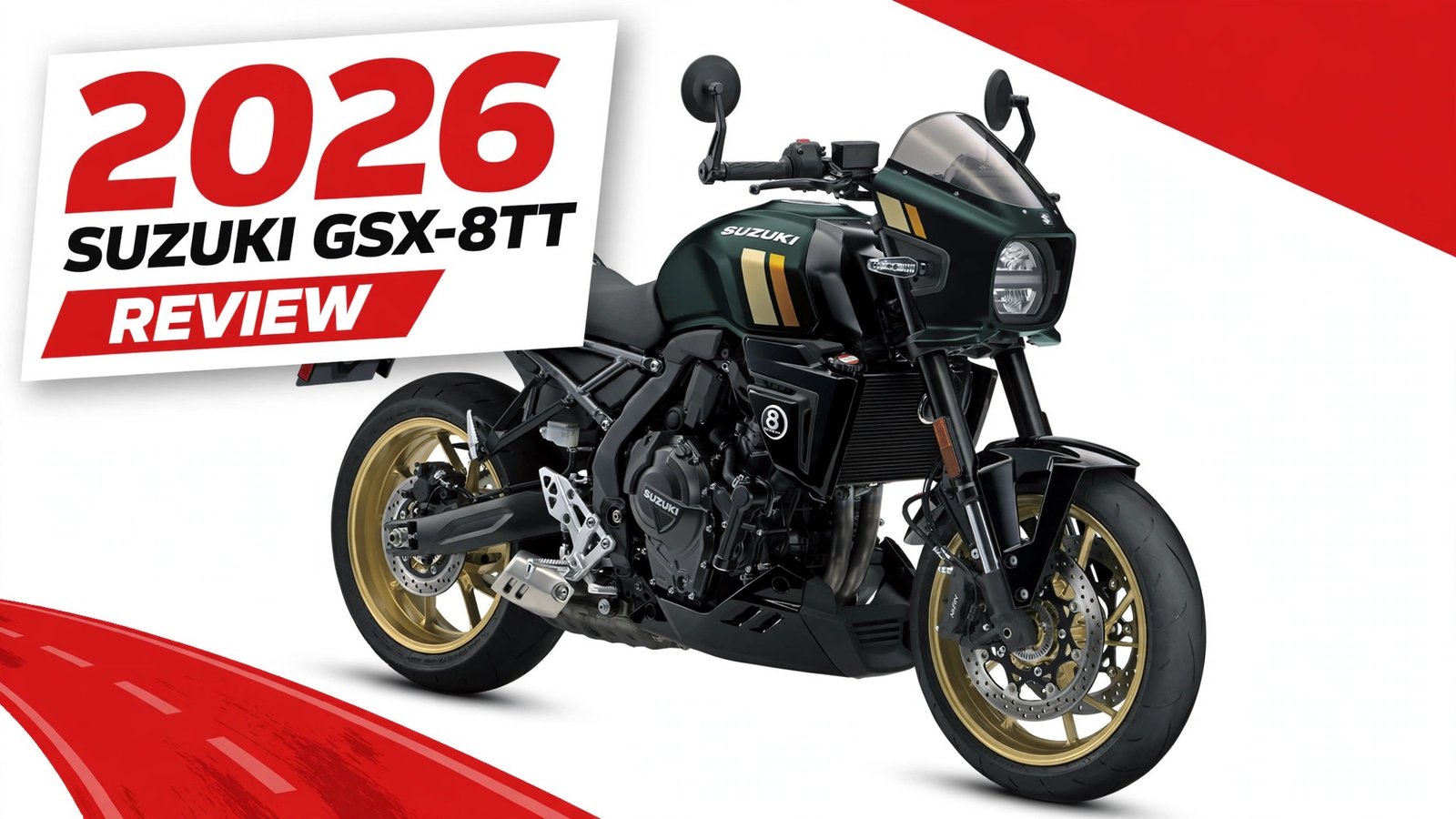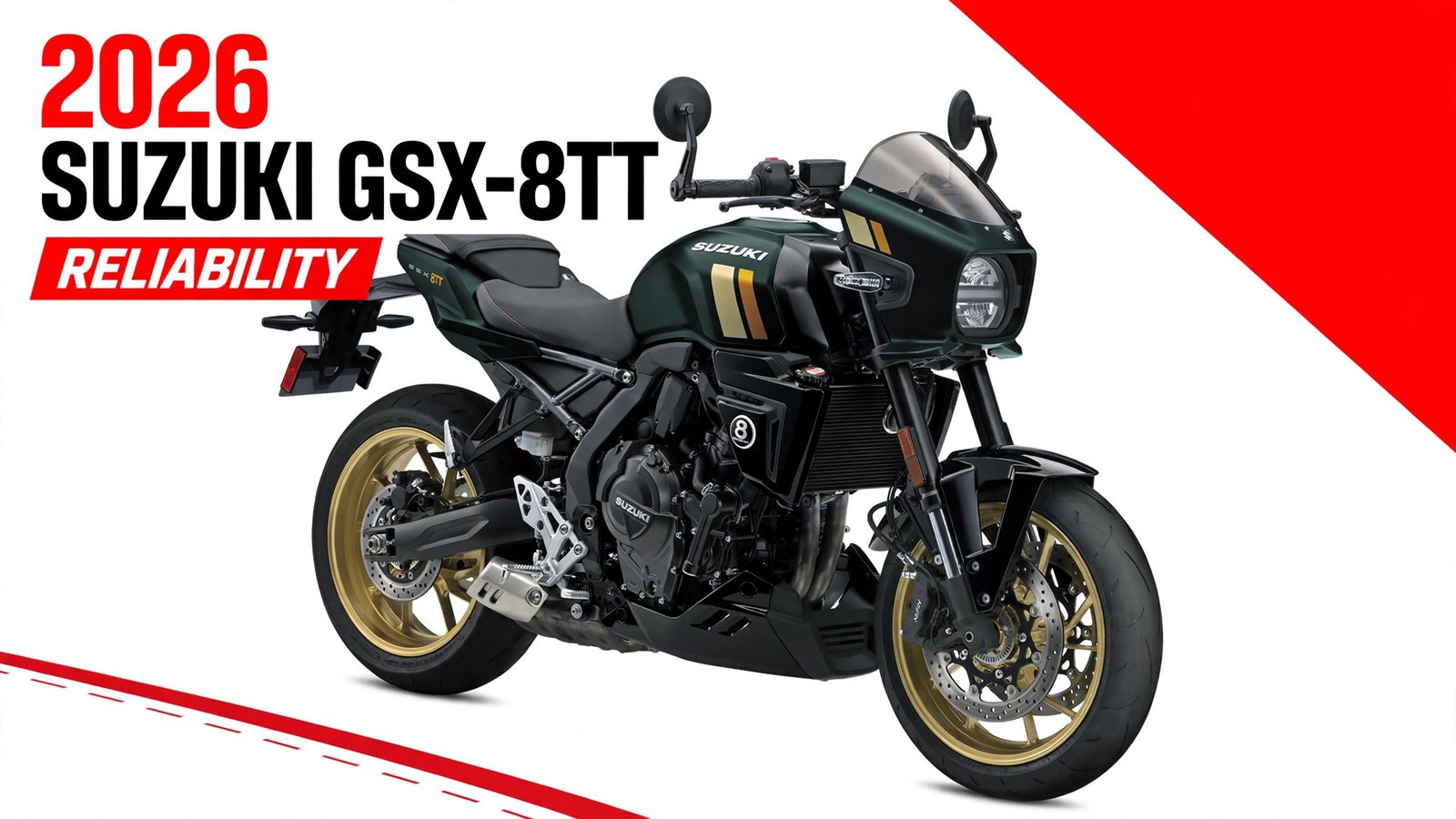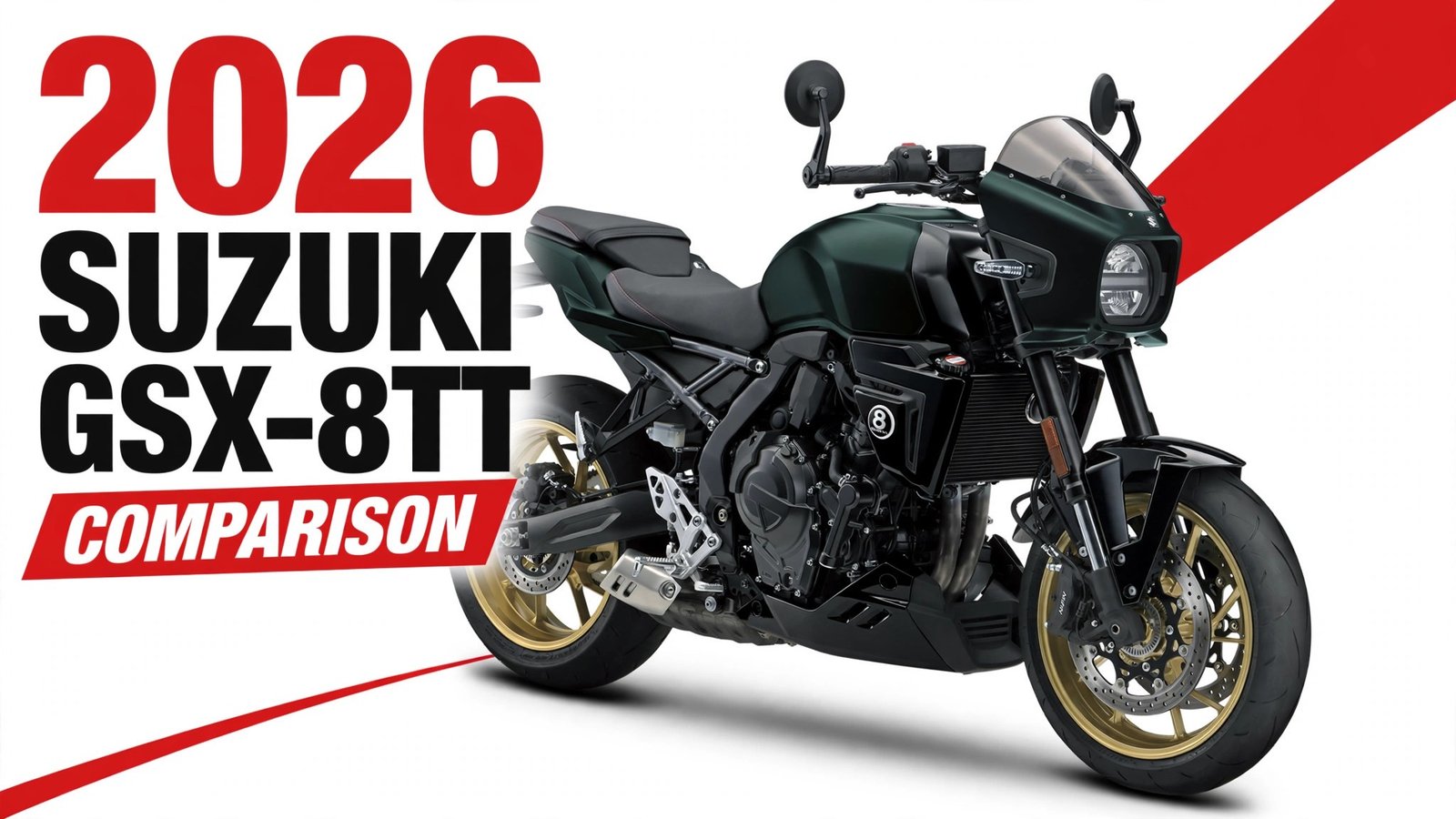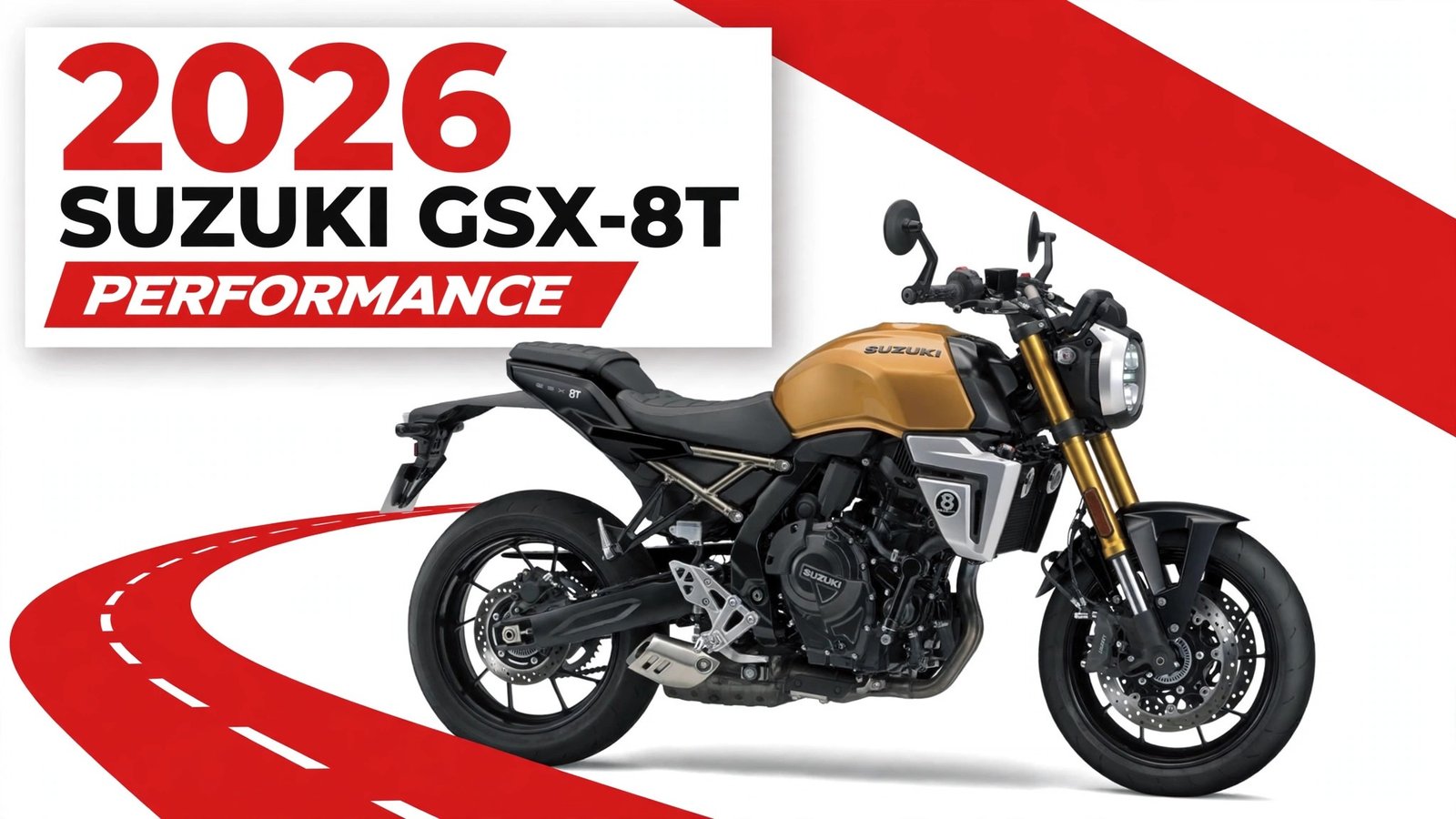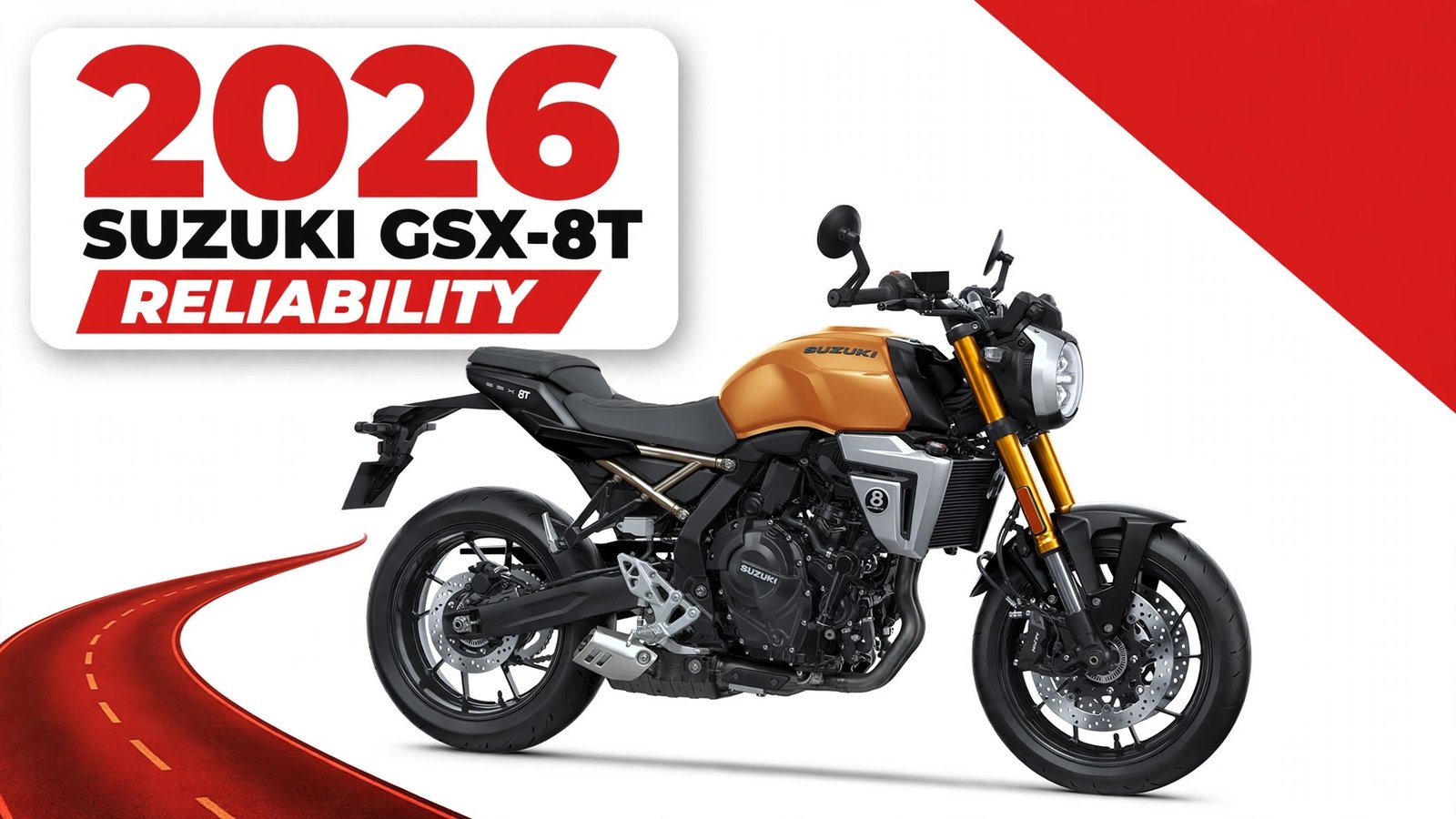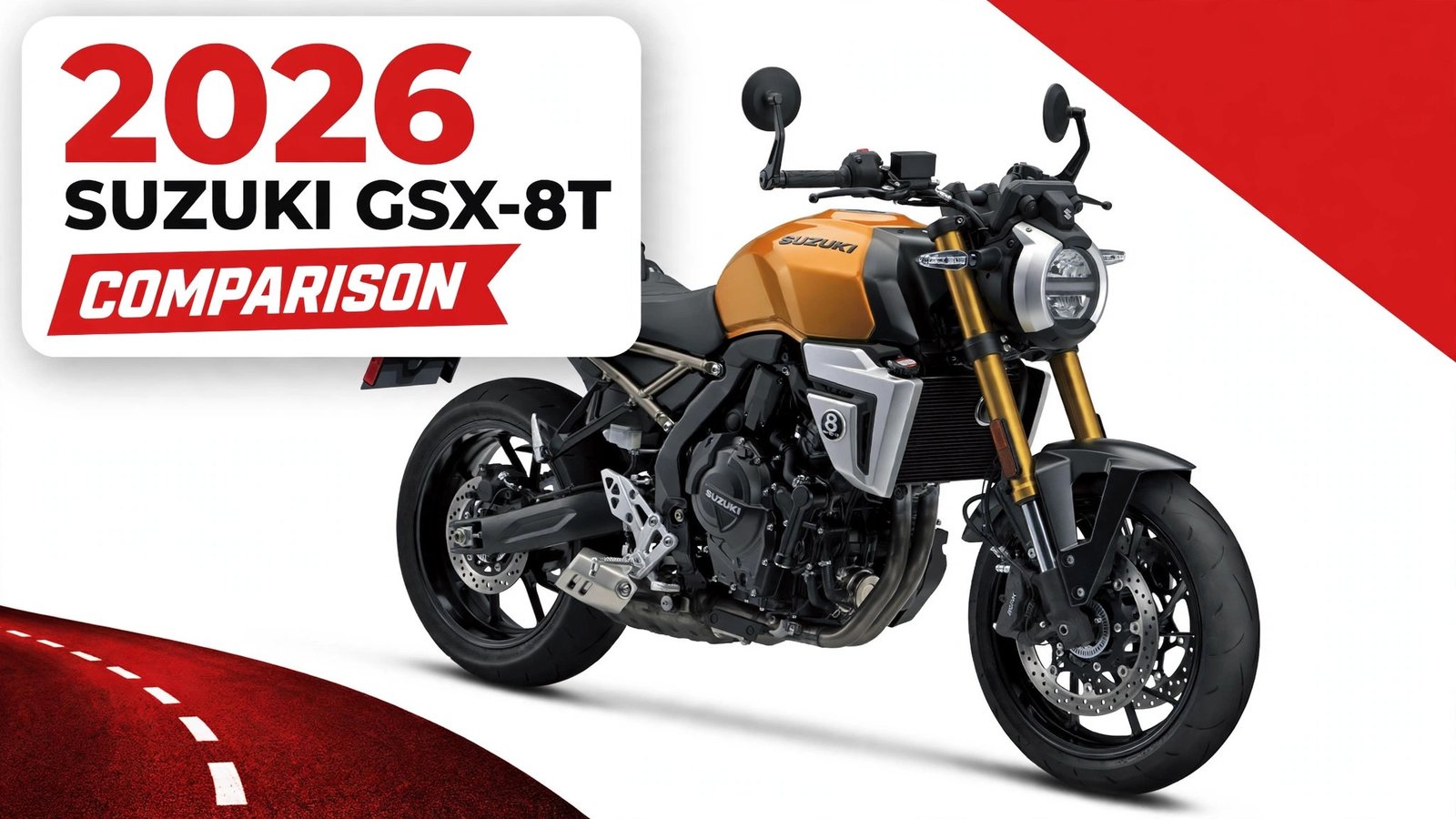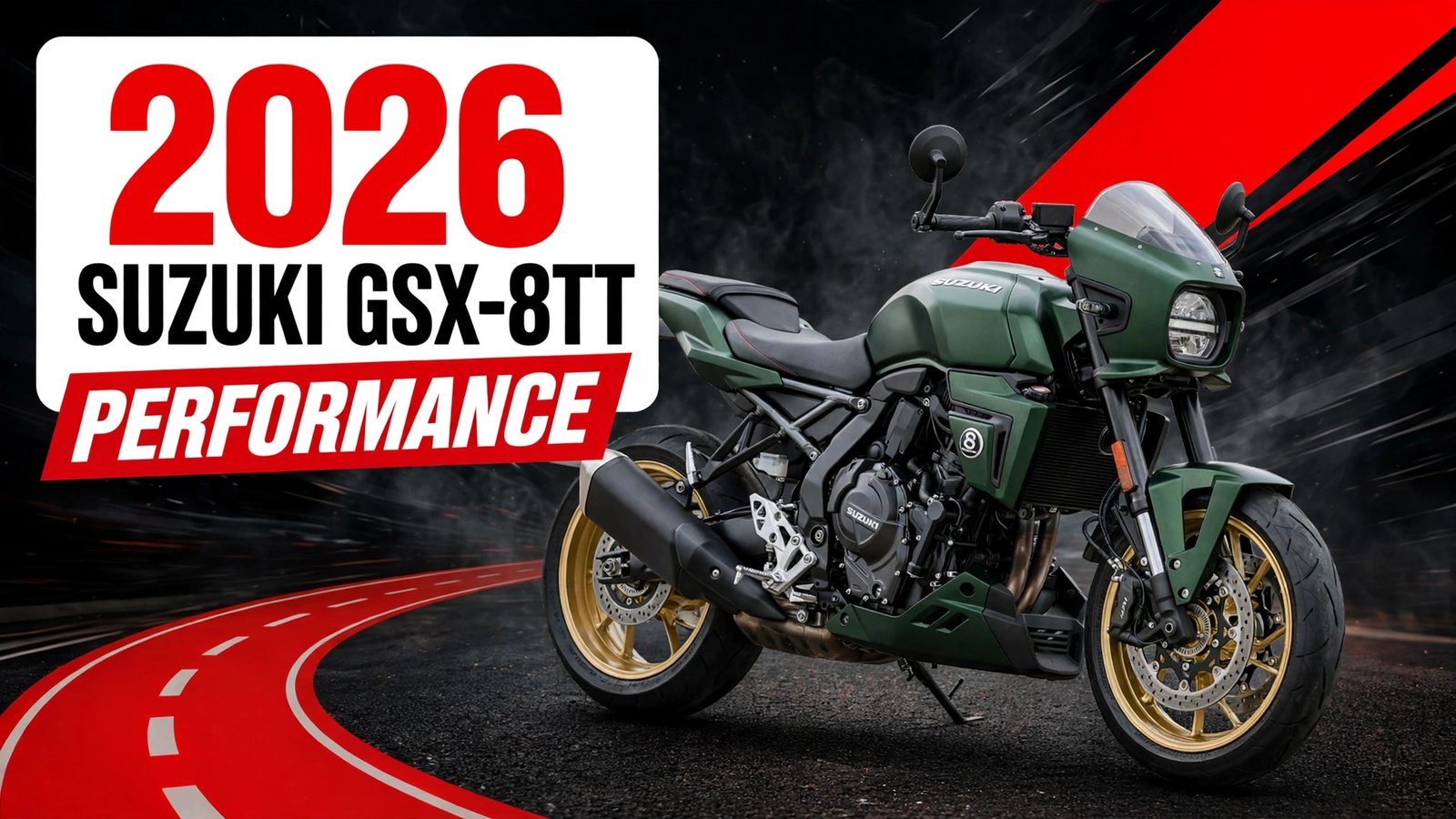
The short answer in this Suzuki GSX-8TT performance guide is that the TT performs exactly like the GSX-8S it is built from — same 776cc twin, same tune, same chassis — because no TT has ever been put on a dyno or through an instrumented test. The claimed output is 81.8 hp at 8,500 rpm with 57.5 lb-ft at 6,800 rpm, the WMTC figure is 56 mpg US, and every measured number here comes from the 8S sibling, labelled as such. What follows in this Suzuki GSX-8TT performance guide is the honest picture: claims, sibling measurements, the cowl, and the rivals.
Suzuki GSX-8TT Engine Performance and Power Delivery
The TT’s engine is the 776cc parallel twin from the GSX-8S, unchanged in tune. The Suzuki GSX-8TT performance specs below are the global claimed figures, because Suzuki USA publishes no horsepower or torque figures of its own.
Syndicated Boxes Mislabel the 8S Dyno as the TT’s
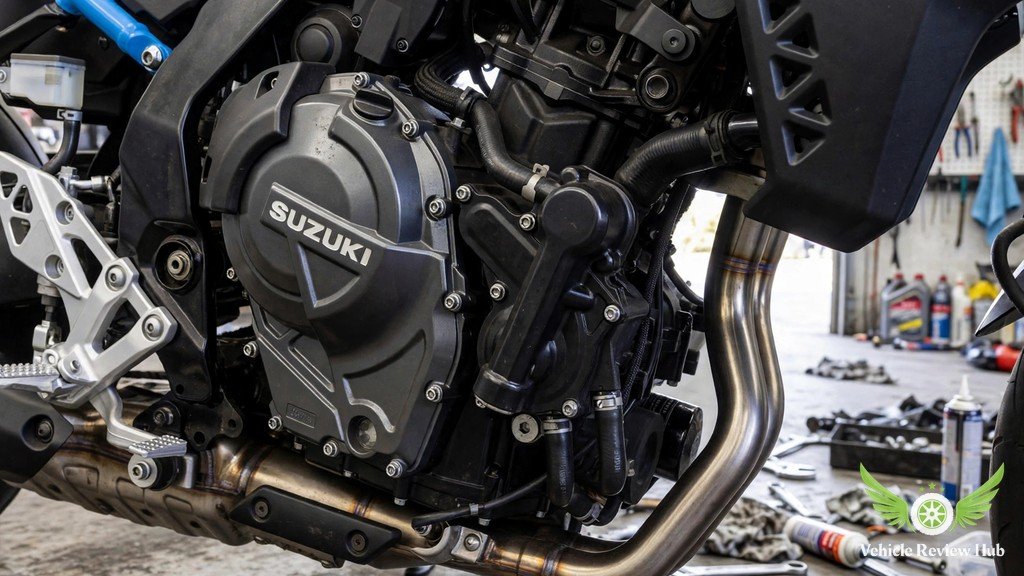
Syndicated spec boxes mislabel the 8S dyno as the TT’s, and the clearest example is Rider Magazine’s own TT spec box, which prints “Horsepower: 75.9 hp @ 8,300 rpm (rear-wheel dyno)” with no label at all. That figure is from Rider’s Jett Tuning dyno run of the GSX-8S — the article text says the dyno bike was an 8S, but the box does not, so the number travels around the internet as a TT figure. Chase on Two Wheels does the same thing, listing “74 HP” for the TT — that is Cycle World’s 8S dyno figure, from a Dynojet 250i run that made 74 hp at 8,380 rpm and 52.3 lb-ft at 5,580 rpm. This Suzuki GSX-8TT performance guide prints those figures only as labelled GSX-8S sibling data, because no TT dyno exists. The other sibling runs tell the same story: Rider’s Jett Tuning run made 75.9 hp at 8,300 rpm and 53.3 lb-ft at 6,700 rpm, and MCN’s GSX-8R run made 76 hp at 8,300 rpm. Four dynos, four answers, all on the same engine family, so this Suzuki GSX-8TT performance guide never ranks them against each other. The GSX-8T performance guide covers the same sibling dyno figures in full. What the numbers agree on is the delivery: a strong midrange, a flat torque curve, and a top end that runs out of breath before the redline, in NastyNils’ words — a character note, not a defect. The engine is, in Cycle News’ words, “lively without being frantic, and smooth without being sterile”, thanks to the 270-degree crank and Suzuki’s Cross Balancer. The Cycle News GSX-8TT review is the source for that verdict.
The video below is Suzuki’s own official launch film for the GSX-8T and GSX-8TT — the TT is the faired one in it.
European Torque Peak: 6,800 RPM or 6,500, Sources Split
The European torque peak is 6,800 rpm or 6,500 rpm depending on which Suzuki source you read — the sources split, and this Suzuki GSX-8TT performance guide names the split instead of picking a side quietly. Suzuki’s global data, Bennetts and BikeReview all print 57.5 lb-ft at 6,800 rpm, and this Suzuki GSX-8TT performance guide uses 6,800 rpm. But Suzuki Philippines’ own site prints 78 Nm at 6,500 rpm, and so does RevZilla’s spec table. It is a genuine split, not one outlet’s mistake. The claimed output is 82.9 PS — 81.8 hp at 8,500 rpm — with 78 Nm, or 57.5 lb-ft, from a 776cc liquid-cooled parallel twin, 84.0 by 70.0 mm, 12.8:1 compression, fed through two 42 mm throttle bodies with ride-by-wire. Suzuki USA prints no hp or torque, so American outlets paraphrase “about 80 hp / 57 lb-ft”. The electronics are the 8T’s: three S-DMS modes, four-mode traction control, a standard quickshifter — but no cruise control, no IMU and no lean-sensitive ABS. RevZilla’s 8T test found the shared quickshifter’s downshifts delayed and not rev-matching sufficiently. The RevZilla first ride review covers the 8T’s riding experience.
Suzuki GSX-8TT Top Speed and Acceleration
Top speed and acceleration are the thinnest part of this Suzuki GSX-8TT performance guide by design: no instrumented test of a TT exists, so this Suzuki GSX-8TT performance guide prints no TT top-speed or 0–60 number. Any site that prints one without naming a test is estimating.
No Dyno or Instrumented Test of a TT Exists
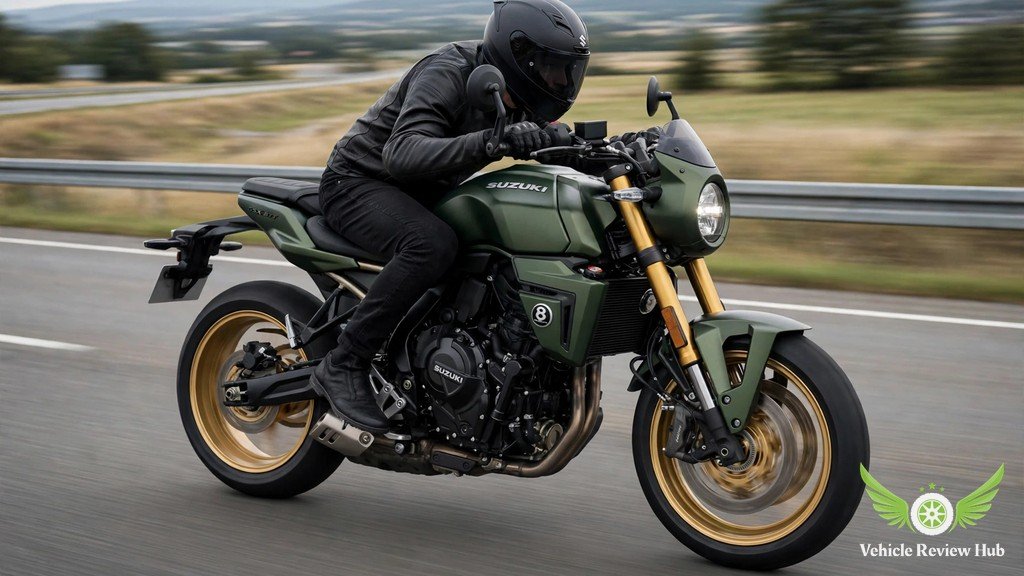
No dyno or instrumented test of a TT exists yet — no TT dyno run, no TT 0–60, no TT quarter-mile, no TT GPS top speed, as of this writing. That is why this Suzuki GSX-8TT performance guide leans on labelled sibling data instead of inventing numbers. One invented figure is worth naming so readers can spot it: an aggregator prints a TT top speed of “approx. 190 km/h (estimated)” — that is an invention, not a test, and it does not appear anywhere in this guide. The TT shares the 8S’s tune and gearing, so its acceleration will be near-identical, and Rider’s TT test found the bike humming along smoothly at 75 mph “with enough power in reserve to make passes or escape trouble as needs require”. Suzuki USA prints 445 lb (203 kg) for the TT — the two numbers do not convert cleanly, so this guide uses the printed 445 lb — against the 8T’s 443 lb. Two pounds is not a difference any rider will feel off the line.
European Claim Is 82.9 PS: a Factory Figure
The European claim is 82.9 PS — a factory figure, not a measured one — and it is the only power number Suzuki itself stands behind for the TT. That is 81.8 hp at 8,500 rpm, with 57.5 lb-ft at 6,800 rpm, and it is a claimed crank figure, not a rear-wheel figure. The gap between the claim and the sibling dynos in this Suzuki GSX-8TT performance guide is normal: Cycle World’s 8S run made 74 hp at the wheel, Rider’s Jett Tuning run made 75.9 hp, and motorcycle.com’s run made 73.5 hp — all rear-wheel figures on the same tune, all lower than the 81.8 hp crank claim, all labelled as 8S data. The Suzuki USA GSX-8TT page lists the $11,149 MSRP and the spec sheet, but no horsepower or torque. For context, the TT costs $500 more than the 8T and $1,900 more than the mechanically identical 8S, for the same engine and tune — the $1,900 buys styling and equipment, not performance. The GSX-8TT review works through the price and styling in full.
Suzuki GSX-8TT Mileage and Fuel Economy
Mileage is where this Suzuki GSX-8TT performance guide has to be careful with gallons: the headline figure — 67 mpg — is imperial, and the US figure is 56 mpg. Every number below in this Suzuki GSX-8TT performance guide is labelled imperial or US.

Bennetts Tested 42.2 MPG Imperial on the TT
Bennetts tested 42.2 mpg imperial on the TT — the only real-world TT consumption figure from a named tester — and that converts to 35.1 mpg in US gallons. Bennetts’ Luke Brackenbury managed 42.2 mpg imperial “on a real mixture of roads”, with a range of about 184 miles and the fuel light at 108.5 miles. The gap is the point: the WMTC number is a laboratory figure, and real riding costs fuel. Flies on the Visor’s 1,000-mile road test averaged 53.7 mpg imperial, with about 55 mpg imperial on the motorway and 170 miles before a refill. BikeReview Australia measured 23.2 km/L on the TT, and AMCN’s test returned 3.5 litres per 100 km. The tank holds 16.5 litres, or 4.3 US gallons, so even at Bennetts’ tested consumption the TT covers roughly 180 miles between fill-ups. Suzuki USA publishes no MPG figure at all, so every consumption number in this Suzuki GSX-8TT performance guide comes from type-approval data or a named tester.
The 67 MPG Figure Is Imperial, Never US MPG
The 67 mpg figure is imperial, never US mpg — and printing it without the word “imperial” is the most common fuel-economy error on this bike. The WMTC consumption is 4.2 litres per 100 km — 67.23 mpg imperial, 56 mpg US. Bennetts prints “67.23mpg (est)” — Bennetts is UK, so its gallons are imperial — while Ultimate Motorcycling’s US table prints “Estimated fuel consumption: 56 mpg”. Same bike, same test, two numbers: the difference is the gallon. This Suzuki GSX-8TT performance guide uses 56 mpg US as its headline figure and labels the 67.23 mpg figure imperial every time it appears. 1000PS adds range context: 4.5 to 5.1 litres per 100 km in real riding, with a 392 km WMTC range.
| Figure | Value | Source |
|---|---|---|
| WMTC consumption | 4.2 L/100 km | Type approval |
| WMTC, imperial | 67.23 mpg imperial | Bennetts spec table |
| WMTC, US | 56 mpg US | Ultimate Motorcycling US table |
| Bennetts tested | 42.2 mpg imperial (35.1 mpg US) | Bennetts riding review |
| BikeReview AU tested | 4.3 L/100 km, 320+ km range | BikeReview Australia |
| Tank | 16.5 L (4.3 US gal) | Suzuki USA |
Suzuki GSX-8TT Real-World Riding Experience
On the road the TT feels like the 8T with a cowl — because that is what it is — and the testers who rode both keep coming back to the same split: the TT is the nicer, more comfortable ride, the 8T the livelier one. This Suzuki GSX-8TT performance guide reports what they found, each verdict attributed.
Motorcycle.com: Its Favourite GSX-8, at 84 Percent
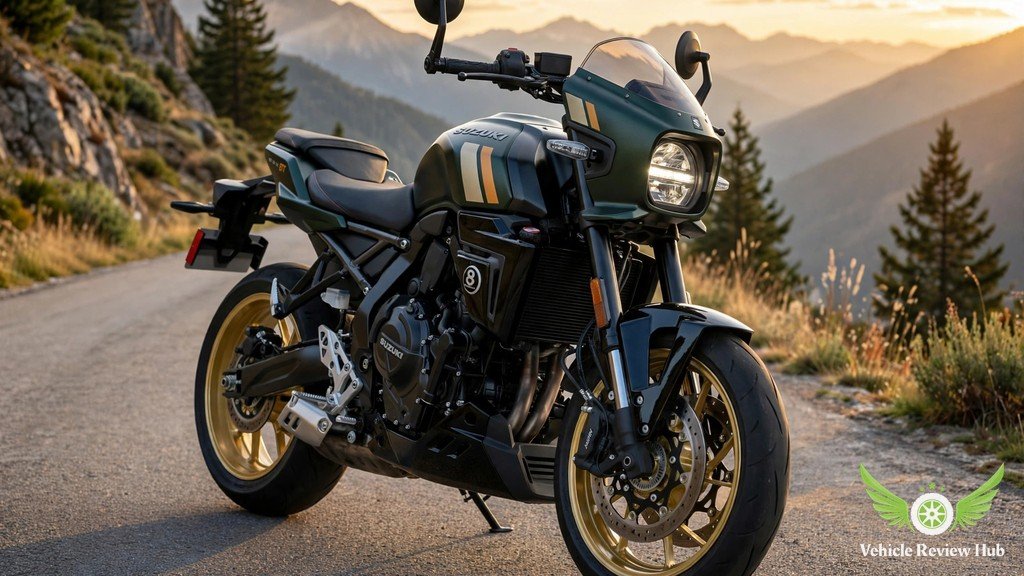
Motorcycle.com calls the TT its favourite GSX-8, at 84 percent — the highest praise any tester has given the bike. Its January 2026 scorecard gave the engine 18 out of 20, the suspension 11.5 out of 15 and the transmission 8 out of 10, for an editors’ score of 84.0 percent, calling it “my favorite bike in the GSX-8 family”. The same tester asked “$11,149… But is it worth twelve grand?” — and the review’s answer is that the TT earns its price on looks and comfort, not hardware. The riding position is upright and neutral, with lower footpegs than the 8S — a comfort gain. The seat is wider and plusher than the 8R’s, per Cycle News, and 5 mm lower than the 8T’s at 810 mm. Comfort holds up to about 6-foot-1, per Cycle News. RevZilla’s 8T test found the shared suspension “more than adequate, assuming you don’t weigh more than 190 to 200 pounds”. The MCN GSX-8TT review records three real owner reviews behind a 5-out-of-5 reliability rating, with expert reliability at 4 out of 5. At low speed the bike is easy: a 31.9-inch seat, a light clutch, Low RPM Assist, and a narrow waist — Annick Magac, a 5-foot-2 rider, could touch down on the balls of her feet.
Destroyed Pegs: Low Ground Clearance at Chuckwalla
Destroyed pegs are the price of the TT’s comfort — low ground clearance at Chuckwalla, proved on track. Motorcycle.com’s tester wrote, “I did destroy the pegs when I took the 8TT to Chuckwalla” — the lower footpegs touch down early when the pace rises. That is a track-day note, not a road problem. BikeReview Australia’s three testers found the same trade-off: the rear shock “becomes the limiting factor once you start riding at around eight-tenths and beyond”, and the suspension is “a tad stiff” at first, per motorcycle.com — both notes about the same KYB set-up. The front fork takes no adjustment whatsoever — one of NastyNils’ two recurring reservations, alongside the price. For road riding the set-up is fine; for track days the pegs and the shock are the limits. The GSX-8T reliability guide covers the same platform schedule — oil and filter every 3,750 miles, spark plugs at 7,500 miles, valve check at 15,000 miles, from the GSX-8S manual, since the TT’s own manual is not public yet.
Suzuki GSX-8TT Handling, Braking and Stability
Handling is where the testers split most sharply, and the split is about feel, not hardware — the TT and the 8T share frame, suspension and tyres. This Suzuki GSX-8TT performance guide keeps the two verdicts side by side.

The Cowl Does Very Little, Says Bennetts
The cowl does very little, says Bennetts — the bluntest verdict on the TT’s fairing. Bennetts’ riding review found that “while the TT’s cockpit fairing and screen look suitably retro, they did very little for weather protection on our chilly February test”, and listed the “small screen (TT) and lacking cruise control” among the bike’s cons. Cycle News agrees: the fairing “takes most of the wind blast out but doesn’t eliminate it entirely”, and “the retro-inspired fairing looks good, it doesn’t provide much in the way of aerodynamic advantage”. On handling, MCN says the extra mass on the steered components dulls the TT’s rate of turn just slightly, while the 8T is “more sprightly for B-road fun”, and the TT “feels even more stable… at the cost of a little agility”. BikeReview Australia’s three testers agreed the 8T “felt livelier and sportier than the GSX-8TT, despite identical suspension settings”, while the TT was “universally agreed to be the nicer, more comfortable ride”. The hardware underneath is identical: a 1,465 mm wheelbase, a KYB inverted 41 mm fork with no front adjustment, a preload-adjustable rear shock, Nissin radial-mount four-piston front calipers on twin 310 mm discs — not 320 mm, as Cycle News’ spec table wrongly prints — and Dunlop Roadsport 2 tyres. The brakes are conventional ABS, not lean-sensitive, and there is no IMU — a fact that matters for newer riders and one this Suzuki GSX-8TT performance guide states plainly.
Visordown Found the Cowl Vent Kills Buffeting
Visordown found the cowl vent kills buffeting — the one tester verdict that defends the fairing as more than styling. Visordown’s Simon “Toad” wrote that the cowl’s aero-vent is “designed to channel air underneath the screen, reducing turbulence and head-buffeting at motorway speeds. It works”, “smoothing out the airflow and noticeably reducing helmet buffeting at higher speeds”. So the cowl’s honest record in this Suzuki GSX-8TT performance guide is mixed rather than bad: Bennetts found it did very little for weather protection in a cold February test, Visordown found its vent noticeably cuts helmet buffeting, and Cycle News sits in the middle, saying it takes most of the wind blast out without eliminating it. The headlight was also repositioned slightly further back, “bringing weight closer to the steering head”, per Visordown — a small change that helps the steering feel. At motorway speeds the bike is stable and smooth, with Rider’s tester noting it hums along at 75 mph with power in reserve. The stability is the TT’s handling strength; the turn-in is its weakness, and only slightly.
Suzuki GSX-8TT Performance Compared With Other Retro Roadsters
Against other retro roadsters the Suzuki GSX-8TT performance story is simple: the quickest and best-equipped of the Japanese retro twins, and the priciest — $11,849 in total against $9,274 for the XSR700 and $9,684 for the Z650RS. The full price-and-value comparison lives in the GSX-8TT comparison.
Suzuki GSX-8TT vs the 8T: Duller Turn-In, Says MCN
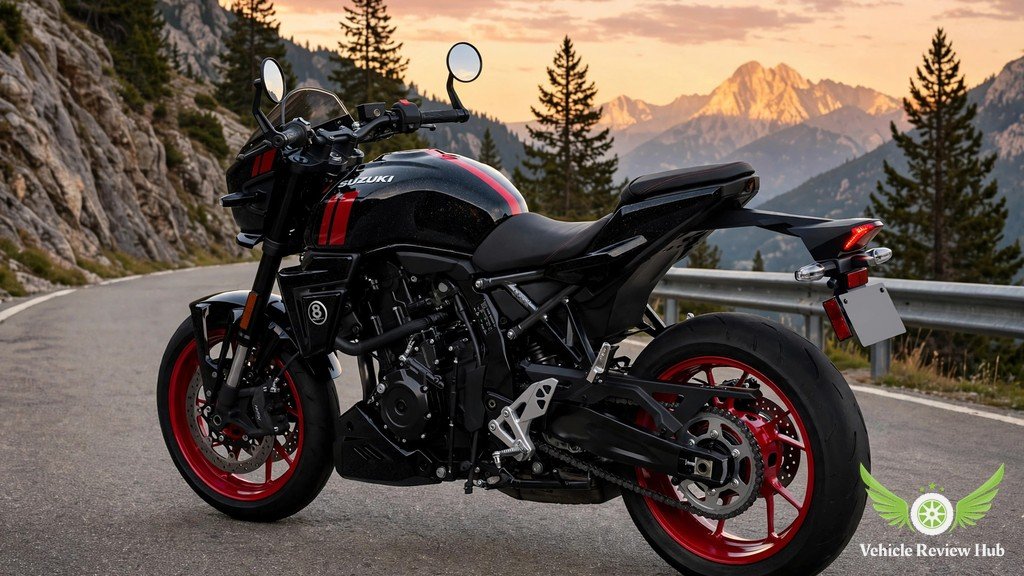
Suzuki GSX-8TT versus the 8T is the closest comparison in motorcycling, because the two bikes are the same machine with and without a fairing — and MCN says the TT has the duller turn-in. BikeReview Australia’s three testers agreed: the 8T “felt livelier and sportier than the GSX-8TT, despite identical suspension settings”. The TT answers with comfort — “universally agreed to be the nicer, more comfortable ride” — and the cowl’s wind relief at motorway speeds. The Suzuki GSX-8TT performance numbers are identical because the hardware is identical: 81.8 hp claimed, 57.5 lb-ft at 6,800 rpm, 445 lb against the 8T’s 443 lb, the same 16.5-litre tank, the same quickshifter, the same TFT. The $500 buys the quarter fairing, the under-cowl, the stitched seat, the dedicated colours and the 3-D 8-ball badges — appearance, not performance. Against the wider retro field, the TT’s 776cc twin out-muscles the XSR700’s 689cc CP2 and the Z650RS’s 649cc twin on paper. The Triumph Speed Twin 900 is the one rival that costs more, at about $12,220 in total, and it answers with 64 hp, 59.0 lb-ft, cruise control and cornering ABS for 2026 — equipment the TT does not have.
| Bike | Engine | Claimed power | Total price (USA) |
|---|---|---|---|
| Suzuki GSX-8TT | 776cc parallel twin | 81.8 hp @ 8,500 rpm | $11,849 |
| Suzuki GSX-8T | 776cc parallel twin | 81.8 hp @ 8,500 rpm | $11,349 |
| Suzuki GSX-8S | 776cc parallel twin | 81.8 hp @ 8,500 rpm | $9,709 |
| Yamaha XSR700 | 689cc CP2 twin | — | $9,274 |
| Kawasaki Z650RS | 649cc parallel twin | — | $9,684 |
| Triumph Speed Twin 900 | 900cc parallel twin | 64 hp | ~$12,220 (freight estimated) |
Is the Suzuki GSX-8TT Suitable for Beginner Riders? Mostly
Is the Suzuki GSX-8TT suitable for beginner riders? Mostly — the same verdict as the 8T, with TT-specific notes on both sides. The case for it is strong: approachable power with a smooth, flat torque curve, a low 31.9-inch seat, a light clutch and Low RPM Assist, plus a narrow waist that lets shorter riders touch down — Annick Magac, a 5-foot-2 rider, could touch on the balls of her feet. The case against it is real too: about 445 lb to manage at parking speeds, a quickshifter whose downshifts are delayed and do not rev-match well, no lean-sensitive ABS and no IMU, and the slightly duller turn-in MCN notes. A careful new rider with some training will be fine, and the TT is a good second bike and a capable first big bike — but this Suzuki GSX-8TT performance guide does not upgrade “mostly” to a yes. The three S-DMS drive modes and four-mode traction control help: Mode C softens the delivery for wet roads and new riders. What a new rider should not expect is cruise control or cornering ABS — the TT has neither, and the engine runs out of breath before the redline.
Suzuki GSX-8TT Performance: Frequently Asked Questions
Direct answers to the questions riders ask about Suzuki GSX-8TT performance.
How much horsepower does the GSX-8TT have?
The Suzuki GSX-8TT performance claim is 81.8 hp at 8,500 rpm with 57.5 lb-ft at 6,800 rpm. Suzuki USA publishes no horsepower or torque figures, and there is no TT dyno — the only measured figures are labelled GSX-8S sibling dyno runs.
What is the GSX-8TT’s top speed?
No instrumented top-speed test of a TT exists, so this Suzuki GSX-8TT performance guide prints no top-speed number. Any site printing one without naming a test is estimating.
What is the GSX-8TT’s 0–60 time?
No instrumented 0–60 test of a TT exists either. The TT shares the 8S’s tune and gearing, so its acceleration will be near-identical — but no measured TT figure has been published.
What is the GSX-8TT’s fuel economy?
The WMTC type-approval figure is 4.2 litres per 100 km — 67.23 mpg imperial, 56 mpg US. Bennetts tested 42.2 mpg imperial on the TT, or 35.1 mpg US.
Why do some sites say 67 mpg and others say 56 mpg?
Both numbers describe the same WMTC figure in different gallons: 67.23 mpg is imperial, 56 mpg is US. Always check which gallon a figure uses.
Is the GSX-8TT faster than the GSX-8T?
No — Suzuki GSX-8TT performance is identical to the 8T’s. The two bikes share the same engine, tune, frame and suspension. The TT is 2 lb heavier on Suzuki USA’s printed figures and, per MCN, slightly duller in turn-in — the $500 buys styling, not speed.
Does the GSX-8TT have a dyno figure?
Not its own. Rider Magazine’s TT spec box prints 75.9 hp at 8,300 rpm without a label, but that is Rider’s Jett Tuning dyno run of the GSX-8S. This Suzuki GSX-8TT performance guide prints sibling dyno figures only as labelled 8S data.
Does the GSX-8TT have cruise control?
No. The TT has no cruise control, no IMU and no lean-sensitive ABS — but it does have ride-by-wire, three ride modes, four-mode traction control, a standard quickshifter and a 5-inch TFT.
How far can the GSX-8TT go on a tank?
The tank holds 16.5 litres, or 4.3 US gallons. At the WMTC figure that is roughly 245 miles; at Bennetts’ tested figure it is about 184 miles, with the fuel light at 108.5 miles.
Is the GSX-8TT good for beginners?
Mostly, in this Suzuki GSX-8TT performance guide’s judgement. Approachable power, a low 31.9-inch seat, a light clutch and Low RPM Assist argue for it; the 445 lb weight, delayed quickshifter downshifts and no lean-sensitive ABS argue against it. A good second bike and a capable first big bike for a careful new rider.
What tyres does the GSX-8TT use?
Dunlop Roadsport 2 tyres — 120/70ZR17 front, 180/55ZR17 rear. Suzuki USA prints “Roadsport2-X”, where the “-X” is the OEM fitment code. “Roadsmart 2” and “SportSmart 2” are errors in other outlets.
Does the GSX-8TT have any recalls?
No recall found in published notices names the 8TT. Recall 24V081 covers the 2024 GSX-8R’s drive chain only, and 24V535 covers the 2023–2024 V-Strom 800DE’s rear tyre only — same engine family does not mean same recall.