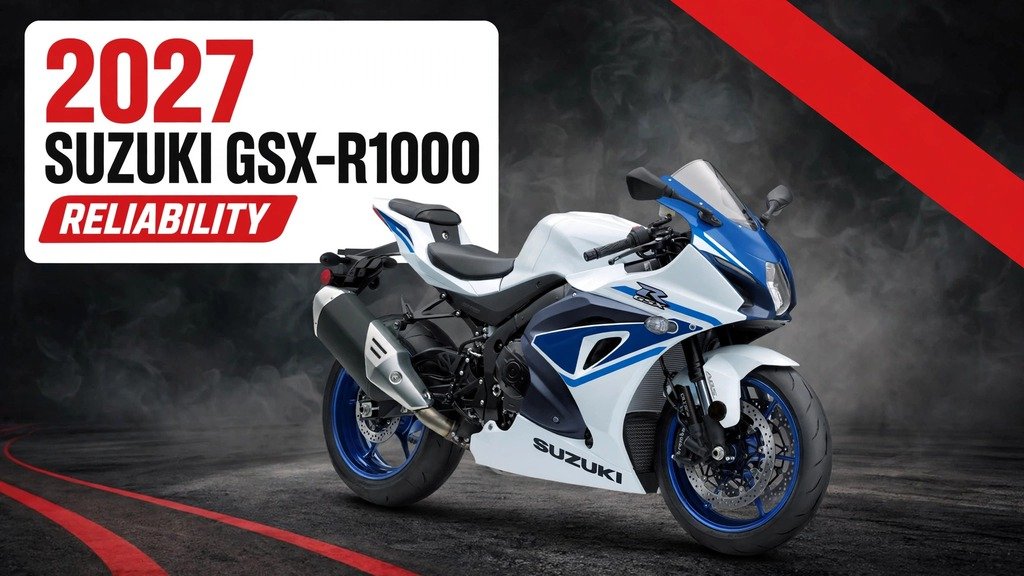
The 2027 Suzuki GSX-R1000 is a heavy revision of the 2017 (L7) platform, not a clean-sheet new generation, and that is good news for anyone asking about Suzuki GSX-R1000 reliability: a decade of owners, six recalls with none after 2018, and a service chart that has barely changed. The engine is the familiar 999.8cc inline-four, but the frame, the service intervals and most of the wear items carry over from the L7. This guide covers what actually goes wrong, what the factory service chart says, what the six recalls mean for a used buyer, and what it costs to keep one on the road.
Suzuki GSX-R1000 Reliability Overview
Suzuki GSX-R1000 reliability rests on a long production run. The GSX-R1000 has been in production since the 2001 K1, and the current platform dates to the 2017 L7 redesign, so there is a decade of owner evidence for the bike you can buy. The 2027 update changes the engine and the electronics, but the chassis, brakes and service schedule carry over, so the L7’s record is the best guide. The Suzuki GSX-R1000 review covers the full specification and the three trims, and the Suzuki GSX-R1000 performance guide covers the dyno figures.

MCN Ratings Rest on Three and Eight Owners
The headline owner ratings for the GSX-R1000 look strong, but they rest on very few owners, and that matters more than the scores themselves. MCN’s owner reviews for the 2017-on base bike come from just three owners: overall 4.7 out of 5, reliability 4.7 and engine 5.0. The R, reviewed by eight owners, scores lower: overall 4.2, reliability 3.8 and engine 4.8. Older generations rest on more owners — eleven for 2012–2016, twelve for 2009–2011 — so treat the L7 numbers as a hint, not a verdict.
How Mileage, Storage and Previous Care Affect Reliability
On a used GSX-R1000, how the bike was kept matters more than how old it is. A low-mileage bike that sat for years in a damp garage can be a worse buy than a higher-mileage bike with a stamped service book. The items that tell the story are the ones this guide covers: oil and filter changes at the chart intervals, a valve check at 14,500 miles, fresh brake fluid every two years, and a chain that has been cleaned rather than left to rust. A bike with all six recalls addressed and a folder of receipts is a different purchase from the same bike with no paperwork. Storage matters too: a bike kept indoors on a charger with a full tank will run cleanly, while one left outside will show corrosion and need the brakes and battery sorted first.
Suzuki GSX-R1000 Common Problems and Wear Items
The GSX-R1000 has no single defining weak point, but it has a short list of things to check, and two come with caveats: the stator and regulator story does not apply to the 1000 the way it does to the 600 and 750, and the cam-chain story is low confidence.
Stator and Regulator Reports on Earlier Bikes
Owner reports of charging problems exist for earlier GSX-Rs, but the GSX-R1000’s own record is thinner than the forums suggest, and the recall history is clear: neither of Suzuki’s two regulator recalls covers the GSX-R1000. The first, 11V108 from February 2011, covered 73,426 bikes across thirteen models — and the GSX-R1000 is not in the list. The second, 16V018 from February 2016, covered a similar spread, and again the GSX-R1000 is not named. One 2003 owner did report a bike that would not hold a charge even after a regulator replacement, with an expert noting a bad ground as a common problem on that model. But the known stator-problem models named by specialists are the 2006–2007 GSX-R600 and GSX-R750, not the 1000. So do not import the 750’s regulator story into the 1000: on a used bike, check that the battery holds a charge and the charging voltage is healthy, and treat a flat battery as a bike that needs diagnosis, not proof of a known 1000 fault.
Cam Chain Reports on 2001-04 Bikes: Low Confidence
The cam chain is listed as a common issue for the 2001–04 bikes, but the evidence behind that listing is weak, and this guide keeps the low-confidence framing rather than presenting it as an established weak point. After targeted searches of named publications and owner forums, no GSX-R1000-specific cam-chain failure report was found. The only related fact is mechanical: for the 2003 K3 revamp, Suzuki changed the cam-chain tensioner’s oil feed from external lines to internal passageways. That does not show chains were failing. The Haynes Manuals channel does have a short clip on the cam-chain rattle at startup and idle — a real noise owners notice, but not evidence of a failure pattern. If a used 2001–04 bike rattles loudly on a cold start and the noise does not settle, get it checked before buying.
Suzuki GSX-R1000 Maintenance Schedule and Servicing
The service chart comes from the L7 owner’s manual, and it is worth reading as written rather than borrowing the 600 or 750 chart: the filter and plug rows differ, and those differences are where owners get caught out. The chart below is the L7 chart in full.

| Service item | 600 mi | 4,000 mi | 7,500 mi | 11,000 mi | 14,500 mi |
|---|---|---|---|---|---|
| Engine oil | R | R | R | R | R |
| Engine oil filter | R | – | R | – | R |
| Valve clearance | – | – | – | – | I |
| Spark plugs | I | – | R | – | R |
| Air cleaner element | – | I | I | R | I |
| Engine coolant | – | – | – | – | R* |
| Brake fluid | I | I | I | I | I† |
| Brake hoses | I | I | I | I | I‡ |
R = replace, I = inspect. *Coolant every 4 years or 48,000 km (29,000 miles). †Brake fluid every 2 years (DOT 4). ‡Brake hoses every 4 years. Columns are miles (km; months). Source: the L7 owner’s-manual chart, via the Suzuki GSX-R1000 L7 maintenance schedule.
Oil Around Every 4,000 Miles on the US Chart
Engine oil is replaced at every column of the chart — 600, 4,000, 7,500, 11,000 and 14,500 miles — so after break-in the gap settles to roughly every 3,500 to 4,000 miles. The spec is SAE 10W-40 or 10W-50, JASO MA, API SG or better. The filter is where the 1000’s chart differs: on the GSX-R1000 it is replaced at 600, 7,500 and 14,500 miles — every other service — and not at 11,000, so anyone who “knows” the filter is done at 600 and 11,000 is remembering the wrong bike. The video below is a detailed oil-and-filter change how-to on a 2023 GSX-R1000 — the same L7 platform — with torque specs, fairing removal and a service-light reset. It is a how-to for the oil change specifically, not a full service guide.
The video below is VTX Fan’s oil-and-filter change on a 2023 Suzuki GSX-R1000 — a how-to for the oil change, not a full service guide.
Valve Inspection Every 14,500 Miles
Valve clearance is inspected once on the chart, at 14,500 miles (24,000 km) — there is no earlier check and no repeat interval printed after it. That single check is the most expensive routine service the bike will ever need, because reaching the valves means removing bodywork, lifting the tank, removing the airbox and the cam cover, and then measuring and shimming. One figure this guide does not print is the valve clearance itself: the K7 manual lists intake 0.08–0.18 mm and exhaust 0.18–0.28 mm cold, but the L7-specific clearances were not separately verified, so no L7 figure appears here.
Suzuki GSX-R1000 Tires, Brakes and Suspension Maintenance
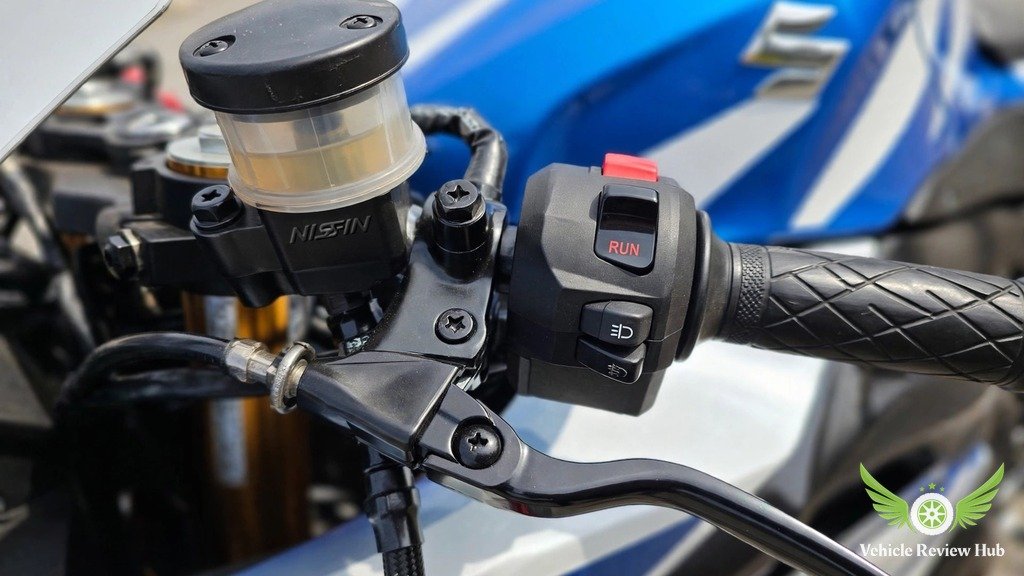
Tyres, brakes and suspension are where the running costs concentrate, and where a used bike shows its history fastest. All three 2027 trims come with Bridgestone Racing Street RS11 tyres, and the first thing to inspect on any used bike is the rear tyre: squared-off centres, cracking, or wear past the wear bars. The brakes are Brembo four-piston monobloc calipers on twin discs up front, with 320 mm T-drive rotors and steel lines on the R and RS, a Nissin single-piston rear caliper, and cornering ABS on every trim. Suspension differs by trim: Showa Big Piston Fork on the base, gold-anodized Showa Balance Free Fork and Rear Cushion Light shock on the R and RS. The base fork legs are black; the gold legs belong on the R and RS only.
Plugs at 7,500 Miles, Coolant Four Years
The spark plugs are NGK CR9EIA-9 iridium, or Denso IU27D as the alternative, verified from the 1000’s own chart. They are inspected at 600 miles and replaced at 7,500 and 14,500, which makes the 7,500-mile service a plugs-and-filter service as well as an oil service. The air cleaner element is inspected at 4,000 and 7,500 miles and replaced at 11,000. Engine coolant is replaced every four years or 48,000 km (29,000 miles) — the calendar limit applies even on a low-mileage bike, because coolant ages whether the bike is ridden or not. Brake fluid is inspected at every service and replaced every two years (DOT 4); brake hoses are inspected at every service and replaced every four years. The drive chain needs cleaning and lubrication every 1,000 km (600 miles) with 20–30 mm of slack — a neglected chain is the most common sign of a bike ridden hard and maintained rarely.
Valve Job at 14,500 Miles: Tank, Airbox and Cam Cover Off
The valve job at 14,500 miles is a strip-down, but a defined one, and one popular claim about it is wrong: the factory procedure does not require dropping the radiator. The manual steps are to remove the right under cowling, lift and support the fuel tank, remove the air-cleaner box, disconnect the camshaft position sensor coupler, remove the PAIR solenoid valve and the spark plugs, loosen the throttle-body clamps and move the throttle body, and then remove the cylinder head cover. No radiator step appears in the procedure. Access is tight, and some mechanics unbolt and lower the radiator for room — shop practice, not the manual procedure. What the job costs depends on whether any shims need changing: an inspection with every clearance in spec is a few hours of labour, while several shims adjusted costs more, because the cams have to come out. A used bike with a fresh valve-check receipt is worth more than the same bike without one, and a bike for sale just short of the interval with no receipt is one whose next owner pays for the job.
Suzuki GSX-R1000 Maintenance and Ownership Costs
Ownership costs are superbike costs, but predictable ones: fuel, oil and filters, tyres, chain and sprockets, brake pads and fluid, and the 14,500-mile valve check. No US dealer service-price schedule was found, so no dollar figures for dealer labour appear here — the MCN figures (£100 a year base, £280 R) are UK figures, not US prices. The pattern is firm: the bike is cheap to buy against its rivals — $16,399 for the base, $17,149 delivered — and the running costs are the same as any litre superbike, with tyres the biggest recurring bill.

Fuel, Routine Servicing, Tires and Replacement Parts
Fuel is the most frequent cost, and the only measured figure is Motorcycle.com’s observed 36.7 mpg in its 2017 Superbike Street Shootout — a worst-case number, logged while the bike was being ridden hard. With a 4.2-US-gallon tank, that works out to roughly 150 miles on a hard-ridden tank. Tyres are the biggest recurring cost after fuel — the RS11s are a soft, track-day-ready compound. Chain and sprockets, brake pads, and the occasional battery and fork-seal job make up the rest.
| Item | When | Notes |
|---|---|---|
| Fuel | Every ride | 36.7 mpg observed worst-case; 4.2-gal tank |
| Engine oil and filter | Oil every ~4,000 mi; filter at 600, 7,500, 14,500 mi | 10W-40 or 10W-50, JASO MA; filter 16510-07J00 |
| Tyres (Bridgestone RS11) | As worn | 120/70ZR17 front, 190/55ZR17 rear; soft compound, biggest recurring cost |
| Chain and sprockets | Clean/lube every 600 mi | Slack 20–30 mm |
| Brake pads and fluid | Fluid every 2 years; hoses every 4 years | DOT 4; Brembo monobloc front, Nissin single-piston rear |
| Valve check | 14,500 mi | Most expensive routine service |
Six Recalls Total, None After 2018
The GSX-R1000 has six NHTSA recalls in total, and none after 2018. The often-quoted figure of seven comes from a paperwork double-count: the 2005–06 frame campaign appears as both 08V-022 and 09V022, and counting both numbers as two campaigns gives seven. The count is six. The full list is in the table below. The master-cylinder recall, 13V449, is the largest: 210,228 across the three models combined, per NHTSA’s Part 573 report — the 1000-only count was not published, and one database lists 208,966. The chain-adjuster recall, 14V629, is the same story: 23,073 is the combined 750 and 1000 population, with no per-model split found. No campaign dated 2019 or later was found, so a 2027 bike starts with a clean recall sheet — but any used bike should still be checked by VIN before money changes hands.
| NHTSA campaign | Model years | Defect | Units affected |
|---|---|---|---|
| 09V022 (Suzuki 2A08) | 2005–2006 | Frame cracking behind and below the steering neck | 26,082 |
| 12V231 (Suzuki 2A29) | 2009–2011 | Side-stand switch bolts loosen and fall out, cutting the ignition | 4,969 |
| 13V449 (Suzuki 2A31–36) | 2005–2013 | Master cylinder piston corrosion, soft lever, reduced braking | 210,228 total across all three models |
| 14V629 (Suzuki 2A40–43) | 2009–2014 | Missed upshift damages the drive-chain adjuster, chain can derail | 23,073 total (750 + 1000 combined) |
| 18V064 (Suzuki 2A76–81) | 2017–2018 | ECM fault, engine stall and drive-chain break risk | 3,097 |
| 18V694 (Suzuki 2A86–88) | 2017–2018 | Fuel-pump O-ring twisted in installation, fuel leak and fire risk | 6,928 total across three models |
The master-cylinder campaign deserves a closer look, because it is the one most likely to touch a used bike you are considering. NHTSA’s Part 573 report for 13V449 lists 210,228 vehicles: corrosion in the master cylinder piston can generate gas, giving a soft lever and reduced braking. If a used bike’s front brake lever feels spongy or pulls to the bar, check the recall status first — the remedy was a master-cylinder replacement.
How to Keep a Suzuki GSX-R1000 Reliable
Keeping a GSX-R1000 reliable is mostly a matter of doing the chart on time and keeping records. The bike is a proven platform with a short list of known issues, almost all of them either recall work done free years ago or wear items the chart already covers.

Preventive Maintenance, Records and Regular Inspections
The preventive routine is the service chart plus a short inspection habit. Change the oil and filter at the chart intervals and keep the receipts; check the chain every 600 miles and clean and lubricate it; inspect the brake fluid and hoses at every service and replace the fluid every two years and the hoses every four; check the tyres before every long ride; and keep the battery on a trickle charger if the bike sits for weeks. Records matter as much as the work itself: a stamped service book and receipts for the valve check, the recalls and the tyres add more to the bike’s value than any accessory, and they are the first thing a careful buyer asks for.
2005-06 Frame Campaign: Check for the Brace
The frame campaign is the single biggest reliability story in the GSX-R1000’s history, and it is the one check that matters most on a 2005–06 bike. NHTSA campaign 09V022, Suzuki campaign 2A08, covered 26,082 bikes from 2005–2006: the frame could crack or break behind and below the steering neck in extreme situations — collisions involving the front wheel and fork assembly, or repeated hard landings from extreme wheelies. Suzuki stressed that ordinary operation did not create a risk and called it a voluntary safety improvement campaign, not a defect recall, but the remedy was real: a slim aluminium brace, weighing less than two pounds, fitted underneath the top spar behind and below the steering neck, attached with bolts and epoxy adhesive, and if cracks were found the frame was replaced with a new one that had the brace installed. The service took about three hours, the bike stayed overnight for the epoxy to cure, and it was free. A class-action settlement later extended the frame warranty to ten years. What to check: look under the top spar behind and below the steering head for the slim aluminium brace, and ask for the 2A08 paperwork. A bike with the brace and the paperwork has its biggest known issue closed; a bike without either needs the check before it is ridden hard.
Suzuki GSX-R1000 Reliability: Frequently Asked Questions
Direct answers to the questions riders ask about Suzuki GSX-R1000 reliability.
Is the Suzuki GSX-R1000 reliable?
Yes, on the evidence available: a decade of owner history, six NHTSA recalls with none after 2018, and no single defining weak point. Owner ratings are favourable but rest on very few owners — three for the base and eight for the R — so treat the scores as a hint.
How many recalls does the GSX-R1000 have?
Six NHTSA recalls in total, none after 2018. The figure of seven comes from counting the 2005–06 frame campaign twice, as both 08V-022 and 09V022 — one campaign, Suzuki 2A08, covering 26,082 bikes. The six are the frame, the side-stand switch, the master cylinder, the chain adjuster, the ECM and the fuel-pump O-ring.
How often should I change the oil on a GSX-R1000?
Engine oil is replaced at every column of the L7 chart — 600, 4,000, 7,500, 11,000 and 14,500 miles — so after break-in it works out to roughly every 3,500 to 4,000 miles. Use SAE 10W-40 or 10W-50, JASO MA, API SG or better. The filter is replaced at 600, 7,500 and 14,500 miles, not at 11,000.
When do the valves need checking on a GSX-R1000?
Valve clearance is inspected once on the chart, at 14,500 miles (24,000 km). The job means removing bodywork, lifting the fuel tank, removing the airbox and the cam cover — the factory procedure does not require dropping the radiator.
What spark plugs does the GSX-R1000 use?
NGK CR9EIA-9 iridium, or Denso IU27D. They are inspected at 600 miles and replaced at 7,500 and 14,500 miles.
Does the GSX-R1000 have stator or regulator problems?
Owner reports exist for earlier bikes, but neither regulator recall — 11V108 nor 16V018 — covers the GSX-R1000, and the known stator-problem models named by specialists are the 2006–2007 GSX-R600 and GSX-R750, not the 1000.
Is the cam chain a problem on the GSX-R1000?
Low confidence. No GSX-R1000-specific cam-chain failure evidence was found in named publications or owner forums, so it is not presented here as an established weak point. A loud rattle on a cold start that does not settle is worth checking before buying.
What should I check on a 2005-06 GSX-R1000 before buying?
Check for the frame reinforcement brace: look under the top spar behind and below the steering head for the slim aluminium brace, and ask for the 2A08 campaign paperwork. The brace weighs less than two pounds and was fitted free under 09V022, with a five-year warranty later extended to ten years by a class-action settlement.
How much does it cost to maintain a GSX-R1000?
No US dealer service-price schedule was found, so no dollar figures are printed here. The pattern is predictable: fuel at 36.7 mpg observed worst-case, oil and filters at the chart intervals, tyres as the biggest recurring cost, and the 14,500-mile valve check as the most expensive routine service.
How often should the coolant be changed?
Engine coolant is replaced every four years or 48,000 km (29,000 miles), whichever comes first — the calendar limit applies even on a low-mileage bike.
What is the warranty on a 2027 GSX-R1000?
Twelve months, unlimited mileage, as a limited warranty — the same wording in all three brochures. Longer coverage is available through Suzuki Extended Protection.
Is the 2027 GSX-R1000 a good used buy?
The 2027 bike is too new to have a used record of its own, so the answer rests on the L7 platform it revises: a decade of history, six recalls with none after 2018, and a service chart that rewards owners who follow it.