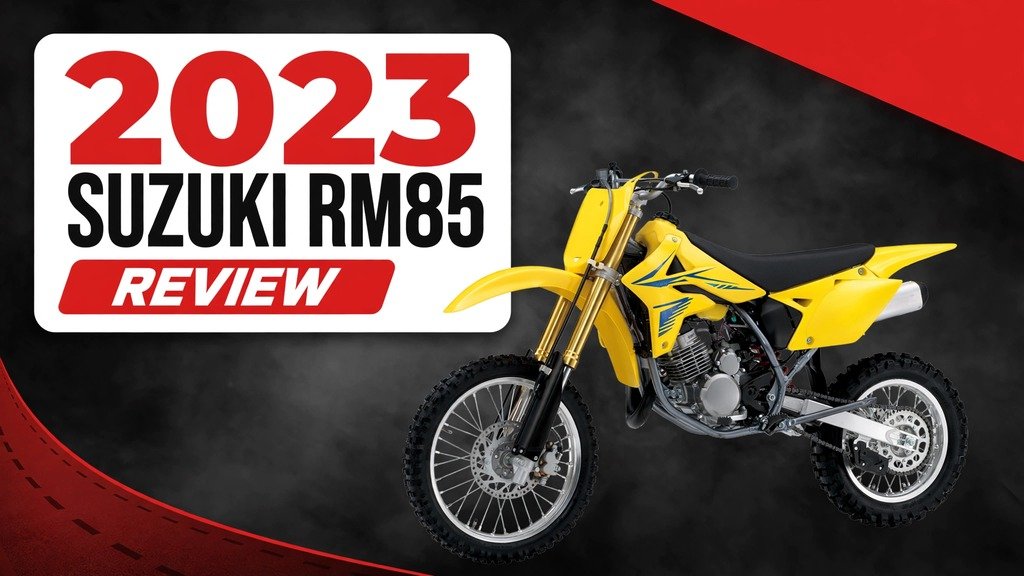
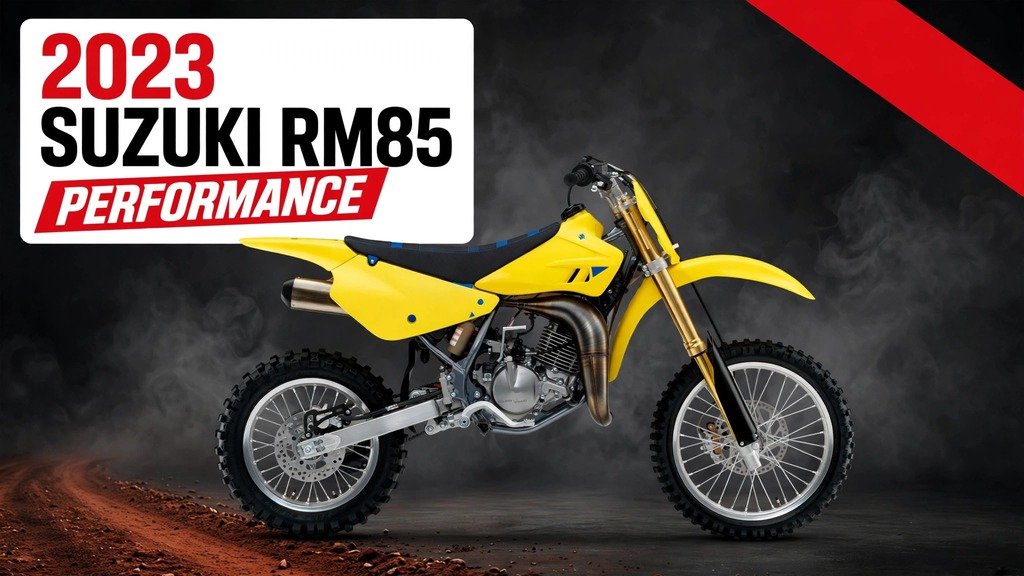
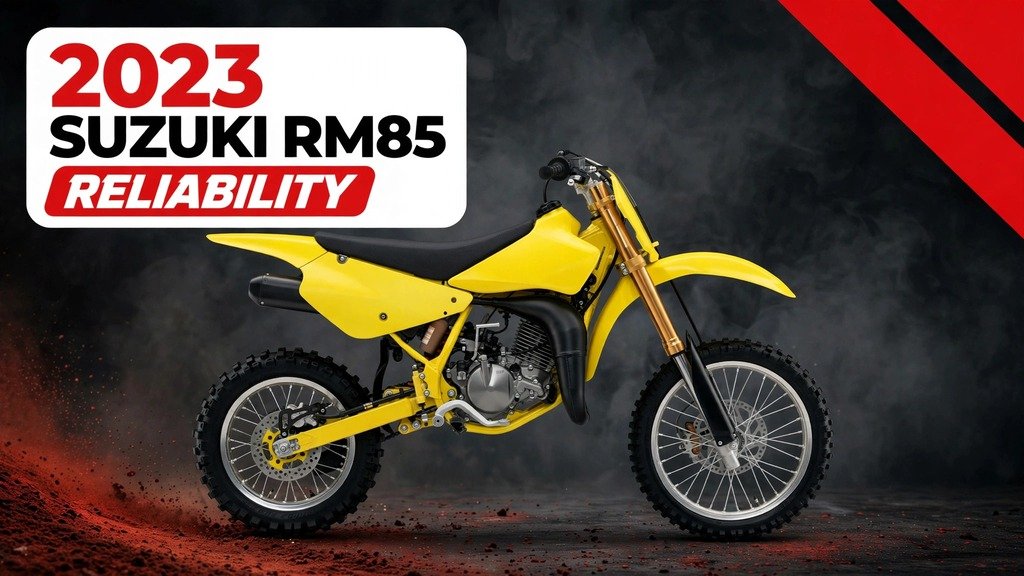
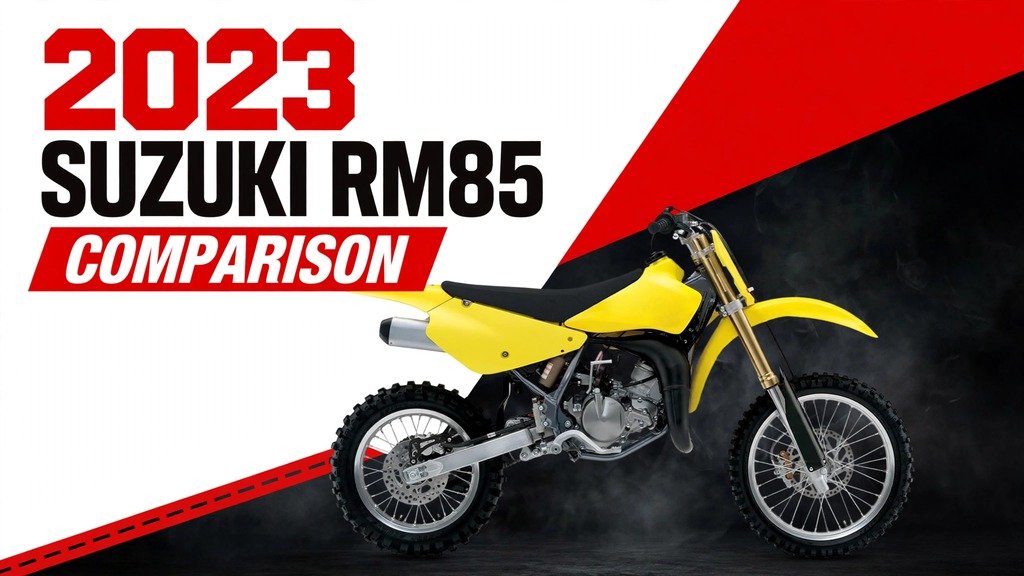
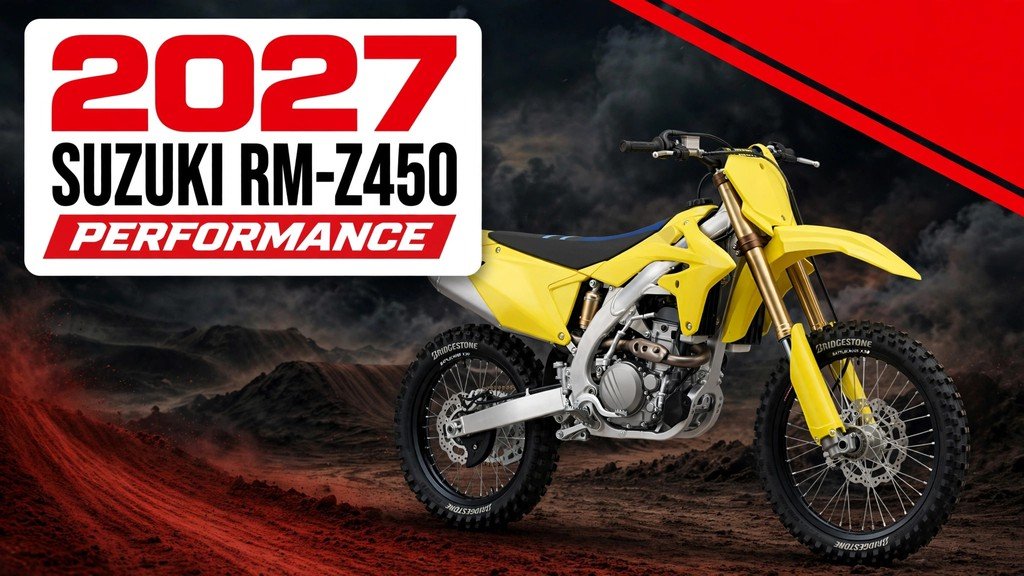
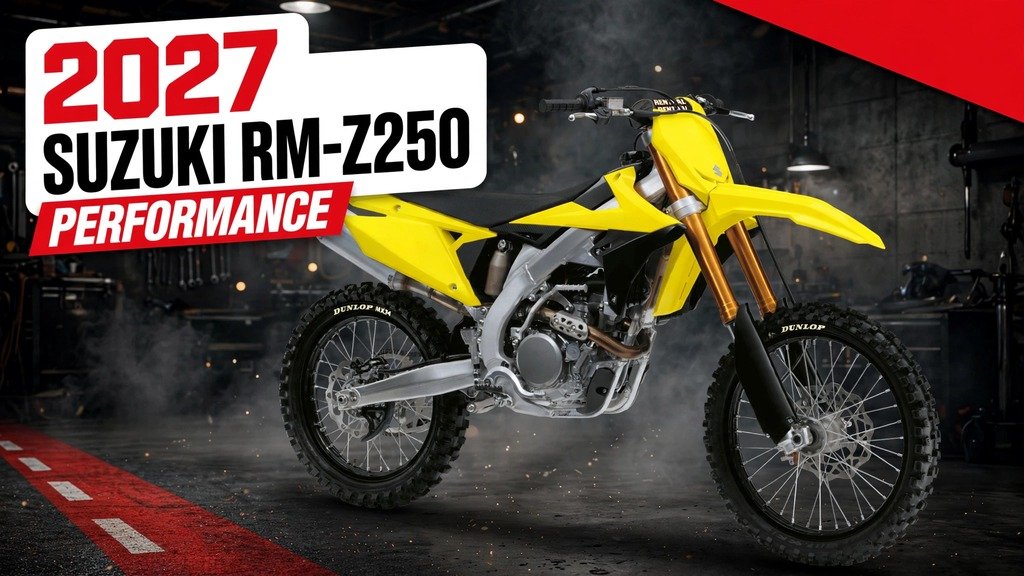
The 2027 Suzuki RM-Z250 is the cheapest 250cc motocross bike you can buy new in America — $8,499 plus $650 destination, $9,149 delivered — and the only one you still have to kick-start. After eight years with almost no changes, Suzuki has updated the bike for 2027 with new KYB settings, a quieter silencer, MX34 tyres and a lighter frame. This Suzuki RM-Z250 review covers the 2027 update, the specs, the dyno results and the ownership costs. The short answer: it corners better than anything in the class once the forks are fixed, but it is the slowest 250F on the dyno.
Suzuki RM-Z250 Overview and Model-Year Updates
The RM-Z250 is Suzuki’s 250cc four-stroke motocross racer, a closed-course competition bike on sale in the USA since 2004. This Suzuki RM-Z250 review starts with what changed for 2027 — for the first time since 2019, there is something to report.
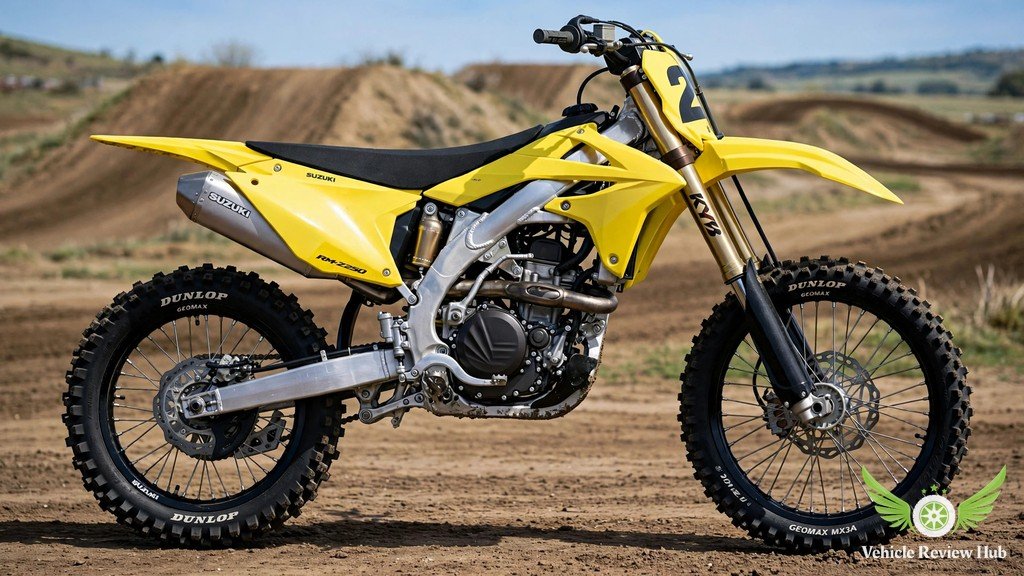
Latest Year 2027 Brings the First Update Since 2019
The 2027 RM-Z250 is the first real update since the 2019 redesign. Suzuki’s 2027 brochure lists the changes: new KYB fork and shock settings, a multi-layer silencer for the 2026 AMA and FIM sound rules, Dunlop GEOMAX MX34 tyres, RK Excel rims, a 370-gram-lighter frame with more torsional rigidity, and a 270-gram-lighter swingarm. The engine gets a revised intake cam, cam-chain tensioner and guide, intake port and piston-pin-hole machining. Second gear and the final ratio are revised, the chain is an RK 520MXZ5, the footpegs move 0.12 inches forward and 0.2 inches up, the grips move 0.3 inches forward and 0.15 inches down, and Renthal tapered bars, a 270 mm wave front rotor and MX-Tuner 4.0 with revised mapping are standard. That long freeze fed a rumour that Suzuki had dropped the bike — it has not: the 2027 model is on sale in the USA now, and this Suzuki RM-Z250 review treats the story as false.
New Silencer, MX34 Tyres, Revised Suspension
Three 2027 changes matter most on the track. The new multi-layer silencer is about sound rules, not power — it meets the tighter AMA and FIM limits without strangling the engine. The Dunlop GEOMAX MX34 tyres replace the older MX33 pattern, so a buyer gets the current Dunlop tyre as standard rather than one to replace on day one. The revised KYB suspension is the change testers will feel first: both fork legs now run the same springs and damping with a free-piston design. The old setup was the bike’s most-criticised feature — the stock 5.0 N/mm fork springs were too stiff for any skill level, a point this Suzuki RM-Z250 review returns to below. The lighter frame and swingarm, the revised intake cam and the revised gearing are smaller steps, but together they make the 2027 bike the first RM-Z250 in eight years that is genuinely different.
Suzuki RM-Z250 Engine and Specifications
The engine is a 249cc liquid-cooled four-stroke single, the same basic unit since the 2019 redesign — both its strength and its weakness. This Suzuki RM-Z250 review puts the official spec table first, then the feature every buyer asks about: the kick starter.

249cc Single, Dual Injectors, 13.75:1
The engine is the 249cc single from the 2019 redesign — the figures are in the table below. Suzuki USA publishes no horsepower or torque figure — there is no manufacturer power claim, and any website printing a crank horsepower number for this bike is guessing. The only power figures are magazine dyno runs, covered in the Suzuki RM-Z250 performance guide: Dirt Rider measured 36.3 hp and 18.6 lb-ft in 2021, while Pro Circuit’s dyno read 39.22 hp at 12,440 rpm and 18.86 lb-ft at 9,140 rpm on a stock 2023 bike.
| Item | 2027 Suzuki RM-Z250 |
|---|---|
| Engine | 249cc, 4-stroke, liquid-cooled single, DOHC, 4 valves, dual-injector fuel injection |
| Bore, stroke, compression | 77.0 × 53.6 mm, 13.75:1 |
| Starter | Primary kickstarter with automatic decompressor |
| Transmission | 5-speed constant mesh, cable clutch |
| Curb weight | 233 lb (106 kg) |
| Seat height | 37.5 in (955 mm) |
| Wheelbase | 58.46 in (1,485 mm) |
| Ground clearance | 13.0 in (330 mm) |
| Fuel tank | 6.3 L (1.7 US gal) |
| Suspension | KYB 48 mm inverted fork, 12.2 in travel; link-type rear shock, 11.8 in travel |
| Front brake | 270 mm wave rotor, Nissin 2-piston caliper |
| Front / rear tyre | 80/100-21 / 100/90-19, Dunlop GEOMAX MX34 |
| Colour | Champion Yellow No. 2 |
The figures in this Suzuki RM-Z250 review table are Suzuki’s own 2027 brochure numbers. Two weights are worth keeping separate in this Suzuki RM-Z250 review: Suzuki’s official curb weight is 233 lb, while Dirt Bike weighed a 2023 bike at 227 lb without fuel and Dirt Rider’s 2021 bike read 237 lb. A rear brake disc size was not verified from any source, so this Suzuki RM-Z250 review does not print one.
Kick Start Only, No Electric Start
The RM-Z250 is the only 250cc four-stroke motocross bike still sold in the USA without electric start — every rival, the Honda CRF250R, the Yamaha YZ250F and the Kawasaki KX250, starts with a button. The Suzuki starts with a primary kickstarter and an automatic decompressor, and there is no battery on the bike. The cost is real: a stall mid-moto costs time — there is no button to thumb the engine back to life, only a kick, and on a muddy track that is a real handicap. Cycle News noted in its 2021 review that the Suzuki was the only 250F without electric start, and Motocross Action has called the kick starter a quirk rather than a deal-breaker for a novice — though for a vet rider who stalls once a moto, it is a bigger deal.
Suzuki RM-Z250 Price and Market Availability
Price is the RM-Z250’s strongest card. This Suzuki RM-Z250 review gives the 2027 price first, then the full price history, because the history explains why the bike is cheap — Suzuki held the price almost flat for five years.
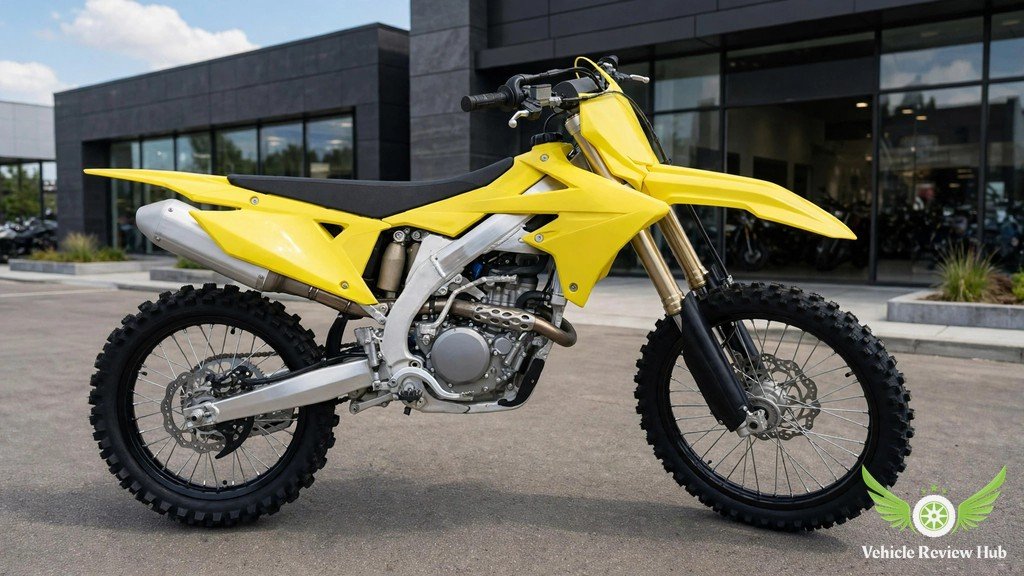
Suzuki RM-Z250 Price in the USA: $8,499 for 2027
The 2027 Suzuki RM-Z250 costs $8,499 plus $650 destination — $9,149 delivered before tax and dealer fees. That is the lowest list price of any 250cc four-stroke motocross bike on sale in the USA for 2027, and the headline figure of this Suzuki RM-Z250 review. The nearest rival, the Honda CRF250R, costs $8,599 plus $600 destination — $9,199 delivered, exactly $50 more. The source is Suzuki USA’s 2027 model page and brochure, with the destination charge confirmed by dealer listings. Dealer discounting is common — Motocross Action’s 2026 race test notes that dealers routinely lop $1,000 to $2,000 off the list price — and a discounted Honda can undercut a full-price Suzuki, so the $50 gap is a list-price gap, not a guarantee.
Plus $650 Destination, Cheapest in Class
Suzuki charged $7,899 flat for five model years, 2019 through 2023 — a total rise of just $600, or 7.6 percent, over eight years, while the bike was mechanically unchanged until 2027. The yearly figures are in this Suzuki RM-Z250 review’s price table. One caution: a single dealer’s figure can bundle freight, setup and a document fee, so it is not the headline delivered price.
| Model year | MSRP | Destination | Delivered |
|---|---|---|---|
| 2019 | $7,899 | — | — |
| 2020 | $7,899 | — | — |
| 2021 | $7,899 | $395 | $8,294 |
| 2022 | $7,899 | — | — |
| 2023 | $7,899 | — | — |
| 2024 | $8,099 | $460 | $8,559 |
| 2025 | $8,199 | — | — |
| 2026 | $8,299 | $600 | $8,899 |
| 2027 | $8,499 | $650 | $9,149 |
The figures in this Suzuki RM-Z250 review table are US list prices with the destination charge where it was verified; a dash means that year’s destination charge was not captured, not that it was zero. Availability is straightforward: the 2027 bike is a current model on Suzuki USA’s website, sold through Suzuki dealers as a closed-course competition machine. This Suzuki RM-Z250 review notes it is not street-legal and cannot be registered for road use — a buyer who wants a trail bike with a plate should look at Suzuki’s street-legal DR-Z400S instead, a very different machine with lights, mirrors and a kickstand.
Suzuki RM-Z250 Design, Features and Technology
The RM-Z250 carries less technology than any rival. There is no traction control, no ride modes, no quickshifter, no TFT dash and no battery. What it does have is a launch-control system and a phone-based fuel-injection tuner, and this Suzuki RM-Z250 review explains both honestly — including what each one does not do.

Launch Control Without Real Traction Control
S-HAC, Suzuki’s Holeshot Assist Control, is a launch-only system with three modes: A for hard or slippery surfaces, B for aggressive starts, and a base mode. It alters ignition timing to help the rider launch, then shuts off after six seconds or in fourth gear. Suzuki’s own 2027 brochure states that it does not measure rear tyre spin — the control module reads throttle opening, engine speed and gear position, and nothing else. It is not a wheel-slip traction control. Suzuki’s marketing copy also calls it an “advanced traction management system”, but that describes the launch system, not a separate traction control. A buyer expecting the cornering traction control of a modern street bike will not find it here, and this Suzuki RM-Z250 review says so plainly.
MX-Tuner 4.0 Included in the Price
MX-Tuner 4.0 is Suzuki’s phone app for tuning the fuel injection, included in the price of the 2027 bike. Version 4.0 holds four pre-programmed maps — aggressive, smooth, richer, leaner — plus custom maps and a Pro Circuit map, and three plug-in fuel couplers come with the bike. The catch: the bike has no battery, so the rider must buy a battery and a connecting cable to power it while tuning. There is no instrument panel, only a run-time indicator light, and no headlight, indicators, mirrors, licence plate, horn or kickstand — the bike is built for closed-course racing only.
Suzuki RM-Z250 Riding Experience and Comfort
On the track, the RM-Z250 is a bike of two halves: the best-cornering chassis in the class, held back by the stiffest forks in the class. This Suzuki RM-Z250 review covers both, because the fix is cheap and the cornering is the reason to buy the bike.

The video below is Motocross Action testing the 2023 RM-Z250 at Glen Helen. It shows the pre-update bike — the 2023 machine is mechanically identical to the 2026 bike, while the 2027 bike carries the first updates since 2019 — so the riding impressions describe the older setup. What it shows well, and what this Suzuki RM-Z250 review keeps returning to, is the bike’s character: the kick starter, the low-to-mid power and the cornering testers keep praising.
Best-Cornering Bike in the Class, Say Testers
Testers have said the same thing about this chassis for years, and this Suzuki RM-Z250 review agrees with them. Motocross Action has said it in 2020, 2022 and 2026: with workable suspension the RM-Z250 is the best-cornering bike in its class. Cycle News called it “still a master of the corners” in 2021, and Ultimate Motorcycling’s 2019 test said the bike feels “as nimble as they come”, with only a slight head shake in braking bumps at high speeds.
233 Pounds and a 37.5-Inch Seat
The RM-Z250 weighs 233 lb at the curb on Suzuki’s official figure, with a 37.5-inch seat. Comfort here is mostly about the suspension, and this Suzuki RM-Z250 review judges it on the fork setup first: the 5.0 N/mm fork springs are the same rate the 450cc bikes run, while the Yamaha YZ250F uses 4.7 N/mm — the stock rate is too stiff for any skill level. The fixes are well known and cheap: dropping the fork oil height by 30 mm in both legs is the cheapest, and fitting 4.7 to 4.8 N/mm springs is the proper one. Motocross Action’s 2026 setup runs 4.7 N/mm fork springs and a 50 N/mm shock spring instead of the stock 52 N/mm unit. With those changes, the bike testers call the best-cornering 250F finally gets suspension that lets it show it.
Suzuki RM-Z250 Review: Pros, Cons and Verdict
The verdict depends on who is buying it. For a novice or vet racer on a budget, it is the smartest buy in the class. For a rider chasing the fastest 250F, it is not. This Suzuki RM-Z250 review ends the review section with the balance sheet, then the warranty position.
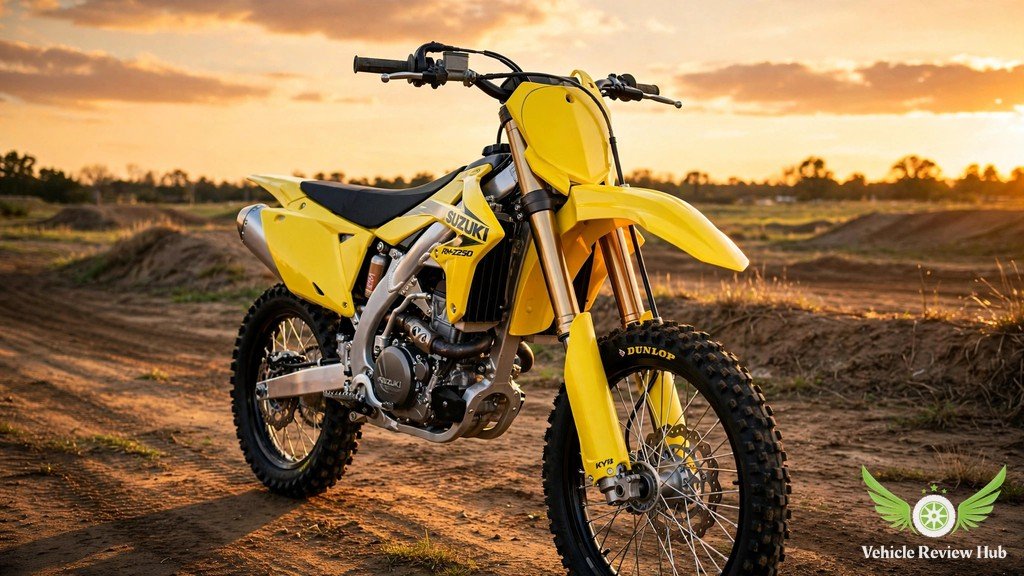
Main Advantages and Limitations of the Suzuki RM-Z250
The advantages in this Suzuki RM-Z250 review start with price and end with handling. At $9,149 delivered the Suzuki undercuts every rival on list price, and dealer discounts of $1,000 to $2,000 off list are common, which widens the real-world gap. The chassis is the best-cornering in the class once the forks are sorted, the low-to-mid power beats a Honda or a Yamaha in that range, and the engine is durable — Motocross Action puts more than 50 hours a year on its RM-Z250 test bikes since 2019 with no serious issues. The limitations are equally clear: seventh of seven in Motocross Action’s 2023 250 shootout and eighth of eight in Cycle News’ 2025 shootout — too slow, too heavy and too stiff. It is the slowest 250F on the dyno, at 36.3 hp on Dirt Rider’s run against a class that runs into the mid-40s, and the only bike in the class without electric start.
| Pros | Cons |
|---|---|
| Cheapest 250F on list price: $9,149 delivered | Slowest 250F on the dyno: 36.3 hp (Dirt Rider 2021) |
| Best-cornering chassis once forks are fixed | Only 250F without electric start |
| Strong low-to-mid power, beats Honda and Yamaha | Stock 5.0 N/mm fork springs too stiff for any skill level |
| First real update since 2019 (KYB, silencer, MX34, lighter frame) | 7th of 7 (MXA 2023), 8th of 8 (Cycle News 2025) |
| Durable engine: 50+ hours a year on MXA test bikes since 2019 | Clutch tends to slip after a few hard hours |
| MX-Tuner 4.0 included, plus S-HAC launch control | No battery — must buy one for MX-Tuner 4.0 |
| No NHTSA recall record | Warranty: not applicable in the USA |
The verdict in this Suzuki RM-Z250 review is straightforward. Buy it if you are a novice or vet rider who wants the cheapest way into 250cc motocross, values cornering feel over peak horsepower, and will spend a little fixing the fork springs. Do not buy it if you need electric start, if you race where five horsepower decides results, or if you want the newest technology — the YZ250F is all-new for 2027 and the CRF250R is only $50 more. The 2027 update improves the bike that finished last in the 2023 and 2025 shootouts, but this Suzuki RM-Z250 review does not claim the shootout order will change on its strength alone.
Warranty: Not Applicable, Says Suzuki
Suzuki lists the warranty for the RM-Z250 in the USA as not applicable. That is normal for a closed-course competition motorcycle, sold without a road-bike warranty. Suzuki UK offers an extended parts warranty and a deposit contribution, but that is a UK-only offer with nothing to do with the US bike. The reliability picture is covered in full in the Suzuki RM-Z250 reliability guide, including the hour-based service schedule, the 12-hour piston job and the clean recall record. The Suzuki RM-Z250 performance guide covers the dyno figures and shootout results, and the Suzuki RM-Z250 comparison puts the Suzuki against the Honda, Yamaha and Kawasaki on price, power and starting.
Suzuki RM-Z250 Review: Frequently Asked Questions
Direct answers to the questions riders ask about this Suzuki RM-Z250 review.
Is the 2027 Suzuki RM-Z250 a new bike?
Not a new generation, but the first real update since 2019. The 2027 bike gets new KYB settings, a multi-layer silencer, MX34 tyres, RK Excel rims, a lighter frame and swingarm, a revised intake cam and gearing, Renthal bars and MX-Tuner 4.0. The engine, frame and layout are the same as the 2019 redesign, so this Suzuki RM-Z250 review calls it an update, not an all-new bike.
How much does the 2027 RM-Z250 cost?
The 2027 RM-Z250 costs $8,499 plus $650 destination — $9,149 delivered before tax and dealer fees. That is the lowest list price in the 250cc four-stroke motocross class. Dealer discounts of $1,000 to $2,000 off list are common — and this Suzuki RM-Z250 review notes a discounted Honda CRF250R can undercut a full-price Suzuki.
Does the RM-Z250 have electric start?
No. The RM-Z250 is the only 250cc four-stroke motocross bike sold in the USA without electric start, and it has never had one. It starts with a primary kickstarter and an automatic decompressor, and there is no battery. A stall mid-moto costs time because there is no button to restart the engine — the most visible handicap in this Suzuki RM-Z250 review.
How much horsepower does the RM-Z250 make?
Suzuki publishes no horsepower figure. The verified magazine dyno runs are Dirt Rider’s 2021 run at 36.3 hp and 18.6 lb-ft, and Pro Circuit’s 2023 run at 39.22 hp at 12,440 rpm and 18.86 lb-ft at 9,140 rpm on a stock bike. A 40.04 hp figure from Dirt Bike’s 2025 test was measured with a Pro Circuit T-6 exhaust fitted, so it is not stock, and this Suzuki RM-Z250 review never presents it as one.
Is the RM-Z250 street legal?
No — and this Suzuki RM-Z250 review is blunt about it: the RM-Z250 is a closed-course competition motorcycle with no headlight, indicators, mirrors, licence plate, horn or kickstand, and it cannot be registered for road use. A rider who wants a street-legal Suzuki single should look at the DR-Z400S, a very different bike built for the road and the trail.
How often do you change the oil on an RM-Z250?
Every six hours of engine running time, per the owner’s manual chart. The manual measures service in hours, not miles, because — as this Suzuki RM-Z250 review notes — the bike has no odometer, only a run-time indicator light. The oil filter is replaced only every 12 hours, not at every oil change, and the oil must be SAE 10W-40 meeting JASO MA.
How often do you replace the piston on an RM-Z250?
Every 12 hours, for both the piston and the piston ring, per the owner’s manual chart. The valve clearance is also inspected every 12 hours, and the fork oil is replaced every 6 hours. These are racing intervals, and this Suzuki RM-Z250 review treats the 12-hour piston job as the main running-cost driver.
Is the RM-Z250 good for beginners?
Yes, for a beginner racer. Motocross Action’s 2023 shootout called it a good starting point for a novice rider, and its low-to-mid power is friendly rather than intimidating. The kick starter and the stiff stock forks are the two things a beginner will notice first — the forks need softer springs or lower oil. On price and cornering, this Suzuki RM-Z250 review still calls it a sensible first 250F.
Is the RM-Z250 reliable?
On the available evidence, yes. Motocross Action puts more than 50 hours a year on its RM-Z250 test bikes since 2019 with no serious issues, and there is no documented valve-train or stalling pattern for the 2019-and-later bike. The NHTSA record is clean — Count 0 for every model year checked — and no CPSC recall naming the RM-Z250 was found. The one real issue is clutch slip after a few hard hours, and this Suzuki RM-Z250 review covers the full picture in the reliability guide.
What is the RM-Z250’s biggest weakness?
Peak power and the lack of electric start, in that order — the two faults this Suzuki RM-Z250 review keeps returning to. At 36.3 hp on Dirt Rider’s dyno it is the slowest 250F in the class, giving up about five horsepower to its high-revving rivals, and it finished seventh of seven (MXA 2023) and eighth of eight (Cycle News 2025). The stock 5.0 N/mm fork springs are the third weakness — too stiff for any skill level — but that one is cheap to fix.
Does the RM-Z250 have traction control?
No, not in the sense a street rider would mean — and this Suzuki RM-Z250 review says so plainly. S-HAC is a launch-only system with three modes that alters ignition timing for the start and shuts off after six seconds or in fourth gear. Suzuki’s own brochure states that it does not measure rear tyre spin, so it is not a wheel-slip traction control. There are no ride modes, no quickshifter and no TFT dash.
What is MX-Tuner 4.0?
MX-Tuner 4.0 is Suzuki’s phone app for tuning the RM-Z250’s fuel injection, included in the price of the 2026 and 2027 bikes. It holds four pre-programmed maps plus custom maps and a Pro Circuit map. The catch is that the bike has no battery, so the rider must buy a battery and a cable to power it while tuning. The 2021 to 2025 bikes ran MX-Tuner 2.0, and this Suzuki RM-Z250 review notes some dealer copies still print the old version number by mistake.