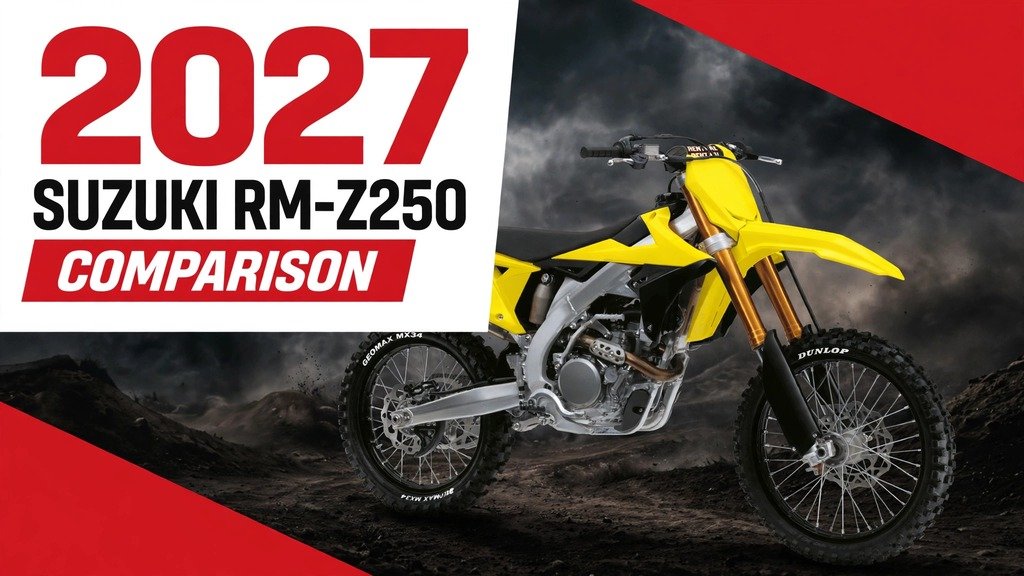
The 2027 Suzuki RM-Z250 is the cheapest 250cc four-stroke motocross bike you can buy in the USA, and the only one you still have to kick-start. That frames this Suzuki RM-Z250 comparison: the Suzuki costs $8,499 before destination, $50 less delivered than the Honda CRF250R, $100 less than the Kawasaki KX250 and $625 less than the Yamaha YZ250F — but every rival starts with a button. The Suzuki is also the slowest bike in the class on the dyno and the last-placed bike in both verified shootouts, yet testers call it the best-cornering 250F once its too-stiff forks are fixed. This Suzuki RM-Z250 comparison puts the four Japanese 250Fs side by side on price, dyno power, starting systems and running costs, then weighs the Austrian premium alternatives.
Suzuki RM-Z250 Overview and Its Closest Rivals
The four bikes in this Suzuki RM-Z250 comparison are the whole Japanese 250F class for 2027. All four are liquid-cooled, fuel-injected, four-stroke singles built for closed-course motocross, and all four cost between $8,499 and $9,099 before destination. The differences are in starting systems, dyno power, suspension setup and freight charges.

Why These Three Rivals: Price, Benchmark, Power
The three rivals were picked for three reasons. Honda is the price rival: the CRF250R lands $50 from the Suzuki once destination is added, so any buyer cross-shopping on price is really choosing between these two. Yamaha is the benchmark: the YZ250F is the class standard and the best-selling Japanese 250F, and for 2027 it is all-new, with a new engine and a rev limit 700 rpm higher. Kawasaki is the power rival: the KX250 is the strongest Japanese 250F on the dyno, and it sets the horsepower bar the Suzuki has to answer. This Suzuki RM-Z250 comparison therefore tests the Suzuki against the cheapest rival, the benchmark and the most powerful rival.
How the Four Bikes Differ at a Glance
At a glance the four bikes look alike — same class, same layout, same job — and the table below shows how close they really are. The makers measure weight differently — Suzuki and Honda quote curb weight, Yamaha wet weight, Kawasaki both — so pound-for-pound ranking would be false precision. What the table shows clearly is the starter split: three electric starters and one kick lever — a split that runs through every section of this Suzuki RM-Z250 comparison.
| Bike | Engine | Starter | Weight | Seat height |
|---|---|---|---|---|
| Suzuki RM-Z250 | 249cc single, DOHC, 13.75:1 | Kick only | 233 lb curb | 37.5 in |
| Honda CRF250R | 249cc single, DOHC, 13.9:1 | Electric | 234 lb curb | 37.6 in |
| Yamaha YZ250F | 250cc single, DOHC, 14.1:1 | Electric | 236 lb wet | 38.2 in |
| Kawasaki KX250 | 249cc single, DOHC | Electric | 240.8 lb curb (230.9 lb without fuel) | 37.6 in |
Sources for this Suzuki RM-Z250 comparison table: Suzuki’s 2027 brochure; Honda’s 2027 spec page; Yamaha’s 2027 spec data; Kawasaki’s 2027 spec sheet. Without fuel the Suzuki weighed 227 lb on Dirt Bike’s scales, against the Kawasaki’s 230.9 lb.
| Bike | Peak hp @ rpm | Peak torque @ rpm | Note |
|---|---|---|---|
| Husqvarna FC 250 | 45.21 @ 13,330 | 21.03 @ 9,230 | Premium alternative |
| KTM 250 SX-F | 45.06 @ 13,470 | 21.05 @ 9,210 | Premium alternative |
| GasGas MC250F | 44.81 @ 13,160 | 21.45 @ 9,280 | 8th bike in the shootout |
| Kawasaki KX250 | 43.49 @ 12,470 | 20.72 @ 9,240 | Strongest Japanese 250F |
| Triumph TF250-X | 42.94 @ 13,340 | 20.36 @ 9,160 | 8th bike in the shootout, not a rival here |
| Yamaha YZ250F | 41.62 @ 12,880 | 19.49 @ 10,100 | All-new 2027 engine |
| Honda CRF250R | 41.51 @ 12,010 | 19.92 @ 9,530 | Closest on price |
| Suzuki RM-Z250 | 40.04 @ 11,830 | 20.05 @ 9,190 | With T-6 exhaust — stock is 39.22 hp |
Source: Dirt Bike Magazine’s 2025 dyno wrap on Pro Circuit’s dyno — same dyno, same day, same operator. The Suzuki is last on peak horsepower and sixth on torque, with its torque peak at the second-lowest rpm. Never mix these figures with Dirt Rider’s dyno (36.3 hp for the Suzuki), a different dyno on a different day.
The video below is Motocross Action’s 2025 250 shootout film, which rides all eight 250 four-strokes in the class, including the Suzuki and its three rivals in this Suzuki RM-Z250 comparison. It is the shootout film, not a results sheet: the 2025 MXA placements were not verified from text, so watch it for the riding, not the finishing order.
Suzuki RM-Z250 vs Honda CRF250R
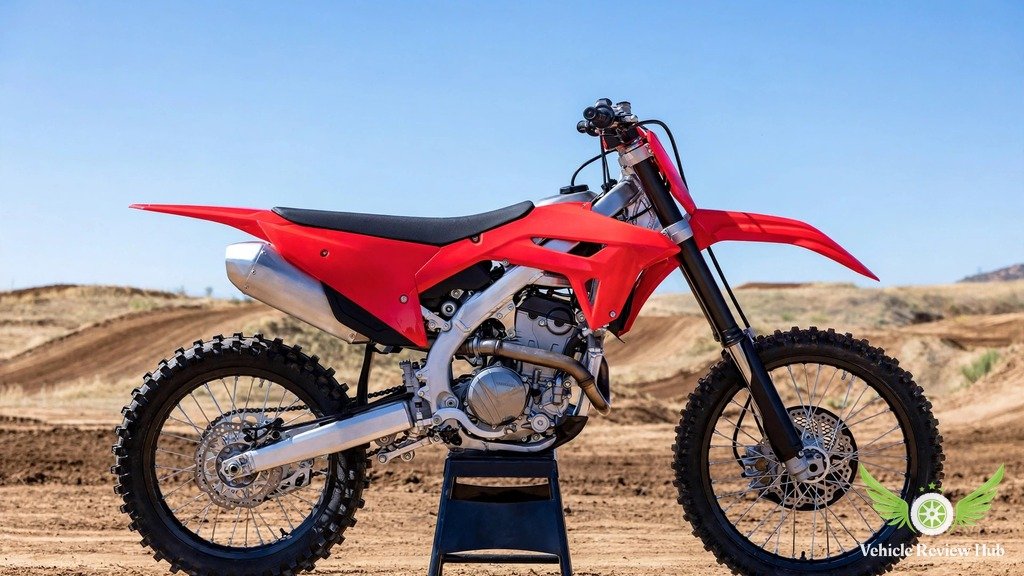
The Honda is the rival this Suzuki RM-Z250 comparison keeps coming back to, because the price gap is $50 — close enough that the decision is about the bikes. The CRF250R is the safe, complete, modern 250F: electric start, a strong top end and dealers with parts on the shelf. The Suzuki answers with a lower list price and better cornering.
Engine, Specs and Performance Side by Side
Both bikes are 249cc liquid-cooled DOHC singles with near-twin spec sheets: Honda 79.0 × 50.9 mm at 13.9:1, Suzuki 77.0 × 53.6 mm at 13.75:1. On the dyno they split. Pro Circuit’s 2025 table puts the Honda at 41.51 hp at 12,010 rpm and 19.92 lb-ft at 9,530 rpm, against the Suzuki’s 40.04 hp at 11,830 rpm and 20.05 lb-ft at 9,190 rpm — measured with the free RM Army T-6 exhaust fitted, so the stock Suzuki is the 2023 run’s 39.22 hp at 12,440 rpm and 18.86 lb-ft at 9,140 rpm. The Honda wins on peak power by about 2.3 hp over the stock Suzuki; the Suzuki’s T-6 figure edges the Honda on torque, though the stock Suzuki’s 18.86 lb-ft trails it, and the Suzuki’s torque peak arrives 340 rpm lower. Dirt Rider’s own dyno agrees: 37.1 hp for the Honda, 36.3 hp for the Suzuki. No top speed or MPG figure exists for either bike, so the power argument in this Suzuki RM-Z250 comparison is a dyno argument: the Honda is stronger at the top, the Suzuki at the bottom.
Price, Equipment and Which Suits Which Rider
Delivered, the Honda is $9,199 against the Suzuki’s $9,149 — $50, the price of a tank of fuel and an oil change. What the $50 buys is the electric start, a battery, and a bike developed every year while the Suzuki sat unchanged from 2019. The Suzuki’s counter is the cornering: testers call it the best-cornering 250F in the class once the stock 5.0 N/mm fork springs are swapped for 4.7–4.8 N/mm springs or the fork oil height is dropped 30 mm. A rider who values a button start and a bike that needs nothing on day one should take the Honda; a rider who corners hard and does their own suspension work should take the Suzuki and spend the saving on springs. That is the $50 decision this Suzuki RM-Z250 comparison keeps returning to; the full price history is in the Suzuki RM-Z250 review.
Suzuki RM-Z250 vs Yamaha YZ250F
The Yamaha is the benchmark in this Suzuki RM-Z250 comparison, and for 2027 the benchmark moved. The YZ250F is all-new — a new engine with finger-follower valve actuation derived from the YZF-R1 programme, more power and torque across the range, and a rev limit 700 rpm higher. It is also the most expensive Japanese rival here, $625 more delivered than the Suzuki. The question is whether a new-generation Yamaha is $625 better than a Suzuki fresh from its first update since 2019.

Engine, Specs and Performance Side by Side
The Yamaha’s new 250cc engine runs the same 77.0 × 53.6 mm bore and stroke as the Suzuki — a coincidence of geometry. On Pro Circuit’s dyno the Yamaha makes 41.62 hp at 12,880 rpm and 19.49 lb-ft at 10,100 rpm, against the Suzuki’s 40.04 hp with the T-6 exhaust and 20.05 lb-ft. The Yamaha revs higher and makes more peak power; the Suzuki makes more torque, 910 rpm lower. The shootout record in this Suzuki RM-Z250 comparison favours the Yamaha too: the Suzuki finished last in both verified shootouts, seventh of seven in MXA’s 2023 test and eighth of eight in Cycle News’ 2025 test, while the Yamaha has long been the class benchmark. Power and results all point the same way — and so does the price.
Price, Equipment and Which Suits Which Rider
At $9,774 delivered the Yamaha costs $625 more than the Suzuki, and the extra money buys the newest engine in the class, the electric start and a bike needing no suspension fix. The Suzuki’s case in this Suzuki RM-Z250 comparison is narrower here: it is the budget pick and the cornering pick, and it asks the rider to kick-start it and to fix the forks. A racer chasing results should take the Yamaha; a rider on a budget who rides corners more than straights — and who will spend a Saturday on fork springs — gets most of the Yamaha’s fun for $625 less. The Suzuki RM-Z250 performance guide has the full dyno story behind these numbers.
Suzuki RM-Z250 vs Kawasaki KX250
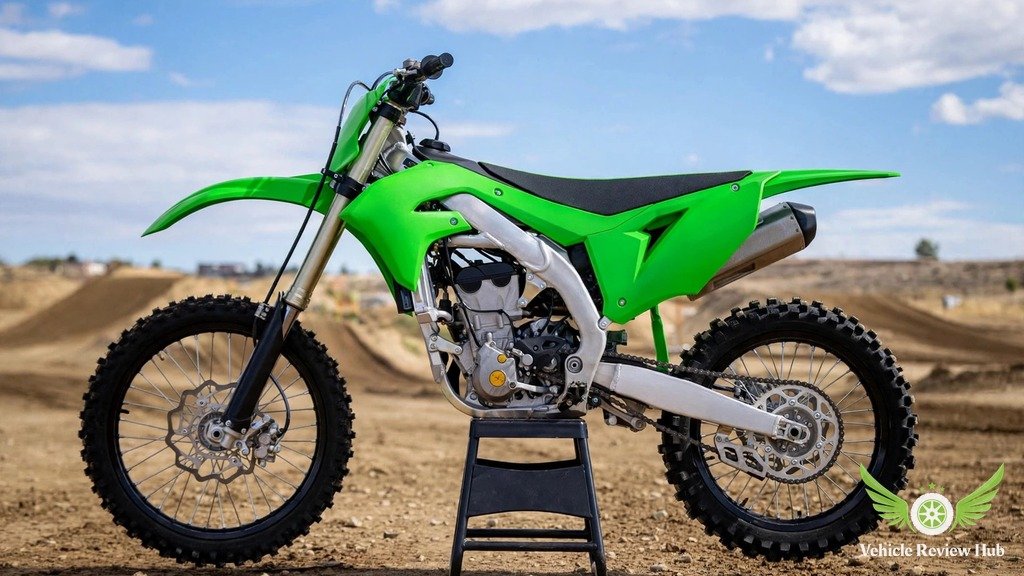
The Kawasaki is the power rival in this Suzuki RM-Z250 comparison, and the dyno table is where the Suzuki’s case is weakest. The KX250 makes 43.49 hp on Pro Circuit’s dyno — 3.45 hp more than the Suzuki’s T-6 figure and 4.27 hp more than the stock Suzuki — for $100 more delivered. If horsepower per dollar is the whole test, the Suzuki loses this one.
Engine, Specs and Performance Side by Side
The KX250’s 249cc engine runs a 78.0 × 52.2 mm bore and stroke with dual injectors and electric start, and on Pro Circuit’s 2025 table it makes 43.49 hp at 12,470 rpm with 20.72 lb-ft at 9,240 rpm — the strongest Japanese 250F, third overall behind the KTM and Husqvarna. Against the Suzuki’s 40.04 hp with the T-6 exhaust and 20.05 lb-ft, the Kawasaki is ahead on both measures; against the stock Suzuki’s 39.22 hp and 18.86 lb-ft the gap widens to 4.27 hp and 1.86 lb-ft. The Suzuki’s only answer is the cornering: MXA’s verdict in this Suzuki RM-Z250 comparison is that once the forks are fixed, the Suzuki is the best-cornering bike in the class.
Price, Equipment and Which Suits Which Rider
At $9,249 delivered the Kawasaki is $100 more than the Suzuki and $50 more than the Honda — mid-pack on price, top of the pack on power. The $100 buys 4.27 hp over the stock Suzuki, an electric start and a battery. The Suzuki’s $100 saving buys the best cornering in the class and the lowest list price, at the cost of a kick start and a fork-spring swap. A rider who rides horsepower — big jumps, deep sand, long straights — should take the Kawasaki; a rider who rides corners should take the Suzuki and spend the $100 on springs, the cheapest win in this Suzuki RM-Z250 comparison.
Suzuki RM-Z250 Price and Value Compared
Price is where this Suzuki RM-Z250 comparison starts and where the Suzuki wins — on list price. The Suzuki is the cheapest 250F in the class at $8,499. The fine print: destination charges differ and dealer discounts of $1,000 to $2,000 off list are common.

| Bike | MSRP | Destination | Delivered | Gap vs RM-Z250 |
|---|---|---|---|---|
| Suzuki RM-Z250 | $8,499 | $650 | $9,149 | — |
| Honda CRF250R | $8,599 | $600 | $9,199 | +$50 |
| Kawasaki KX250 | $8,599 | $650 | $9,249 | +$100 |
| Yamaha YZ250F | $9,099 | $675* | $9,774 | +$625 |
| KTM 250 SX-F | $10,699 | Not verified | — | +$2,200 (MSRP) |
| Husqvarna FC 250 | $10,799 | $690 | $11,489 | +$2,340 |
* Yamaha freight is a dealer-listing figure — Yamaha USA does not publish destination. KTM destination is unverified, so no delivered KTM price is printed in this Suzuki RM-Z250 comparison. All prices are 2027 US figures; the Suzuki’s $8,499 MSRP is confirmed on Suzuki USA’s 2027 page.
Honda Lands Just $50 Away All-In
The $50 gap is the headline of this Suzuki RM-Z250 comparison. The Suzuki’s MSRP is $100 lower than the Honda’s, but its destination charge is $50 higher — $650 against $600 — so half the advantage disappears in freight. What is left is $50, and dealer discounting can erase even that — MXA’s 2026 test notes dealers commonly lop $1,000 to $2,000 off the Suzuki’s list price. A buyer who visits both dealers on the same Saturday may find the Honda cheaper out the door. The honest way to read the $50 in this Suzuki RM-Z250 comparison is as a tie: the two bikes cost the same money in the real world, and the choice is between a kick starter and a button, between cornering and top-end power, and between fork work and no fork work.
Running Costs and Resale Value Compared
Running costs tilt the Suzuki RM-Z250 comparison toward the Suzuki — and then away again. The Suzuki’s service schedule is the most demanding in this Suzuki RM-Z250 comparison: oil every 6 hours, a piston and ring every 12 hours, fork oil every 6 hours and the air filter cleaned after every ride, all in engine hours because the bike has no odometer. No dealer service-labour price list was found for the 12-hour piston job, so this guide prints no service price — get the quote from a dealer first. The rivals are modern 250Fs with the same piston-and-valve reality; the Suzuki is not uniquely expensive to run, just uniquely honest about it in its manual. Resale is the Suzuki’s weak spot: MXA warns it is hard to get good money for a used RM-Z250 when dealerships already mark new ones down below list price, and 1000PS averages put a 2019 bike at $4,300 to $4,500 and a 2023 at $5,800 to $6,000. A used Suzuki with unknown hours is often a worse buy than a discounted new one — the hour-based schedule behind that warning is in the Suzuki RM-Z250 reliability guide.
Suzuki RM-Z250 Comparison Verdict and US Alternatives
The verdict of this Suzuki RM-Z250 comparison is not a shootout win — the Suzuki has never won one — it is a value judgement. The Suzuki is the cheapest bike, the best-cornering bike once the forks are fixed, and the only bike that still makes the rider kick it. Whether that is the right bike depends on what the rider values most.

Every Rival Has Electric Start
The starting gap is the one difference in this Suzuki RM-Z250 comparison that no setup change can fix. Every rival has electric start and a battery; the Suzuki has a kick lever, an automatic decompressor and no battery. The consequence is practical: a stall mid-moto costs the Suzuki rider the seconds it takes to kick the bike back to life while the rest of the class pushes a button — the only 250F in the class where a stall can cost a position. The missing battery has a second cost: the MX-Tuner 4.0 app, included in the Suzuki’s price, needs a separately bought battery and cable to power the bike. S-HAC launch control is no substitute for traction control — Suzuki’s own brochure says it does not measure rear tyre spin. Riders coming from any modern 250F should try kicking a hot 250F in boots first. The DR-Z400S review shows the other end of Suzuki’s own range — a single with an electric start and a licence plate.
KTM and Husqvarna Premium Alternatives
The Austrian pair sit above this Suzuki RM-Z250 comparison as the price ceiling, not as rivals. The KTM 250 SX-F is $10,699 before destination — $2,200 more than the Suzuki on MSRP alone, destination unverified, so no delivered price is printed here — and the Husqvarna FC 250 is $11,489 delivered, $2,340 more than the Suzuki. What the money buys is power: on Pro Circuit’s dyno the Husqvarna makes 45.21 hp and the KTM 45.06 hp, against the Suzuki’s 40.04 hp with the T-6 exhaust and 39.22 hp stock — roughly 5 to 6 hp. Both Austrians have electric start and lead the class on power. For a privateer on a budget the gap is hard to justify: the Suzuki plus fork springs and a spare piston kit still costs thousands less. For a racer chasing the last horsepower, the Suzuki was never the answer — the answer is orange or white, at $2,200 more. The closed-course-only DR-Z400E review is the closest Suzuki analogue.
Suzuki RM-Z250 Comparison: Frequently Asked Questions
Direct answers to the questions US buyers ask in this Suzuki RM-Z250 comparison.
Which is cheaper, the RM-Z250 or the CRF250R?
In this Suzuki RM-Z250 comparison the Suzuki wins on price, by $50 delivered: $9,149 against the Honda’s $9,199. The list-price gap is $100, but the Suzuki’s $650 destination charge is $50 more than the Honda’s $600 — and dealer discounts can flip the result either way.
Is the RM-Z250 slower than the YZ250F?
Yes, on peak power in this Suzuki RM-Z250 comparison. The stock Suzuki makes 39.22 hp on Pro Circuit’s dyno against the Yamaha’s 41.62 hp, and the Yamaha’s 2027 engine is all-new with a rev limit 700 rpm higher. The Suzuki answers with more torque lower down — 20.05 lb-ft at 9,190 rpm with the T-6 exhaust, against 19.49 lb-ft at 10,100 rpm.
Does the RM-Z250 have electric start?
No. The RM-Z250 is kick-start only on every model year, with no battery and no electric-start button — the only 250F in the class without it. Every rival in this Suzuki RM-Z250 comparison starts with a button.
Which 250F is best for a beginner?
The Suzuki has a strong case in this Suzuki RM-Z250 comparison: the lowest price, the best cornering once the forks are fixed, and a forgiving low-to-mid powerband that MXA calls a good starting point for a novice rider. The catches are the kick start and the stock 5.0 N/mm fork springs, too stiff for any skill level until changed.
Is the RM-Z250 good for vet riders?
Yes. Vet riders value the low price, the cornering and the simple cable clutch, and they rarely chase the last horsepower. The cost is the hour-based service schedule — oil every 6 hours, a piston and ring every 12 hours — the price of owning the cheapest bike in this Suzuki RM-Z250 comparison.
Which 250F corners best?
The Suzuki, once the forks are fixed — the cornering pick of this Suzuki RM-Z250 comparison. MXA’s verdict across its 2020, 2022 and 2026 tests is that the RM-Z250 is the best-cornering bike in the class after the too-stiff 5.0 N/mm fork springs are swapped for 4.7–4.8 N/mm springs or the oil height is lowered 30 mm.
How much horsepower does the RM-Z250 make compared with its rivals?
On Pro Circuit’s dyno the stock Suzuki makes 39.22 hp, against 41.51 hp for the Honda, 41.62 hp for the Yamaha and 43.49 hp for the Kawasaki; the KTM and Husqvarna make 45.06 and 45.21 hp. On Dirt Rider’s dyno the Suzuki makes 36.3 hp. Those are the numbers behind this Suzuki RM-Z250 comparison — never compare across dynos without naming the dyno.
Is the RM-Z250 reliable compared with its rivals?
On the evidence this Suzuki RM-Z250 comparison could verify, yes. MXA has run 50-plus hours a year on its RM-Z250 test bikes since 2019 with no serious issues, and calls the engine a solid engine with a long lifespan. Clutch slip is the one documented common problem, and the NHTSA recalls database returns zero recall records for the RM-Z250. The caveat: no owner survey exists — the record is one magazine’s test fleet.
Should I buy a used RM-Z250 or a discounted new one?
Often the discounted new one. Dealer discounts of $1,000 to $2,000 off the $8,499 list are common, while 1000PS averages put a 2019 bike at $4,300 to $4,500 and a 2023 at $5,800 to $6,000. A used bike with unknown hours is a worse buy — check the hours on the run-time indicator light, the piston history and the air filter before paying. The running-costs section of this Suzuki RM-Z250 comparison explains why.
Is the KTM 250 SX-F worth $2,200 more than the RM-Z250?
For a racer chasing power, yes: the KTM makes 45.06 hp against the Suzuki’s 39.22 hp stock, and it has electric start. For a privateer on a budget, no: in this Suzuki RM-Z250 comparison the Suzuki plus fork springs and a spare piston kit still costs thousands less than the KTM.
Does the RM-Z250 have traction control?
No. The Suzuki has S-HAC launch control only, which alters ignition timing for the start and shuts off after six seconds or in fourth gear. Suzuki’s own brochure states it does not measure rear tyre spin, so it is not a wheel-slip traction control — a distinction this Suzuki RM-Z250 comparison keeps explicit.
Which 250F should I buy in 2027?
In this Suzuki RM-Z250 comparison, buy the Suzuki for the lowest price and the best cornering if you can live with a kick starter; the Honda for the closest all-rounder at $50 more; the Kawasaki for the most Japanese horsepower per dollar; the Yamaha for the newest engine and the benchmark bike; the KTM or Husqvarna for the most power in the class at $2,200 more.