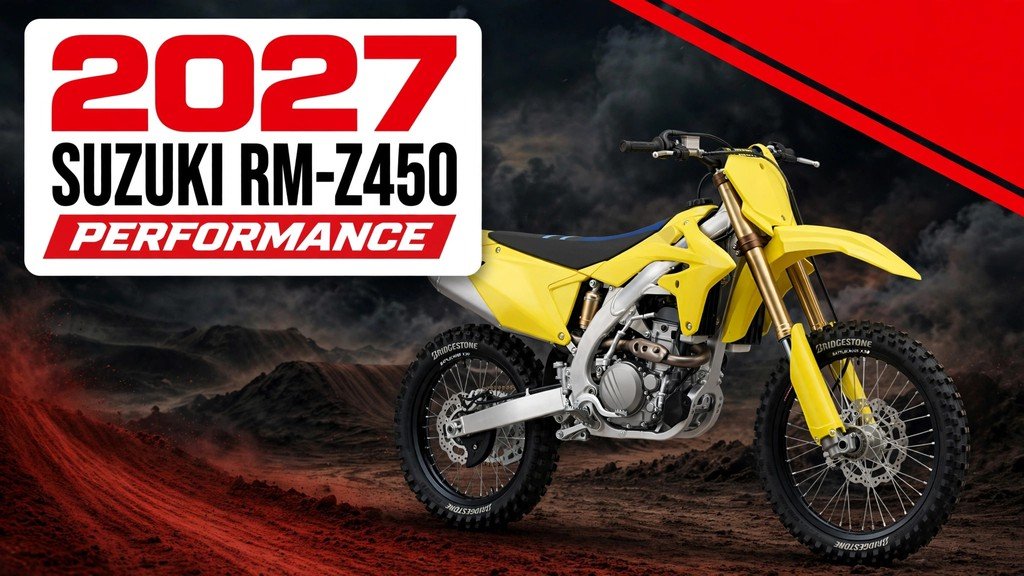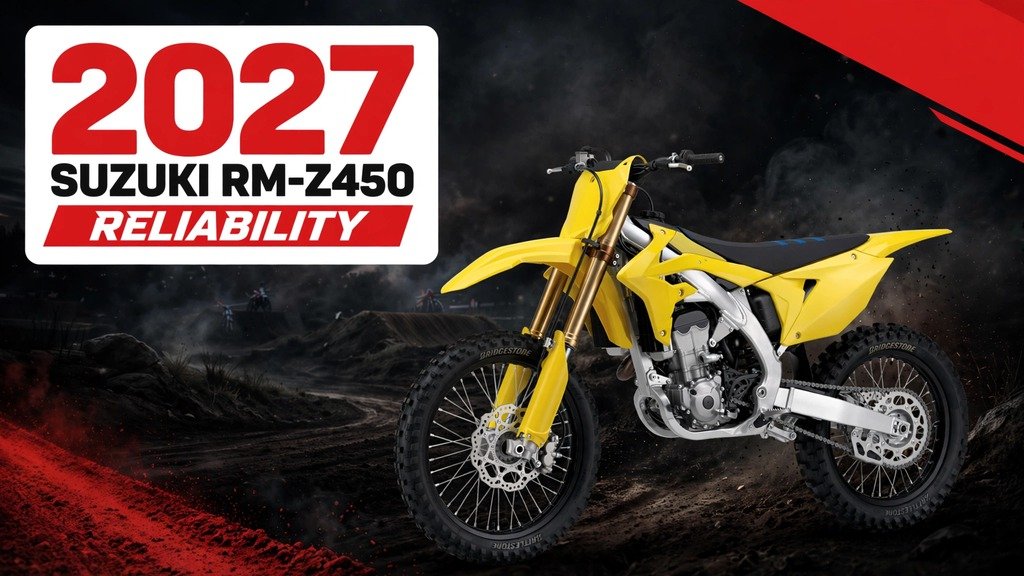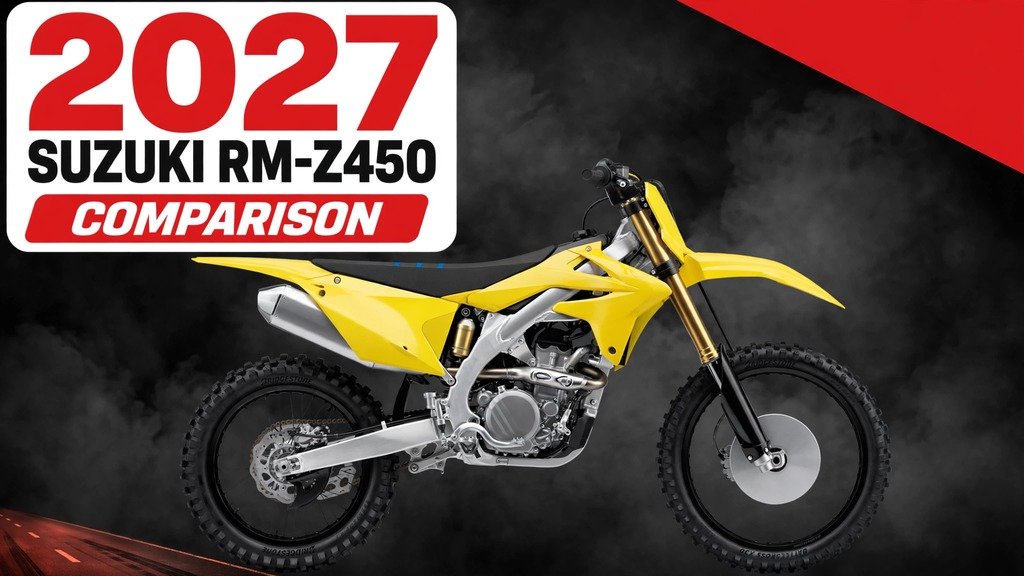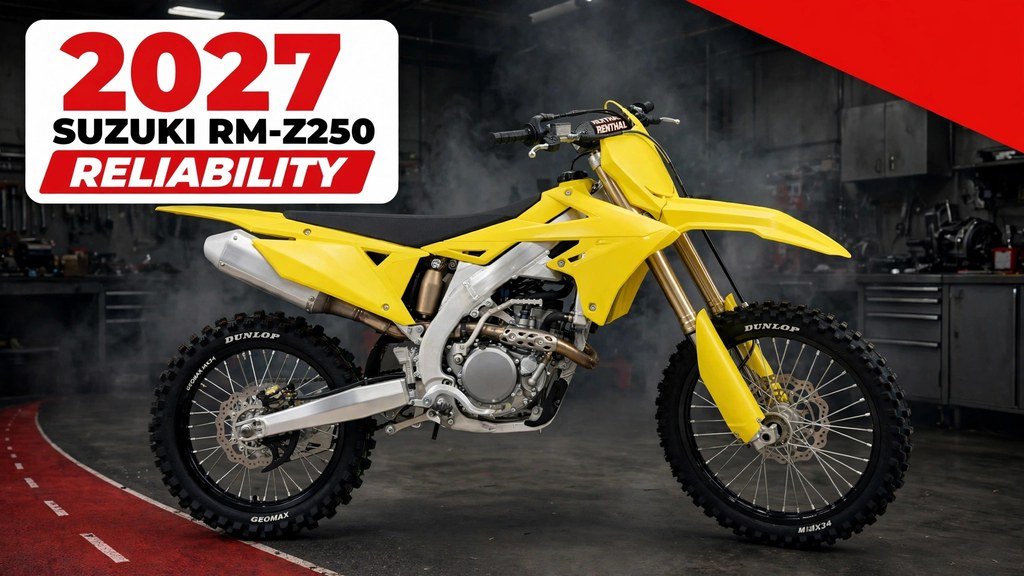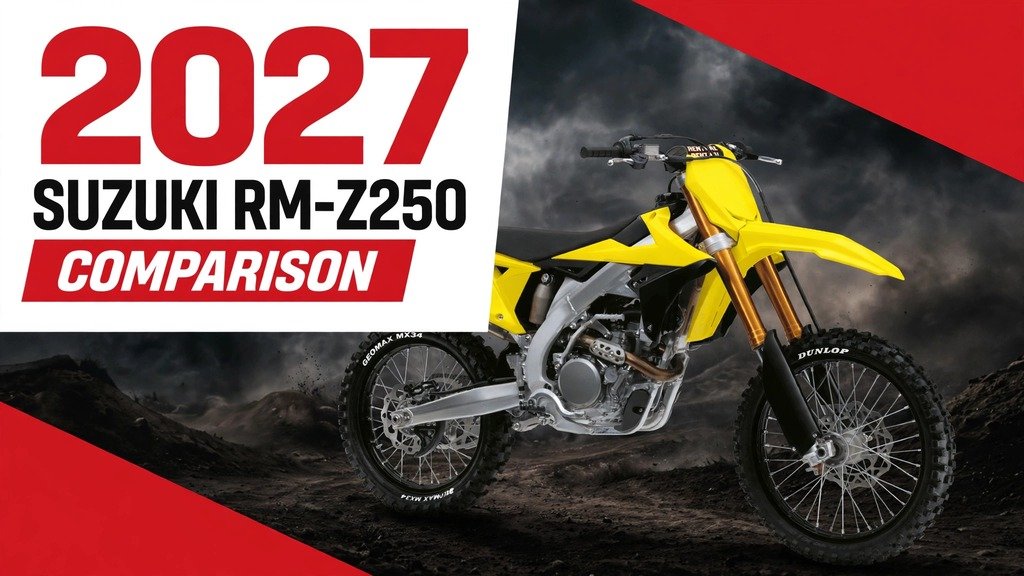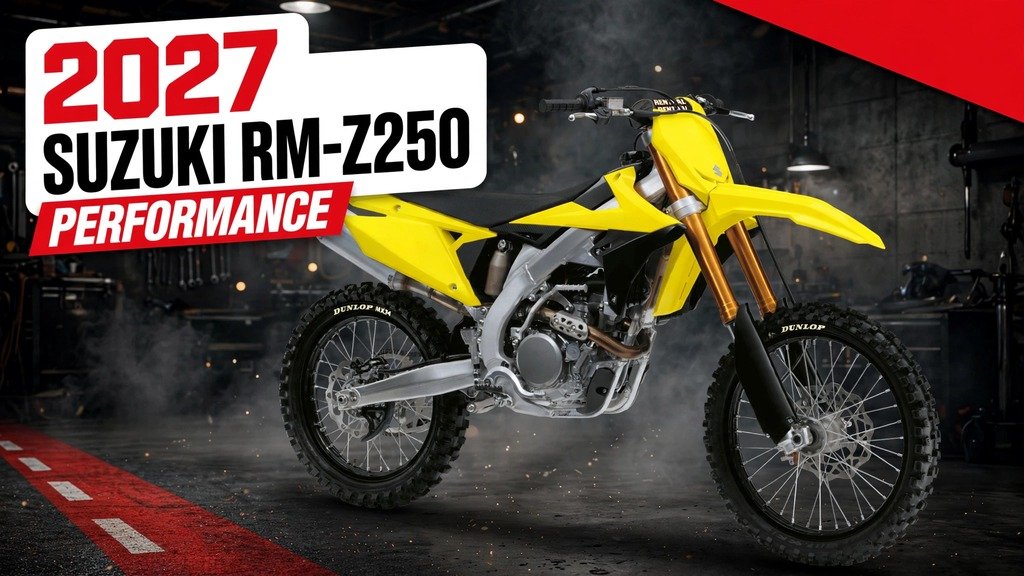
The 2027 Suzuki RM-Z250 is the slowest 250cc four-stroke motocross bike on the dyno and one of the best-cornering bikes in the class — the whole story of this Suzuki RM-Z250 performance guide. Dirt Rider measured 36.3 hp in 2021; Pro Circuit’s dyno read 39.22 hp on a stock 2023 bike, and the 2027 update changes the suspension, silencer and tyres without adding power. There is no top speed and no MPG figure for this bike, because no outlet has ever tested either one, and Suzuki publishes no horsepower figure at all. This Suzuki RM-Z250 performance guide puts every verified dyno run on its own dyno and explains why the numbers differ.
Suzuki RM-Z250 Engine Performance and Power Delivery
The engine is a 249cc liquid-cooled four-stroke single (77.0 × 53.6 mm, 13.75:1, dual injectors, five-speed) — the same basic unit since the 2019 redesign — with strong low-to-mid pull, a weak top end, and the lowest peak power in the class. This Suzuki RM-Z250 performance section starts with the only verified dyno runs that exist — every number below comes from a magazine dyno, named with it.
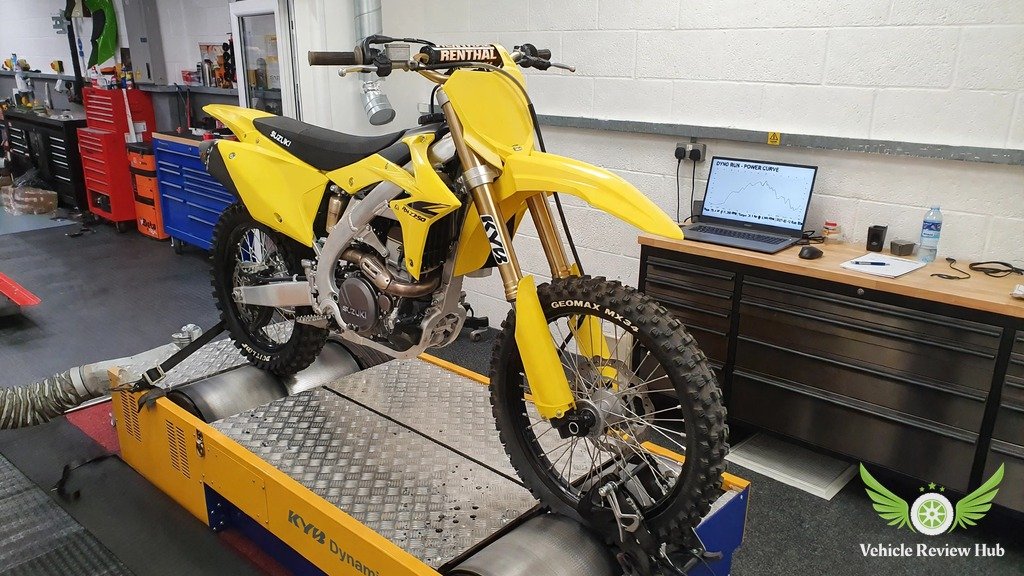
Dirt Rider Dyno: 36 to 37 HP Across Five Years
Dirt Rider’s in-house Dynojet 250i measured 36.3 hp and 18.6 lb-ft on a 2021 RM-Z250. The engine was mechanically unchanged from 2019 through 2026, so 36 to 37 hp is the honest band for the whole generation on that dyno — and this Suzuki RM-Z250 performance guide anchors on the verified 2021 run, because only that run was located. Dirt Rider’s own verdict was that the engine “runs very well” with “a midrange powerband with a very nice throttle response, similar to a YZ250F but with less overall power.” Cycle News put it more bluntly in 2021: a “measly” 36 hp “just doesn’t cut it, especially in a class that is all about horsepower.”
Pro Circuit’s Dyno Reads 3 HP Higher
Pro Circuit’s dyno read 39.22 hp at 12,440 rpm and 18.86 lb-ft at 9,140 rpm on a stock 2023 bike — 2.92 hp higher than Dirt Rider’s 36.3 hp, on a different dyno on a different day. Never mix the two dynos in one sentence without naming the dyno — this Suzuki RM-Z250 performance guide keeps every figure with its dyno. Motocross Action’s own race tests on the same Pro Circuit dyno read 39.52 hp in 2025 and “a hair under 40 horsepower” in 2026, both on stock bikes. Motocross Action’s 2023 shootout prints 39.33 hp in its summary line and 39.22 hp in its detailed sentence — this guide uses 39.22 hp, the detailed figure. The one figure that must never be quoted as stock is the 40.04 hp from Dirt Bike’s 2025 test: that run was made with the free RM Army Pro Circuit T-6 exhaust fitted, so it is an exhaust-equipped figure, not a stock one.
| Bike | Peak hp @ rpm | Peak torque @ rpm |
|---|---|---|
| Husqvarna FC250 | 45.21 @ 13,330 | 21.03 @ 9,230 |
| KTM 250 SX-F | 45.06 @ 13,470 | 21.05 @ 9,210 |
| GasGas MC250F | 44.81 @ 13,160 | 21.45 @ 9,280 |
| Kawasaki KX250 | 43.49 @ 12,470 | 20.72 @ 9,240 |
| Triumph TF250X | 42.94 @ 13,340 | 20.36 @ 9,160 |
| Yamaha YZ250F | 41.62 @ 12,880 | 19.49 @ 10,100 |
| Honda CRF250R | 41.51 @ 12,010 | 19.92 @ 9,530 |
| Suzuki RM-Z250 (with T-6 exhaust) | 40.04 @ 11,830 | 20.05 @ 9,190 |
The figures in this Suzuki RM-Z250 performance table are Dirt Bike’s 2025 Pro Circuit dyno runs, all on the same dyno on the same day. The Suzuki is last on peak horsepower at 40.04 hp with the T-6 exhaust fitted — and sixth on torque at 20.05 lb-ft, ahead of only the Honda and the Yamaha. The Suzuki’s torque peak arrives at 9,190 rpm, the second-lowest in the table after the Triumph’s 9,160 rpm — the low-to-mid character testers keep describing.
Suzuki RM-Z250 Top Speed and Acceleration
No one has ever measured this bike’s top speed or its fuel economy. That is not a gap in this Suzuki RM-Z250 performance guide — it is the honest state of the record for a closed-course motocross bike.

No Top-Speed Testing Exists for Motocross Bikes
Motocross bikes are not top-speed tested. The RM-Z250 runs knobby Dunlop GEOMAX MX34 tyres on 21-inch front and 19-inch rear wheels, close-ratio motocross gearing, a 6.3-litre tank and no speedometer — there is nothing to read a top speed from and no reason to measure one on a closed course. No GPS-timed top speed, no magazine-measured top speed and no manufacturer claim exists for any RM-Z250 year, and this Suzuki RM-Z250 performance guide prints none. The same goes for acceleration: no instrumented 0–60 or quarter-mile test exists for the RM-Z250, so there is no launch time to quote. What testers do say is that the bike is neck-and-neck with the YZ250F until 6,500 rpm before the Yamaha pulls away in the midrange — a rolling-race impression, not a timed figure.
Any MPG Figure Online Is Fabricated
If you find an MPG figure for the RM-Z250 online, it was made up or estimated. Suzuki publishes no fuel-economy figure, no outlet has measured one, and there is no WMTC or EPA rating for a closed-course motocross bike. This Suzuki RM-Z250 performance guide says so plainly rather than printing a plausible-looking number: a fabricated MPG figure would be worse than no figure at all. The same caution applies to the aggregator power figures floating around online — 1000PS’s 42 hp and MotorcycleDB’s 43 hp are second-hand estimates, not test results, and neither belongs in a performance guide.
Suzuki RM-Z250 Mileage and Fuel Economy
Fuel economy on an RM-Z250 is measured in hours, not miles — the bike has no odometer. This Suzuki RM-Z250 performance section covers what the tank holds and why a miles-per-gallon number cannot exist for this bike.

Fuel Use Is Measured in Hours, Not Miles
The owner’s manual schedules everything by engine hours: oil every 6 hours, the piston and ring every 12 hours, the air filter cleaned after every ride. The tank holds 6.3 litres (1.7 US gallons) and the bike has no odometer — only an engine run-time indicator light that flashes 0.2 seconds per hour of running time. This Suzuki RM-Z250 performance guide does not convert the tank into a miles-per-tank figure, because the conversion would need a distance the bike never records. The contrast with Suzuki’s street-legal DR-Z400S is instructive: that bike has an odometer, lights, mirrors and a kickstand, so its fuel use can be measured in miles — the RM-Z250 has none of those things.
Suzuki Publishes No MPG Figure
Suzuki USA publishes no MPG, no fuel-consumption figure and no range figure for the RM-Z250, and no magazine has published one either. The owner’s manual lists the fuel grade — premium unleaded, minimum 90 pump octane, maximum 10 percent ethanol — without a consumption figure. Any website printing an MPG number for this bike is estimating, and this Suzuki RM-Z250 performance guide treats every such number as unverified. The honest answer to “what MPG does it get” is that nobody knows, because nobody has measured it.
Suzuki RM-Z250 Real-World Riding Experience
On a track, the RM-Z250 is a bike of two halves: the slowest engine in the class in the best-cornering chassis in the class. This Suzuki RM-Z250 performance section covers the shootout results and the fork problem that hides the chassis.

Shootouts: Seventh of Seven, Eighth of Eight
The video below is Dirt Bike’s 2025 250 motocross shootout film. It covers all eight bikes in the class, including the RM-Z250, and it is the film that goes with the dyno figures in the table above — the dyno numbers themselves come from Dirt Bike’s written dyno wrap, not from the video, and the film does not rank the bikes in the way this guide’s shootout table does.
Motocross Action’s 2023 shootout placed the Suzuki seventh of seven, with the verdict that it is “too slow, too heavy and too stiff” — and “still a good starting point for a Novice rider.” Cycle News’ 2025 shootout placed it eighth of eight: “with virtually no R&D improvements since its last redesign in 2019, the RM-Z falls behind on the track and in the overall results.” This Suzuki RM-Z250 performance guide attributes those two placements only — the MXA 2025 and Dirt Bike 2025 shootout placements were not verified from text, so no placement is claimed for either one.
| Shootout | Bikes | Suzuki placement | Verdict |
|---|---|---|---|
| Motocross Action 2023 | 7 | Seventh of seven | “Too slow, too heavy and too stiff” |
| Cycle News 2025 | 8 | Eighth of eight | “Falls behind on the track” |
The figures in this Suzuki RM-Z250 performance table are the two verified shootout placements. Both come from the shootout articles themselves, not from the videos.
Forks Far Too Stiff From the Factory
The stock 5.0 N/mm fork springs are the same rate the 450s run — the YZ250F uses 4.7 N/mm — and Motocross Action’s verdict is blunt: the stock rate “is too stiff for any skill level.” The forks are KYB coil-spring units, and the stiffness is a setup problem, not a failure: the bike’s best-cornering chassis only shows itself once the forks move. The cheapest fix is lowering the fork oil height by 30 mm in both legs; the proper fix is 4.7 to 4.8 N/mm springs. Motocross Action’s 2026 setup runs 4.7 N/mm fork springs, compression 14 clicks out against 11 stock, rebound 13 clicks out, a 50 N/mm shock spring against the stock 52 N/mm, and 102 mm of sag. This Suzuki RM-Z250 performance guide treats the fork fix as the single most important performance change a buyer can make.
Suzuki RM-Z250 Handling, Braking and Stability
Handling is where the RM-Z250 wins — once the forks are sorted. This Suzuki RM-Z250 performance section covers the cornering the testers keep praising, the brakes, and the pre-ride checks before a moto.
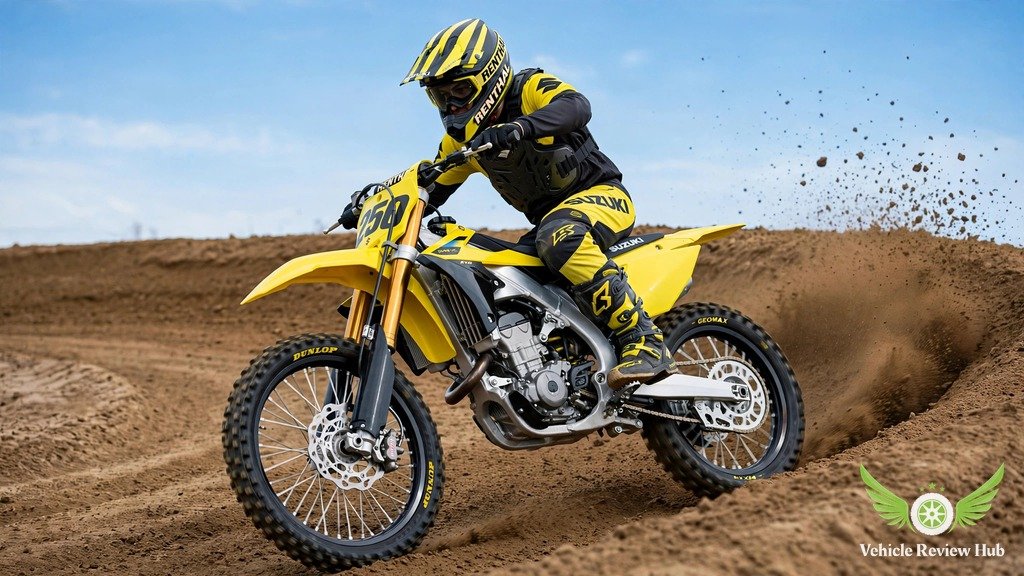
Handling, Braking and Stability on Track
Motocross Action has said it three times: in 2020, “given more practical suspension, the RM-Z250 is the best cornering bike in its class”; in 2022, “the RM-Z250 would be the best-cornering 250 on the track if the forks moved up and down”; and in 2026, “after you fix the forks, the RM-Z250 loves to corner.” Cycle News called it “still a master of the corners” in 2021, and Ultimate Motorcycling’s testers said it feels “as nimble as they come,” with only a slight head shake in braking bumps at high speeds. The bike weighs 233 lb at the curb on Suzuki’s official figure, on a twin-spar aluminium frame with a hydro-formed swingarm. The brakes are a 270 mm wave rotor with a Nissin two-piston caliper up front; no instrumented braking-distance test exists, so this Suzuki RM-Z250 performance guide prints no stopping distance. Stability at speed is the one handling weakness testers name: the head shake in braking bumps that Ultimate Motorcycling noted.
Tire, Brake and Suspension Checks That Matter
This is the pre-ride checklist, not the maintenance schedule — the hour-based service chart belongs to the Suzuki RM-Z250 reliability guide. Before a moto: check the Dunlop GEOMAX MX34 tyre pressures and tread, feel the front brake lever for a firm pull on the Nissin caliper, and work the KYB fork through its travel to confirm the clickers are where you left them. After a moto: clean the air filter, check the chain slack, and retighten the bolts — the manual calls for a bolt check after every race. The suspension settings are the performance lever that matters most: compression and rebound clickers, sag at 102 mm on the MXA 2026 setup, and fork oil height if the forks still feel harsh. This Suzuki RM-Z250 performance guide keeps the checks short because the point is simple — the bike’s handling advantage only exists when the suspension is set up, and a neglected bike gives it away.
Suzuki RM-Z250 Performance Compared With Other 250Fs
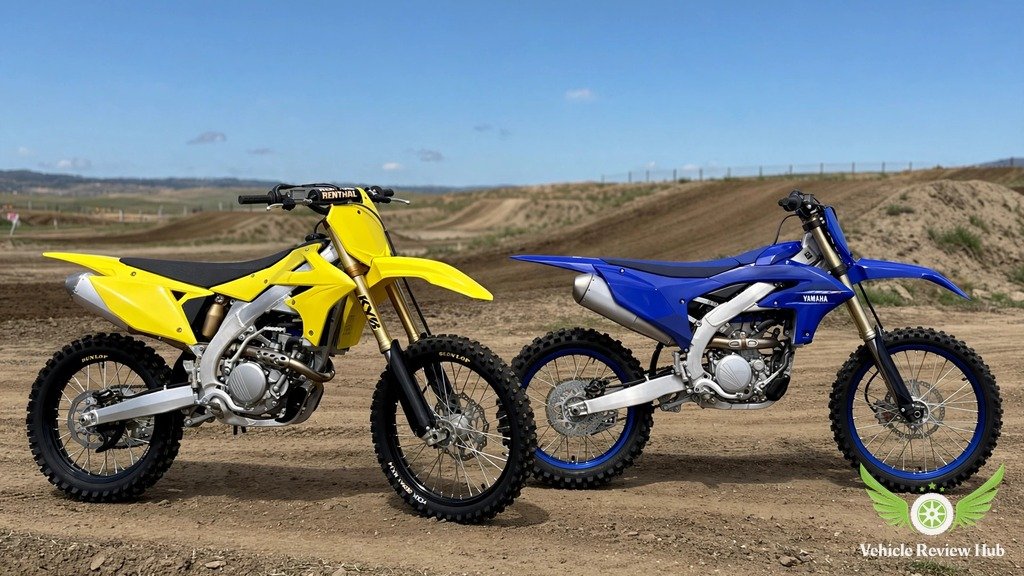
Against the class, the Suzuki is last on power and first on cornering — and cheapest on list price. This Suzuki RM-Z250 performance section puts the Suzuki against the Yamaha YZ250F, the benchmark rival, and asks who should buy it.
| Bike | Dirt Rider dyno (hp) | Pro Circuit dyno (hp) | Gap |
|---|---|---|---|
| Suzuki RM-Z250 | 36.3 | 39.22 | +2.92 hp |
| Honda CRF250R | 37.1 | 41.51 | +4.4 hp |
| Yamaha YZ250F | 38.3 | 41.62 | +3.3 hp |
The figures in this Suzuki RM-Z250 performance table show the same three bikes on two different dynos. The gap is a dyno-to-dyno difference — different dynos, different days, different bikes — not a Suzuki inconsistency.
Suzuki RM-Z250 vs Yamaha YZ250F
The YZ250F is the benchmark the Suzuki is measured against — and for 2027 it is all-new, with a new engine and a rev limit 700 rpm higher, while the Suzuki’s 2027 update is the first change since 2019. On Dirt Rider’s dyno the Yamaha made 38.3 hp against the Suzuki’s 36.3 hp; on Pro Circuit’s dyno it made 41.62 hp against the Suzuki’s 39.22 hp. The Yamaha’s torque peak arrives at 10,100 rpm — the highest in the 2025 table — against the Suzuki’s 9,190 rpm, the second-lowest: the Yamaha is a top-end bike, the Suzuki a low-to-mid bike, and Motocross Action’s 2023 verdict is that the two are “neck-and-neck until 6500 rpm, and then the Yamaha hits the midrange and pulls away.” The Yamaha also has electric start, which the Suzuki has never had. What the Suzuki offers is the price — $8,499 plus $650 destination ($9,149 delivered) against the Yamaha’s $9,774 delivered price — and the cornering. This Suzuki RM-Z250 performance guide calls the Yamaha the faster bike and the Suzuki the better-value one, and the choice depends on whether the buyer races for results or rides for the feel of the corners. The full price and equipment comparison is in the Suzuki RM-Z250 comparison, and the Suzuki RM-Z250 review covers the 2027 update, the price history and the verdict in full.
Is the Suzuki RM-Z250 Suitable for Beginner Riders?
Yes — for a beginner racer, it is the sensible first 250F, and this Suzuki RM-Z250 performance guide says so for the same reasons the shootouts do. Motocross Action’s 2023 shootout called it “a good starting point for a Novice rider”: the low-to-mid power is friendly rather than intimidating, the bike is the cheapest in the class at $9,149 delivered, and the cornering teaches a rider to carry speed rather than chase horsepower. The two things a beginner will notice first are the kick starter — a stall mid-moto costs time, because there is no button to restart the engine — and the stiff stock forks, which need softer springs or lower oil before the bike shows its handling. A beginner who fixes the forks gets the best-cornering 250F in the class for the lowest price in the class; a beginner who races for results will find the five-horsepower gap to the class leaders soon enough.
Suzuki RM-Z250 Performance: Frequently Asked Questions
Direct answers to the questions riders ask about this Suzuki RM-Z250 performance guide.
How much horsepower does the RM-Z250 make?
Suzuki publishes no horsepower figure. The verified magazine dyno runs are Dirt Rider’s 2021 run at 36.3 hp and 18.6 lb-ft, and Pro Circuit’s 2023 run at 39.22 hp at 12,440 rpm and 18.86 lb-ft at 9,140 rpm on a stock bike. A 40.04 hp figure from Dirt Bike’s 2025 test was measured with a Pro Circuit T-6 exhaust fitted, so it is not stock — and this Suzuki RM-Z250 performance guide never presents it as one.
What is the RM-Z250’s top speed?
There is no verified top-speed figure for the RM-Z250 — no GPS-timed run, no magazine test and no manufacturer claim. Motocross bikes are not top-speed tested, and the bike has no speedometer to read one from. Any top-speed number printed online for this bike is an estimate, and this Suzuki RM-Z250 performance guide prints none.
What MPG does the RM-Z250 get?
No MPG figure exists. Suzuki publishes none, no outlet has measured one, and fuel use on this bike is measured in hours, not miles — the tank holds 6.3 litres. Any MPG number online for the RM-Z250 is fabricated — and this Suzuki RM-Z250 performance guide says so rather than printing one.
Is the RM-Z250 the slowest 250F?
On the dyno, yes: this Suzuki RM-Z250 performance guide records 36.3 hp on Dirt Rider’s dyno and 39.22 hp on Pro Circuit’s dyno — both the lowest in the class. On the track the picture is different: the bike is the best-cornering 250F in the class once the forks are fixed, and its low-to-mid power beats the Honda and the Yamaha in that range.
Why do two dynos give different horsepower numbers?
Because they are different dynos on different days. Dirt Rider’s in-house Dynojet read 36.3 hp on a 2021 bike; Pro Circuit’s dyno read 39.22 hp on a stock 2023 bike. The gap is 2.92 hp, and the same pattern holds for the rivals — the CRF250R reads 4.4 hp higher and the YZ250F 3.3 hp higher on Pro Circuit’s dyno. This Suzuki RM-Z250 performance guide keeps every figure with its dyno so the numbers are never mixed.
How does the RM-Z250 compare with the YZ250F on power?
The Yamaha makes more peak power on both dynos: 38.3 hp against 36.3 hp on Dirt Rider’s dyno, and 41.62 hp against 39.22 hp on Pro Circuit’s dyno. The two are neck-and-neck until 6,500 rpm, then the Yamaha pulls away in the midrange. The Suzuki’s torque peak arrives much lower — 9,190 rpm against the Yamaha’s 10,100 rpm — so the Suzuki feels stronger down low and weaker up top, and this Suzuki RM-Z250 performance guide keeps the two dynos separate so the comparison stays honest.
Does the RM-Z250 have electric start?
No. It is the only 250cc four-stroke motocross bike sold in the USA without electric start, and it has never had one. It starts with a primary kickstarter and an automatic decompressor, and there is no battery. A stall mid-moto costs time because there is no button to restart the engine — the most visible performance handicap on the bike.
How fast does the RM-Z250 accelerate?
There is no instrumented acceleration test for the RM-Z250 — no 0–60 and no quarter-mile time exists. What testers report is the feel: strong low-to-mid pull, neck-and-neck with the YZ250F until 6,500 rpm, then the Yamaha pulls away. This Suzuki RM-Z250 performance guide prints no acceleration figure because none has been measured.
What is the RM-Z250’s torque?
Suzuki publishes no torque figure. Dirt Rider measured 18.6 lb-ft in 2021 and Pro Circuit measured 18.86 lb-ft at 9,140 rpm on a stock 2023 bike. The 20.05 lb-ft figure from Dirt Bike’s 2025 test was measured with a T-6 exhaust fitted, so it is not a stock figure. On the 2025 Pro Circuit table the Suzuki ranks sixth on torque, ahead of only the Honda and the Yamaha. This Suzuki RM-Z250 performance guide uses the stock figures — 18.6 lb-ft and 18.86 lb-ft — as the headline numbers.
What is the 2027 update — does it make the bike faster?
The 2027 update is the first since 2019, but it does not add power: new KYB settings, a multi-layer silencer, MX34 tyres, RK Excel rims, a lighter frame and swingarm, a revised intake cam and gearing, Renthal bars and MX-Tuner 4.0. The engine is the same 249cc single, so the Suzuki RM-Z250 performance figures for 2027 are the same 36.3 hp and 39.22 hp dyno runs — the update improves the chassis and the suspension, not the peak power.
Is the RM-Z250 good for beginners?
Yes, for a beginner racer. Its low-to-mid power is friendly, it is the cheapest 250F in the class at $9,149 delivered, and it is the best-cornering bike in the class once the forks are fixed. The kick starter and the stiff stock forks are the two things a beginner will notice first, and this Suzuki RM-Z250 performance guide covers both fixes in the sections above.
What is the best performance upgrade for the RM-Z250?
Fix the forks first. Softer 4.7 to 4.8 N/mm springs, or lowering the fork oil height by 30 mm in both legs, is the cheapest change and the one that unlocks the chassis. After that, MX-Tuner 4.0 lets a rider change the fuel-injection maps — but the bike has no battery, so a battery and a cable are needed to power it while tuning. Engine work costs far more for far less gain than the fork fix — the honest conclusion of this Suzuki RM-Z250 performance guide.