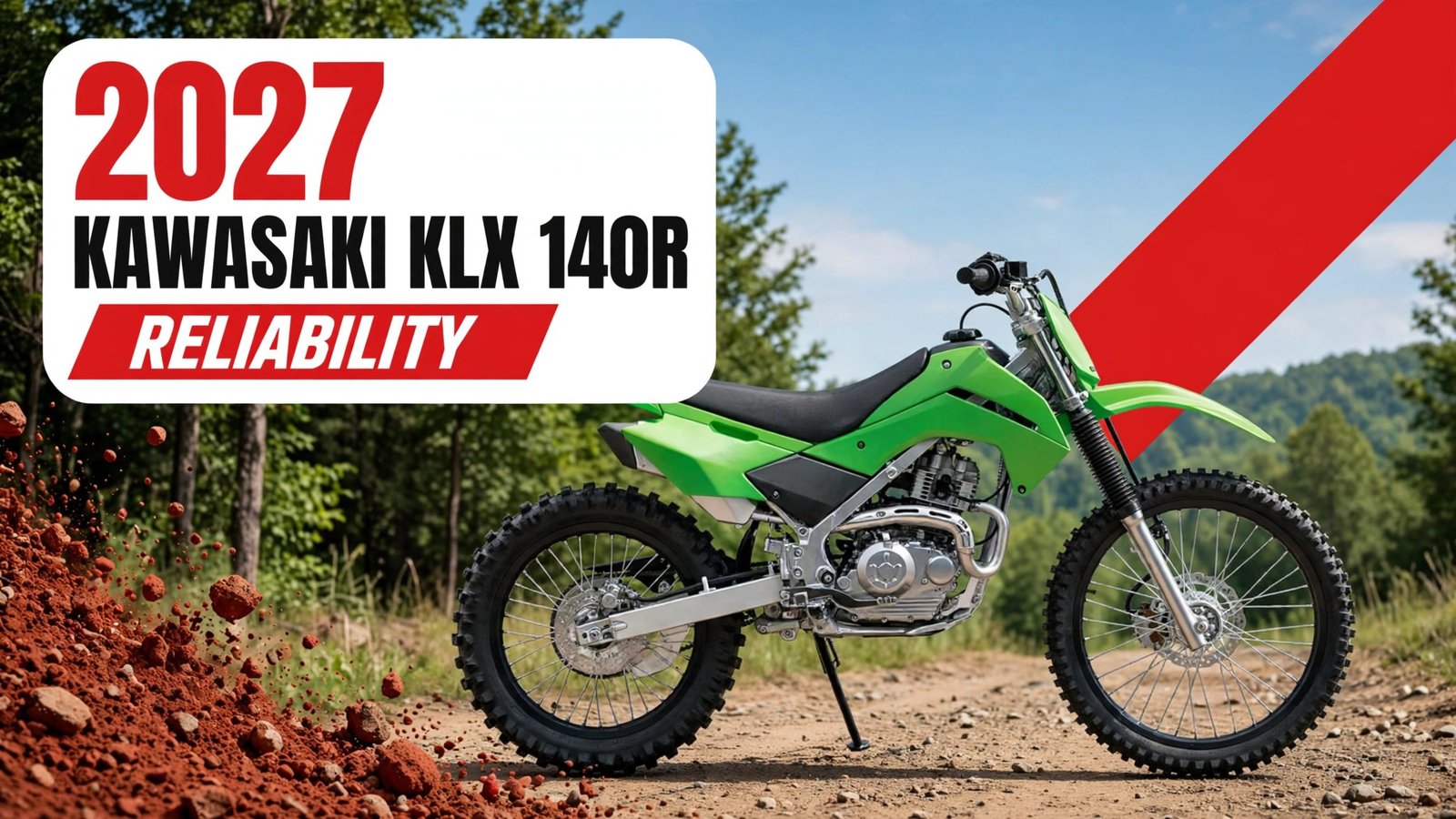
The short answer is yes: the Kawasaki KLX 140R is a reliable trail bike, because so little can go wrong. It is a 144cc air-cooled single with a Keihin PB20 carburettor, a five-speed manual gearbox, electric start only, and discs at both ends — no fuel injection, no electronics to chase. This Kawasaki KLX 140R reliability guide works through what actually wears, what the manual asks for, and the one recall on the record.
The record shows one CPSC recall from 2008, a pilot jet that runs lean from the factory, and small wear items owners fix cheaply. The servicing is counted in hours, not miles, because the bike has no odometer. This Kawasaki KLX 140R reliability guide uses the owner’s manual as the authority throughout, and says plainly where blogs disagree with it.
Kawasaki KLX 140R Reliability Overview
The KLX 140R is a low-performance four-stroke, and that is a reliability feature. It makes its power low down, and it is built from simple parts a home mechanic can reach. Its only published power figure is the Canadian-sheet 11 PS, about 10.8 hp, and the bike carries 205.0 lb on a 30.7-inch seat with 17/14 wheels. This Kawasaki KLX 140R reliability overview explains the hour-based servicing first, because the clock is what owners get wrong.
Servicing Counted in Hours
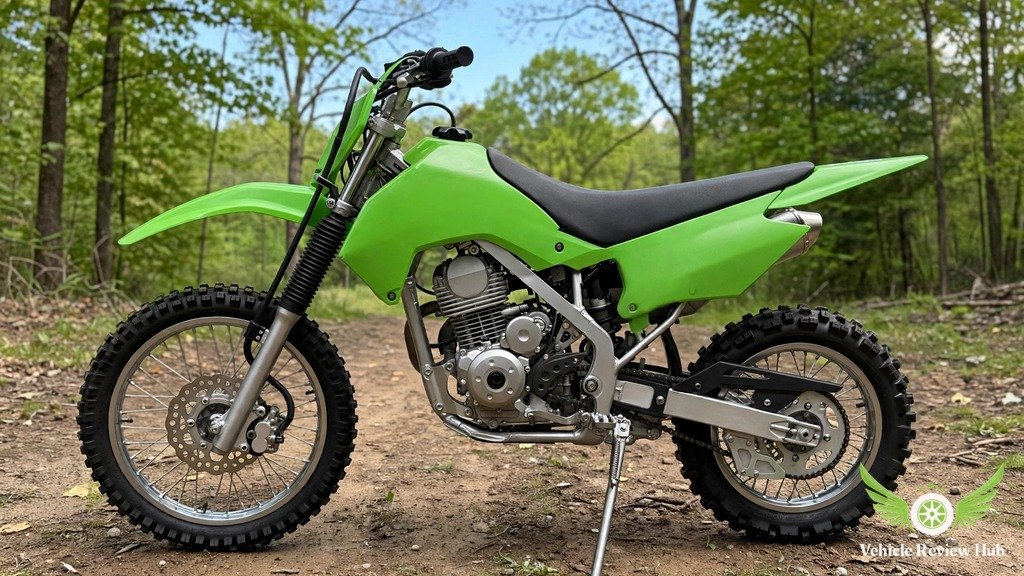
Servicing is counted in hours, not miles. The first service falls at 5 hours or 1 month, then every 50 hours or 6 months, with valve clearances every 100 hours or 12 months. There is no odometer, so any listing that quotes a mileage service interval for this bike is guessing. This Kawasaki KLX 140R reliability guide follows the manual’s hour chart.
Hours are a fairer measure for a trail bike: a bike idling in a training field and a bike running wide open cover the same miles in very different engine hours. A cheap hour meter keeps a rider on schedule; guessing by the calendar does not. The jobs are small: oil and filter, a foam air filter, a chain that needs frequent attention, and a valve check with screw adjusters instead of shims.
How Hours, Storage and Previous Care Affect Reliability
Hours tell the truth, but they are not the whole story. A bike with 40 hours that sat for two winters with old fuel can be harder to live with than a bike with 120 hours that was ridden every weekend and serviced on time. Storage is the quiet factor: fuel goes stale, the carburettor gums up, and a flat battery may not recover. This Kawasaki KLX 140R reliability guide treats a bike’s storage history as seriously as its hour count.
Previous care matters more than age. The 141-hour owner bike needed nothing but routine maintenance across five seasons, while other owners report small rubber parts rotting or cracking early on bikes that lived outside. Buyers should ask for service records and start the bike cold.
Kawasaki KLX 140R Common Problems and Wear Items
The problems on this bike are small and known. The signature item is the carburettor pilot jet, and after that the list is wear parts. This Kawasaki KLX 140R reliability guide lists each one with its fix.
Pilot Jet Is the Signature Item
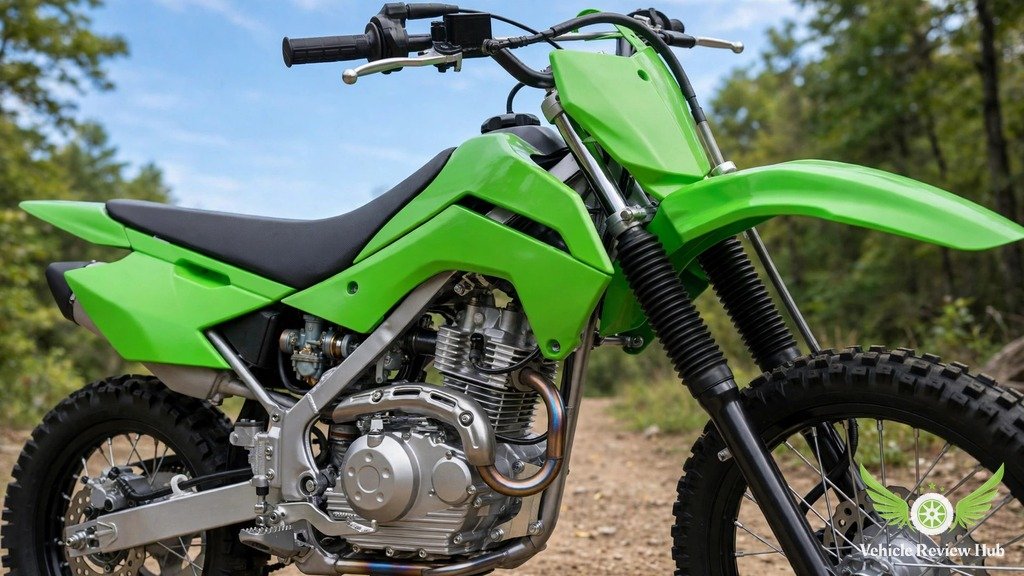
The stock pilot jet is a #38, and the carburettor runs lean from the factory. The clearest record comes from the Road and Trail long-term review of a 2020 KLX140L: from new, the bike stumbled at low engine speed at 1,200 metres of elevation. The dealer worked through pilot jets under warranty — #38, then #42, then #40, then back to #42 — and none of it fully fixed the stumble at elevation. The owner’s settled fix was a #42 pilot jet with the air/fuel screw 2.0 turns out, at 1,200 to 1,500 metres, with the stock main jet. This Kawasaki KLX 140R reliability guide calls the jet the signature item because it is the fault nearly every owner thread mentions, and the fix is a ten-dollar part and an afternoon.
Two cautions belong with the jet. First, the fix is elevation-dependent: a #42 that suits a rider at 1,200 metres may be rich at sea level, so set the jetting for where the bike is ridden. Second, the carburettor is sensitive to old fuel — the Motocross Hideout KLX140 guide recommends fresh, non-oxygenated fuel where possible — and stale fuel makes a bike stumble for the same reason a lean jet does.
The other carburettor story is a fuel leak from the float-bowl gasket at the end of the 2022 season — traced to improper dealer service, where sealant was used where the manual says none and the JIS screws were mismatched and loose. A new gasket fixed it. That is a service-caused defect, not a design defect, and this Kawasaki KLX 140R reliability guide labels it as such.
One Recall: 2008 Frame Welds
There is exactly one recall on the KLX140 record. CPSC Alert #08-548, issued March 4, 2008, covers about 200 units of the 2008 KLX140A8F and KLX140B8F — the standard R and the taller L — because frame welds could be missing or made incorrectly, allowing the frame to crack or break. No injuries were reported. The bikes were sold by Kawasaki dealers in January and February 2008 for about $2,700, made in Thailand, and the remedy was a free inspection and repair at an authorised dealer. This Kawasaki KLX 140R reliability guide prints the number because it is the only one.
The NHTSA recalls database returns zero recalls for the KLX140R — but that zero is not meaningful evidence. NHTSA does not regulate off-road motorcycles, so the CPSC record is the one that matters, and this Kawasaki KLX 140R reliability guide leads with it. The KLX110’s four CPSC recalls (05-524, 10-750, 14-714, 14-731) do not name the 140.
For a buyer, the recall’s age is the point: any 2008 bike still running has either had the inspection or survived eighteen years of use, but a buyer should still confirm the frame inspection with a Kawasaki dealer, using the frame number. The CPSC release lists the affected models and the free-inspection remedy.
| Problem | What happens | What to do |
|---|---|---|
| Lean pilot jet (#38 stock) | Hard starting, stumbling at low speed, very little power at elevation | Fit a #42 pilot jet, air/fuel screw 2.0 turns out, set for local elevation |
| Carburettor float-bowl gasket leak | Fuel leak from the float bowl | New gasket; no sealant where the manual says none |
| Clutch safety switch | Intermittent no-crank with the clutch lever pulled | Remove, clean, and lightly lubricate the switch |
| Lower chain roller wear | More chain noise as the roller wears | Replace the roller before the next season |
| Rubber parts (grommets, boots, drain tube) | Cracking or rotting, sometimes from new | Replace on warranty or at service; store the bike under cover |
| Thin frame paint | Chips and rock-impact marks on the frame and guards | Touch up paint; fit frame guards |
Notes: the problems in this Kawasaki KLX 140R reliability table come from the Road and Trail long-term owner review of a 2020 KLX140L, which ran 141 hours. The engine, transmission, and frame needed nothing beyond the items listed.
Kawasaki KLX 140R Maintenance Schedule and Servicing
The schedule is short, cheap, and hour-based. Oil and filter at every service, valves every 100 hours with screw adjusters, and replacement items on two-, four-, and five-year cycles. This Kawasaki KLX 140R reliability guide prints the manual’s chart in full below.
First Service at 5 Hours
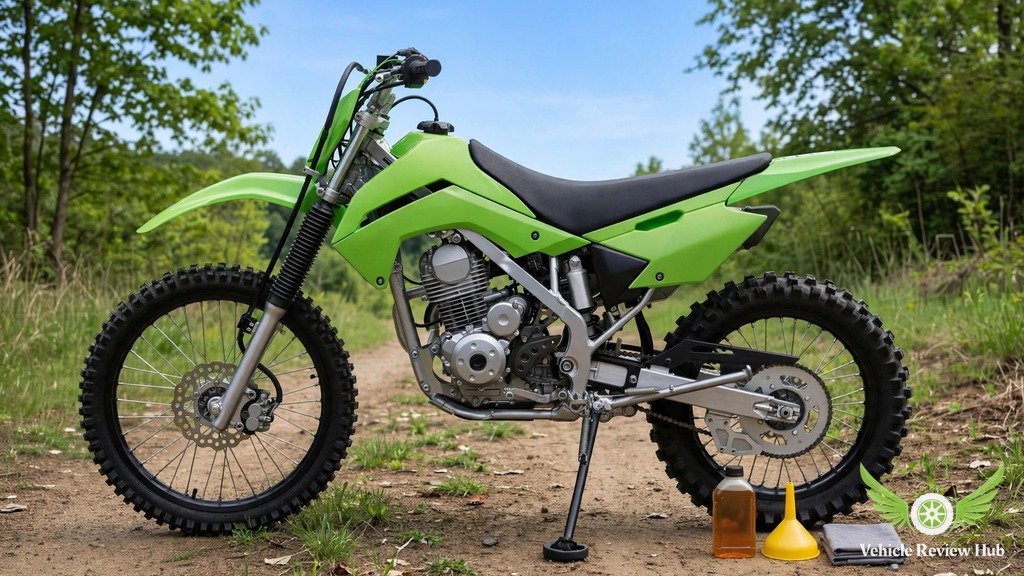
The first service falls at 5 hours or 1 month, and it matters most. It covers an oil and filter change and a valve-clearance check, plus fasteners and the air filter. The first oil change carries out break-in debris, and the first valve check catches intakes that can run slightly tight from new — the long-term owner’s first check found the intakes tight by 0.01 mm. This Kawasaki KLX 140R reliability guide treats a missed first service as the one shortcut worth worrying about on a used bike.
The video below shows an oil change on a 2019 KLX140L — the taller L trim, not the standard R — but the engine is the same 144cc single and the procedure is identical to the R’s. Partzilla walks through drain, filter, and refill.
Oil is SAE 10W-40, API SG through SM, JASO MA, MA1, or MA2. Capacity is 1.13 litres without a filter change, 1.15 litres with one, and 1.30 litres dry. The drain plug torques to 18 N·m (13 ft·lb) and the oil filter cover bolts to 8.8 N·m (78 in·lb). The official 2027 spec-sheet PDF lists the engine’s service figures.
Valves Every 100 Hours, Screw Adjusters
Valve clearances are checked every 100 hours or 12 months, and the adjusters are screws with locknuts — not shims. Cold clearances are 0.04–0.08 mm on the intake and 0.11–0.15 mm on the exhaust. Note the exhaust figure: it is wider than the KLX110’s 0.04–0.08 mm on both sides. This Kawasaki KLX 140R reliability guide prints the 140’s own figures — the long-term owner adjusted the valves three times in 141 hours.
A tight intake at the first check is normal, not a warning sign — that is what the first service is for. What matters is that the check happens on schedule. The valve adjusting screw locknuts torque to 8.8 N·m, and the spark plug — gap 0.6–0.7 mm — is checked at the same service. The factory service manual lists the clearances and torque figures.
| Service item | Interval | Notes |
|---|---|---|
| Engine oil + filter | First 5 h, then every 50 h | SAE 10W-40, 1.15 L with filter |
| Valve clearances | Every 100 h | Screw adjusters; intake 0.04–0.08 mm, exhaust 0.11–0.15 mm |
| Air filter | Inspect 2–3 times a season | Foam; clean and re-oil |
| Spark plug | At valve service | Gap 0.6–0.7 mm |
| Drive chain | Clean, lube, adjust often | Non-O-ring 428×122; slack 35–41 mm |
| Fork oil | Per manual chart | SHOWA SS8GO, 296 mL per leg (R) |
| Brake fluid | Every 2 years | Per owner’s manual |
| Brake hoses | Every 4 years | Per owner’s manual |
| Fuel hose | Every 5 years | Per owner’s manual |
Notes: the intervals in this Kawasaki KLX 140R reliability table come from the owner’s manual and the factory service manual. Oil and filter change at every service — 5 hours, then every 50 hours.
Kawasaki KLX 140R Tires, Brakes and Suspension Maintenance
Tyres, brakes, and suspension are the wear items a rider feels first. The tyres are small and cheap, the brakes are discs at both ends, and the fork wears boots that keep the seals alive. The service manual sets a 154 lb rider weight limit for the standard R, and heavier riders will work the soft stock suspension harder. This Kawasaki KLX 140R reliability guide covers the checks that belong on every service.
Brake Fluid Every 2 Years
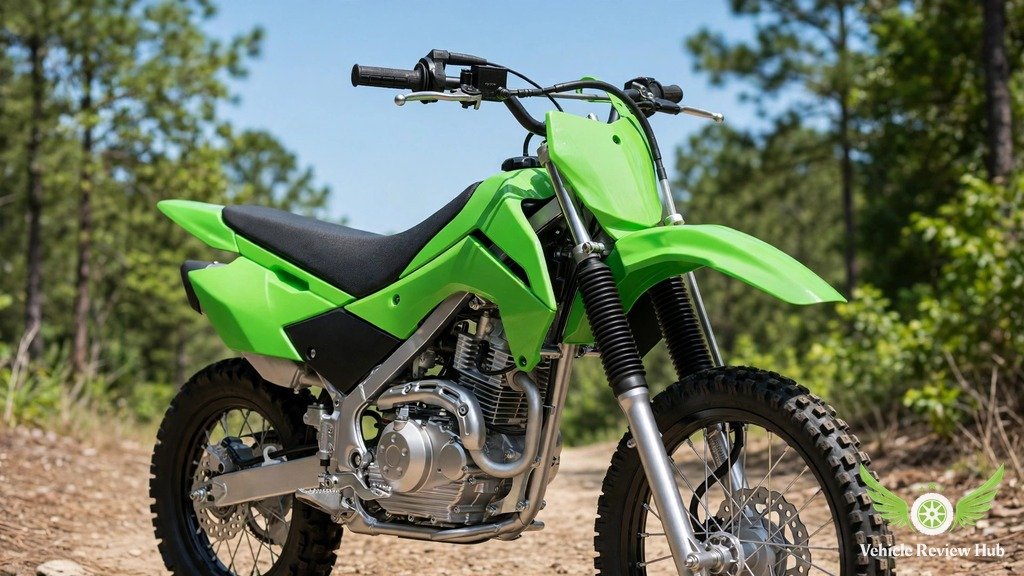
Brake fluid is changed every 2 years, and two manuals agree — the 2018 KLX140 owner’s manual says brake fluid needs changing every 2 years and the fuel hose every 5 years, and the 2019 KLX140L manual says the same, with brake hoses every 4 years and fuel hoses every 5 years. This Kawasaki KLX 140R reliability guide prints the 2-year figure with the owner’s manual as the source.
Fluid is hygroscopic, so the two-year cycle is about water in the fluid, not miles, and the 2018 KLX140 owner’s manual states the intervals.
Tire, Brake and Suspension Checks That Matter
Tyres on the standard R are 70/100-17 front and 90/100-14 rear, and the long-term owner was still on the stock tyres at 141 hours and rated them fine. Check the knobs, the sidewalls, and the pressures before every ride. This Kawasaki KLX 140R reliability guide puts the tyre check first because it is the check owners skip most.
Brakes are discs at both ends — 220 mm front, 186 mm rear — so check pads, fluid, and lever and pedal play. The long-term owner found the brakes a bit grabby and the rear pedal a bit high; the pedal height is adjustable. Suspension checks are the fork seals under their boots, the rear shock’s preload setting, and the chain slack at 35–41 mm measured between the chain and the swingarm at the end of the chain slipper. The R’s rear shock has 5-way preload only and is not rebuildable, so a shock that will not hold preload is a replacement.
Kawasaki KLX 140R Maintenance and Ownership Costs
The costs table below prints intervals and specifications only — no dollar figures, because no verified running-cost figures exist. What costs money is neglect: a gummed carburettor, a chain run dry, or a valve never checked. This Kawasaki KLX 140R reliability guide prices nothing it cannot verify.
Fuel, Routine Servicing, Tires and Replacement Parts
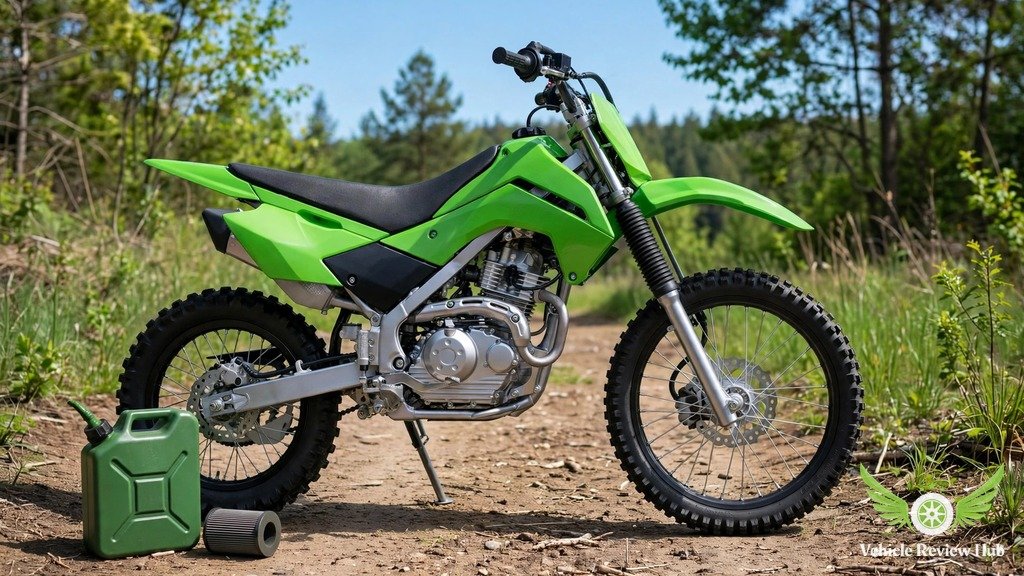
Fuel is the only running cost that repeats, and the tank holds 1.5 gallons. Use fresh, non-oxygenated fuel where possible — stale fuel in the carburettor is the classic way to earn a carburettor clean. Routine servicing is oil and filter every 50 hours, an air filter cleaned each season, and a non-O-ring chain that needs frequent cleaning and adjustment. This Kawasaki KLX 140R reliability guide treats the chain as a consumable: the long-term owner expected to replace the drive chain after 141 hours, and the lower chain roller wears and raises chain noise first.
Tyres and replacement parts are small, cheap, and easy to find. The stock tyres lasted the long-term owner 141 hours of trail riding, brake pads are small jobs, and the rubber parts are the items most likely to need replacing early. The full KLX 140R review covers the purchase price and the verdict in detail.
Blog Intervals Contradict the Manual
Blogs and aggregators give this bike mileage- or calendar-based intervals — one suggests once or twice a year, another quotes 7,000–10,000 miles for synthetic oil. Both are meaningless for an hour-metered trail bike, and this Kawasaki KLX 140R reliability guide sides with the manual: the first service at 5 hours, then oil and filter every 50 hours, valves every 100 hours. A bike that does 50 hours in a season needs two oil changes that year; a bike that does 10 hours needs one. The manual’s hour chart is the authority, and any interval quoted in miles for this bike is invented.
| Consumable | Change interval | Specification |
|---|---|---|
| Engine oil | Every 50 h (first 5 h) | SAE 10W-40, API SG–SM, JASO MA/MA1/MA2; 1.15 L with filter |
| Oil filter | Every service | Replace at every service interval |
| Air filter | Inspect 2–3 times a season | Foam; clean and re-oil |
| Spark plug | At valve service | Gap 0.6–0.7 mm |
| Drive chain | Replace when worn | 428×122; slack 35–41 mm |
| Fork oil | Per manual chart | SHOWA SS8GO, 296 mL per leg (R) |
| Brake fluid | Every 2 years | Per owner’s manual |
| Brake hoses | Every 4 years | Per owner’s manual |
| Fuel hose | Every 5 years | Per owner’s manual |
Notes: the consumables in this Kawasaki KLX 140R reliability table list intervals and specifications only. No dollar figures are printed — no verified running-cost or resale figures exist.
How to Keep a Kawasaki KLX 140R Reliable
Keeping this bike reliable is a matter of doing the small jobs on time and keeping records. The difference between a 141-hour bike with no issues and a 40-hour bike with a gummed carburettor is storage and servicing. This Kawasaki KLX 140R reliability guide closes with the habits that keep the bike going.
Preventive Maintenance, Records and Regular Inspections
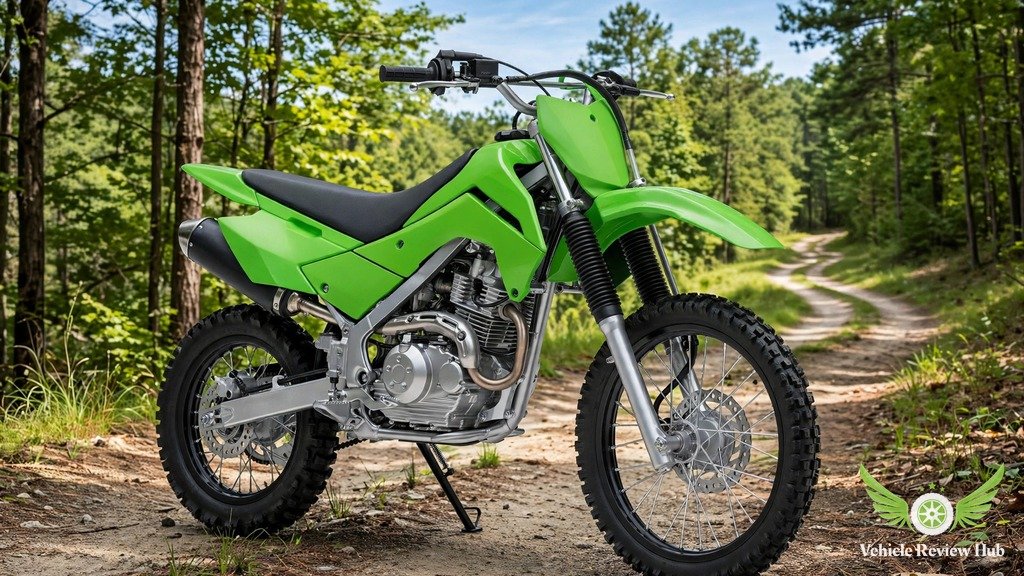
Preventive maintenance is a short list: oil and filter every 50 hours, valves every 100 hours, the air filter cleaned each season, the chain cleaned and adjusted often, and the brake fluid, hoses, and fuel hose on their two-, four-, and five-year cycles. Records matter because the bike has no odometer — a notebook with dates and hours is the only service history. This Kawasaki KLX 140R reliability guide recommends an hour meter, a cheap add-on that makes the schedule automatic.
Regular inspections are the other half: start the bike cold, check the chain slack at 35–41 mm, look at the fork seals and the tyres. The KLX 110R L reliability guide covers the same hour-based routine on the smaller bike in the family, and the habits transfer directly.
141 Hours, Five Seasons, One Owner
The best proof is a single owner story, with the trim named honestly. Road and Trail’s long-term review follows a 2020 KLX140L — the taller L, not the standard R — bought new at the start of the 2020 season. Over 141 hours and five seasons, the bike needed nothing but routine maintenance — oil and filter changes and three valve adjustments. “Other than the points mentioned above, the bike has just required routine maintenance… There have been no other issues.” This Kawasaki KLX 140R reliability guide treats that record as the honest answer to the reliability question: a simple bike, serviced on hours, lasts.
The same review is candid about the bike’s limits. The carburettor is finicky at elevation, the suspension bottoms for heavier riders, the bars are low when standing, and the bike still has enough power for their kid “even after five seasons”. None of those is a reliability failure. The KLX 140R performance guide covers the jetting case and the suspension verdicts in detail.
Kawasaki KLX 140R Reliability: Frequently Asked Questions
These are the questions riders ask most about the KLX 140R. This Kawasaki KLX 140R reliability guide answers each one with the verified figures above.
How reliable is the Kawasaki KLX 140R?
Very reliable. It is a simple low-stress four-stroke, and this Kawasaki KLX 140R reliability guide found one recall from 2008, a lean pilot jet, and small wear items — no pattern of engine or transmission failure.
How often does the Kawasaki KLX 140R need an oil change?
At the first service at 5 hours, then every 50 hours, and this Kawasaki KLX 140R reliability guide notes the oil filter is replaced at every service too.
What are the valve clearances on the Kawasaki KLX 140R?
Intake 0.04–0.08 mm and exhaust 0.11–0.15 mm, checked cold every 100 hours, and this Kawasaki KLX 140R reliability guide notes the adjusters are screws, not shims.
Has the Kawasaki KLX 140R ever been recalled?
Once. CPSC Alert #08-548 from March 2008 covers about 200 bikes for missing or incorrect frame welds, and this Kawasaki KLX 140R reliability guide found no other recall naming the bike.
What is the most common problem with the Kawasaki KLX 140R?
The lean stock pilot jet, a #38. It causes hard starting and stumbling at elevation, and this Kawasaki KLX 140R reliability guide points to the owner’s #42 fix at 2.0 turns out.
Does the Kawasaki KLX 140R have a kick starter?
No. It has push-button electric start only, and this Kawasaki KLX 140R reliability guide warns there is no kick backup if the battery dies.
How often should the brake fluid be changed?
Every 2 years, and this Kawasaki KLX 140R reliability guide cites the owner’s manual — brake hoses every 4 years and fuel hoses every 5 years.
What oil does the Kawasaki KLX 140R take?
SAE 10W-40, API SG through SM, JASO MA, MA1, or MA2, and this Kawasaki KLX 140R reliability guide lists 1.15 litres with a filter change.
What is the chain slack on the Kawasaki KLX 140R?
35–41 mm, measured between the chain and the swingarm at the end of the chain slipper, and this Kawasaki KLX 140R reliability guide warns the alignment marks are imprecise.
How long will a Kawasaki KLX 140R last?
With hour-based servicing it lasts for years: one owner ran 141 hours over five seasons with routine maintenance only, and this Kawasaki KLX 140R reliability guide treats that as the honest answer.
Does the Kawasaki KLX 140R need premium fuel?
No. Fresh, non-oxygenated fuel is what matters, and this Kawasaki KLX 140R reliability guide notes stale fuel is the classic cause of carburettor trouble.
What is included in the first service on a Kawasaki KLX 140R?
An oil and filter change and a valve-clearance check at 5 hours or 1 month, and this Kawasaki KLX 140R reliability guide calls it the most important service in the bike’s life.