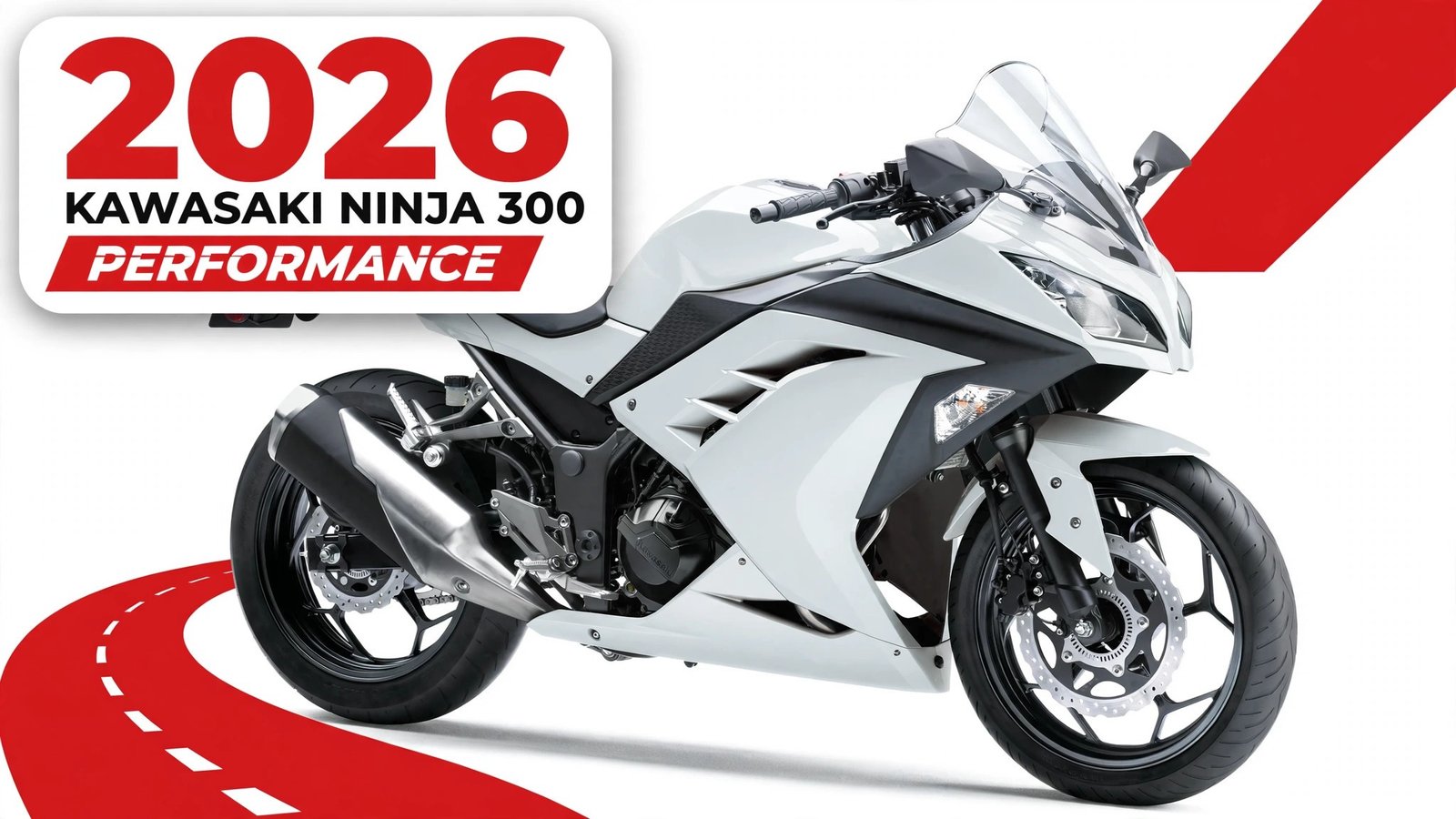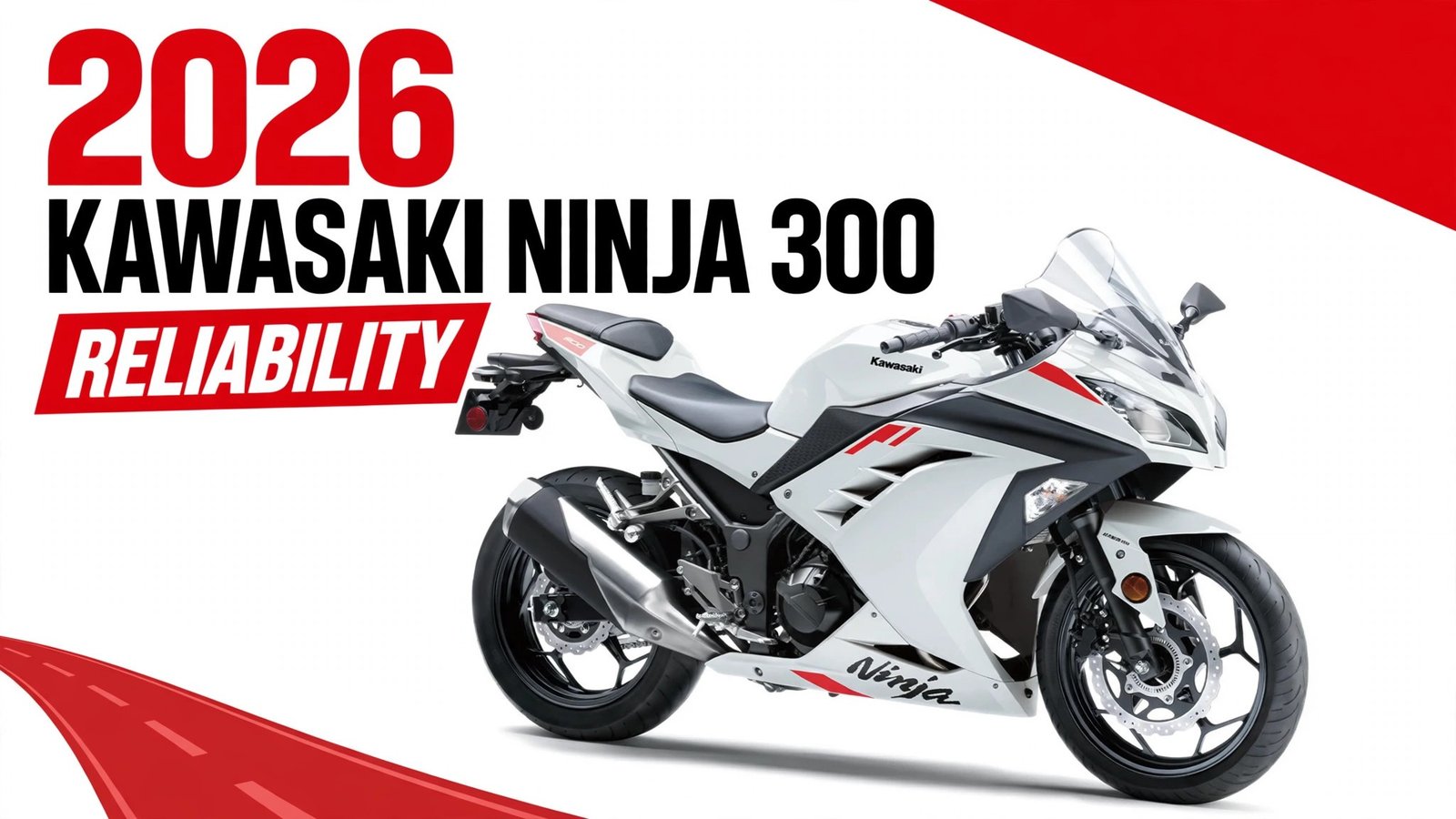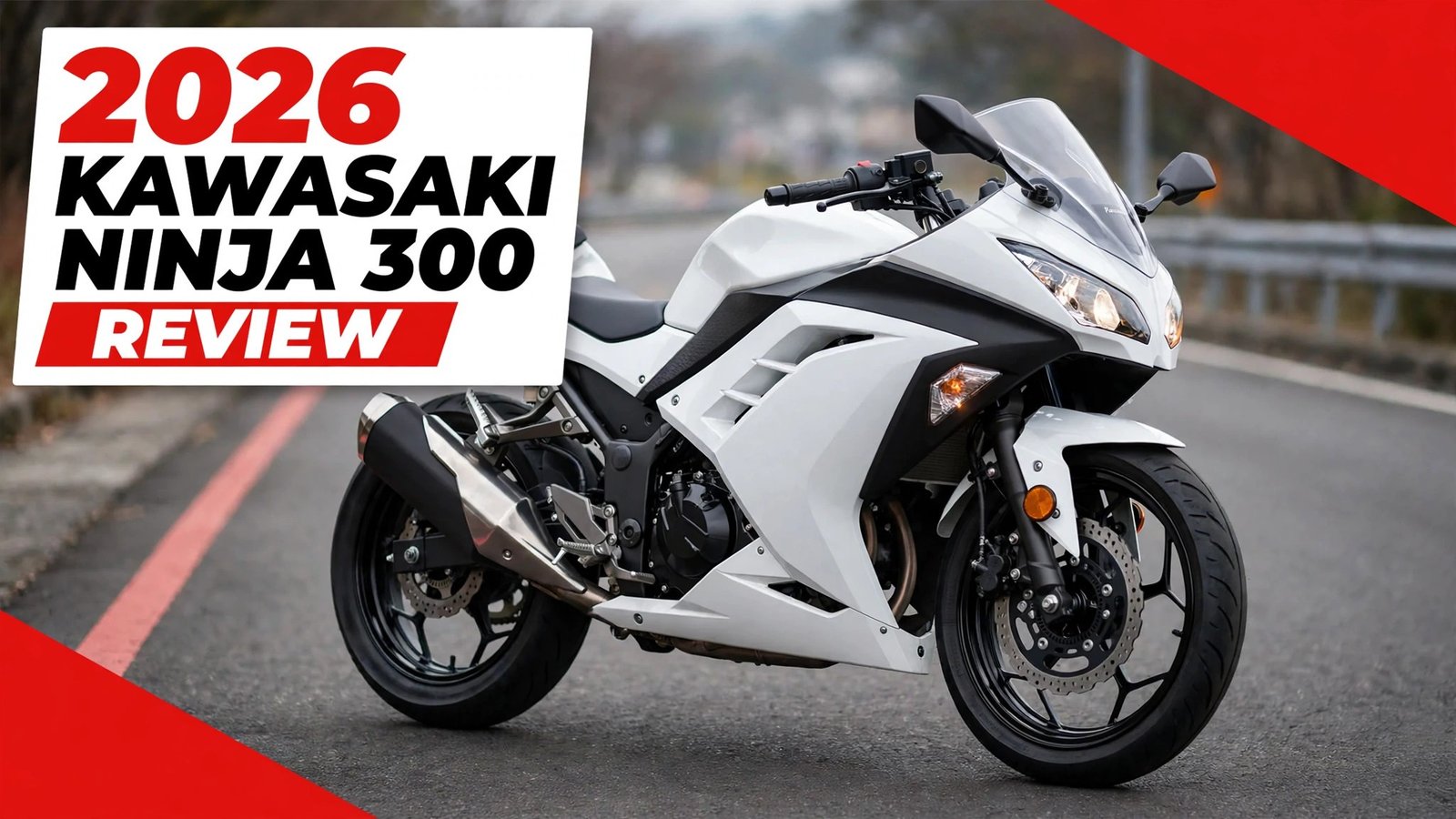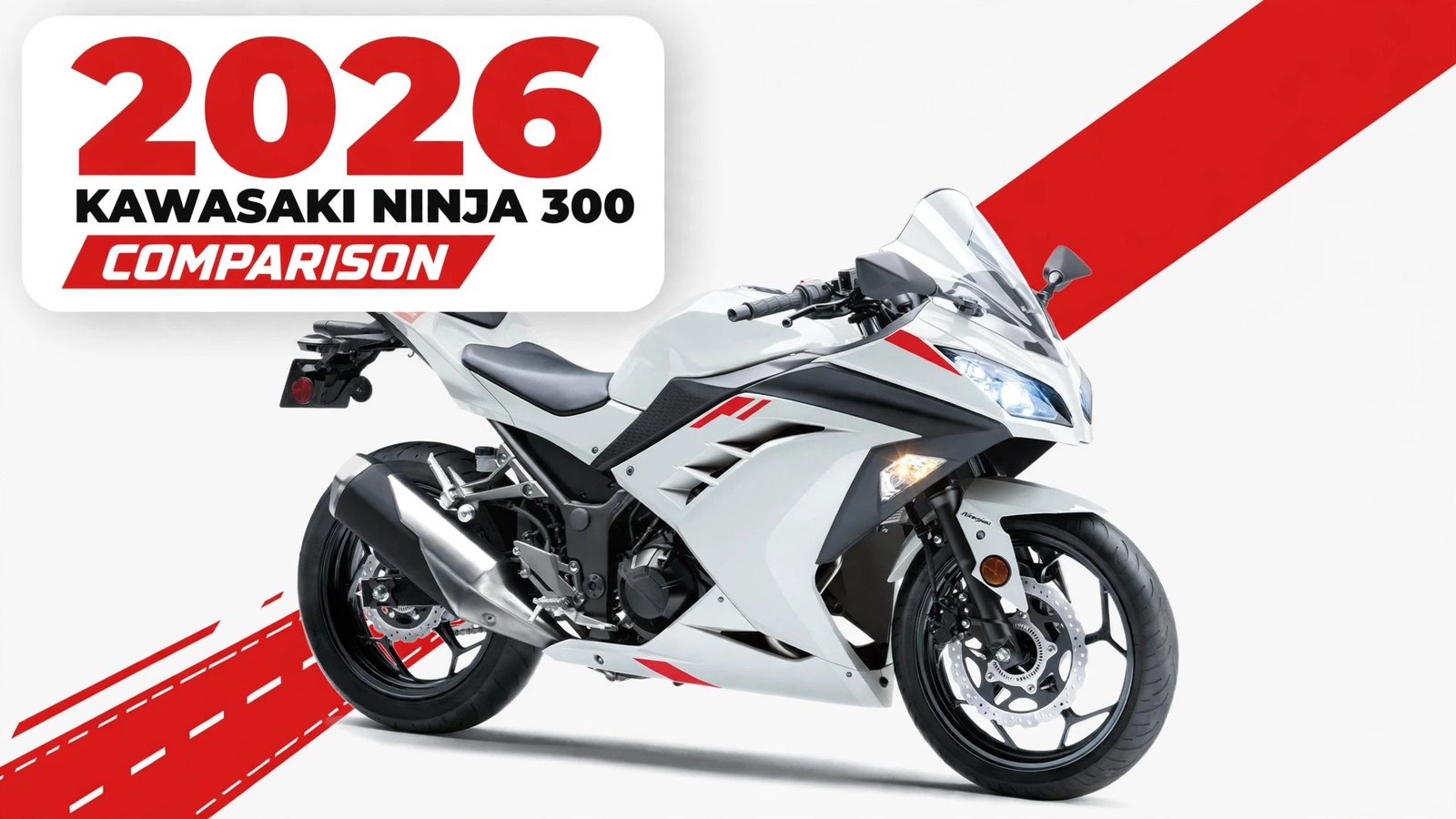
The revived 2026 Ninja 300 is the cheapest full-faired twin in its class at $5,649 delivered, undercutting its three closest rivals by $400 to $1,350. This Kawasaki Ninja 300 comparison lines it up against those rivals on price, power and weight to show where the old bike still wins.
The only new bike that beats it on price is the CFMOTO 300SS, and this Kawasaki Ninja 300 comparison checks the used 2013–2017 bikes too, since a returning model is always judged against its own past as well as its rivals.
Kawasaki Ninja 300 Overview and Its Closest Rivals
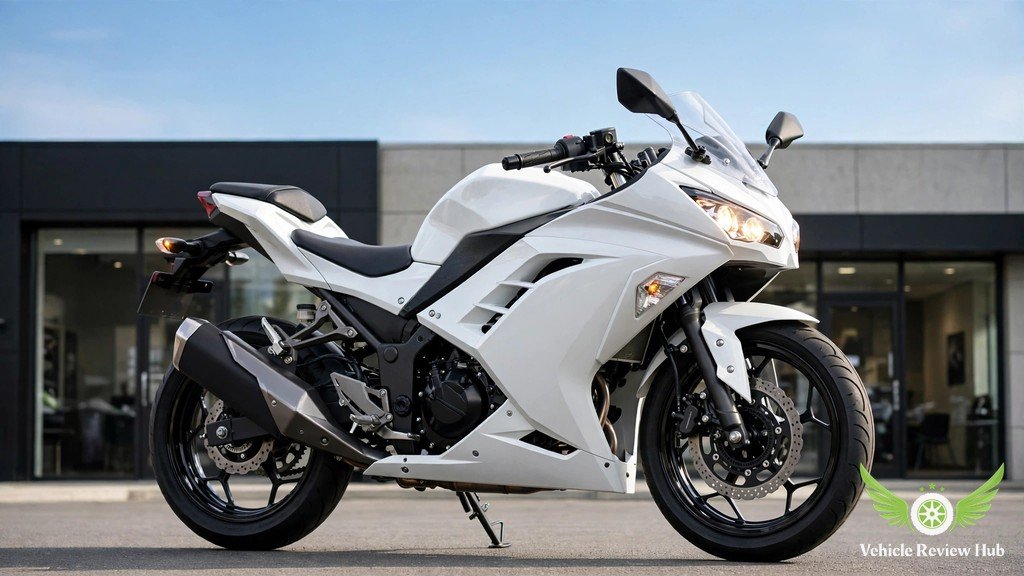
The short answer in this Kawasaki Ninja 300 comparison is that the revived 2026 Ninja 300 is the cheapest full-faired twin in its class. At $5,649 delivered, it undercuts its three closest rivals by $400 to $1,350 in this Kawasaki Ninja 300 comparison, and the only new bike that beats it on price is the CFMOTO 300SS. It lines the 300 up against its three rivals on price, power and weight, then checks what a used 2013 to 2017 bike is really worth now.
Revival Caps the Used Market
The 2026 revival changes the used market more than any spec sheet does. Before the revival, a clean used Ninja 300 was the only way to buy one, and sellers could ask near new-bike money. Now a new 2026 bike with standard ABS and a 12-month warranty costs $5,649 delivered, so a used 2017 asking $4,900 makes little sense. A used bike only wins now when it is genuinely cheap. This Kawasaki Ninja 300 comparison prices that gap with live listings from November 2026.
How the Four Bikes Differ at a Glance
Four numbers decide most of this Kawasaki Ninja 300 comparison: engine, power, weight and delivered price. The Ninja 300 is the smallest twin here at 296cc and the cheapest twin by a clear margin, and the table below puts all five bikes side by side.
| Bike | Engine | Claimed power | Curb weight | Seat height | Fuel tank | Delivered price |
|---|---|---|---|---|---|---|
| Kawasaki Ninja 300 ABS (2026) | 296cc parallel twin | 38.9 hp @ 11,000 rpm | 388.1 lb | 30.9 in | 4.5 gal | $5,649 |
| Kawasaki Ninja 500 ABS (2026) | 451cc parallel twin | 51 hp @ 10,000 rpm | 381.5 lb | 30.9 in | 3.7 gal | $6,449 |
| Yamaha YZF-R3 (2026) | 321cc parallel twin | 42 hp @ 10,750 rpm | 373 lb | 30.7 in | 3.7 gal | $6,149 |
| Honda CBR500R (2026) | 471cc parallel twin | 47 hp @ 8,500 rpm | 421 lb | 31.1 in | 4.5 gal | $6,999 |
| CFMOTO 300SS (2026) | 298cc single | 29.5 hp @ 9,500 rpm | 364 lb | 30.7 in | 3.2 gal | $4,599 MSRP + freight |
Notes: delivered prices are 2026 MSRP plus the manufacturer’s destination charge, re-verified from the manufacturers’ own pages in November 2026. The CFMOTO 300SS MSRP excludes freight. Power figures are manufacturer-claimed, except the Ninja 300’s tested 35 rear-wheel hp on Cycle World’s dyno; no same-day test exists for the others, so this Kawasaki Ninja 300 comparison keeps claimed and tested figures separate.
Kawasaki Ninja 300 vs Kawasaki Ninja 500
The Ninja 500 is the rival that lives in the same showroom and the same family, and it is the comparison most buyers make. It costs $400 more than the 300 at base MSRP, and that gap is the first test in this Kawasaki Ninja 300 comparison. This Kawasaki Ninja 300 comparison asks whether that $400, and the $800 gap between the two ABS models delivered, buys enough extra bike to matter.
Engine, Specs and Performance Side by Side
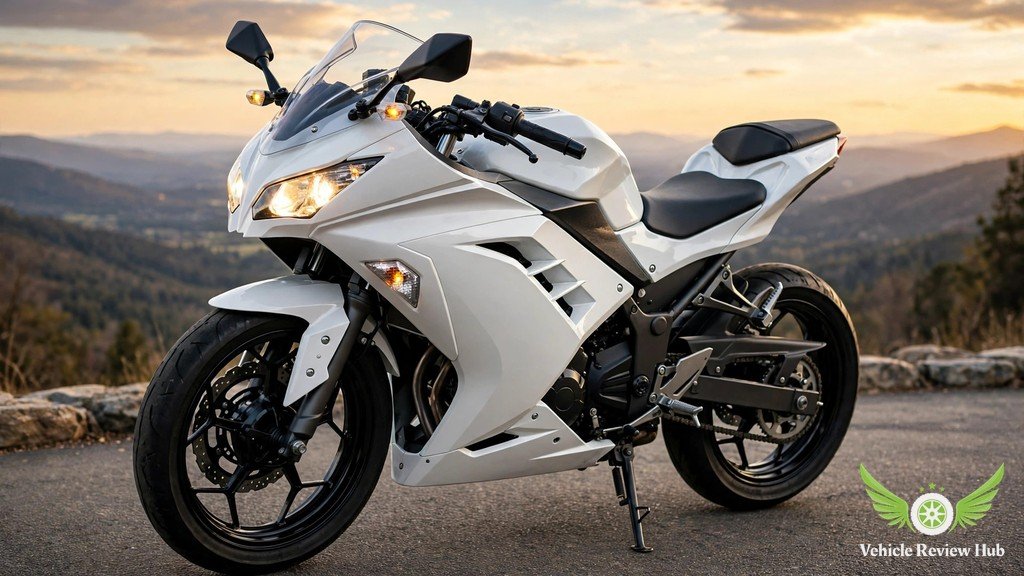
The 500’s engine is 155cc bigger than the 300’s, and the claimed power gap is 12.1 hp: 51 hp against 38.9 hp. The surprise is the weight: the 500 ABS is 6.6 lb lighter than the 300 at 381.5 lb against 388.1 lb, so the power-to-weight gap in this Kawasaki Ninja 300 comparison is wider than the power gap alone suggests: 0.134 hp per pound for the 500 against 0.100 for the 300, computed from claimed power and curb weight. The 500 also gets its torque lower down, with 43 Nm against the 300’s 19.3 lb-ft. Both bikes are six-speed twins with slipper clutches and 30.9-inch seats, and the 300’s tested numbers come from Cycle World: 35 rear-wheel hp, 0 to 60 mph in 5.6 seconds, a quarter mile in 14.43 seconds at 90.58 mph and a tested top speed of 106 mph. No comparable published test figures for the 500 were in hand at writing, so this Kawasaki Ninja 300 comparison prints claimed figures for the 500 and tested figures for the 300.
| Specification | Kawasaki Ninja 300 ABS (2026) | Kawasaki Ninja 500 ABS (2026) |
|---|---|---|
| Engine | 296cc parallel twin, DOHC, liquid-cooled | 451cc parallel twin, DOHC, liquid-cooled |
| Claimed power | 38.9 hp @ 11,000 rpm (ISO 4106) | 51 hp @ 10,000 rpm |
| Claimed torque | 19.3 lb-ft @ 10,000 rpm | 43 Nm (31.7 lb-ft) |
| Tested rear-wheel power | 35 hp (Cycle World, Dec 2012) | Not verified at writing |
| 0 to 60 mph (tested) | 5.6 seconds (Cycle World, Dec 2012) | Not verified at writing |
| Top speed (tested) | 106 mph (Cycle World, Dec 2012) | Not verified at writing |
| Seat height | 30.9 in | 30.9 in |
| Curb weight | 388.1 lb | 381.5 lb |
| Fuel tank | 4.5 gal | 3.7 gal |
| Dash | Analogue tach + LCD, no gear indicator, no TFT | LCD (base and ABS); 4.3-in colour TFT on SE ABS |
| ABS | Standard | Option (base is non-ABS); standard on SE ABS |
| Delivered price | $5,649 | $6,449 (ABS); $7,149 (SE ABS) |
Notes: the 500’s figures are Kawasaki’s claimed numbers, while the 300’s tested figures come from Cycle World’s December 2012 test of a 2013 ABS bike. The two bikes share the same 30.9-inch seat height, so the step up is about power and equipment, and the 300’s larger 4.5-gallon tank gives it longer legs than the 500’s 3.7-gallon tank, and that range edge matters in this Kawasaki Ninja 300 comparison. No tested 0 to 60 mph, quarter-mile or top-speed figure for the 500 is printed here because none was verified at writing.
Price, Equipment and Which Suits Which Rider
The family price ladder in this Kawasaki Ninja 300 comparison is short: the 300 costs $4,999, the 500 base $5,399 in black or $5,599 in Lime Green, the 500 ABS $5,799 and the SE ABS $6,499, all before the $650 destination charge. Delivered, that is $5,649, $6,049, $6,449 and $7,149. The $800 gap between the two ABS bikes buys 155cc, 12.1 claimed hp, a lighter bike and a newer platform, and the SE’s extra $700 buys a 4.3-inch colour TFT with smartphone connectivity and cosmetic trim. The 300 is deliberately simpler: an analogue tachometer with a small LCD, halogen lighting, no traction control, no ride modes and no TFT, and that simplicity is part of this Kawasaki Ninja 300 comparison, because the 300 asks the buyer to pay for the bike, not the dashboard. Kawasaki’s own Ninja 500 page lists the three trims and their prices. Buy the 300 if the budget is the decision and a new bike with a warranty matters more than speed; buy the 500 ABS if the extra power is worth $800 and the bike will see highway miles; buy the SE only if the TFT and trim are worth another $700, because nothing mechanical changes with it. The full Ninja 500 review covers that bike in detail.
Kawasaki Ninja 300 vs Yamaha YZF-R3
The YZF-R3 is the Ninja 300’s oldest rival and its closest on paper. The two bikes have been compared since the R3 arrived in 2015, and the 300 beat it in Motorcycle.com’s 2015 four-bike shootout, 85.0 percent against the R3’s 84.0 percent. This Kawasaki Ninja 300 comparison asks whether the revived 300 still holds that edge now that the R3 costs $500 more delivered.
Engine, Specs and Performance Side by Side
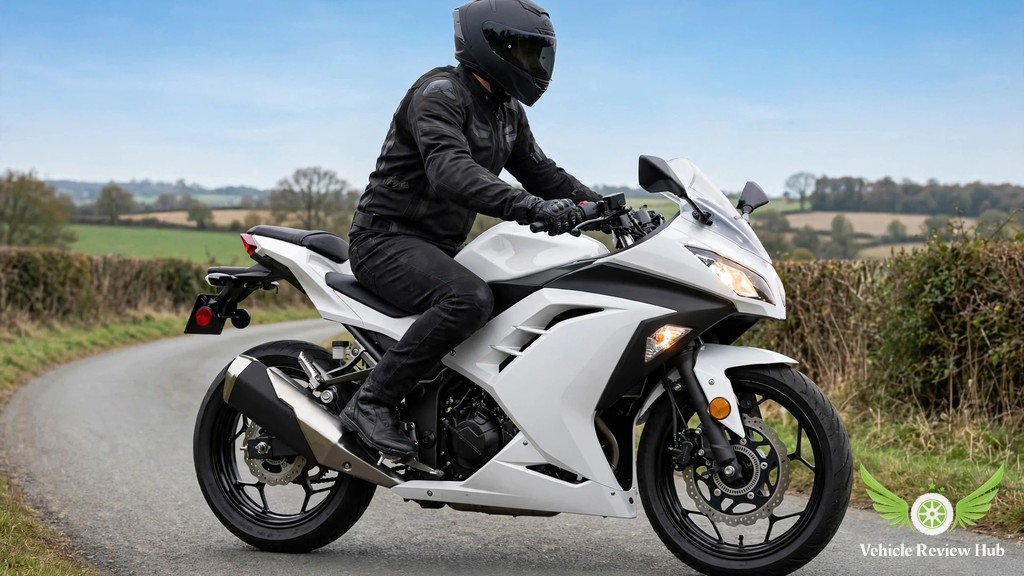
In this Kawasaki Ninja 300 comparison the R3’s 321cc twin makes 42 hp at 10,750 rpm, 3.1 hp more than the 300’s claimed 38.9 hp, and 21.8 lb-ft of torque. The R3 is also the lightest twin here at 373 lb wet, 15.1 lb less than the 300, with power-to-weight of 0.113 hp per pound against the 300’s 0.100. The R3 brings a 37 mm upside-down fork, winglets and a slipper clutch, while the 300 answers with a 4.5-gallon tank and tested numbers from the same era: Cycle World measured the 300 at 106 mph and 5.6 seconds to 60 mph, and Motorcycle.com measured 54.3 mpg in the 2015 shootout. Neither bike has a TFT, traction control or ride modes, so in this Kawasaki Ninja 300 comparison the choice comes down to power and price.
| Specification | Kawasaki Ninja 300 ABS (2026) | Yamaha YZF-R3 (2026) |
|---|---|---|
| Engine | 296cc parallel twin, DOHC, liquid-cooled | 321cc parallel twin, DOHC, liquid-cooled |
| Claimed power | 38.9 hp @ 11,000 rpm (ISO 4106) | 42 hp @ 10,750 rpm |
| Claimed torque | 19.3 lb-ft @ 10,000 rpm | 21.8 lb-ft @ 9,000 rpm |
| Tested rear-wheel power | 35 hp (Cycle World, Dec 2012) | Not verified at writing |
| 0 to 60 mph (tested) | 5.6 seconds (Cycle World, Dec 2012) | Not verified at writing |
| Top speed (tested) | 106 mph (Cycle World, Dec 2012) | Not verified at writing |
| Seat height | 30.9 in | 30.7 in |
| Curb / wet weight | 388.1 lb curb | 373 lb wet |
| Fuel tank | 4.5 gal | 3.7 gal |
| Front fork | 37 mm telescopic, conventional | 37 mm upside-down |
| Dash | Analogue tach + LCD, no gear indicator, no TFT | LCD, no TFT |
| ABS | Standard | Standard |
| Delivered price | $5,649 | $6,149 ($6,349 for 70th Anniversary) |
Notes: the R3’s figures are Yamaha’s published 2026 numbers, re-verified from Yamaha’s own page in November 2026 for this Kawasaki Ninja 300 comparison, and the 70th Anniversary Edition at $5,699 MSRP adds only throwback livery and a badge. The 300’s tested figures come from Cycle World’s December 2012 test. The weights are reported on different bases, so the 15.1 lb gap is indicative rather than exact. No tested 0 to 60 mph, quarter-mile or top-speed figure for the R3 is printed here because none was verified at writing.
Price, Equipment and Which Suits Which Rider
The R3 costs $5,499 plus the same $650 destination charge, or $6,149 delivered, $500 more than the Ninja 300 in this Kawasaki Ninja 300 comparison, and the 70th Anniversary Edition costs $5,699, or $6,349 delivered. For that $500 the R3 gives 25cc more, 3.1 claimed hp more, 15.1 lb less weight, an upside-down fork and fresh styling. The 300 answers with a bigger tank, a longer tested fuel range and $500 left in the buyer’s pocket, the value case this Kawasaki Ninja 300 comparison keeps returning to. Yamaha’s own YZF-R3 page lists the $5,499 price and the 321cc engine, and the Motorcycle.com 2015 shootout is the test where the 300 beat the R3 on overall score. Buy the 300 if the $500 matters and the riding is mostly commuting and weekend roads; buy the R3 if the sharper front end, the lighter weight and the newer styling are worth $500, and buy the 70th Anniversary Edition only for its livery. Our Yamaha YZF-R3 review covers that bike in full.
Kawasaki Ninja 300 vs Honda CBR500R
The CBR500R is the biggest bike in this Kawasaki Ninja 300 comparison and the most expensive, and the one that changed price the most for 2026. Honda cut $1,000 from it for 2026, bringing it to $6,399 plus a $600 destination charge, or $6,999 delivered, a $1,350 gap to the Ninja 300 that makes this Kawasaki Ninja 300 comparison a real decision.
Engine, Specs and Performance Side by Side
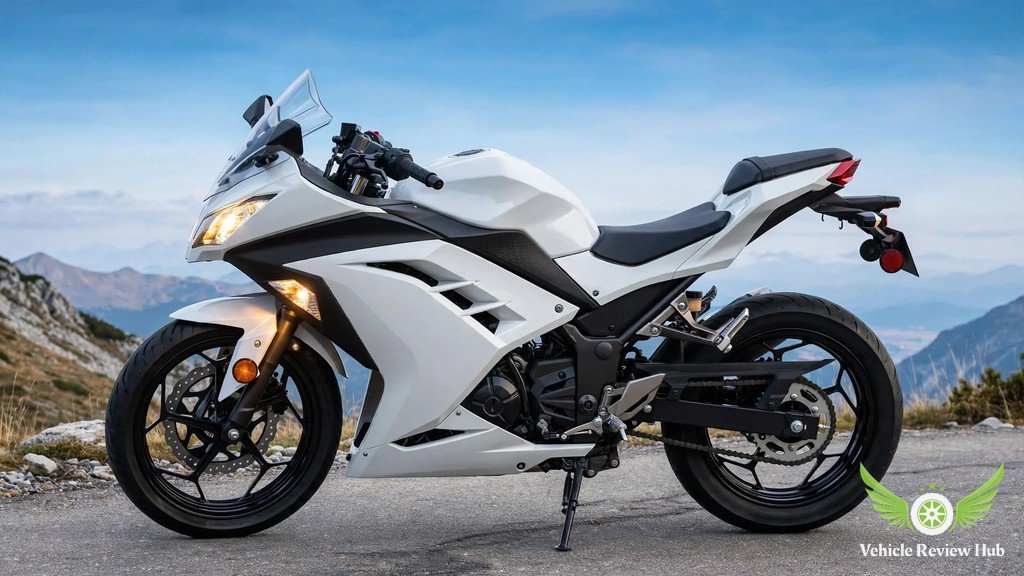
The Honda’s 471cc twin makes 47 hp at 8,500 rpm and 43 Nm of torque at 6,500 rpm, or 31.7 lb-ft, and it makes that torque far lower in the rev range than the 300, which needs 10,000 rpm for its 19.3 lb-ft. The Honda is the heaviest bike here at 421 lb curb, 32.9 lb more than the 300, so its power-to-weight of 0.112 hp per pound sits just behind the R3’s 0.113 and ahead of the 300’s 0.100. Its equipment leads the class: a 5-inch TFT with Honda RoadSync, Honda Selectable Torque Control, dual 296 mm front discs, a 41 mm Showa upside-down fork and a slipper clutch, with an E-Clutch option. The 300 answers with a 4.5-gallon tank that matches the Honda’s and tested figures: Cycle World measured the 300 at 106 mph and 5.6 seconds to 60 mph, with 60 to 0 mph braking in 135 feet, the tested evidence this Kawasaki Ninja 300 comparison leans on.
| Specification | Kawasaki Ninja 300 ABS (2026) | Honda CBR500R (2026) |
|---|---|---|
| Engine | 296cc parallel twin, DOHC, liquid-cooled | 471cc parallel twin, DOHC, liquid-cooled |
| Claimed power | 38.9 hp @ 11,000 rpm (ISO 4106) | 47 hp @ 8,500 rpm |
| Claimed torque | 19.3 lb-ft @ 10,000 rpm | 43 Nm (31.7 lb-ft) @ 6,500 rpm |
| Tested rear-wheel power | 35 hp (Cycle World, Dec 2012) | Not verified at writing |
| 0 to 60 mph (tested) | 5.6 seconds (Cycle World, Dec 2012) | Not verified at writing |
| Top speed (tested) | 106 mph (Cycle World, Dec 2012) | Not verified at writing |
| Seat height | 30.9 in | 31.1 in |
| Curb weight | 388.1 lb | 421 lb |
| Fuel tank | 4.5 gal | 4.5 gal |
| Front fork | 37 mm telescopic, conventional | 41 mm Showa upside-down |
| Dash | Analogue tach + LCD, no gear indicator, no TFT | 5-in TFT with Honda RoadSync |
| Traction control | None | Honda Selectable Torque Control (HSTC) |
| ABS | Standard | Standard, dual-channel |
| Delivered price | $5,649 | $6,999 |
Notes: the Honda’s figures are Honda’s published 2026 numbers, re-verified from Honda’s own specification sheet for this Kawasaki Ninja 300 comparison, and the $6,399 price and its $1,000 cut against 2025 are confirmed in RevZilla’s 2026 CBR500R review. The 300’s tested figures come from Cycle World’s December 2012 test. The Honda’s torque advantage is the largest single performance gap in this Kawasaki Ninja 300 comparison: 31.7 lb-ft at 6,500 rpm against 19.3 lb-ft at 10,000 rpm. No tested 0 to 60 mph, quarter-mile or top-speed figure for the CBR500R is printed here because none was verified at writing.
Price, Equipment and Which Suits Which Rider
At $6,999 delivered the Honda costs $1,350 more than the Ninja 300, and that premium buys the strongest engine in this group, the best brakes, the best fork, the only traction control and the only full TFT. RevZilla’s 2026 CBR500R review confirms the $6,399 price and the $1,000 cut, and Honda’s own CBR500R page lists the 471cc engine and the 421 lb curb weight. The Honda is the only bike here that feels like a middleweight rather than a beginner bike: it suits a rider who will keep the bike for years, while the 300 suits a rider who wants the cheapest way in. Buy the 300 if $1,350 matters more than torque and electronics; buy the Honda if the riding includes two-up work, highway miles or long ownership, and that trade is the heart of this Kawasaki Ninja 300 comparison.
Kawasaki Ninja 300 Price and Value Compared
Price is where this Kawasaki Ninja 300 comparison is decided, because the 300’s whole case is value: cheapest twin new, capped used by its own revival. The two tables below put the new-bike ladder and the live used market side by side.
Used Saving Is Now $1,700 to $2,200
A new 2026 Ninja 300 costs $5,649 delivered, so in this Kawasaki Ninja 300 comparison a used 2013 to 2017 bike only makes sense when it is genuinely cheaper, and the live listings from November 2026 show it is. The typical used asking price sits between $3,500 and $4,500, and the saving works out to $1,700 to $2,200 when the used bike costs $3,449 to $3,949. The table below shows real listings checked in November 2026 for this Kawasaki Ninja 300 comparison.
| Used bike (listing, November 2026) | Asking price | Mileage / notes | Saving vs new $5,649 |
|---|---|---|---|
| 2013 Ninja 300, private seller, Sedalia, MO | $3,000 | Lowest asking price found | $2,649 |
| 2016 Ninja 300 ABS, Combustion Cycles, Durham, NC | $3,295 | 8,438 miles | $2,354 |
| 2014 Ninja 300 ABS, private seller, San Diego, CA | $3,800 | Low miles, dealer serviced | $1,849 |
| 2014 Ninja 300 SE, Thrill Point Motorsports, Medina, OH | $4,399 | 4,949 miles | $1,250 |
| 2017 Ninja 300 ABS, private seller, Plano, TX | $4,799 | High end of the typical band | $850 |
| 2017 Ninja 300 ABS Winter Test Edition, dealer, Chelmsford, MA | $5,599 | Special-edition asking price | $50 |
Notes: listings checked on Cycle Trader and SmartCycleGuide in November 2026; treat every figure as a snapshot. The $1,700 to $2,200 saving maps to a used price of $3,449 to $3,949 against $5,649 new, and the listings above show that band is real. The Winter Test Edition at $5,599 saves only $50 against a new bike, which is no saving at all once the warranty and standard ABS are counted. That is the revival cap in action, the sharpest finding in this Kawasaki Ninja 300 comparison.
Running Costs and Resale Value Compared
Running costs favour the 300 in this Kawasaki Ninja 300 comparison. Its tested fuel economy is 54.1 mpg in Cycle World’s test conditions, with nearly 70 mpg observed in gentle riding, and the 4.5-gallon tank gives a range of about 243 miles. The major services fall every 7,600 miles, covering oil and filter, spark plugs and the valve clearance inspection, and the valve check is the expensive one because the cams have to come out. The 500, the R3 and the CBR500R all drink more per mile because their engines are bigger, and the Honda’s 421 lb weight costs more in tyres and brake pads, though no verified dollar figure for parts and labour exists. On resale, no published resale percentage exists for any bike in this group. What the listings show is that the 300’s used values are capped by the revival: a used 300 cannot rise above the new bike’s $5,649. The new-bike ladder below shows the whole market at once.
| Bike (2026) | MSRP | Destination | Delivered | Gap vs Ninja 300 |
|---|---|---|---|---|
| CFMOTO 300SS | $4,599 | Freight extra | $4,599 + freight | $1,050 under, before freight |
| Kawasaki Ninja 300 ABS | $4,999 | $650 | $5,649 | Baseline |
| Kawasaki Ninja 500 (base) | $5,399 | $650 | $6,049 | $400 more |
| Yamaha YZF-R3 | $5,499 | $650 | $6,149 | $500 more |
| Kawasaki Ninja 500 ABS | $5,799 | $650 | $6,449 | $800 more |
| Honda CBR500R | $6,399 | $600 | $6,999 | $1,350 more |
| Kawasaki Ninja 500 SE ABS | $6,499 | $650 | $7,149 | $1,500 more |
Notes: all prices are 2026 MSRP plus the manufacturer’s destination charge, re-verified in November 2026 from the manufacturers’ own pages and dealer listings for this Kawasaki Ninja 300 comparison. The 300SS MSRP excludes freight. The R3 70th Anniversary Edition at $5,699 MSRP, or $6,349 delivered, is not listed separately because it adds styling only. The ladder spans $1,050 at the bottom to $1,500 at the top, and the Ninja 300 sits second from the bottom, which is why this Kawasaki Ninja 300 comparison keeps coming back to value: the 300 is the cheapest twin you can buy new, and only a single undercuts it.
Kawasaki Ninja 300 Comparison Verdict and US Alternatives
The verdict in this Kawasaki Ninja 300 comparison is simple: the Ninja 300 wins on value, the Ninja 500 wins on power, the R3 wins on sharpness and the CBR500R wins on equipment.
Verdict: Buy New or Buy Cheap
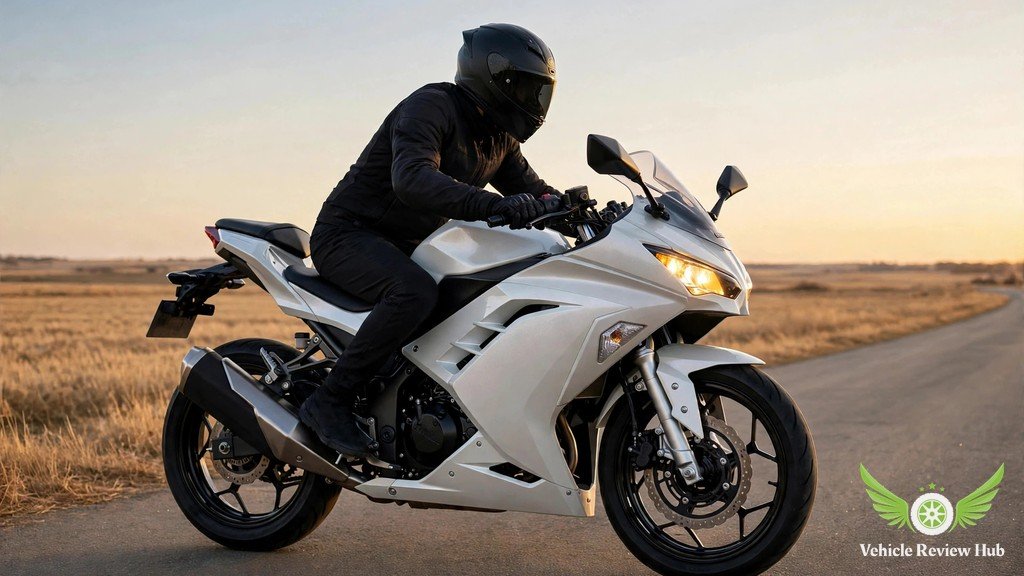
Buy new if the budget reaches $5,649, because a new 2026 bike brings standard ABS, a 12-month warranty, a taller windscreen and a clean service history. Buy used only if the bike is genuinely cheap: a clean 2013 to 2017 bike at $3,449 to $3,949 saves $1,700 to $2,200. Do not pay $4,800 or more for a used 300, and do not pay $5,299 or $5,599 for a special edition, because those prices sit at or above a new bike with a warranty. The Ninja 300 review covers the new bike, the Ninja 300 performance guide carries the full test figures, and the Ninja 300 reliability guide covers the two 2013 recalls and the maintenance schedule. The smaller Ninja 125 is the step below, though it was never sold in the United States. The Suzuki GSX250R was discontinued in the United States after 2020 and the Honda CBR300R is no longer sold new, so neither gets a comparison section in this guide. The verdict on this Kawasaki Ninja 300 comparison is that the 300 is the value pick, the 500 is the pick for longer ownership, the R3 is the pick for sharp handling, and the CBR500R is the pick for equipment.
CFMOTO 300SS Undercuts Everything
The CFMOTO 300SS undercuts everything in this Kawasaki Ninja 300 comparison on price, and it does it with more equipment than the 300. At $4,599 MSRP it is $400 under the Ninja 300 before freight, and it brings a 298cc single making 29.5 hp at 9,500 rpm and 19.9 lb-ft at 6,500 rpm, a 5-inch TFT dash with Bluetooth, full LED lighting, ABS, a slipper clutch and a two-year warranty, twice the 300’s 12 months. It is also the lightest bike here at 364 lb curb with the lowest seat alongside the R3 at 30.7 inches, though its 3.2-gallon tank is the smallest and its single gives up 9.4 hp to the 300’s twin. Motorcycle.com’s comparison listing confirms the $4,599 MSRP and the 29.5 hp figure. The 300SS suits a buyer who wants the lowest price and the most modern dash and does not mind a single-cylinder engine or a shorter dealer network, while the Ninja 300 suits a buyer who wants a twin, a Kawasaki badge and a bigger tank. That trade is the whole story of this Kawasaki Ninja 300 comparison: the 300 is the cheapest twin, the 300SS is the cheapest bike, and the $400 between them buys a second cylinder, a bigger tank and a bigger dealer network.
Kawasaki Ninja 300 Comparison Frequently Asked Questions
These answers settle the Ninja 300’s closest contests in this Kawasaki Ninja 300 comparison: the Ninja 500, the YZF-R3, the CBR500R and the CFMOTO 300SS, and the new-or-used question American buyers ask first.
Ninja 300 or Ninja 500 — which should I buy?
Buy the 300 if the budget is the decision, and buy the 500 ABS if the extra power is worth $800. The 500 costs $5,399 at base, $5,799 as the ABS and $6,499 as the SE ABS, against the 300’s $4,999 with ABS standard. Delivered, that is $6,049, $6,449 and $7,149 against the 300’s $5,649. The $800 gap between the two ABS bikes buys 155cc, 12.1 claimed hp, 51 hp against 38.9 hp, and a bike that is 6.6 lb lighter at 381.5 lb, with a 4.3-inch colour TFT on the SE. Both bikes share a 30.9-inch seat and a slipper clutch, and the 300 answers with a bigger 4.5-gallon tank against the 500’s 3.7 gallons. That trade is the heart of this Kawasaki Ninja 300 comparison: the 300 is the cheapest way in, the 500 is the pick for longer ownership and highway miles.
Ninja 300 or Yamaha YZF-R3 — which is better?
They are the closest pair in this Kawasaki Ninja 300 comparison, and the 300 won the test that matters: Motorcycle.com’s 2015 four-bike shootout scored the Ninja 300 at 85.0 percent against the R3’s 84.0 percent. On the dyno they are almost identical, 34.6 hp for the Kawasaki against 35.3 hp for the Yamaha, but the R3 is 15.1 lb lighter at 373 lb and brings a 37 mm upside-down fork. The 2026 prices sharpen it: the R3 costs $5,499 plus $650, or $6,149 delivered, $500 more than the 300, for 25cc more, 3.1 claimed hp more and fresher styling. Buy the 300 if the $500 matters and the riding is mostly commuting and weekend roads. Buy the R3 if the sharper front end, the lighter weight and the newer styling are worth $500, and that is the value call this Kawasaki Ninja 300 comparison keeps returning to.
Ninja 300 or Honda CBR500R — which is better?
The Honda is the biggest and most expensive bike here, and the best equipped. Its 471cc twin makes 47 hp at 8,500 rpm and 31.7 lb-ft at 6,500 rpm, torque far lower in the rev range than the 300, which needs 10,000 rpm for its 19.3 lb-ft, and it brings a 5-inch TFT with Honda RoadSync, Honda Selectable Torque Control, dual 296 mm front discs and a 41 mm Showa upside-down fork. It costs $6,399 plus $600, or $6,999 delivered, $1,350 more than the 300, even after Honda cut $1,000 from it for 2026. Buy the 300 if $1,350 matters more than torque and electronics. Buy the Honda if the riding includes two-up work, highway miles or long ownership, and that trade is the verdict of this Kawasaki Ninja 300 comparison.
Ninja 300 or CFMOTO 300SS — which is better value?
The 300SS undercuts everything on price in this Kawasaki Ninja 300 comparison: $4,599 MSRP, $400 under the Ninja 300 before freight, and it brings more equipment, a 5-inch TFT dash with Bluetooth, full LED lighting, ABS, a slipper clutch and a two-year warranty, twice the 300’s 12 months. It is also the lightest bike here at 364 lb. What it gives up is the second cylinder: a 298cc single making 29.5 hp at 9,500 rpm, 9.4 hp less than the 300’s twin, and the smallest tank at 3.2 gallons. The 300SS suits a buyer who wants the lowest price and the most modern dash and does not mind a single or a shorter dealer network, while the Ninja 300 suits a buyer who wants a twin, a Kawasaki badge and a bigger tank. That $400 buys a second cylinder, a bigger tank and a bigger dealer network, and that is the trade this Kawasaki Ninja 300 comparison keeps coming back to.
Should I buy a new Ninja 300 or a used one?
Buy new if the budget reaches $5,649, and this Kawasaki Ninja 300 comparison says so plainly, because a new 2026 bike brings standard ABS, a 12-month warranty, a taller windscreen and a clean service history. Buy used only if the bike is genuinely cheap: a clean 2013 to 2017 bike at $3,449 to $3,949 saves $1,700 to $2,200, and the live listings from November 2026 show that band is real, a 2013 bike at $3,000, a 2016 ABS at $3,295 with 8,438 miles, a 2014 ABS at $3,800. Do not pay $4,800 or more for a used 300, and do not pay $5,299 or $5,599 for a Winter Test or KRT special edition, because those prices sit at or above a new bike with a warranty. A used 2017 asking $4,900 makes little sense against a new 2026 at $5,649, and this Kawasaki Ninja 300 comparison prices that gap with the listings, not with a guess.
What does the Ninja 300 cost to run, and does it hold its value?
Running costs favour the 300. Its tested fuel economy is 54.1 mpg in Cycle World’s test conditions, with nearly 70 mpg observed in gentle riding, and the 4.5-gallon tank gives a range of about 243 miles. The major services fall every 7,600 miles, covering oil and filter, spark plugs and the valve clearance inspection, and the valve check is the expensive one because the cams have to come out. The 500, the R3 and the CBR500R all drink more per mile because their engines are bigger, though no verified dollar figure for parts and labour exists. On resale, no published resale percentage exists for any bike in this group, and this Kawasaki Ninja 300 comparison prints none: what the listings show is that the 300’s used values are capped by the revival, because a used 300 cannot rise above the new bike’s $5,649.