Is the Kawasaki Ninja ZX-10R still the litre superbike to buy in 2027? At $17,839 delivered, it sits $690 above the cheapest bike in the class and $3,131 below the most powerful one, with a claimed 190 hp and seven WorldSBK titles. That is the short answer this Kawasaki Ninja ZX-10R comparison starts from: the Kawasaki is neither the cheapest nor the quickest on paper, but it is the only bike in the group that pairs a sub-$18,000 delivered price with a factory 190 hp claim and a full IMU electronics suite.
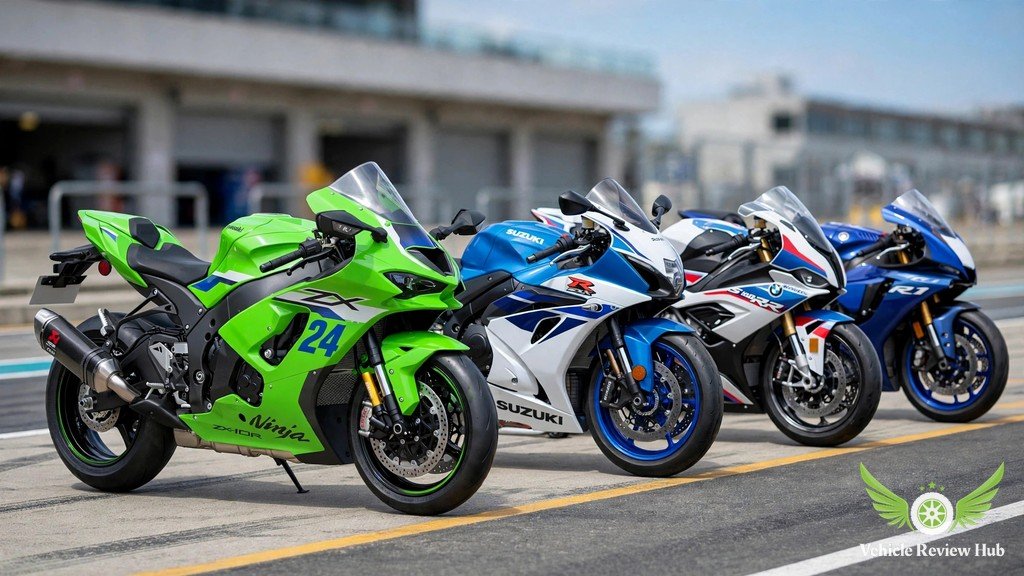
This Kawasaki Ninja ZX-10R comparison puts the 2026 bike against the three rivals US buyers actually cross-shop — the Suzuki GSX-R1000, the BMW S 1000 RR and the Yamaha YZF-R1 — on delivered price, claimed power, dyno figures, weight and equipment. Every price below is a delivered figure (MSRP plus destination, before dealer fees and tax) unless it says otherwise, and every power figure carries its source.
Kawasaki Ninja ZX-10R Overview and Its Closest Rivals
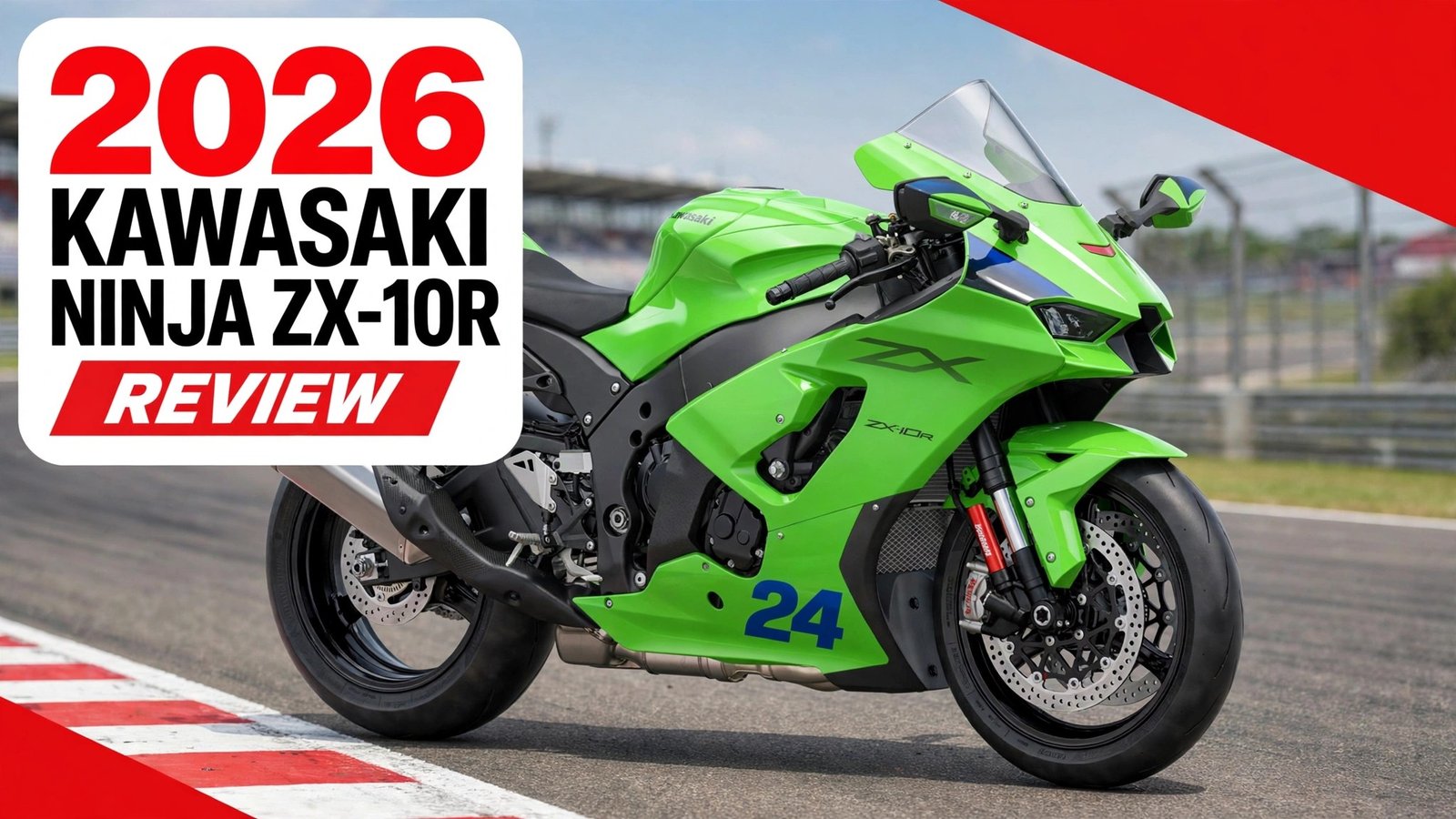
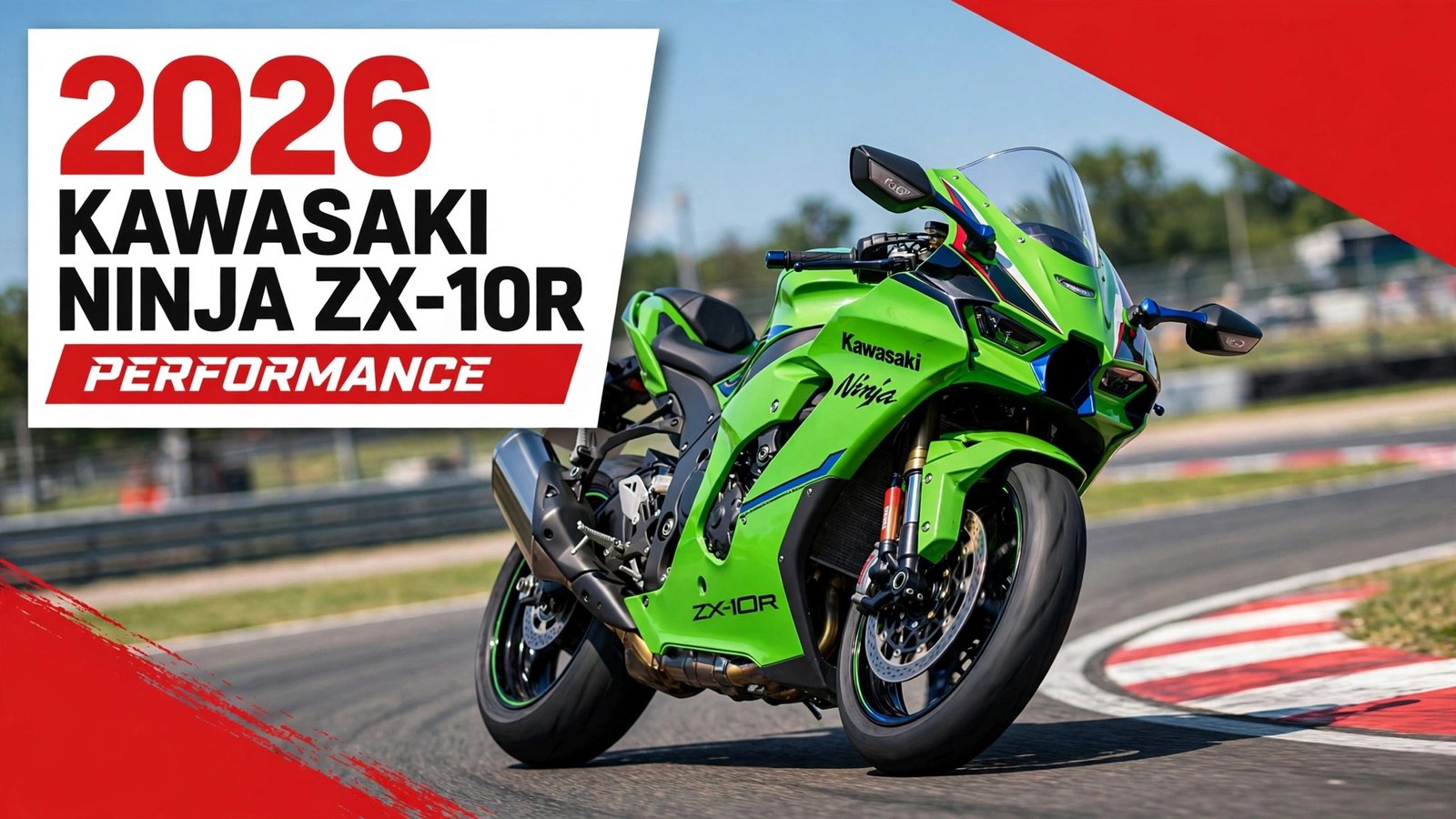
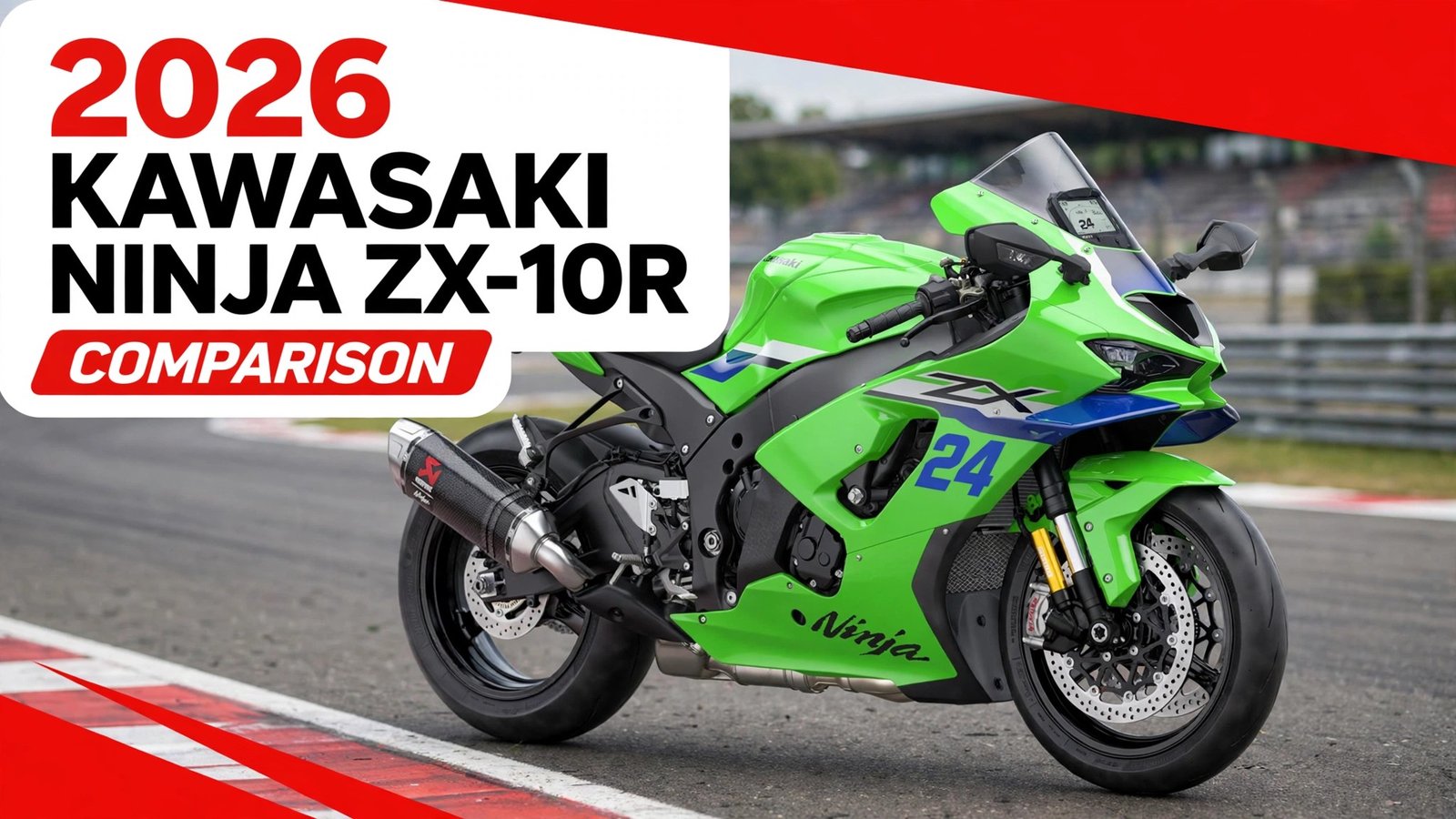
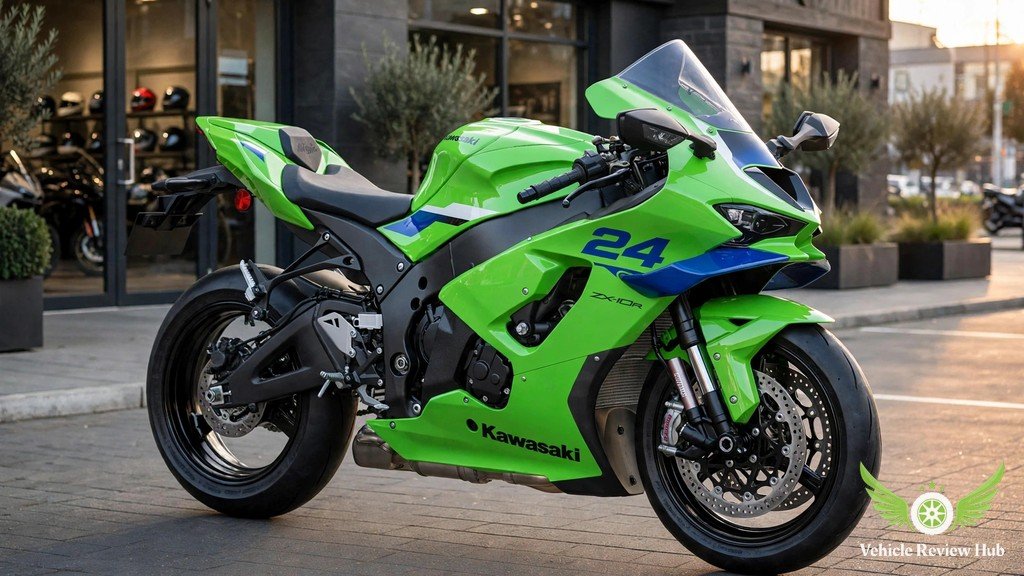
The 2026 ZX-10R is a new generation: winglets, revised chassis geometry, a 5-inch TFT, and an engine retuned to a claimed 190.0 hp at 11,500 rpm with 82.5 lb-ft at 11,300 rpm, down 6 hp from the 2025 bike’s 196.0 hp. It carries the full IMU electronics suite and a quickshifter, plus Brembo M50 calipers on dual 330 mm discs and a 43 mm inverted Showa BFF fork, all confirmed on Kawasaki’s 2026 spec sheet. The base bike costs $16,999 plus $840 destination, $17,839 delivered; the ABS bike is $17,999 plus $840, $18,839 delivered. This Kawasaki Ninja ZX-10R comparison measures that package against three very different answers to the same question.
Suzuki Undercuts It Now
The cheapest bike in this Kawasaki Ninja ZX-10R comparison is the 2027 Suzuki GSX-R1000 at $17,149 delivered, which undercuts the base ZX-10R by $690. Suzuki cut the base price $100 for 2027, while the ZX-10R held its $16,999 MSRP after the $800 cut from 2024 to 2025. The Suzuki is also the lightest bike here at 448.0 lb curb, 15.1 lb under the ZX-10R ABS, and it shares the Kawasaki’s 32.5-inch seat height. What the Suzuki does not match is the ZX-10R’s electronics or its claimed output.
The 2027 BMW S 1000 RR starts at $19,975 plus $995 destination, $20,970 delivered — $3,131 more than the base ZX-10R — and the 2027 Yamaha YZF-R1 is $19,199 plus $775, $19,974 delivered, $2,135 more. The Ducati Panigale V4 sits far above them all at $29,290 delivered, and the Honda CBR1000RR is the closest-priced rival of all at $17,874 delivered — just $35 above the base ZX-10R. The ZX-10R is therefore the second-cheapest bike in this Kawasaki Ninja ZX-10R comparison and the only one under $18,000 delivered with a claimed 190 hp.
How the Four Bikes Differ at a Glance
Four numbers decide most of this Kawasaki Ninja ZX-10R comparison: claimed power, weight, delivered price, and what the electronics do with the first three. Only the BMW claims more than the ZX-10R’s 190 hp, and only the Kawasaki pairs its 190 hp claim with a delivered price under $18,000 and a full IMU suite.
| Bike (2027 model year) | Claimed power | Weight | Delivered price |
|---|---|---|---|
| Kawasaki Ninja ZX-10R (base) | 190.0 hp @ 11,500 rpm (ISO 4106) | 463.1 lb curb (ABS); 458.6 lb (non-ABS) | $17,839 |
| Suzuki GSX-R1000 (base) | No US claim published; global 195 PS (192.3 hp) | 448.0 lb curb | $17,149 |
| BMW S 1000 RR (base) | 205 hp @ 13,000 rpm | 437 lb road-ready | $20,970 |
| Yamaha YZF-R1 (base) | No US claim published; global 200 PS (197 hp) | 448 lb wet | $19,974 |
Note: Delivered prices in this Kawasaki Ninja ZX-10R comparison are MSRP plus destination, before dealer fees and tax. The ZX-10R figure is the 2026 model ($16,999 plus $840); the other three are 2027 models. Suzuki and Yamaha publish no US claimed power figures, so their global figures are shown and labelled as global. Weight definitions differ by maker — curb for Kawasaki and Suzuki, wet for Yamaha, road-ready for BMW — so the weights are not measured on the same basis.
Kawasaki Ninja ZX-10R vs Suzuki GSX-R1000
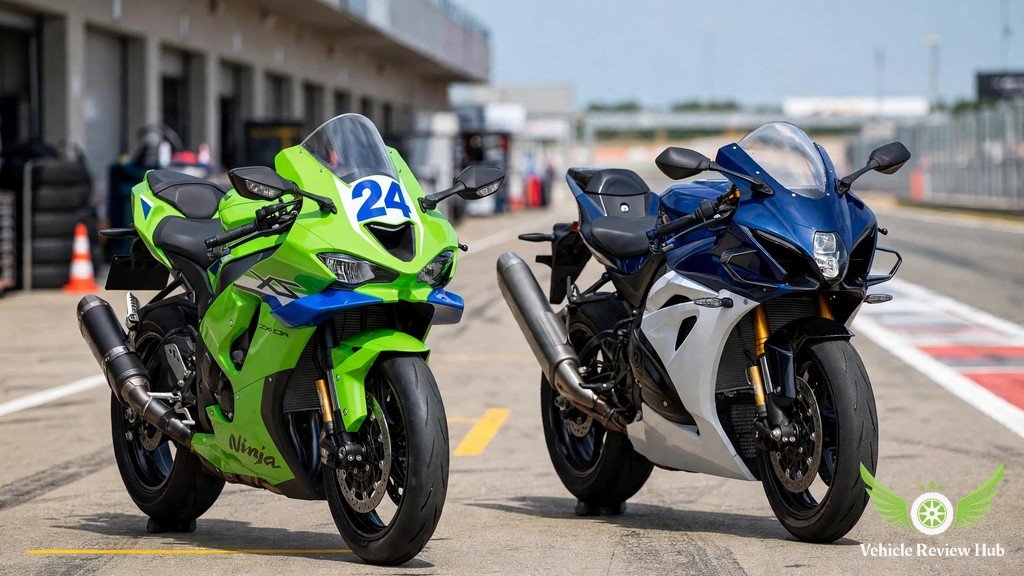
The GSX-R1000 is the rival that matters most to a ZX-10R buyer on price. The current Suzuki is essentially the 2017 redesign carried forward, while the Kawasaki is a new generation for 2026. That gap shows up everywhere except the price tag: the Suzuki is cheaper, lighter and simpler, and the Kawasaki is newer, more powerful on paper and far better equipped. This Kawasaki Ninja ZX-10R comparison weighs those two very different deals on their own terms.
Engine, Specs and Performance Side by Side
On claimed power the Kawasaki wins by default: Suzuki USA publishes no claimed power figure for the 2027 GSX-R1000. The global figure is 195 PS (192.3 hp), but that is not a US claim. The honest test in this Kawasaki Ninja ZX-10R comparison is on the dyno. In Motorcycle.com’s 2017 shootout the base GSX-R1000 made 161 hp on the rear wheel, and Cycle World’s 2017 test of the R recorded 177.2 hp. The best comparable ZX-10R figure is Motorcycle.com’s 2016 faceoff: the 2016 ZX-10R ABS KRT made 170.0 hp at 11,900 rpm and 76.3 lb-ft at 11,500 rpm. No dyno result exists yet for the 2026 ZX-10R, so its 190 hp claim is untested at the wheel.
The chassis figures tell a closer story. Both bikes carry a 32.5-inch seat, the Suzuki is 15.1 lb lighter at the curb, and its wheelbase is 55.9 inches against the ZX-10R’s 57.1 inches. The Suzuki’s fuel tank is smaller at 4.2 gallons against 4.5. Where the Kawasaki pulls away in this Kawasaki Ninja ZX-10R comparison is the electronics: the ZX-10R has a Bosch IMU driving cornering ABS, traction control, corner management and launch control, while the GSX-R1000 has a three-level traction system and a quickshifter but no IMU and no cornering ABS.
Price, Equipment and Which Suits Which Rider
The price gap is $690 at the base. The base GSX-R1000 is $16,399 plus $750 destination, $17,149 delivered, against the base ZX-10R at $17,839. The GSX-R1000R is $18,689 delivered and the GSX-R1000RS is $19,389 delivered. The ZX-10R ABS at $18,839 delivered sits between the R and the RS. Suzuki also cut prices for 2027 — the base by $100 and the R by $710 — while the ZX-10R held its price after the $800 cut from 2024 to 2025.
In this Kawasaki Ninja ZX-10R comparison, the Kawasaki is the better track-day bike for a rider who wants the electronics to cover mistakes, and the Suzuki is the better buy for a rider who wants the lightest, cheapest litre bike. The ZX-10R gives you the IMU suite, 5-inch TFT, winglets and Brembo M50 calipers on 330 mm discs, all as standard. The Suzuki is a simpler, lighter bike with fewer systems to maintain. The Suzuki GSX-R1000 review sets out the Suzuki’s full case.
Kawasaki Ninja ZX-10R vs BMW S 1000 RR
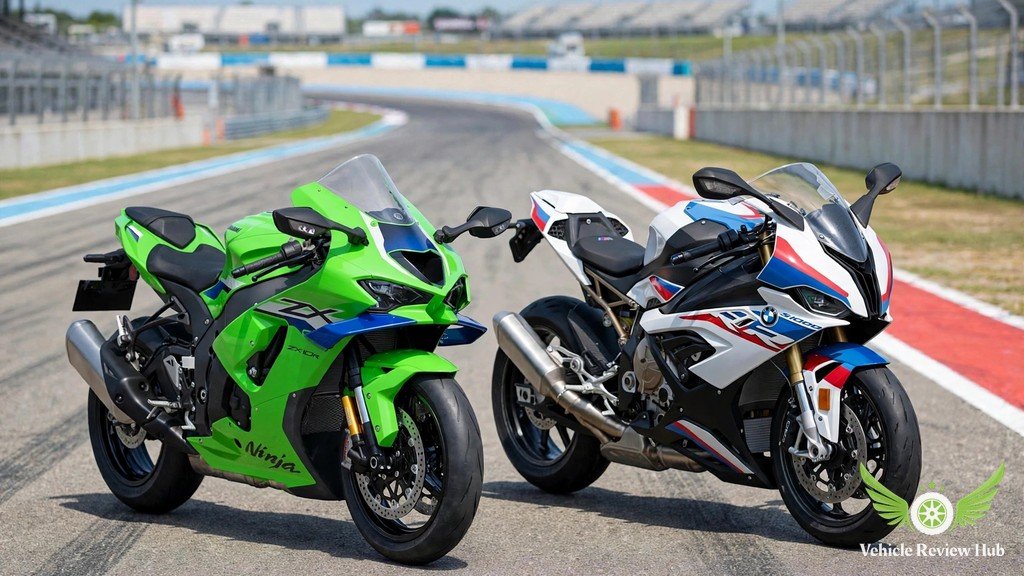
The BMW S 1000 RR is the most powerful bike in this Kawasaki Ninja ZX-10R comparison and the most expensive of the four headline rivals. Its 2027 base price is $20,970 delivered, which is $3,131 more than the base ZX-10R. For that money it claims 205 hp at 13,000 rpm and 83 lb-ft at 11,000 rpm, and it weighs 437 lb road-ready. The question is whether 15 more claimed horsepower and 26 fewer pounds are worth $3,131.
Engine, Specs and Performance Side by Side
The BMW’s 205 hp claim is the highest in this Kawasaki Ninja ZX-10R comparison, 15 hp above the Kawasaki’s 190 hp. The BMW is also the only bike here with ShiftCam variable valve timing. On the dyno the gap was smaller: Motorcycle.com’s 2016 faceoff measured the 2016 ZX-10R at 170.0 hp at the rear wheel, with the 2016 S 1000 RR in the same test. No dyno result exists yet for the 2026 ZX-10R, so the 15 hp gap is a claim, not a measurement.
The Kawasaki’s case in this Kawasaki Ninja ZX-10R comparison is that it gives you 93 percent of the BMW’s claimed power and the same electronics for $3,131 less. Both bikes carry a 43 mm inverted fork, a fully adjustable rear shock, Brembo calipers and a 6-axis IMU. The BMW adds its M package options, while the Kawasaki adds seven WorldSBK titles — six for Jonathan Rea from 2015 to 2020 plus Tom Sykes in 2013.
Price, Equipment and Which Suits Which Rider
The base ZX-10R is $17,839 and the base S 1000 RR is $20,970, a gap of $3,131 before dealer fees. The BMW’s 2026 base price was $19,895, so the 2027 bike is $80 more before destination, and its destination charge is $995 against the Kawasaki’s $840. Sources disagree on the 2025 BMW base price — TopSpeed lists $18,995 while a specs database lists $19,690 — so this Kawasaki Ninja ZX-10R comparison does not print either figure as settled. What is settled is that the BMW costs more at every trim, and the gap narrows only when dealer discounts enter the picture.
Both bikes have the IMU suite, a quickshifter, a TFT display and Brembo brakes. The BMW’s ShiftCam engine and lighter weight give it the edge for a rider chasing outright speed. The Kawasaki’s edge is value: the same electronics, a 190 hp claim, seven WorldSBK titles and a $3,131 lower starting price. A rider with a $21,000 budget who wants the fastest bike should buy the BMW; a rider with an $18,000 budget should buy the ZX-10R. The Ninja ZX-6R comparison shows how the same value argument plays out one class down.
Kawasaki Ninja ZX-10R vs Yamaha YZF-R1
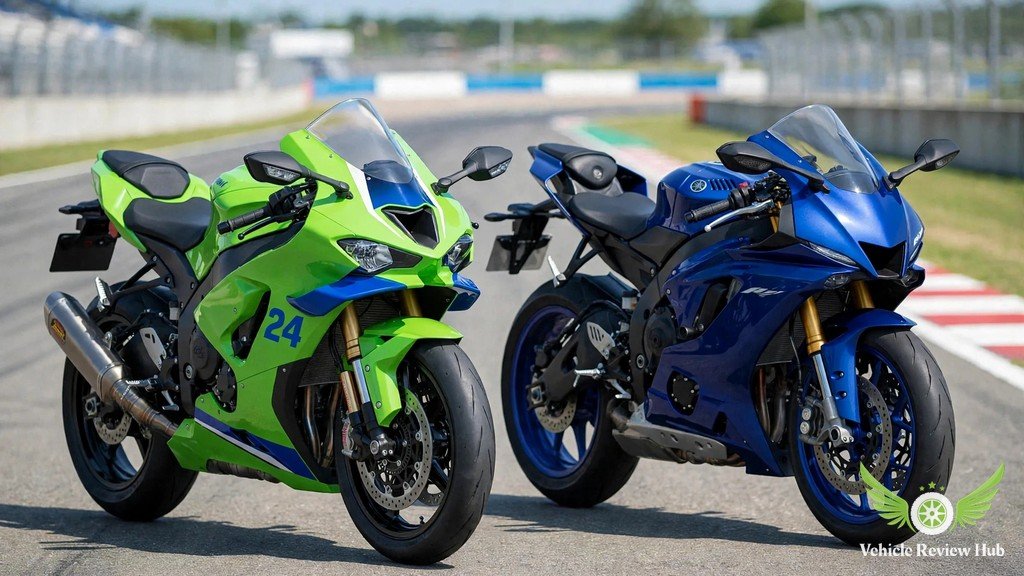
The Yamaha YZF-R1 is still a street-legal US motorcycle. Europe made the R1 track-only from 2025, but Yamaha USA kept the R1 and the R1M street-legal. The 2027 R1 is $19,974 delivered, and the R1M is $28,674 delivered. That puts the base R1 $2,135 above the base ZX-10R. This Kawasaki Ninja ZX-10R comparison treats the R1 as a live rival.
Engine, Specs and Performance Side by Side
Yamaha USA does not publish a claimed power figure for the 2027 R1. The global figure is 200 PS (197 hp) at 13,500 rpm with 113 Nm (83.2 lb-ft) of torque at 11,500 rpm, and that is the figure to quote, labelled as global. Against the ZX-10R’s claimed 190.0 hp, the R1’s global figure is 7 hp higher, but the two numbers come from different markets and test standards. In this Kawasaki Ninja ZX-10R comparison, that gap is not a measured advantage.
The chassis figures are close. The R1 weighs 448 lb wet against the ZX-10R’s 463.1 lb curb (ABS), and its seat is 33.7 inches, 1.2 inches taller than the Kawasaki’s. Its wheelbase is 55.3 inches against 57.1. The R1’s 2025 updates brought Brembo Stylema calipers and a redesigned 43 mm KYB fork, while the R1M adds an Öhlins NPX fork with ERS semi-active suspension. Both bikes carry a 6-axis IMU, cornering ABS and traction control. The ZX-10R performance guide covers the Kawasaki’s own numbers in full.
Price, Equipment and Which Suits Which Rider
The R1 costs $2,135 more than the base ZX-10R delivered — $19,974 against $17,839 — and the R1M costs $28,674 delivered. The 2027 bike is $200 more than the 2025 bike at each trim. The $775 destination charge is confirmed for both trims by Motorcycle.com’s R1 spec page and its R1M spec page. What the extra money buys in this Kawasaki Ninja ZX-10R comparison is character and exclusivity: the crossplane crankshaft’s feel, the R1M’s carbon bodywork and semi-active Öhlins suspension, and a bike that is rarer on the road than the Kawasaki.
Buy the R1 if you want the crossplane character, the shorter wheelbase and the sharper handling, at $2,135 more. Buy the R1M only for the carbon bodywork, semi-active suspension and the numbered exclusivity. Buy the ZX-10R if you want the newest generation, a 190 hp claim you can actually quote, and the lowest price in this Kawasaki Ninja ZX-10R comparison bar the Suzuki. And if your budget is smaller, the Ninja 650 comparison makes the same argument at a lower price point, and the Ninja ZX-4RR comparison covers the lightweight end.
Kawasaki Ninja ZX-10R Price and Value Compared
Price is where this Kawasaki Ninja ZX-10R comparison is decided for most buyers. The table below lists every delivered price in the group. The ZX-10R sits second from the bottom on price and second from the top on claimed power.
RR Discounts Vary by Dealer
BMW discounts the S 1000 RR more aggressively than any other bike in this Kawasaki Ninja ZX-10R comparison. The biggest verified figure is $3,000 off a 2026 RR: World of Powersports listed one at $26,105 with $3,000 off to $23,105, on sale until December 31, 2026. BMW also offered $3,000 in customer cash on 2026 RR models, expiring October 31, 2026, and $2,500 on the 2025 RR, expired April 30, 2026. The 2027 RR carries $1,500 in customer cash. No $4,100 discount on the S 1000 RR could be found in any live source checked for this guide, so no such figure is printed here.
A discounted 2026 RR can land close to the ZX-10R ABS price — but only while the offers last. A buyer flexible on model year should price a 2026 RR before buying a ZX-10R ABS — $3,000 off closes most of the $3,131 gap in this Kawasaki Ninja ZX-10R comparison.
Running Costs and Resale Value Compared
No ZX-10R-specific running-cost or resale data exists in the sources used for this Kawasaki Ninja ZX-10R comparison, so none is invented here. What can be compared honestly is the maintenance schedule. The ZX-10R’s first service is at 1,000 km (600 miles), oil and filter every 12,000 km (7,600 miles) or 12 months, plugs every 12,000 km, air filter every 18,000 km, and valve checks every 24,000 km (15,000 miles). The plugs are NGK SILMAR9B9 ×4, gapped 0.8 to 0.9 mm, and the chain is a 525 with 116 links, 17-tooth front and 41-tooth rear sprockets, with 20 to 30 mm of slack. Tyre pressures are 36 psi front and 42 psi rear, cold.
Two things are worth knowing before you budget. First, the oil capacity is genuinely disputed: the 2016 owner’s manual says 3.7 litres, while a 2021-manual reading says 3.8 litres with filter, 3.4 litres drain-only and 4.5 litres dry. Second, the ZX-10R’s 15,000-mile valve interval is long for the class. On resale, no verified figures exist for any of the four bikes, so this guide prints none.
| Bike | MSRP | Destination | Delivered price |
|---|---|---|---|
| Suzuki GSX-R1000 (2027 base) | $16,399 | $750 | $17,149 |
| Suzuki GSX-R1000R (2027) | $17,939 | $750 | $18,689 |
| Suzuki GSX-R1000RS (2027) | $18,639 | $750 | $19,389 |
| Kawasaki Ninja ZX-10R (2026 base) | $16,999 | $840 | $17,839 |
| Kawasaki Ninja ZX-10R ABS (2026) | $17,999 | $840 | $18,839 |
| Honda CBR1000RR (2027 base) | $17,099 | $775 | $17,874 |
| Honda CBR1000RR ABS (2027) | $17,399 | $775 | $18,174 |
| Yamaha YZF-R1 (2027) | $19,199 | $775 | $19,974 |
| BMW S 1000 RR (2027 base) | $19,975 | $995 | $20,970 |
| Ducati Panigale V4 (2027 base) | $27,995 | $1,295 | $29,290 |
Note: Delivered prices in this Kawasaki Ninja ZX-10R comparison are MSRP plus destination, before dealer fees and tax. The ZX-10R is a 2026 model; all other bikes are 2027 models. The R1M ($28,674 delivered) and the Panigale V4 S ($37,290 delivered) are not in the table because they are the premium trims of their ranges. The GSX-R1000 undercuts the base ZX-10R by $690 delivered; the CBR1000RR sits $35 above it; the S 1000 RR costs $3,131 more; and the Panigale V4 costs $11,451 more.
Kawasaki Ninja ZX-10R Comparison Verdict and US Alternatives
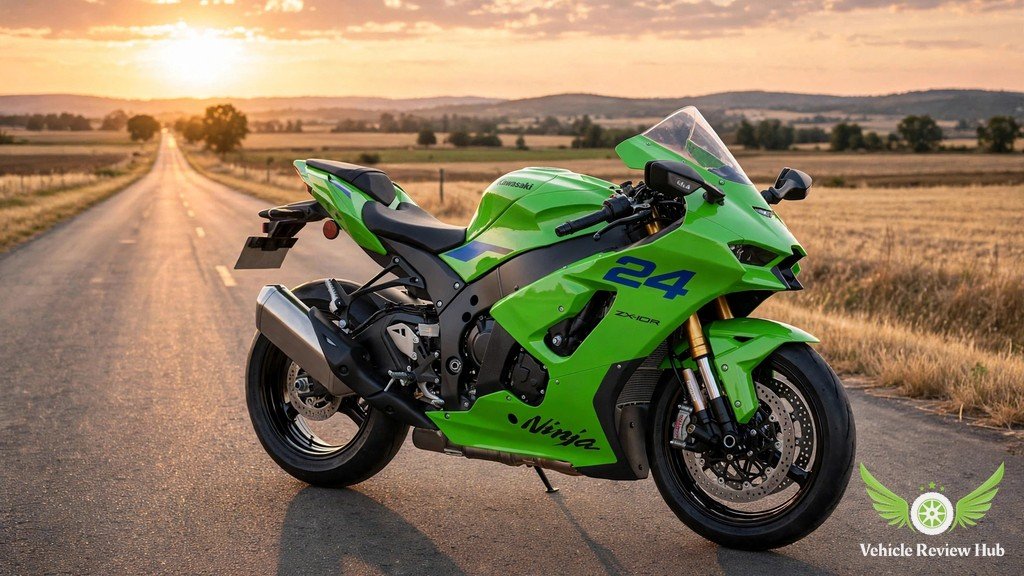
Four bikes, four different deals, and the ZX-10R’s deal is the most balanced. It is not the cheapest — the Suzuki undercuts it by $690 — and it is not the most powerful — the BMW claims 15 hp more. But it is the only bike that is second-cheapest and second-most-powerful. This Kawasaki Ninja ZX-10R comparison ends where it started: the Kawasaki is the value pick.
Verdict: Pedigree at a Cut
Buy the 2026 ZX-10R if you want a new-generation litre superbike with a 190 hp claim, a full IMU suite, Brembo M50 brakes and seven WorldSBK titles, for $17,839 delivered. The ABS bike at $18,839 adds cornering ABS for $1,000. No other bike in this Kawasaki Ninja ZX-10R comparison carries seven world titles on its platform. The ZX-10R review and the ZX-10R reliability guide cover the bike itself in full.
Buy something else in three cases. Buy the GSX-R1000 if $690 matters more than the newest electronics and you want the lightest, cheapest litre bike in the US. Buy the S 1000 RR for the most claimed power and the lightest weight, at $3,131 more — or hunt a dealer discount. Buy the R1 for the crossplane character, at $2,135 more. And if your budget is smaller, the Ninja ZX-6R KRT Edition comparison covers the 600 class for thousands less.
Panigale V4 Tops the Field
The Ducati Panigale V4 tops the field on price and on position, and the “tops the field” claim in this Kawasaki Ninja ZX-10R comparison is about price and position only — not about a power advantage. The 2027 Panigale V4 is $29,290 delivered, and the V4 S is $37,290 delivered. Its US claimed power is 209 hp at 12,750 rpm with 89 lb-ft at 11,250 rpm, confirmed by TopSpeed’s 2027 first look. The European version makes 218 hp at 13,500 rpm, not the US figure.
Is the Panigale worth the extra money? At $11,451 more than the base ZX-10R delivered, the answer is no for most riders — the Ducati costs 64 percent more for 10 percent more claimed power, and the money buys exclusivity. It is worth it for a rider who wants the most exotic litre bike on sale. For everyone else, the ZX-10R at $17,839 is the better buy in this Kawasaki Ninja ZX-10R comparison.
Kawasaki Ninja ZX-10R Comparison: Frequently Asked Questions
The questions buyers ask after reading this Kawasaki Ninja ZX-10R comparison, answered with the same figures above. Every price is a delivered figure, and every power figure carries its source.
Which is cheaper, the ZX-10R or the GSX-R1000?
The GSX-R1000 is cheaper. In this Kawasaki Ninja ZX-10R comparison, the 2027 base Suzuki is $17,149 delivered, which undercuts the 2026 base ZX-10R at $17,839 delivered by $690. The Suzuki is also lighter at 448.0 lb curb against 463.1 lb for the ZX-10R ABS, but it has no IMU electronics and no claimed power figure.
Is the ZX-10R faster than the GSX-R1000?
On claimed power, yes — in this Kawasaki Ninja ZX-10R comparison, the ZX-10R claims 190.0 hp at 11,500 rpm and Suzuki publishes no US claim for the GSX-R1000. On the dyno, the best figures are historical: the 2016 ZX-10R made 170.0 hp at the rear wheel in Motorcycle.com’s faceoff, and the 2017 GSX-R1000R made 177.2 hp in Cycle World’s test. No dyno result exists yet for the 2026 ZX-10R.
How does the ZX-10R compare with the BMW S 1000 RR?
The BMW claims more power, weighs less, and costs more. The 2027 S 1000 RR claims 205 hp at 13,000 rpm and weighs 437 lb road-ready — 26 lb lighter — against the ZX-10R’s 190 hp and 463.1 lb curb. The BMW is $20,970 delivered, which is $3,131 more than the base ZX-10R. Both bikes in this Kawasaki Ninja ZX-10R comparison have a full IMU electronics suite, and BMW discounts the RR more aggressively — $3,000 off a 2026 model at one dealer.
How does the ZX-10R compare with the Yamaha YZF-R1?
The R1 costs $2,135 more delivered in this Kawasaki Ninja ZX-10R comparison and has no US power figure to quote. The 2027 R1 is $19,974 delivered, against $17,839 for the base ZX-10R. Yamaha USA publishes no claimed horsepower for the R1; the global figure is 200 PS (197 hp) at 13,500 rpm. The R1 is 15.1 lb lighter and 1.2 inches taller at the seat, and it is still street-legal in the US.
What is the cheapest litre superbike in the US right now?
The 2027 Suzuki GSX-R1000, at $17,149 delivered, is the cheapest bike in this Kawasaki Ninja ZX-10R comparison. The 2026 ZX-10R is second-cheapest in this Kawasaki Ninja ZX-10R comparison at $17,839 delivered, and the 2027 Honda CBR1000RR is third at $17,874 delivered — just $35 above the Kawasaki. All three are under $18,000 delivered, and only the ZX-10R has a claimed 190 hp and a full IMU electronics suite.
Is the Ducati Panigale V4 worth the extra money?
For most riders in this Kawasaki Ninja ZX-10R comparison, no. The 2027 Panigale V4 is $29,290 delivered — $11,451 more than the base ZX-10R — for a US claimed 209 hp at 12,750 rpm, 19 hp more than the Kawasaki. That is 64 percent more money for 10 percent more claimed power. It is worth it only for a rider who wants the most exotic litre bike on sale.