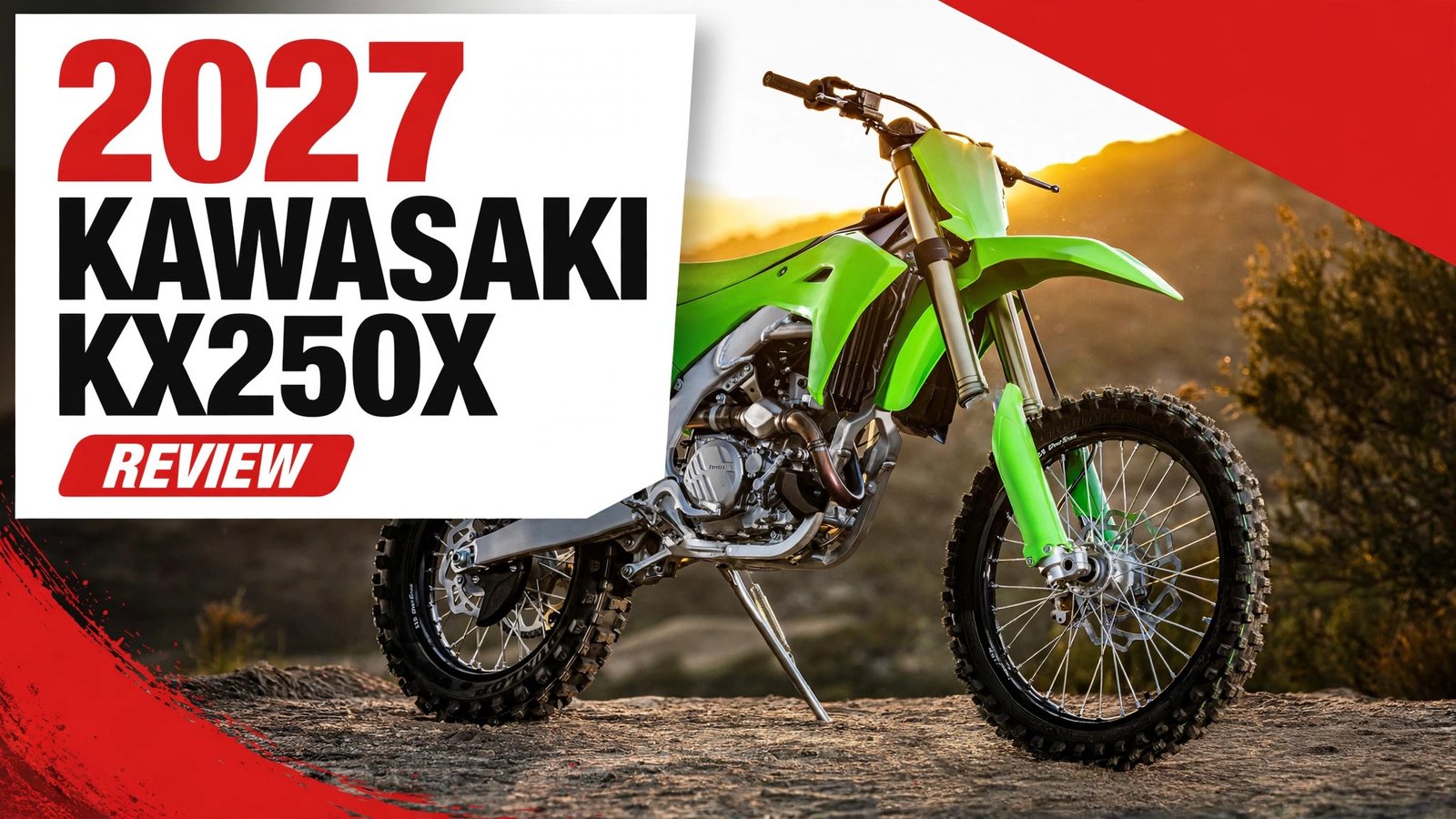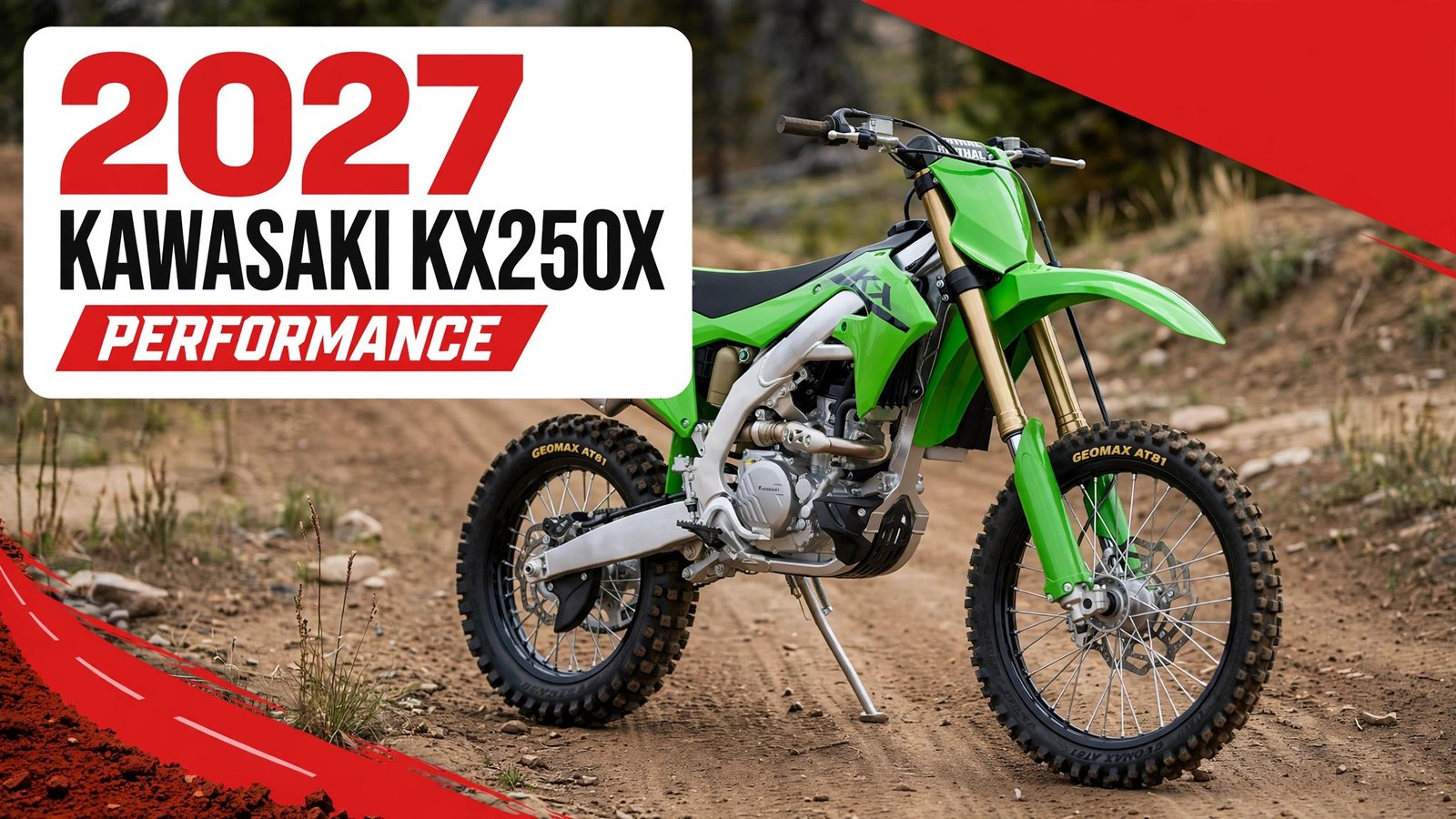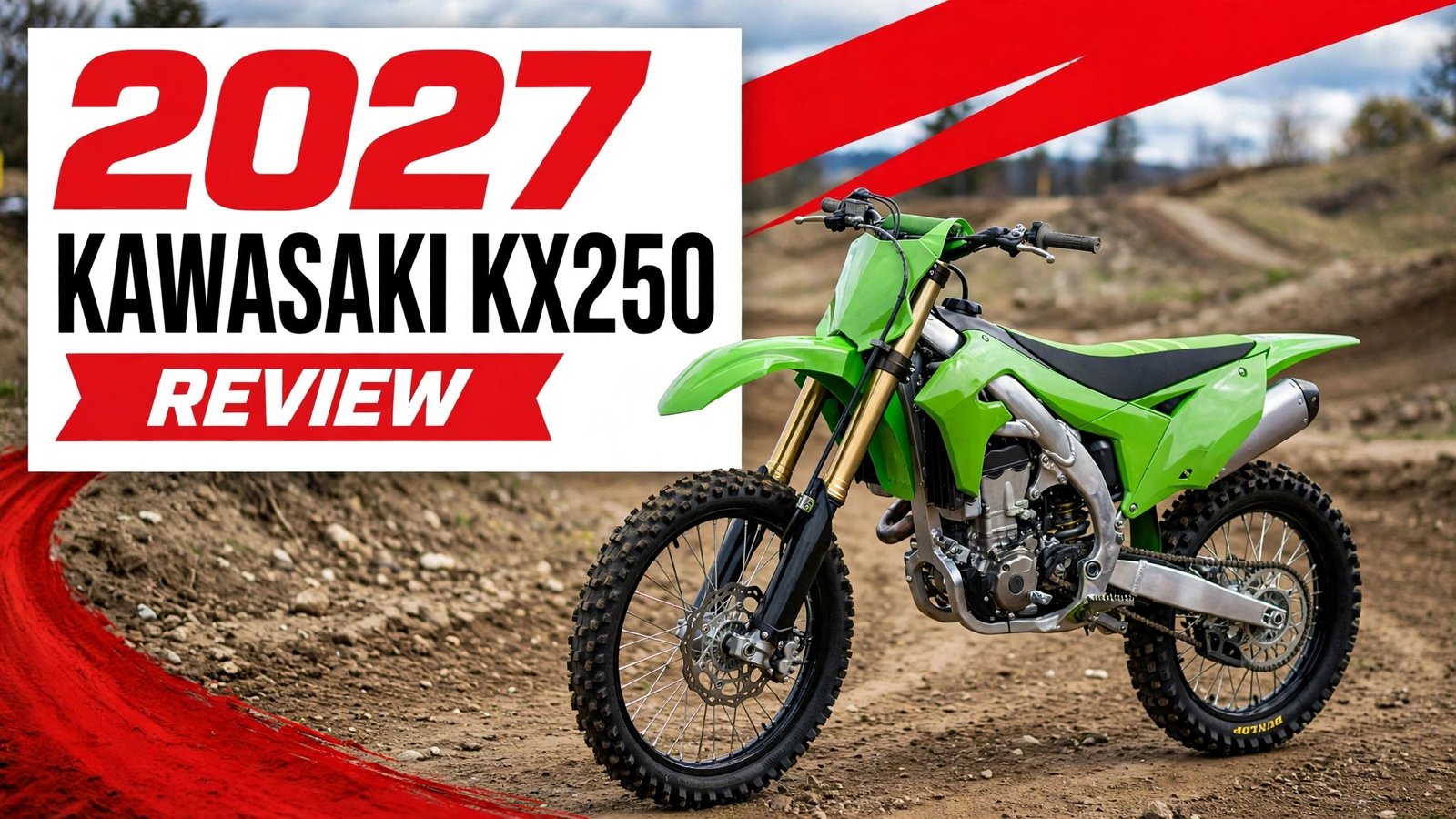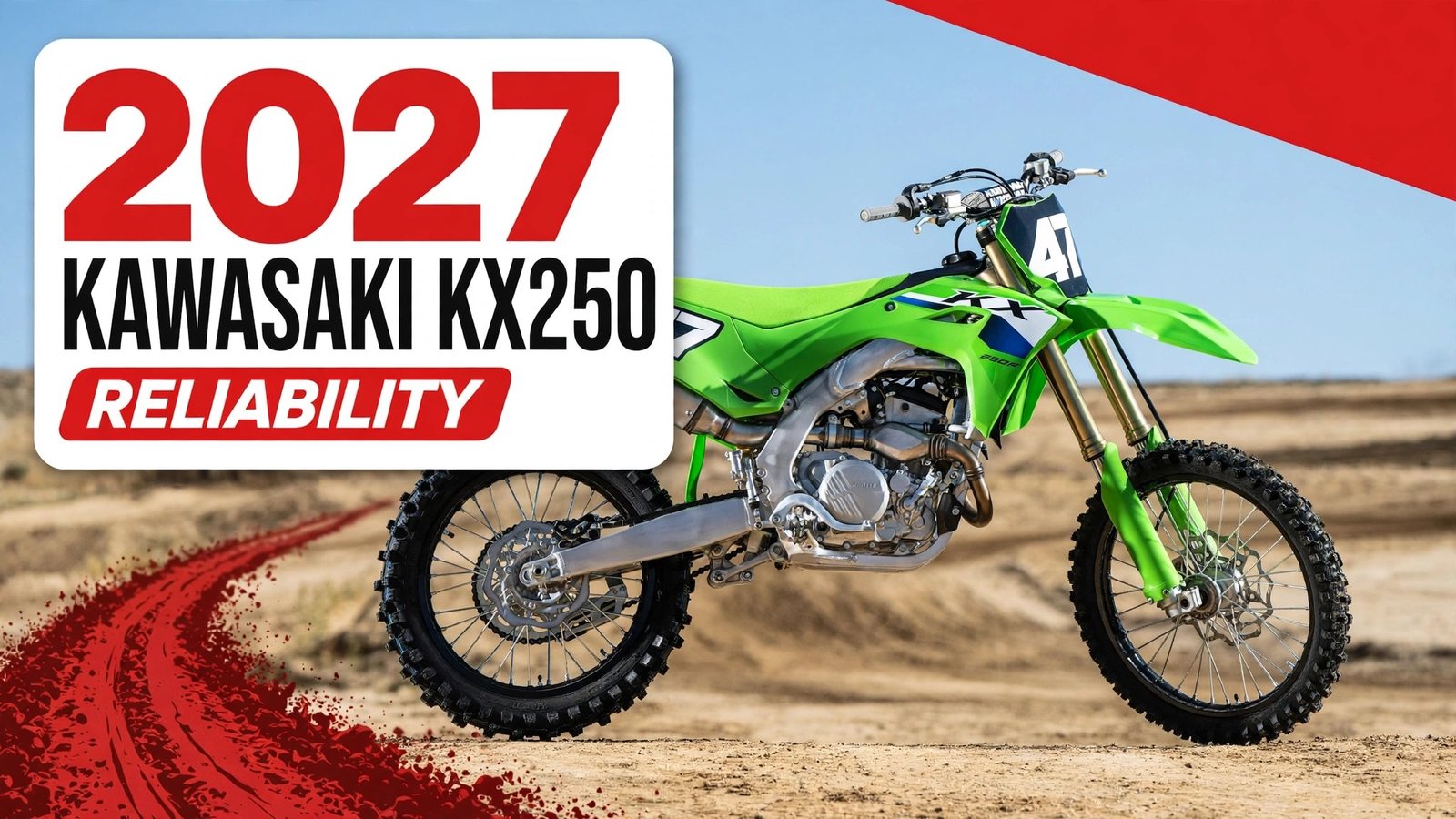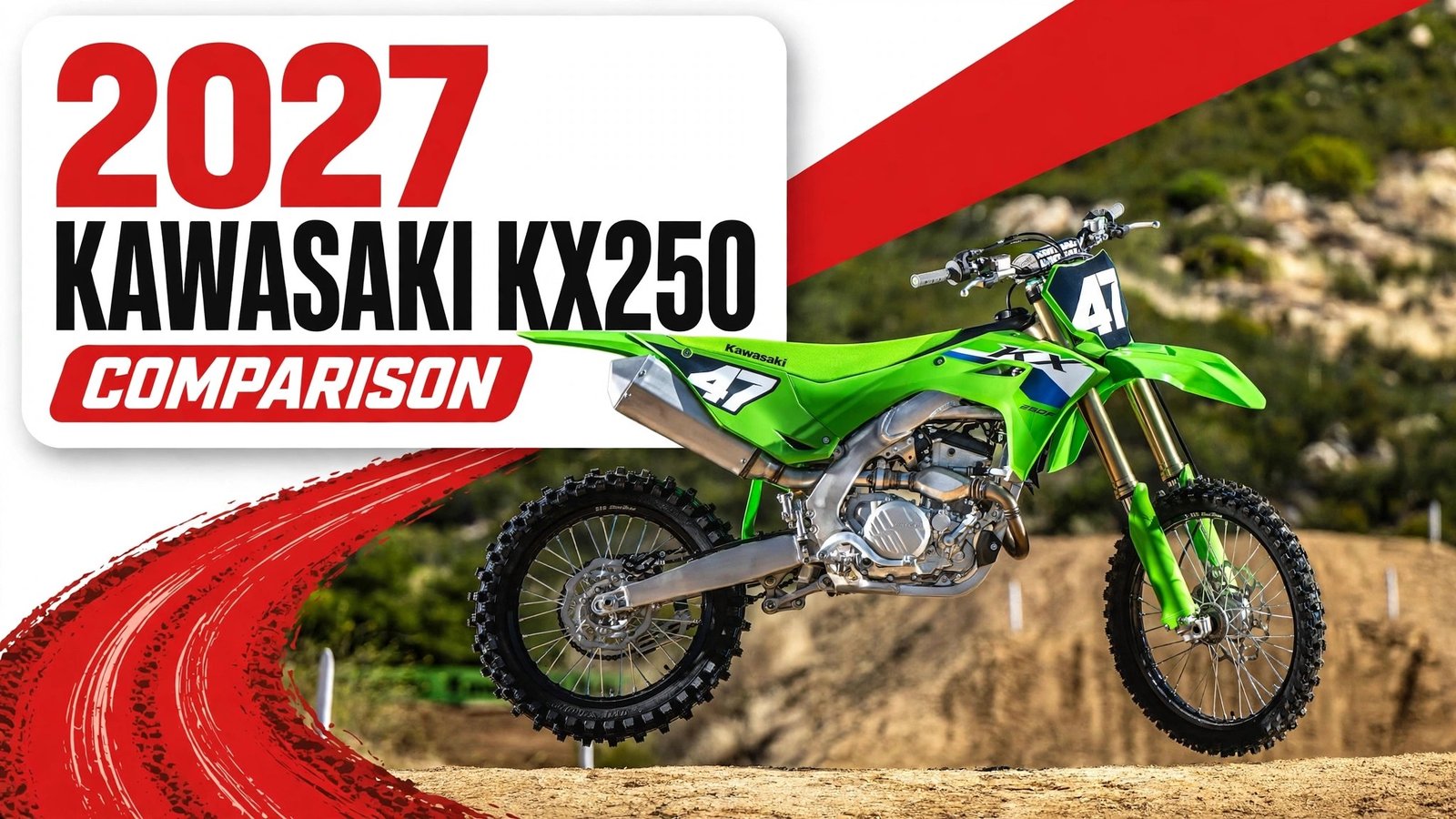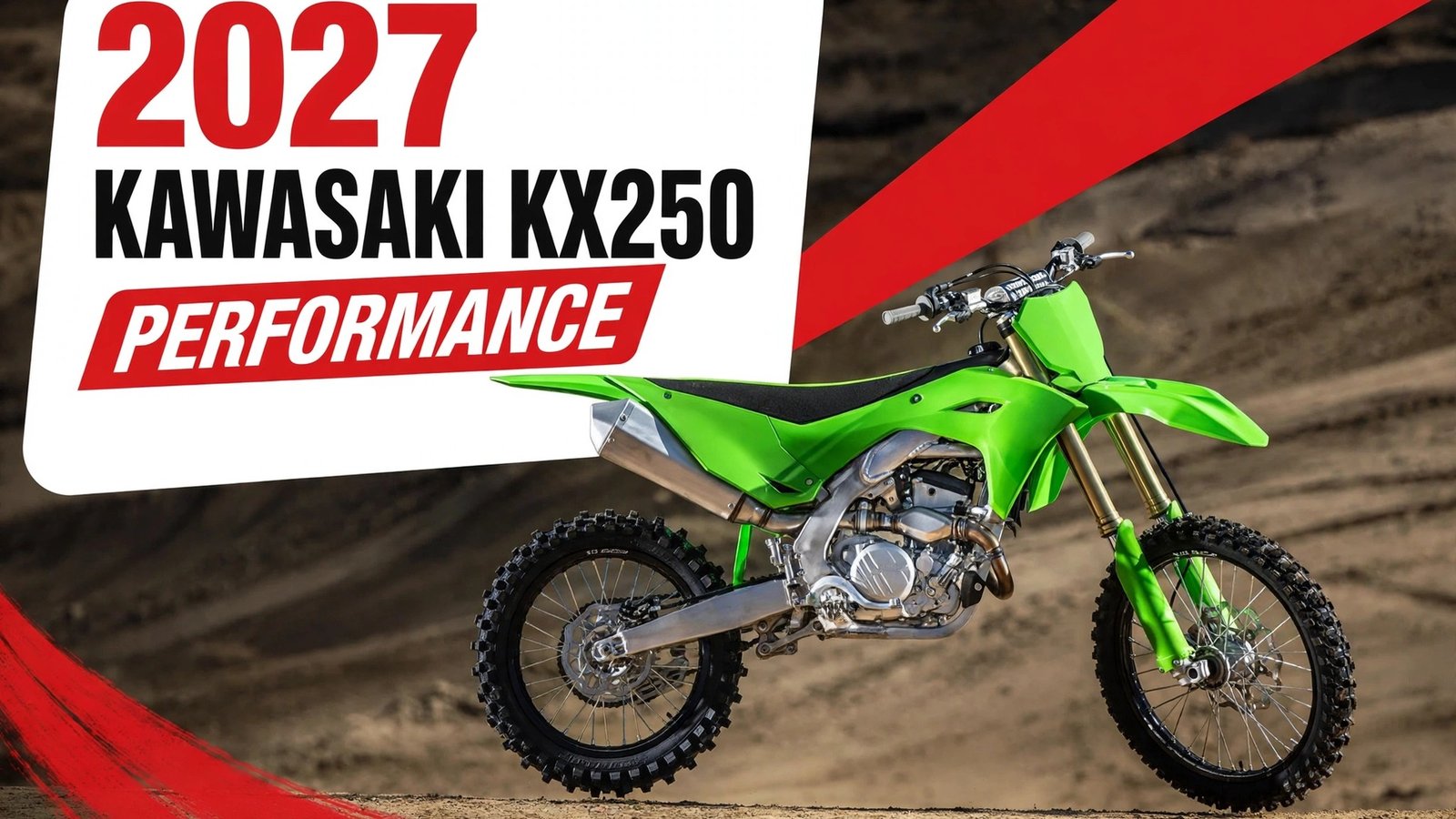
The Kawasaki KX250 performance story is a split decision. On one dyno it makes 39.2 hp, on another 43.7 hp, and on a third 43.49 hp, yet the same bike finished last in Dirt Rider’s 2026 seven-bike shootout. This Kawasaki KX250 performance guide sorts out which number belongs to which dyno, why the testers still complain about the bottom end, and what the 2027 updates change.
The bike in this Kawasaki KX250 performance guide is the 249cc four-stroke KX250 and KX250F, the same engine in the 2025 and 2026 bikes and the base for the 2027 KX250F. Kawasaki claims the 2027 bike makes about 0.7 hp more peak power than the 2026 bike, but no magazine has dyno-tested a 2027 bike yet.
Kawasaki KX250 Engine Performance and Power Delivery
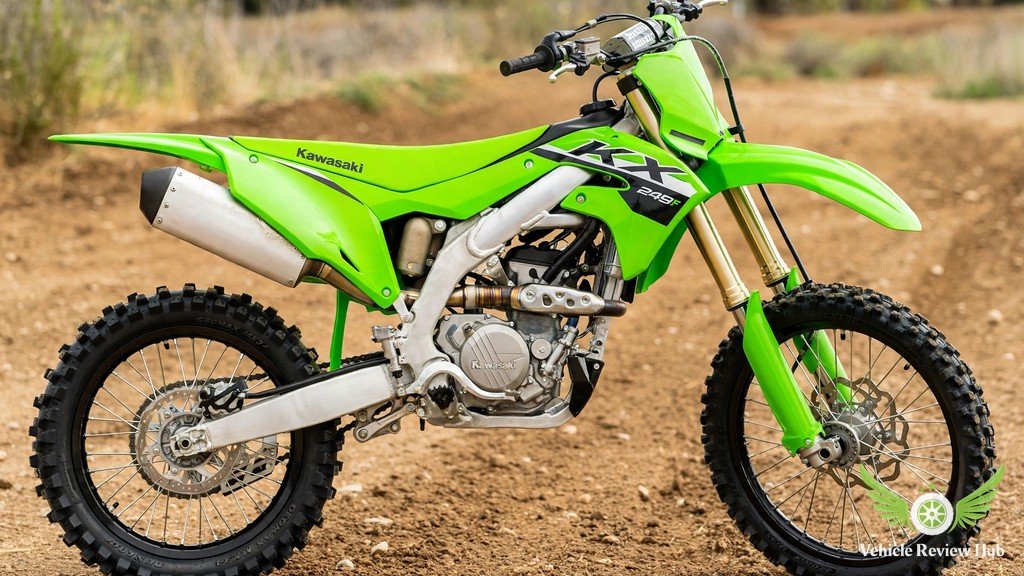
The engine is a 249cc liquid-cooled four-stroke single with a 78.0 mm bore and 52.2 mm stroke, 14.1:1 compression, and a 44 mm Keihin throttle body with dual injectors. Kawasaki publishes no power figure for any KX250 year, so the only horsepower numbers come from magazine dynos. This section of the Kawasaki KX250 performance guide prints the three published dyno runs side by side, with the warning that different dynos give different numbers and none of them is wrong.
Dirt Rider Dyno: 39.2 hp
Dirt Rider’s in-house Dynojet 250i, the primary dyno in this Kawasaki KX250 performance guide, measured the 2026 KX250 at 39.2 hp at 12,700 rpm and 18.7 lb-ft of torque at 9,100 rpm, rear wheel. The Dirt Rider 2026 KX250 technical overview prints both figures, and the same numbers appear in Dirt Rider’s standalone dyno article on the bike. The 2026 bike is mechanically unchanged from the 2025 bike, graphics only, so the 39.2 hp figure covers the 2025-2026 engine.
The 39.2 hp figure is lower than the 2024 bike’s number on the same dyno. Dirt Rider measured the 2024 KX250 at 41.0 hp at 13,800 rpm, so the 2025 redesign lost about 1.8 hp at peak but gained low-end usability, which is exactly the trade Kawasaki was trying to make.
MXA Dyno Reads Higher
Motocross Action’s own dyno read the same engine higher: 43.7 hp at 12,500 rpm and 20.48 lb-ft of torque at 9,200 rpm for the 2025-26 KX250. The MXA 2026 KX250 video test prints the figures in its article text, and the same text gives the 2024 bike’s figure as 45.11 hp at 13,300 rpm with 21.0 lb-ft at 9,000 rpm. That 45.11 hp number belongs to the 2024 bike only, and this Kawasaki KX250 performance guide never attaches it to a 2025, 2026, or 2027 bike.
The gap between the two dynos is 4.5 hp and 1.78 lb-ft, and the gap needs a caveat every time it appears. The same warning applies to the third published run, on Dirt Bike Magazine’s Pro Circuit dyno, where the 2025 KX250 made 43.49 hp at 12,470 rpm and 20.72 lb-ft at 9,240 rpm. MXA also notes that a $2,500 Pro Circuit package, with a Twin Air Powerflow kit, a remapped ECU, a Ti-6 exhaust, and a Pro Circuit piston, adds about 2 hp.
Watch the 2026 test: Motocross Action Magazine’s video test of the 2026 Kawasaki KX250, “2026 Kawasaki KX250 TESTED”, runs 11 minutes 8 seconds and shows the 2026 bike ridden and tested by MXA’s Josh Mosiman and Brian Medeiros, including a second KX250 fitted with $2,500 of Pro Circuit mods. The bike shown is the 2026 model, not the 2027 KX250F: the 2026 engine is the same unit as the 2025, while the 2027 KX250F has the revised combustion chamber, the longer exhaust header, and Kawasaki’s claimed 0.7 hp more peak power. This Kawasaki KX250 performance guide points to the video because its article text is the source for the 43.7 hp MXA dyno figure above.
| Dyno (bike year) | Peak horsepower | Peak torque |
|---|---|---|
| Dirt Rider Dynojet 250i (2026) | 39.2 hp @ 12,700 rpm | 18.7 lb-ft @ 9,100 rpm |
| MXA dyno (2025-26) | 43.7 hp @ 12,500 rpm | 20.48 lb-ft @ 9,200 rpm |
| Pro Circuit dyno, Dirt Bike wrap (2025) | 43.49 hp @ 12,470 rpm | 20.72 lb-ft @ 9,240 rpm |
| MXA dyno (2024, for context) | 45.11 hp @ 13,300 rpm | 21.0 lb-ft @ 9,000 rpm |
Note: The three dynos above are different machines on different days, so the figures are not directly comparable and this Kawasaki KX250 performance guide never mixes them in one comparison. The 2024 row is the previous-generation engine, shown only so the 45.11 hp figure is never mistaken for a 2025 or 2026 number. No dyno figure exists yet for the 2027 KX250F; Kawasaki claims about 0.7 hp more peak power than the 2026 bike.
Kawasaki KX250 Top Speed and Acceleration
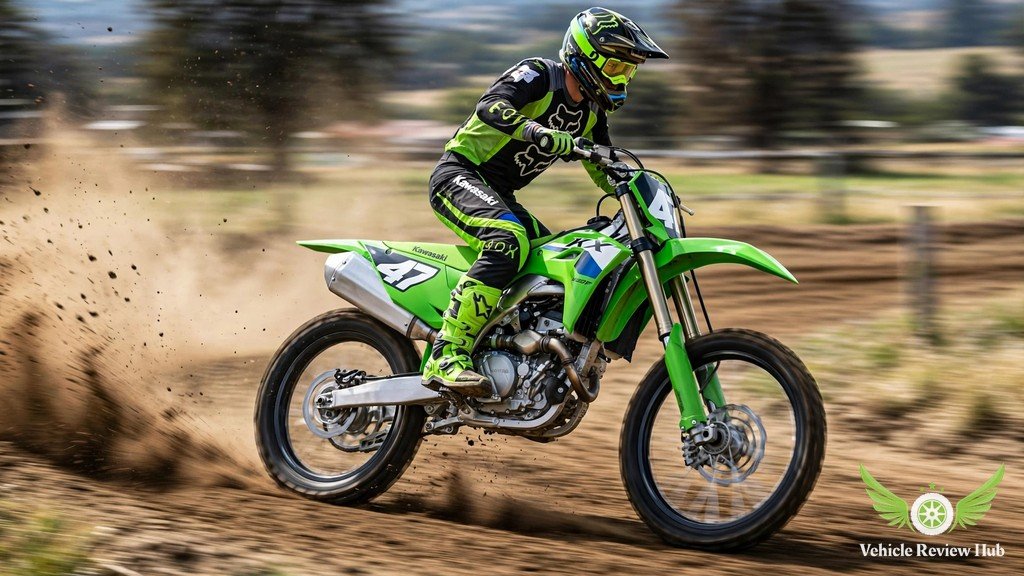
There is no tested top speed and no timed acceleration run for the KX250, and this section of the Kawasaki KX250 performance guide says so plainly instead of filling the gap with a guess. Kawasaki publishes no top speed and no acceleration times for any KX250 year, and no magazine has timed the bike. The numbers that circulate online come from content farms and simulations, not from tests, and this Kawasaki KX250 performance guide leaves them out.
No Tested Top Speed Exists
The only traceable tested claim is about 75 mph, from a Dirt Bike Vault 2022 test as reported by SlashGear, and even that page is now unavailable, confirmed gone in November 2026. This Kawasaki KX250 performance guide mentions it only as one old report that cannot be verified today, not as a figure to trust. Dirt Bike’s gearing table gives a calculated 73.0 mph in fifth gear at 12,500 rpm for the KX250X, with the explicit warning that it is a calculation, not observed speed.
No Timed Runs Either
No magazine has timed a 0-60 mph run or a quarter-mile for the KX250, and this Kawasaki KX250 performance guide found no such time in any published source. The 4.7-second 0-60 figure that appears on some pages is a MotorbikeCatalog simulation, not a test, and this Kawasaki KX250 performance guide never prints it as measured.
What exists instead is gearing and feel. The KX250 runs a close-ratio five-speed gearbox, and testers describe the acceleration as strong once the engine is on the pipe, with the work done by the clutch and the gearbox out of slow corners.
Kawasaki KX250 Mileage and Fuel Economy

There is no miles-per-gallon figure for the KX250, and this section of the Kawasaki KX250 performance guide explains why instead of inventing one.
No MPG for a Moto Bike
No MPG figure exists for the KX250 because the bike is a closed-course competition machine with no DOT or EPA road hardware. The 30 km/l figures on some Indian aggregator pages are database filler, and this Kawasaki KX250 performance guide does not use them. A rider’s real fuel question is simpler: how long does a tank last on track, and the honest answer is that it depends on the rider, the track, and the throttle, and no tester has published a measured number.
The bike’s fuel system is a 44 mm Keihin throttle body with dual injectors, fed by a fuel pump in the tank, and the mapping is selectable through the handlebar-mounted power-mode switch. The companion Kawasaki KX250 reliability guide covers fuel and servicing costs in more detail, and it prints no fuel-economy figure either, for the same reason.
Tank Holds 1.64 Gallons
The fuel tank holds 1.64 gallons (6.2 litres), and this Kawasaki KX250 performance guide verified the figure three ways. Kawasaki’s 2027 KX250F spec sheet prints “Fuel Capacity 1.64 gal”, the 2026 KX250 spec sheet prints the same figure, and Dirt Rider rounds it to 1.6 gallons in its spec table, with the Kawasaki 1.64-gallon figure governing. The 2027 KX250F spec sheet from Kawasaki USA is the source this Kawasaki KX250 performance guide relies on.
Do not confuse the four-stroke’s tank with the new two-stroke’s. The 2027 KX327 two-stroke carries a semi-transparent tank of about 2.2 to 2.3 gallons, and the 1.64-gallon figure belongs only to the four-stroke KX250 and KX250F.
Kawasaki KX250 Real-World Riding Experience
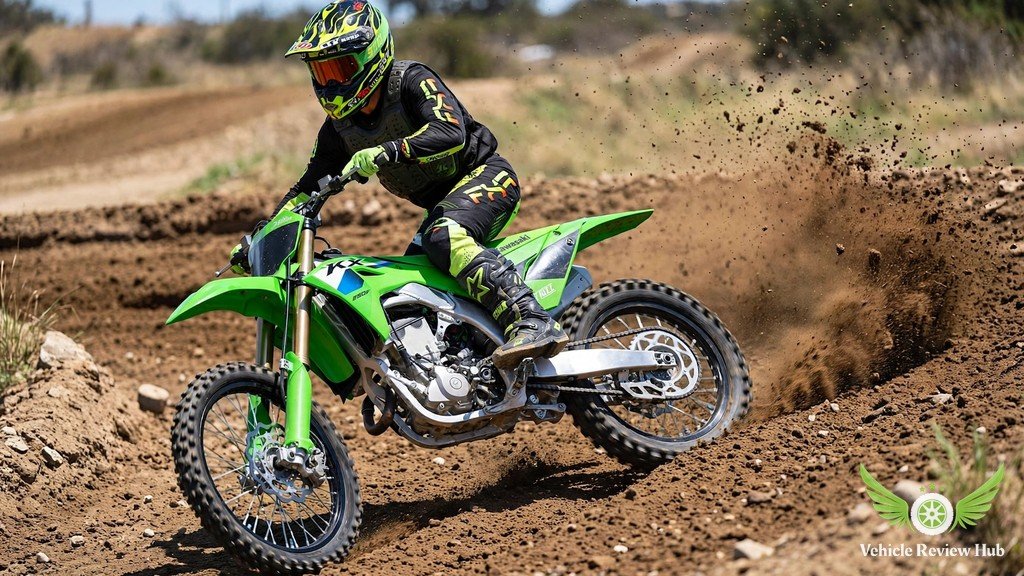
The numbers only tell half the Kawasaki KX250 performance story. The other half is what testers feel on the track: a bike that is fast on top, demanding at the bottom, and more comfortable for bigger riders than for lighter ones. This section of the Kawasaki KX250 performance guide gathers what the first-ride and long-term testers actually said, with the praise and the complaint side by side.
The Riding Experience Buyers Actually Talk About
The 2027 first rides agree on the shape of the bike. Cycle News, testing at Perris Raceway, found the engine most effective from the midrange to the high end, with new levers that finally feel like a conventional lever and suspension that worked well for a 190 lb tester. The Cycle News 2027 KX250F review is the source for the tester weight and the suspension findings, and the Dirt Bike Magazine 2027 first ride is the source for the handling notes.
Kris Keefer’s early impression of the 2027 bike, summarised from his video, ranked the bottom end by initial throttle response: the Yamaha YZ250F strongest off idle, the Honda softest down low, and the Kawasaki between them with more bottom-end torque than the Honda, then building more usable midrange through second and third gear. The full review of the bike, including the price and the spec sheet, is in the companion Kawasaki KX250 review.
Bottom End Is the Complaint
The bottom end is the one complaint every tester names. Dirt Bike Magazine put it plainly in its 2025 dyno wrap: “It looks great on paper, but on the track it’s hard to ride and feels like it has little low-end power.” The same magazine’s 2026 full test added the other side of the coin: “On top, the KX is still the most powerful of the 250s from Japan, but whether or not it matches the universal appeal of the Yamaha power delivery is debatable.” That tension, strong on paper and hard to ride down low, is the core of this Kawasaki KX250 performance guide.
Australasian Dirt Bike, at 22 hours on its 2026 KX250, wrote: “I am starting to want a little more out of the bottom end of this bike, though. … I find myself wanting a little more punch down low.” Motocross Action, testing Pro Circuit’s Team Green race bike, noted that the 2024 KX250 was known for high-end horsepower but lacked torque down low, making it hard to use all 45 horses, and that the 2025 updates were aimed at improving low-end performance, with the new bike 1.4 hp slower than the 2024 on the dyno, peaking 700 rpm earlier with half a pound-foot less torque.
Cycle News disagreed, and the disagreement belongs in the blog. Its 2027 review is blunter: the engine is weak at the very bottom and needs more clutch work and higher rpm out of tight inside ruts. The 2027 longer header, revised combustion chamber, and remap are Kawasaki’s direct answer to the complaint, and this Kawasaki KX250 performance guide presents both sides because the testers themselves are split.
Kawasaki KX250 Handling, Braking and Stability
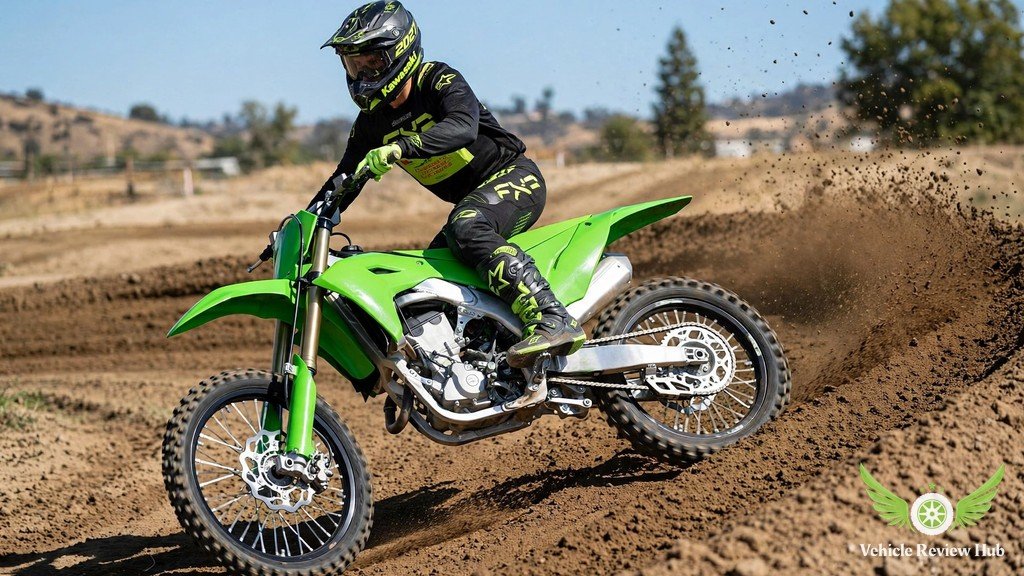
The chassis is the part of the Kawasaki KX250 performance story that testers praise, even as the bike finishes last in shootouts. The Showa suspension, the shared KX450 frame, and the long stable feel earn good words, while the weight and the engine are what sink the result. This section of the Kawasaki KX250 performance guide separates the two, because a buyer should know the handling is not the problem.
Last in 2026 Shootout
The KX250 finished seventh and last in Dirt Rider’s 2026 250F comparison test, a seven-bike shootout won by the Yamaha YZ250F. The Dirt Rider 2026 250F shootout ranked the bikes Yamaha first, KTM 250 SX-F second, Honda CRF250R third, Triumph TF 250-X fourth, Husqvarna FC 250 fifth, GasGas MC 250F sixth, and the Kawasaki KX250 seventh.
The KX250 was fifth in Dirt Rider’s 2024 test, then seventh in 2025, then seventh again in 2026. Motocross Action’s 2026 250 shootout exists only as a video, and no text source states the KX250’s placement in it, so this Kawasaki KX250 performance guide cites no MXA placement. Dirt Rider measured the KX250 at 242 lb with a full tank, the heaviest of the seven, against the Yamaha at 234 lb.
| Place | Bike | Measured weight (full tank) |
|---|---|---|
| 1 | Yamaha YZ250F (winner) | 234 lb |
| 2 | KTM 250 SX-F | 237 lb |
| 3 | Honda CRF250R | 232 lb |
| 4 | Triumph TF 250-X | 233 lb |
| 5 | Husqvarna FC 250 (2025 bike) | 235 lb |
| 6 | GasGas MC 250F | 240 lb |
| 7 | Kawasaki KX250 | 242 lb |
Note: The ranking above is Dirt Rider’s 2026 250F comparison test, seven bikes, and this Kawasaki KX250 performance guide names Dirt Rider explicitly because the placement belongs to that test, not to every shootout. The weights are Dirt Rider’s own measured figures with a full tank, and the KX250 is the heaviest of the seven by 2 lb over the GasGas.
Handling, Braking and Stability on Real Roads
The heading says real roads, but the KX250 never sees one. It is a closed-course motocross bike with no lights, no mirrors, and no road registration, so this section of the Kawasaki KX250 performance guide frames the heading as track stability and handling, not street riding.
Dirt Bike Magazine’s 2026 full test found that the Showa switch made a noticeable improvement in the overall ride, and that the bike is well balanced and seems to get better and better the harder it is ridden. The 2027 first ride added that the handling has not changed, the suspension is a little more active than before, and the bike has more of a long stable feel than a cut-and-slice feel, favouring big riders. The same review was honest about the brakes: the Nissin front brake is not as good as the Brembo on the KX450, but the front-brake and clutch levers now share the same bend.
| Item | 2027 KX250F |
|---|---|
| Front fork | 49 mm Showa inverted coil-spring, 12.0 in travel, 16-way compression and rebound |
| Rear shock | Uni-Trak with Showa shock, 12.1 in travel, dual-range compression, 22-way rebound |
| Front brake | Single semi-floating 270 mm Braking petal disc, dual-piston Nissin caliper |
| Rear brake | Single 240 mm Braking petal disc, single-piston Nissin caliper |
| Rake / trail | 27.0 degrees / 4.6 in |
| Wheelbase | 58.5 in |
| Ground clearance | 13.4 in |
| Weight | 230.9 lb without fuel / 240.8 lb curb (Kawasaki claimed); 242 lb wet measured by Dirt Rider |
| Tyres | Dunlop Geomax MX34, 80/100-21 front, 110/90-19 rear |
| Seat height | 37.6 in |
Note: The figures above are from Kawasaki’s 2027 KX250F spec sheet, with the measured weight from Dirt Rider’s shootout table. The 2026 and 2027 spec sheets agree on the suspension and brake hardware, and this Kawasaki KX250 performance guide uses the 2027 sheet as the source. The Nissin caliper detail comes from Dirt Rider’s spec table.
Kawasaki KX250 Performance Compared With Other Sport Bikes
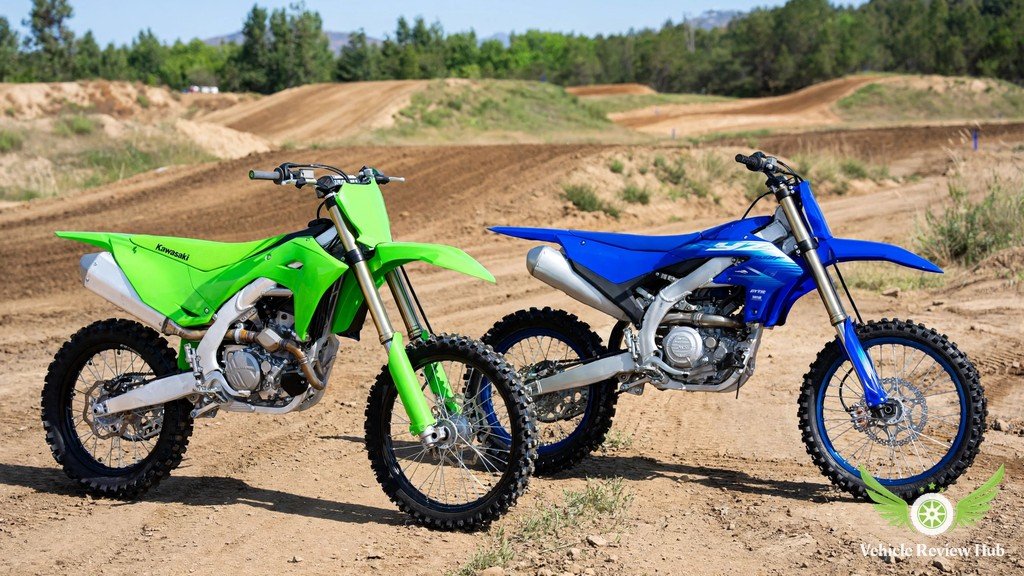
The heading says sport bikes, but the rivals here are motocross bikes, and this section of the Kawasaki KX250 performance guide compares the KX250 with its closest 250 four-stroke rival, the Yamaha YZ250F, on the only basis that counts: the same dyno, the same shootout, and the same price list. The full four-bike price and value comparison is in the companion Kawasaki KX250 comparison.
Kawasaki KX250 vs Yamaha YZ250F
On price the Kawasaki wins. The 2027 KX250F lists at $8,599, which is $500 less than the 2027 YZ250F at $9,099, and the Yamaha is all-new for 2027, with a new engine that revs 700 rpm higher, compression up from 13.8:1 to 14.1:1, and a bilateral beam frame taken from the YZ450F. The Yamaha’s wet weight is 236 lb against the Kawasaki’s claimed 240.8 lb curb, and its seat is 38.2 inches against the Kawasaki’s 37.6 inches, so the Yamaha is about 5 lb lighter by the claimed figures and 0.6 inches taller at the seat.
On Dirt Rider’s Dynojet 250i the 2026 KX250 made 39.2 hp and 18.7 lb-ft, while the 2026 YZ250F made 39.5 hp and 18.4 lb-ft, so the Yamaha edges the Kawasaki by 0.3 hp and the Kawasaki edges the Yamaha by 0.3 lb-ft. On Dirt Bike Magazine’s Pro Circuit dyno the 2025 KX250 made 43.49 hp and 20.72 lb-ft against the YZ250F’s 41.62 hp and 19.49 lb-ft, so the Kawasaki is ahead by 1.87 hp and 1.23 lb-ft on that dyno. Both pairs are same-dyno comparisons, and this Kawasaki KX250 performance guide never mixes the two dynos.
The YZ250F won Dirt Rider’s 2026 shootout while the KX250 finished seventh and last, and the same pattern held in Cycle News’ 2025 shootout, where the Yamaha won and the Kawasaki was seventh of eight. The lesson of this Kawasaki KX250 performance guide is that dyno numbers do not decide shootouts: the Yamaha’s usable delivery beats the Kawasaki’s peak numbers, and the Kawasaki’s weak bottom end costs it more than its top-end power gains it.
Is the Kawasaki KX250 Suitable for Beginner Riders?
Not as a first bike. The KX250 is a closed-course race bike with a 37.6-inch seat, a claimed 240.8 lb wet weight, a high-revving engine, and a 15-hour piston interval in the factory chart, and this Kawasaki KX250 performance guide says no beginner should start there.
The honest limit is a fit, tall beginner with track access and a budget for maintenance. The seat needs a 32-inch inseam as a fair minimum, the suspension is stiff for riders under 150 lb, and the close-ratio five-speed gearbox asks for clutch work that a new rider has not learned yet. A KLX230 or CRF250F trail bike is the better first bike, and the KX250 is the bike to move up to once the basics are learned. This Kawasaki KX250 performance guide says so plainly because the 15-hour piston interval alone makes the running costs a beginner’s surprise, and the companion reliability guide covers that interval in full.
Kawasaki KX250 Performance: Frequently Asked Questions
The questions below cover the performance facts buyers ask about most, and every answer comes from the verified research in this Kawasaki KX250 performance guide.
How much horsepower does the Kawasaki KX250 make?
It depends on the dyno, and this Kawasaki KX250 performance guide always says which one. Dirt Rider’s Dynojet 250i measured the 2026 KX250 at 39.2 hp at 12,700 rpm, with 18.7 lb-ft of torque at 9,100 rpm. Motocross Action’s own dyno read higher: 43.7 hp at 12,500 rpm, with 20.48 lb-ft at 9,200 rpm. Different dynos, different days, and neither number is wrong. No dyno figure exists yet for the 2027 KX250F; Kawasaki claims about 0.7 hp more peak power.
What is the top speed of the Kawasaki KX250?
No tested top speed exists. No magazine or manufacturer has measured it, and this Kawasaki KX250 performance guide prints no top-speed figure for that reason. The 75 to 85 mph figures on some aggregator pages are unsourced or come from a single old report whose page is gone, so they should not be trusted.
What is the fuel economy of the Kawasaki KX250?
No MPG figure exists for the KX250, and this Kawasaki KX250 performance guide prints none. It is a closed-course competition bike with no DOT or EPA road hardware, so it is never EPA-tested, and no magazine runs a fuel-economy loop on a motocross bike. Its tank holds 1.64 gallons, from the Kawasaki spec sheet.
Why do testers complain about the KX250’s bottom end?
The engine is a top-end screamer: strong from the midrange up, but weak at the very bottom. Dirt Bike Magazine put it plainly: “It looks great on paper, but on the track it’s hard to ride and feels like it has little low-end power.” Testers say it needs more clutch work out of tight corners. Cycle News disagreed, calling the low-end impressive, so this Kawasaki KX250 performance guide presents both sides. The 2027 longer header and revised combustion chamber are Kawasaki’s direct answer to the complaint.
Where did the KX250 finish in the 2026 shootouts?
Last, seventh of seven, in Dirt Rider’s 2026 250F comparison test, with the verdict that green could use more power. It was also seventh of eight in Cycle News’ 2025 250 shootout. The chassis was praised; the engine and the heaviest-in-class weight, 242 lb wet as Dirt Rider measured it, are what sank it.
Is the Kawasaki KX250 good for beginners?
Not as a first bike, and this Kawasaki KX250 performance guide is blunt about it. It is a closed-course race bike with a 37.6-inch seat, 240.8 lb claimed wet weight, a high-revving engine, and a 15-hour piston interval. Cycle News calls the 2025-and-newer bike easy to ride for its class, but a fit, tall beginner with track access is the honest limit, and a KLX230 or CRF250F trail bike is the better first bike.