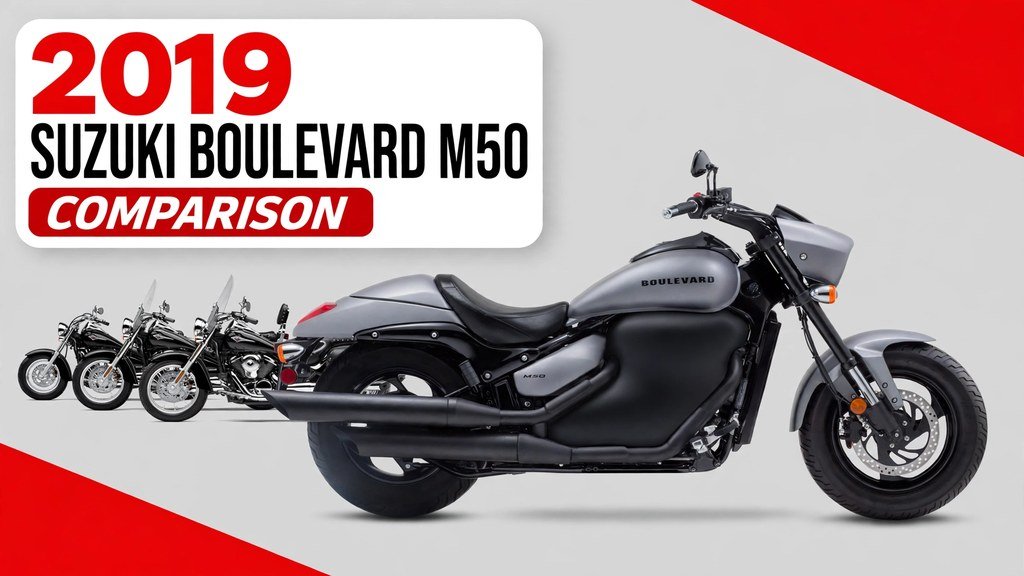
The Suzuki Boulevard M50 has not been sold new since 2019, yet it still sets the price every middleweight cruiser buyer measures against. This Suzuki Boulevard M50 comparison puts the last-new M50 — $8,699 plus $395 destination, $9,094 in total — against the three rivals a buyer can still buy new in 2026: the Kawasaki Vulcan 900 Custom, the Vulcan 900 Classic and the Honda Shadow Phantom. The short answer: the M50 still wins on price and shaft-drive simplicity, the Phantom wins on brakes, and the two Vulcans win on engine size and tank range.
Suzuki Boulevard M50 Overview and Its Closest Rivals
A Suzuki Boulevard M50 comparison only works if the rivals do the same job. All four bikes here are middleweight V-twin cruisers with low seats, five-speed gearboxes and prices under $11,000 out the door — and the M50 is the only one that cannot be bought new, so its figures are its last-new 2019 numbers.
Why These Three Rivals: Same Class, Same Job
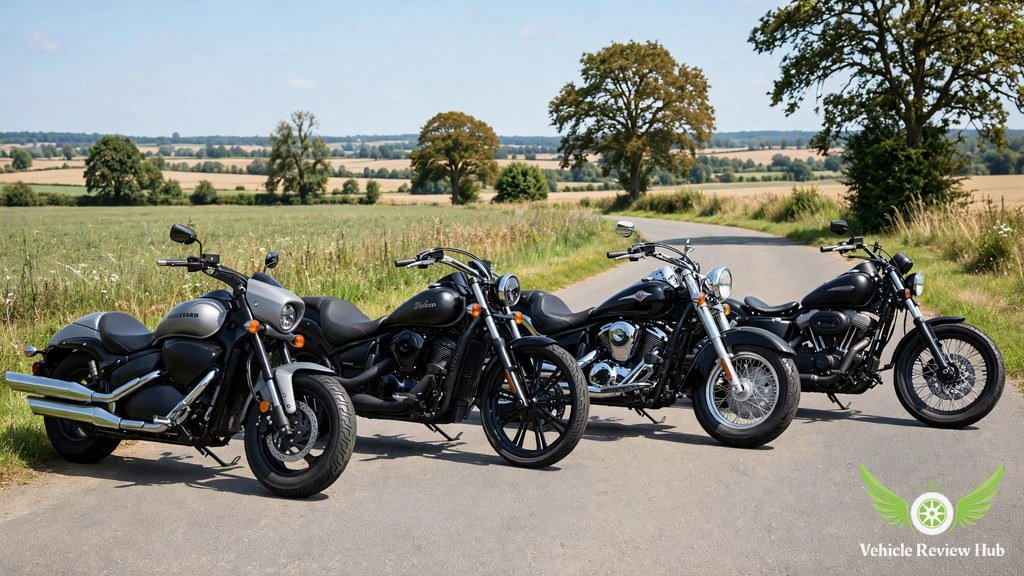
The three rivals in this Suzuki Boulevard M50 comparison were picked because each one challenges the M50 on a different strength. The Vulcan 900 Custom is the style rival: a 21-inch front wheel, drag bars and slash-cut exhausts, the same muscle-cruiser look the M50 sells on. The Vulcan 900 Classic is the traditional rival: spoked wheels, classic fenders, same 903cc engine. The Shadow Phantom is the practical rival: the only bike here with shaft drive like the M50 and the only one with ABS. The Suzuki Boulevard M50 review covers the M50’s own prices, specs and riding experience in full.
How the Four Bikes Differ at a Glance
The table below is the whole Suzuki Boulevard M50 comparison on one page.
| Specification | Suzuki Boulevard M50 (2019) | Vulcan 900 Custom (2026) | Vulcan 900 Classic (2026) | Shadow Phantom (current) |
|---|---|---|---|---|
| Total price, new / last new | $9,094 | $10,839 | $10,439 | $9,299 |
| Engine | 805cc liquid-cooled 45° V-twin | 903cc liquid-cooled 55° V-twin | 903cc liquid-cooled 55° V-twin | 745cc liquid-cooled 52° V-twin |
| Power | 52 hp claimed; 43.5 hp dyno | 51 hp @ 5,500 rpm | 51 hp @ 5,500 rpm | ~44.6–44.9 hp (independent) |
| Final drive | Shaft | Kevlar belt | Belt | Shaft |
| Curb weight | 593 lb | 610.8 lb | 619.6 lb | 553 lb |
| Seat height | 27.6 in | 27.0 in | 26.8 in | 25.6 in |
| Fuel tank | 4.1 gal | 5.3 gal | 5.3 gal | 3.9 gal |
| Brakes / ABS | Front disc, rear drum; no ABS | Discs front and rear; Non-ABS | Discs front and rear; Non-ABS | Discs front and rear; ABS front and rear |
The video below is Motorcycle.com’s 2015 “Strange Bedfellows” shootout, the M50 against the Star Bolt C-Spec — not a comparison against these three rivals, but the only head-to-head test that ever measured the M50 on a dyno against another middleweight cruiser.
Suzuki Boulevard M50 vs Kawasaki Vulcan 900 Custom
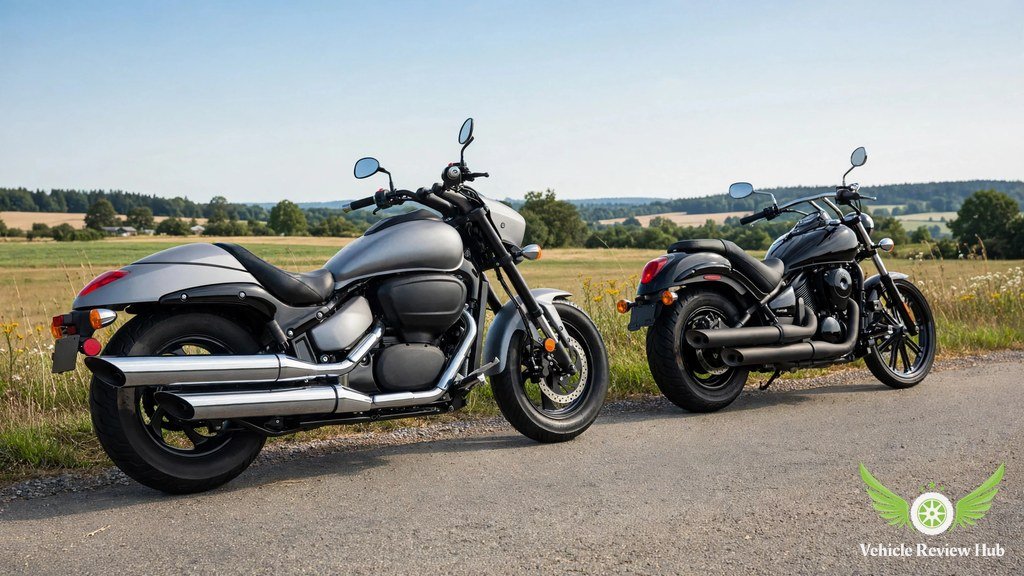
The Vulcan 900 Custom is the closest thing to a new M50 a buyer can find in 2026 — same muscle-cruiser idea, same drag-bar stance, same slash-cut exhausts — but a different bike underneath, and $1,745 more out the door. In this Suzuki Boulevard M50 comparison, the Custom is the rival for the buyer who likes the M50’s look and wants it new, with a bigger engine and tank.
Engine, Specs and Performance Side by Side
On paper the Custom’s engine is the bigger one: 903cc against the M50’s 805cc, both liquid-cooled V-twins. Kawasaki publishes its own figures — 51 hp at 5,500 rpm and 58.3 lb-ft at 3,500 rpm — while Suzuki never published a power figure for the M50 at all. The M50’s numbers come from elsewhere: a database claim of 52 hp and 51 lb-ft for 2009-and-later bikes, and Motorcycle.com’s 2015 dyno run of 43.5 hp. The M50’s real rear-wheel output sits below the Custom’s published 51 hp, and the Custom’s 58.3 lb-ft is comfortably ahead of the M50’s claimed 51 lb-ft. The Custom is the quicker bike, and its 5.3-gallon tank against the M50’s 4.1 gallons means fewer fuel stops. The hardware split is clear: the M50 runs a shaft final drive and a 41mm inverted fork with black outer tubes, the only inverted fork in this group, while the Custom runs a Kevlar-reinforced belt and a conventional 41mm Showa fork. The Custom’s signature is its 21-inch front wheel with a skinny 80/90-21 tire, against the M50’s 16-inch cast wheel. Weight favours the M50: 593 lb curb against 610.8 lb. Brakes are a wash: both bikes have a single front disc and no ABS — the Custom’s rear is a 270mm disc where the M50 still uses a rear drum. The Suzuki Boulevard M50 performance guide covers the M50’s dyno figures and the 42.8 MPG test.
Price, Equipment and Which Suits Which Rider
The Custom lists at $9,999 plus $840 destination, $10,839 in total; the M50’s last-new total was $9,094, so a new Custom costs $1,745 more than the M50 cost new — and far more than a used M50, which marketplace guides commonly list in the $2,500–$8,500 range (a weak source — treat as ranges, not verified prices). What the extra money buys is newness: a 2026 bike with a full warranty, a bigger engine and tank, and the Custom’s drag-bar styling. What it does not buy is shaft drive, the M50’s inverted fork, or ABS, which neither bike offers. In this Suzuki Boulevard M50 comparison, the Custom suits the rider who wants the M50’s look in a brand-new bike. The M50 suits the rider who wants the same job done for thousands less. Kawasaki’s own 2026 Custom page lists the full spec table behind these figures.
Suzuki Boulevard M50 vs Kawasaki Vulcan 900 Classic
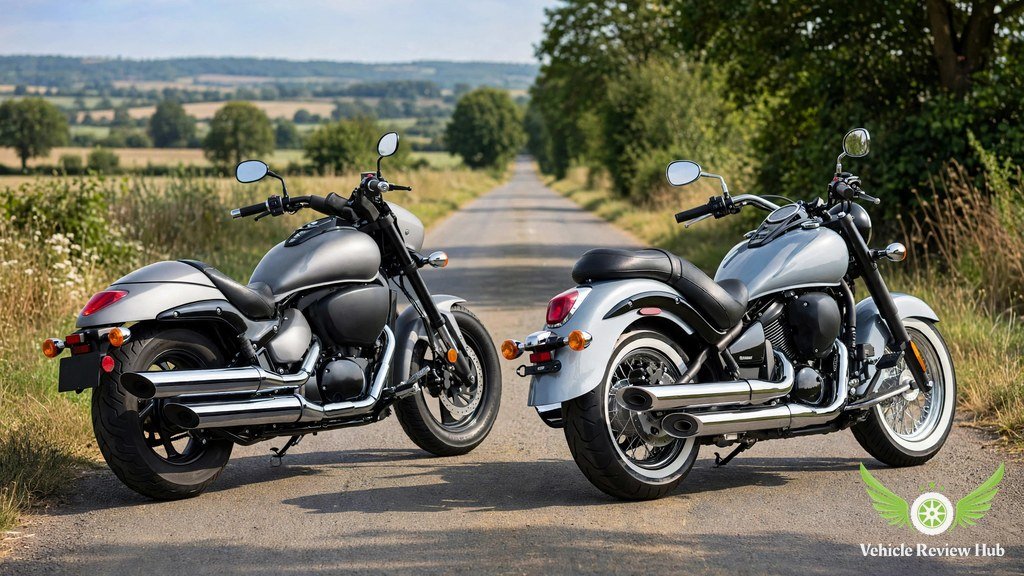
The Vulcan 900 Classic is the same motorcycle as the Custom underneath — same 903cc engine, same frame, same belt drive — dressed as a traditional cruiser instead of a drag bike. That makes this Suzuki Boulevard M50 comparison a question of style and stance rather than power: the Classic trades the Custom’s 21-inch front wheel for spoked wheels and classic fenders, and costs $400 less than its Custom sibling.
Engine, Specs and Performance Side by Side
The Classic’s engine is identical to the Custom’s — a 903cc liquid-cooled 55-degree V-twin, 88.0 by 74.2 mm, 9.5:1 compression, with digital fuel injection — and Kawasaki publishes the same figures: 51 hp at 5,500 rpm and 58.3 lb-ft at 3,500 rpm. Against the M50 that is the same advantage the Custom holds: roughly 98cc more displacement. The Classic rolls on spoked wheels — a 130/90-16 front and a 180/70-15 rear — where the M50 uses cast wheels. The Classic is also the heaviest bike in this Suzuki Boulevard M50 comparison at 619.6 lb curb, 26.6 lb heavier than the M50’s 593 lb and 8.8 lb heavier than the Custom, though its 26.8-inch seat is the second-lowest here. The Classic shares the Custom’s suspension and brakes — a 41mm Showa fork, Uni-Trak rear swingarm, a single 300mm front disc and a single 270mm rear disc, no ABS. The M50 answers with its inverted fork, its shaft drive against the Classic’s Kevlar belt, and a rear drum. Kawasaki’s own 2026 Classic page confirms the $9,599 base price, the $840 destination charge, the 619.6 lb curb weight and the 26.8-inch seat height.
Price, Equipment and Which Suits Which Rider
The Classic lists at $9,599 plus $840 destination, $10,439 in total — $1,345 more than the M50’s last-new total of $9,094, and $400 less than the Custom. For that money the buyer gets the traditional cruiser look — spoked wheels, full classic fenders, Metallic Ocean Blue or Pearl Stardust White paint — with the same engine and warranty as the Custom. Against the M50, the Classic’s case is comfort and presence: a lower seat, a wider rear tire and a bigger tank. In this Suzuki Boulevard M50 comparison, the Classic suits the rider who wants a classic-looking cruiser and does not mind a belt drive or the extra 26.6 lb. The M50 suits the rider who prefers the muscle-cruiser stance and would rather spend the $1,345 difference on riding gear, tires and servicing.
Suzuki Boulevard M50 vs Honda Shadow Phantom
The Shadow Phantom is the most interesting rival in this Suzuki Boulevard M50 comparison because it is the cheapest new bike here and the only one that beats the M50 at its own game. It matches the M50 on shaft drive, undercuts it on weight and seat height, and adds the one thing no M50 ever had: ABS on both wheels. It gives up 60cc and a little torque to do it, and its 3.9-gallon tank is the smallest in the group — but at $9,299 out the door, only $205 more than the M50’s last-new total, it makes the used-M50 decision hardest.

Engine, Specs and Performance Side by Side
The Phantom’s engine is the smallest here: a 745cc liquid-cooled 52-degree V-twin with programmed fuel injection, 79.0 by 76.0 mm and 9.6:1 compression. Honda publishes no power figure for it — the same silence as Suzuki for the M50 — so the numbers available are independent-testing figures of roughly 44.6 to 44.9 hp and 47.9 lb-ft at 3,500 rpm, estimates, not factory claims. On those figures the Phantom sits almost exactly level with the M50’s 43.5 hp dyno run, so neither bike has a meaningful straight-line advantage. It is the lightest bike in the group at 553 lb curb — 40 lb lighter than the M50 — and its 25.6-inch seat is the lowest by two full inches. Its brakes are the best here in this Suzuki Boulevard M50 comparison by a clear margin: a single 296mm front disc and a single 276mm rear disc, both with ABS, where the M50 has a front disc and a rear drum with no ABS in any year. The Phantom’s final drive is a shaft, like the M50’s, so both bikes share the same near-zero drivetrain maintenance. Its weak point is range: the 3.9-gallon tank is the smallest here. Honda’s current Shadow Phantom page lists the bike at $8,699 plus $600 destination, and shows the 2025 Shadow Phantom ABS in dealer inventory.
Price, Equipment and Which Suits Which Rider
At $8,699 — exactly the same MSRP the M50 carried in 2019 — plus $600 destination, the Phantom totals $9,299, just $205 more than the M50’s last-new total of $9,094. A buyer choosing between a used M50 at $4,000 to $7,000 and a brand-new Phantom at $9,299 is choosing between saving roughly $2,300 to $5,300 and getting a new bike with a warranty and ABS. The Phantom’s equipment list is short but well aimed: bobber-inspired styling, a blacked-out finish in Deep Pearl Gray or Flare Orange Metallic, and the same low-maintenance shaft drive the M50 is praised for. What it gives up is presence — the 745cc engine is the smallest here. The Phantom suits the shorter rider, the newer rider, and anyone who puts ABS at the top of the list. In this Suzuki Boulevard M50 comparison, the M50 suits the rider who wants more visual muscle and the lower used price, and who is comfortable riding without ABS. The YouMotorcycle M50 review, written by a rider who owns three M50s, calls the M50 “one of the most low maintenance motorcycles you can get”.
Suzuki Boulevard M50 Price and Value Compared
Price is where this Suzuki Boulevard M50 comparison turns into a buying decision, because the four bikes span a $1,745 spread new — and the M50 is not new at all. Read the numbers below as two different purchases: the M50’s last-new price against three current new prices, and the used M50’s real price against the same three bikes.

New Prices Across the Four Bikes in the USA
Every total in this Suzuki Boulevard M50 comparison is the manufacturer’s own base price plus its own destination charge, before tax, title and dealer fees. The M50’s row is its 2019 last-new price: $8,699 plus a $395 destination charge on Suzuki’s own 2019 page — with a $15 split worth naming: motorcycle.com’s spec database prints a $380 destination charge, but Suzuki’s own page charges $395, so $9,094 is the headline total. The Phantom’s MSRP is exactly the same as the M50’s was, $8,699, which is why the Phantom costs only $205 more out the door — the difference is entirely in the destination charge, $600 against the M50’s $395. The two Vulcans are the expensive end: Custom $10,839, Classic $10,439.
| Bike | MSRP | Destination | Total | Gap vs M50 last-new |
|---|---|---|---|---|
| Suzuki Boulevard M50 (2019, last new) | $8,699 | $395 | $9,094 | — |
| Kawasaki Vulcan 900 Custom (2026) | $9,999 | $840 | $10,839 | +$1,745 |
| Kawasaki Vulcan 900 Classic (2026) | $9,599 | $840 | $10,439 | +$1,345 |
| Honda Shadow Phantom (current) | $8,699 | $600 | $9,299 | +$205 |
Running Costs and Resale Value Compared
Running costs in this Suzuki Boulevard M50 comparison favour the two shaft-drive bikes. The M50 and the Phantom both need almost nothing from their final drives, while the two Vulcans’ Kevlar belts need periodic adjustment and eventual replacement, a real cost the shaft bikes never face. Fuel is the M50’s cheapest running cost: Motorcycle.com tested 42.8 MPG in its 2015 shootout, the only named, tested figure in this group. The Phantom’s 56 mpg is Honda’s own estimate, not a test, and Kawasaki publishes no MPG figure for the Vulcans. Servicing is simple — oil at every interval, the filter only at 600 and 11,000 miles, valve clearance inspected every 7,500 miles — and parts are plentiful. The full service chart is in the M50 service schedule from the manual, and the Suzuki Boulevard M50 reliability guide covers the maintenance costs and the one recall that applies. Resale cuts the other way: a used M50 has already taken its depreciation, but the new bikes carry a factory warranty the M50 cannot.
Suzuki Boulevard M50 Comparison Verdict and US Alternatives
The verdict of this Suzuki Boulevard M50 comparison depends on the buyer’s budget and their feelings about ABS. If the budget is under $7,000, the answer is the used M50 — nothing new in this class comes close to its price. If the budget stretches to $9,299 and ABS matters, the answer is the current Shadow Phantom, which matches the M50 on shaft drive and beats it on brakes, weight and seat height. If the budget stretches past $10,000, the Vulcan 900 Classic is the better buy of the two Kawasakis for most riders — same engine as the Custom, $400 cheaper and a lower seat.
All Three Rivals Are Still New in 2026
All three rivals in this Suzuki Boulevard M50 comparison are still sold new in 2026. Kawasaki’s own 2026 pages list the Vulcan 900 Custom at $9,999 and the Classic at $9,599, and Honda’s current Shadow Phantom page lists the bike at $8,699 with 2025 models in dealer inventory. None of the three is a leftover being cleared out — they are current production motorcycles. That availability is also what sets the M50’s used price: a buyer can always walk away from a used M50 and buy a new Phantom for $9,299, so no used M50 is worth anything close to that figure — and clean examples leave room for the ignition-switch recall check the Boulevard C50 comparison also flags. Two alternatives sit outside the doc’s three rivals: the Suzuki Boulevard C50, the M50’s sibling with the same 805cc engine family and shaft drive, at $8,299 plus $380 destination for 2026 per motorcycle.com’s spec database; and the discontinued Yamaha V Star 950, used-market only.
The Phantom Matches on Shaft Drive, Adds ABS
The heading says the Phantom’s whole case in this Suzuki Boulevard M50 comparison in one line. The Phantom matches the M50 on shaft drive — no chain to clean, no belt to adjust — and then adds the safety feature the M50 never had in any year: ABS on the front and rear discs. The M50’s brakes are its weakest point against all three rivals: a single front disc and a rear drum, while the Phantom runs discs at both ends with ABS. For a rider who commutes in the rain or is buying a first cruiser, that ABS advantage outweighs the Phantom’s smaller engine and tank. For a rider who does their own maintenance and values the M50’s inverted fork, the M50’s shaft drive plus its thousands-lower used price still wins. Neither answer is wrong — but the buyer should make it knowingly.
Suzuki Boulevard M50 Comparison: Frequently Asked Questions
Direct answers to the questions riders ask when cross-shopping the Suzuki Boulevard M50 against the Vulcan 900 Custom, Vulcan 900 Classic and Honda Shadow Phantom.
Which is the best value — the M50, Vulcan 900 Custom, Classic, or Shadow Phantom?
In this Suzuki Boulevard M50 comparison, the used M50 is the best value on purchase price — clean examples commonly list at $4,000 to $7,000, thousands below any new rival. The best value among new bikes is the Shadow Phantom at $9,299 out the door, the only new rival that matches the M50 on shaft drive and adds ABS.
Is the Suzuki Boulevard M50 cheaper than the Vulcan 900 Custom?
Yes, by a wide margin. In this Suzuki Boulevard M50 comparison, the M50’s last-new total was $9,094 in 2019, and used examples commonly list at $2,500 to $8,500, while a new 2026 Vulcan 900 Custom totals $10,839 — $1,745 more than the M50 cost new.
Which bike is faster — the M50 or the Vulcan 900?
In this Suzuki Boulevard M50 comparison, the Vulcan 900 is the quicker bike: Kawasaki publishes 51 hp and 58.3 lb-ft for both Vulcans, against the M50’s 43.5 hp dyno run and a database claim of 52 hp. No instrumented 0–60 or top-speed test exists for the M50.
Does the M50 have ABS like the Shadow Phantom?
No. ABS was never offered on the US M50 in any year. The Shadow Phantom is the only bike in this Suzuki Boulevard M50 comparison with ABS, on both wheels. The two Vulcans are also non-ABS.
Which bikes have shaft drive — the M50, the Vulcan 900, or the Shadow Phantom?
The M50 and the Shadow Phantom both have shaft drive; the two Vulcan 900 models use a Kevlar-reinforced belt instead. Shaft drive needs almost no maintenance, while a belt needs periodic adjustment and eventual replacement.
Is the Suzuki Boulevard M50 still sold new in 2026?
No. In this Suzuki Boulevard M50 comparison, the M50’s last US model year was 2019. The M50 is available only used, commonly listed in the $2,500–$8,500 range, while all three rivals are still sold new in 2026.
Which is the lightest bike — the M50, Vulcan 900 Custom, Classic, or Phantom?
The Shadow Phantom is the lightest at 553 lb curb, 40 lb lighter than the M50’s 593 lb. The Vulcan 900 Custom is 610.8 lb and the Classic is the heaviest at 619.6 lb.
Which bike has the lowest seat height?
The Shadow Phantom, at 25.6 inches — two full inches lower than the M50’s 27.6 inches. The Vulcan 900 Classic is next at 26.8 inches, then the Custom at 27.0 inches.
Is the Vulcan 900 Custom better than the Classic?
They are the same motorcycle underneath — same 903cc engine, same 51 hp and 58.3 lb-ft, same frame, same belt drive. The Custom costs $400 more and buys the 21-inch front wheel and drag bars; the Classic buys spoked wheels and classic fenders. The Classic is the better buy for most riders.
What does a used M50 cost compared to a new rival?
Used M50s commonly list in the $2,500–$8,500 range, with clean examples around $4,000–$7,000, according to marketplace buying guides — a weak source, so treat the figures as ranges, not verified prices. Against that, a new Shadow Phantom totals $9,299, a new Vulcan 900 Classic $10,439 and a new Vulcan 900 Custom $10,839.
Which rival is best for a beginner rider?
The Shadow Phantom: it is the lightest at 553 lb, it has the lowest seat at 25.6 inches, and it is the only bike here with ABS. The M50 is also beginner-friendly, but it has no ABS and its brakes are the weakest in the group.
Should I buy a used M50 or a new Vulcan 900 or Shadow Phantom?
In this Suzuki Boulevard M50 comparison, buy the used M50 if your budget is under $7,000, you do your own maintenance, and you value shaft drive and the lowest running costs. Buy the new Shadow Phantom if your budget reaches $9,299 and ABS, a warranty and a new bike matter more. Buy a new Vulcan 900 if you want the biggest engine and tank and will pay $10,439 to $10,839. Before buying any used M50, run the VIN through the NHTSA recalls lookup for the 2005–06 ignition-switch recall, campaign 05V-566.