The short answer first: the 2026 Suzuki DR-Z125L is one of the most reliable trail bikes you can buy, and the reason is simple — there is almost nothing on it to break. A 124cc air-cooled single with a carburettor, a kick starter, no battery and no electronics has been in production since 2003, and owners who have lived with it for years say the same thing: change the oil, clean the carburettor if it sits, and it keeps running. This Suzuki DR-Z125L reliability guide sets out what goes wrong, what the calendar-based service chart asks for, what it costs to keep, and why no recall has ever been issued for this bike.
Suzuki DR-Z125L Reliability Overview
The DR-Z125L’s reliability story starts with its age. The same 124cc air-cooled two-valve single, the same Mikuni VM20SS carburettor and the same five-speed gearbox have been in production since 2003, essentially unchanged. A bike unchanged for more than twenty years has no new-design surprises left, and every weakness it ever had has had two decades to show up.

Extraordinarily Reliable, Says Ultimate Motorcycling
Ultimate Motorcycling’s 2016 review put the verdict in the first paragraph: “The first thing to know is that the Suzuki DR-Z125L is an extraordinarily reliable motorcycle. The air-cooled two-valve single has been around for years, and should provide service for decades, making it an excellent hand-me-down dirt bike.” The Ultimate Motorcycling 2016 review is the source, and it added the practical reason the bike lasts: “Maintenance is a breeze, as the air and oil filters are easily cleaned or swapped (though both require tools), and it is simple to adjust the chain and change the oil.” There is no battery to tend to, no fuel injection to diagnose and no radiator to leak — the three systems that generate most repair bills on modern trail bikes are simply not on this one. The Dirt Rider 2008 midsize playbike comparison is the only named press test this Suzuki DR-Z125L reliability guide draws on.
No Model-Specific Defect Reporting Was Found
No pattern of a specific part failing on the DR-Z125L was found in owner reports, forums or press coverage. The issues that do appear are storage and learner issues, not design defects — a carburettor clogged by old fuel after months in the garage, a clutch worn by a learner slipping it, a chain left dry. This Suzuki DR-Z125L reliability guide does not invent a “common problems” list from other bikes — the honest list is short and it is covered in the next section. The kick starter can be hard for a lighter rider to work — a design choice, covered in the Suzuki DR-Z125L review — and the bike is cold-blooded at starting, which the Suzuki DR-Z125L performance guide covers in full. The engine, gearbox and chassis have no known weak point, and for a learner’s trail bike that will be dropped, stalled and stored, that is the whole point.
Suzuki DR-Z125L Common Problems and Wear Items
The DR-Z125L’s common problems are not the kind that strand a rider on the trail. They show up after the bike has sat in a garage for months, or after a learner has spent a season slipping the clutch. Both are cheap to prevent and cheap to fix, and this Suzuki DR-Z125L reliability guide covers both with the actual fix.

Carb Clogging From Storage Is the Top No-Start Cause
The top no-start cause on the DR-Z125L is a clogged carburettor after storage — the one problem every owner source agrees on, and the first thing this Suzuki DR-Z125L reliability guide names. Motocross Hideout puts it plainly: “The biggest issues will most likely be from the owner not keeping up on maintenance or letting it sit too long, causing it to not start.” The Mikuni VM20SS carburettor holds a small amount of fuel in its float bowl, and when the bike sits for weeks that fuel evaporates and leaves varnish in the pilot jet — the tiny jet that feeds the engine at idle. The Motocross Hideout DRZ125 review is the source for the storage warning, and the fix is the one every carburetted bike has used for decades: drain the float bowl before storage, or run the bike dry, and use fresh fuel with a stabiliser if it will sit.
Learner Clutch Wear and Cold-Start Habits
The second wear item is the clutch, and it wears the way learner clutches always wear: a new rider slips it. The DR-Z125L is a proper learning bike with a true manual clutch and a five-speed gearbox, and its buyers are teens and smaller adults learning to ride — short first and second gears, a light 196 lb weight, and a forgiving engine. A learner holding the clutch half-engaged wears it faster, and the symptom is slip under load or drag at the lever. The clutch cable play is inspected at every service interval, and the fix for a worn clutch is a set of plates — a cheap, routine job on a 124cc single. A carburetted single with a choke needs a starting routine: choke on, a firm kick, choke off as it warms. Ultimate Motorcycling’s testers found the bike cold-blooded at starting but reliable once the routine was learned. The CycleChaos DR-Z125 page lists the 12 HP at 9,500 rpm claimed figure.
Suzuki DR-Z125L Maintenance Schedule and Servicing
The DR-Z125L’s service chart is different from every other Suzuki in this line: it is calendar-based, not mileage-based. The owner’s manual gives three columns — months 1, 6 and 12 — and no mileage column at all. That makes sense for a trail play bike that may cover a few hundred miles a year: the service is due by the calendar, whether the bike has been ridden or not.

The video below is a general maintenance walkthrough on a DRZ 125 — Davies Squared showing routine maintenance tips on the bike, not a new-bike test and not a dealer service video. It shows the kind of hands-on work this guide’s service chart asks for.
Calendar Schedule: Service at 1, 6 and 12 Months
The owner’s manual maintenance chart (Suzuki Australia PDF 99011-08G80-28BEN) uses three intervals — 1 month, 6 months and 12 months — and the table below reproduces it. In the chart, I means inspect and clean, adjust, replace or lubricate as necessary; R means replace; T means tighten; C means clean. Engine oil is replaced at every interval, and the oil filter is replaced at 1 and 12 months only, not at 6 months. That is the opposite of the pattern on the bigger Suzukis in this line, and the detail most often got wrong: some auto-generated FAQ pages claim the oil and filter must both be changed every 6,000 kilometres, which is wrong on both counts. The spark plug is inspected at 6 months and replaced at 12 months — an NGK DR8EA or DENSO X24ESU as standard, with a gap of 0.6–0.8 mm (0.024–0.031 in). The oil grade is SAE 10W-40, and the capacity is about 1.1 litres with the filter — a secondary figure, so this Suzuki DR-Z125L reliability guide prints it as such.
| Item | 1 month | 6 months | 12 months |
|---|---|---|---|
| Valve clearance | I | I | I |
| Engine oil | R | R | R |
| Engine oil filter | R | — | R |
| Spark plug (NGK DR8EA, gap 0.6–0.8 mm) | — | I | R |
| Air cleaner element | — | I | I |
| Fuel hose | I | I | I |
| Spark arrester | — | — | C |
| Camshaft drive chain | I | I | I |
| Brakes | I | I | I |
| Tires | — | I | I |
| Steering | I | — | I |
| Front fork | — | — | I |
| Rear suspension | — | — | I |
| Chassis bolts and nuts | T | T | T |
| Exhaust pipe and muffler bolts | T | T | T |
Three items sit outside the 1/6/12 columns and are easy to miss. The drive chain is cleaned, oiled and inspected each time the motorcycle is ridden. The spoke nipples are inspected each time the motorcycle is ridden. Brake fluid is replaced every 2 years and brake hoses every 4 years. Those per-ride items are the ones that actually keep a trail bike reliable day to day, and they are covered in the next section.
Valve Clearance Inspected at Every Interval
The single most distinctive service fact on the DR-Z125L is the valve clearance: it is inspected at every interval — 1 month, 6 months and 12 months. No other Suzuki in this line inspects valves at every service. The DR-Z400’s valves are checked only at 15,000 miles, and the Boulevard cruisers’ every 7,500 miles — never carry another bike’s interval across. The valve check is a shim-under-bucket job, and for most owners it is a dealer job rather than a home job: the camshaft has to come out to change a shim, and the clearances have to be measured with feeler gauges. The 124cc two-valve single is a low-stress engine that spends its life in the midrange, so the clearances move slowly. The Suzuki DR-Z400S review covers the big bike’s 15,000-mile valve interval — a very different rhythm.
Suzuki DR-Z125L Tires, Brakes and Suspension Maintenance
The running gear is where a learner’s trail bike earns its reliability reputation or loses it. The DR-Z125L’s tyres, brakes and suspension are basic — a 30 mm conventional fork, a link-type rear shock, a single 220 mm front disc and a rear drum — and basic is good, because there is little to fail. What the running gear needs is the per-ride attention the owner’s manual asks for.

Chain Cleaned and Oiled Every Ride
The owner’s manual is blunt about the chain: clean, oil and inspect it each time the motorcycle is ridden. The DR-Z125L runs a DID 428HG chain with 130 links on 14/57 sprockets for a 4.071 final drive, and a dry chain is the most common source of the notchy shifting owners complain about — a chain that is dry drags, and a dragging chain makes the gearbox feel worse than it is. The chain is on the left side of the bike, and the sprockets are the L’s own 14/57 set, not the small wheel’s 14/51 — the 3.64 figure some spec databases print under the L is the small wheel’s ratio, misfiled. The tyres sit in the same per-ride routine: check the knobs for chunking and the pressures before every ride.
Spokes Checked Every Ride, Brake Fluid Every 2 Years
The spoke nipples are inspected each time the motorcycle is ridden — the manual’s own words — and on a 19/16 spoked-wheel trail bike ridden by a learner, that is not a formality. The brakes follow a longer rhythm. The front brake is a single 220 mm disc with a two-piston caliper on post-2007 L models, and the rear brake is a drum — never a rear disc — and there is no ABS, because there never has been on this bike. The 220 mm figure comes from dealer and spec listings, not from Suzuki. The brakes are inspected at every interval, the brake fluid is replaced every 2 years, and the brake hoses are replaced every 4 years. The suspension is inspected at 12 months — the 30 mm conventional fork with 180 mm of travel and the link-type rear shock with 170 mm of travel and fully adjustable spring preload — and the travel figures come from 1000PS’s database, not from Suzuki.
Suzuki DR-Z125L Maintenance and Ownership Costs
The DR-Z125L is cheap to buy and cheap to keep, and the two facts belong together. The 2026 bike costs $3,649 plus $300 destination, $3,949 in total, and the running costs that follow are the smallest in its segment — a 124cc carburetted single that uses about a litre of oil, a spark plug that costs a few dollars, and tyres that last a season of trail riding, as this Suzuki DR-Z125L reliability guide sets out below.
Fuel, Routine Servicing, Tires and Replacement Parts
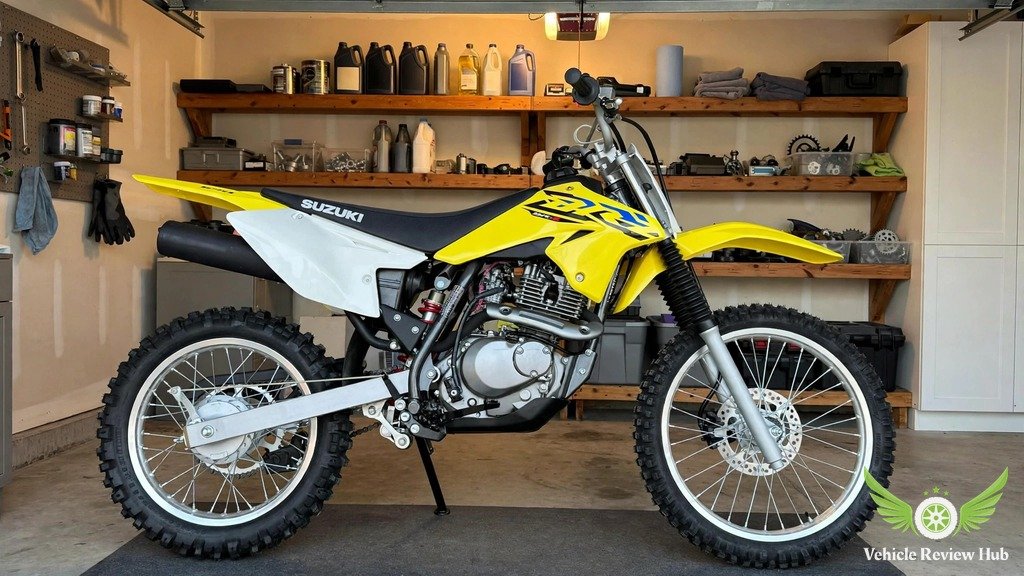
Fuel is the smallest running cost and the hardest to pin down, because no official MPG figure exists for this bike. Off-road bikes carry no EPA rating, Suzuki publishes no MPG, and no magazine test-loop MPG exists — so this Suzuki DR-Z125L reliability guide prints no miles-per-gallon figure as if it were tested. What can be said is that a 1.3-gallon tank at trail pace gives roughly 60 to 90 miles — a rough derived estimate, never a tested figure. Routine servicing is where the money actually goes, and the table below sets out the recurring items with their intervals from the owner’s manual chart. Oil is the big one — SAE 10W-40 replaced at every interval, about 1.1 litres with the filter — and the filter itself is replaced at 1 and 12 months only. Tyres are the largest single consumable: a set of 70/100-19 front and 90/100-16 rear knobby tube-type tyres, wearing unevenly on a learner bike. On the used market, clean DR-Z125Ls typically list at $1,500 to $3,000 depending on year and condition, at drafting time.
| Running cost | What it is |
|---|---|
| Engine oil (SAE 10W-40) | Replaced at 1, 6 and 12 months; about 1.1 L with filter |
| Oil filter | Replaced at 1 and 12 months only, not at 6 months |
| Spark plug (NGK DR8EA) | Inspected at 6 months, replaced at 12 months; gap 0.6–0.8 mm |
| Air cleaner | Inspected at 6 and 12 months; cleaned every 6 months |
| Drive chain (DID 428HG, 130 links) | Cleaned, oiled and inspected every ride |
| Brake fluid | Replaced every 2 years; brake hoses every 4 years |
| Tyres (70/100-19 front, 90/100-16 rear) | Knobby tube-type; pressures checked before every ride |
| Valve clearance check | Inspected at every interval; shim-under-bucket, usually a dealer job |
No Recalls Found in CPSC or NHTSA Searches
No recall was found for the DR-Z125L in published CPSC or NHTSA searches. That is the finding as phrased — a published-search result, not an API-verified zero — and it is backed by Suzuki’s own recalls page, which lists the “2005 DR-Z110” and the “2018 DR-Z400S-SM Stop Lamp Switch” and no DR-Z125L letter. The Suzuki safety recalls page is the source for that check. The absence of a recall is consistent with the rest of the reliability record: a simple, under-stressed engine with no known defect pattern, in production for more than twenty years, has had every chance to earn a recall and has not earned one. That is the strongest statement the published record supports.
How to Keep a Suzuki DR-Z125L Reliable
Keeping a DR-Z125L reliable is mostly a matter of doing the small things on time. The bike asks for very little — oil by the calendar, a chain oiled after every ride, a carburettor drained before storage — and it rewards the owner who does those things with decades of service. This final section of the Suzuki DR-Z125L reliability guide turns the service chart into a routine a new owner can follow, and clears up the two recall confusions that trip up buyers.

Preventive Maintenance, Records and Regular Inspections
The routine in this Suzuki DR-Z125L reliability guide is short enough to fit on a card. Before every ride: check the tyre pressures, tap the spokes, and look at the chain — clean and oil it if it is dry. After every ride: wash the mud off, and if the bike will sit, drain the carburettor float bowl. Follow the chart: oil at 1, 6 and 12 months, filter at 1 and 12 months, valves checked at every interval. Brake fluid every two years, hoses every four. And keep records. A folder with the service dates, the oil changes and the valve checks is worth real money on a used DR-Z125L, because it proves the calendar chart was followed. The Suzuki DR-Z125L comparison guide sets the bike against its three rivals on price, start type, brakes, seat height and value.
Do Not Confuse the DR-Z110 and DR-Z4 Recalls
Two recalls turn up when buyers search for DR-Z recalls, and this Suzuki DR-Z125L reliability guide states plainly that neither one belongs to the DR-Z125L. The first is the 2005 DR-Z110 recall, announced by the CPSC on December 10, 2004: about 1,500 units of the 2005 DR-Z110K5, whose rear shock absorber may have been assembled with an incorrect o-ring, allowing fluid to leak and damping to be lost. The DR-Z110 was a different, smaller 111cc bike, and no injuries were reported. The second is the DR-Z4 recall 25V873, covering the 2025–2026 DR-Z4S and DR-Z4SM family — about 3,003 US bikes — for rear brake master-cylinder reservoir cap screws that were under-torqued. The Suzuki DR-Z400SM review covers the 398cc supermoto and its own recall record. A buyer who finds either recall in a search should check the model name on the notice: if it says DR-Z110 or DR-Z4, it is not this bike.
Suzuki DR-Z125L Reliability: Frequently Asked Questions
Direct answers to the questions riders ask about this Suzuki DR-Z125L reliability guide.
Is the Suzuki DR-Z125L reliable?
Yes. This Suzuki DR-Z125L reliability guide starts from Ultimate Motorcycling’s verdict: it called the bike “an extraordinarily reliable motorcycle” whose engine “should provide service for decades”, and owner reports back that up — the air-cooled two-valve single has been in production since 2003 with no known defect pattern.
How often does the DR-Z125L need servicing?
The service chart is calendar-based: months 1, 6 and 12. Valves are inspected at every interval, engine oil is replaced at every interval, and the oil filter is replaced at 1 and 12 months only.
How often should the valve clearance be checked?
At every interval — 1, 6 and 12 months. That is the most distinctive service fact in this Suzuki DR-Z125L reliability guide: no other Suzuki in this line inspects valves at every service. It is a shim-under-bucket job, usually a dealer job for most owners.
What is the most common problem with the DR-Z125L?
Carb clogging from storage. Old fuel left in the Mikuni VM20SS float bowl evaporates and varnishes the pilot jet shut, so the bike will not start or will not idle. Drain the bowl before storage and the problem never appears.
Does the DR-Z125L have any recalls?
No recall was found for the DR-Z125L in published CPSC or NHTSA searches, and Suzuki’s own recalls page lists no DR-Z125L letter. Do not confuse it with the 2005 DR-Z110 recall (about 1,500 units) or the 2025 DR-Z4 recall 25V873 (about 3,003 bikes).
What spark plug does the DR-Z125L use?
An NGK DR8EA or DENSO X24ESU as standard, with a gap of 0.6–0.8 mm. It is inspected at 6 months and replaced at 12 months. A hotter DR7EA is specified if the plug runs wet or dark, and a colder DR9EA if it runs glazed or white.
How often should the oil be changed?
At every interval — 1, 6 and 12 months — with SAE 10W-40, about 1.1 litres when the filter is also replaced. The oil filter is replaced at 1 and 12 months only, not at 6 months.
Is the DR-Z125L hard to start?
It can be cold-blooded: Ultimate Motorcycling found it “a bit on the cold-blooded side” at starting, though it was a reliable starter for the entire test. The kick starter is also hard for lighter riders to work after a stall.
Does the DR-Z125L have a rear disc brake?
No. The front brake is a single 220 mm disc and the rear brake is a drum — never a rear disc. There is no ABS, because there never has been on this bike.
How long is the DR-Z125L warranty?
Six months, limited — Suzuki’s own pages print “Includes a Suzuki six-month limited warranty”. It is longer than the Yamaha TT-R125LE’s 90-day limited factory warranty, and it is not no warranty.
What should I check on a used DR-Z125L?
Start the bike cold and listen for a clean idle — a clogged carburettor shows up at once. Check the clutch for slip, the chain for dryness and the spokes for looseness.
Is the DR-Z125L a good beginner bike?
Yes, with one caveat. It is a proper learning bike — a true manual clutch, a five-speed gearbox, short first and second gears, light weight and a low seat. The caveat is the kick start: lighter riders can find it hard to restart, and every rival has electric start.