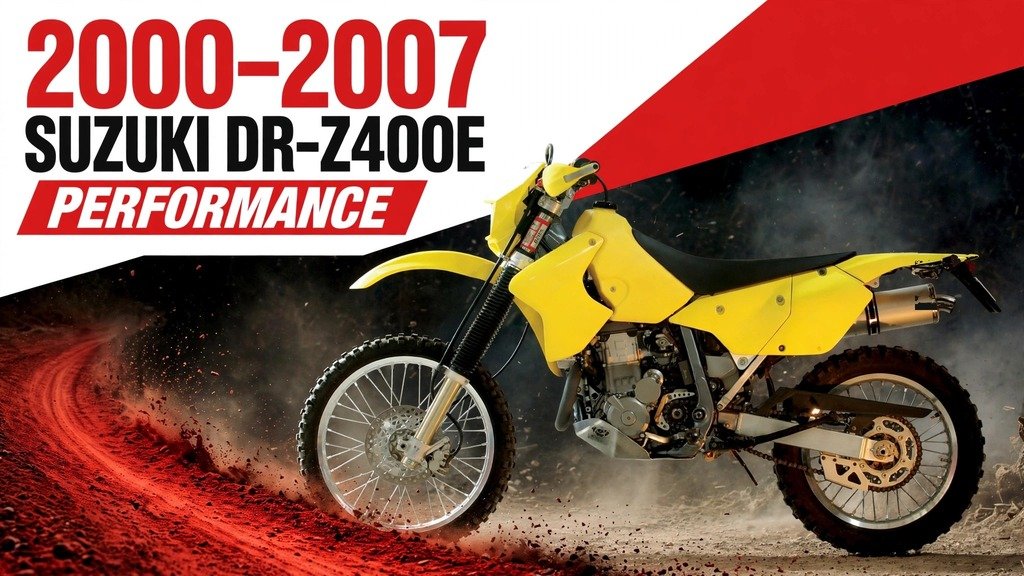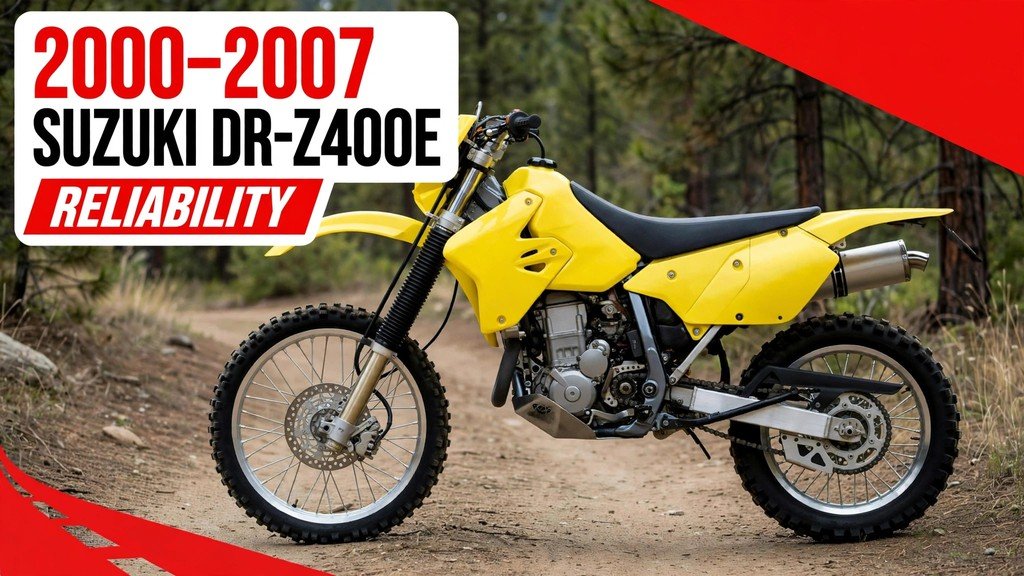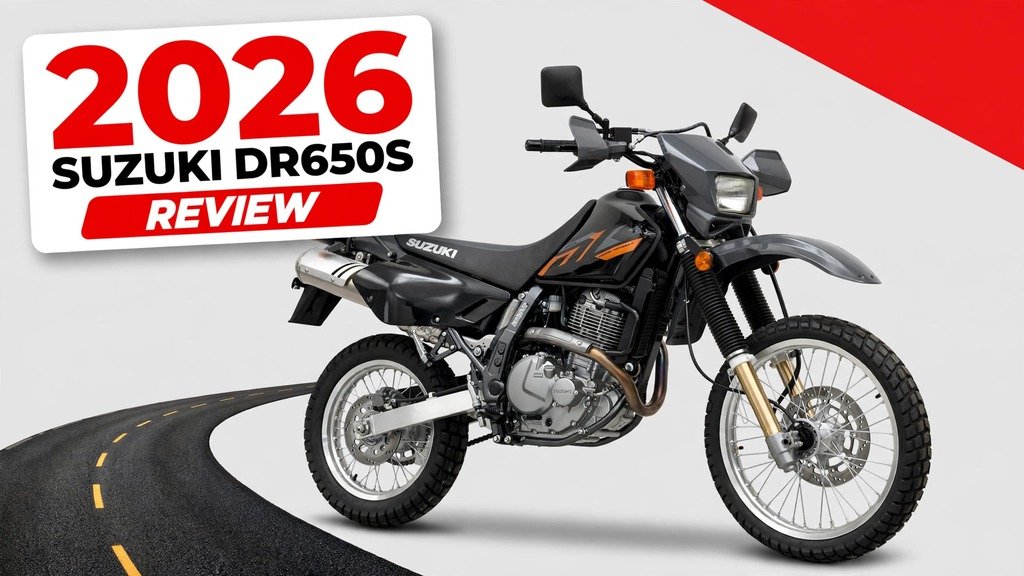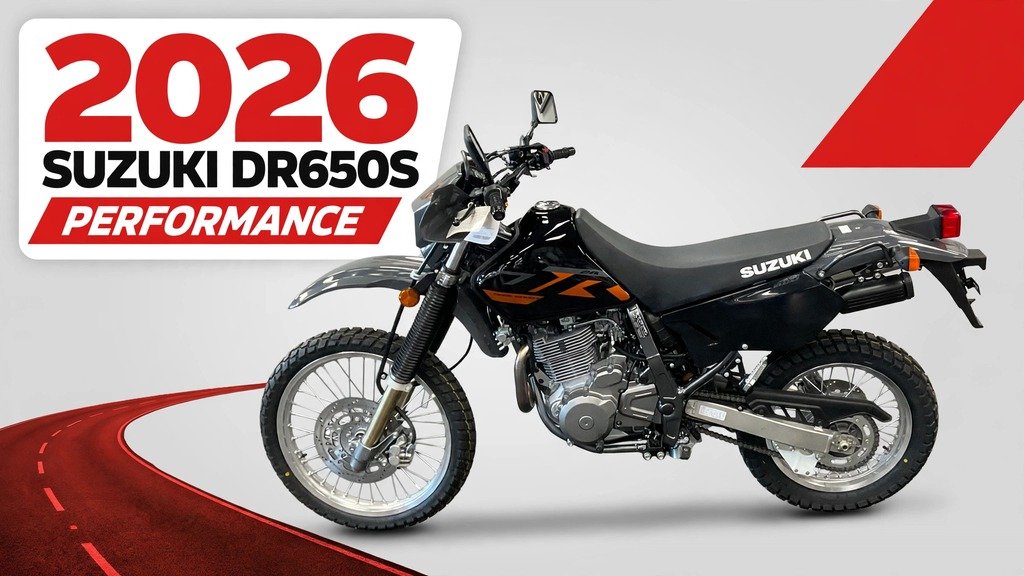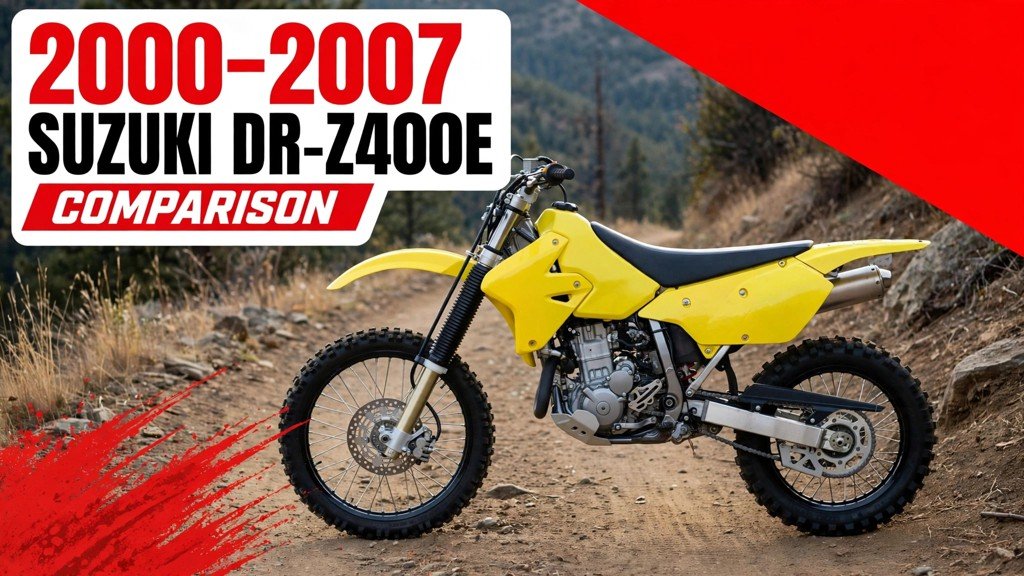
The short answer first: a used Suzuki DR-Z400E is still the cheapest honest trail bike in this Suzuki DR-Z400E comparison. The E was Suzuki’s off-road-only enduro, sold in the USA from 2000 to 2007 with no headlight, no mirrors and no speedometer. The three modern bikes that split its role are the Kawasaki KLX300R, the Honda CRF450X and the Yamaha WR450F — all three off-road only, all three new, and all three dearer than a used E. A mid-2000s E sells for roughly $2,500 to $4,200 in November 2026 listings, while the cheapest new rival, the KLX300R, costs $6,399 delivered. This Suzuki DR-Z400E comparison puts the old bike against each rival on engine, specs and price, then looks at the E’s in-era rivals and the street-legal bikes that inherited its role.
Suzuki DR-Z400E Overview and Its Closest Rivals
The E was a simple proposition: a 398cc liquid-cooled single with a Keihin FCR39 pumper carburettor, 12.2:1 compression, a claimed 48 hp at 9,000 rpm, a fully adjustable 49 mm fork, and a dry weight of 262 lb. It was the hardest-tuned DR-Z400 Suzuki sold, with an hour-based service schedule and no electronics to fail. The DR-Z400E review covers the bike in full, and the DR-Z400E reliability guide covers what goes wrong.

The video below is a group trail ride — a DR-Z400 out with a WR250R and a KLX351 — not a head-to-head comparison test.
Why These Three Rivals: Its Role Split Three Ways
No single new bike replaces the E, because the E did three jobs at once and each modern rival does one of them. The Kawasaki KLX300R takes the cheap-trail-bike job: it is the only new off-road-only bike anywhere near the E’s price, and the only one a buyer cross-shops on money. The Honda CRF450X takes the serious-enduro job: a 450cc race-bred machine with fuel injection and a wide-ratio six-speed. The Yamaha WR450F takes the lineage job: the E was aimed squarely at Yamaha’s WR in the period tests. The street-legal sibling in the DR-Z400S review is a different purchase, and the street-legal heirs get their own section at the end.
How the Four Bikes Differ at a Glance
The table below is the whole Suzuki DR-Z400E comparison in one place. The weights are printed on the basis each maker publishes them — dry for the Suzuki and the Kawasaki, curb for the Honda, wet for the Yamaha — because no single basis exists across all four.
| Bike | Engine | Gearbox | Seat height | Weight (as published) | Price delivered |
|---|---|---|---|---|---|
| Suzuki DR-Z400E (used, 2000–2007) | 398cc single, Keihin FCR39 carb | 5-speed | 37.2 in | 262 lb dry | $2,500–$4,200 used |
| Kawasaki KLX300R (2026) | 292cc single, fuel-injected | 6-speed | 35.4 in | 264.6 lb dry | $6,399 |
| Honda CRF450X (2026) | 449.7cc single, PGM-FI | 6-speed wide-ratio | 37.9 in | 275 lb curb | $10,599 |
| Yamaha WR450F (2026) | 450cc single, fuel-injected | 5-speed | 37.6 in | 258 lb wet | $10,949 |
Suzuki DR-Z400E vs Kawasaki KLX300R
The KLX300R is the rival that matters most in this Suzuki DR-Z400E comparison, because it is the only new bike in the same price conversation. At $5,749 plus a $650 destination charge — $6,399 delivered, per Dirt Rider’s first look — it is the cheapest new off-road-only trail bike on sale, and still $2,200 to $3,900 dearer than a used E. The two bikes are the same idea twenty years apart: a simple, cheap, liquid-cooled trail single.

Engine, Specs and Performance Side by Side
The Kawasaki’s 292cc liquid-cooled fuel-injected single gives away 106cc to the E’s 398cc, and the difference shows in how the two bikes make power. The E’s Keihin FCR39 pumper carburettor and 12.2:1 compression give a claimed 48 hp at 9,000 rpm with a hard, immediate throttle response, while the KLX300R’s fuel injection gives a cleaner delivery with no jetting to change and no choke to remember. The Kawasaki’s extra gear is its real advantage on faster trails, where the E’s short 14/47 trail gearing runs out of legs. On weight the two are effectively tied at 264.6 lb dry against 262 lb dry. Where they differ is reach and range: the KLX300R’s seat is 35.4 in against the E’s 37.2 in, and the E’s 2.6-gallon tank holds half a gallon more than the Kawasaki’s 2.1 gallons. The E’s 49 mm conventional fork was fully adjustable from 2000, with 11.3 in of travel up front and 11.6 in at the rear. Both are off-road only, both carry a six-month limited warranty, and neither has ABS.
Price, Equipment and Which Suits Which Rider
On price the used E wins outright. A mid-2000s E at $2,500 to $4,200 leaves $2,200 to $3,900 in the buyer’s pocket against a new KLX300R at $6,399. What the Kawasaki buys is newness: a warranty, fuel injection, no previous owner, and no twenty-year-old accelerator-pump diaphragm to replace. The E suits the rider who wants the most trail bike for the least money and is happy to service on an hour chart — parts are still available, because the E shares its engine with the DR-Z400S, the DR-Z400SM and the kick-start DR-Z400. The KLX300R suits the rider who wants to buy new and never think about jetting: a first trail bike, a returning rider, or anyone who values a warranty over outright performance. The DR-Z400E performance guide covers the E’s power delivery in full.
Suzuki DR-Z400E vs Honda CRF450X
The CRF450X is the other end of this Suzuki DR-Z400E comparison: the modern 450 enduro, built for riders who found the E too soft at race pace. At $9,999 plus a $600 destination charge — $10,599 delivered — it costs more than double the top of the used E’s price band, The two bikes share the same job description — off-road only, no street gear — and almost nothing else.

Engine, Specs and Performance Side by Side
The Honda’s 449.7cc liquid-cooled Unicam single runs 96.0 by 62.1 mm at 12.1:1 compression, with programmed fuel injection through a 46 mm throttle body and a wide-ratio six-speed manual gearbox — the change that matters most against the old five-speed X. The E answers with its 398cc, its Keihin FCR39 pumper carburettor and its claimed 48 hp at 9,000 rpm, but the Honda’s extra 52cc and its injection give it a broader, stronger pull, and the wide-ratio sixth gear gives it a top gear the E never had. The CRF450X runs a 49 mm inverted Showa fork with 12.0 in of travel — inverted, where the E’s 49 mm fork is conventional — and a Pro-Link Showa rear shock with 11.8 in of travel, against the E’s 11.3 in front and 11.6 in rear. Brakes are bigger on the Honda, 260 mm front and 240 mm rear against the E’s 250 mm and 220 mm, and the two bikes share tyre sizes. The Honda’s seat is 37.9 in against the E’s 37.2 in, its ground clearance is 13.1 in against the E’s 12.8 in, and its 275 lb curb weight cannot be set directly against the E’s 262 lb dry.
Price, Equipment and Which Suits Which Rider
On price there is no contest: the CRF450X at $10,599 is $6,399 to $8,099 dearer than a used E — the whole price of another used bike. What the Honda buys is a modern race-bred enduro with fuel injection, a wide-ratio six-speed, and a chassis that does not bottom in high-speed whoops — the exact place Dirt Bike Magazine’s 2000 shootout called the E “truly bad”. The E suits the trail rider who wants a plush, torquey, forgiving bike and does not race: the DR-Z400E reliability guide shows it is cheap to keep, with no recall against its name. The CRF450X suits the rider who rides hard, races, or rides desert and open trails.
Suzuki DR-Z400E vs Yamaha WR450F
The WR450F is the rival with the longest history in this Suzuki DR-Z400E comparison. The E was aimed squarely at Yamaha’s WR in the period tests — Dirt Bike Magazine’s June 2000 shootout ran the DR-Z400 directly against the WR400F — and the WR450F is what that line grew into. At $10,299 plus a $650 destination charge — $10,949 delivered — it is the dearest of the three modern rivals, and the one that has changed the most since 2000.

Engine, Specs and Performance Side by Side
The Yamaha’s 450cc liquid-cooled DOHC single is a full generation ahead of the E’s carburetted 398cc: fuel injection, a modern combustion chamber, and a five-speed gearbox spaced for a 450’s torque rather than a 400’s trail gearing. The WR450F’s seat is 37.6 in against the E’s 37.2 in, its wet weight is 258 lb, and its tank holds 2.1 gallons against the E’s 2.6. The Yamaha’s warranty is the shortest here — a 30-day limited factory warranty, against the E’s six months when new. In 2000 the gap was small: the WR400F made 43.5 hp at 8,900 rpm on Dirt Bike Magazine’s dyno against the DR-Z400’s 38.4 hp at 9,800 rpm — published for “the DRZ400” without saying whether the E or the kick-start bike was on the dyno — and the Yamaha was 3 lb heavier dry, 265 lb against 262 lb, and $550 dearer at $5,899 against $5,349. Twenty-six years on, the WR450F is faster and far dearer, while the E is still the same honest trail bike it was.
Price, Equipment and Which Suits Which Rider
On price the WR450F is the hardest of the three to justify against a used E: $10,949 delivered is $6,749 to $8,449 more than a mid-2000s E,. What the Yamaha buys is the most developed enduro of the three, with the WR name’s competition record and a chassis built for racing. The E suits the rider who wants the WR idea — a fast, plush, torquey trail single — at a quarter of the price. The WR450F suits the rider who races enduros or rides hard enough that the E’s suspension and carburettor become the limit.
Suzuki DR-Z400E Price and Value Compared
Money is where this Suzuki DR-Z400E comparison is decided. The E is not the best bike here on any single measure except one: it is the cheapest by a distance, and it has finished depreciating. Every new rival loses value the moment it is ridden; a used E bought well can be ridden for a season and sold for what it cost.

The E’s Used Prices vs Three New Rival Prices
A mid-2000s US E sells for roughly $2,500 to $4,200 in November 2026 listings — the working band from live listings checked at drafting, including a 2006 E in good condition asking $2,999 in Grand Junction, Colorado, and a SmartCycleGuide sample of 2006 DR-Z400 listings from $2,499 to $4,200.
| Bike | MSRP | Destination / freight | Total |
|---|---|---|---|
| Suzuki DR-Z400E (used, mid-2000s) | — (used) | — | $2,500–$4,200 |
| Kawasaki KLX300R (2026) | $5,749 | $650 | $6,399 |
| Honda CRF450X (2026) | $9,999 | $600 | $10,599 |
| Yamaha WR450F (2026) | $10,299 | $650 | $10,949 |
The KLX300R costs $2,199 to $3,899 more than a used E. The CRF450X costs $6,399 to $8,099 more. The WR450F costs $6,749 to $8,449 more. The E was cheap when it was new, too: $5,349 at launch in 2000 and $5,199 in its final US year of 2007 — less, in nominal dollars, than the KLX300R costs today. No destination charge was ever found for the E’s model years, so the E’s prices are printed as MSRP only, with no total invented.
Running Costs and Resale Value Compared
Running costs favour the old bike. The E’s routine service is oil, a filter and a spark plug on an hour chart — oil and filter together at 5 hours, then together again at every 60 hours, with an NGK CR8E plug inspected at 30 hours and replaced at 60 — and the parts are cheap because the engine is shared across the DR-Z400 family. The modern rivals need less tinkering — fuel injection means no jetting and no accelerator-pump diaphragm to wear — but their parts cost more. Fuel is the one cost the E cannot win cleanly: there is no official MPG figure for it, because off-road bikes get no EPA rating, and owner-reported DR-Z400-family figures run roughly 45 to 68 mpg in UK gallons, so any range figure is labelled arithmetic from owner reports, never a tested number. The S bike’s EPA figure of 74.7 mpg belongs to the S, not the E, and is never printed as the E’s. On resale the E is already at its floor: a used E bought at $3,000 can be sold at $3,000 a year later if it is kept serviced, while a new rival loses a four-figure sum the moment it leaves the dealer. The E’s only resale risk is condition: a neglected bike with a gummed carburettor and a dry chain is worth parts money, so check the hour chart, the cam chain tensioner on a 2000–2002 bike, and the title before buying.
Suzuki DR-Z400E Comparison Verdict and US Alternatives
The verdict of this Suzuki DR-Z400E comparison is simple: buy the used E if you want the most trail bike for the least money, the KLX300R if you want new and cheap, the CRF450X if you want the fastest modern 450, and the WR450F if you want the WR name.

In-Era Rivals Were the WR400F and KTM 400 EXC
The E’s real rivals were the bikes it was tested against in 2000, and Dirt Bike Magazine’s June 2000 eight-bike 400 four-stroke shootout is still the fairest record of where it stood. The E cost $5,349, the second-cheapest bike in the test, $550 under the Yamaha WR400F at $5,899 and $1,646 under the KTM 400 EXC at $6,995 — and the KTM won. The WR400F made 43.5 hp at 8,900 rpm on the magazine’s dyno, the KTM 400 EXC made 39.1 hp at 7,200 rpm, and the DR-Z400 made 38.4 hp at 9,800 rpm — published for “the DRZ400” without saying whether the E or the kick-start bike was on the dyno. On peak power the ranking was Yamaha first, Husaberg second, Suzuki third, KTM fourth; on low-end power it was Honda first, Suzuki second, KTM third. The E’s suspension was its weak point even then: fifth at slow speed and last at high speed — “truly bad in high-speed whoops” — and sixth on stability. The shootout’s conclusion still fits: the DR-Z400 was “more like an updated and modern Honda XR400R”, a bike that “could do almost anything” with work. The DR-Z400 history on motocrosshideout records the E’s place in the family plainly, and the MotorTrend 2007 DR-Z400E review lists the final-year price at $5,199.
Street-Legal Heirs Are the EXC-F and Beta RS
The E was never street-legal, and the bikes that inherited its role for riders who need a plate are the KTM EXC-F and the Beta RS — both 50-state street-legal dual-sports, both far dearer than a used E.
| Street-legal heir | MSRP | Freight / shipping | Total | Street-legal |
|---|---|---|---|---|
| KTM 350 EXC-F (2026) | $13,049 | $650 | $13,699 | Yes, 50-state |
| KTM 500 EXC-F (2026) | $13,499 | $650 | $14,149 | Yes, 50-state |
| Beta 390 RS (2026) | $12,490 | $549 | $13,039 | Yes, 50-state |
| Beta 430 RS (2026) | $12,590 | $549 | $13,139 | Yes, 50-state |
The Beta RS range sat out 2025 and returned for 2026 on the RR X-Pro platform, with a 24-month limited warranty — the longest cover in this Suzuki DR-Z400E comparison. The KTM EXC-F twins are the purest heirs: 350 and 500cc four-strokes, six speeds, plated from the factory. The 350 EXC-F at $13,699 delivered is the closest in spirit to the E, while the 500 EXC-F at $14,149 is the fast one; the Beta 390 RS at $13,039 and the 430 RS at $13,139 — per Beta USA’s official pricelist — undercut both KTMs, and the 350 RS at $12,939 and the 500 RS at $13,239 fill out the range. None of these is cheap, and none of them is the E: the E’s role as a cheap, simple, off-road-only trail bike has no direct successor. The closest thing Suzuki sells to a successor is the DR-Z4S at $8,999 plus $600, or $9,599 delivered — fuel-injected, ride-by-wire, with three ride modes and switchable ABS — but it is a street-legal dual-sport. The honest purchase is still the simple one: buy the E as a trail bike, trailer it to the trail, and judge it on the hour chart and the condition.
Suzuki DR-Z400E Comparison: Frequently Asked Questions
Direct answers to the comparison questions riders ask in this Suzuki DR-Z400E comparison.
Is the Suzuki DR-Z400E better than the KLX300R?
It is faster and cheaper, and the KLX300R is newer and easier. The E’s 398cc and claimed 48 hp beat the Kawasaki’s 292cc, and a used E at $2,500 to $4,200 undercuts the new KLX300R at $6,399. The Kawasaki buys fuel injection, a warranty and no previous owner.
Is the DR-Z400E faster than the CRF450X?
No. The CRF450X’s 449.7cc fuel-injected engine, wide-ratio six-speed and modern chassis are faster than the E in every measure that matters — Dirt Bike Magazine’s 2000 shootout ranked the E’s suspension last at high speed. The E is the plush trail bike; the X is the race bike.
How much does a used DR-Z400E cost?
Roughly $2,500 to $4,200 for a mid-2000s US bike in November 2026 listings, including a 2006 E asking $2,999 in Grand Junction, Colorado. A serviced bike with records is worth the top of the band; a neglected bike with a gummed carburettor is worth parts money.
Is the DR-Z400E street-legal?
No. The US E was sold off-road only, with no headlight, no taillight, no turn signals, no mirrors, no horn and no speedometer. Some Es have been converted, but a converted bike needs a clean street title — the title is what matters, not the parts bolted to it.
What replaced the DR-Z400E?
Nothing directly. The E’s US run ended in 2007 and Suzuki never sold another off-road-only DR-Z. The closest modern equivalents are the KLX300R, the CRF450X and the WR450F, and the street-legal heirs are the KTM EXC-F and the Beta RS.
Is the DR-Z400E good for beginners?
It can be, with care. The E’s power is smooth and linear, but its seat is tall at 37.2 in and it has no ABS and no traction control. A taller beginner will find it forgiving; a shorter one will struggle, and the KLX300R at 35.4 in is the easier first bike.
Does the DR-Z400E have fuel injection?
No. The E runs a Keihin FCR39 pumper carburettor, with a Mikuni BSR36 in California models. Fuel injection is the single biggest difference between the E and all three modern rivals — it is why the E needs jetting attention and the new bikes do not.
How heavy is the DR-Z400E compared to the WR450F?
The E is 262 lb dry and the WR450F is 258 lb wet, so the two cannot be set directly against each other — dry and wet are different bases. On the figures as published, the Yamaha is lighter in ready-to-ride trim and the E is lighter on a dry-weight basis.
Which is cheaper to run, the E or the KLX300R?
The E, on parts and depreciation. Its service is oil, a filter and a plug on an hour chart, its parts are cheap and shared across the DR-Z400 family, and it has already finished depreciating. The KLX300R costs more to buy and loses value faster, but its fuel injection means less tinkering.
Can I still buy parts for a DR-Z400E?
Yes. The E shares its engine with the DR-Z400S, the DR-Z400SM and the kick-start DR-Z400, so engine parts are still available, and the Kawasaki KLX400 of 2003 was a rebadged DR-Z400E. Wear items are common sizes.
What is the difference between the DR-Z400E and the DR-Z400S?
The E is the off-road-only enduro and the S is the street-legal dual-sport. The E has higher compression at 12.2:1 against 11.3:1, a Keihin FCR39 pumper carburettor against the S’s Mikuni BSR36, hotter cams, fully adjustable suspension from 2000, and no street gear. It is 29 lb lighter dry, 262 lb against 291 lb, and was $400 cheaper in 2007.
Should I buy a used DR-Z400E or a new KLX300R?
Buy the E if you want the most trail bike for the least money and are happy to service on an hour chart. Buy the KLX300R if you want a new bike with a warranty, fuel injection and no previous owner. The E is the faster, cheaper buy; the Kawasaki is the easier ownership experience.