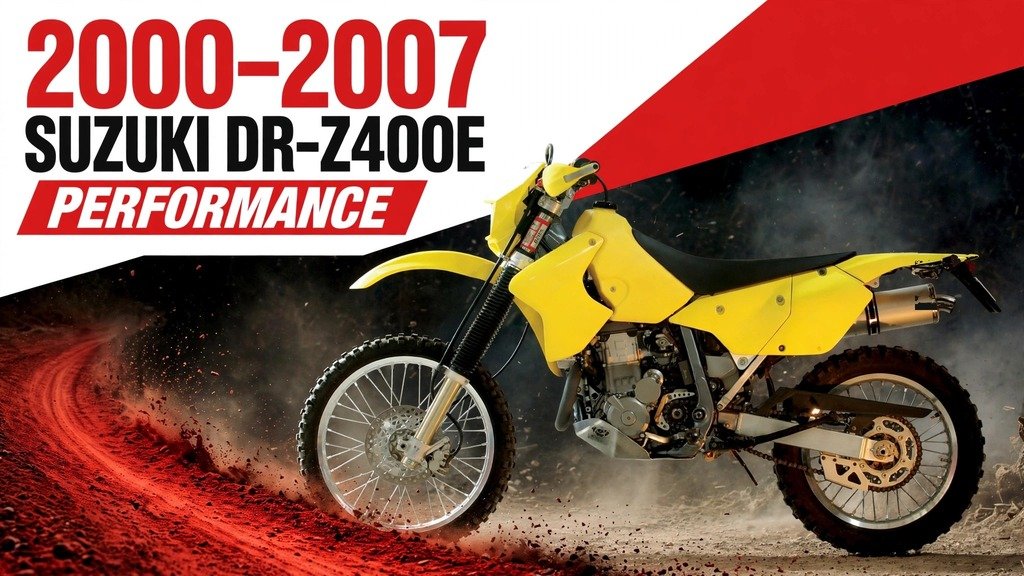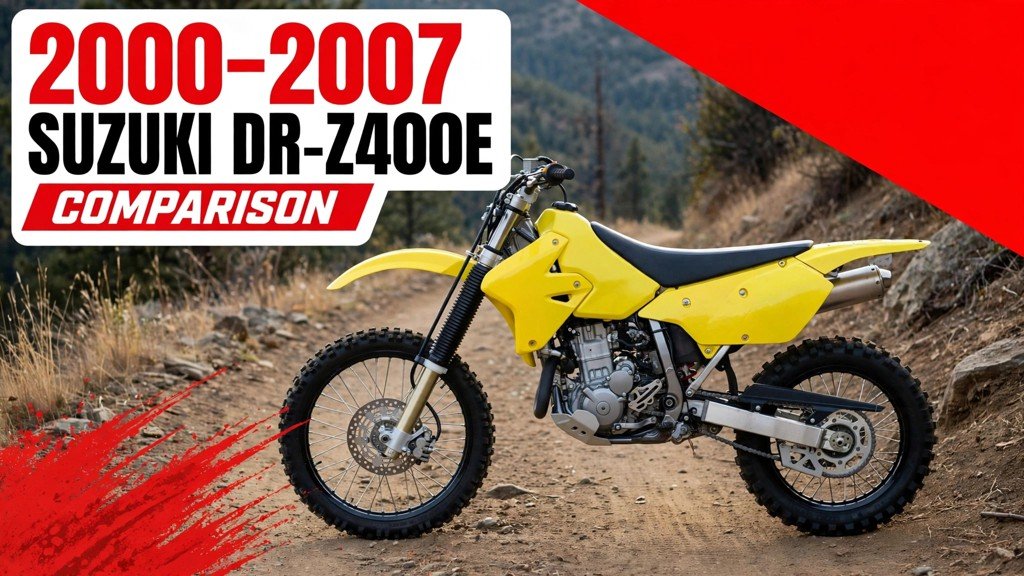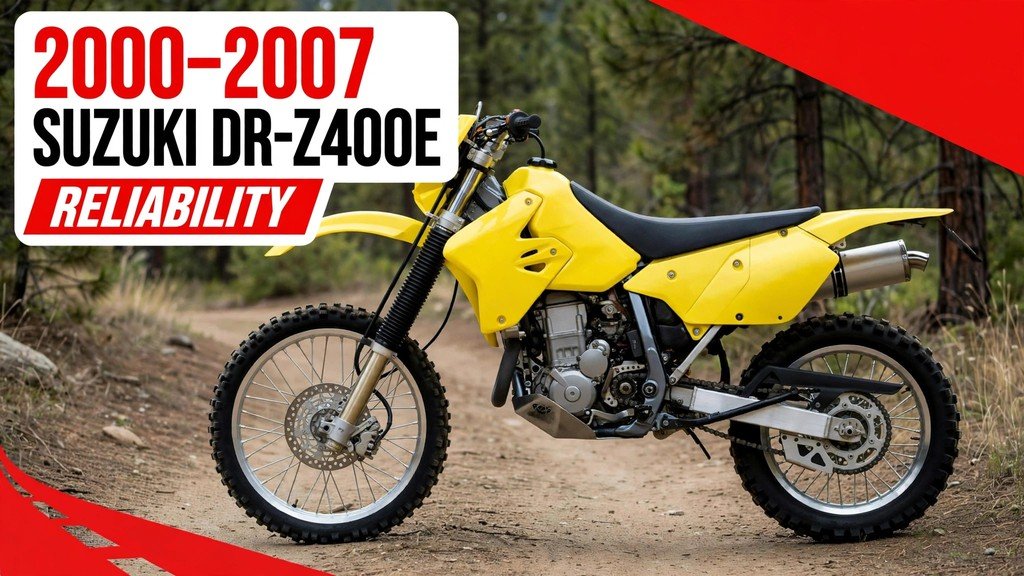
The short answer first: the Suzuki DR-Z400E is a reliable trail bike, with an unusually clean record for a twenty-year-old enduro. No recall has ever named the DR-Z400E in any of its eight US model years, its engine is a simple liquid-cooled single with no electronics to fail, and its service schedule is short and honest. The problems it does have are known, owner-documented and fixable: a cam chain tensioner risk on 2000–2002 bikes, a wearing accelerator-pump diaphragm in the FCR39 carburettor, and a handful of fasteners that need threadlocker. This Suzuki DR-Z400E reliability guide covers the recall record, the common problems, the hour-based service schedule and what the bike costs to keep going.
Suzuki DR-Z400E Reliability Overview
The E’s reliability starts with what it does not have. There is no fuel injection, no ride-by-wire, no traction control, no ABS and no radiator fan — just a 398cc liquid-cooled single, a five-speed gearbox, a chain and a carburettor. Fewer systems means fewer things to break, and the engine is understressed at a claimed 48 hp at 9,000 rpm. The DR-Z400E review covers the engine in full.

The video below shows an old DR-Z400E still going strong on a bush ride — the kind of long service life this Suzuki DR-Z400E reliability guide is about.
No Recall Has Ever Named the DR-Z400E
No recall has ever named the DR-Z400E. That is not a gap in the records — the NHTSA recalls API was queried for the DR-Z400E for all eight US model years, 2000 through 2007, and it returned zero recalls in every year. The API itself is live: the same query for the 2018 DR-Z400S returns one recall, 18V441, for the rear brake stop-lamp switch. The E’s zero is a real, API-verified zero, and the NHTSA recalls API query for a 2007 E is the direct evidence.
How Mileage, Storage and Previous Care Affect Reliability
The E has no odometer and no hour meter from the factory, so a used buyer cannot read its life off a dial. That makes previous care the single biggest reliability factor on this bike. The things that kill these bikes are neglect items: stale fuel gumming the FCR39, a hardened accelerator-pump diaphragm, a chain run dry, and coolant left in for a decade. The DR-Z400S reliability guide covers the street-legal sibling’s own record — but the S at least has an odometer, and the E does not.
Storage matters more than mileage on a bike this old. A bike kept dry with the tank drained ages slowly; one left under a tarp with fuel in the tank ages fast, and the first jobs on a barn-find E are almost always the same: clean the carburettor, change the oil and filter, and fit a fresh battery.
Suzuki DR-Z400E Common Problems and Wear Items
The E’s problem list is short, and every item on it is shared with the rest of the DR-Z400 family — the same engine runs in the kick-start DR-Z400, the DR-Z400S and the DR-Z400SM, so twenty years of owner reports cover the E as well. None of the items below is a recall, and none is a reason to walk away from a good bike; this Suzuki DR-Z400E reliability guide treats them as checks to make.
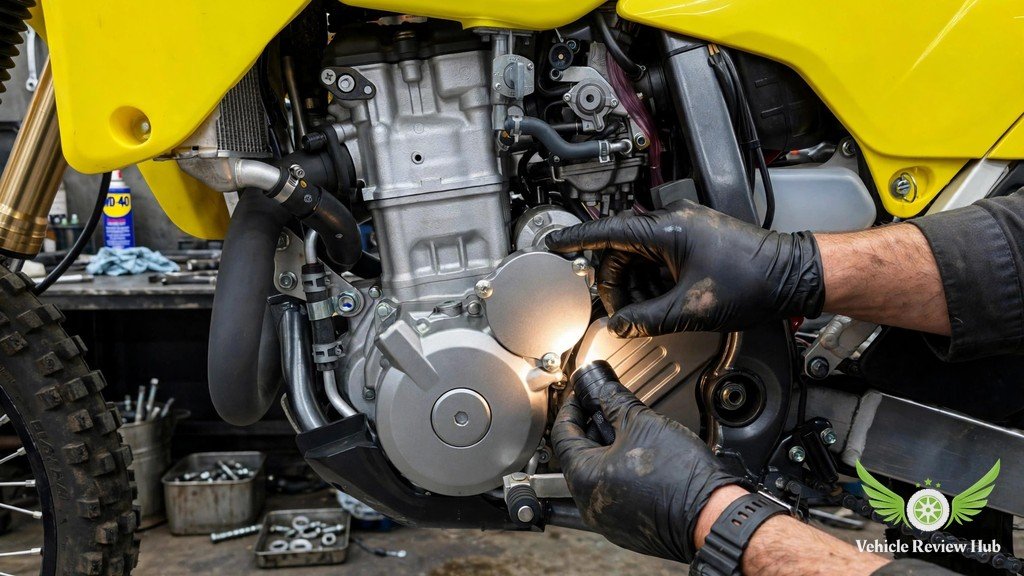
2000-2002 Cam Chain Tensioner Risk Is Real
The one problem worth a dedicated check is the cam chain tensioner on 2000–2002 bikes. Owner reports across the DR-Z400 family document tensioner failures on pre-2003 bikes, and Suzuki revised the tensioner for 2003, which is why the risk window is 2000–2002. The symptom is a cam chain rattle that does not go away once the engine is warm — a healthy DR-Z400 engine is noisy at idle, so the test is whether the rattle stays loud and gets worse with revs.
The tensioner is owner evidence, not a Suzuki bulletin, and there is no recall for it. The fix is a replacement tensioner, a job a home mechanic can do with the manual open; the DR-Z400E service manual covers the cam chain and the tappet work in the same section. A buyer looking at a 2000–2002 E should ask whether the tensioner has been done and listen for the rattle.
Stator and Countershaft Reports Are Owner Evidence
Two more items come from long-term owner reports, and both are cheap prevention rather than expensive repair. The stator bolts can work loose, and owners threadlock them. The countershaft sprocket needs a locking washer or retainer, and owners fit one for the same reason: a loose countershaft sprocket wears the shaft splines, and worn splines are the expensive version of a cheap problem. Both are owner evidence, with no Suzuki bulletin behind them.
The same owner thread names two more preventive jobs: the vacuum-operated petcock can fail and leak fuel into the engine, so owners fit a manual petcock — the same issue is documented on the DR-Z400S — and the water pump should be re-sealed with RTV before any long trip, with a spare ceramic seal and oil seal carried, because the repair is not a roadside job. The primary drive nut should be torqued and threadlocked. None of these is a design defect; they are the known fasteners and seals on a twenty-year-old single.
Suzuki DR-Z400E Maintenance Schedule and Servicing
The E’s service schedule is hour-based, not mileage-based, and that is the first thing this Suzuki DR-Z400E reliability guide has to teach a new owner. The bike has no odometer, so Suzuki’s periodic maintenance chart runs on hours: an initial service at 5 hours, then columns at every 30 hours and every 60 hours. There is no mileage column in the E’s chart, so this guide never converts the hours to miles or prints the S bike’s mileage intervals for the E.

| Service item | Initial 5 hours | Every 30 hours | Every 60 hours |
|---|---|---|---|
| Engine oil and oil filter | Replace together | — | Replace together |
| Tappet clearance | Inspect | — | Inspect |
| Spark plug (NGK CR8E) | — | Inspect | Replace |
| Spark arrester | — | Clean | Clean |
| Steering, fork, rear suspension | Inspect | — | Inspect |
| Chassis nuts and bolts | Tighten | Tighten | Tighten |
| Coolant | — | — | Replace every 2 years |
Hour-Based Schedule: Oil at 5 Hours, Then 60
Engine oil and the oil filter are replaced together at 5 hours, then together again at every 60 hours — the filter is not a separate, longer interval on this bike, unlike the S bike’s rule, where the filter is replaced only at 600 and 11,000 miles. The oil is SAE 10W-40, API SF or SG, and the capacities are 1.7 litres for an oil-only change, 1.8 litres with a filter, and 1.9 litres on an overhaul. Change the oil while it is warm and check the level on the dipstick between the L and F marks.
The 60-hour interval sounds short until the hours are counted honestly: sixty hours of trail riding is a season of weekends for most owners, not a month. The manual adds that more frequent servicing may be needed on motorcycles used under severe conditions, and trail riding in dust and mud is severe conditions. Change the oil and filter at the start of the season and check the level before every ride.
Tappets Checked on the Same Hour Cycle
The tappets — the valve clearances — are inspected at 5 hours and then at every 60 hours, on the same cycle as the oil and filter. The clearances are checked cold: intake 0.10–0.20 mm and exhaust 0.20–0.30 mm, adjusted by replacing the shim under the bucket, with shims available from 2.30 to 3.50 mm in 0.05 mm steps. The Suzuki DR-Z400 history notes the same shim-under-bucket design across the family, and the DR-Z400SM reliability guide covers the supermoto sibling’s version of the same job.
A tappet check is the one service job that makes owners nervous, and it should not. The clearances on a DR-Z400 rarely move far once the engine is run in, and a check that finds everything in spec is a normal result. What matters is that the check happens on the hour cycle, because a tight exhaust valve does not announce itself — it just gets quieter and then burns.
Suzuki DR-Z400E Tires, Brakes and Suspension Maintenance
The rolling chassis asks for attention every ride, not every 60 hours. The manual puts the chain, the tyres and the spoke nipples on an every-ride cycle, and the brakes, clutch and carburettor on the 5-hour and 60-hour inspections. This Suzuki DR-Z400E reliability section covers the tyres, brakes and suspension first, then the carburettor and the cooling system that keep the engine alive.

FCR Carb Care and Accelerator Pump Wear
The Keihin FCR39 pumper carburettor is the E’s best performance part and its most age-sensitive one. The accelerator pump has a diaphragm, an O-ring and a U-ring, and the diaphragm hardens and wears with age; when the pump squirt weakens, the symptom is an off-idle bog or hesitation on a quick throttle blip. The fix is a diaphragm kit with a leak-jet and pump-timing check, and it is an age item on a 2000–2007 bike, not a defect. There is no Suzuki bulletin for it, and no recall; it is owner and mechanic evidence, and a buyer who blips the throttle on a test ride is testing the diaphragm without knowing it.
The carburettor is also altitude-sensitive: one long-term owner found the carb on the E “very grumpy about big changes in altitude”. The jetting has to match the muffler state, too — the Australian de-restriction recipe was baffle out, airbox cover off and a .178 main jet, and a bike with the baffle removed and stock jetting will run lean. Keep the airbox and the muffler matched and drain the carburettor before storage.
Coolant Every Two Years, Air Filter by Hours
Coolant is replaced every two years on the E — 1,250 ml of antifreeze for aluminium radiators mixed with distilled water at 50:50 to 40:60 — and the level is checked before every ride at the overflow tank. The S bike’s interval is four years — the two should not be swapped. The radiator hoses are inspected at 5, 30 and 60 hours. The E has no radiator fan at all — the manual contains no cooling fan anywhere — so cooling is by airflow only, and slow going on a hot day will heat the bike. Owners fit aftermarket fans for slow going on hot days.
The air filter is inspected on every ride and cleaned as necessary: a foam element, washed in nonflammable solvent and oiled with SAE #30 or 10W-40, and never run torn or missing. The fuel line is inspected at 5 and 30 hours and replaced every four years, the brake fluid is replaced every two years and the brake hoses every four years, and the drive chain — an RK520KZO with 112 links, slack 40–50 mm — is cleaned, lubricated and inspected on every ride and replaced with the sprockets as a set when the 20-pitch service limit of 319.4 mm is reached.
Suzuki DR-Z400E Maintenance and Ownership Costs
The E is cheap to keep, and this Suzuki DR-Z400E reliability guide can say so plainly because there is very little on it to buy. A routine service is oil, a filter and a spark plug; the tyres are common enduro sizes; and the bike shares its engine with the DR-Z400S, the DR-Z400SM and the kick-start DR-Z400, so parts are still available. The MotorTrend 2007 DR-Z400E review lists the final-year price at $5,199, and the used market in November 2026 runs roughly $2,500 to $4,200 for a mid-2000s US bike.

| Cost item | What it is | How often |
|---|---|---|
| Oil and filter | 10W-40 oil, 1.8 L with filter | Every 60 hours |
| Spark plug | NGK CR8E, gap 0.7–0.8 mm | Replace every 60 hours |
| Coolant | 1,250 ml, antifreeze + distilled water | Every 2 years |
| Chain and sprockets | RK520KZO, 112 links, 14/47 | Inspect every ride; replace as a set |
| Tyres | 80/100-21 front, 110/100-18 rear | Check every ride; replace on wear |
| Brake fluid and hoses | DOT 4 fluid; hoses on age | Fluid 2 years; hoses 4 years |
Fuel, Routine Servicing, Tires and Replacement Parts
Fuel is the E’s smallest running cost and its easiest one to get wrong. The tank holds 2.6 US gallons with a 0.6-gallon reserve, and there is no fuel gauge and no odometer, so a rider judges range by feel and by the reserve tap. There is no official MPG figure — off-road bikes get no EPA rating — and owner-reported family figures run roughly 45 to 68 mpg depending on speed, in UK gallons, so range is labelled arithmetic from owner reports, never a tested figure. The DR-Z400E performance guide covers the fuel-economy evidence in full.
Routine servicing is oil, a filter and a plug on the 60-hour cycle, and the parts are cheap. Tyres are the recurring cost that surprises new owners: the E takes an 80/100-21 front and a 110/100-18 rear, and the rear size is a trap for anyone coming from the S, which takes a wider 120/90-18. The brakes are a 250 mm front disc with a 2-piston caliper and a 220 mm rear disc with a 1-piston caliper, DOT 4 fluid, and the pads are judged by their grooved wear-limit line; there is no ABS on any year, so there is no ABS hardware to service or fail. The fork takes 720 ml of Suzuki SS-05 fork oil per leg.
Recall 18V441 Cannot Apply to the E
The recall that causes the most confusion in the DR-Z400 family is 18V441, and it cannot apply to the E. Recall 18V441 — NHTSA campaign 18V441000, Suzuki campaign 2A84 — covers the 2018 DR-Z400S and DR-Z400SM only, 191 units, for the rear brake stop-lamp switch. A 2018-model recall cannot apply to a bike that ended production in 2007. The DR-Z4 recall 25V873, for the 2025–2026 DR-Z4S and DR-Z4SM, is also not this bike’s.
The practical point for a buyer is that a seller who says “the recall was done” on a DR-Z400E is either confused or selling a different bike. There is no recall work to check on an E and no recall paperwork to ask for. What to ask for instead is the service history: oil and filter changes on the hour chart, tappet checks, the cam chain tensioner on a 2000–2002 bike, and the stator bolts.
How to Keep a Suzuki DR-Z400E Reliable
Keeping an E reliable — the subject of this Suzuki DR-Z400E reliability guide — is mostly a matter of following the hour chart and doing the small preventive jobs before they become repairs. The bike rewards owners who service on hours, not on feelings, and it punishes the two habits that kill old trail bikes: stale fuel left in the carburettor and a chain run dry. The DR-Z125L review covers the little off-road-only sibling, and the same rule applies there.

Preventive Maintenance, Records and Regular Inspections
Keep records, even simple ones. The E has no odometer and no hour meter, so a notebook with dates and hours is the service history — write down every oil and filter change, every tappet check and every coolant change. Before every ride, check the oil and coolant levels, the chain slack at 40–50 mm, the tyre pressures, the spoke nipples and the brakes. At 5 hours and every 60 hours, do the chart: oil and filter together, tappets, steering, fork and rear suspension inspections, and tighten the chassis nuts and bolts. At 30 hours, inspect the plug and clean the spark arrester. Every two years, replace the coolant and brake fluid; every four years, the brake hoses and fuel line.
The preventive jobs from the owner reports belong on the same list: threadlock the stator bolts, fit a locking washer on the countershaft sprocket, re-seal the water pump with RTV before a long trip and carry a spare ceramic seal and oil seal, and torque and threadlock the primary drive nut. Fit a manual petcock if the vacuum petcock shows any sign of leaking fuel.
Converted Bikes: Check the Title Before the Bike
The E was never street-legal in the USA, and that creates the one paperwork trap in this cluster. Some Es have been converted for road use, and some of those conversions carry a street title in some states — but a converted bike is not a factory dual-sport, and the title is what matters, not the parts bolted to it. Before buying a converted E, check the title itself: does it say the bike is street-legal, and does the buyer’s state accept the conversion? The DR-Z400 history on motocrosshideout records the E’s off-road-only status plainly.
The Kawasaki KLX400 of 2003 is the closest thing to a second source for this bike — Dirt Rider’s 2003 test notes that the KLX400 is identical to the E-start DR-Z — and a KLX400 carries the same off-road-only status and the same title warning. The honest purchase is the simple one: buy the E as a trail bike, trailer it to the trail, and judge it on the hour chart and the condition, not on a promise that it can be plated.
Suzuki DR-Z400E Reliability: Frequently Asked Questions
Direct answers to the reliability questions riders ask in this Suzuki DR-Z400E reliability guide.
Has the DR-Z400E had any recalls?
No recall has been found for the DR-Z400E in NHTSA API queries for any US model year, 2000 to 2007. The 2018 recall 18V441 covers the 2018 DR-Z400S and DR-Z400SM only, and it cannot apply to a bike whose final US year was 2007.
How often should I change the oil on a DR-Z400E?
Oil and filter together at 5 hours, then together again at every 60 hours. The oil is SAE 10W-40, 1.7 litres for an oil-only change and 1.8 litres with a filter.
What spark plug does the DR-Z400E use?
An NGK CR8E, gapped at 0.7–0.8 mm and torqued to 11 N·m. It is inspected at 30 hours and replaced at 60 hours on the service chart.
What is the DR-Z400E’s valve clearance?
Intake 0.10–0.20 mm and exhaust 0.20–0.30 mm, checked cold. The tappets are inspected at 5 hours and then at every 60 hours, and adjusted by replacing the shim under the bucket.
Does the DR-Z400E have a radiator fan?
No. The E has no radiator fan — the service manual contains no cooling fan anywhere — and cooling is by airflow only. Owners fit aftermarket fans for slow going on hot days.
What are the common problems on a DR-Z400E?
The cam chain tensioner on 2000–2002 bikes, a wearing accelerator-pump diaphragm in the FCR39 carburettor that causes an off-idle bog, and fastener items: stator bolts that need threadlocker and a countershaft sprocket that needs a locking washer. None of them is a recall.
Is the 2000–2002 cam chain tensioner a problem?
Yes, on owner evidence: pre-2003 DR-Z400 cam chain tensioner failures are documented across the family, and Suzuki revised the tensioner for 2003. Listen for a cam chain rattle that stays loud once the engine is warm, and ask whether the tensioner has been replaced.
How do I check the chain on a DR-Z400E?
The chain is an RK520KZO with 112 links, and the slack must be 40–50 mm. It is cleaned, lubricated and inspected on every ride, and replaced with the sprockets as a set when the 20-pitch service limit of 319.4 mm is reached.
When should I replace the coolant?
Every two years, with 1,250 ml of antifreeze for aluminium radiators mixed with distilled water.
Is the DR-Z400E reliable?
Yes — and this Suzuki DR-Z400E reliability guide says so on the evidence: no recall has ever named it, the engine is a simple understressed single with no electronics to fail, and the known problems are cheap preventive jobs. Previous care matters more than model year, because the bike has no odometer and no hour meter.
Does the DR-Z400E have ABS?
No. The E has no ABS on any model year. Braking is a 250 mm front disc with a 2-piston caliper and a 220 mm rear disc with a 1-piston caliper.
What should I check before buying a used DR-Z400E?
The service history on the hour chart, the cam chain tensioner on a 2000–2002 bike, the battery and the carburettor, the chain and sprockets, and the title — a converted bike needs a clean street title.