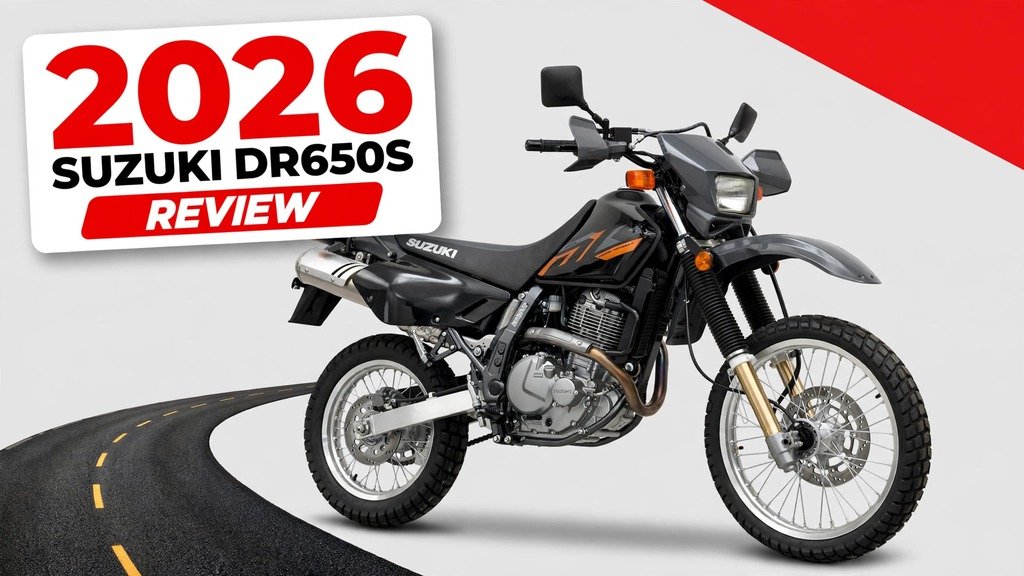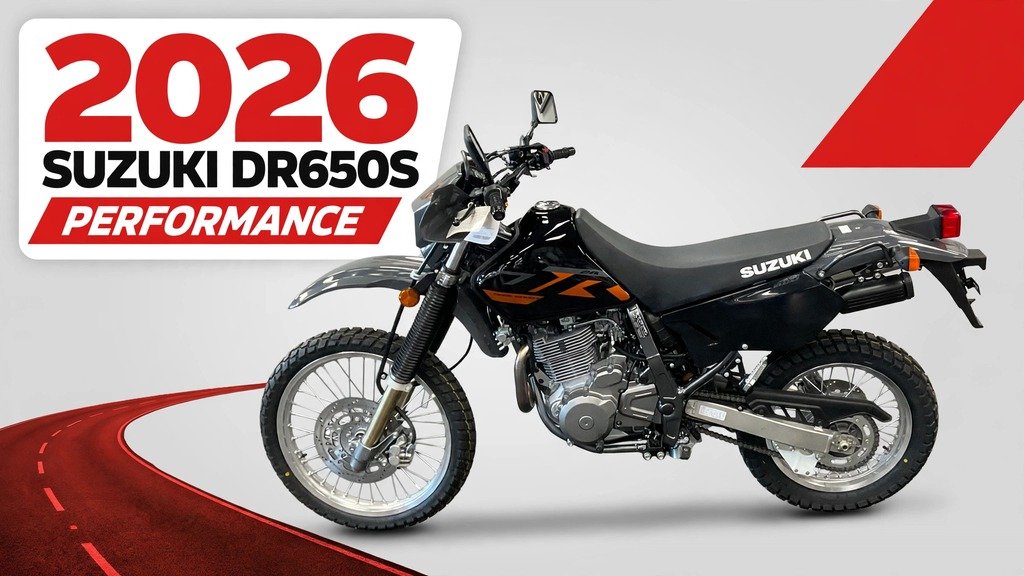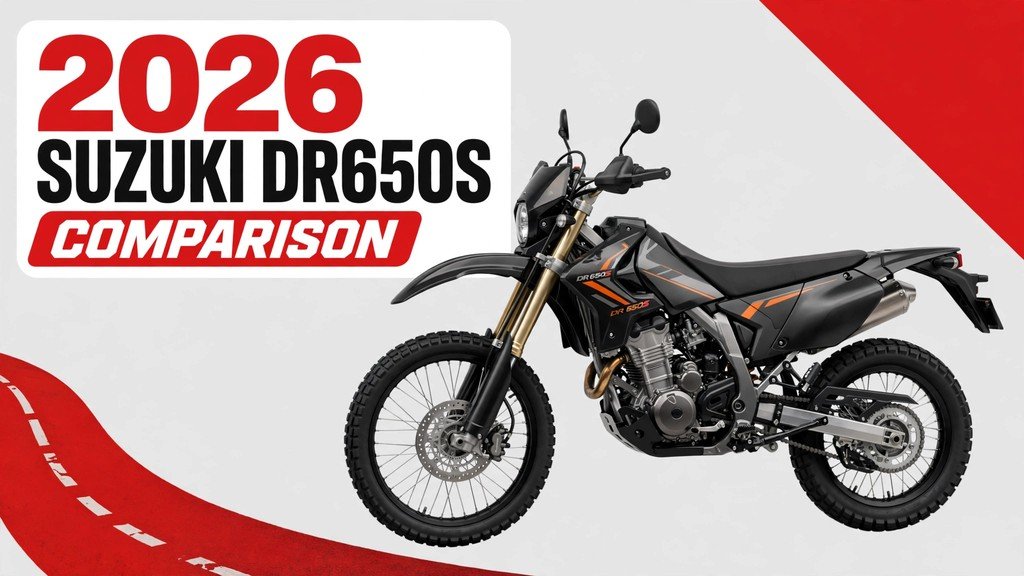
The short answer first: the 2026 Suzuki DR650S is the best value of the four big singles in this Suzuki DR650S comparison. It costs $7,899 out the door and gives up nothing in measured power to either Japanese rival. The Kawasaki KLR650 is cheaper at $7,684 but carries 90 lb more weight. The Honda XR650L is the cheapest at $7,599 and the DR650S’s closest mechanical twin — the same 644cc and bore and stroke, 1.0 hp apart on Dirt Rider’s dyno. The KTM 690 Enduro R is the outlier: more than double the power at $14,199, nearly double the price. This guide puts all four side by side on price, specs, equipment and value.
Suzuki DR650S Overview and Its Closest Rivals
The DR650S does not compete against the whole dual-sport market — it competes against three bikes: one is cheaper, one is its mechanical twin, and one costs nearly twice as much. The Suzuki DR650S review covers the bike itself; this Suzuki DR650S comparison measures it against the only bikes a buyer would cross-shop.

Why These Three Rivals: Price, Character, Premium
The Kawasaki KLR650 is the price rival: $6,999 MSRP and $7,684 out the door, $215 cheaper than the DR650S. It is the only rival with fuel injection, a fuel gauge and a digital dash, and the only one with a 6.1-gallon tank — and it is 90 lb heavier, which is the whole argument against it.
The Honda XR650L is the character rival and the DR650S’s closest mechanical twin: the same 644cc, the same 100.0 × 82.0 mm bore and stroke, the same air-cooled carburetted formula, 1.0 hp and 0.8 lb-ft apart on Dirt Rider’s dyno. The XR is $300 cheaper out the door and 20 lb lighter, but its 37.0-inch seat is the tallest of the four and its 2.8-gallon tank the smallest.
The KTM 690 Enduro R is the premium rival: $13,399 plus $800 destination, $14,199 in total, $6,300 more than the DR650S out the door. For that money it gives 79 claimed horsepower, ride-by-wire, traction control, switchable ABS and a 4.2-inch TFT screen. It is the better dirt bike and the worse value, and this Suzuki DR650S comparison states that trade plainly.
How the Four Bikes Differ at a Glance
The four bikes in this Suzuki DR650S comparison look alike on paper until the weight and tank columns: the three Japanese bikes make almost the same measured power — 35.1, 34.6 and 34.1 horsepower — and the differences that matter are weight, tank size, seat height and equipment. The 690 is the only bike in a different performance class.
| Bike | Published total | Engine | Rear-wheel dyno | Tank | Seat | Curb weight |
|---|---|---|---|---|---|---|
| Suzuki DR650S | $7,899 | 644cc air/oil single, carb | 35.1 hp / 32.2 lb-ft (Dirt Rider, measured) | 3.4 gal | 34.8 in | 366 lb |
| Kawasaki KLR650 | $7,684 | 652cc liquid single, FI | 34.6 hp / 33.5 lb-ft (derived) | 6.1 gal | 34.3 in | 456 lb |
| Honda XR650L | $7,599 | 644cc air single, carb | 34.1 hp / 31.4 lb-ft (Dirt Rider, measured) | 2.8 gal | 37.0 in | 346 lb |
| KTM 690 Enduro R | $14,199 | 693cc liquid single, FI | 79 hp claimed (no US dyno cited) | 3.5 gal | 36.8 in | 357 lb (fully fueled) |
Two figures deserve a note: the KLR650’s dyno figure is derived from Dirt Rider’s XR650L comparison line — “0.5 hp and 2.1 lb-ft less than the KLR650” — not a direct KLR dyno quote, so it is labelled derived; and the 690’s weight is its fully fueled weight from KTM’s own page (152 kg without fuel, 162 kg fully fueled), with its 935 mm (36.8 in) seat and 13.3-litre (3.5 gal) tank verified from KTM’s own page at drafting time.
Suzuki DR650S vs Kawasaki KLR650
The KLR650 is the DR650S’s closest rival on price and its biggest contrast on character: it costs less, carries more fuel, and gives a fuel gauge, a digital dash and optional ABS — but it weighs 456 lb, 90 lb more than the DR650S, and that weight shows everywhere the road ends. This is the head-to-head most buyers face.

The video below is Riding in the Ozarks’ direct comparison — a 2022 Kawasaki KLR650 against a 2021 Suzuki DR650, both mechanically the same as the 2026 models.
Engine, Specs and Performance Side by Side
On the dyno the two bikes are effectively identical: the DR650S measured 35.1 hp at 6,200 rpm and 32.2 lb-ft at 4,500 rpm on Dirt Rider’s Dynojet 250i, and the KLR650’s derived figure is 34.6 hp and 33.5 lb-ft — within half a horsepower. The Dirt Rider 2022 DR650S dyno test is the source; the KLR figure is derived, labelled as such.
The DR650S is a 644cc air/oil-cooled single with a Mikuni BST40 carburettor; the KLR650 is a 652cc liquid-cooled single with fuel injection, and both are five-speeds. The KLR’s fuel injection means no choke routine on cold mornings and no jetting change at altitude; the DR650S’s carburettor means a manual choke and fixed jetting that runs richer as the air thins. The Suzuki DR650S performance guide covers the dyno result in full.
Where the two bikes split is weight and range: the KLR weighs 456 lb and carries 6.1 gallons — at the owner-reported 45 to 55 mpg band, roughly 275 to 335 miles before reserve, nearly double the DR650S’s 155 to 190 miles. The DR650S is 90 lb lighter and narrower, and easier at walking pace and on the trail. The KLR’s seat is 34.3 inches, half an inch lower than the DR650S’s 34.8.
Price, Equipment and Which Suits Which Rider
The KLR650 costs $6,999 plus $685 destination — $7,684 total, $215 less than the DR650S — and gives a liquid-cooled fuel-injected engine, a 6.1-gallon tank, a digital dash with a fuel gauge, and optional ABS (the ABS trim is $7,299 plus $685, or $7,984). The DR650S gives a simpler bike: no ABS, no fuel injection, no fuel gauge, and an analogue speedometer.
Which suits which rider comes down to where the bike goes. The KLR650 suits the rider who tours: the tank, the fuel gauge and the optional ABS make it the better long-distance machine. The DR650S suits the rider who rides off-road: 90 lb less weight, a narrower bike, and a simpler engine any owner can service with basic tools. The KLR is the better tourer; the DR650S is the better trail bike.
Suzuki DR650S vs Honda XR650L
The XR650L is the DR650S’s closest mechanical twin, and the comparison between them is the purest in this Suzuki DR650S comparison: two 644cc air-cooled carburetted singles, the same bore and stroke, measured 1.0 hp apart. The differences are in the seat, the tank and the suspension.

Engine, Specs and Performance Side by Side
Both bikes displace 644cc with the same 100.0 × 82.0 mm bore and stroke: the DR650S uses a Mikuni BST40 carburettor, the XR650L a Keihin 42.5 mm CV. Dirt Rider measured the DR650S at 35.1 hp at 6,200 rpm and 32.2 lb-ft at 4,500 rpm, and the XR650L at 34.1 hp at 6,100 rpm and 31.4 lb-ft at 5,300 rpm — 1.0 hp and 0.8 lb-ft apart. The Dirt Rider 2023 XR650L dyno test is the source.
The chassis is where the twins diverge. The XR650L weighs 346 lb — 20 lb lighter — with longer suspension (11.6 in front, 11.0 in rear, against the DR650S’s 10.2 in at both ends) and 13.0 inches of ground clearance against the DR650S’s 10.4. The DR650S counters with a lower seat (34.8 in vs 37.0) and a bigger tank (3.4 gal vs 2.8). Neither bike has ABS, fuel injection or a fuel gauge; both are five-speed, chain-drive, electric-start singles, and the XR runs a dry sump at 8.3:1 against the DR’s wet sump at 9.5:1.
Price, Equipment and Which Suits Which Rider
The XR650L costs $6,999 plus $600 destination — $7,599 total, $300 less than the DR650S and $85 less than the KLR650, because its destination charge is $85 lower than the KLR’s. The two Japanese rivals match on MSRP at $6,999 but do not cost the same out the door — the destination charge is the difference.
Equipment is nearly identical: neither bike offers ABS, fuel injection, a fuel gauge or a windscreen. The DR650S offers a factory lowering kit that drops the seat to 33.2 inches; the XR650L offers none, and its 37.0-inch seat is the tallest. A shorter rider fits the DR650S more easily, with or without the lowering kit; a taller rider who rides dirt will prefer the XR650L’s suspension.
Suzuki DR650S vs KTM 690 Enduro R
The 690 Enduro R is the premium rival, and the gap is the point: $6,300 more out the door, more than double the claimed power, and a motorcycle from a different decade of engineering. The DR650S is a 1996 design still in production; the 690 is a 2026 bike with ride-by-wire, traction control, switchable ABS and a TFT screen. The question is not which bike is faster — the 690 is, by a wide margin. The question is whether the extra $6,300 buys a better bike, and for most buyers the answer is no.

Engine, Specs and Performance Side by Side
The 690’s engine is a 693cc LC4 liquid-cooled single with four valves, ride-by-wire fuel injection and a six-speed gearbox. KTM claims 79 hp at 8,000 rpm with 73 Nm (54.2 lb-ft) of torque: more than double the DR650S’s measured 35.1 hp and about two-thirds more torque than its 32.2 lb-ft. No US dyno figure was cited for the 690, so its power is printed as KTM’s claim, never as a measurement — the same honesty this Suzuki DR650S comparison applies to the DR650S’s own figures.
The 690’s seat is 935 mm (36.8 in), two inches taller than the DR650S’s 34.8, and its tank 13.3 litres (3.5 gal), barely larger than the DR650S’s 3.4. Ground clearance is 265 mm (10.4 in), identical to the DR650S’s. Weight without fuel is 152 kg (335 lb); fully fueled it is 162 kg (357 lb) — only 9 lb lighter than the DR650S’s 366 lb curb weight. Service intervals run longer at 9,000 miles; the warranty is 12 months limited to 12,000 miles, against the DR650S’s 12-month unlimited-mileage warranty.
Equipment is where the $6,300 shows: the 690 carries ride-by-wire, traction control, switchable ABS, multiple ride modes and a 4.2-inch TFT display, all new for 2026; the DR650S carries an analogue speedometer, a halogen headlight and a carburettor. The 690 is the better dirt bike — lighter, faster, far more capable off-road — and the bike with more to go wrong, more to service, and a TFT screen that will date faster than the DR650S’s analogue dash.
Price, Equipment and Which Suits Which Rider
The 690 Enduro R costs $13,399 plus $800 destination — $14,199 total, $6,100 more than the DR650S on MSRP and $6,300 more out the door. For a rider who rides hard off-road and wants the fastest single-cylinder dual-sport on sale, the 690 is the only answer, and its price is the cost of that answer. For a rider who commutes, tours and rides trails at a relaxed pace, the 690’s extra power and electronics buy capability that is never used.
Running costs follow the purchase price. The 690’s service intervals are longer at 9,000 miles, but its parts, tyres and insurance cost more, and premium fuel adds to every fill-up. The DR650S runs on regular fuel, uses cheap parts, and can be serviced at home with basic tools. The Suzuki DR650S reliability guide covers the DR650S’s service schedule and its zero-recall record in detail.
Suzuki DR650S Price and Value Compared
Price is where this Suzuki DR650S comparison is decided. The DR650S is not the cheapest bike here — the XR650L is, by $300 — and not the most capable — the 690 is, by a wide margin. It gives the most for the money: the same measured power as its Japanese rivals, the lowest running costs of the four, and a price $6,300 below the premium rival.

| Bike | MSRP | Destination | Published total | vs DR650S total |
|---|---|---|---|---|
| Suzuki DR650S | $7,299 | $600 | $7,899 | — |
| Kawasaki KLR650 | $6,999 | $685 | $7,684 | $215 less |
| Honda XR650L | $6,999 | $600 | $7,599 | $300 less |
| KTM 690 Enduro R | $13,399 | $800 | $14,199 | $6,300 more |
KLR650 Is Cheaper, XR650L Matches at $6,999
The heading says it plainly. The KLR650 is cheaper than the DR650S on MSRP — $6,999 against $7,299 — and cheaper out the door at $7,684 against $7,899. The XR650L matches the KLR650 on MSRP at $6,999, and because its destination charge is $600 against the KLR’s $685, the XR is $85 cheaper out the door at $7,599. The three Japanese bikes sit within $300 of each other, and the destination charge — not the sticker price — decides which $6,999 bike costs less.
One more price deserves a sentence. The 2024 DR650S price is split between two named sources: one listing prints $7,099 and a 2024 dealer brochure prints $6,999. This guide names the split and picks neither. The 2026 price is not split — $7,299 plus $600 is confirmed four ways, including Suzuki’s own structured data. A freight surcharge also exists for certain 2025 and 2026 models shipped on or after September 17, 2025, but no amount is published for the DR650S, so this guide adds nothing to the total.
Running Costs and Resale Value Compared
Running costs in this Suzuki DR650S comparison favour the DR650S. Its service schedule is the shortest and cheapest: oil every 3,500 miles, filter every second change, valves every 7,500 miles, screw-and-locknut, no shims. The KLR650’s liquid cooling adds a coolant change and a more complex engine. The XR650L’s schedule is similar, but its 2.8-gallon tank means more fuel stops. The 690’s intervals are longer at 9,000 miles, but its parts and premium fuel cost more, and its electronics need a dealer diagnostic tool the DR650S never will.
Resale value follows the same pattern: the DR650S holds its value because it never changes: a ten-year-old DR650S is mechanically the same motorcycle as a new one, and clean used bikes typically list at $3,500 to $6,500 depending on year and condition at drafting time. The KLR650 and XR650L hold value the same way — all three are old designs that buyers trust. The 690 depreciates faster, because it is a premium bike whose electronics and price date quickly. The cheapest bike to own over five years is the DR650S; the most expensive is the 690.
Suzuki DR650S Comparison Verdict and US Alternatives
The verdict of this Suzuki DR650S comparison is simple: buy the DR650S for the best value in the big dual-sport class, the XR650L for the lightest and most dirt-capable Japanese single, the KLR650 if you tour, and the 690 Enduro R only if you ride hard enough off-road to use it. No buyer here makes a bad choice — but only one gets the best value, and that buyer rides the DR650S.

KTM 690 Price Conflict: $12,999 vs $13,399
The 690’s price conflict is resolved: both figures are real, from different years. KTM announced the 2026 model in August 2025 at $12,999, unchanged from the outgoing model. The bike actually reached dealers at $13,399, confirmed by motorcycle.com’s 2026 spec database ($13,399 plus $800 destination) and by Cycle News’ 2026 review (the same MSRP). The 2025 bike was $12,999; the 2026 bike is $13,399, published total $14,199.
One source still prints the old figure: a November 2026 headline calls it “the $12,999 KTM 690 Enduro R” — the announcement price, not the delivered price. No source states why the price rose $400 between announcement and delivery, so this guide names the jump and never explains it. The lesson is practical: the 690’s price moved $400 in a year, the DR650S’s $100 — $7,199 in 2025 to $7,299 in 2026 — and the Japanese bikes’ prices are the stable ones in this class.
CRF450RL Alternative Sits in a Different Class
The Honda CRF450RL is not a fourth rival in this Suzuki DR650S comparison — it is an alternative in a different class. At $10,099 plus $600 destination ($10,699 total) it sits $2,800 above the DR650S and $3,500 below the 690. Its 449.7cc liquid-cooled single made 36.0 hp at 7,800 rpm and 26.9 lb-ft at 6,500 rpm in a motorcycle.com shootout dyno, at about 291 lb — 75 lb lighter.
The CRF450RL is the lighter, sharper, more dirt-focused tool: a six-speed enduro-derived dual-sport with a Unicam head, built for trail performance over road comfort. It is not a replacement for the DR650S — 200cc smaller, less torque, and costs more for a bike that does less on the road. A buyer who wants the DR650S’s road manners and range should not buy it; one who rides mostly dirt should test it against the 690. The DR-Z400S comparison covers the CRF450RL’s closest rival in the smaller class, and the V-Strom 650 comparison covers the road-biased adventure alternative for riders who want a fairing, a V-twin and ABS.
Suzuki DR650S Comparison: Frequently Asked Questions
Direct answers to the questions riders ask in this Suzuki DR650S comparison.
Which is better, the DR650S or the KLR650?
Neither is better in every way. The DR650S is 90 lb lighter, simpler to service and easier off-road; the KLR650 is cheaper, carries 6.1 gallons, and offers fuel injection, a fuel gauge and optional ABS. This Suzuki DR650S comparison calls the KLR the better tourer, the DR650S the better trail bike.
Is the DR650S faster than the XR650L?
Barely: Dirt Rider measured the DR650S at 35.1 hp and 32.2 lb-ft, and the XR650L at 34.1 hp and 31.4 lb-ft — 1.0 hp and 0.8 lb-ft apart. On the road the difference is invisible; on the trail the XR650L’s longer suspension and 13.0-inch clearance matter more.
How much more does the KTM 690 Enduro R cost than the DR650S?
The 690 costs $13,399 plus $800 destination — $14,199 total, $6,300 more than the DR650S’s $7,899. The 2025 690 was $12,999; the 2026 price is $13,399, confirmed by motorcycle.com and Cycle News.
Is the DR650S cheaper than the KLR650?
No — the KLR650 is $7,684 out the door, $215 less than the DR650S’s $7,899. The DR650S is the better value off-road, but the KLR650 is the cheaper bike to buy.
Which bike has the biggest fuel tank?
The KLR650, by a wide margin: 6.1 gallons, against 3.4 for the DR650S, 3.5 for the 690 and 2.8 for the XR650L. At the owner-reported 45 to 55 mpg band the KLR gives roughly 275 to 335 miles before reserve — nearly double the DR650S’s 155 to 190.
Which bike is the lightest?
The XR650L, at 346 lb — 20 lb lighter than the DR650S at 366 lb. The 690 is 357 lb fully fueled, 9 lb lighter, and the KLR650 is heaviest at 456 lb.
Does the DR650S have ABS like the KLR650?
No — the DR650S has never had ABS. The KLR650 offers it as an option, the 690 carries switchable ABS; the XR650L, like the DR650S, has none.
Is the DR650S fuel-injected like the KLR650?
No — the DR650S uses a Mikuni BST40 carburettor, the XR650L a Keihin CV. The KLR650 and the 690 are the only fuel-injected bikes in this group.
Which bike is best for beginners?
The DR650S, with caveats: its engine is forgiving, its seat is 34.8 inches with a lowering kit to 33.2, and its weight is manageable. The XR650L’s 37.0-inch seat is too tall for most beginners, the KLR650’s 456 lb is a lot to manage, and the 690’s 79 hp is too much for a new rider.
What is the cheapest big dual-sport in this group?
The Honda XR650L: $7,599 out the door ($6,999 plus $600 destination). The KLR650 is $7,684, the DR650S $7,899, the 690 Enduro R $14,199.
Is the KTM 690 Enduro R worth double the price?
Only for hard off-road riding. The 690 makes more than double the DR650S’s measured power and carries modern electronics, but it costs $6,300 more and costs more to run. For commuting, touring and relaxed trail riding, the DR650S gives the same measured power as its Japanese rivals at half the price.
What about the Honda CRF450RL?
It sits in a different class: 449.7cc, about 291 lb, $10,699 out the door. It is lighter and sharper than the DR650S but 200cc smaller, with less torque and a higher price — the alternative for dirt-first riders, not a head-to-head rival.