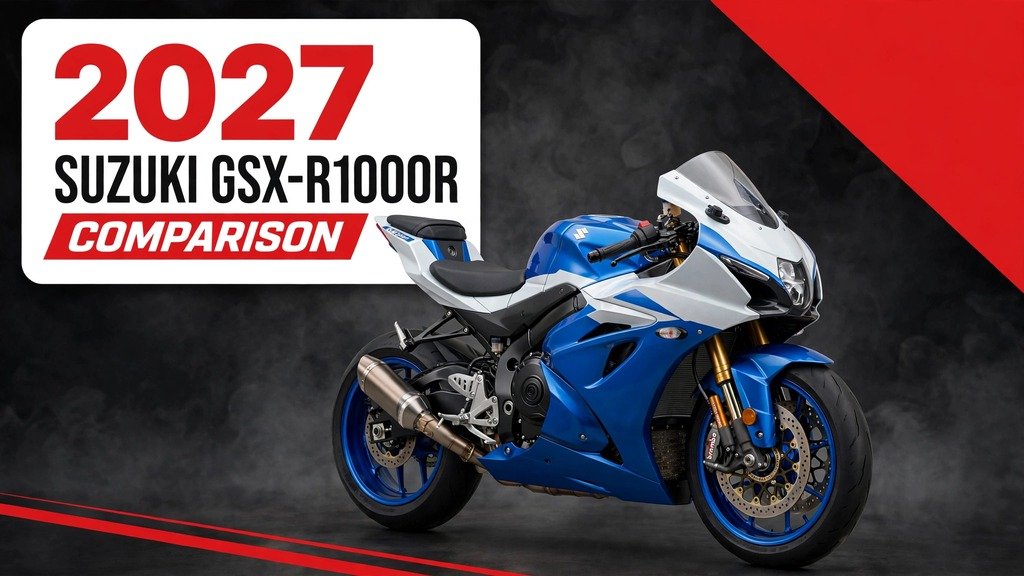
At $18,689 delivered, the 2027 Suzuki GSX-R1000R is the cheapest ABS litre bike in its premium rival set — undercutting the ZX-10R ABS by $150, the R1 by $1,285 and the S 1000 RR by $2,281. It does that with a 192.3 hp global claimed output, gold-anodized Showa BFF suspension and a full Bosch IMU electronics suite, but it keeps the LCD dash its rivals replaced with TFT screens years ago, and no independent 2027 multi-bike test has judged it against those three rivals. This Suzuki GSX-R1000R comparison weighs the R against the ZX-10R, the R1 and the S 1000 RR on price, hardware and value.
Suzuki GSX-R1000R Overview and Its Closest Rivals
The R is the middle trim of Suzuki’s three-model 2027 litre range: the base at $16,399, the R at $17,939 and the new RS at $18,639, all before the $750 destination charge. All three share the same heavily revised 2017 L7 platform — frame and swingarm fundamentally unchanged — with the same 999.8cc inline-four, Bosch IMU electronics and Bridgestone RS11 tyres. What separates them is hardware: the R adds the gold-anodized Showa BFF fork and BFRC-Lite shock, stainless-steel brake lines and a braced swingarm with an adjustable pivot over the base, while the RS adds carbon winglets and a solo tail cowl over the R.

Why These Three Rivals: the Premium Litre Field
The ZX-10R, the R1 and the S 1000 RR are the three rivals that matter because each one attacks the R from a different angle. The Kawasaki is the value rival: its ABS model sits just $60 above the R on MSRP. The Yamaha is the premium Japanese rival: the R1 is still sold new in the US for 2027 at $19,199, with a crossplane-crank engine and a TFT dash the Suzuki cannot match. The BMW is the technology rival: it costs $2,281 more delivered, but it brings 205 hp and the most advanced electronics in the class. The Honda CBR1000RR is not in this group — it was the base GSX-R1000’s rival. The Ducati Panigale V4 appears only as context, at $29,290 delivered — a different price league entirely.
How the Four Bikes Differ at a Glance
The four bikes are closer on paper than their prices suggest: the R’s 192.3 hp global claimed figure sits between the ZX-10R’s 190 hp and the R1’s 197 hp, and only the BMW’s 205 hp opens a clear gap. The R is the only one still using an LCD dash, and the cheapest of the four once destination is counted.
| Bike | Delivered price | Claimed power | Front suspension | Dash |
|---|---|---|---|---|
| Suzuki GSX-R1000R | $18,689 | 192.3 hp @ 13,200 rpm (global) | 43 mm Showa BFF, manual | LCD, not TFT |
| Kawasaki Ninja ZX-10R ABS | $18,839 | 190 hp @ 11,500 rpm | 43 mm Showa BFF | TFT colour dash |
| Yamaha YZF-R1 | $19,974 | 197 hp @ 13,500 rpm (claimed) | 43 mm KYB, fully adjustable | TFT dash |
| BMW S 1000 RR | $20,970 | 205 hp @ 13,000 rpm (US) | 45 mm USD, fully adjustable | 6.5-inch TFT dash |
The video below is a compilation comparing 2017 1000cc superbikes on sound, top speed, looks and power, using credited clips — it is not a ridden shootout and not a 2027 test.
Suzuki GSX-R1000R vs Kawasaki Ninja ZX-10R
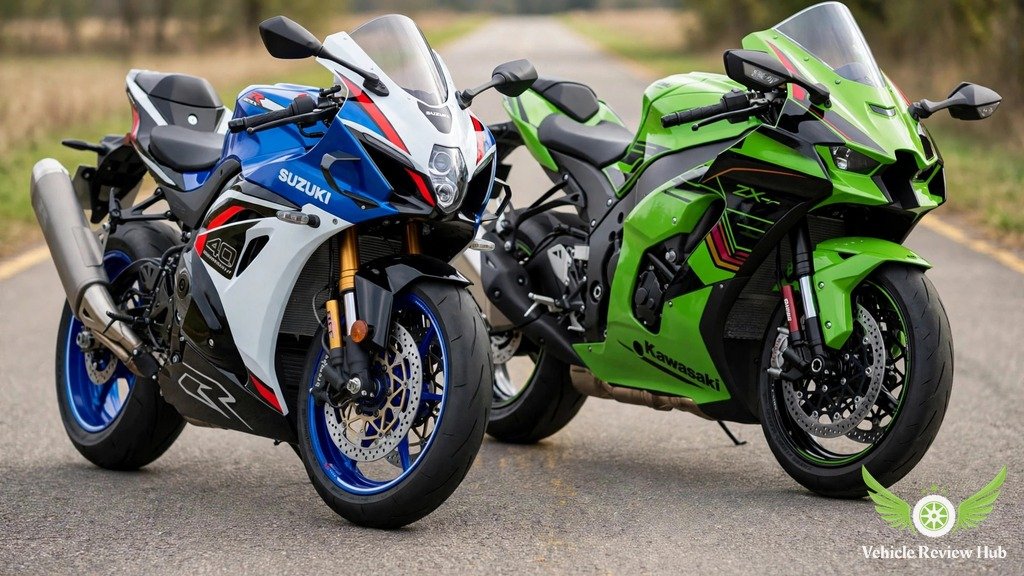
The ZX-10R is the R’s closest rival on price and the hardest one to beat on value. Kawasaki’s 2027 ZX-10R costs $16,999 before destination, and the ABS model — the one that matches the R’s standard ABS — costs $17,999. With destination added, the base is $17,839 delivered, $850 under the R, while the ABS model is $18,839, just $150 over it.
Engine, Specs and Performance Side by Side
Both bikes use a 998cc-class inline-four with almost identical claimed outputs: the ZX-10R makes 190 hp at 11,500 rpm in US trim, while the R’s global claimed figure is 192.3 hp at 13,200 rpm. On measured power the picture is thinner: Cycle World measured 177.2 rear-wheel hp on a 2017 R, and Motorcycle.com measured 162.2 hp at 11,000 rpm on a 2020 R, but no named US outlet has published a 2027 dyno figure for either bike. No peak rpm is stated for the Cycle World figure. The quarter-mile story is the same: Suzuki’s factory claim of 9.8 seconds was made for “the new Gixxer” without naming a trim, and no instrumented quarter-mile test of the R exists. Top speed is equally untested — Cycle World saw an indicated 184 mph on a 2017 R at Phillip Island, and the compiled figure for the L7 generation is around 186 mph, a limiter figure rather than a GPS-tested speed. Both bikes run Showa BFF front forks and 190-section rear tyres, and the R weighs 448 lb. The real split is the dash: the Kawasaki’s TFT colour dash looks a generation newer than the Suzuki’s black-background LCD, which reviewers keep calling out — Motorcycle.com asked “Why are we still using an LCD screen?” and Cycle News said the dash “was barely acceptable in 2017.”
Price, Equipment and Which Suits Which Rider
On equipment, the R’s $1,540 premium over its own base buys the gold-anodized BFF fork and BFRC-Lite shock, stainless-steel brake lines, a braced swingarm with an adjustable pivot and a lightweight upper triple clamp — but the quickshifter, launch control, Brembo Monobloc calipers and 320 mm T-drive rotors are on the 2027 base bike too, so none of those is an R-only advantage over the Kawasaki either. The ZX-10R ABS answers with its own full electronics suite and TFT dash, and its $60 MSRP gap becomes a $150 delivered gap once destination is counted — $840 for Kawasaki against $750 for Suzuki. A rider who values the newest dash and $150 saved will take the Kawasaki; a rider who wants the gold-fork hardware, the stainless lines and the Suzuki’s lower delivered price will take the R. The non-ABS ZX-10R is a different question: at $17,839 delivered it undercuts the R by $850, but it gives up ABS, which the R has as standard. For a road rider who wants ABS, the R is the cheaper bike; for a track rider, the base ZX-10R’s $850 saving is real money. The 2027 ZX-10R first look confirms the Kawasaki’s prices are unchanged from last year.
Suzuki GSX-R1000R vs Yamaha YZF-R1
The R1 is the premium Japanese rival, still sold new in the US for 2027 — Yamaha’s November 4, 2026 pricing release lists the YZF-R1 at $19,199 and the R1M at $27,899. With the $775 destination charge, the R1 is $19,974 delivered, $1,285 over the R, while the R1M is $28,674 delivered, $9,985 over it. The R1’s case against the Suzuki is not price — it is character, electronics and the dash.

Engine, Specs and Performance Side by Side
The R1’s 998cc crossplane-crank inline-four is claimed at 197 hp at 13,500 rpm — a figure converting from the 200 PS Euro rating, since Yamaha’s US release gives price only. Against the R’s 192.3 hp global claimed figure, the Yamaha holds a small on-paper edge of about 5 hp. The riding character differs: the crossplane crank gives the R1 a distinctive uneven firing order and mid-range surge, while the Suzuki’s engine is praised for its linearity — MCNews called it “incredibly linear” with a “monster mid-range” and “great throttle.” On measured dyno figures, Motorcycle.com’s 2020 test put the R at 162.2 hp at 11,000 rpm, and Cycle World’s 2017 test measured 177.2 rear-wheel hp. The R1’s TFT dash is the other clear gap: Yamaha’s colour TFT against the Suzuki’s LCD. The R answers with its gold-anodized BFF fork and BFRC-Lite shock, stainless-steel brake lines and a Bosch 6-axis IMU running three SDMS modes and ten STCS traction-control levels plus off.
Price, Equipment and Which Suits Which Rider
The $1,285 delivered gap buys the R1’s crossplane character, its TFT dash and the Yamaha badge’s track pedigree — but not more suspension hardware than the R’s gold BFF setup, and not a tested performance advantage. The R1M, at $28,674 delivered, is a different purchase: Öhlins electronic suspension and carbon bodywork for nearly $10,000 over the R. A rider who wants the most engaging engine note and the modern dash and will pay $1,285 for it should take the R1. A rider who wants the same litre-bike speed, better suspension hardware per dollar and $1,285 left for tyres and track days should take the R. The Yamaha 2027 pricing release confirms the R1 is genuinely available new in the US for 2027. Do not use the “2027 R1 Revival” article claiming 210 hp and a $19,999 price — it contradicts Yamaha’s own release on both figures.
Suzuki GSX-R1000R vs BMW S 1000 RR
The S 1000 RR is the technology rival and the most expensive bike here. BMW’s 2027 S 1000 RR costs $19,975 before destination, and with the $995 destination charge it is $20,970 delivered — $2,281 over the R. It is also the most powerful bike here by a clear margin, and the only one with a 6.5-inch TFT dash and a full suite of rider aids.

Engine, Specs and Performance Side by Side
BMW’s US figure is 205 hp at 13,000 rpm from its 999cc inline-four — the Euro rating is 210 PS at 13,750 rpm. That is roughly 13 hp over the R’s 192.3 hp global claimed figure, the largest gap here, and it shows in the only head-to-head evidence: the AutoTrader.ca four-bike track test of August 2017 put the BMW S1000RR first and the Suzuki GSX-R1000R fourth and last, with the ZX-10R second and the Aprilia RSV4 RR third. The testers called the Suzuki “our least favourite” and noted that “even with the full-on R package the GSX-R just wasn’t as enjoyable to ride as the others,” though its 203 kg wet weight was the lightest in the group. That was a 2017 test, not a 2027 one, and the revised Suzuki has a new crankshaft, higher 13.8:1 compression and updated electronics — but no 2027 multi-bike test exists to say whether the gap has closed. On measured power, Motorcycle.com’s 2020 test of the R recorded 162.2 hp at 11,000 rpm, while Cycle World’s 2017 test measured 177.2 rear-wheel hp. The BMW’s advantage is not only power: its 6.5-inch TFT dash and shift-cam valve timing are technology the Suzuki lacks. The R’s answer is a manually adjustable gold BFF fork and BFRC-Lite shock, stainless-steel lines, and a Bosch IMU suite covering traction, wheelie and launch control without a TFT menu.
Price, Equipment and Which Suits Which Rider
The $2,281 delivered gap buys 13 hp, the TFT dash and the most advanced electronics in the class — and it buys the only bike here that won a head-to-head track test against the R, even if that test is from 2017. BMW’s $995 destination charge is the highest in this group, and a fully optioned build can pass $30,000 — the “$30,325” figure online is an optioned configurator number, not the base price. The fastest, most high-tech litre bike is the BMW. Ninety-five percent of the speed, better suspension hardware per dollar and $2,281 left for tyres and track days is the Suzuki. The BMW 2027 model-year update confirms the $19,975 MSRP and the 205 hp US figure.
Suzuki GSX-R1000R Price and Value Compared
Price is where the R makes its strongest case. At $18,689 delivered it undercuts every rival here, while carrying the gold BFF suspension hardware its own $16,399 base bike does not have. The full delivered-price picture is below — MSRP alone hides the real gap on some bikes.

| Bike | MSRP | Destination | Delivered | vs R ($18,689) |
|---|---|---|---|---|
| Suzuki GSX-R1000R | $17,939 | $750 | $18,689 | — |
| Suzuki GSX-R1000 (base) | $16,399 | $750 | $17,149 | R is +$1,540 |
| Suzuki GSX-R1000RS | $18,639 | $750 | $19,389 | R is $700 under |
| Kawasaki Ninja ZX-10R | $16,999 | $840 | $17,839 | R is +$850 |
| Kawasaki Ninja ZX-10R ABS | $17,999 | $840 | $18,839 | R is −$150 |
| Yamaha YZF-R1 | $19,199 | $775 | $19,974 | R is −$1,285 |
| Yamaha YZF-R1M | $27,899 | $775 | $28,674 | R is −$9,985 |
| BMW S 1000 RR | $19,975 | $995 | $20,970 | R is −$2,281 |
| Ducati Panigale V4 | $27,995 | $1,295 | $29,290 | R is −$10,601 |
| Ducati Panigale V4 S | $35,995 | $1,295 | $37,290 | R is −$18,601 |
ZX-10R ABS Sits Just $60 Above the R
The $60 figure is real, but it is an MSRP comparison only. The R’s MSRP is $17,939 and the ZX-10R ABS is $17,999, a $60 gap. Once destination is added, the gap grows to $150: $18,689 for the Suzuki against $18,839 for the Kawasaki, because Kawasaki charges $840 against Suzuki’s $750. The base ZX-10R tells the other side: at $16,999 MSRP it is $940 under the R, and at $17,839 delivered it is $850 under — but it has no ABS, while the R has ABS as standard. So the honest statement is twofold: against the ABS Kawasaki the R is $150 cheaper delivered; against the non-ABS Kawasaki it costs $850 more for ABS and the gold BFF hardware. The R is also $710 cheaper on MSRP than the 2025 R — $17,939 against $18,649 — and $490 cheaper delivered, since the 2025 bike carried a $530 destination charge. The $18,299 figure that circulates for the 2025 R was the 2023 price.
Running Costs and Resale Value Compared
Running costs favour the R the same way its purchase price does. The service chart is shared with the base bike: oil at every column, filter at 600, 7,500 and 14,500 miles, plugs at 7,500 and 14,500, and valves inspected at 14,500 miles only. There is no tested MPG figure for the R from any named US outlet — the 36.7 mpg figure from Motorcycle.com’s 2017 street shootout belongs to the base bike, not the R — though the European combined figure for the 2017–2022 R is 6.2 L/100 km, about 37.9 US mpg. Wear is known: MCN’s long-term R went through four sets of tyres and a new chain and sprockets in 11,000 miles with six track days, and MCN’s owners rate the R’s annual servicing at £280 against £100 for the base — UK figures from thin samples. Only two recalls can apply to the R, both 2017–2018 campaigns, and 2019–2022 R bikes have no applicable US recall — a used R with a VIN check showing both campaigns done carries no outstanding safety item. The dollars-per-horsepower table below makes the value case in one line.
| Bike | Delivered | Claimed hp | $ per hp | Strongest card |
|---|---|---|---|---|
| Suzuki GSX-R1000R | $18,689 | 192.3 (global) | $97 | Cheapest ABS litre bike in this set |
| Kawasaki Ninja ZX-10R ABS | $18,839 | 190 | $99 | TFT dash at near-R money |
| Yamaha YZF-R1 | $19,974 | 197 (claimed) | $101 | Crossplane character, TFT dash |
| BMW S 1000 RR | $20,970 | 205 (US) | $102 | Most power, most technology |
Suzuki GSX-R1000R Comparison Verdict and US Alternatives
The verdict: the R wins on value and loses on technology. It is the cheapest ABS litre bike against the named rival set, it has the best suspension hardware per dollar, and its $1,540 premium over the base buys real hardware rather than badges. It loses on the dash, on outright power to the BMW, and on the only head-to-head track test ever run — a 2017 test in which it finished last. Most bike for the least money: the R. Most technology: the BMW. Most character: the Yamaha. Newest dash for near-R money: the Kawasaki.
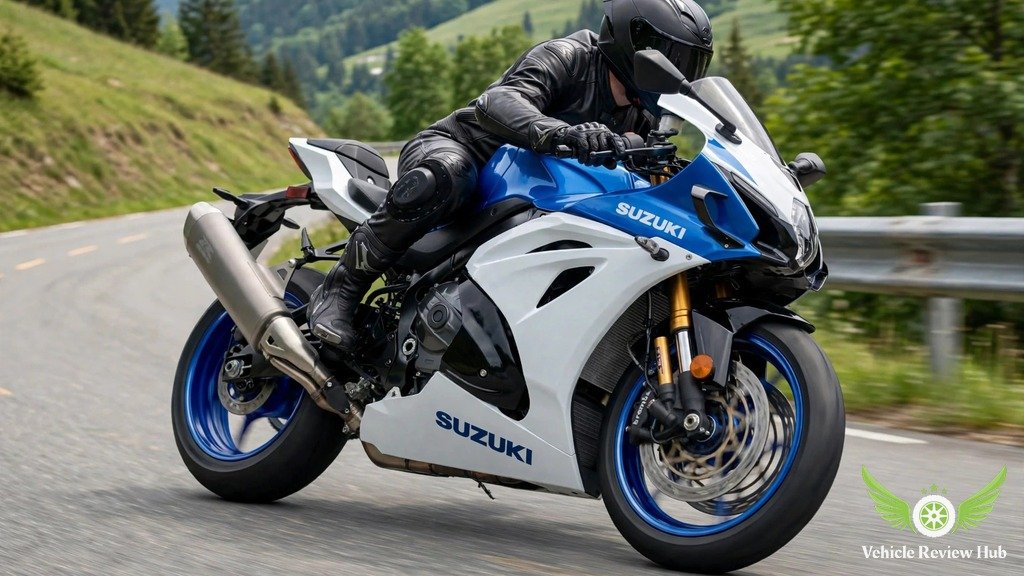
No US Test Has Judged the 2027 R Premium Yet
No 2027 multi-bike comparison or shootout including the 2027 GSX-R1000R exists yet — only solo coverage: Motorcycle.com’s 2027 first ride tested the RS at Monteblanco in Spain, Cycle News reviewed the RS alone, MCNews tested the R alone at One Raceway in Australia, and Moto-1 track-tested the R alone at Chuckwalla while teasing an upcoming shootout that has not yet been published. This comparison is therefore a spec, price and value judgement, not a tested verdict. The only prior head-to-head evidence is 2017-era: Motorcycle.com’s 2017 shootouts, in which the base GSX-R1000 finished fourth on the street at 89.95 percent and fifth on track at 90.24 percent, and the AutoTrader.ca four-bike track test, in which the R finished fourth and last behind the S1000RR, ZX-10R and RSV4 RR. Both tests used the pre-revision bike — the 2027 bike has a new crankshaft, higher compression and updated electronics — but until a 2027 test is published, the R’s premium has not been independently judged. The Motorcycle.com 2017 street shootout is the clearest record of where the base bike stood.
The Base Bike and RS Are In-House Alternatives
The R’s closest alternatives are inside Suzuki’s own showroom. The base GSX-R1000 costs $16,399 plus $750 destination, $17,149 delivered — $1,540 under the R — and it shares the same engine, IMU electronics, quickshifter, launch control, Brembo calipers, 320 mm T-drive rotors and RS11 tyres. What it does not have is the gold BFF fork and BFRC-Lite shock, the stainless-steel brake lines, the braced swingarm with adjustable pivot, the lightweight upper triple clamp and the R colours. A rider who will never adjust suspension or ride hard enough to feel the difference should save the $1,540 and buy the base — the GSX-R1000 comparison makes that case in full. The RS costs $18,639 plus $750, $19,389 delivered — $700 over the R — and adds carbon-fibre winglets and a solo tail cowl, the only two things the R lacks. A rider who wants the winglets and the cowl should pay the $700; a rider who does not should not. The full picture of what the premium buys is in the GSX-R1000R review, and the dyno and speed figures are in the GSX-R1000R performance guide.
Suzuki GSX-R1000R Comparison: Frequently Asked Questions
Direct answers to the questions riders ask about the Suzuki GSX-R1000R against its rivals.
Which is the cheapest litre bike in this Suzuki GSX-R1000R comparison?
The R, at $18,689 delivered — under the ZX-10R ABS by $150, the R1 by $1,285 and the S 1000 RR by $2,281, against the named rival set only.
Is the Suzuki GSX-R1000R faster than the ZX-10R?
No tested answer exists. The claimed figures are almost identical — 192.3 hp global for the R against 190 hp for the ZX-10R — and no named US outlet has published a 2027 dyno figure for either bike.
Is the Yamaha YZF-R1 worth $1,285 more than the R?
It is worth it for the crossplane engine character and the TFT dash. It is not worth it for suspension hardware, where the R’s gold BFF setup is stronger per dollar.
Is the BMW S 1000 RR worth $2,281 more than the R?
It is worth it for 205 hp, the TFT dash and the most advanced electronics. It is not worth it for value — the R is $97 per claimed horsepower against the BMW’s $102.
Does the GSX-R1000R have a TFT dash?
No. The R uses a black-background LCD multifunction instrument panel inspired by the GSX-RR MotoGP dash. Every rival here has a TFT dash.
Which bike is best for track days?
On 2017 evidence, the BMW — it won the only head-to-head track test against the R. On 2027 hardware per dollar, the R’s gold BFF suspension and stainless lines are the strongest package.
Which bike is best for the road?
The R, for most riders: the lowest delivered price, the most linear engine character and the most manageable power delivery. The R1 suits riders who want crossplane character above all.
Should I buy the base GSX-R1000 instead of the R?
Yes, if you will never adjust suspension or ride hard enough to feel the BFF fork, the stainless lines and the braced swingarm — the base shares the engine, electronics, quickshifter and launch control for $1,540 less.
Should I buy the RS instead of the R?
Only if you want the carbon winglets and the solo tail cowl. The RS is $700 over the R and adds nothing else.
Has any 2027 test compared the R against its rivals?
No. No 2027 multi-bike comparison including the R exists yet. The only head-to-head evidence is 2017-era.
How many recalls apply to the GSX-R1000R?
Only two: 18V064, the ECM fault, and 18V694, the fuel-pump O-ring. Both cover only certain 2017–2018 bikes, and 2019–2022 R bikes have no applicable US recall.
Which bike holds its value best?
No published resale data separates these four, but the R starts cheapest and its 2027 price dropped $710 from 2025. Check a 2017–2018 R’s VIN for both recalls before buying used.