The 2027 Suzuki GSX-R1000R costs $17,939 before destination, or $18,689 delivered — $710 cheaper than the 2025 R. That price cut is the headline of this Suzuki GSX-R1000R review, but it is not the whole story: the R is a heavy revision of the 2017 (L7) platform, not a clean-sheet new generation, and the $1,540 premium over the base bike buys gold-anodized Showa BFF suspension, stainless-steel brake lines and a braced swingarm — not the quickshifter, launch control or TFT dash that some buyers expect. The short answer: the R is the best-suspended GSX-R1000 you can buy new.
Suzuki GSX-R1000R Overview and Model-Year Updates
The GSX-R1000R is the top trim of Suzuki’s 999.8cc litre superbike, and the 2027 bike is the latest chapter of the 2017 (L7) platform: the frame and swingarm are fundamentally unchanged from 2017, the engine is a reworked version of the same 999.8cc inline-four with compression raised to 13.8:1, and the electronics suite has been overhauled around a new Bosch 6-axis IMU. Suzuki sells three US trims for 2027 — base, R and RS — all as 40th Anniversary Edition models, and the R sits $1,540 above the base and $700 below the RS.

Latest Year Is 2027 and the Price Dropped $710
The latest year is 2027, and the R is cheaper than it was. Suzuki’s own 2025 R page listed the bike at $18,649; the 2027 R is priced at $17,939 in Suzuki’s 2027 lineup announcement — a $710 drop on the sticker. With the $750 destination charge, the delivered total is $18,689, against $19,179 for the 2025 bike with its $530 destination charge — a real saving of $490. One figure to avoid: $18,299 circulates as a 2025 R price, but that was the 2023 price. The US bike is the global 2026 bike sold as a 2027. The revised bike returns with a new crankshaft, new pistons, larger exhaust valves, a lithium-ion battery and a 4-2-1 exhaust with a smaller 5.5-litre muffler, but the chassis underneath is the one Suzuki has sold since 2017.
All Three Trims Weigh the Same 448 Pounds
All three 2027 trims weigh the same 448 pounds at the kerb, according to Suzuki’s own spec tables, so the R’s extra hardware does not cost any weight. The base, the R and the RS all share the 999.8cc engine, the 32.5-inch seat height, the 4.2-US-gallon tank and the 55.9-inch wheelbase. What changes between trims is equipment, not dimensions: the R adds the gold-anodized Showa BFF fork and BFRC-Lite shock, stainless-steel front brake lines, a braced swingarm with an adjustable pivot and a lightweight upper triple clamp, while the RS adds carbon-fibre winglets and a colour-matched solo tail cowl. The Suzuki GSX-R1000 review covers the base bike’s full specification, and the differences in this review are the R’s alone.
Suzuki GSX-R1000R Engine and Specifications
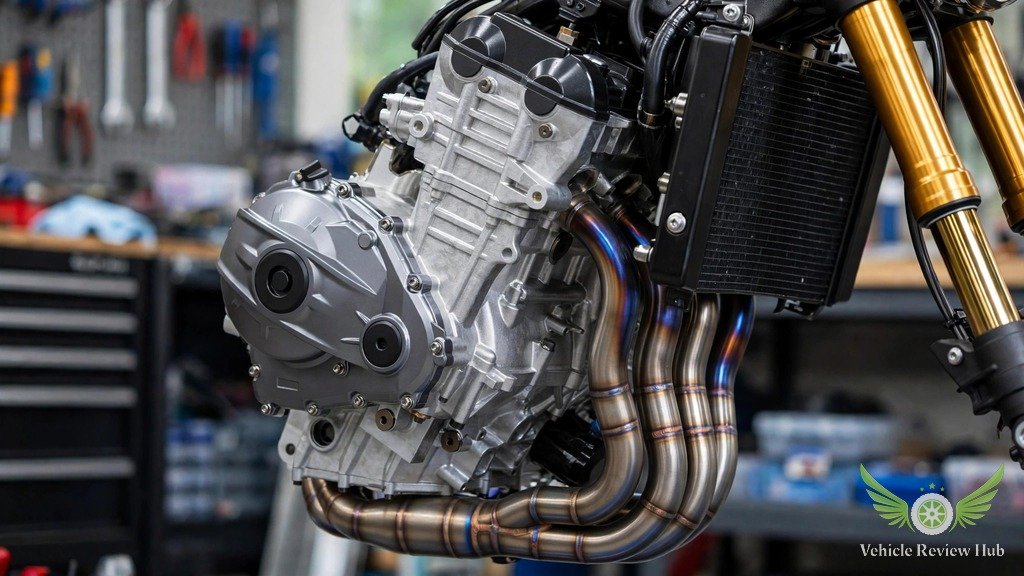
The R shares its engine with the base bike: a 999.8cc liquid-cooled inline-four with a 76.0 × 55.1 mm bore and stroke, 13.8:1 compression and Suzuki’s SR-VVT variable valve timing. The 2027 rework adds a new crankshaft, crankcases, pistons and connecting rods, larger exhaust valves and 48 mm throttle bodies, and a new 4-2-1 exhaust with a titanium muffler smaller than the old bike’s 8.3-litre unit. The full specification table is below.
| Specification | 2027 Suzuki GSX-R1000R |
|---|---|
| Engine | 999.8cc liquid-cooled DOHC inline-four |
| Bore × stroke | 76.0 × 55.1 mm |
| Compression ratio | 13.8:1 |
| Power (global claim) | 195 PS / 192.3 hp @ 13,200 rpm |
| Torque (global claim) | 110 Nm / 81.1 lb-ft @ 11,000 rpm |
| Power (Suzuki USA) | No figure published |
| Electronics | Bosch 6-axis IMU, SDMS 3 modes, STCS 10 + OFF, Smart TLR, launch control, quickshifter |
| Dash | Black-background LCD multifunction panel (not TFT) |
| Front suspension | 43 mm Showa BFF, fully adjustable, gold-anodized |
| Rear suspension | Showa BFRC-Lite, fully adjustable |
| Front brakes | Brembo Monobloc calipers, 320 mm T-drive rotors, stainless-steel lines |
| Rear brake | Nissin single-piston caliper, single disc |
| Tyres | Bridgestone RS11, 120/70ZR17 front, 190/55ZR17 rear |
| Curb weight | 448 lb |
| Seat height | 32.5 in |
| Fuel tank | 4.2 US gal |
| Wheelbase | 55.9 in |
| Warranty | Twelve-month unlimited-mileage limited warranty |
Shared 999.8cc Engine, 13.8:1 for 2027
The shared 999.8cc engine is the same unit in all three trims, and the 2027 compression rise from 13.2:1 to 13.8:1 is the biggest single engine change. Suzuki USA publishes no horsepower or torque figure for the bike at all — the US brochure spec tables contain no output line — so the only published numbers are the global claim of 195 PS, or 192.3 hp, at 13,200 rpm and 110 Nm, or 81.1 lb-ft, at 11,000 rpm. That global figure is lower than the old bike’s 202 PS, or 199 hp, claim. On a dyno, the numbers are lower still: Cycle World measured 177.2 rear-wheel horsepower on a 2017 R in its November 2017 test, and Motorcycle.com measured 162.2 hp at 11,000 rpm and 78.0 lb-ft at 10,800 rpm on a stock 2020 R on a MotoGP Werks dyno. Both are rear-wheel measurements on US bikes, lower than the claimed crank figure, which is normal — the gap is partly emissions tuning and partly the difference between crank and rear-wheel measurement.
Smart TLR Has No Count of Its Own: It Follows the STCS Level
Smart TLR has no mode count of its own: it automatically aligns the Lift Limiter and the Roll Torque Control to the selected STCS level, so the wheelie and cornering-torque responses change with the traction-control setting. The counts Suzuki does state are three SDMS riding modes, A, B and C, all of which deliver peak output and differ in throttle response, and ten STCS traction-control modes plus OFF, with mode 1 giving the least intervention and mode 10 the most, for wet or slick roads. The full S.I.R.S. suite also includes launch control, which holds the engine at 9,500 rpm while the rider holds the throttle open and feeds out the clutch, a bi-directional quickshifter with auto-blipper, the Motion Track Brake System, Slope Dependent Control, Easy Start and Low RPM Assist. One point worth stating plainly: the launch control and quickshifter are not R-only features in 2027 — the base bike gets both as standard.
Suzuki GSX-R1000R Price and Market Availability
The R is priced at $17,939 for 2027, and the destination charge is $750, so the delivered total is $18,689. That puts it $1,540 above the base bike, $700 below the RS, and $710 below the 2025 R. The destination charge is not printed by Suzuki itself — its price footnote says the MSRP excludes destination freight — so the $750 figure comes from Motorcycle.com’s spec database and dealer listings.
| Trim (2027, USA) | MSRP | Destination | Delivered |
|---|---|---|---|
| Suzuki GSX-R1000 (base) | $16,399 | $750 | $17,149 |
| Suzuki GSX-R1000R | $17,939 | $750 | $18,689 |
| Suzuki GSX-R1000RS | $18,639 | $750 | $19,389 |
Suzuki GSX-R1000R Price in the USA: $17,939 for 2027
The $17,939 price is confirmed in two places: Suzuki’s 2027 lineup announcement, which states the GSX-R1000R 40th Anniversary Edition is priced at $17,939, and the R’s own product page on Suzuki’s site, which lists the same figure. The 2025 R was $18,649 on Suzuki’s own 2025 page, so the 2027 bike is $710 cheaper, and with the destination charge taken into account it is $490 cheaper delivered than the 2025 bike was. For context, the 2017 R was $16,999 when it launched and the 2020 R was $16,499. The Suzuki GSX-R1000 performance guide covers the dyno figures behind the R’s claimed output.
Plus $750 Destination, Two Colour Choices
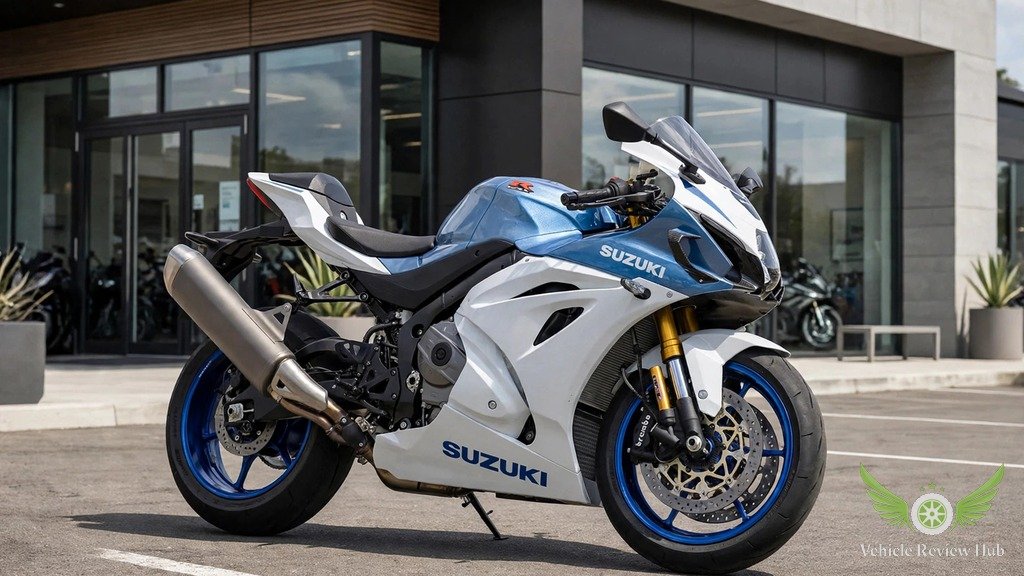
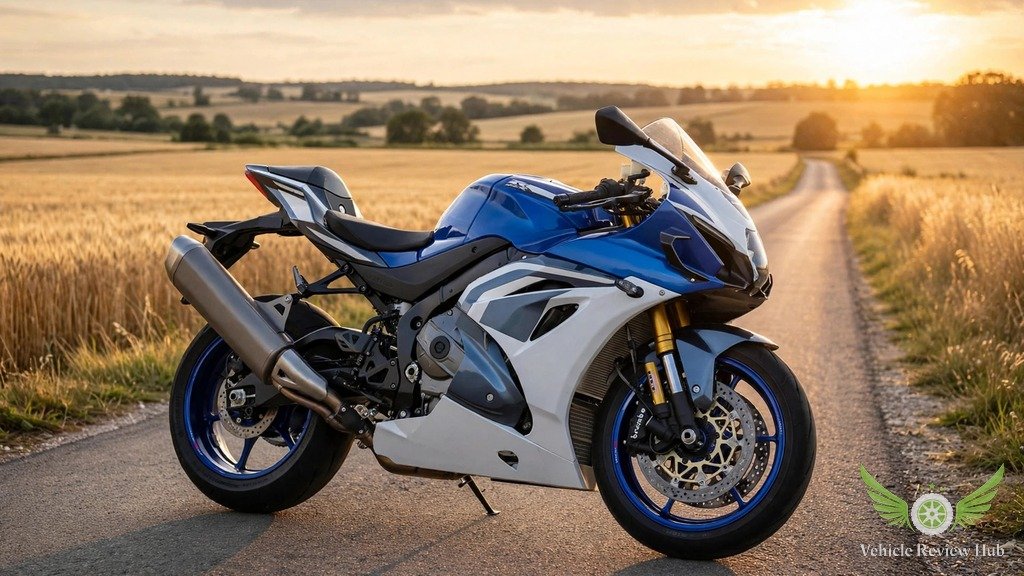
Plus the $750 destination charge, the R comes in exactly two colours in the US: Pearl Vigor Blue / Pearl Tech White (C6F) and Candy Daring Red / Pearl Tech White (C7Q). The blue-and-white scheme is the signature livery, the one Suzuki connects to its championship-winning GSX-R race bikes, and the red-and-white scheme connects to the same racing history. There is no third US R colour: the Pearl Ignite Yellow / Metallic Mat Stellar Blue scheme that appears on some R photos is the base model’s second colour in the US, not an R colour, so a yellow R is not a US bike. The red R is also not a solid red bike — it is red and white, with white lower fairing and tank panels.
Suzuki GSX-R1000R Design, Features and Technology
The R’s design is the L7 fairing shape with the R’s hardware on show: gold-anodized fork legs, gold front brake rotor carriers, stainless-steel brake lines and the braced swingarm. The fairing is unchanged in shape from the 2017 bike, and the dash is a black-background LCD panel, not a TFT — a point the reviews keep returning to, because every rival at this price has a colour TFT. The electronics — a Bosch 6-axis IMU, ten-level traction control, Smart TLR, launch control and a bi-directional quickshifter — are on the base trim as well as the R.

What $1,540 Still Buys: Suspension and Hardware
What $1,540 still buys is suspension and hardware, and the list is specific. The R gets the gold-anodized 43 mm Showa BFF fork and the BFRC-Lite rear shock, both fully adjustable and both manual — there is no semi-active or electronic adjustment anywhere on the bike. It gets stainless-steel front brake lines, exclusive to the R and RS, a superbike-braced swingarm with an adjustable swingarm pivot, and a lightweight race-ready upper triple clamp, plus the two R colour schemes. What the premium does not buy is equally specific: the launch control and bi-directional quickshifter are on the base too in 2027, the Brembo Monobloc calipers and 320 mm T-drive rotors are also on the base, and the engine, IMU, electronics suite and Bridgestone RS11 tyres are identical across all three trims. The R’s brake upgrade is the stainless lines and the gold-anodized carriers, not the calipers or rotors. For a rider who values suspension feel, $1,540 is a fair price for the BFF/BFRC-Lite package; for a rider who only wants the electronics, the base bike already has them.
Winglets Are Standard Only on the RS
Winglets are standard only on the RS, and the US R has none as standard. The RS gets carbon-fibre winglets on the sides of the front cowling, plus the colour-matched solo tail cowl. The US R owner who wants winglets can buy them as an optional accessory, but Suzuki calls those “CF-look” winglets — carbon-fibre look, not real carbon. The Australian-spec R gets carbon winglets and a seat cowl as standard, which is why some overseas reviews show a winged R, but that is not the US bike. One global first-ride line says the R “now gets steel-braided brake lines and winglets”, but that describes the 2026 global R, not the US 2027 R. The R’s visual signature is the gold fork legs, not winglets.
Suzuki GSX-R1000R Riding Experience and Comfort
The riding experience is where the R earns its premium, and it is also where the reviews agree most: the bike is fast enough to be exciting without overwhelming the rider, the engine pulls cleanly and linearly, and the BFF suspension gives the front end a settled feel that the base bike’s Big Piston Fork does not quite match. The seat is 32.5 inches high, the tank holds 4.2 gallons, and the riding position is a committed superbike crouch — this is not a comfortable commuter. The video below is Motobob’s review of the 2027 GSX-R1000R 40th Anniversary Edition.
Riding Position, Handling and Low-Speed Maneuverability
The riding position is a full superbike crouch: low clip-ons, high rearsets and a 32.5-inch seat that puts the rider over the front wheel. At speed the bike feels settled and easy to ride quickly — Motorcycle.com’s first ride of the 2027 range called the bike “so easy to ride quickly” and praised the updated electronics as “a big step up”, and MCN’s review of the R called it “fast enough to be exciting, reasonably effective on a track, but a little more manageable than something making 200+ bhp”. Ultimate Motorcycling, which tested the R itself at Monteblanco in Spain, found the bike “smoother and pulls cleaner” than the old one, and said it “remains seriously fast, though without overwhelming the rider physically or mentally”. At low speed the bike is less happy: heavy steering at parking speeds, a wide turning circle and a firm clutch. One honest caveat: the 2027 first ride most outlets quote tested the RS, not the R, so its verdicts about the winglets and the solo tail cowl do not apply to the R.
BFF Suspension Is Manual, Not Semi-Active
The BFF suspension is manual, not semi-active, and that is a deliberate choice rather than a missing feature. The 43 mm Showa BFF fork and the BFRC-Lite rear shock are both fully adjustable by hand — compression, rebound and preload — with no electronic adjustment, no semi-active damping and no suspension menu on the dash. Ultimate Motorcycling put it plainly: conventional suspension rather than pricier semi-active units saves money at the dealership. For a track-day rider, manual suspension is a positive: simple, consistent, and set up once and left alone. For a rider who wants the bike to adapt itself to the road, the R does not offer that. The gold-anodized finish on the fork legs and the front brake rotor carriers is the R’s visual signature, and the easiest way to tell an R from a base bike at a glance. The suspension is an inspect-only item on the service chart — inspected at 7,500 and 14,500 miles, with no fork-oil change or shock rebuild interval in the owner’s-manual chart.
Suzuki GSX-R1000R Review: Pros, Cons and Verdict
The verdict of this Suzuki GSX-R1000R review is that the R is the best-suspended GSX-R1000, the easiest to justify in years thanks to the price cut, and still not the class leader on paper. It wins on price against its rivals, on suspension feel against its own base bike, and on a decade of L7 owner history; it loses on the dash, on the lack of winglets below the RS, and on the absence of a published horsepower figure from Suzuki USA. The table below sums up the balance.
| Pros | Cons |
|---|---|
| $710 cheaper than the 2025 R, at $17,939 | LCD dash, not a TFT — criticised by every reviewer |
| Gold-anodized Showa BFF fork and BFRC-Lite shock, fully adjustable | No winglets as standard in the US (RS only) |
| Stainless-steel brake lines and 320 mm T-drive rotors | Suzuki USA publishes no horsepower figure |
| Full electronics suite: 6-axis IMU, Smart TLR, launch control, quickshifter | No cruise control and no independent wheelie-control adjustment |
| Twelve-month unlimited-mileage warranty; only two recalls can apply to the R | Firm ride on poor roads; heavy steering at low speed |
Main Advantages and Limitations of the Suzuki GSX-R1000R
The main advantages start with the suspension: the BFF fork and BFRC-Lite shock are the reason to buy the R over the base, and both are fully adjustable by hand. The price is the second advantage — $17,939 is $710 less than the 2025 R, and the R undercuts the Yamaha YZF-R1 by $1,260 on the sticker and the BMW S 1000 RR by $2,036. The electronics are the third: the Bosch 6-axis IMU, Smart TLR, launch control and bi-directional quickshifter are all standard, and the engine is linear and easy to ride quickly. The limitations are the dash, which Cycle News called simply not good enough for a premium superbike, the absence of winglets on the US R, the absence of cruise control, and a firm ride on poor roads that MCN flagged. On reliability, only two recalls can apply to the R, both from 2017–2018, and MCN’s eight R owners rate the bike 4.2 overall — though reliability sits lower at 3.8 and the sample is tiny. The Suzuki GSX-R1000 reliability guide covers the recall history.
Twelve-Month Unlimited-Mileage Warranty
The twelve-month unlimited-mileage warranty is the standard cover on the 2027 R, with longer coverage available through Suzuki Extended Protection. Unlimited mileage matters on a bike like this: a rider who covers 10,000 miles in the first year is covered for all of them, where a mileage-capped warranty would have expired. The warranty is a limited warranty, so it covers manufacturing defects rather than wear items — tyres, brake pads and chains are the owner’s cost — but the engine, electronics and chassis are covered for the full year.
Suzuki GSX-R1000R Review: Frequently Asked Questions
Direct answers to the questions riders ask in this Suzuki GSX-R1000R review — its price, its specs and whether the R is worth the premium over the base bike.
How much does the 2027 Suzuki GSX-R1000R cost?
The 2027 Suzuki GSX-R1000R costs $17,939 before destination, or $18,689 delivered with the $750 destination charge — $710 cheaper than the 2025 R at $18,649.
What does the $1,540 premium over the base GSX-R1000 buy?
The $1,540 premium buys the gold-anodized Showa BFF fork and BFRC-Lite rear shock, stainless-steel front brake lines, a superbike-braced swingarm with an adjustable swingarm pivot, a lightweight upper triple clamp and the two R colour schemes. It does not buy the quickshifter, launch control, Brembo calipers or T-drive rotors — the 2027 base bike already has all of those.
Is the 2027 GSX-R1000R a new generation?
No. The 2027 bike is a heavy revision of the 2017 (L7) platform, not a clean-sheet new generation. The frame and swingarm are fundamentally unchanged from 2017, while the engine, electronics and exhaust are reworked.
How much horsepower does the GSX-R1000R make?
Suzuki USA publishes no horsepower figure for the bike. The global claim is 195 PS, or 192.3 hp, at 13,200 rpm, with 110 Nm, or 81.1 lb-ft, at 11,000 rpm. On a dyno, Cycle World measured 177.2 rear-wheel horsepower on a 2017 R, and Motorcycle.com measured 162.2 hp at 11,000 rpm on a stock 2020 R. The old 202 PS, or 199 hp, figure was the previous bike’s claim.
Does the GSX-R1000R have a TFT dash?
No. The R has a black-background LCD multifunction instrument panel, inspired by the GSX-RR MotoGP dash, with adjustable intensity and a white backlight — not a TFT. Reviewers have criticised it: Motorcycle.com asked why the bike still uses an LCD screen, and Cycle News called it simply not good enough for a premium superbike.
Does the GSX-R1000R have winglets?
Not as standard in the US. Carbon-fibre winglets are standard only on the RS. The US R owner can buy “CF-look” winglets as an optional accessory — carbon-fibre look, not real carbon. The Australian-spec R gets carbon winglets as standard, which is not the US specification.
What colours does the 2027 GSX-R1000R come in?
Two colours in the US: Pearl Vigor Blue / Pearl Tech White and Candy Daring Red / Pearl Tech White — the blue-and-white scheme is the signature livery. The red scheme is red and white, not solid red, and there is no yellow R in the US — yellow belongs to the base model.
Is the BFF suspension semi-active?
No. The Showa BFF fork and BFRC-Lite rear shock are fully adjustable by hand — compression, rebound and preload — with no electronic or semi-active adjustment.
How many recalls apply to the GSX-R1000R?
Only two recalls can apply to the R, both from 2017–2018: the ECM recall (18V064, 3,097 bikes in total, of which 1,150 were R models) and the fuel-pump O-ring recall (18V694, 6,928 bikes across five models). R bikes from 2019 to 2022 have no applicable US recall — the earlier frame, side-stand, master-cylinder and chain-adjuster campaigns predate the R.
What is the warranty on the 2027 GSX-R1000R?
Twelve months, unlimited mileage, as a limited warranty, with longer coverage available through Suzuki Extended Protection. Unlimited mileage means a high-mileage first year is fully covered, unlike warranties with a mileage cap.
Is the GSX-R1000R good for beginners?
No. It is a litre superbike with a claimed 192.3 hp, a 13,200 rpm peak and a 448 lb kerb weight, and it is not suitable for beginner riders. A new rider should start on a smaller bike — the Suzuki GSX-R750 review covers a more sensible step up.
Should I buy the GSX-R1000R or the base GSX-R1000?
Buy the R if you value suspension: the BFF fork, BFRC-Lite shock, stainless-steel brake lines and braced swingarm are worth $1,540 to a rider who sets up their own suspension or rides track days. Buy the base if you only want the electronics — the quickshifter, launch control, IMU and LCD dash are the same on both, and the base is $1,540 cheaper at $17,149 delivered.