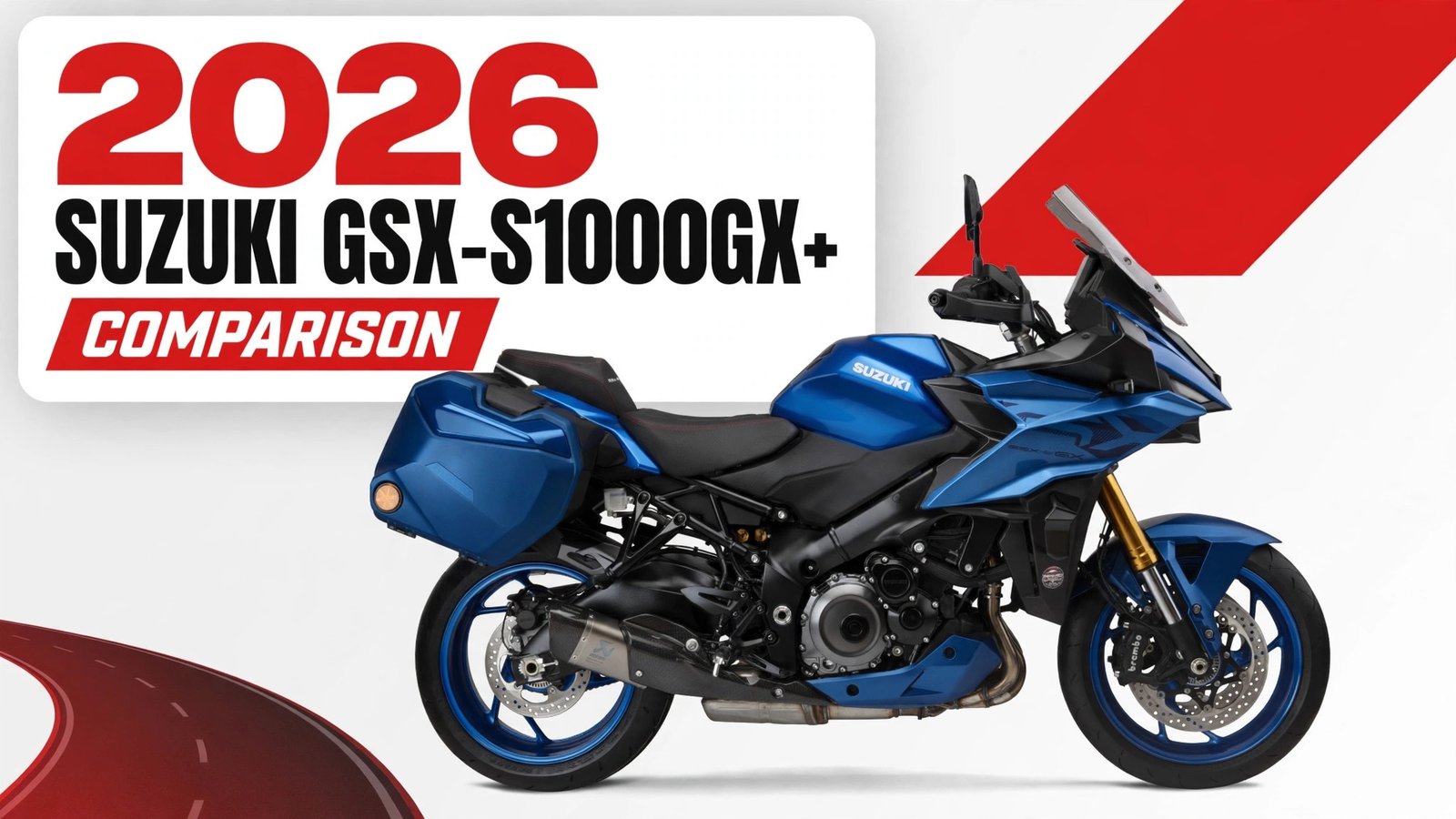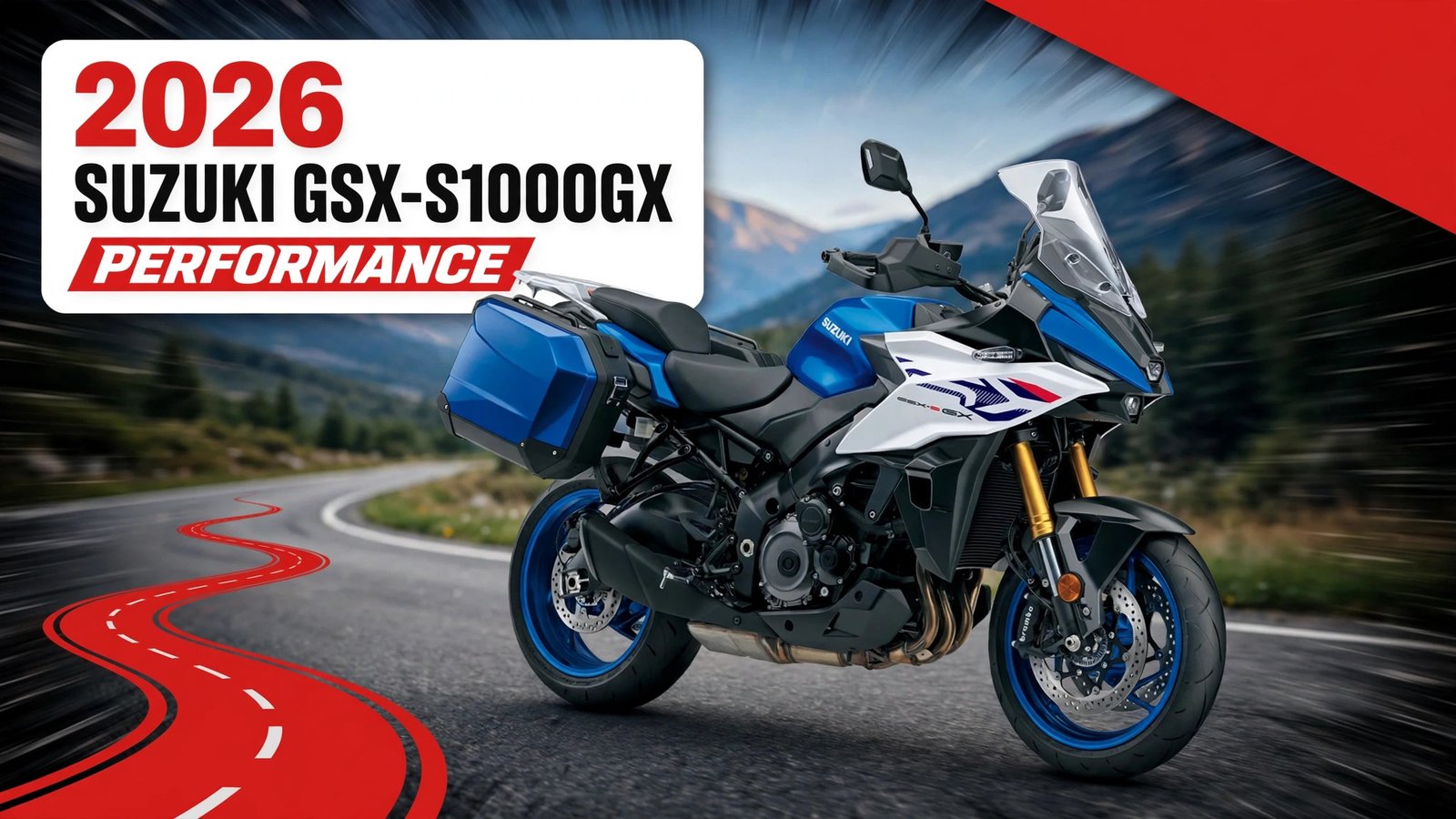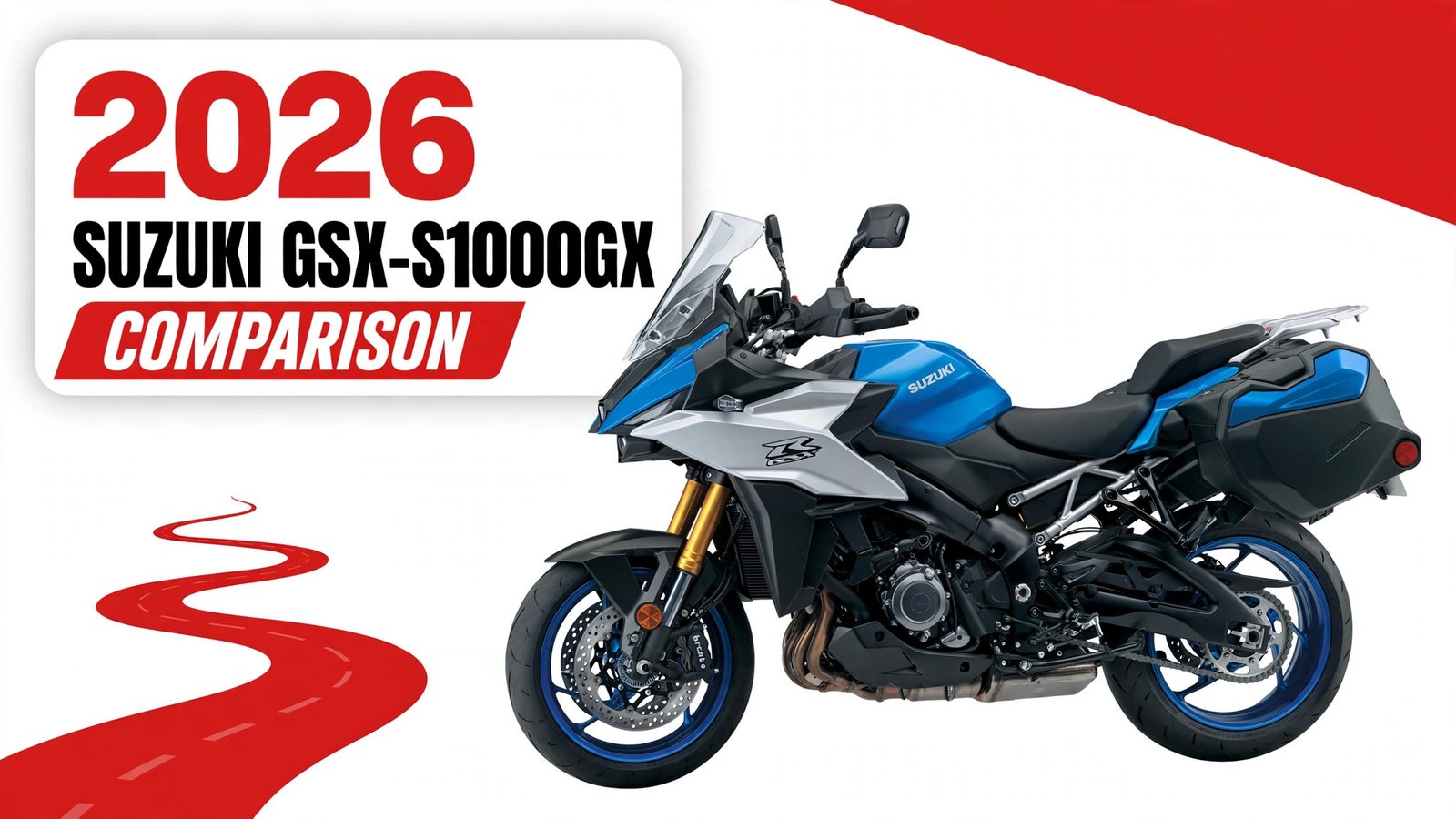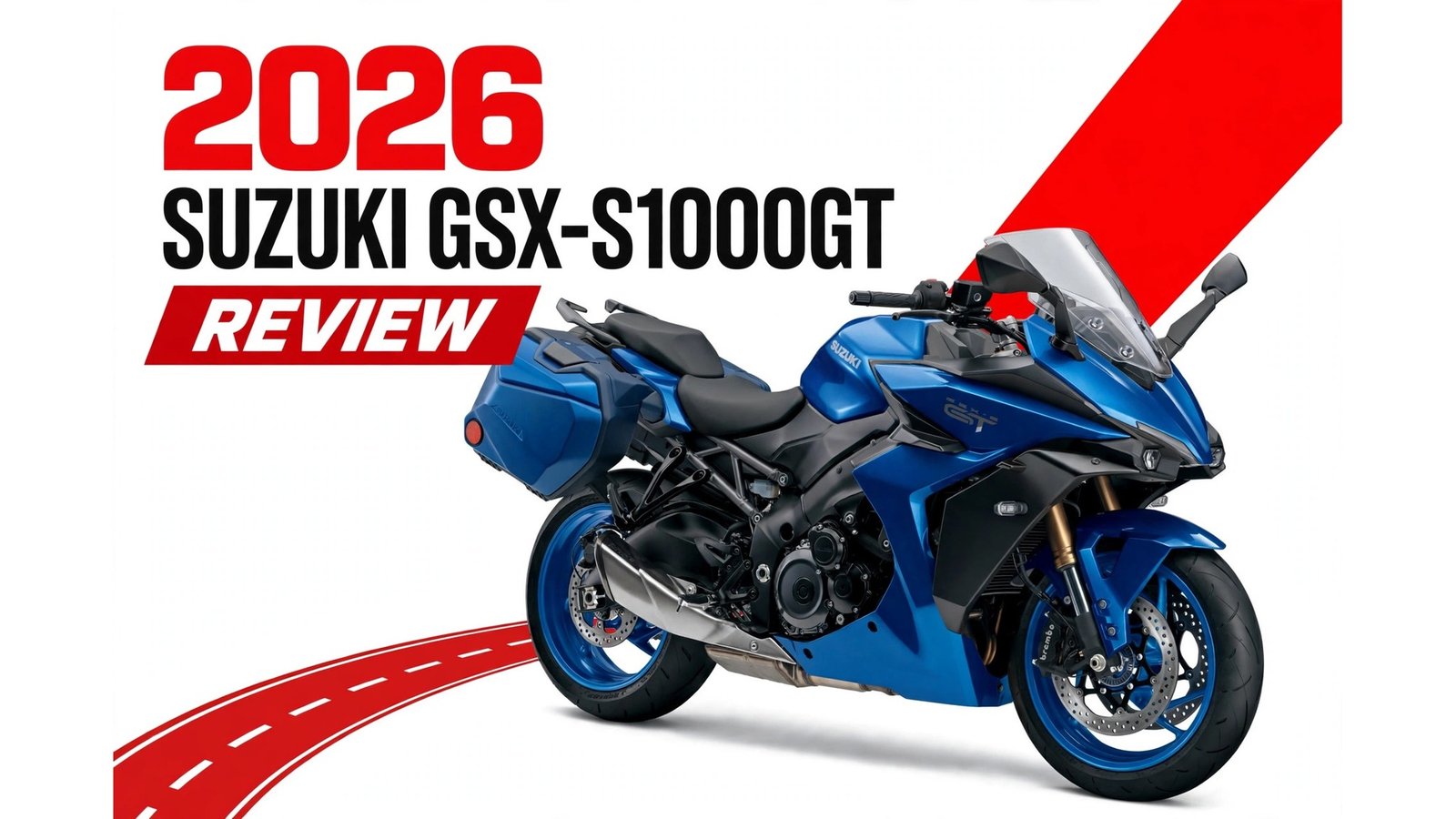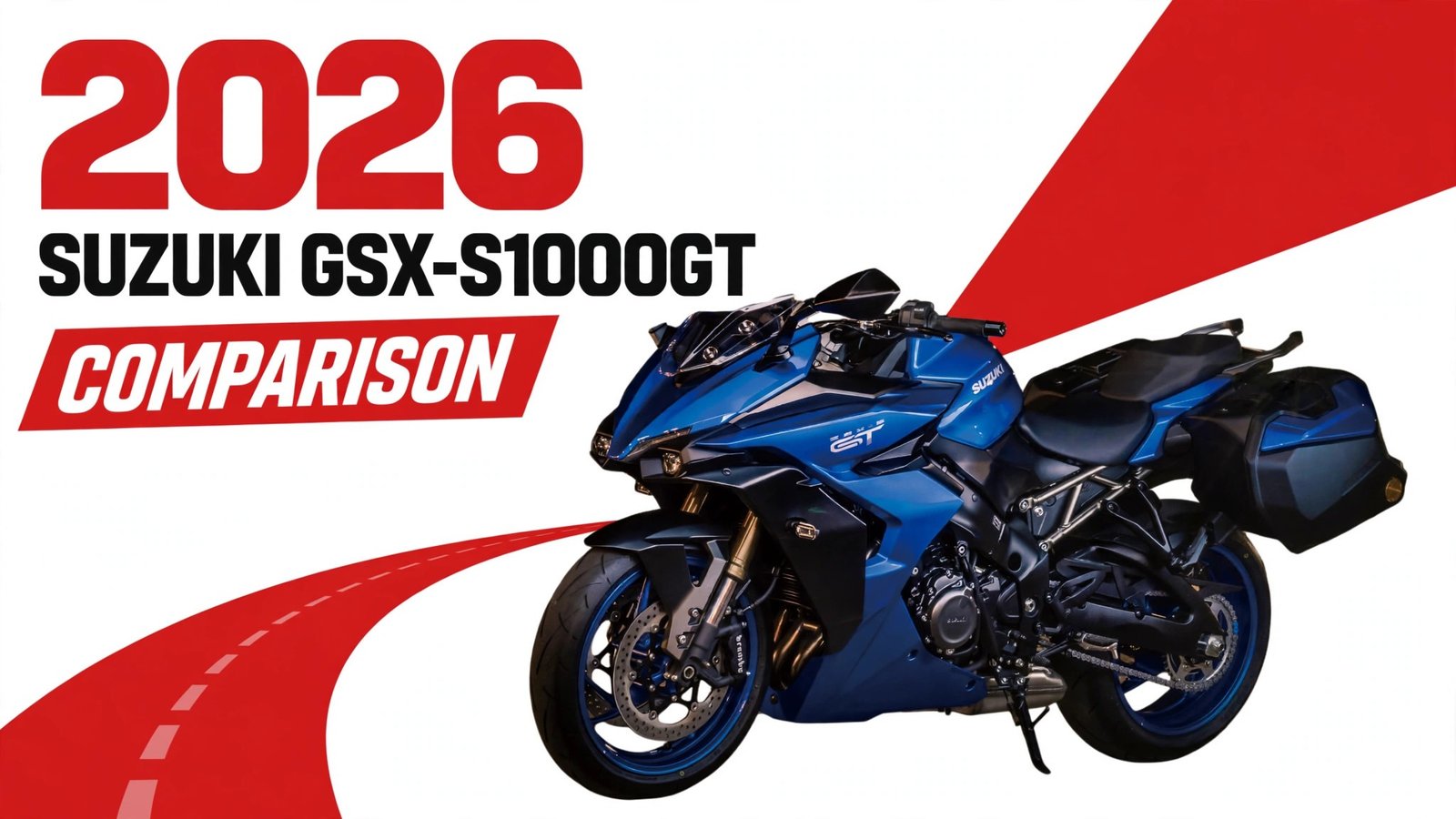
The short answer in this Suzuki GSX-S1000GT comparison: the Kawasaki Ninja 1100SX is the closest rival overall, the Yamaha Tracer 9 is the cheapest way into the class, and the BMW S 1000 XR is the fastest and most expensive bike here by a wide margin. On 2026 US prices with destination added, the Tracer 9 costs $13,299, the Ninja 1100SX $14,839, the GT+ $15,099 and the XR $19,820. The GT+ sits only $260 above the Ninja and $4,721 below the XR. This Suzuki GSX-S1000GT comparison puts all four bikes side by side on price, engine, electronics, weight and running costs, so you can see where the GT wins, where it loses, and which rival fits your riding.
Suzuki GSX-S1000GT Overview and Its Closest Rivals
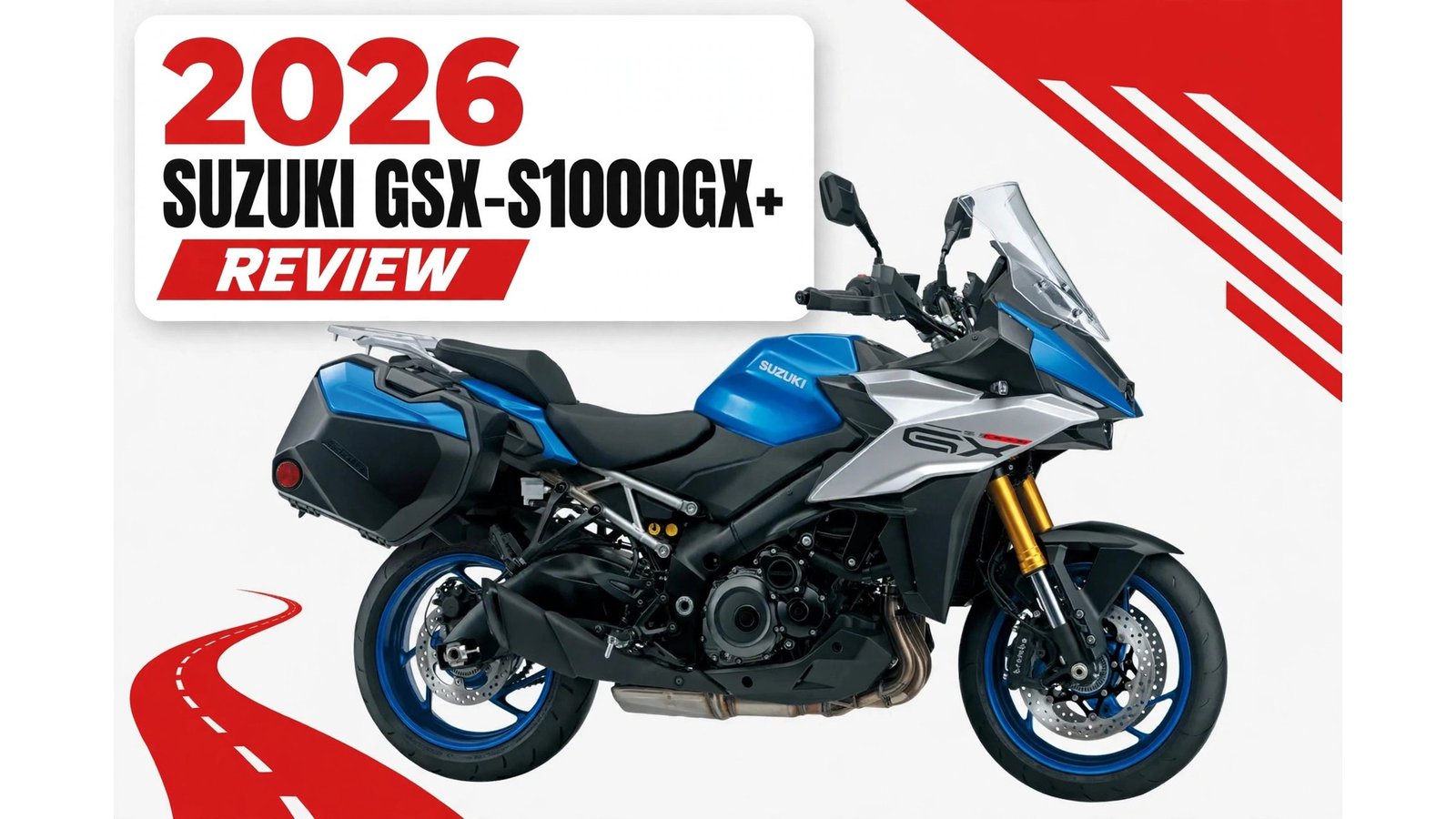
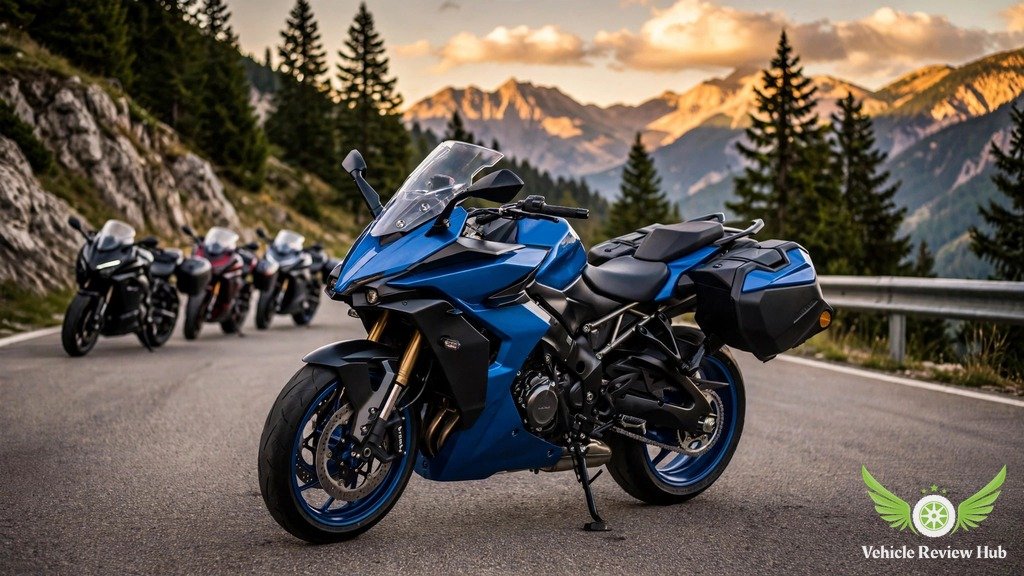
In this Suzuki GSX-S1000GT comparison, the GT+ is a traditional low-slung sport-tourer: a 999cc inline-four with a full fairing, hard panniers included, a 31.9-inch seat and simple electronics. Its rivals do the same job in three different ways, and this Suzuki GSX-S1000GT comparison measures each of them against the Suzuki. The Ninja 1100SX is the direct twin — same class, same layout, nearest price. The Tracer 9 is the lighter triple that trades power for economy and touring kit. The S 1000 XR is the tall crossover that trades the GT’s low stance for more power and a generation of extra electronics.
Why These Three Rivals: Same Class, Same Job
All four bikes are litre-class sport-tourers built to cover big miles fast with luggage, and all four are on sale in the USA for 2026. The Ninja 1100SX is the obvious pick because it is the bike the GT has been measured against since launch. The Tracer 9 earns its place as the value rival: cheaper than the GT+, with more touring equipment included and far better fuel economy. The S 1000 XR is the ceiling of the class — the bike that shows what another $4,700 buys. Bikes that are not sold in the USA do not belong in this Suzuki GSX-S1000GT comparison, which is why the Honda NT1100 is left out: American riders cannot buy one. The same rule keeps the Euro-only Tracer 9 GT and GT+ variants out — the US gets the base Tracer 9 only.
How the Four Bikes Differ at a Glance
Four engines, four characters in this Suzuki GSX-S1000GT comparison. The GT+ and the XR both run 999cc inline-fours, but the BMW claims 170 hp against the Suzuki’s 150. The Ninja runs a bigger 1,099cc four tuned for torque, and the Tracer runs an 890cc triple that gives up 33 hp to the GT but sips fuel. The GT+ holds its own on weight at 518 lb claimed, the same as the Ninja’s; Tracer 9 and S 1000 XR weights were not verified from a primary source, so they are left out. The GT is the only bike here without an IMU.
| Bike (2026 US) | Engine | Claimed power | Total price |
|---|---|---|---|
| Suzuki GSX-S1000GT+ | 999cc inline-four | 150 hp @ 11,000 rpm | $15,099 |
| Kawasaki Ninja 1100SX ABS | 1,099cc inline-four | 134 hp @ 9,000 rpm | $14,839 |
| Yamaha Tracer 9 | 890cc CP3 triple | 117 hp @ 10,000 rpm | $13,299 |
| BMW S 1000 XR | 999cc inline-four | 170 hp @ 11,000 rpm | $19,820 |
Suzuki GSX-S1000GT vs Kawasaki Ninja 1100SX
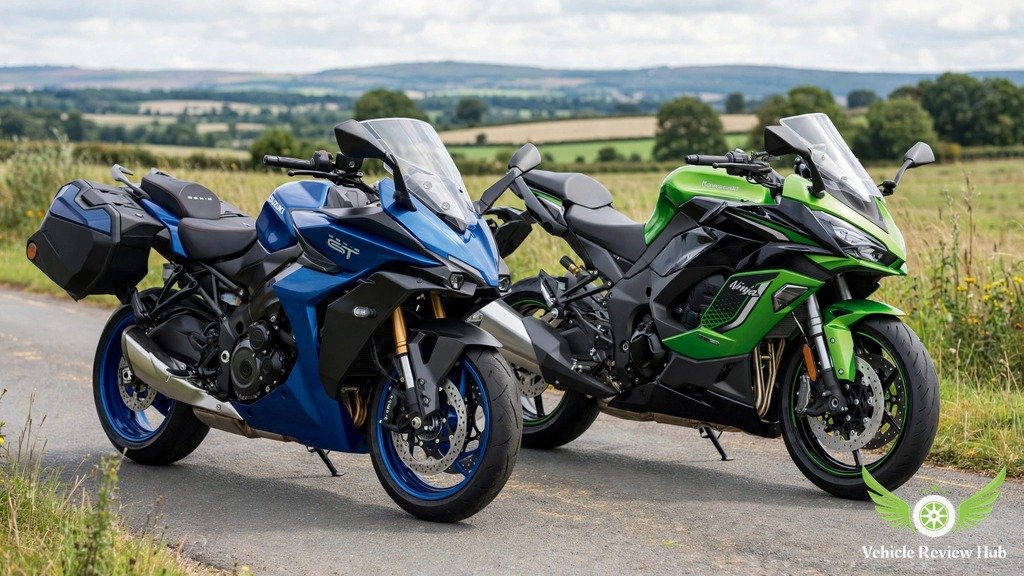
This is the rivalry that matters most in this Suzuki GSX-S1000GT comparison, because the two bikes are separated by $260 and aimed at the same rider. The GT+ is the rawer, livelier bike; the Ninja 1100SX is the smoother, better-equipped one. The GT review guide covers the Suzuki’s prices and specs year by year.
Engine, Specs and Performance Side by Side
On claimed figures the GT leads this Suzuki GSX-S1000GT comparison: 150 hp at 11,000 rpm from 999cc against the Ninja’s 134 hp at 9,000 rpm from 1,099cc. The Ninja answers with torque — 83.2 lb-ft at 7,600 rpm against the GT’s 78 lb-ft at 9,250 rpm — so the Kawasaki pulls harder in the mid-range and feels ultra-smooth, while the Suzuki feels rougher and more alive. The only fair dyno comparison between the two comes from motorcycle.com’s Showdown, which ran both bikes on the same dyno on the same day: the GT+ made 125.4 hp at 10,400 rpm and 65.0 lb-ft at 9,700 rpm, while the older 1,043cc Ninja 1000SX made 120.5 hp at 9,900 rpm and 70.8 lb-ft at 8,600 rpm. The motorcycle.com Showdown verdict went to the Suzuki for its livelier engine, quickshifter, included saddlebags and stiffer chassis, while the Ninja was judged more comfortable and more agile.
The video below is a fresh back-to-back of the GT+ against the current Ninja 1100SX SE, ridden by a Suzuki fan and a Kawasaki fan together.
Price, Equipment and Which Suits Which Rider
In this Suzuki GSX-S1000GT comparison, the Ninja 1100SX ABS costs $13,999 plus an $840 destination charge, $14,839 in total. The GT+ costs $14,399 plus $700, $15,099 in total — $260 more. The SE version of the Ninja, at $15,799 plus $840, costs more than the GT+. What the $260 buys depends on what you value. The Ninja brings a 6-axis IMU with cornering traction control and cornering ABS, a remote rear preload adjuster and a height-adjustable screen — none of which the GT has. The GT brings standard ABS only, a fixed screen and manual preload, but its hard panniers are standard equipment, while the Ninja’s cases are an add-on: in the Showdown era the bags cost $922.95 on top of the bike. Buy the Ninja for the smoother engine, the modern rider aids and the adjustable screen. Buy the GT+ for the livelier engine, the better quickshifter, luggage in the price and the lower running cost of a simpler bike. The GT performance guide covers the Suzuki’s dyno results and real-world mileage in full.
Suzuki GSX-S1000GT vs BMW S 1000 XR
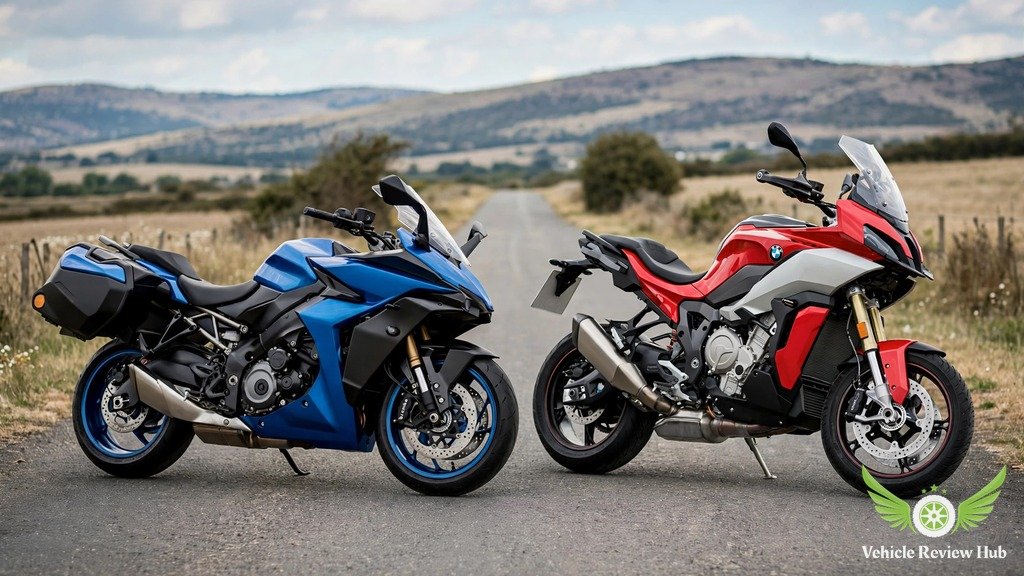
The XR is the most expensive and most powerful bike in this Suzuki GSX-S1000GT comparison, and it asks a simple question: is 20 more horsepower and a generation of extra electronics worth $4,721? The answer depends on your height, your roads and your budget, because the two bikes are built for different riders.
Engine, Specs and Performance Side by Side
The XR’s 999cc inline-four claims 170 hp at 11,000 rpm and 84 lb-ft at 9,250 rpm, against the GT’s 150 hp and 78 lb-ft — 20 hp more from the same capacity, and it shows in the top speed: the XR is listed at 155 mph, while MCN lists the GT at about 145 mph. The BMW S 1000 XR specs confirm the 2026 price and the 170-hp claim, and the gap is real, not a rounding difference. Electronics widen the gap in this Suzuki GSX-S1000GT comparison. The XR carries a 6-axis IMU, cornering ABS, lean-sensitive traction control and semi-active suspension options, with a TFT and connectivity — a full generation ahead of the GT, which has standard ABS only, five levels of traction control with no lean sensitivity, and conventional KYB suspension. The 145-mph figure is MCN’s UK listing — no US instrumented top-speed run exists for the GT.
Price, Equipment and Which Suits Which Rider
In this Suzuki GSX-S1000GT comparison, the S 1000 XR costs $18,825 plus a $995 destination charge, $19,820 in total. The GT+ costs $14,399 plus $700, $15,099 in total. The gap is $4,721, and it buys power, electronics and the BMW badge. It also buys a different riding position: the XR is a tall adventure-crossover stance, while the GT is a low traditional sport-tourer with a 31.9-inch seat. Taller riders will fit the XR better; shorter riders will fit the GT better. The XR also carries a 3-year, 36,000-mile warranty against the GT’s 12-month unlimited-mileage warranty in the USA. The GT reliability guide covers what the Suzuki costs to keep running, and the short warranty is the one place the GT looks thin against the BMW. Buy the XR for the fastest bike here, the best electronics and the longest warranty. Buy the GT+ for about 90 percent of the road performance for about 76 percent of the money. For most riders, the GT+ is the better value; for riders who use the electronics every day, the XR earns its premium.
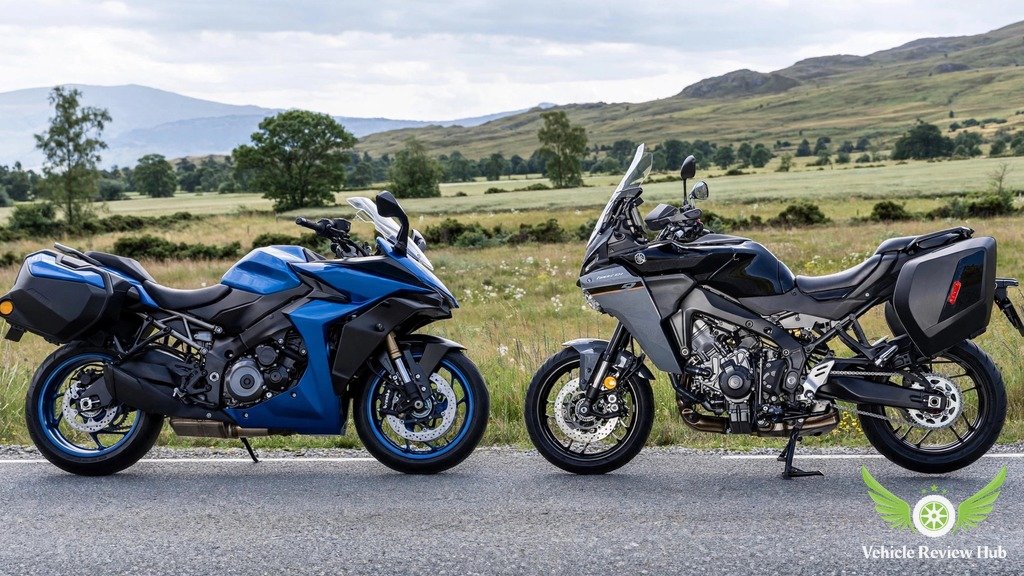
Suzuki GSX-S1000GT vs Yamaha Tracer 9
The Tracer 9 is the cheapest bike in this Suzuki GSX-S1000GT comparison and the most economical to run. It gives up power to the Suzuki, but it answers with a triple’s character, a 48-mpg claimed figure and more touring kit for less money.
Engine, Specs and Performance Side by Side
The Tracer’s 890cc CP3 triple claims 117 hp at 10,000 rpm and 68.6 lb-ft at 7,000 rpm — 33 hp and 9.4 lb-ft down on the GT. On paper the Suzuki wins this Suzuki GSX-S1000GT comparison easily. Where the Tracer wins outright is fuel economy: Yamaha claims 48 mpg, against the GT’s tested 35.5 mpg from Rider, which gives the Tracer about 240 miles per tank against the GT’s roughly 178 miles. The Tracer rider stops for fuel less often and spends less doing it. The Tracer 9 pricing and specs confirm the 2026 US price of $12,599, and the 48-mpg claim is Yamaha’s own figure, labelled as claimed rather than tested. The US Tracer 9 is the base version only — the Euro GT+ variants are not sold here.
Price, Equipment and Which Suits Which Rider
In this Suzuki GSX-S1000GT comparison, the Tracer 9 costs $12,599 plus a $700 destination charge, $13,299 in total. The GT+ costs $14,399 plus $700, $15,099 in total. The Tracer undercuts the GT+ by $1,800 and brings more touring kit for that lower price: an IMU with cornering traction control and cornering ABS, an adjustable screen and hard cases as standard. The GT answers with 33 more horsepower, a bigger engine and a lower, sportier riding position. Buy the Tracer 9 if you want the cheapest bike here, the best fuel economy, the longest range and the most included equipment. Buy the GT+ if you want the power, the inline-four character and the sportier chassis, and you are willing to pay $1,800 more.
Suzuki GSX-S1000GT Price and Value Compared
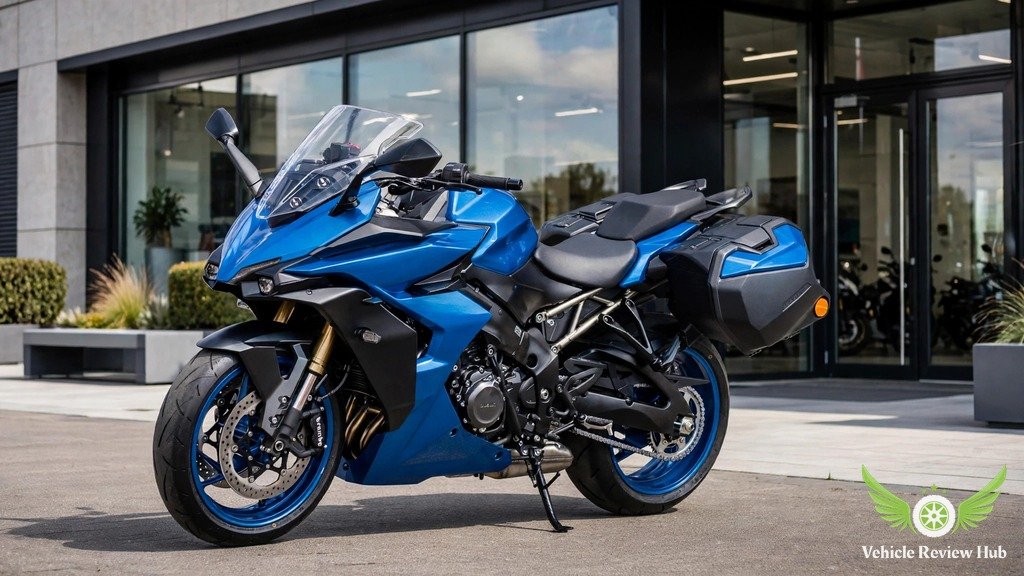
Price is where this Suzuki GSX-S1000GT comparison gets concrete. All four bikes are 2026 US models, priced with destination included, so the totals below are what a buyer actually pays before tax and dealer fees. The GT+ sits in the middle of the ladder — closer to the Ninja than to the XR.
New Prices Across the Four Bikes in the USA
The Tracer 9 is the cheapest in this Suzuki GSX-S1000GT comparison at $13,299 in total, the Ninja 1100SX ABS next at $14,839, the GT+ at $15,099 — $260 above the Ninja and $1,800 above the Tracer — and the S 1000 XR a step apart at $19,820, $4,721 above the GT+. The Ninja 1100SX specs confirm its $13,999 price and $840 destination charge, and the GT+ price is confirmed on Suzuki USA’s GT+ page, which lists the 2027 GT+ at $14,599 with a $750 destination charge — the 2026 bike at $14,399 plus $700 is the one in this table, and the two model years should not be mixed. The 2026 Ninja is $13,999, not the 2025 price of $13,699, and the 2026 Tracer 9 is $12,599, not the 2024 Tracer 9 GT+ price of $16,499.
| Bike (2026 US) | MSRP | Destination | Total |
|---|---|---|---|
| Yamaha Tracer 9 | $12,599 | $700 | $13,299 |
| Kawasaki Ninja 1100SX ABS | $13,999 | $840 | $14,839 |
| Suzuki GSX-S1000GT+ | $14,399 | $700 | $15,099 |
| BMW S 1000 XR | $18,825 | $995 | $19,820 |
Running Costs and Resale Value Compared
The GT drinks in the mid-30s — Rider tested 35.5 mpg, about 178 miles per tank — while the Tracer claims 48 mpg and about 240 miles per tank. At 10,000 miles a year, the GT burns about 282 gallons and the Tracer about 208, a difference of roughly 74 gallons a year. No named-test US MPG figure was verified for the Ninja 1100SX or the S 1000 XR, so no number is printed for either. On insurance, the only verified US figure is the GT+ at $960 a year in one Boundless Rider dataset, labelled illustrative, with no equivalent figures verified for the rivals. The GT’s oil interval is every 3,750 miles under the US manual, with a valve check at 15,000 miles, but rival service intervals were not verified and are not printed. No verified US resale dataset exists for any of the four bikes, so no resale percentages are printed anywhere in this guide. Used GT prices in the UK run £6,500 to £10,400 according to MCN — UK figures, labelled as such. The honest summary of this Suzuki GSX-S1000GT comparison: the Tracer is cheapest to run on fuel, the GT is cheap to insure in the one dataset available, and the XR is the most expensive to buy and to keep.
Suzuki GSX-S1000GT Comparison Verdict and US Alternatives
The verdict in this Suzuki GSX-S1000GT comparison: the GT+ is the value pick of the class, the Ninja 1100SX is its closest rival, the Tracer 9 is the economy pick, and the S 1000 XR is the premium pick. The right one depends on whether you buy for the engine, the electronics, the fuel bill or the badge.
The Ninja 1100SX Is the Closest Match Overall
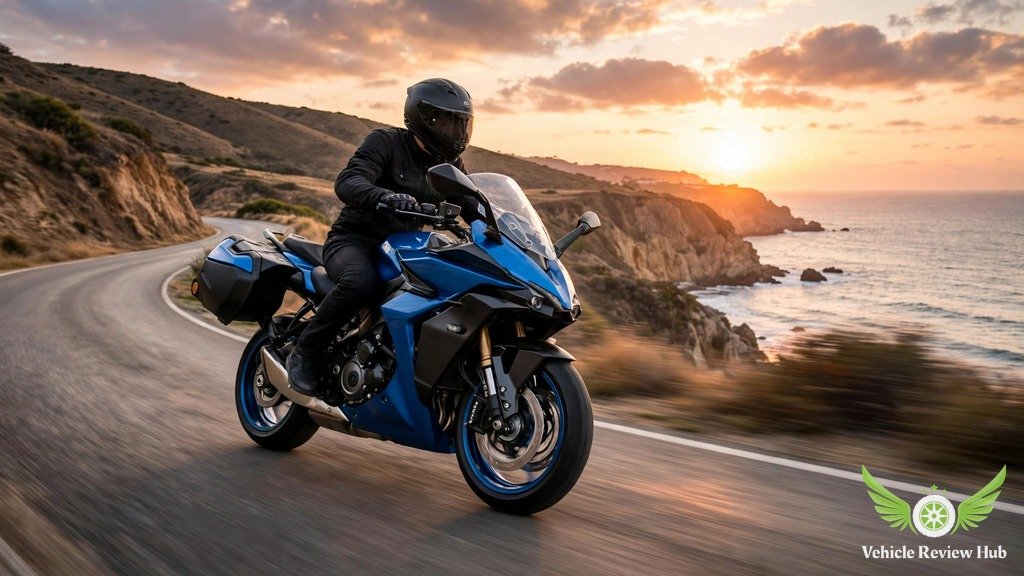
The Ninja 1100SX is the closest match overall in this Suzuki GSX-S1000GT comparison because it is the only rival that matches the GT on class, layout, price and capability at the same time. Same litre-class sport-touring job, same faired four-cylinder layout, $260 apart on price, and the same 518-lb claimed weight. The GT wins on engine character, on its quickshifter and on value for money — luggage included, simpler electronics, lower price once the Ninja’s cases are added. The Ninja wins on refinement, on its IMU-based rider aids, on its adjustable screen and on its remote preload adjuster. MCN’s 2025 group test called the Kawasaki an easy win on refinement, but the GT remained a lot of fast, dependable sport-tourer for the money. Buy the Ninja if refinement and electronics matter most; buy the GT+ if the engine, the price and the included luggage matter more.
Super Duke GT Ended in the US After 2024
The KTM 1290 Super Duke GT is the alternative beyond the three rivals in this Suzuki GSX-S1000GT comparison, but only as a used bike. The 2023 base model cost $19,799, with the Tech Pack taking it to $20,799 as tested, and the 1,301cc V-twin makes about 175 hp — more power than anything here except the XR. The last US model year was 2024, and the 1390 Super Duke GT was not brought to North America for 2025. A used 2023 or 2024 GT is the alternative now — no new one is on sale. Its side cases were optional at $824.99 for the 30-litre pair, and it carries a 2-year, 24,000-mile warranty, double the GT’s 12 months. Two more alternatives sit outside the main three. Suzuki’s own GSX-S1000GX is the in-family crossover on the same 999cc engine, taller and more upright, with semi-active suspension the GT does not have — but its top speed is GPS-capped at 132.92 mph. The BMW R 1300 RS is another premium alternative, praised in MCN’s 2025 group test — no US price was verified for it, so none is printed. The Honda NT1100, by contrast, is not sold in the US at all and is not an alternative for American riders.
Suzuki GSX-S1000GT Comparison: Frequently Asked Questions
Direct answers to the questions riders ask in this Suzuki GSX-S1000GT comparison. Every price is a 2026 US figure with destination included, and every figure is labelled by its source.
Which is better, the Suzuki GSX-S1000GT or the Kawasaki Ninja 1100SX?
Neither is better outright in this Suzuki GSX-S1000GT comparison — they win different things. The Ninja 1100SX is smoother, better equipped and more refined, with an IMU, cornering ABS and an adjustable screen. The GT+ has the livelier engine, the better quickshifter and its panniers included, and it costs $260 less before the Ninja’s cases are added.
Is the Ninja 1100SX cheaper than the GSX-S1000GT+?
Yes, by $260 on the sticker in this Suzuki GSX-S1000GT comparison: the Ninja 1100SX ABS is $13,999 plus $840 destination, $14,839 in total, against the GT+ at $14,399 plus $700, $15,099 in total. The gap reverses once luggage is added, because the GT+ includes its hard panniers while the Ninja’s cases are an extra cost.
Does the Ninja 1100SX have cornering ABS and the GT does not?
Yes. The Ninja 1100SX has a 6-axis IMU with cornering traction control and cornering ABS, while the GT has standard ABS only, with no IMU and no cornering ABS. The Tracer 9 also has an IMU, so the GT is the only bike here without one.
Which is faster, the GSX-S1000GT or the Ninja 1100SX?
The GT is the faster bike on claimed power in this Suzuki GSX-S1000GT comparison: 150 hp against the Ninja’s 134 hp. On the same dyno on the same day, motorcycle.com measured the GT+ at 125.4 hp and the older Ninja 1000SX at 120.5 hp. The Ninja answers with more mid-range torque — 83.2 lb-ft against the GT’s 78 — so it feels stronger in the middle of the rev range.
Is the BMW S 1000 XR worth $4,700 more than the GSX-S1000GT+?
It depends on what you use. The XR costs $19,820 in total against the GT+ at $15,099 in this Suzuki GSX-S1000GT comparison, a gap of $4,721, and it buys 20 more horsepower, a 6-axis IMU, cornering ABS, semi-active suspension options and a 3-year warranty. If you use the electronics daily, it earns its premium; if you want most of the performance for much less money, the GT+ is the better value.
Does the S 1000 XR have semi-active suspension?
Yes — in this Suzuki GSX-S1000GT comparison, semi-active suspension is available on the XR, along with a 6-axis IMU, cornering ABS and lean-sensitive traction control. The GT has conventional KYB suspension with no electronics — a fully adjustable fork and a preload-and-rebound rear shock — which is simpler and cheaper to live with, but a generation behind the BMW.
Which is better for touring, the GSX-S1000GT or the Yamaha Tracer 9?
The Tracer 9 is the better touring bike on economy and equipment in this Suzuki GSX-S1000GT comparison: 48 mpg claimed and about 240 miles per tank against the GT’s tested 35.5 mpg and about 178 miles, with an IMU, an adjustable screen and hard cases for $1,800 less. The GT is the better touring bike on power and engine character, with 150 hp against the Tracer’s 117. For long distances on a budget, take the Tracer; for the engine, take the GT.
Does the Tracer 9 get better MPG than the GSX-S1000GT?
Yes, by a wide margin — the clearest running-cost win in this Suzuki GSX-S1000GT comparison. Yamaha claims 48 mpg for the Tracer 9, while Rider tested the GT at 35.5 mpg in the US. At 10,000 miles a year the GT burns about 282 gallons and the Tracer about 208 — roughly 74 gallons a year less.
Which of the four bikes is cheapest to buy in the USA?
The Yamaha Tracer 9, at $12,599 plus $700 destination, $13,299 in total — the cheapest bike in this Suzuki GSX-S1000GT comparison. Next is the Ninja 1100SX at $14,839, then the GT+ at $15,099, and the S 1000 XR is the most expensive at $19,820.
Does the GSX-S1000GT+ come with luggage while the Ninja does not?
Yes. In this Suzuki GSX-S1000GT comparison, the GT+ includes its colour-matched locking side cases and taller windscreen as standard. The Ninja’s cases are an add-on — $922.95 in the Showdown era — so its $260 sticker advantage disappears once luggage is fitted.
What is the closest rival to the GSX-S1000GT overall?
The Kawasaki Ninja 1100SX — the closest rival in this Suzuki GSX-S1000GT comparison: same class, same layout, $260 apart, and the same 518-lb claimed weight. The Tracer 9 is the economy alternative and the S 1000 XR the premium one.
Is the KTM 1290 Super Duke GT still sold in the USA?
No, not as a new bike — the last US model year was 2024, and the 1390 was not brought to North America for 2025. A used 2023 or 2024 Super Duke GT is the only way to buy one now; the 2023 base model cost $19,799. That used-only status is why the Super Duke sits outside the main Suzuki GSX-S1000GT comparison.