The short answer in this Suzuki GSX-S1000GX reliability guide is that the early evidence is good, with a clear limit on how much evidence exists. Four owners on MCN’s owners’ page rate the GX’s reliability and build quality at 4.8 out of 5, and MCN reports no mechanical or electrical problems from those owners — except thin paintwork in places and fasteners corroding during winter riding. The engine is a proven K5-derived 999cc four, and the GX performance guide covers its dyno figures. The honest limit is the sample: four owners and one 9,000-mile long-term test are not a fleet study, and the SAES suspension is too new for a long-term failure pattern to exist yet. This Suzuki GSX-S1000GX reliability guide works through what is actually known, the service schedule from the US owner’s manual, and the used-bike checks.
Suzuki GSX-S1000GX Reliability Overview
The GX has only been on sale since the 2024 model year, so the reliability evidence in this Suzuki GSX-S1000GX reliability guide is young by nature. What exists is encouraging: owners who rate it highly, a UK long-term test that ran to 9,000 miles, and US launch reviews found nothing mechanically worrying. This part sets out that evidence plainly, including where it is thin.

MCN Owners: 4.8 for Reliability, From Four Owners
MCN’s owners’ page for the GX carries reviews from four owners: an overall rating of 4.5 out of 5, ride quality and brakes at 4.8, the engine at a full 5 out of 5, and reliability and build quality at 4.8 out of 5. Annual servicing on the same page is listed at £240 (UK). The MCN GX owners’ reviews sum the picture up in one line: no reports of mechanical or electrical problems, except for thin paintwork in places and fasteners corroding during winter riding. One 2024 GX+ owner wrote after his 7,000-mile service that reliability is first class, while also complaining about the screen fixings. Four owners is a small sample, and this Suzuki GSX-S1000GX reliability guide says so every time the 4.8 figure appears — it is four riders, not a survey of hundreds. MCN’s own long-term GX test ran to 9,000 miles, with final thoughts published in March 2025 — the closest thing to a longer reliability study the bike has, and this Suzuki GSX-S1000GX reliability guide does not invent a verdict for it.
How Mileage, Storage and Previous Care Affect Reliability
The owner reports point at care and storage more than at mileage. The thin paint and fastener corrosion reports come from winter riding, and the lesson is that a bike ridden through winter without cleaning corrodes its fasteners — an MCN expert point echoed by the owners themselves. As general guidance, service history plus dry storage plus regular use beats low mileage with neglect. No engine-failure pattern appears anywhere in the owner reviews, which fits the engine’s history — the same K5-derived four has been in Suzuki’s range for nearly two decades, with the same tune as the GT. What a used buyer should weigh instead is the newer hardware: the SAES suspension and the six-axis IMU are the parts with no long history, and the sections below cover exactly how they are serviced — or, in the SAES case, how they are not.
Suzuki GSX-S1000GX Common Problems and Wear Items
The honest list of GX problems is short, and that is good news for a buyer. Only one recurring problem pattern is reported anywhere in the owner evidence; the rest of this section is wear items and comfort complaints, not reliability faults.
The video below is Carole Nash Insidebikes’ GX review from the Portugal launch — a UK road test of the GX, and a useful second opinion on the bike’s everyday behaviour before the problem list below.
Thin Paint and Corroding Fasteners: UK Owner Reports
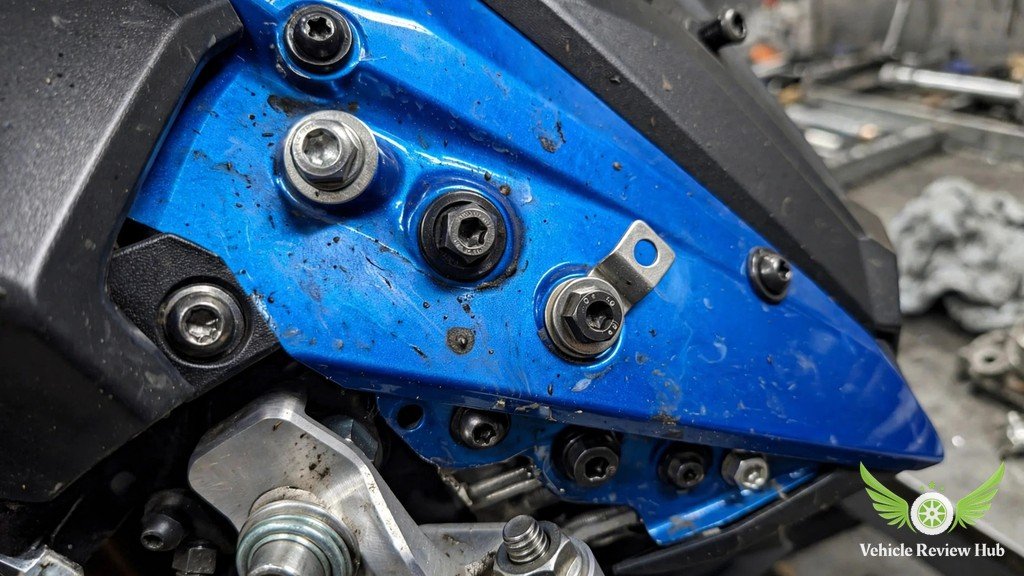
Thin paint on the bodywork and fasteners corroding during winter riding is the only recurring problem pattern in this Suzuki GSX-S1000GX reliability guide, and it comes from MCN’s expert review and the MCN owners’ page together. The paint is thin in places, and fasteners left dirty through a winter of salted roads corrode. It is cosmetic and preventable: wash the bike after winter rides, keep the fasteners clean, and use a corrosion protector such as ACF-50 on exposed metal. A used GX should be checked for paint chips and for white corrosion on bolt heads and brackets, especially around the wheels and the underside. The one other owner complaint on record is the screen fixings, raised by a single 2024 GX+ owner at his 7,000-mile service — one rider’s complaint, not a pattern.
Chain, Sprockets, Tires, Fork Seals, Brakes and Electrical Checks
The rest of the used-bike checklist is standard wear items, not GX-specific failures, and buyers reading this Suzuki GSX-S1000GX reliability guide should treat them that way. The chain needs cleaning and lubrication every 600 miles, with slack at 20–30 mm, and the sprockets checked with it. The stock Dunlop Roadsport 2 tyres get an “average grip” verdict from Rider, and they are widely replaced early on the GT family according to MCN — a family trait, not a GX failure. Fork seals, brake pads, lines and fluid all need checking at every service, and the battery and electrical connectors deserve a look for winter corrosion. The front brake itself is a known weak point rather than a reliability fault: motorcycle.com found little initial bite and a vague feel at the lever, and MCN agrees the brakes lack power and feel. The owner fix is sintered pads and braided hoses — an owner modification, not a factory recall. Two comfort items belong here too, labelled as comfort items and not faults: the stock seat creates hotspots after only a few hours according to motorcycle.com, and the engine buzzes at 70 mph and above, visible in the mirrors, according to a 2026 GX+ owner and a second tester at 6,000 rpm. One 2026 owner also reports that the mySPIN app simply does not work — one owner’s report, not a verified defect. That owner’s two-month GX+ verdict is the source for the buzz, the mySPIN complaint and the too-firm SAES setting, and it still calls the bike a mostly excellent machine.
Suzuki GSX-S1000GX Maintenance Schedule and Servicing
The GX follows the US owner’s manual schedule, and the numbers are straightforward: oil every 3,750 miles, a valve inspection at 15,000 miles, and spark plugs replaced at 7,500 and 15,000 miles. The trap for buyers coming from the older GSX-S1000 is the interval itself: the older bike ran a 3,500-mile oil interval and a 14,500-mile valve check, and neither applies to the GX.

| Service item | Interval | Notes |
|---|---|---|
| First service | 600 mi / 1,000 km or 2 months | Oil + filter + chassis inspection |
| Engine oil | Every 3,750 mi / 6,000 km or 12 months | SAE 10W-40, JASO MA |
| Spark plugs (NGK CR9EIA-9) | Inspect 3,750 + 11,250 mi; replace 7,500 + 15,000 mi | Iridium, 4 needed |
| Valve clearance | Inspect at 15,000 mi / 24,000 km | Not the older bike’s 14,500 mi |
| Chain | Clean + lubricate every 600 mi / 1,000 km | Slack 20–30 mm (0.8–1.2 in) |
| Coolant | Super long-life: 4 years / 30,000 mi | Otherwise every 2 years / 15,000 mi |
| Brake fluid / hoses | Fluid every 2 years; hoses every 4 years | DOT 4 fluid |
Oil Every 3,750 Miles, First Service at 600
The first service falls at 600 miles or 1,000 km, or 2 months, and covers an oil and filter change plus a chassis inspection. After that, the engine oil in this Suzuki GSX-S1000GX reliability guide is replaced every 3,750 miles or 6,000 km, or 12 months, whichever comes first. The oil is SAE 10W-40 meeting JASO MA and API SF, SG, SH or SJ, and the oil filter is replaced at 600 and 7,500 miles. The GX maintenance schedule transcribed from the owner’s manual confirms the same figures. The 3,750-mile figure is worth stressing because it is easy to get wrong: the 2016–2021 GSX-S1000 and F ran a 3,500-mile oil interval, and some UK sources for the GT family quote 7,500 miles, a different market. Neither applies to the GX in the United States — the US manual says 3,750 miles, the same as the GT.
Valve Clearance Inspection at 15,000 Miles
Valve clearance is inspected at 15,000 miles or 24,000 km — the first major service milestone in this Suzuki GSX-S1000GX reliability guide. It is a different number from the older bike’s 14,500-mile valve check, and the two should never be mixed up — a seller quoting a 14,500-mile valve interval is quoting the 2016–2021 GSX-S1000, not this bike. The same 15,000-mile service also covers the second spark plug replacement and a throttle valve synchronization, which the manual also calls for at 600 and 7,500 miles. Clutch cable play is checked at the lever end (10–15 mm). Because the valve check is the most labour-heavy item on the schedule, a used GX near 15,000 miles without a record of it is worth a price conversation, and one just past 15,000 miles with the check stamped in its book is worth more.
Suzuki GSX-S1000GX Tires, Brakes and Suspension Maintenance
Tyres, brakes and suspension on the GX are conventional to service, with one exception that matters more than the rest in this Suzuki GSX-S1000GX reliability guide: the SAES semi-active suspension has no service interval at all in the owner’s manual. It is inspected, not serviced, and a failure is a dealer job. The ordinary items come first, the SAES exception second.
No SAES Service Interval: Inspection Only
The owner’s manual lists the front forks and the rear suspension as inspection items only — “inspect for smooth operation, leaks” — at 7,500 and 15,000 miles. There is no SAES fluid change, no seal service and no electronic service interval anywhere in the manual, and that is the exact position this Suzuki GSX-S1000GX reliability guide prints: inspection only. For running costs that is good news — no SAES service bill to budget for. The other side is that a SAES fault is a dealer-level diagnosis with no owner-serviceable parts, because the units are sealed electronic Showa components. A buyer test-riding a used GX should cycle through the SAES modes — Soft, Medium, Hard and User — and check that the damping actually changes and that no warning shows. No SAES failure pattern has been reported by MCN owners or the long-term test, and no verified SAES repair price exists, so this guide prints neither a failure rate nor a price.
Plugs Replaced at 7,500 and 15,000 Miles
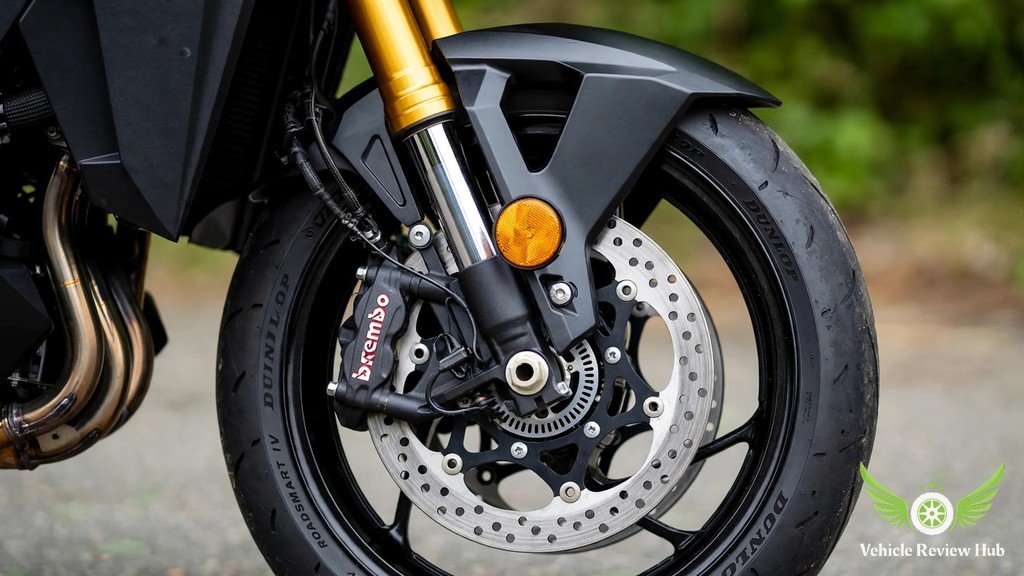
The spark plugs are NGK CR9EIA-9 iridium plugs, four of them, and the manual this Suzuki GSX-S1000GX reliability guide follows is specific about what happens when: inspect at 3,750 and 11,250 miles, and replace at 7,500 and 15,000 miles. Replace, not inspect only — a seller who says the plugs were “checked” at 7,500 miles has not done the job the manual calls for. The tyres this Suzuki GSX-S1000GX reliability guide lists are 120/70ZR17 at the front, inflated to 36 psi cold, and 190/50ZR17 at the rear at 42 psi cold, with the Dunlop Roadsport 2 as standard fitment. The brakes are Brembo radial four-piston calipers on dual 310 mm discs at the front, with a Nissin single-piston caliper at the rear and ABS. Pads, lines and fluid are checked at every service, DOT 4 fluid replaced every two years, and hoses every four years. A used GX with braided lines and sintered pads fitted is a bike whose owner already fixed the brake feel, and the GX review covers the brake complaint in full.
Suzuki GSX-S1000GX Maintenance and Ownership Costs
Running a GX is not expensive for a litre bike, and the biggest cost surprise in this Suzuki GSX-S1000GX reliability guide is not the servicing — it is what the GX+ includes as standard. The cases that cost a GT owner over $1,000 to retrofit come fitted on the GX+, and the 12-month unlimited-mileage warranty covers the SAES suspension and the electronics while it lasts. Riders weighing the GX+ against the GT+ can see the price gap in the GT comparison guide. The known costs are below, with plain notes where no verified figure exists.

| Ownership cost | Figure | Source / note |
|---|---|---|
| Fuel economy | 48 mpg imperial (≈40 mpg US) | MCN measured, UK test |
| Annual servicing | £240 | MCN owners page, UK figure |
| US dealer service price | Not verified | Varies by dealer — get a quote |
| Premium seat | $400 | Motorcycle.com |
| GT+ case set retrofit | Over $1,000 | Motorcycle.com; standard on GX+ |
| Warranty | 12 months, unlimited mileage | US limited warranty |
Fuel, Routine Servicing, Tires and Replacement Parts
Fuel is the most predictable cost in this Suzuki GSX-S1000GX reliability guide: MCN measured 48 mpg imperial on test, about 40 mpg US, with the fuel light at 150 miles. As an illustration only, at $3.50 a gallon, 8,000 miles a year at 40 mpg US uses 200 gallons and costs about $700 in fuel — not a measured figure, since fuel prices vary. Routine servicing in the UK runs £240 a year according to MCN’s owners page, and that figure must be read as a UK number; no verified US dealer service price was found, so US buyers should get a quote from their dealer. Tyres are the Dunlop Roadsport 2 as standard, and owners commonly switch to the RoadSmart 3, Road 6 or Roadtec 01 on the GT family. Replacement parts worth knowing about are the $400 premium seat for riders who find the stock seat creates hotspots, and the GT+ side-case set, which costs over $1,000 to retrofit to a base GT according to motorcycle.com. The GX+ buyer gets the cases standard, which is part of the GX+’s value case.
SAES Failures Are Dealer-Level, Big-Ticket Items
A SAES failure is the one ownership cost that cannot be priced in advance. The SAES units are sealed electronic Showa components with no owner-service interval, so a failure means dealer diagnosis and replacement, not a home repair, as this Suzuki GSX-S1000GX reliability guide stresses — and no verified GX SAES repair price was found, so none is printed here. What can be said is what has not happened: no SAES failure pattern has been reported by MCN owners or the long-term test. The 12-month unlimited-mileage US warranty covers the SAES suspension and the electronics while it lasts. Twelve months passes quickly on a bike built for big miles, so service records matter more than the warranty.
How to Keep a Suzuki GSX-S1000GX Reliable
Keeping a GX reliable is mostly a matter of following the manual and protecting the bike from winter. Nothing in the owner evidence points to a hidden weakness, and this final section turns the schedule into a short checklist, then clears up the one recall buyers keep confusing with the GX.

Preventive Maintenance, Records and Regular Inspections
Follow the 3,750-mile oil rule without stretching it — the first rule of this Suzuki GSX-S1000GX reliability guide — keep the chain cleaned and lubricated every 600 miles, and protect the fasteners and electrical connectors in winter with a corrosion protector such as ACF-50 or an equivalent, as general guidance. Check the rear shock and the tyres early on a used bike, and keep the service records. Inspect the SAES by cycling through its modes on a test ride, and replace the brake fluid every two years and the hoses every four. Before buying used, run the VIN through NHTSA’s recall lookup as a routine check, and check the paint and fasteners for winter corrosion. The GT reliability guide follows the same 3,750-mile oil rule and 15,000-mile valve check, since the GX shares the GT’s schedule, and the same habits apply to both bikes.
Recall 25V505 Does Not Include the GX or GX+
No recall found in published notices names the GX or GX+, and that is the correct way to put it — the NHTSA recall database has proven unreliable to query directly, so this Suzuki GSX-S1000GX reliability guide does not claim an API-verified zero. The recall buyers keep asking about is 25V505, reported on August 7, 2025 under Suzuki numbers 3A06 and 3A07: the upper headlight beam is too bright, a FMVSS 108 noncompliance, fixed with a free headlamp replacement and owner letters mailed on November 7, 2025. It covers 2020–2025 V-Strom 1050 models (1,393 bikes) plus 2020 and 2024 Katana GSX-S1000S models (150 bikes) — 1,543 in total — and the NHTSA owner letter for recall 25V505 names those models and no others. The Katana shares the GSX-S1000 platform, but the GX and GX+ are not named. A used-GX buyer should still run the VIN through NHTSA’s recall lookup before buying, and not let a seller or a listing confuse the Katana recall with the GX.
Suzuki GSX-S1000GX Reliability: Frequently Asked Questions
Direct answers to the questions riders ask about Suzuki GSX-S1000GX reliability.
Is the Suzuki GSX-S1000GX reliable?
The early evidence says yes, with a small-sample limit. Four owners on MCN’s page rate reliability and build quality at 4.8 out of 5, and none reports a mechanical or electrical problem. The engine is a proven K5-derived four, and MCN’s long-term test ran to 9,000 miles. The SAES suspension has no long-term failure pattern yet, so this Suzuki GSX-S1000GX reliability guide calls the bike reliable on the evidence available.
What do MCN owners rate the GSX-S1000GX?
Four owners rate the GX 4.5 out of 5 overall, 4.8 for ride quality and brakes, 5 out of 5 for the engine, and 4.8 for reliability and build quality, with annual servicing at £240 in the UK. The sample is four owners.
Does the GSX-S1000GX have any recalls?
No recall found in published notices names the GX or GX+. That is the correct phrasing in this Suzuki GSX-S1000GX reliability guide, since the NHTSA recall database cannot be relied on for a direct query, and this Suzuki GSX-S1000GX reliability guide does not claim an API-verified zero.
Does recall 25V505 affect the GSX-S1000GX?
No. Recall 25V505 covers the 2020–2025 V-Strom 1050 and the 2020 and 2024 Katana GSX-S1000S only — 1,543 bikes in total — for a headlight that is too bright. The GX and GX+ are not named.
How often should I change the oil on a GSX-S1000GX?
Every 3,750 miles or 6,000 km, or 12 months, whichever comes first, with SAE 10W-40 oil meeting JASO MA — the interval this Suzuki GSX-S1000GX reliability guide uses. The first service is at 600 miles or 2 months, and this Suzuki GSX-S1000GX reliability guide uses the US manual’s figure, not the older bike’s 3,500 miles.
When does the GSX-S1000GX need a valve check?
Valve clearance is inspected at 15,000 miles or 24,000 km. That is the GX’s figure — the older 2016–2021 GSX-S1000 used 14,500 miles, and the two should never be mixed up.
When should the spark plugs be replaced?
The NGK CR9EIA-9 iridium plugs are inspected at 3,750 and 11,250 miles and replaced at 7,500 and 15,000 miles. Replace, not inspect only — a seller who says the plugs were only checked at 7,500 miles has not done the job.
What are the most common problems on the GSX-S1000GX?
Thin paint on the bodywork and fasteners corroding during winter riding is the only recurring problem pattern this Suzuki GSX-S1000GX reliability guide found. Everything else — the seat hotspots, the brake feel, the engine buzz, the mySPIN app — is a comfort item or a single owner’s report, not a reliability fault.
Does the GSX-S1000GX have a SAES service interval?
No. The owner’s manual this Suzuki GSX-S1000GX reliability guide follows lists the front forks and rear suspension as inspection items only at 7,500 and 15,000 miles, with no fluid change, seal service or electronic service interval. This Suzuki GSX-S1000GX reliability guide prints that exactly as the manual has it.
What happens if the SAES suspension fails?
A SAES failure is a dealer-level diagnosis and replacement, not a home repair, because the units are sealed electronic Showa components with no owner-serviceable parts. No verified SAES repair price exists, and no SAES failure pattern has been reported by MCN owners or the long-term test.
How do I keep a GSX-S1000GX reliable for years?
Follow the 3,750-mile oil rule, clean and lubricate the chain every 600 miles, protect the fasteners and connectors in winter, keep the service records, and cycle through the SAES modes on every test ride — the short version of this Suzuki GSX-S1000GX reliability guide. This Suzuki GSX-S1000GX reliability guide also advises a VIN check through NHTSA’s recall lookup before buying used.
What should I check before buying a used GSX-S1000GX?
Check the service records first, then the chain and sprockets, the tyres, the fork seals, the brakes, the paint and fasteners for winter corrosion, and the SAES modes on a test ride — the full used-bike checklist from this Suzuki GSX-S1000GX reliability guide. Run the VIN through NHTSA’s recall lookup, and remember that recall 25V505 does not cover the GX.