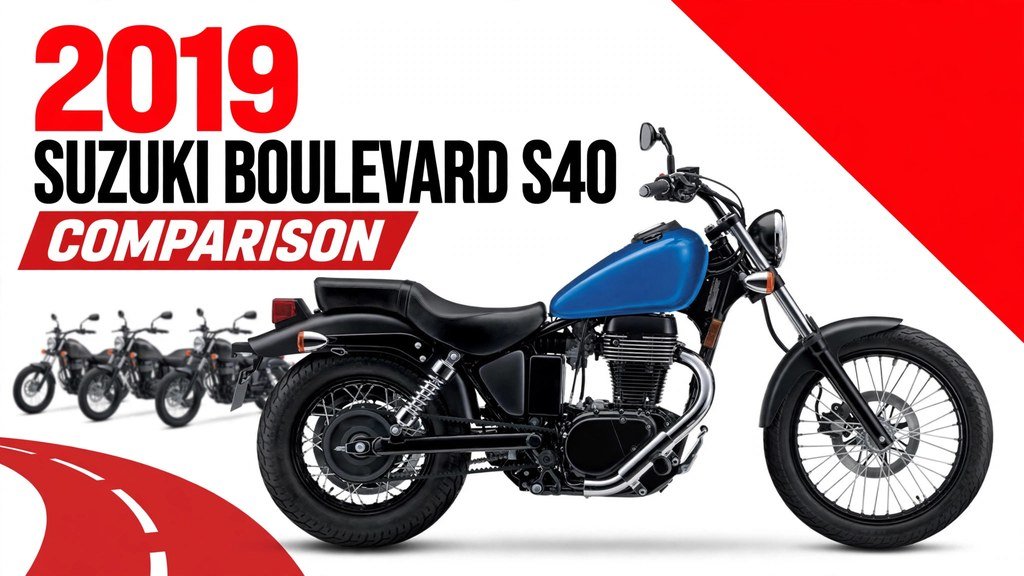
The short answer in this Suzuki Boulevard S40 comparison is that the S40 still wins on price and simplicity — but only as a used bike. Its last new price was $5,799 plus $395 destination in 2019, a total of $6,194, and no new S40 has been sold since. Against today’s new beginner cruisers, that 2019 figure sits $1,000 below the 2026 Honda Rebel 500, $450 above the 2026 Honda Rebel 300 E-Clutch and $900 above the 2026 Royal Enfield Meteor 350 on MSRP. The real question is whether a used S40 at $2,500–$4,500 beats a new rival at full price.
Suzuki Boulevard S40 Overview and Its Closest Rivals
The three rivals in this Suzuki Boulevard S40 comparison do the same job for the same rider: a small, light, approachable first cruiser that costs little to buy and less to run. The Rebel 500 is the modern middleweight of the group, the Rebel 300 E-Clutch is the beginner-tech pick, and the Meteor 350 is the classic-styled single — all under $7,000 before destination.

Why These Three Rivals: Same Class, Same Job
The Rebel 500, Rebel 300 E-Clutch and Meteor 350 chase the same buyer: a new or returning rider who wants a low seat, a light bike and a price that does not need financing gymnastics. The S40’s full story is in the Suzuki Boulevard S40 review. The rivals are all current, fuel-injected and built around modern electronics. The S40 is a 652cc air-cooled single with a carburetor, a belt drive and no ABS, no tachometer and no fuel gauge.
How the Four Bikes Differ at a Glance
The table below is the whole Suzuki Boulevard S40 comparison in one place. The S40’s price is its last new price from 2019; the others are current 2026 new prices.
| Bike | Engine | Power | Weight | Seat | Tank | MSRP |
|---|---|---|---|---|---|---|
| Suzuki Boulevard S40 (2019, last sold) | 652cc air-cooled single, carbureted | 31 hp (database claim); 31 hp at the wheel (MCN 1996 dyno) | 381 lb curb | 27.6 in | 2.8 gal | $5,799 |
| Honda Rebel 500 (2026) | 471cc liquid-cooled parallel twin | 46 hp @ 8,500 rpm | 414 lb curb | 27.2 in | 3.0 gal | $6,799 base / $6,999 SE |
| Honda Rebel 300 E-Clutch (2026) | 286cc liquid-cooled single | ~27 hp claimed | 379 lb curb | 27.2 in | 3.0 gal | $5,349 |
| Royal Enfield Meteor 350 (2026) | 349cc air/oil-cooled single | 20.2 bhp claimed; 17.86 hp (CW dyno) | 421 lb curb | 30.1 in | 4.0 gal | $4,899 |
One warning: the S40’s 31 hp is a database-circulated claim, not a figure Suzuki USA ever published — it matches the 31 hp Motorcycle Consumer News measured at the rear wheel in 1996. The Rebel 300 E-Clutch’s ABS status is also genuinely split between sources, dealt with honestly in its own section below.
Suzuki Boulevard S40 vs Honda Rebel 500
The Rebel 500 is the strongest rival in this Suzuki Boulevard S40 comparison: a modern, liquid-cooled, fuel-injected parallel twin with standard ABS, a six-speed gearbox with a slipper clutch . The S40 answers with less weight, a lower price as a used bike and a mechanical simplicity the Rebel cannot match.

Engine, Specs and Performance Side by Side
The engines could hardly be more different. The S40’s 652cc air-cooled SOHC single breathes through a Mikuni BS40 carburetor, makes its database-claimed 31 hp at 5,400 rpm and 37 lb-ft at 3,400 rpm, and sends it through a five-speed gearbox and a belt. The Rebel 500’s 471cc liquid-cooled DOHC parallel twin is fuel-injected, makes 46 hp at 8,500 rpm and 31.9 lb-ft at 6,000 rpm, and sends it through a six-speed gearbox with a slipper clutch and a chain. On the road the Rebel 500 pulls harder and longer — Motorcycle Cruiser’s 2006 verdict was that the S40 feels “a bit out of breath at 65 mph” and is “not particularly happy out on a wide-open interstate”. The S40’s only instrumented figures are its two quarter-mile runs — 15.3 seconds in 1996 and 16.35 seconds in 2006 — and Honda publishes no equivalent for the Rebel 500 in this Suzuki Boulevard S40 comparison. Weight favours the Suzuki: 381 lb curb against 414 lb.
Price, Equipment and Which Suits Which Rider
The 2026 Rebel 500 base costs $6,799 plus $600 destination, a $7,399 total before tax and title; the factory-custom SE costs $6,999 plus $600, or $7,599 in total. Dealer listings also show a $300 tariff surcharge on the 2026 Rebels, noted separately and not folded into those totals. The S40’s last new total was $6,194 in 2019 — $1,205 less than the Rebel 500 base as a new-bike figure — but no new S40 exists, so the honest comparison is a used S40 at $2,500–$4,500 against a new Rebel 500 at $7,399: a $2,900–$4,900 gap, which buys a lot of servicing. For 2026, Honda made ABS standard on every Rebel 500 trim — its own page says “disc brakes with ABS now come standard on all trims”, with a single 296mm front disc and a 240mm rear disc. That resolves the open question from the earlier performance guide, where base-trim ABS was unconfirmed: it is now confirmed standard. The Rebel 500 also brings fuel injection, a slipper clutch, a digital LCD gauge and all-LED lighting, against the S40’s analogue speedometer and nothing else. The Rebel 500 suits the rider who wants a new bike with a warranty; the S40 suits the rider who wants the cheapest way into motorcycling. The 2026 Honda Rebel 500 specifications confirm the ABS change and the 414 lb curb weight.
Suzuki Boulevard S40 vs Honda Rebel 300 E-Clutch
The Rebel 300 E-Clutch is the closest rival to the S40 in spirit: a small, light, beginner-sized single-cylinder cruiser, and the newest idea in this Suzuki Boulevard S40 comparison — a 286cc liquid-cooled single with Honda’s E-Clutch system, which automates clutch operation at starts, stops and gear changes while keeping the conventional foot lever. The two bikes weigh almost the same — 381 lb for the S40, 379 lb for the Rebel 300 E-Clutch — and their seats are within half an inch of each other.

Engine, Specs and Performance Side by Side
The S40’s 652cc single is more than twice the Rebel 300’s 286cc, and the power figures show it — the S40’s database claim is 31 hp at 5,400 rpm with 37 lb-ft at 3,400 rpm, while the Rebel 300 E-Clutch claims about 27 hp with 27 Nm (19.9 lb-ft) of torque, per Torquepedia’s spec table, and TopSpeed’s review puts it at 27 hp and 20 lb-ft. Both are manuals — the S40 a five-speed with a belt, the Rebel 300 a six-speed with a chain and the E-Clutch, which works the clutch so the bike cannot stall. Brakes are where the two bikes need an honest footnote. Honda’s own US specification page for the 2026 Rebel 300 E-Clutch lists the brakes as a single 296mm front disc and a single 240mm rear disc, with no ABS named anywhere in the table — while its Rebel 500 page names ABS explicitly on both discs. TopSpeed’s full review states no ABS-equipped version is available for the US market, while several dealer listings and spec databases list ABS as standard. The status is genuinely split, so this Suzuki Boulevard S40 comparison does not print ABS as a confirmed feature of the US Rebel 300 E-Clutch — a buyer should check the actual bike. The TopSpeed Rebel 300 E-Clutch review is the source for those figures and the US ABS statement.
Price, Equipment and Which Suits Which Rider
The 2026 Rebel 300 E-Clutch costs $5,349 plus $600 destination, a $5,949 total — $245 less than the S40’s last new total of $6,194. Dealer listings also show the same $300 tariff surcharge as on the Rebel 500, noted separately and not folded into that total. As new bikes, the two are effectively the same money; as real purchases they are not, because the S40 can only be bought used at $2,500–$4,500, undercutting the new Rebel 300 by $1,400–$3,400. Equipment favours the Honda: fuel injection, the E-Clutch, a digital LCD gauge, all-LED lighting and a 41mm fork. What the S40 offers instead is displacement — a 652cc single and a belt drive inspected every 2,000 miles. The Rebel 300 E-Clutch suits the absolute beginner who wants the bike to make stalling impossible. The S40 suits the rider who is comfortable with a clutch, wants more engine for less money, and is happy buying used. The 2026 Honda Rebel 300 E-Clutch specifications confirm the 379 lb curb weight, 27.2 in seat and 3.0 gal tank used in this Suzuki Boulevard S40 comparison.
Suzuki Boulevard S40 vs Royal Enfield Meteor 350
The Meteor 350 is the most old-fashioned of the new bikes in this Suzuki Boulevard S40 comparison, and the closest in spirit to the S40: a small single-cylinder cruiser with classic styling and a low price. It is the cheapest new bike in the group and the only one with a three-year warranty — but also the heaviest at 421 lb and the tallest-seated at 30.1 in.

Engine, Specs and Performance Side by Side
The Meteor’s 349cc SOHC single is air/oil-cooled, fuel-injected and claims 20.2 bhp at 6,100 rpm. Cycle World’s dyno measured 17.86 hp at 6,070 rpm and 18.21 lb-ft at 2,800 rpm — the only instrumented dyno figure for the Meteor, and a different dyno on a different day from the S40’s 1996 MCN rear-wheel figure of 31 hp, so the two should be read as separate data points rather than a head-to-head. The Meteor’s five-speed gearbox and chain drive are conventional; the S40’s five-speed and belt drive are simpler to live with, since the belt needs only an inspection every 2,000 miles. The Meteor is 421 lb curb — 40 lb heavier — and its 30.1 in seat is 2.5 in taller than the S40’s 27.6 in. The Meteor’s 4.0 gal tank is the largest here: at Cycle World’s 60 mpg it gives roughly 240 miles of range, against the S40’s roughly 148 miles. Brakes and equipment are the Meteor’s clear win: dual-channel ABS is standard, plus Tripper navigation and a three-year unlimited-miles warranty. The Royal Enfield Meteor 350 page confirms the 2026 model and price.
Price, Equipment and Which Suits Which Rider
The 2026 Meteor 350 costs $4,899 plus $495 freight, a $5,394 total — $800 less than the S40’s last new total of $6,194 and $900 less on MSRP alone. Against a used S40 at $2,500–$4,500, the Meteor is still $900–$2,900 more expensive — but it is new, warranted for three years and fitted with ABS and navigation, which the S40 cannot offer at any price. In this Suzuki Boulevard S40 comparison, the Meteor 350 suits the rider who wants a new bike and a warranty. The S40 suits the rider who wants the lightest, lowest and simplest bike for the lowest price.
Suzuki Boulevard S40 Price and Value Compared
Price is the heart of this Suzuki Boulevard S40 comparison: the S40’s price is its last new price from 2019; the others are current 2026 new prices. The table below puts them side by side with destination and freight included,

New Prices Across the Four Bikes in the USA
| Bike | MSRP | Destination / freight | Total | vs S40 total |
|---|---|---|---|---|
| Suzuki Boulevard S40 (2019, last sold) | $5,799 | $395 | $6,194 | — |
| Honda Rebel 500 base (2026) | $6,799 | $600 | $7,399 | $1,205 more |
| Honda Rebel 500 SE (2026) | $6,999 | $600 | $7,599 | $1,405 more |
| Honda Rebel 300 E-Clutch (2026) | $5,349 | $600 | $5,949 | $245 less |
| Royal Enfield Meteor 350 (2026) | $4,899 | $495 | $5,394 | $800 less |
On MSRP alone the S40’s $5,799 is $1,000 less than the Rebel 500 base, $1,200 less than the Rebel 500 SE, $450 more than the Rebel 300 E-Clutch and $900 more than the Meteor 350. Two surcharges sit outside those totals: a $300 tariff surcharge on both 2026 Rebels, and a $15 split on the S40’s destination — Suzuki’s own page prints $395, motorcycle.com’s database prints $380. This Suzuki Boulevard S40 comparison headlines Suzuki’s $395 and never prints $6,179 as the total. The archived Suzuki USA 2019 S40 page confirms the $5,799 MSRP and the $395 destination charge. Used S40s commonly list at $2,500–$4,500, a marketplace range rather than a verified price — $1,400–$3,400 below the cheapest new rival in this Suzuki Boulevard S40 comparison.
Running Costs and Resale Value Compared
Running costs in this Suzuki Boulevard S40 comparison favour the S40 almost everywhere, and the service schedule is the reason. The S40’s manual asks for oil, filter and valve work at every interval — 600, 4,000, 7,500, 11,000 and 14,500 miles — which sounds demanding until you see how simple each job is: one cylinder, one carburetor, a belt inspected every 2,000 miles, and cheap common parts like the HFA3608 oil filter and the NGK DPR8EA-9 spark plug. The S40 service chart from the manual is the source for those intervals. The rivals all run chains, which need cleaning and lubrication. Fuel is the S40’s other running-cost win: its two tested figures are 55 mpg (Motorcycle Consumer News, 1996) and 52.9 mpg (Motorcycle Cruiser, 2006), both recorded in the Suzuki Boulevard S40 history and specifications. The Meteor 350’s Cycle World figure is 60 mpg, which with its 4.0 gal tank gives it the longest range here; Honda publishes no MPG figure for either Rebel. The trade-off is warranty: the Meteor 350 carries a three-year unlimited-miles warranty, while every S40 is long out of its 12-month warranty.
Suzuki Boulevard S40 Comparison Verdict and US Alternatives
The verdict in this Suzuki Boulevard S40 comparison depends on one decision: new or used. As a new-bike purchase the S40 cannot win, because it cannot be bought new — among the three current rivals, the Meteor 350 is the cheapest, the Rebel 300 E-Clutch is the easiest for a brand-new rider, and the Rebel 500 is the most capable all-rounder. As a used purchase, the S40 is the best value in the group: the lightest, lowest and simplest bike, with the most torque and the lowest price.

The video below is Some Moto Guy’s “1 Year and 5k Miles Later: Suzuki Boulevard S40 Review (Good & Bad)” — a one-year, 5,000-mile ownership review of a 2006 S40, not a head-to-head comparison: no verified S40-versus-rival comparison video exists.
No Modern Equivalent to a Carbureted 652 Single
There is no modern equivalent to the S40, and that is the point of the bike rather than a flaw in this Suzuki Boulevard S40 comparison. No current manufacturer sells a carbureted 652cc single-cylinder cruiser with a belt drive, no ABS, no tachometer and no fuel gauge. The bigger Boulevards went shaft-drive instead, as the Boulevard C50 comparison and the Boulevard M109R comparison show. The Meteor 350 comes closest in spirit — a small single with classic styling — but it is fuel-injected, chain-driven, heavier, taller and fitted with ABS and navigation. A buyer who wants the S40 experience — a big single, a carburetor, a belt and nothing electronic — has exactly one option, and it is a used S40. No recall was found in published notices for the S40, and its known faults — the head-plug oil leak and the vacuum petcock — are cheap, owner-documented fixes covered in the Suzuki Boulevard S40 reliability guide.
V Star 250 Still Sells: Carbureted, but a 250
One other bike deserves a line in this Suzuki Boulevard S40 comparison, because it is the only still-new carbureted rival in the class: the Yamaha V Star 250. It is still selling new as a 2025 model at $4,799, and no 2026 V Star 250 is confirmed. It is a 249cc air-cooled carbureted V-twin with a chain drive, roughly 330 lb wet and a 27.0 in seat — not 27.6 in, as some AI-written pages print. It is the only new bike a buyer can walk into a dealership and ride away on with a carburetor, but it is a 250: less than half the S40’s displacement. It suits a rider who insists on buying new and carbureted. Also worth a line: the Honda Shadow Aero, a 745cc shaft-drive V-twin a size class up, was last sold as a 2024 model at $7,949 non-ABS or $8,249 ABS plus $600 destination.
Suzuki Boulevard S40 Comparison: Frequently Asked Questions
Direct answers on prices, ABS, weight, speed and whether to buy used or new in this Suzuki Boulevard S40 comparison.
Which is the best beginner cruiser — the S40 or the Rebel 300 E-Clutch?
For an absolute beginner, the Rebel 300 E-Clutch: its E-Clutch makes stalling all but impossible, and it weighs 379 lb. For a rider who is comfortable with a clutch, a used S40 at $2,500–$4,500 is the better buy in this Suzuki Boulevard S40 comparison — 652cc against 286cc and a belt drive instead of a chain.
Is the S40 cheaper than the Rebel 500?
As a used bike, yes — by a wide margin. A clean used S40 commonly lists at $2,500–$4,500, while a new 2026 Rebel 500 base costs $6,799 plus $600 destination, or $7,399 in total.
Does the S40 have ABS like the Rebel 500?
No. No ABS was ever fitted to any S40 in any year or any market. The 2026 Rebel 500 has ABS standard on every trim and the Meteor 350 has dual-channel ABS standard. The 2026 Rebel 300 E-Clutch’s ABS status is genuinely split — Honda’s US spec table does not name ABS, while dealer listings claim it as standard — so check the actual bike.
Is the Rebel 300 E-Clutch faster than the S40?
No, on the figures available. The S40’s database claim is 31 hp with 37 lb-ft of torque, and its only instrumented quarter-mile runs are 15.3 seconds in 1996 and 16.35 seconds in 2006. The Rebel 300 E-Clutch claims about 27 hp with about 20 lb-ft, and no instrumented quarter-mile figure for it was found in this Suzuki Boulevard S40 comparison.
Which bike is the lightest in this comparison?
The Honda Rebel 300 E-Clutch, at 379 lb curb — 2 lb lighter than the S40’s 381 lb — is the lightest bike in this Suzuki Boulevard S40 comparison. The Rebel 500 is 414 lb and the Meteor 350 is 421 lb.
Which bike is best for short riders?
The S40 and the two Rebels are effectively tied: the S40’s seat is 27.6 in and both Rebels sit at 27.2 in. The Meteor 350 is the outlier in this Suzuki Boulevard S40 comparison at 30.1 in, which is 2.5 in taller than the S40 and a real difference for a short rider.
Can I still buy a new Suzuki Boulevard S40?
No. The last US model year was 2019, priced at $5,799 plus $395 destination, and no 2020 model exists. Any S40 for sale today is used, and clean running examples commonly list in the $2,500–$4,500 range — a marketplace range, not a verified price, and the key fact of this Suzuki Boulevard S40 comparison.
Which bike costs the least to run?
The S40, on service and parts: one cylinder, one carburetor, a belt inspected every 2,000 miles, and cheap common parts. The Meteor 350 has the best tested fuel economy at 60 mpg (Cycle World) and the longest range at roughly 240 miles, against the S40’s tested 52.9–55 mpg and roughly 148 miles.
Is the Meteor 350 a good alternative to the S40?
Yes, if you want a new bike. The 2026 Meteor 350 costs $4,899 plus $495 freight, or $5,394 in total — $800 less than the S40’s last new total — and brings dual-channel ABS, Tripper navigation and a three-year warranty. It is heavier, taller and weaker, but the cheapest new bike in this Suzuki Boulevard S40 comparison.
Which bike holds its value best?
The used S40 in this Suzuki Boulevard S40 comparison: bought at $2,500–$4,500, a clean example has little left to lose, while a new Rebel 500 at $7,399 or a new Meteor 350 at $5,394 will both lose value from new. No verified resale-value index exists, so this is a market observation, not a measured figure.
Is the Yamaha V Star 250 still sold new?
Yes, as a 2025 model at $4,799 — a 249cc air-cooled carbureted V-twin, about 330 lb wet and a 27.0 in seat. No 2026 V Star 250 is confirmed. It is the only still-new carbureted rival in this Suzuki Boulevard S40 comparison, but it is a 250, with far less power than the S40.
Should I buy a used S40 or a new Rebel 300 E-Clutch?
Buy the used S40 in this Suzuki Boulevard S40 comparison if you are comfortable with a clutch, want the most engine for the least money, and can check the head plug, test the petcock and run the VIN before buying. Buy the new Rebel 300 E-Clutch if you are a brand-new rider who wants stalling to be impossible and a bike you can buy from a dealer today for $5,349 plus $600 destination.