The short answer in this Suzuki Boulevard M109R comparison is that the big Suzuki is still the cheapest way into the power-cruiser class: $15,799 plus $600 destination for 123 claimed horsepower, against $22,999 for the Harley-Davidson Breakout, $24,995 for the Triumph Rocket 3 Storm R, and $14,999 for the Indian Chief base. The Suzuki is the only one under $16,000, the only one with a shaft drive and a 240 rear tire at this price, and the only one with no ABS at all.
Suzuki Boulevard M109R Overview and Its Closest Rivals
The M109R has been the value pick of the power-cruiser class since 2006. Its original rivals — the Honda VTX1800, the Kawasaki Vulcan 2000, the Yamaha Roadliner — are all gone from showrooms, leaving a smaller, more expensive field: Harley’s Breakout, Triumph’s Rocket 3 Storm and Indian’s Chief. This section of the Suzuki Boulevard M109R comparison explains why those three are the right rivals.

The video below is SRK Cycles’ essay on why the M109R itself is compelling — a piece about the Suzuki on its own merits, not a head-to-head test. No verified M109R-versus-rival comparison video exists, so watch it for the bike, and read the numbers below for the comparison.
Why These Three Rivals: Same Class, Same Job
The three rivals in this Suzuki Boulevard M109R comparison were chosen because they do the same job: big-displacement, low-slung cruisers built for straight-line muscle and boulevard presence. The Breakout is the closest match — a factory custom with the same 240mm rear tire, a similar chopper stance and a Milwaukee-Eight 117 that answers the Suzuki’s V-twin with more torque. The Rocket 3 Storm R is the class overachiever: a 2,458cc triple that makes the Suzuki look modest on paper. The Chief is the price rival — the only one that undercuts the Suzuki on MSRP, at $14,999 for the Thunderstroke 111 base, and the only one that answers it with a classic American cruiser. The Suzuki Boulevard M109R review covers the bike itself in full, including the B.O.S.S. years and the chrome return.
How the Four Bikes Differ at a Glance
Before the detail, the shape of this Suzuki Boulevard M109R comparison is simple: the Suzuki is the cheapest and the most powerful on claimed horsepower per dollar, the Rocket is the most powerful outright, the Breakout is the lightest and lowest-seated, and the Chief is the cheapest to buy and the lightest of all four. The table below puts the four bikes side by side.
| Item | M109R (2025) | Breakout (2026) | Rocket 3 Storm R (2025) | Chief base (2025) |
|---|---|---|---|---|
| MSRP | $15,799 | $22,999 | $24,995 | $14,999 |
| Engine | 1,783cc 54° V-twin, liquid-cooled | 1,923cc Milwaukee-Eight 117, air/oil-cooled | 2,458cc inline triple, liquid-cooled | 1,811cc Thunderstroke 111, air-cooled |
| Claimed power | 123 hp @ 6,200 rpm | 103 hp @ 4,800 rpm | 180 hp @ 7,000 rpm | — (Indian publishes no hp) |
| Claimed torque | 118 lb-ft @ 3,200 rpm | 126 lb-ft @ 3,000 rpm | 166 lb-ft @ 4,000 rpm | 108 lb-ft @ 3,200 rpm |
| Transmission / drive | 5-speed, shaft | 6-speed, belt | 6-speed, shaft | 6-speed, belt |
| Weight | 764 lb curb | 681 lb wet | 699 lb wet | 670 lb wet |
| Seat height | 27.8 in | 25.6 in | 30.4 in | 26.0 in |
| Fuel tank | 5.2 gal | 5.0 gal | 4.75 gal | 4.0 gal |
| ABS / tech | None, in any year | ABS standard, ride modes | Cornering ABS, 4 ride modes, TFT, cruise | ABS standard, ride modes, cruise |
Suzuki Boulevard M109R vs Harley-Davidson Breakout
The Breakout is the rival this Suzuki Boulevard M109R comparison keeps coming back to: same 240mm rear tire, same low chopper stance, same job — and a $7,200 price gap on MSRP. The Harley is the more modern motorcycle, the Suzuki the faster one on paper, and the choice is really between equipment and value.

Engine, Specs and Performance Side by Side
On the engine, the Suzuki wins the numbers and the Harley wins the feel. The M109R’s 1,783cc liquid-cooled 54-degree V-twin claims 123 hp at 6,200 rpm and 118 lb-ft at 3,200 rpm, and its only instrumented dyno — Motorcycle.com’s 2007 Godzilla shootout — measured 106.4 hp and 101.3 lb-ft at the rear wheel. The Breakout’s 1,923cc Milwaukee-Eight 117 Custom claims 103 hp at 4,800 rpm and 126 lb-ft at 3,000 rpm, and Harley’s own page confirms the 240mm rear tire, the 21-inch front wheel and the 34-degree rake. So the Suzuki makes 20 hp more on the claim and the Harley makes 8 lb-ft more torque, and the Suzuki’s dyno figure alone beats the Harley’s claimed crank figure. The weight gap helps the Harley: 681 lb wet against the Suzuki’s 764 lb curb, and the Breakout’s seat is 2.2 inches lower at 25.6 inches. The Suzuki answers with a five-speed shaft drive against the Harley’s six-speed belt, and with the only tested acceleration in this Suzuki Boulevard M109R comparison — 0–60 in 3.89 seconds and a 12.08-second quarter mile, both from 2006 at 2,800 feet. No tested Breakout acceleration figure was found: the Suzuki is faster on paper, the Harley torquier and lighter. The Suzuki Boulevard M109R performance guide covers the dyno and the quarter mile in full.
Price, Equipment and Which Suits Which Rider
The price gap is the whole argument: the 2026 Breakout costs $22,999 plus $895 destination — $7,200 more than the M109R on MSRP, $7,495 more once both destination charges are counted. What the extra money buys is equipment the Suzuki has never offered: standard ABS — the M109R has none in any US year — plus customizable ride modes and Harley’s Rider Safety Enhancements, a single 300mm front disc, a 4-inch analog gauge, full LED lighting and a USB-C charging port. The rider each bike suits follows from that. The M109R suits a rider who wants the most horsepower per dollar and does not mind a bike with no electronic safety net. The Breakout suits a rider who wants the badge, the lower seat, the lighter weight and the safety equipment — and is willing to pay $7,200 for it. A buyer who wants ABS should not have to think twice: that alone settles this Suzuki Boulevard M109R comparison for a large share of riders.
Suzuki Boulevard M109R vs Triumph Rocket 3 Storm
The Rocket 3 Storm R is not a fair fight, and that is why it is in this Suzuki Boulevard M109R comparison: it shows what the class looks like when money is no object. Triumph’s 2,458cc triple is the largest production motorcycle engine in the world, and the Storm R makes the M109R’s numbers look ordinary. The question is whether the extra speed is worth nearly ten thousand dollars.

Engine, Specs and Performance Side by Side
The engine gap is the biggest in this Suzuki Boulevard M109R comparison. The Rocket 3 Storm R’s liquid-cooled inline triple displaces 2,458cc — 675cc more than the Suzuki — and Triumph claims 180 hp at 7,000 rpm and 166 lb-ft at 4,000 rpm. Against the M109R’s 123 hp and 118 lb-ft, that is 57 hp and 48 lb-ft more. The Rocket is also lighter: 699 lb wet against the Suzuki’s 764 lb curb, so the Triumph carries 65 lb less and makes far more power. The Rocket’s seat is the tallest here at 30.4 inches against the Suzuki’s 27.8, and its 4.75-gallon tank is the smaller of the two, but its equipment is a generation ahead: lean-sensitive cornering ABS, traction control, four ride modes, ride-by-wire, a colour TFT display, cruise control and hill hold, with Brembo Stylema calipers on twin 320mm front discs. The Rocket’s rear tire is a 240/50R16, wider in profile than the Suzuki’s 240/40R18, and both bikes drive through a shaft — the Rocket is the only rival that shares the Suzuki’s shaft drive. Rider Magazine’s Storm first look confirms the 180 hp, 166 lb-ft, 699 lb and $24,995 figures used here.
Price, Equipment and Which Suits Which Rider
At $24,995, the Storm R costs $9,196 more than the M109R on MSRP, and the Storm GT at $25,795 costs $9,996 more — nearly two-thirds of the Suzuki’s price again. What that buys is not just speed: it buys the most complete motorcycle in this Suzuki Boulevard M109R comparison, with cornering ABS, traction control, four ride modes, a TFT, cruise and hill hold as standard. The Suzuki’s answer is value and simplicity. It costs less than two-thirds of the Triumph, its engine has run mechanically unchanged since 2006, and its service schedule is short — oil at five fixed mileages, a valve check only at 14,500 miles. The Rocket suits a rider who wants the fastest, most powerful production cruiser money can buy. The M109R suits a rider who wants most of the muscle-bike feeling for $9,196 less and does not need the electronics. Nobody cross-shops these two on price alone.
Suzuki Boulevard M109R vs Indian Chief
The Chief is the only rival in this Suzuki Boulevard M109R comparison that undercuts the Suzuki on price, and it does so while offering the equipment the Suzuki lacks. At $14,999, the Thunderstroke 111 base Chief is $800 cheaper than the M109R on MSRP — but it is a different kind of bike.

Engine, Specs and Performance Side by Side
The Chief’s 1,811cc air-cooled Thunderstroke 111 makes 108 lb-ft at 3,200 rpm, and Indian publishes no horsepower figure for it at all — so this Suzuki Boulevard M109R comparison prints no Chief horsepower number. Against the Suzuki’s 123 hp claim and 118 lb-ft, the Chief gives up 10 lb-ft of torque, but it is the lightest bike here at 670 lb wet, with a 26.0-inch seat and a 4.0-gallon tank. The Chief Dark Horse, at $18,499, swaps in the 1,890cc Thunderstroke 116 with 120 lb-ft at 2,900 rpm — 2 lb-ft more than the Suzuki — on the same 670 lb chassis. Both Chiefs run a six-speed belt drive against the Suzuki’s five-speed shaft, and both come with standard ABS, ride modes, cruise control and keyless ignition. The Motorcycle.com Chief Dark Horse specs confirm the $18,499 price, the 1,890cc engine, the 670 lb wet weight and the 4.0-gallon tank used here.
Price, Equipment and Which Suits Which Rider
The price story splits by trim, and this Suzuki Boulevard M109R comparison names the trim every time. The base Chief at $14,999 is $800 cheaper than the M109R on MSRP, and $700 cheaper once destination is counted — $15,699 against $16,399. The Dark Horse at $18,499 is $2,700 more than the Suzuki on MSRP. The base Chief suits a rider who wants a classic American cruiser — valanced fenders, a solo seat, a teardrop tank, a low 26-inch seat — with modern equipment and the lowest price in the group. The Dark Horse suits a rider who wants the same bike blacked out with the bigger 116 engine, a 4-inch touchscreen Ride Command display and 120 lb-ft of torque, for $3,500 more than the base. The M109R suits a rider who wants the muscle-bike character — the fat 240 rear tire, the drag-race acceleration, the 106.4 hp dyno figure — rather than the Chief’s classic styling. The Chief is the better motorcycle for most riders on equipment and price; the Suzuki is the better one for the rider who wants the fastest, cheapest muscle cruiser and nothing else. That is the honest split in this Suzuki Boulevard M109R comparison, and the Chief is the rival the Suzuki should worry about most.
Suzuki Boulevard M109R Price and Value Compared
Price is where this Suzuki Boulevard M109R comparison is decided for most buyers, because the gaps are large. The Suzuki is the cheapest of the three muscle bikes and $800 dearer than the cheapest Chief — and dealers are already discounting it hard.

New Prices Across the Four Bikes in the USA
The table below lists the four bikes’ US prices with destination charges where they could be verified. The M109R is $15,799 plus $600 destination, $16,399 before tax and title, per Suzuki’s own 2025 page. The Breakout is $22,999 plus $895 destination as dealer-reported, $23,894 in total. The Rocket 3 Storm R is $24,995, and its destination charge was not confirmed at writing time, so no total is printed for it. The Chief base is $14,999 plus $700 destination, $15,699 in total. The Chief Dark Horse is $18,499. The gaps on MSRP alone: the Suzuki is $7,200 cheaper than the Breakout, $9,196 cheaper than the Rocket 3 Storm R, and $800 more than the base Chief — but $2,700 cheaper than the Dark Horse. Dealers were reported selling new 2025 M109Rs for around $12,000 in 2026 against the $15,799 list price, which widens every gap by roughly another $3,800 — at that price the Suzuki undercuts even the base Chief, and no rival in this Suzuki Boulevard M109R comparison can match it.
| Bike | MSRP | Destination | Total before tax |
|---|---|---|---|
| Suzuki Boulevard M109R (2025) | $15,799 | $600 | $16,399 |
| Harley-Davidson Breakout (2026) | $22,999 | $895 (dealer-reported) | $23,894 |
| Triumph Rocket 3 Storm R (2025) | $24,995 | Not confirmed | — |
| Indian Chief base (2025) | $14,999 | $700 | $15,699 |
| Indian Chief Dark Horse (2025) | $18,499 | Not confirmed | — |
Running Costs and Resale Value Compared
Running costs favour the Suzuki, and resale value is the one place this Suzuki Boulevard M109R comparison has to be honest about what it cannot prove. The M109R’s only tested economy figure is Rider’s 36.4 mpg from June 2006, which implies roughly 189 miles from its 5.2-gallon tank. Its rear tire is the recurring cost — owners report 5,000 to 7,000 miles per 240-section rear — and its service schedule is short: oil at 600, 4,000, 7,500, 11,000 and 14,500 miles, a valve check only at 14,500 miles. No tested MPG figure was found for the Breakout, the Rocket or the Chief, so no fuel-cost comparison is printed here. Structurally, the Suzuki’s shaft drive needs almost nothing, the Breakout and Chief belts need tension checks and eventual replacement, and the Rocket’s shaft is the only rival drivetrain as low-maintenance as the Suzuki’s. On resale, no verified resale-value index exists for these four bikes, so this Suzuki Boulevard M109R comparison prints no resale percentages. The honest version is this: the Suzuki’s low entry price — and the dealer discounts around $12,000 — mean less money to lose, while the Harley, Triumph and Indian badges hold value on brand strength. The Suzuki Boulevard M109R reliability guide covers the service schedule and both recalls in full — check both recalls by VIN on the NHTSA recalls lookup before buying used.
Suzuki Boulevard M109R Comparison Verdict and US Alternatives
The verdict of this Suzuki Boulevard M109R comparison is that the Suzuki wins on value and loses on equipment. It is the cheapest muscle cruiser in the group, the fastest per dollar on claimed horsepower, and the only one with a shaft drive and a 240 rear tire under $16,000 — and the only one with no ABS, no ride modes and no traction control.
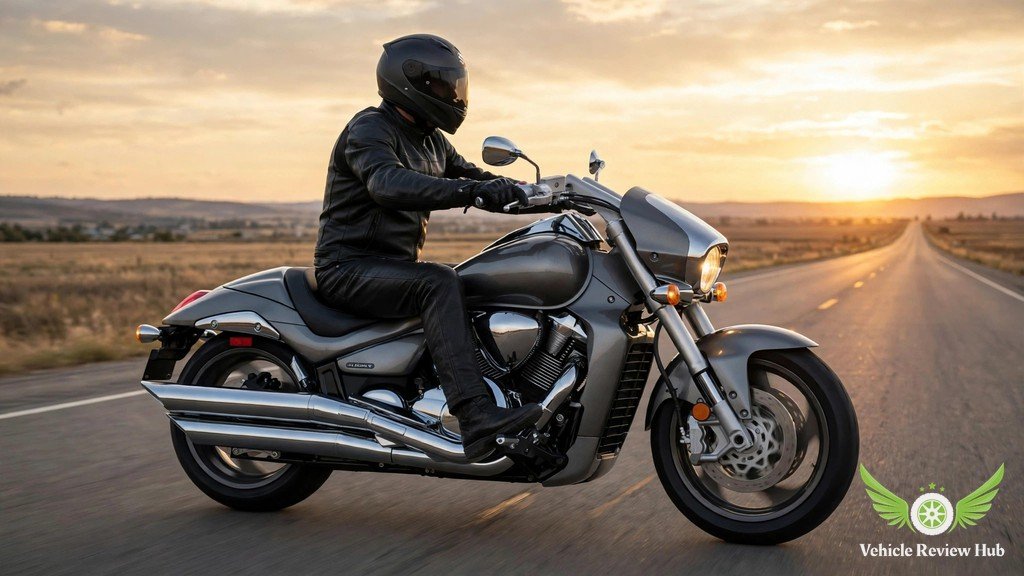
The Breakout Shares Even Its 240 Rear Tire
The closest single fact in this Suzuki Boulevard M109R comparison is the tire: the Breakout’s 240/40R18 rear matches the Suzuki’s exactly, confirmed on Harley’s own Breakout page and in the MotorcycleDB spec comparison. It is the signature detail of the class, the fat rear tire that defines the muscle-cruiser look, and the only two bikes that still wear it new are the Suzuki and the Harley. The Rocket’s rear is a 240/50R16, wider in profile but on a smaller wheel, and the Chief’s rear is a narrower 180-section tire. The shared 240 is why the Breakout is the M109R’s true rival: same stance, same tire, same job, $7,200 apart. A rider who loves the fat-tire look has exactly two new bikes to choose from, and the Suzuki is the cheaper one. The Boulevard C50 comparison makes the same value argument at the smaller end of the line.
Its Original Class Has Largely Disappeared
The M109R’s original class is gone. In the 2007 Godzilla shootout, Motorcycle.com lined the Suzuki up against the Honda VTX1800, the Kawasaki Vulcan 2000, the Yamaha Roadliner and the Harley CVO Springer — and of those five, only Harley still builds a bike in the class, and it is the Breakout. The VTX1800, the Vulcan 2000, the Roadliner and Victory are all gone. The M109R survives as the last Japanese V-twin shaft-drive muscle cruiser still sold new, and the last one under $16,000. Alternatives beyond these three: Harley’s Low Rider S at $19,999 with the 117 High Output engine, the Sportster S at $15,999, and Indian’s 101 Scout at $16,999 — all named in TopSpeed’s own M109R comparisons. But none of them is the M109R: a 1,783cc V-twin, a shaft, a 240 rear tire and 106.4 hp at the wheel for $15,799. That combination has no direct replacement, which is why this Suzuki Boulevard M109R comparison ends where it started — the Suzuki is the cheapest way in.
Suzuki Boulevard M109R Comparison: Frequently Asked Questions
Direct answers to the questions riders ask when comparing the Suzuki Boulevard M109R with its three rivals — prices, specs, equipment and value.
Which is faster, the M109R or the Breakout?
On paper, the M109R: it claims 123 hp against the Breakout’s 103 hp, and its only instrumented dyno — 106.4 hp at the rear wheel — beats the Harley’s claimed crank figure. On torque the Breakout wins, 126 lb-ft against 118 lb-ft.
Is the Rocket 3 Storm R worth $9,196 more than the M109R?
For outright performance, yes: 180 hp and 166 lb-ft against 123 hp and 118 lb-ft, plus cornering ABS, four ride modes, a TFT and cruise control. For value, no: the Suzuki gives most of the muscle-bike feeling for $9,196 less.
Is the Indian Chief cheaper than the M109R?
The base Chief is: $14,999 against $15,799 on MSRP, $15,699 against $16,399 once destination is counted — $700 cheaper in total. The Chief Dark Horse, at $18,499, is $2,700 more than the Suzuki.
Which of the four bikes has ABS?
Three of them: the Breakout, the Rocket 3 Storm R (cornering ABS) and the Chief all have standard ABS. The M109R is the only one with no ABS in any US year — the single biggest equipment gap in this Suzuki Boulevard M109R comparison.
Which is the lightest of the four?
The Indian Chief base, at 670 lb wet — then the Breakout at 681 lb, the Rocket 3 Storm R at 699 lb, and the M109R heaviest at 764 lb curb.
Does the Breakout really share the M109R’s 240 rear tire?
Yes, exactly: both bikes run a 240/40R18 rear tire, confirmed on Harley’s own Breakout page and in the MotorcycleDB spec comparison.
Which bike has the most torque?
The Rocket 3 Storm R, by a wide margin: 166 lb-ft at 4,000 rpm. Then the Breakout at 126 lb-ft, the Chief Dark Horse at 120 lb-ft, the M109R at 118 lb-ft, and the base Chief at 108 lb-ft.
Which is best for a shorter rider?
The Breakout, with the lowest seat at 25.6 inches, then the Chief at 26.0 inches, the M109R at 27.8 inches, and the Rocket 3 Storm R tallest at 30.4 inches. Seat height is a fit question — sit on each before deciding.
Which is cheapest to run?
The M109R has the only tested economy figure in this Suzuki Boulevard M109R comparison — 36.4 mpg from Rider’s 2006 test — and the shortest service schedule, with a valve check only at 14,500 miles. No tested MPG figure was found for the rivals, so no fuel-cost ranking is printed.
Can I still buy a new M109R?
Yes, but only as a 2025: no 2026 M109R exists on Suzuki’s US site. Dealers were reported selling new 2025 bikes for around $12,000 in 2026, well under the $15,799 list price — the cheapest entry point in this Suzuki Boulevard M109R comparison.
Which rival is closest to the M109R’s character?
The Breakout: same 240 rear tire, same low chopper stance, same muscle-cruiser job, and the only rival that matches the Suzuki’s fat-tire signature. The Rocket is faster but a different purchase, and the Chief is a classic cruiser rather than a muscle bike.
What alternatives exist beyond these three rivals?
Harley’s Low Rider S at $19,999 with the 117 High Output engine, the Sportster S at $15,999, and Indian’s 101 Scout at $16,999 — all named in TopSpeed’s own M109R comparisons.