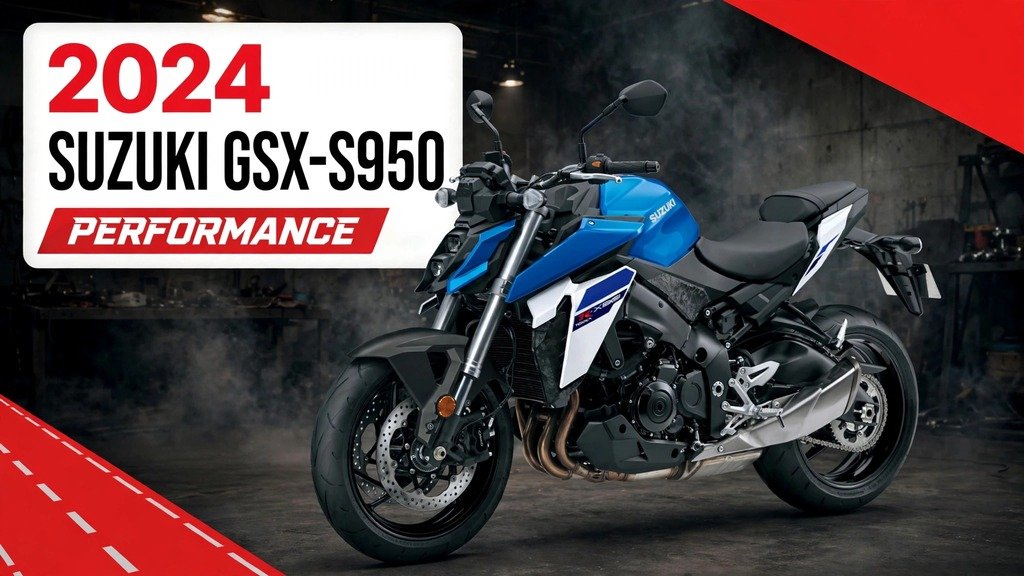
The Suzuki GSX-S950 is a strange performance proposition: a 999cc superbike-derived engine capped at 95 PS, built for a licence class, with no dyno test and no timed acceleration run from any named outlet. This Suzuki GSX-S950 performance guide gives the honest picture first — the claimed figures, the three top-speed numbers that disagree, the real fuel economy, and what testers actually said on the road. Everything in this Suzuki GSX-S950 performance guide comes from Suzuki’s own figures or named road tests, and where no test exists, it says so plainly. For prices, colours and the full verdict, see the GSX-S950 review.
Suzuki GSX-S950 Engine Performance and Power Delivery
The engine is a 999cc liquid-cooled inline-four, the same K5-derived block as the 2021 GSX-S1000, capped at 95 PS and 92 Nm. This Suzuki GSX-S950 performance section starts with the two honest facts that frame everything else: the power is claimed, not dyno-verified, and the engine delivers it low in the rev range, not at the top.
95 PS Claimed, No Dyno From Named Outlets
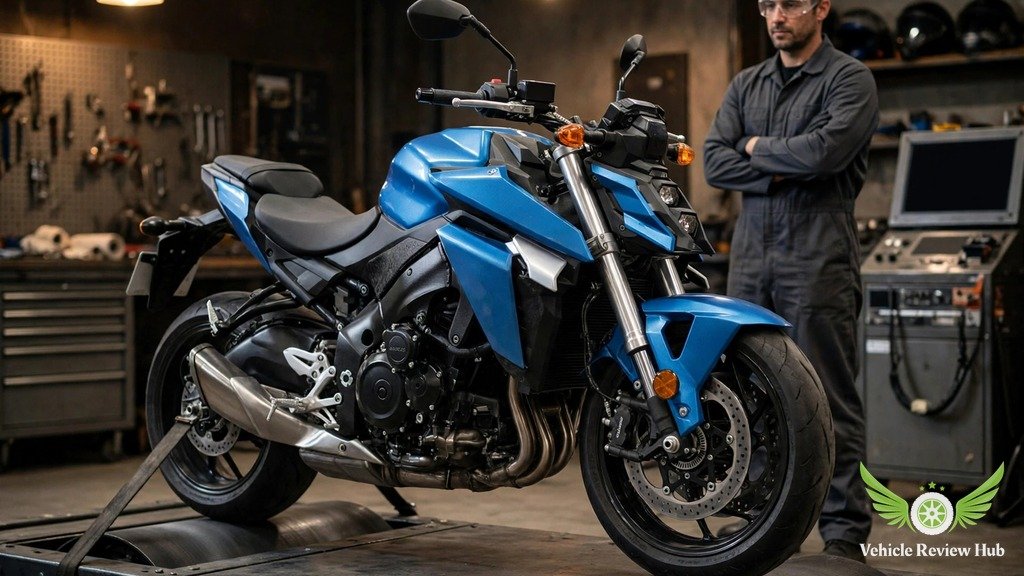
Full power is 95 PS (70 kW) at 7,800 rpm, with 92 Nm (67.9 lb-ft) at 6,500 rpm, and the A2 version makes 47.5 PS (35 kW) at around 6,100 rpm with 76 Nm at 3,250 rpm. The restriction is an ECU remap only, and Suzuki puts de-restriction at under €100 through a dealer reflash. No named outlet has ever put a GSX-S950 on a dyno: Cycle World, Motorcycle.com and Motorcyclist never tested it, because the bike was never sold in the USA; MCN road-tested it without a dyno; Bennetts only covered the launch; and 1000PS published a written verdict only. A dyno figure sometimes attached to the 950 actually belongs to the GSX-S1000 GX, tested by inSella — not this bike. That means there is no rear-wheel horsepower figure for this bike anywhere, and this Suzuki GSX-S950 performance guide prints none. The claimed crank figures are all that exist, and they are the figures this guide uses throughout.
Power Tails Off Past 6,000 RPM, Says MCN
MCN tested the bike in A2 trim and found the power impressive at first, then tailing off past 6,000 rpm — the engine making more noise than performance beyond that point. The full-power bike is different: Le Repaire found it pulling firmly from 3,000 to 7,000 rpm on 92 Nm, and Motofichas found the push intensifying from 5,000 rpm. One magazine line needs correcting: MCN writes the torque is “unaffected by the restriction”, but Suzuki’s figures cut it from 92 Nm at 6,500 rpm to 76 Nm at 3,250 rpm in A2 trim. The torque arrives much lower, which is why the restricted bike still feels strong in town, and why it runs out of breath past 6,000 rpm. That low-down pull is the heart of this Suzuki GSX-S950 performance story: presence and torque, middleweight pace.
Suzuki GSX-S950 Top Speed and Acceleration
Top speed is where this Suzuki GSX-S950 performance guide has to slow down and label everything, because three published figures disagree and none of them comes from a measured test. Acceleration is simpler to report: no instrumented test exists at all.
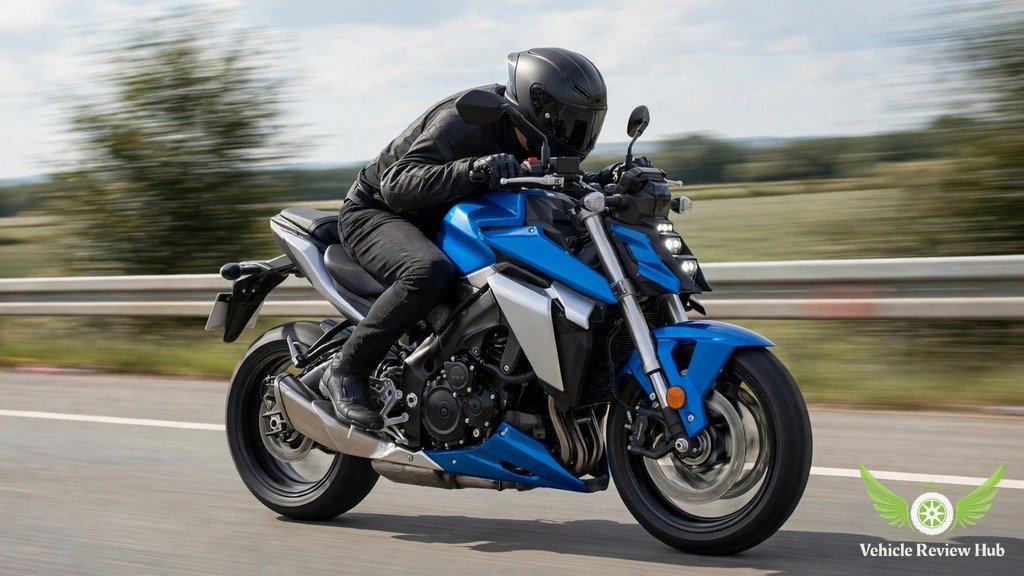
| Source | Figure | What it actually is |
|---|---|---|
| MCN | 120 mph (193 km/h) | Listed top speed, full-power bike |
| Motoplanete | Over 200 km/h (124 mph) | Spec-sheet figure, not a measured test |
| 1000PS | 160 km/h (99 mph) | A2-restricted 48 PS variant only — not the 95 PS bike |
| Swiss type approval | 210 km/h | Homologation figure (Vmax) for the 70 kW version |
The four figures in this Suzuki GSX-S950 performance table are kept separate because they measure different things — a listed top speed, a spec-sheet figure, an A2-variant figure and a homologation figure — and merging them into one number would be dishonest.
Three Top-Speed Figures That Disagree
MCN lists 120 mph for the full-power bike. Motoplanete lists over 200 km/h, also for the full-power bike — and the two still disagree, 193 km/h against more than 200. The third figure, 1000PS‘s 160 km/h, belongs to the A2-restricted 48 PS variant, not the 95 PS bike: the same page’s engine table shows 48 HP at 6,100 rpm and 76 Nm at 3,250 rpm, so the figure cannot be attached to full power. Swiss type approval adds a fourth data point: a 210 km/h Vmax for the 70 kW version. 1000PS even contradicts itself, listing 160 km/h on its 2024 page and 175 km/h on its 2026 sheet for the same A2 variant. Le Repaire rode the full-power bike and wrote that it gets fairly quickly towards 200 km/h. No outlet has published a GPS or timed top speed, so this Suzuki GSX-S950 performance guide treats every figure above as a listing, not a measurement. The 155 mph trap is worth naming too: no source attaches 155 mph to the 950 — that figure belongs to the GSX-S1000GX+ — and this Suzuki GSX-S950 performance guide leaves it out.
No Instrumented Acceleration Test Exists
There is no 0–60 mph time, no 0–100 km/h time and no quarter-mile time for the GSX-S950 from any named outlet. MCN lists quarter-mile acceleration as a dash — no data. Motoplanete lists acceleration as “non communiqué”, not disclosed. No GPS-timed figure from a named outlet was found either, so this Suzuki GSX-S950 performance guide prints no acceleration number at all. One trap to avoid: a “3.6 s” figure appears on a Motoplanete comparison table, but it belongs to the BMW F 900 R in the same table, not the 950 — the 950’s row reads “Undisclosed”. What testers said, qualitatively, is all there is: MCN found the A2 bike far from slow, easily reaching 70 mph with good low and mid-range torque; Motofichas found the A2 version accelerating linearly and decisively until the cut around 6,000–7,000 rpm. In the only three-way A2 road test found, MOTOCICLISMO said the Suzuki accelerates and recovers a little better than the Z900.
Suzuki GSX-S950 Mileage and Fuel Economy
Fuel economy is the one area where this Suzuki GSX-S950 performance guide can quote a solid official figure: 6.1 litres per 100 km on the WMTC cycle, with a 311 km range from the 19-litre tank.
| Measure | Figure | Note |
|---|---|---|
| WMTC combined consumption | 6.1 L/100 km | Suzuki official; same for A2 and full power |
| CO2 emissions | 143 g/km | Suzuki official |
| Tank range | ~311 km (~193 miles) | 19-litre tank; MCN’s 230-mile listing is inconsistent — do not use |
| UK mpg (converted) | ~46 mpg | Conversion of 6.1 L/100 km; Suzuki claim 46 mpg; one owner reports 47 mpg |
| US mpg | No figure exists | Never sold in the USA; no EPA rating; 38.6 US mpg is arithmetic only |
The figures in this Suzuki GSX-S950 performance table are Suzuki’s official WMTC numbers plus labelled conversions — the UK mpg is a conversion of the official figure, and the US column exists only to say the figure cannot exist.
Official WMTC Figure Is 6.1 Litres per 100km
Suzuki’s official WMTC figure is 6.1 litres per 100 km combined, with 143 g/km of CO2, and the same figure applies to the A2 and full-power variants — both are homologated at 6.1 L/100 km. That works out to about 46 mpg in UK gallons, matching MCN’s 46 mpg and the single owner’s reported 47 mpg average. Real-world figures agree: Permis Pratique recorded 6 L/100 km in A2 use with a range over 300 km, and the Dutch owner review by Meifesto reported around 18 km per litre, or roughly 250–300 km per tank. The one number to avoid is MCN’s spec-table tank range of 230 miles: it is inconsistent with its own 46 mpg and 19-litre tank, which give about 193 miles, and this Suzuki GSX-S950 performance guide uses the 311 km figure instead.
No US MPG Figure Can Exist
There is no US mpg figure for the GSX-S950, and there cannot be one. The bike was never sold in the USA, so there is no EPA rating, no American road test and no US owner data. The 38.6 US mpg sometimes quoted online is pure arithmetic — 235.21 divided by 6.1 — a conversion of the European WMTC figure, not a measurement. The 46.3 UK mpg conversion is plausible because UK gallons are larger, but the US conversion is not a tested figure and this Suzuki GSX-S950 performance guide does not present it as one. The honest answer is the European one: 6.1 litres per 100 km, about 46 mpg UK, and a 311 km range — and a 2022 bike cannot be imported until 2047 under the 25-year rule.
Suzuki GSX-S950 Real-World Riding Experience
On the road, this Suzuki GSX-S950 performance story splits in two: the A2 bike MCN rated three stars out of five, and the full-power bike the French and Spanish testers liked considerably more. Servicing and long-term ownership are covered in the reliability guide.
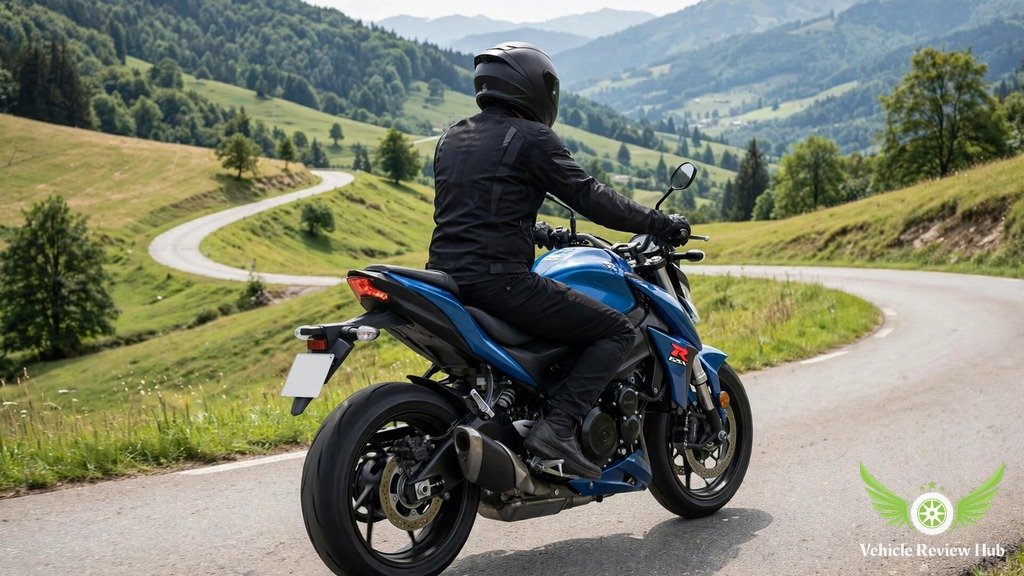
The video below is a first-ride review of the GSX-S950 by Usernamekate — subjective riding impressions on the road, not an instrumented performance test — covering engine feel, handling, brakes and the final verdict.
MCN Gave It Three Stars in A2 Trim
MCN tested the GSX-S950 in A2 trim — 46.6 bhp as tested — and gave it three stars out of five overall: engine four, ride quality and brakes three, reliability and build quality four, value versus rivals three. Its verdict sums up the A2 bike: “While I get the point in Suzuki building the GSX-S950 naked motorbike, I struggle to see many new riders wanting to spend that amount of cash on their first bike and it only works for a very small niche of the market.” The counterpoint, also MCN’s, is that the bike can be de-restricted, so “it is far more a long-term investment than a pure A2-legal bike.” The A2 engine note is vivid: even in A2-legal 46.6 bhp mode, the bike “sounds like it will rip your head off with a proper super naked snarling exhaust note, which is fantastic, but to ride it is a bit like a small dog with a big bark.” That is the trade this Suzuki GSX-S950 performance review keeps coming back to — presence and torque, middleweight pace.
French Testers Rode Both Versions
Le Repaire des Motards rode both versions in Auvergne at the 2021 launch and came away warmer than MCN: the 950 is convincing, more affordable and more manageable than the 1000, and “lacks neither pep nor efficiency”. In A2 trim the qualities are kept, and the promise of a different machine after de-restriction — under €100, per Suzuki — is the key selling point. The full-power bike delivers “a very different dynamic, getting fairly quickly towards 200 km/h”, with revs climbing very linearly, though beyond 7,000 rpm the engine needs more patience. The A2 bike is strong from the lowest revs in any gear, though the jerky on/off throttle reappears in A2 trim; the full-power bike is smoother. The Spanish testers agreed: Motofichas found the chassis far above what the engine demands, and Canariasenmoto called it the largest-capacity naked that can legally be restricted. This Suzuki GSX-S950 performance guide weighs the French verdict as the full-power verdict, and MCN’s as the A2 verdict — neither alone is the whole bike.
Suzuki GSX-S950 Handling, Braking and Stability
The chassis is the GSX-S1000’s — an aluminium twin-spar frame, 1,460 mm wheelbase, 43 mm inverted fork — with the 1000’s adjustability and Brembos taken away. This Suzuki GSX-S950 performance section covers what that trade costs: brakes that match the 1000 for power, and a fork every tester mentions.
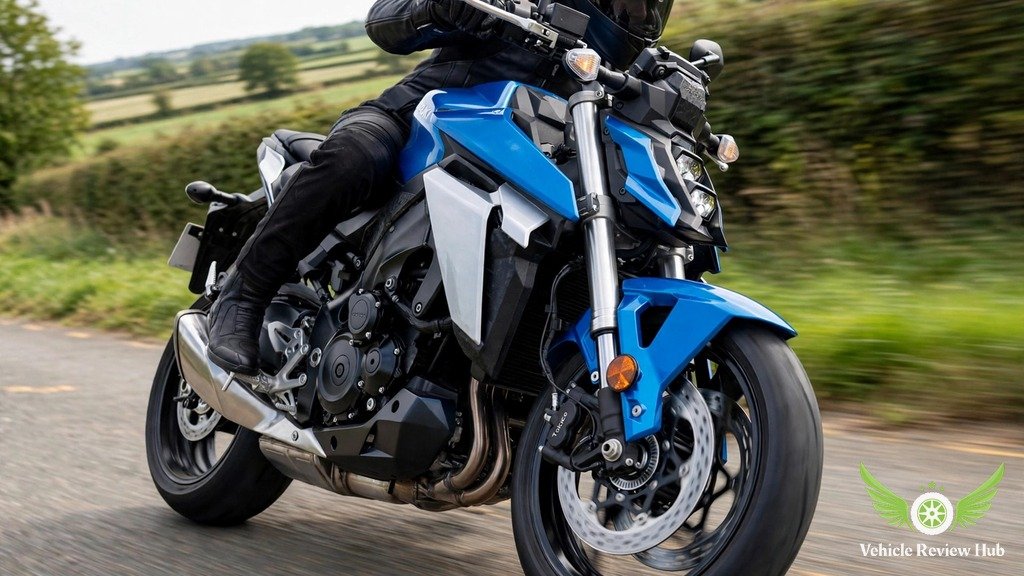
Tokico Brakes Match the Brembos for Power
The front brakes are twin 310 mm discs with Tokico four-piston radial monobloc calipers, ABS, and a 240 mm rear disc. MCN’s verdict is that the Tokicos “have all of the stopping power of the 1000’s Brembos” — monobloc and radial like the Brembos, perfectly acceptable on the road, with only a slightly weak initial bite that a pad upgrade fixes. Le Repaire agreed: the Tokicos are less biting but keep appreciable power and are very progressive, though the front end dives a bit quickly on initial lever pull. No instrumented braking-distance test was found from any outlet, so this Suzuki GSX-S950 performance guide prints no stopping-distance figure.
Too-Soft Chassis Is the Repeated Criticism
The repeated criticism of this bike is its suspension, and it comes from 1000PS: “Anyone who wants it to be as sporty as on the GSX-S1000 will already fail due to the somewhat too soft, non-adjustable suspension.” The 43 mm KYB inverted fork has no adjustment at all, and the rear shock offers only preload and rebound. MCN says the lower-spec forks are “more than up to the job for road riding, delivering a good ride quality”, and its main handling complaint is weight: the 950 “feels like a solid and secure super naked minus its power, not an agile and light fun middleweight”. Le Repaire found the fork remarkably capable on broken back roads at lean, and called the rear shock the weak link. Motofichas called the chassis oversized for the power. The fair line, and the one this Suzuki GSX-S950 performance guide stands behind, is that the soft, non-adjustable fork is the repeated criticism, while the chassis itself is universally praised for stability and precision.
Suzuki GSX-S950 Performance Compared With Other Nakeds
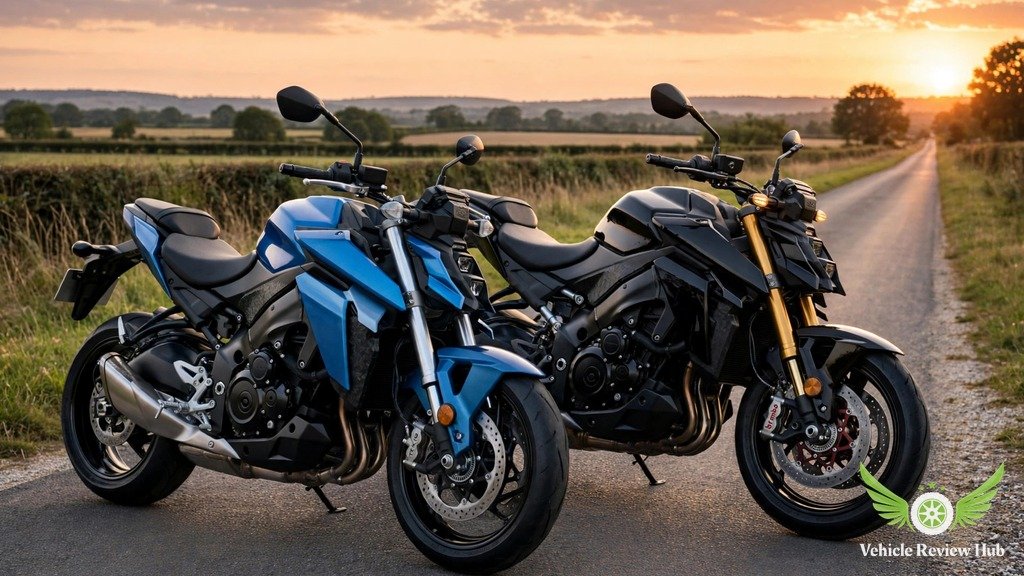
Against other nakeds, this Suzuki GSX-S950 performance picture is a trade: the biggest engine and the most torque in the A2 class, on the heaviest chassis, at a price that undercuts its own sibling by £1,000. The 950 replaced the GSX-S750 performance bike in Suzuki’s European line-up. The comparison below uses claimed power and UK launch prices only, and the full rival-by-rival breakdown is in the comparison.
| Bike | Claimed power | UK launch price |
|---|---|---|
| Suzuki GSX-S950 (full power) | 95 PS | £9,999 |
| Suzuki GSX-S1000 | 152 PS | £10,999 |
| Triumph Trident 660 | 78.9 bhp | £7,395 |
| Honda CB650R | 92 bhp | £7,399 |
| Yamaha MT-07 | 72.4 bhp | £6,902 |
| Aprilia Tuono 660 | 93.7 bhp | £9,700 |
The figures in this Suzuki GSX-S950 performance table are claimed power and UK launch prices from MCN’s rival list — on paper the 950 tops the A2 class for power in full-power mode.
Suzuki GSX-S950 vs Suzuki GSX-S1000
The GSX-S1000 is the same bike with the restrictions removed: the same 999cc block making 152 PS at 11,000 rpm and 106 Nm at 9,250 rpm, the same 214 kg, the same frame, tank and wheelbase. What the extra £1,000 at UK launch bought was Brembos instead of Tokico, a fully adjustable gold fork, five-mode traction control, S-DMS ride modes, a quickshifter, LED indicators and a TFT dash from 2025. Every contrast in this Suzuki GSX-S950 performance guide is a spec and parts-bin contrast, not a head-to-head result. The 950’s case against its sibling is the A2 licence: the 1000 cannot be restricted to 35 kW, because its 152 PS is over the 70 kW origin limit. The 1000’s case against the 950 is everything else — 57 more horsepower for £1,000, on the identical chassis. For an American buyer the argument is already settled: the 950 was never sold in the USA, and the 2027 GSX-S1000 costs $10,798 plus $750 destination. The full-power sibling’s numbers are in the GSX-S1000 performance guide.
Is the Suzuki GSX-S950 Suitable for Beginner Riders?
For an A2 licence holder, the 950 is close to unique: a full-size 999cc naked that can be ridden restricted and then de-restricted to 95 hp for under €100, with torque — 76 Nm at 3,250 rpm restricted — that no rival in the class matches. For a full-licence rider, the case is weaker: MCN gave it three stars overall because lighter rivals like the Trident 660 and CB650R are cheaper and more fun, and the 950’s 214 kg is roughly 30 kg more than the Monster and Tuono 660. It suits an A2 holder who wants a big bike now and a full-power bike later, or a returning rider who values torque and a full-size chassis over outright pace. It does not suit a rider shopping on performance per pound, or anyone who wants the latest electronics — there are no ride modes, no quickshifter and no TFT on the 2021–24 bike. American buyers who want this kind of bike now should look at the GSX-8S review instead. This Suzuki GSX-S950 performance guide calls it a narrow, clever machine: brilliant at the one job it was built for, and too heavy and too plainly equipped to be anything more.
Suzuki GSX-S950 Performance: Frequently Asked Questions
Direct answers to the questions riders ask about this Suzuki GSX-S950 performance guide.
How much power does the GSX-S950 make?
Full power is 95 PS (70 kW) at 7,800 rpm with 92 Nm at 6,500 rpm; the A2 version makes 47.5 PS (35 kW) at around 6,100 rpm with 76 Nm at 3,250 rpm. That is the claimed figure at the centre of this Suzuki GSX-S950 performance guide — no dyno figure exists to check it against.
Has the GSX-S950 ever been dyno tested?
No. No named outlet has published a dyno run for the GSX-S950 — the American magazines never tested it, because the bike was never sold in the USA. This Suzuki GSX-S950 performance guide prints only the claimed crank figures.
What is the top speed of the GSX-S950?
Three figures disagree, and none of them is a measured test: MCN lists 120 mph, Motoplanete lists over 200 km/h, and 1000PS lists 160 km/h — but that last figure belongs to the A2-restricted 48 PS variant, not the 95 PS bike. Swiss type approval lists a 210 km/h maximum for the 70 kW version. This Suzuki GSX-S950 performance guide lists them, not a single number.
What is the 0–60 mph time of the GSX-S950?
There is none. No instrumented acceleration test exists for this bike: the quarter-mile column in MCN’s spec table is a dash, and Motoplanete lists acceleration as “non communiqué” (not disclosed). This Suzuki GSX-S950 performance guide prints no acceleration number.
What fuel economy does the GSX-S950 get?
Suzuki’s official WMTC figure is 6.1 litres per 100 km, with 143 g/km of CO2 and about 311 km of range from the 19-litre tank — roughly 46 mpg in UK gallons; the single MCN owner reports 47 mpg. Those are the figures this Suzuki GSX-S950 performance guide uses.
Is there a US MPG figure for the GSX-S950?
No, and there cannot be one. The bike was never sold in the USA, so there is no EPA rating and no American test data. The 38.6 US mpg sometimes quoted is arithmetic — 235.21 divided by 6.1 — a conversion of the European figure, not a measurement, as this Suzuki GSX-S950 performance guide explains.
What did MCN rate the GSX-S950?
Three stars out of five overall, tested in A2 trim: engine four, ride and brakes three, reliability and build four, value three. MCN’s verdict is quoted in full in this Suzuki GSX-S950 performance guide.
Does the A2 version of the GSX-S950 feel slow?
No. It pulls strongly from the lowest revs with good low and mid-range torque, then tails off past 6,000 rpm. The full-power bike pulls firmly from 3,000 to 7,000 rpm. That split character is the verdict of this Suzuki GSX-S950 performance guide.
Are the Tokico brakes as good as Brembos?
On power, yes: MCN says the Tokicos “have all of the stopping power of the 1000’s Brembos”, with only a slightly weak initial bite that a pad upgrade fixes. Le Repaire found them less biting but very progressive. That is the brake verdict in this Suzuki GSX-S950 performance guide — and no braking-distance test exists to add to it.
Is the suspension too soft?
1000PS says it is too soft and non-adjustable, and that is the repeated criticism. MCN says the forks are more than up to the job for road riding, and Le Repaire calls the rear shock — not the fork — the weak link. The fork is the repeated criticism in this Suzuki GSX-S950 performance guide; the chassis itself is praised for stability and precision.
Is the GSX-S950 faster than the GSX-S1000?
No. The GSX-S1000 makes 152 PS against the 950’s 95 PS, on the same 214 kg chassis, so the 1000 is faster in every measure. The 950’s advantage is the A2 licence: the 1000 cannot be restricted to 35 kW. That is the honest comparison in this Suzuki GSX-S950 performance guide.
Is the GSX-S950 a good first big bike?
For an A2 licence holder, it is close to unique — a full-size 999cc naked that can be ridden restricted and de-restricted to 95 hp for under €100. For a full-licence rider, lighter and cheaper rivals are more fun. That is the verdict this Suzuki GSX-S950 performance guide reaches.