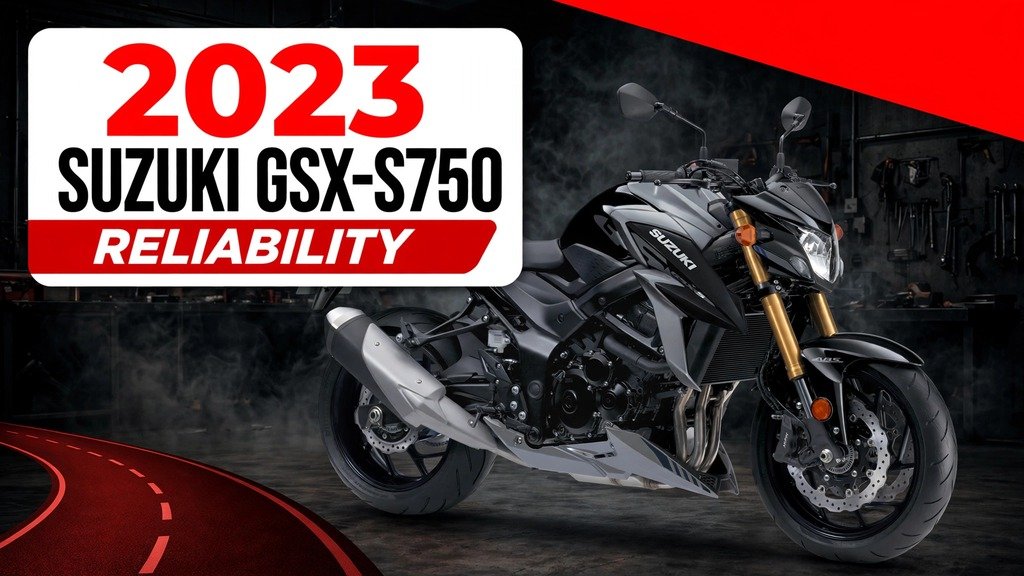
The Suzuki GSX-S750 never won a horsepower war, and that is the wrong way to judge it. What the numbers actually show is a middleweight naked whose real-world speed came from a flat torque curve, a slick gearbox and best-in-class brakes — not from a headline power figure. This Suzuki GSX-S750 performance guide works through the figures the magazines actually measured: the Cycle World and Motorcycle.com dyno runs, the 140 mph top speed, the 11.24-second quarter-mile, and the tested fuel economy from 37 to 48 miles per gallon. Suzuki USA publishes no horsepower or torque figure for this bike, so every power number in this Suzuki GSX-S750 performance guide is a global claim or a named dyno result, labelled as such.
Suzuki GSX-S750 Engine Performance and Power Delivery
The engine is a 749cc liquid-cooled inline-four, derived from the 2005 GSX-R750’s K5 unit, with a 72.0 × 46.0 mm bore and stroke against the GSX-R750’s 70.0 × 48.7 mm. It is not the same engine as the GSX-R750, and this Suzuki GSX-S750 performance guide does not call it one. The 2015–2016 bike claimed 104.6 hp at 10,000 rpm and 59 lb-ft (80 Nm) at 9,000 rpm, while the revised 2018–2023 bike claimed 112.4–112.6 bhp — 114 PS — at 10,500 rpm and 81 Nm (59.7 lb-ft) at 9,000 rpm. Those are global claims, not Suzuki USA figures.
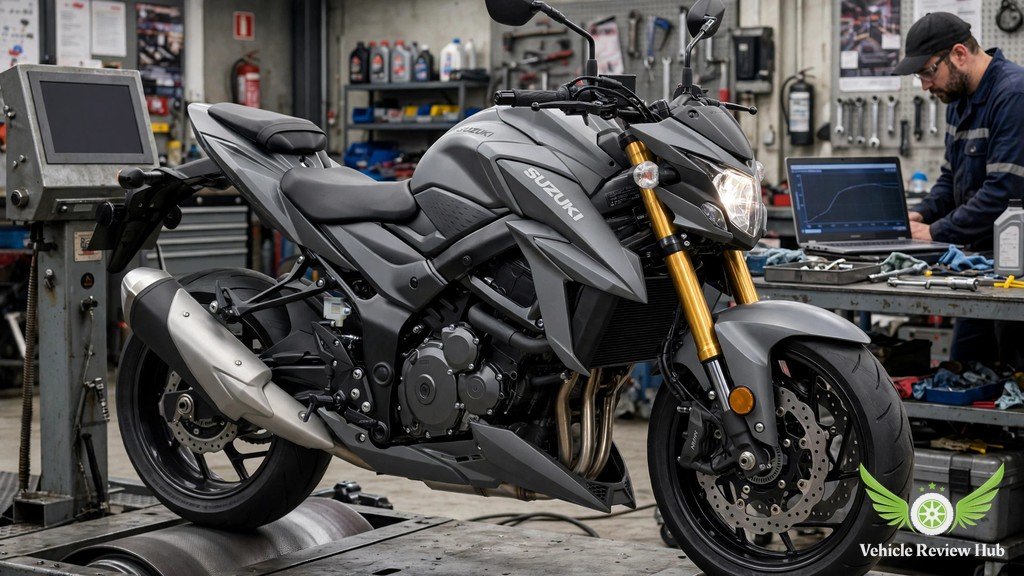
Cycle World Dyno: 99.1 HP in 2015
Cycle World’s 2015 comparison put the first-generation GSX-S750 on the dyno and measured 99.1 hp at 10,170 rpm and 54.3 lb-ft at 9,060 rpm at the rear wheel. That sits about five horsepower below the 104.6 hp crank claim — a normal drivetrain loss. Cycle World called the engine predictable and linear. The Cycle World comparison is the source for the dyno figure and the 140 mph top speed.
Motorcycle.com Measured 96.1 HP
Motorcycle.com’s 2015 shootout ran the same-generation bike on a MotoGP Werks dyno and measured 96.1 hp at 10,300 rpm and 51.7 lb-ft at 8,900 rpm — three horsepower below Cycle World’s run on a different dyno. The three runs bracket the early bike at roughly 96 to 99 rear-wheel horsepower, and this Suzuki GSX-S750 performance guide treats that range as the honest answer. The 2018 bike has no exact published rear-wheel peak — Motorcycle.com called it “nearly 100” horsepower, and its long-term test said “almost 100 horsepower (at 10,400 rpm)” — so the honest wording is around 100 hp at the rear wheel.
| Dyno run | Rear-wheel hp | Rear-wheel torque | Source |
|---|---|---|---|
| 2015 GSX-S750 | 99.1 hp @ 10,170 rpm | 54.3 lb-ft @ 9,060 rpm | Cycle World |
| 2015 GSX-S750 | 96.1 hp @ 10,300 rpm | 51.7 lb-ft @ 8,900 rpm | Motorcycle.com |
| 2016 GSX-S750 | 98.6 hp @ 10,000 rpm | 54.9 lb-ft @ 8,900 rpm | Motorcycle.com |
| 2018 GSX-S750 | Around 100 hp (no exact peak published) | Not published | Motorcycle.com |
| 2015 Yamaha FZ-09 | 104.6 hp @ 9,800 rpm | 59.3 lb-ft @ 9,700 rpm | Motorcycle.com |
| 2017 Kawasaki Z900 | 115.6 hp @ 9,800 rpm | Not published in test | Motorcycle.com |
| 2016 Kawasaki Z800 | 103.2 hp @ 10,100 rpm | 58.1 lb-ft @ 7,800 rpm | Motorcycle.com |
The dyno table in this Suzuki GSX-S750 performance guide uses only named-outlet rear-wheel runs; the 2018 bike has no exact published peak, so it is listed as around 100 hp.
Suzuki GSX-S750 Top Speed and Acceleration
Straight-line speed was never the GSX-S750’s party trick, but the measured figures are respectable for a middleweight naked under $9,000. The quarter-mile rests on a single aggregator, the top speed on a named magazine test, and this Suzuki GSX-S750 performance guide keeps the two kinds of evidence separate instead of blending them into one confident-sounding number.

Quarter-Mile 11.24 Seconds, MotoStatz
The best verified quarter-mile figure is 11.24 seconds, from MotoStatz. This Suzuki GSX-S750 performance guide labels it as such and does not dress it up as a magazine test result, because no named magazine published a timed quarter-mile for this bike. For context, the same aggregator gives the 2017 Z900 a best quarter-mile of 10.89 seconds at 129 mph, and Cycle World timed the 2014 FZ-09 at 10.66 seconds. No timed roll-on figures exist for the GSX-S750 — Cycle World said only that the FZ-09 “rules in … top-gear roll-ons” — so this Suzuki GSX-S750 performance guide prints no roll-on times at all.
Top Speed 140 MPH, Tested by Cycle World
Cycle World’s 2015 comparison tested the GSX-S750 at 140 mph, against an FZ-09 electronically limited to 130 mph. Bennetts lists “140 mph (est)”. Whether Cycle World’s figure was measured by GPS or read from the speedometer is not stated in the accessible text, so this Suzuki GSX-S750 performance guide does not claim GPS. MotoStatz lists 142 mph and Motoroids saw 228 km/h on the speedometer, but both are speedometer readings. The 155 mph figure on Wikipedia is an uncited gearing claim, not a test result.
The video below is a speedometer top-speed run by Real Auto Reviews — not an instrumented magazine test — showing what the bike’s speedometer reads at full throttle, which is not the same evidence as Cycle World’s 140 mph.
| Figure | GSX-S750 | FZ-09 (2015) | Z900 (2017) |
|---|---|---|---|
| Quarter-mile | 11.24 s (MotoStatz) | 10.66 s (Cycle World) | 10.89 s @ 129 mph (MotoStatz) |
| 0–60 mph | 3.1 s (MotoStatz) | Not published in test | 3.10 s (MotoStatz) |
| Top speed | 140 mph (Cycle World) | 130 mph, electronically limited (Cycle World) | About 146 mph (Driven) |
The acceleration table in this Suzuki GSX-S750 performance guide mixes magazine tests and labelled aggregator figures; the source is named in every cell so the reader can see which is which.
Suzuki GSX-S750 Mileage and Fuel Economy
Fuel economy is where the two generations genuinely differ. Tested US economy runs from the high-30s to the high-40s in US gallons depending on the year, and this Suzuki GSX-S750 performance guide gives the year-by-year numbers rather than a single blended range.

Tested MPG: 37 to 48 in US Tests
Motorcycle.com measured 36.9 mpg on the 2015 bike in its “More for Less” shootout, 37.7 mpg on a second early ride, and 41.7 mpg on the 2016 bike, against the Z800’s 40.4 mpg — the figures this Suzuki GSX-S750 performance guide uses. The 2018 bike did better: Motorcycle.com’s long-term test reported “always between 46 and 48 miles per gallon.” One figure this Suzuki GSX-S750 performance guide does not use is 45 mpg: no Cycle World mpg figure for this bike exists, and the only “45 mpg” in print for this engine family is MCN’s UK-Imperial-gallon figure for the predecessor GSR750. UK Imperial figures such as Bennetts’ 57.6 Imp mpg brochure number must never be mixed into a US-mpg range.
| Test | GSX-S750 mpg (US) | Notes |
|---|---|---|
| Motorcycle.com “More for Less”, 2015 | 36.9 | FZ-09 managed 35.9 mpg in the same test |
| Motorcycle.com second ride, 2015 | 37.7 | Early running |
| Motorcycle.com “Gentleman’s Hooligan”, 2016 | 41.7 | Z800 managed 40.4 mpg in the same test |
| Motorcycle.com long-term test, 2018 | 46–48 | About 1,500 miles, revised mapping and gearing |
| Suzuki claim, 2015 | 48 | Manufacturer claim, not a test result |
| EPA estimate | 47.2 | Via a secondary source citing EPA certificate FSKXC.749VD1-019 |
The fuel-economy table in this Suzuki GSX-S750 performance guide lists US-gallon test figures only; UK Imperial-gallon figures are excluded because they are not comparable.
Shootout Bike Led Its Group on Economy
In Motorcycle.com’s 2017 three-way test, the Suzuki “burned a half-gallon less pump juice than the ‘Priller to lead the fuel-economy sweepstakes” — it beat the Aprilia Shiver 900 on fuel use, though no mpg number was printed. The payoff is range: roughly 195–200 miles between fill-ups on the 2018 bike, and roughly 170–190 miles on the early bike.
Suzuki GSX-S750 Real-World Riding Experience
Magazine testers agreed on this bike more than they disagreed. The engine is linear and rev-hungry, the steering is quick, the seat is comfortable, and the 2018 bike’s brakes are the best in its group — but the bike is heavy, the clutch is heavy, and the suspension gives the rider almost nothing to adjust. This Suzuki GSX-S750 performance guide reports that consensus as the testers wrote it.

Three-Way Shootout: Second Behind the Z900
The GSX-S750 finished second in both of Motorcycle.com’s big shootouts. In the 2015 “More for Less” test the Yamaha FZ-09 won with 86.6 percent, the Suzuki took second with 83.9 percent, and the Aprilia Shiver 750 came third with 82.5 percent. In the 2017 “Naked Sports Threeway” the Kawasaki Z900 won with 89.4 percent, the Suzuki again took second with 86.5 percent, and the Shiver 900 came third with 86.3 percent. Motorcycle.com called the Suzuki “the over-achieving GSX-S750, which delighted us with its fun-to-ride nature and its overall competency.” A third comparison, the 2016 “Gentleman’s Hooligan” test against the Kawasaki Z800, went the other way by a whisker: Z800 85.2 percent, GSX-S750 84.8 percent — the Suzuki won on price and seat comfort, the Kawasaki on looks and standard ABS. The Motorcycle.com three-way test and the 2016 comparison against the Z800 are the sources here.
Best Brakes of the Three, Said Testers
The 2018 bike’s brakes were the single clearest win in any GSX-S750 test. Motorcycle.com’s three-way test said the Suzuki had “the best brakes of the group, hands down… strong initial bite with predictable and linear braking feel,” scoring 90.8 percent against the Z900’s 85.0 and the Shiver 900’s 84.2. The test bike was the non-ABS base model at $8,299. Cycle World’s Don Canet wrote in November 2017 that the new Nissin calipers and 310 mm petal-type rotors “should put a stop to criticism the previous gen’s dated brake system has generated.” The 2015–2016 bike’s two-piston sliding calipers were marked down by both outlets, scoring 78.3 percent — last of three — in “More for Less” and 77.5 percent against the Z800’s 82.5 percent in “Gentleman’s Hooligan”. The two brake generations must never be confused: the “best brakes” verdict belongs to the 2018 bike only. No 60–0 mph stopping distance exists from any named outlet, so this Suzuki GSX-S750 performance guide prints none — the 70–0 mph figure in review indexes belongs to a GSX-S1000 comparison.
Suzuki GSX-S750 Handling, Braking and Stability
The chassis is a steel twin-spar and tubular frame, a 41 mm KYB inverted fork and a link-type rear shock, with spring preload as the only adjustment at either end. This Suzuki GSX-S750 performance guide treats handling, braking and stability as one subject, because the same suspension that firms the ride also decides how the bike behaves under braking.
Preload-Only Suspension at Both Ends
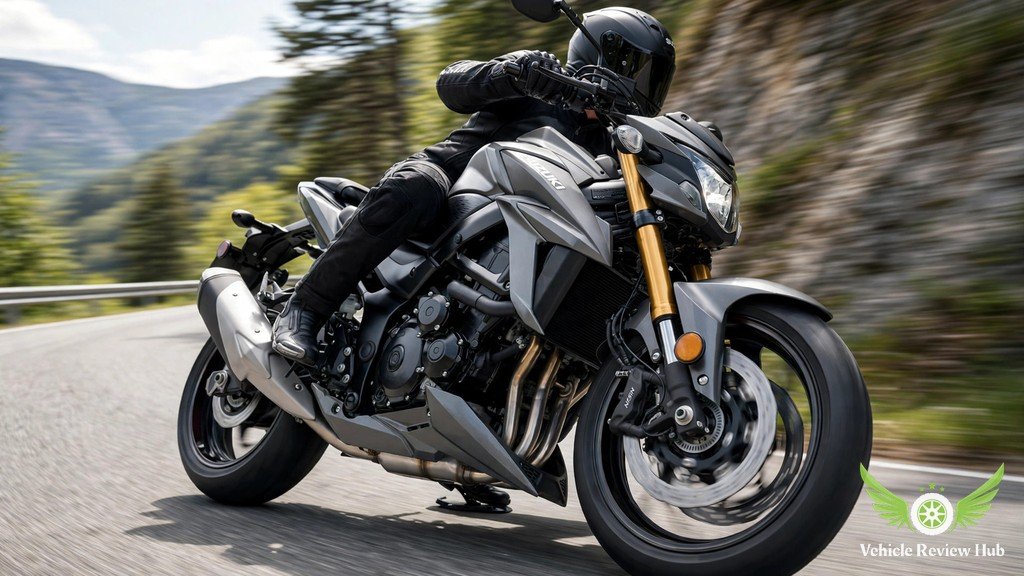
Spring preload is the sole suspension adjustment front and rear, on both generations. Cycle World wrote in 2015 that “the inverted fork and single shock look trick but have far fewer adjustments than their racier counterparts: Spring preload is it.” The 2018 bike kept the same arrangement, with damping “calibrated on the sporting side, providing responsive handling feel and steadfast stability at the expense of ride comfort over sharp bumps.” The hardware is a 41 mm KYB inverted fork with 4.7 inches of travel and a link-type rear shock with 5.4 inches of travel on the 2018 bike (5.1 inches on the 2015 bike) and 7-way adjustable rear preload, on a 1,455 mm wheelbase, 25.3 degrees of rake and 4.1 inches of trail. There is no compression or rebound adjustment, and no rider aid compensates for it — the traction control is wheel-speed-based with three modes plus off, with no IMU, no ride modes and no quickshifter. Testers split on the ride quality: Cycle World called the 2015 bike “way overdamped, resulting in a buckboard ride,” while Motorcycle.com’s testers rated its suspension best in the “More for Less” test at 88.3 percent — a split this Suzuki GSX-S750 performance guide reports rather than resolves. The 2018 bike improved but stayed firm — Motorcycle.com’s long-term test agreed that “it only hurts over big sharp bumps.” The Cycle World 2018 review is the source for the preload-only verdict on the later bike.
Tire, Brake and Suspension Checks That Matter
Three checks matter more than any other when judging a used GSX-S750’s performance. First, the tyres: the 2018 and later bikes wear Bridgestone Battlax Hypersport S21 rubber, and worn tyres will mask the bike’s quick steering more than any suspension setting. Second, the brakes: the 2018 bike’s Nissin radial monoblocs are the best in the bike’s class, but the 2015–2016 bike’s sliding calipers were criticised for weak initial bite, so test the first pull of the lever on a pre-purchase ride, not the tenth. Third, the suspension: with preload as the only adjustment, a bike that feels harsh is usually set up for the wrong rider weight — check the rear preload setting before assuming the shock is worn. Three checks like these are what this Suzuki GSX-S750 performance guide comes back to when judging a used bike. The reliability guide has the full service picture, and the RevZilla first ride notes the throttle snap and the lack of ABS on the early bike.
Suzuki GSX-S750 Performance Compared With Other Nakeds
Against its rivals the GSX-S750 is the value pick that finishes second: slower than the Z900 and the FZ-09, cheaper than both, better braked than either in 2018 form, and more economical than both. This Suzuki GSX-S750 performance guide closes with the comparison that matters most to a buyer — the Z900, the bike that beat it — and with the beginner question, because a used S750 is often a first big bike.
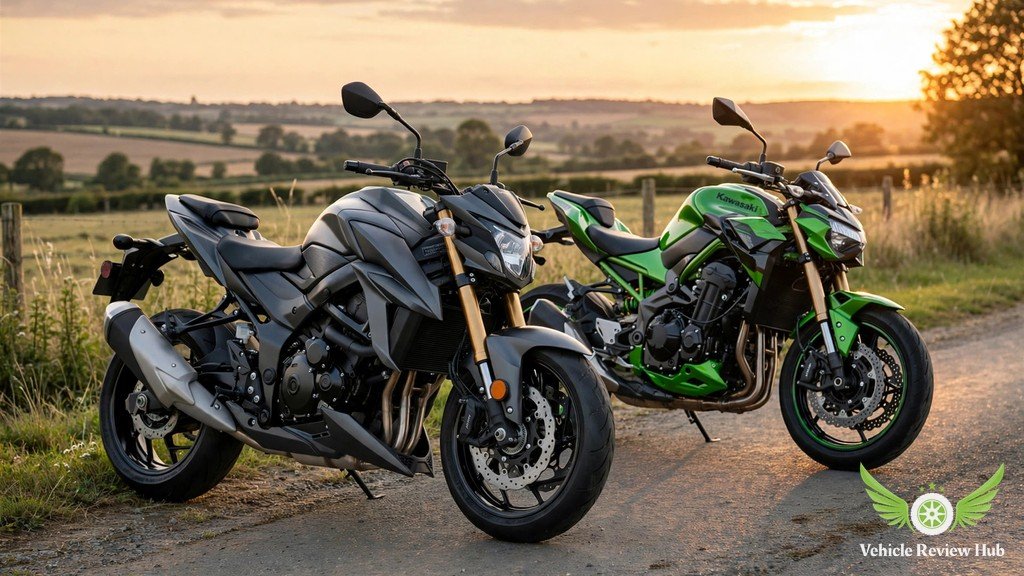
Suzuki GSX-S750 vs Kawasaki Z900
The 2017 Kawasaki Z900 beat the GSX-S750 in Motorcycle.com’s three-way test, and the numbers explain why: the Z900 claimed 125 hp at 9,500 rpm and 98.6 Nm (72.7 lb-ft) at 7,700 rpm, and measured 115.6 hp at 9,800 rpm where the Suzuki made around 100 hp. The Z900’s best quarter-mile was 10.89 seconds at 129 mph with a 0–60 mph time of 3.10 seconds, against the Suzuki’s 11.24 seconds. The Z900 also weighed 469 pounds fully fuelled — two pounds more than the Suzuki’s 467 — so the gap is power, not mass. What the Suzuki gives back is price and brakes: the 2018 S750 cost $8,299 against the Z900’s $8,399, and its brakes scored 90.8 percent against the Z900’s 85.0 — the two wins this Suzuki GSX-S750 performance guide keeps coming back to. The comparison puts the two bikes side by side, and the GSX-8S performance guide shows how the newer successor compares.
Is the Suzuki GSX-S750 Suitable for Beginner Riders?
It can be, with caveats, and the 2018-or-later Z ABS is the sensible pick. The upright riding position, the predictable linear power delivery, the traction control on 2018 and later bikes and Low RPM Assist all help a newer rider. Against that, the bike weighs 465–470 pounds, the clutch pull is the heaviest in its group, the suspension is firm, and the engine wants revs to make its power — “past about 8,000 rpm, the afterburner is truly lit,” as Motorcycle.com put it. RevZilla also noted throttle snap and the lack of ABS on the early bike, which is why this Suzuki GSX-S750 performance guide steers beginners to the 2018-or-later Z ABS rather than the cheapest 2015 bike. The SV650 review covers the V-twin alternative at a similar used price.
Suzuki GSX-S750 Performance: Frequently Asked Questions
Direct answers to the questions riders ask about this Suzuki GSX-S750 performance guide.
How much power does the GSX-S750 make?
Suzuki USA publishes no horsepower figure. The global claim for the 2018–2023 bike is 112.4–112.6 bhp (114 PS) at 10,500 rpm, and the 2015–2016 bike claimed 104.6 hp at 10,000 rpm. On the dyno, Cycle World measured 99.1 rear-wheel horsepower at 10,170 rpm on the 2015 bike, Motorcycle.com measured 96.1 at 10,300 rpm and 98.6 at 10,000 rpm on the same dyno, and the 2018 bike is best described as around 100 hp at the rear wheel — no exact peak was ever published for it. That is the power picture this Suzuki GSX-S750 performance guide uses throughout.
What is the top speed of the GSX-S750?
140 mph, tested by Cycle World in its 2015 comparison against the Yamaha FZ-09, which was electronically limited to 130 mph — the headline number of this Suzuki GSX-S750 performance guide. Whether Cycle World’s figure was GPS or speedometer is not stated, so this Suzuki GSX-S750 performance guide does not claim GPS. MotoStatz lists 142 mph and Motoroids saw 228 km/h on the speedometer, but both are speedometer readings. The 155 mph figure on Wikipedia is an uncited gearing claim, not a test result.
What is the quarter-mile time of the GSX-S750?
11.24 seconds, from MotoStatz — a single-source aggregator, labelled as such. No named magazine published a timed quarter-mile for this bike, so this Suzuki GSX-S750 performance guide does not present the figure as a magazine test result. MotoStatz also lists 0–60 mph in 3.1 seconds and 0–100 mph in 6.76 seconds from the same source.
What MPG does the GSX-S750 get?
Tested US economy runs 37 to 48 mpg. Motorcycle.com measured 36.9 mpg on the 2015 bike, 37.7 mpg on a second early ride and 41.7 mpg on the 2016 bike, while the 2018 bike returned 46–48 mpg in its long-term test. This Suzuki GSX-S750 performance guide does not use the 45 mpg figure sometimes quoted for this bike — that is MCN’s UK-Imperial-gallon figure for the predecessor GSR750, not a US test result.
Does the GSX-S750 have good brakes?
The 2018 bike does, and the 2015–2016 bike does not. The 2018 bike’s Nissin four-piston radial monoblocs on twin 310 mm wave discs won Motorcycle.com’s three-way brakes scorecard at 90.8 percent against the Z900’s 85.0 and the Shiver 900’s 84.2. The 2015–2016 calipers were criticised for weak initial bite. This Suzuki GSX-S750 performance guide keeps the two brake generations separate.
How heavy is the GSX-S750?
The first-generation bike weighed 463 pounds wet. The second-generation bike weighs 465 pounds without ABS and 469–470 pounds with ABS. One Motorcycle.com comparison lists 436 pounds, conflicting with its own 464.7-pound figure; this Suzuki GSX-S750 performance guide uses the consistent 465–467-pound band.
Is the GSX-S750 faster than the Z900?
No. The Z900 claimed 125 hp and measured 115.6 hp at the rear wheel, against the Suzuki’s claimed 112.6 hp and roughly 100 hp measured, and it won the 2017 three-way test 89.4 percent to 86.5 percent. The Z900’s best quarter-mile was 10.89 seconds at 129 mph against the Suzuki’s 11.24 seconds. The Suzuki’s wins were price and brakes, not speed, and this Suzuki GSX-S750 performance guide says so plainly.
Does the GSX-S750 have a TFT dash or ride modes?
No. The dash is a full LCD panel on 2018 and later bikes and an analog tachometer with a small LCD on the 2015–2016 bikes — never a TFT. There is no ride-by-wire, no ride modes, no quickshifter and no cruise control on any GSX-S750. The only rider aids are the three-mode traction control plus off, ABS on Z trims only, Easy Start and Low RPM Assist on 2018 and later bikes. That is the electronics picture this Suzuki GSX-S750 performance guide records.
What is the best year GSX-S750 to buy?
The 2018-or-later bike, preferably a Z ABS, is the pick this Suzuki GSX-S750 performance guide makes. The 2018 update brought the Nissin radial brakes, the traction control, the full LCD dash, Easy Start and Low RPM Assist and the best tested fuel economy at 46–48 mpg. The 2015–2016 bikes have weak brakes, no ABS at all and were never sold in California. It is the pick on performance grounds alone, before price even enters the picture.
How does the GSX-S750 compare with the GSX-8S?
The GSX-8S is Suzuki’s newer parallel-twin successor, but it is not a like-for-like swap: the 8S makes about 82 hp from its 776cc twin against the S750’s roughly 100 rear-wheel horsepower, with modern electronics including a quickshifter and a TFT dash. The new 2027 GSX-8S costs $9,499 delivered — $90 cheaper than the last new GSX-S750 ABS was. Buy the S750 for its inline-four character and lower used price; buy the 8S for its warranty and electronics. This Suzuki GSX-S750 performance guide treats the 8S as the de facto successor, not an official replacement, because no Suzuki statement calls it one.
Is the GSX-S750 a good beginner bike?
It can be, with caveats. The upright riding position, the predictable linear power, the traction control on 2018 and later bikes and Low RPM Assist all help a newer rider. Against that, the bike weighs 465–470 pounds, the clutch pull is the heaviest in its group, the suspension is firm and the engine wants revs to make its power. This Suzuki GSX-S750 performance guide steers beginners to the 2018-or-later Z ABS rather than the cheapest 2015 bike, because the early bike has no ABS at all.
Where can I read the full GSX-S750 review?
The review covers the final 2023 prices, the full specs and the ownership picture, while this Suzuki GSX-S750 performance guide covers the dyno runs, the top speed, the quarter-mile and the tested fuel economy. The reliability guide covers servicing and the single recall.