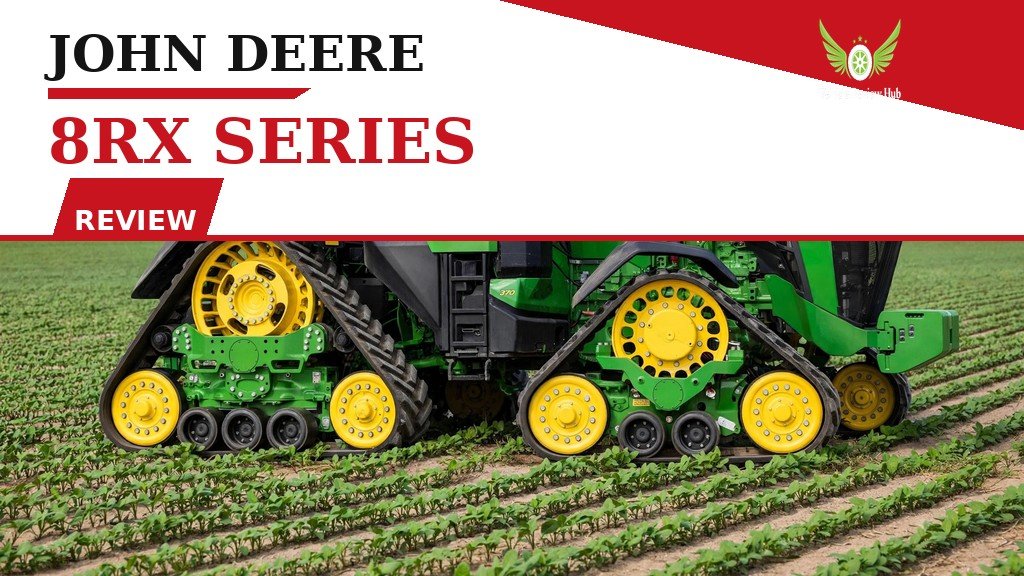
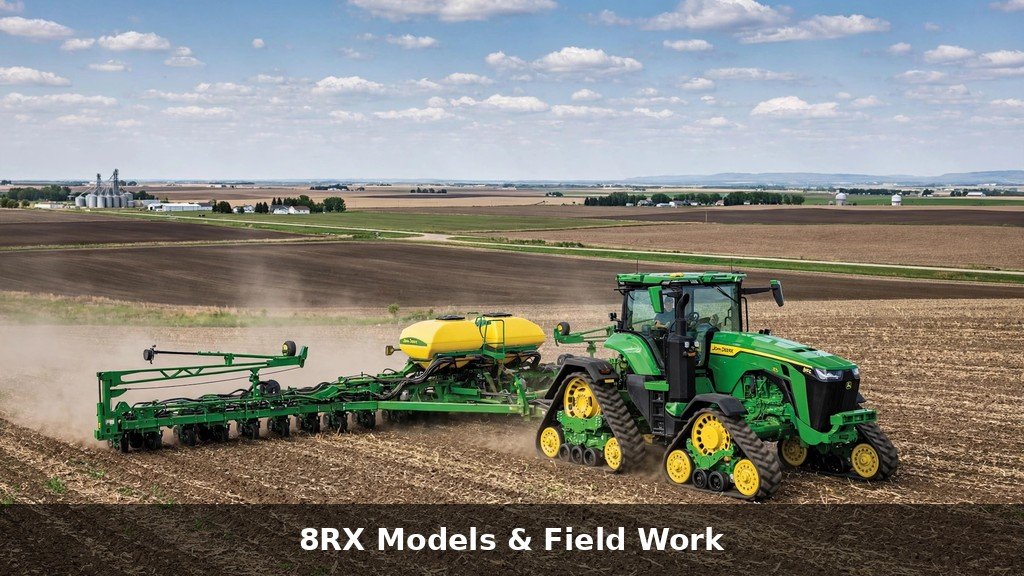
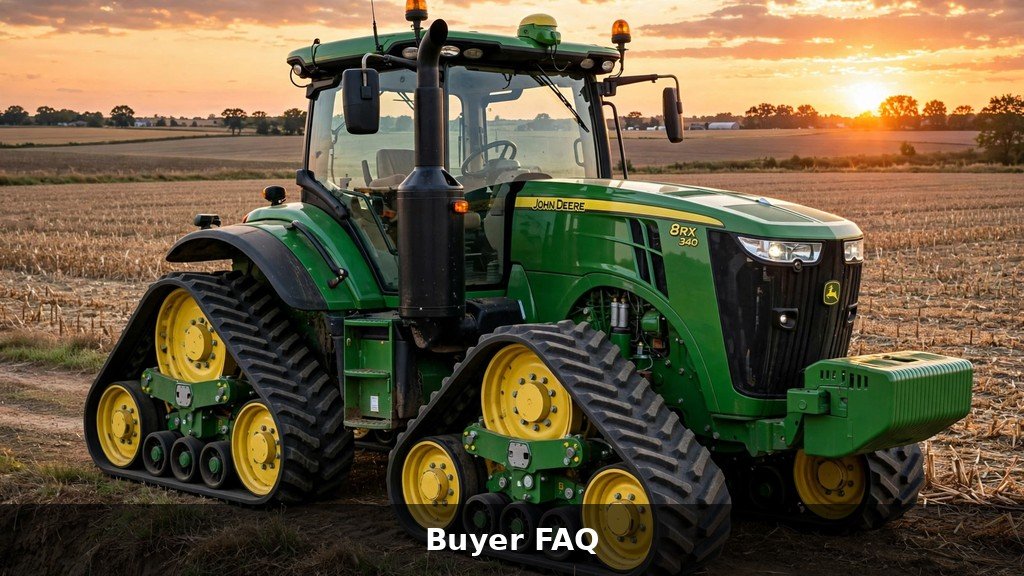
The John Deere 8RX Series is the four-track answer for farms where wheels can’t keep up — four models from the 8RX 310 (310 hp) to the 8RX 410 (410 hp), all running the PowerTech 9.0L six-cylinder with e23 PowerShift or AutoPowr IVT. With four rubber belt tracks, the 8RX puts power down with up to 4.57 m² of ground contact and ground pressure as low as 36 kPa fully ballasted, protecting soil structure while pulling bigger implements in tighter windows.
This John Deere 8RX Series review covers every model, current new and used pricing, engine and track specs, transmission options, and how the 8RX compares to the wheeled 8R and the two-track 8RT — so you can judge whether four tracks belong on your farm. Here is what this John Deere 8RX Series review found after digging through the specs, dealer listings, and owner reports.
John Deere 8RX Series Review, Models and Price
John Deere introduced the 8RX in 2019 as the soil-protection specialist of the 8 Series family — the same Waterloo, Iowa-built platform as the wheeled 8R, but with four independently suspended rubber belt tracks instead of tires. Same cab, same displays, same 9.0L engine; the difference is entirely in how that power reaches the ground — the core question this John Deere 8RX Series review sets out to answer.
8RX Tractor Models, Features and Intended Uses
The 8RX line spans four models — the 8RX 310, 8RX 340, 8RX 370, and 8RX 410 — the 8RX starts at 310 hp, while the wheeled 8R reaches down to 230. Rated horsepower runs 310 to 410 hp, with maximum engine power of 341 to 443 hp (before Intelligent Power Management adds up to 35 hp in transport and mobile PTO work). All four use the same 9.0L PowerTech six-cylinder — the 310 and 340 carry the PVS version, a consolidation this John Deere 8RX Series review welcomes, the 370 and 410 the PSS version, per dealer brochures — so the lineup is really about matching power to your implement load, not about different engines — a point this John Deere 8RX Series review will return to when comparing models.
Intended uses track the power bands. The 8RX 310 and 340 are the primary-tillage volume sellers — big discs and chisel plows — which this John Deere 8RX Series review expects to dominate dealer lots — where four tracks convert horsepower into drawbar pull that wheels can’t match in soft conditions. The 8RX 370 and 410 handle the heaviest draft work: deep rippers and 60-foot air seeders on 3,000+ acre operations. This John Deere 8RX Series review treats the 370 and 410 as the reference machines for exactly that reason: maximum pull with minimum soil disturbance.
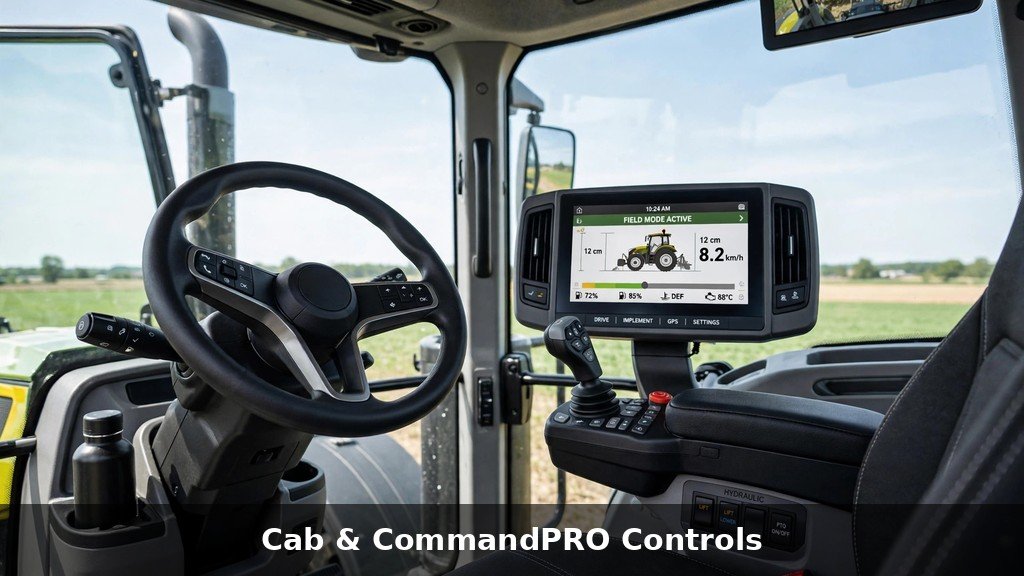
Standard kit includes the e23 PowerShift with Efficiency Manager (AutoPowr IVT and eAutoPowr EVT optional), CommandPRO on IVT models, ActiveCommand Steering 2, 60 gpm hydraulics (84 gpm optional), and up to six rear SCVs. The CommandView cab offers 114 cubic feet with 70 square feet of glass, plus integrated AutoTrac and JDLink — the operator environment this John Deere 8RX Series review rates as best-in-class for long days. The video below — an overview of the 8RX 370 from Atlas Ag — shows what four tracks look like on the machine:
New and Used Prices by Model, Year and Configuration
New 8RX pricing sits above the wheeled 8R — and pricing is where this John Deere 8RX Series review starts — the tracks, AirCushion suspension, and heavier chassis add roughly $30,000–$50,000 over a comparable 8R (estimate). For reference, John Deere’s May 2026 government price page lists the wheeled 8R 370 base machine at $642,367 before options. AllMachines prices the 8RX 370 between $416,000 and $476,000 by year and condition.
Used values hold up well — key for the math in our John Deere 8RX Series ownership cost guide. Recent US listings: a 2023 8RX 370 with 1,519 hours at $382,900 (LandMark), and a 2022 8RX 370 with 697 hours at $466,999 (Papé). Older 8RX 310s and 340s from 2020–2022 with 2,000–4,000 hours typically trade at a discount to the 370 (estimate — check current listings). Track condition is the big variable — belts are the single most expensive wear item, so inspect them on every used purchase — this John Deere 8RX Series review stresses it. This John Deere 8RX Series review recommends budgeting for track replacement when comparing used 8RX prices against used 8R wheel tractors.
John Deere 8RX Series Engine, Horsepower and Specifications
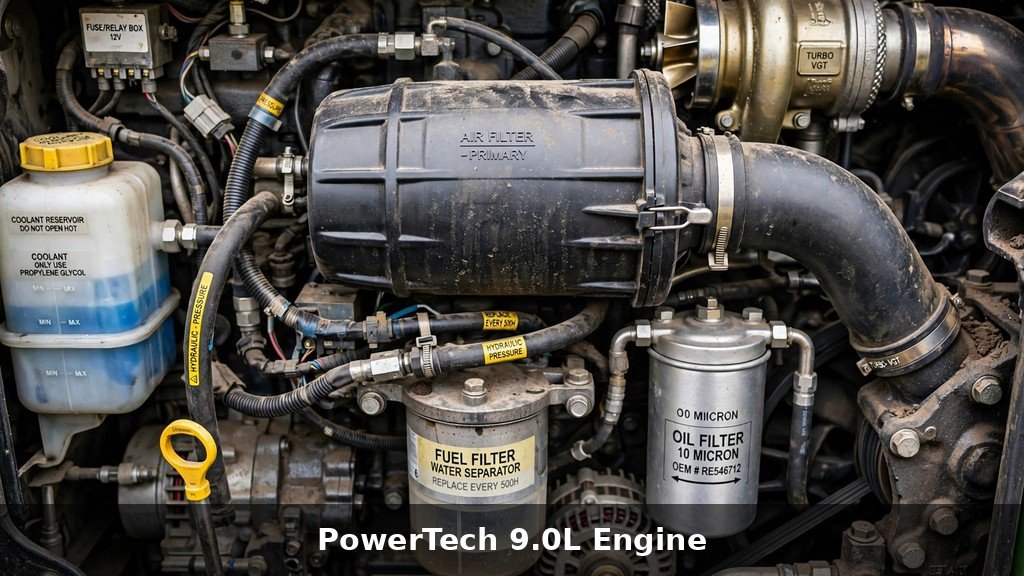
One engine family covers all four 8RX models: the John Deere PowerTech 9.0L six-cylinder (549 cu in.), B20-compatible, with dual turbos in series, air-to-air aftercooling, and cooled EGR. US Final Tier 4 aftertreatment is DOC + DPF + SCR with DEF — auto-regenerating DPF, 9.8-gallon DEF tank (engine family MJDXL09.0333 on US-spec 8RX 410 sheets).
Rated HP, Maximum HP, Engine Displacement and PTO Power
Rated engine power runs 310 hp (8RX 310) to 410 hp (8RX 410) at 2,100 rpm — a clean 30-hp ladder. Maximum engine power without IPM reaches 341, 374, 407, and 443 hp; Intelligent Power Management adds up to 35 hp (FT4/Stage V) in transport above 14 mph and mobile PTO work, pushing the biggest models to roughly 458 hp in the field. Rated PTO power is 257, 284, 310, and 310 hp SAE — the 370 and 410 share the 310-hp PTO ceiling, protecting the driveline.
Torque is where the 9.0L earns its keep: the 8RX 370 makes 1,732 Nm (1,277 lb-ft) at 1,600 rpm, and the 8RX 410 peaks at 1,851 Nm (1,365 lb-ft), with a 40 percent PTO torque rise and roughly 10 percent power bulge. That curve lets an 8RX lug through heavy draft at low engine speed without downshifting — and it’s the number to compare against the wheeled 8R Series review figures, which share the same powertrains.
Dimensions, Hydraulics, Hitch Capacity and Track Configurations
The 370 and 410 spec table below — the two models this John Deere 8RX Series review uses as reference machines — shows how the big end of the lineup is configured:
| Specification | 8RX 370 | 8RX 410 |
|---|---|---|
| Engine | PowerTech PSS 9.0L 6-cyl | PowerTech PSS 9.0L 6-cyl |
| Rated / max hp | 370 / 407 | 410 / 443 |
| Rated PTO hp | 310 | 310 |
| Peak torque @1,600 rpm | 1,277 lb-ft | 1,365 lb-ft |
| Transmission | e23 40K std; IVT/eAutoPowr opt | e23 40K std; eAutoPowr EVT opt |
| Hydraulics | 60 gpm std / 84 gpm opt | 60 gpm std / 84 gpm opt |
| Rear hitch | Cat 4N/3, 15,200 lb std (20,000 opt) | Cat 4N/3, 20,000 lb std |
| Track widths | 18 / 24 / 30 in | 18 / 24 / 30 in |
| Base weight | 43,300 lb | 43,300 lb |
| Fuel / DEF | 244 gal (e23) / 9.8 gal | 244 gal (e23) / 9.8 gal |
Track configurations are the 8RX’s signature spec: 18, 24, and 30-inch belt widths (a 25-inch option appears in some markets), each with AirCushion suspension. Ground contact reaches 4.57 m² and fully ballasted rear ground pressure can be as little as 36 kPa (per Deere literature). Base weight is 43,300 lb, max ballast 44,100 lb, max permissible 53,000 lb; wheelbase 127.36 inches.
Hydraulics match the 8R: 60 gpm closed-center PFC standard, 84 gpm with the dual-pump option, up to six rear SCVs (35 gpm on 1/2-inch couplers, 42 gpm on 3/4-inch). The Cat 4N/3 hitch lifts 15,200 lb standard on the 370 (20,000 lb optional) and 20,000 lb standard on the 410, with 26,729 lb maximum lift behind the lift points — specs this John Deere 8RX Series review verified on dealer sheets. Fuel is 244 gallons with the e23 (219 with the EVT); DEF holds 9.8 gallons. Service: engine oil 500h, transmission-hydraulic oil 1,500h, coolant 6,000h.
John Deere 8RX Series Transmission and Implement Compatibility
The 8RX transmission menu mirrors the 8R: e23 PowerShift with Efficiency Manager standard, AutoPowr IVT optional, and the eAutoPowr EVT on larger models. The e23 gives 23 forward and 11 reverse speeds at 40 km/h — 40K is standard. CommandPRO is available on IVT models. Pick the gearbox that matches your duty cycle.
e23 PowerShift, IVT and Available Transmission Options
The e23 is the workhorse: full powershift with Efficiency Manager matching engine speed to load for fuel savings. Owner reports describe the e23 as essentially bulletproof with dealer maintenance — harsh shifting is usually fixed by a recalibration, not a rebuild. The AutoPowr IVT trades some simplicity for infinite speed control, preferred for PTO work (planting, spraying) where ground speed must stay constant. The eAutoPowr EVT on the 370 and 410 blends mechanical and electric drive for peak efficiency. In this John Deere 8RX Series review’s judgment, the e23 remains the default right answer for pure draft work.
Choosing between them comes down to duty cycle. For pure draft work — ripping, deep tillage, heavy cultivation — the e23’s mechanical efficiency and simplicity win, and this John Deere 8RX Series review’s take is that most 8RX buyers already know which camp they’re in. For mixed PTO and transport duty, the IVT’s infinite speed control pays for itself. Our John Deere 8RX Series performance and fuel usage guide digs into how each transmission affects gallons per hour across real tasks.
PTO, Three-Point Hitch, Hydraulic Flow and Implement Compatibility
The independent rear PTO is 1,000 rpm on a 1.75-inch 20-spline shaft, arriving at 2,000 engine rpm, with a 1,000E economy option for light loads. Front PTO (1,000 rpm) comes with the optional front hitch. Engagement is via electric switch with adjustable modulation, and — a detail this John Deere 8RX Series review wants to highlight — the 310-hp PTO ceiling on the 370/410 protects the driveline at full engine power — important on big PTO-driven implements like large manure spreaders.
Implement compatibility is broad: the Cat 4N/3 hitch with Quik-Coupler handles the largest mounted implements, and the 84 gpm hydraulic option feeds the hungriest hydraulic-drive tools. Up to six rear SCVs are available (42 gpm at a single 3/4-inch outlet). For the full maintenance picture, see our John Deere 8RX Series maintenance and reliability guide.
John Deere 8RX Series vs. 8R and 8RT Tractors
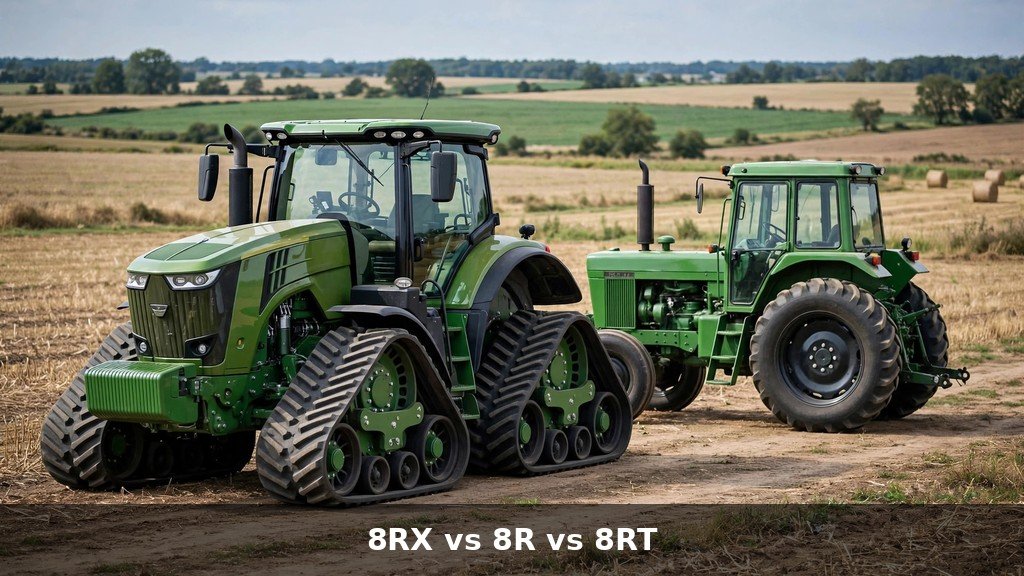
Deere sells three 8 Series flavors: the wheeled 8R, the two-track 8RT, and the four-track 8RX — same engines, transmissions, cabs, and hydraulics, differing only in running gear. The 8R is the all-rounder: lowest price, simplest maintenance, best road manners, and the only one that takes a loader. The 8RT puts two wide tracks down for maximum straight-line flotation. The 8RX uses four narrower tracks — more maneuverable than the 8RT, more flotation than wheels.
Differences in Four-Track, Wheel and Two-Track Designs
| Attribute | 8R (Wheeled) | 8RX (Four-Track) | 8RT (Two-Track) |
|---|---|---|---|
| Ground contact | Tire footprint | Up to 4.57 m² | Large (two wide belts) |
| Soil berming on turns | Minimal | Almost none | More than 8RX |
| Turning radius | Tightest | Smaller than 8R (per Deere) | Widest |
| Hillside stability | Good | Outstanding | Very good |
| Road transport | Best | Good (40K) | Slowest |
| Purchase price | Lowest | Highest of the three | Between 8R and 8RX |
| Track/belt wear cost | Tire replacement | Four belts + undercarriage | Two belts + undercarriage |
The four-track party trick this John Deere 8RX Series review keeps coming back to is turning: front and rear tracks steer in coordination, so headland berming is almost nonexistent and the turning radius is smaller than the wheeled 8R’s, per Deere. Hillside traction is outstanding — four contact patches keep the 8RX planted where wheels slip. The trade-off: the 8RX costs the most to buy, and four belts plus undercarriage parts are the priciest wear items in the lineup.
Which Tractor Configuration Fits Your Farm and Soil Conditions?
Choose the 8R if you need a loader tractor, do significant road transport, or want the lowest purchase price and simplest maintenance — any tire shop can handle wheels, while track work needs a dealer or specialist. Our John Deere 8R Series review covers the wheeled lineup in the same depth as this John Deere 8RX Series review.
Choose the 8RX if soil protection is a profit driver: controlled-traffic farming, strip-till, high-value crops on fragile soils, or tight wet-year timing windows. Deere-cited studies show up to 6.8 percent yield improvement with tracks — behind this John Deere 8RX Series review’s verdict. The 8RX also wins on hillsides and soft ground. Choose the 8RT for maximum straight-line flotation below the 8RX’s price. The 8RX is the premium choice, the 8R the value choice — and this John Deere 8RX Series review’s verdict is that the premium pays when compaction costs yield.
Frequently Asked Questions About the John Deere 8RX Series
Common questions about the 8RX four-track lineup — models, tracks, pricing, and how it compares to the wheeled 8R — answered from verified specs and owner reports. This John Deere 8RX Series review closes with the questions buyers ask most.
What models are in the John Deere 8RX Series?
Four models: the 8RX 310, 340, 370, and 410, rated from 310 to 410 hp. All share the PowerTech 9.0L six-cylinder and the same transmission, hydraulic, and cab options — the lineup is about matching power to your implement load, as this John Deere 8RX Series review details above.
How much does a John Deere 8RX cost?
New 8RX tractors run roughly $30,000–$50,000 above a comparable wheeled 8R (estimate, based on dealer pricing patterns), with the 8RX 370 typically priced between $416,000 and $476,000 depending on year and condition per AllMachines. Used examples: a 2023 8RX 370 with 1,519 hours listed at $382,900 (LandMark Implement, Minden NE) and a 2022 8RX 370 with 697 hours at $466,999 (Papé Machinery, Lynden WA). Dealers quote final new-machine prices on request. Factory coverage is 24 months or 2,000 hours (whichever comes first), with paid PowerGard extended plans available — a point this John Deere 8RX Series review notes because Deere’s longer powertrain extensions apply to other series, not the 8RX.
What engine does the 8RX use?
The PowerTech 9.0L six-cylinder (549 cu in.), B20-biodiesel-compatible, with dual turbochargers in series, air-to-air aftercooling, and cooled EGR. The 310 and 340 use the PVS version; the 370 and 410 use the PSS version. US Final Tier 4 aftertreatment is DOC + DPF + SCR with DEF (9.8-gallon DEF tank), and the engine family MJDXL09.0333 is listed on US-spec 8RX 410 dealer sheets.
What track widths are available on the 8RX?
18, 24, and 30-inch belt widths (a 25-inch option appears in some markets), each with AirCushion suspension. Ground contact area reaches 4.57 m², and fully ballasted static ground pressure at the rear can be as little as 36 kPa, per Deere’s technical literature — the core of the 8RX’s soil-protection claim.
Is the 8RX better than the wheeled 8R?
For soil protection, traction in soft conditions, and hillside stability — yes, decisively, and that is the central finding of this John Deere 8RX Series review. For purchase price, maintenance simplicity, road transport, and loader work — no; the wheeled 8R wins those. The 8RX costs more to buy and its four belts are the most expensive wear items in the 8 Series. Choose based on whether soil compaction is costing you yield.
Are there any recalls on the John Deere 8RX Series?
In the course of this John Deere 8RX Series review, we could not verify any 8RX-specific CPSC recall in original CPSC releases — treat any such claim as reported rather than confirmed. The September 2024 CPSC brake recall covered only the 1023E, 1025R, and 2025R compact tractors. Before buying used, run the serial number through Deere’s recall lookup or call 800-537-8233, and check service history and software updates as part of your inspection.