The John Deere 9520RX is a four-track articulated tractor that delivers 520 rated horsepower on four rubber belt tracks, and on the used market it sells for roughly $200,000 to $420,000 depending on hours, track condition and options. This John Deere 9520RX review covers the full picture: the 13.5L PowerTech engine, e18 PowerShift transmission, real used prices from current dealer listings, and how this 2015–2018-era flagship compares to the 9570RX and the newer 9RX 540.
Built in Waterloo, Iowa, the 9520RX was one of Deere’s first four-track tractors, launched in 2015 alongside the 9470RX, 9570RX and 9620RX. It is discontinued, so every buyer is a used buyer. That is the frame this John Deere 9520RX review uses throughout: what to verify, what to pay, and whether the older 9520RX still makes sense against newer tracked machines. Every figure below comes from Deere spec data, current used listings or labeled owner reports — nothing is guessed.
John Deere 9520RX Review, Features and Used Price
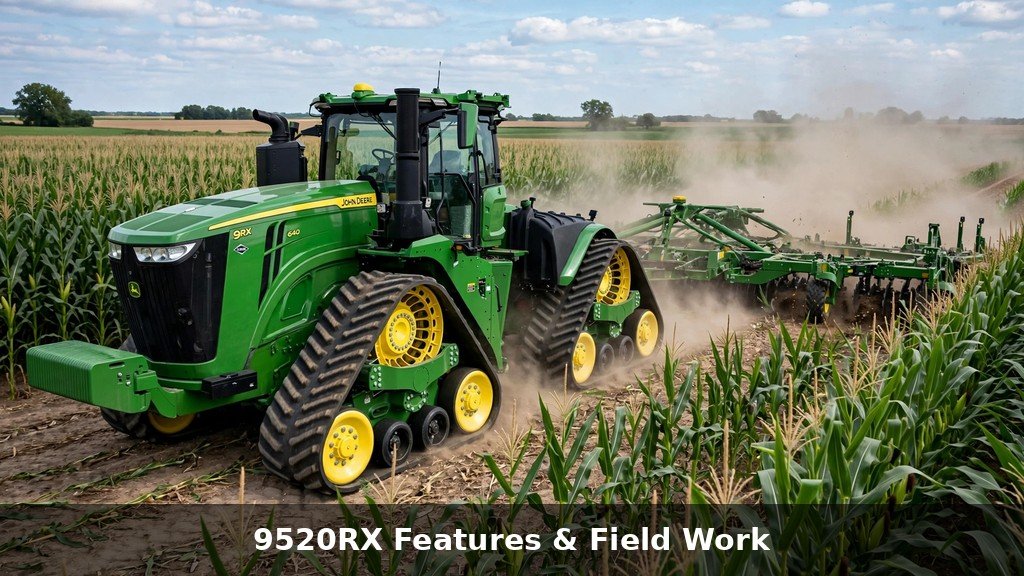
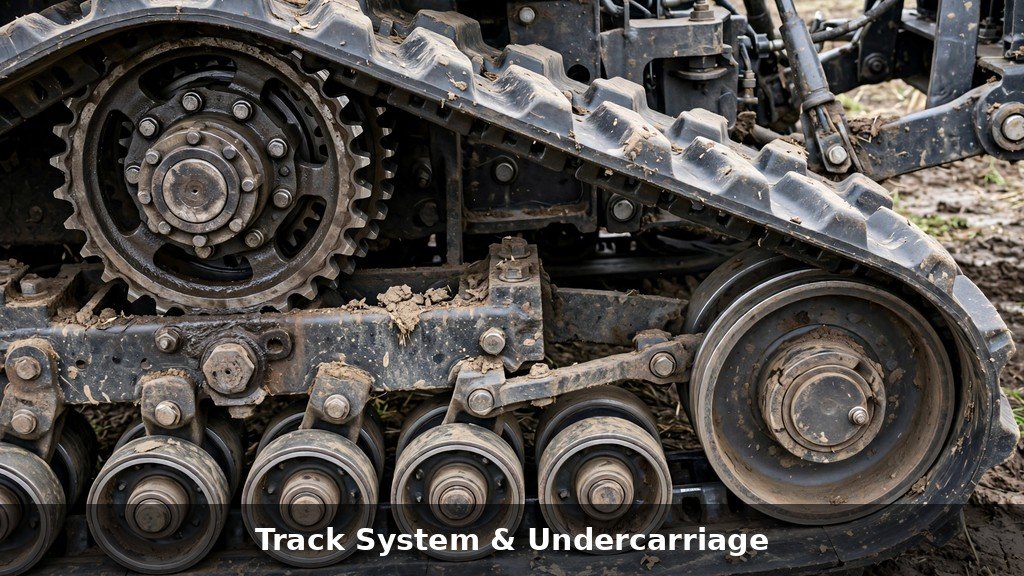
In this John Deere 9520RX review, the 9520RX was Deere’s answer to farms that needed more than 500 horsepower put to the ground without destroying soil structure. Four rubber belt tracks replace wheels, spreading roughly 43,500 pounds of shipping weight over a long footprint that reviewers and owners consistently praise for traction and floatation. This John Deere 9520RX review treats the machine as it is today: a proven, discontinued flagship that trades on the used market at a steep discount to new four-track tractors.
Key Features, Configurations and Intended Uses
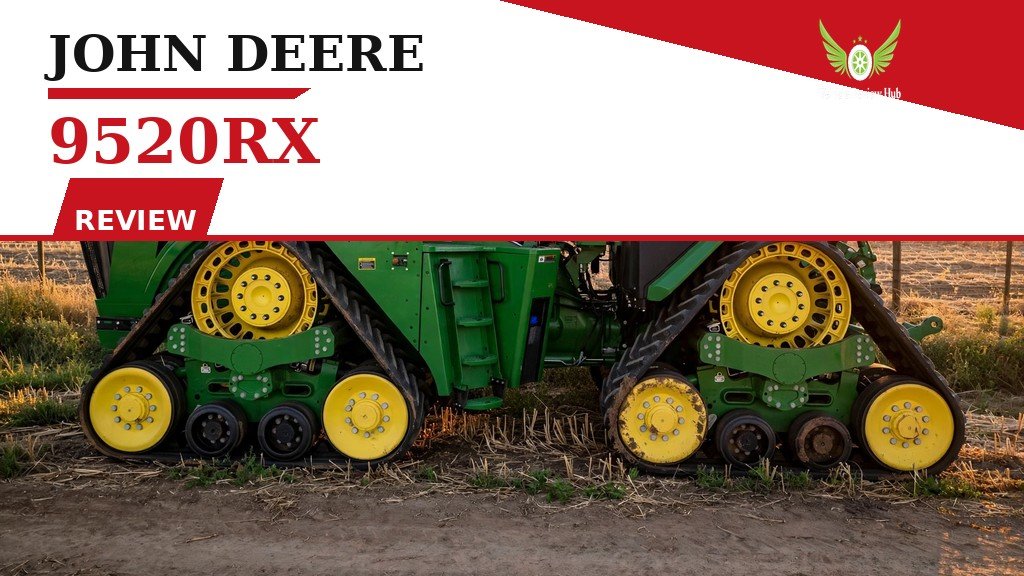
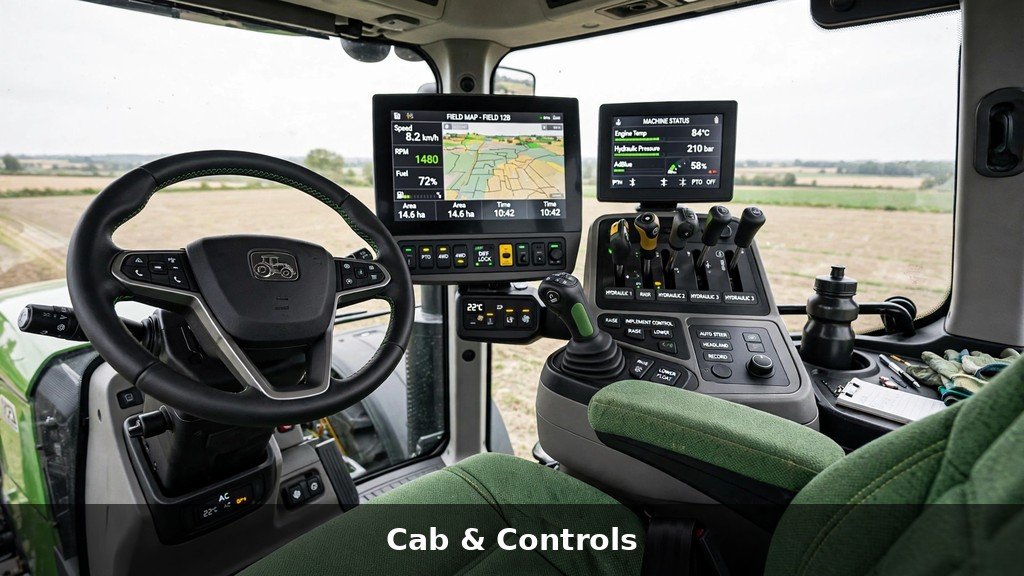
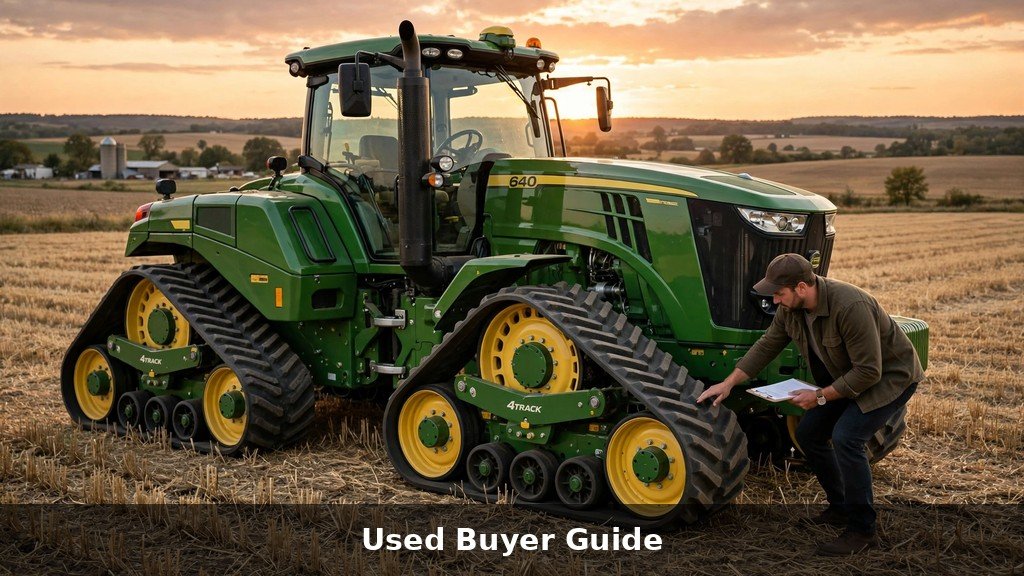
The core of this John Deere 9520RX review is the four-track undercarriage. A large-diameter drive sprocket drives positive-drive rubber belts with optimally placed idlers and mid-rollers, delivering high drawbar horsepower with less track slippage than wheels on soft ground. Camso Duradrive 3500 and 6500 belts come in 30-inch and 36-inch widths, and owners on farming forums describe the ride — a mechanical parallel-plane four-bar linkage with about four inches of vertical travel — as a major step up from older two-track machines. The CommandView III cab carries Gen 4 CommandCenter displays (a 7-inch 4100 standard, 10-inch 4600 optional), StarFire 6000 guidance and integrated AutoTrac, plus JDLink telematics on connected machines. The video below — John Deere’s own introduction to the 9RX narrow-track tractors — shows the machine this John Deere 9520RX review covers up close:
Configurations vary widely on the used market — something this John Deere 9520RX review keeps coming back to. Most 9520RX tractors were ordered with the 1,000-rpm PTO option and a Category 5 drawbar with heavy-duty support — the RX is a drawbar machine, with no rear three-point hitch. Hydraulic options run from the standard 58-gpm pump to the 115-gpm dual-pump setup with five or six rear SCVs, and the used listings confirm both: a 2018 9520RX listed by Papé Machinery shows 36-inch tracks and no PTO, while another Papé unit carries 36-inch tracks with the PTO and no three-point. Track spacing, cab trim (leather comfort packages are common), premium LED lighting and guidance receivers all move used value. Intended uses have not changed: heavy primary tillage, deep ripping, large air seeders and grain carts on 3,000-plus-acre operations — the work this John Deere 9520RX review finds it still does well. Buyers stepping up from the smaller four-track 8RX line should read our 8RX Series review for the modern comparison, and our 9520RX performance and fuel usage guide covers what the 13.5L burns under load.
Used Prices by Model Year, Hours and Configuration
Used pricing for the 9520RX follows hours and condition more than model year. Current dealer listings put the working band at roughly $200,000 to $420,000. At the low end, Papé Machinery lists a 2016 9520RX with 6,146 hours and 30-inch tracks at $199,999 (McMinnville, Oregon) — a high-hour machine priced for a buyer who will run it hard. Mid-range, a 2018 with 3,477 hours, 36-inch tracks and no PTO lists at $279,999 (Mount Vernon, Washington), while a 2018 with 4,171 hours, 36-inch tracks and the PTO lists at $313,999 (Harrisburg, Oregon). At the top, Brandt Agriculture lists a clean 2018 with just 2,400 hours, 36-inch Camso 3500 tracks, five remotes and the 115-gpm high-flow pump at 592,000 CAD — about $417,000 USD — in Regina, Saskatchewan. A 2019 at 618,000 CAD has already sold. As a reference point, aggregator price data shows the 9520RX originally listed around $420,000 to $464,000 when new, so today’s used prices represent a 30 to 50 percent discount from new. This John Deere 9520RX review treats track condition as the single biggest price lever: a full set of four new belts can cost $40,000 to $50,000 installed at dealer rates, so a machine with 60-percent belts should price materially below one with fresh rubber. For the running-cost math behind those prices, see our 9520RX ownership cost and buying guide.
John Deere 9520RX Engine, Horsepower and Specifications
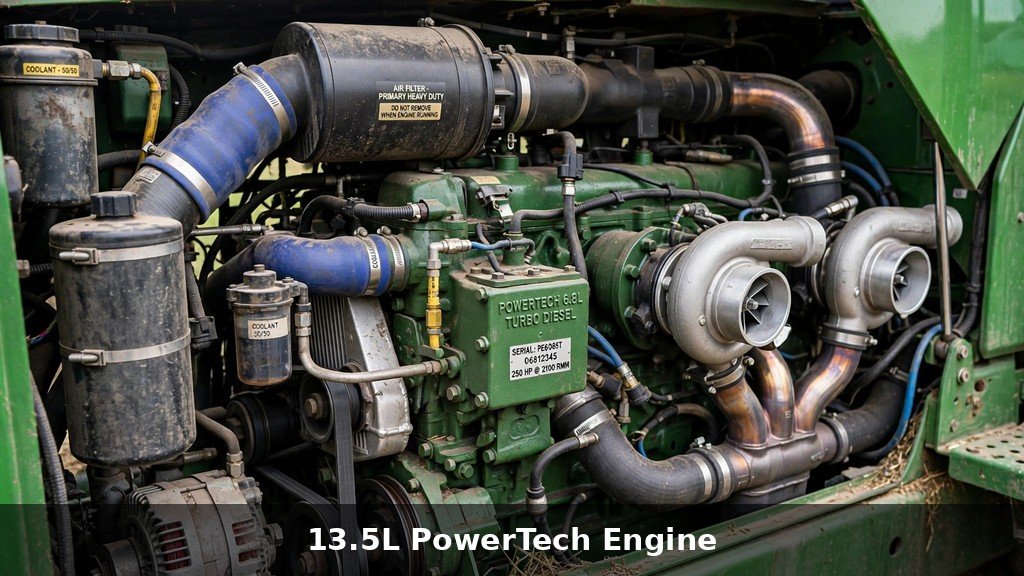
At the heart of this John Deere 9520RX review, the 9520RX runs John Deere’s own PowerTech PSS 13.5L — an 824-cubic-inch inline six with wet-sleeve liners, four valves per cylinder and dual series turbochargers feeding air-to-air aftercooling with cooled EGR. This John Deere 9520RX review focuses on the verified numbers: 520 rated horsepower at 2,100 rpm, 335 rated PTO horsepower, a 10 percent power boost in transport and mobile PTO applications, and 38 percent torque rise. US Final Tier 4 aftertreatment is DOC plus DPF plus SCR with DEF — the DPF uses parked and automatic regeneration, and the machine carries a 31.7-gallon DEF tank alongside its 400-gallon diesel tank. That matters for used buyers: check regen history and DEF system fault codes before money changes hands.
13.5L Diesel Engine, Rated HP and PTO Power
Deere’s spec data (engine family JJDXL13.5310) rates the 13.5L at 520 horsepower gross with the 10 percent boost available when the machine is not pulling full draft load — transport and mobile PTO work. Rated PTO power is 335 horsepower at the 1,000-rpm shaft, which runs a 1-3/4-inch 20-spline output. The engine is B20 biodiesel compatible. Owners describe the 13.5L as a steady, long-lived powerplant; the known watch items on used machines are DEF system faults (NOx sensors, stale DEF), interrupted-regen derates, and DOC inlet temperature sensor codes — all covered in our 9520RX maintenance and common problems guide. Service access is from ground level for daily checks, and the cooling package needs regular cleaning in dusty tillage work — clogged screens are the most common cause of high-temperature derates on these machines.
Dimensions, Fuel Capacity, Hydraulic Flow and Track Options
| Specification | John Deere 9520RX |
|---|---|
| Engine | John Deere PowerTech PSS 13.5L (824 cu in), inline 6 |
| Rated power | 520 hp @ 2,100 rpm (10% power boost in transport/mobile PTO) |
| Rated PTO power | 335 hp (1,000 rpm, 1-3/4 in. 20-spline) |
| Aftertreatment | Final Tier 4: DOC + DPF + SCR with DEF (31.7-gal DEF tank) |
| Transmission | e18 18-speed PowerShift with Efficiency Manager (18F/6R, 25 mph) |
| Hydraulics | 58 gpm standard / 115 gpm dual-pump option @ 2,900 psi; 4–6 rear SCVs standard |
| Tracks | Camso Duradrive 3500/6500 belts, 30 in. or 36 in. widths |
| Fuel / capacities | 400 gal diesel; 13 gal crankcase; 15 gal cooling; 60 gal trans-hydraulic |
| Dimensions / weight | ~24 ft long, 12 ft tall, ~15 ft wide; ~43,550 lb shipping weight |
| Cab / tech | CommandView III; Gen 4 CommandCenter 4100 (7 in.) std / 4600 (10 in.) opt; StarFire 6000, AutoTrac, JDLink |
| Hitch | Drawbar only (no rear 3-pt hitch); Cat 5 drawbar with heavy-duty support |
The 400-gallon fuel tank keeps the 9520RX in the field for full days of heavy tillage — at 20-plus gallons per hour under full draft load, that is roughly 16 to 20 hours of hard work between fills. The 115-gpm high-flow pump, available on well-optioned machines, is the option serious air-seeder operators want: it feeds up to eight rear SCVs and the fan drives on large seeding trains without starving steering or hitch functions. Track choice matters for the farm: 30-inch belts suit row-crop spacing and transport, while 36-inch belts maximize floatation on soft ground. This John Deere 9520RX review treats the wide-track, high-flow, PTO-equipped machines as the premium used buys.
John Deere 9520RX Transmission and Implement Compatibility
In this John Deere 9520RX review, the 9520RX runs Deere’s e18 18-speed full PowerShift with Efficiency Manager — 18 forward and 6 reverse gears, a 25-mph road speed, and automatic engine/transmission coordination that picks the most economical gear for the target speed. Owners describe the e18 as one of the most reliable parts of the machine, though used buyers should verify shift quality and calibration, since harsh shifts on a high-hour machine usually trace to software or clutch calibration rather than mechanical failure — a used-buying tip this John Deere 9520RX review emphasizes.
e18 PowerShift Transmission and Available Configurations
The e18 pairs with the 13.5L through Efficiency Manager, which automatically manages engine rpm and gear selection for the set speed — the same architecture Deere uses across the 9R family. Configurations on the used market split into two useful groups: drawbar-only machines (common on grain farms that never needed a PTO) and PTO-equipped machines with the 1,000-rpm shaft for grain carts, manure pumps and other PTO work. Track width (30 vs 36 inch), hydraulic pump size (58 vs 115 gpm), SCV count and cab trim round out the configuration choices. A 2018 9520RX listed by Brandt Agriculture shows the desirable spec: 36-inch Camso 3500 tracks, the 115-gpm dual pump, five rear SCVs, the 1,000-rpm PTO and a Category 5 drawbar with heavy-duty support. That is the configuration this John Deere 9520RX review would pay up for.
PTO, Three-Point Hitch, Drawbar and Implement Compatibility
As noted in this John Deere 9520RX review, the 9520RX is a drawbar tractor — there is no rear three-point hitch, and that is by design on a four-track machine of this size. The 1,000-rpm PTO is optional, so verify it exists before buying if your work needs it: some machines were ordered without it. Implement compatibility is otherwise broad: up to eight rear SCVs on high-flow machines, ISOBUS implement control, and the drawbar rated for the heaviest draft implements — deep rippers, 60-foot air seeders, large discs and heavy grain carts. Tractor Implement Automation (TIA) readiness appears on late machines. Compared with the wheeled 9R line, the tracked 9520RX converts more of its 520 horsepower into drawbar pull in soft conditions, at the cost of higher track replacement expense over the machine’s life. Our 9R Series review covers the wheeled alternative for buyers deciding between tracks and wheels.
John Deere 9520RX vs. 9570RX and 9RX 540
The machine at the center of this John Deere 9520RX review never sold in isolation: Deere launched four four-track models in 2015, and the next generation brought the 9RX 490/540/590/640 naming. The comparison buyers actually make is against the 9570RX (same generation, more power, Cummins engine) and the 9RX 540 (the next generation’s machine in the same power class). This John Deere 9520RX review breaks down where the older 9520RX still wins.
Differences in Horsepower, Engine and Operating Capabilities
The 9570RX is the same 2015-generation machine with a Cummins QSX15 instead of the Deere 13.5L, rated at 570 horsepower — 50 more than the 9520RX. As Equipment World’s launch coverage noted, the four original models split engines this way: the 9470RX and 9520RX used the John Deere PowerTech PSS 13.5L, while the 9570RX and 9620RX used the Cummins QSX15. The 9570RX pulls harder and costs more used; the 9520RX’s Deere-built engine keeps parts and service inside the Deere dealer network, which some owners prefer. The 9RX 540 is the 2018-generation machine in the same slot — roughly 540 rated horsepower on the evolved 13.5L platform with updated electronics and cab refinements. It is newer, more expensive used, and depreciates faster. For the newest generation comparison, see our 9RX Series review covering the 710, 770 and 830 with the JD18 engine.
Which Track Tractor Offers Better Value?
Value depends on hours and work. A used 9520RX at $250,000 to $320,000 with 3,000 to 4,500 hours buys 520 horsepower of proven four-track traction for less than half the price of a new-generation machine — a 2024 9RX 540 with 981 hours recently listed near $607,000. The 9570RX adds 50 horsepower for a premium that only pays off on the heaviest draft work; for most tillage and seeding, the 9520RX’s 520 horsepower is enough tractor. The 9RX 540 wins on technology, cab and remaining life, but loses on purchase price and depreciation curve. This John Deere 9520RX review’s verdict: the 9520RX is the value buy for operations that need four-track traction on a budget, provided the buyer budgets for belt condition — inspect track wear, alignment and undercarriage hours carefully, because a $45,000 belt job changes the math. Our 9520RX ownership cost and buying guide walks through the full used-buying math.
Frequently Asked Questions About the John Deere 9520RX
Common questions from used buyers, answered with verified specs and current market data.
How much horsepower does the John Deere 9520RX have?
Per this John Deere 9520RX review, the 9520RX is rated at 520 horsepower gross at 2,100 rpm from its John Deere PowerTech PSS 13.5L inline six, with a 10 percent power boost available in transport and mobile PTO applications. Rated PTO power is 335 horsepower at the 1,000-rpm shaft.
What years was the 9520RX made?
As this John Deere 9520RX review documents, the 9520RX was part of Deere’s first four-track launch in 2015, alongside the 9470RX, 9570RX and 9620RX, and it was built through about 2018, when the next generation (9RX 490/540/590/640 naming) took over. It is discontinued — every machine on the market today is used.
How much does a used 9520RX cost?
This John Deere 9520RX review puts the used band at roughly $200,000 to $420,000, based on current dealer listings. A 2016 with 6,146 hours lists near $200,000, mid-life 2018 machines with 3,400 to 4,200 hours list at $280,000 to $314,000, and a clean low-hour 2018 with 2,400 hours lists around $417,000 USD equivalent. Hours, track condition, PTO and hydraulic options drive the spread.
Does the 9520RX use DEF?
Yes — a point this John Deere 9520RX review stresses. Unlike the newest JD18-powered 9RX models, which run EGR-only with no DEF, the 9520RX’s 13.5L uses Final Tier 4 aftertreatment with DOC, DPF and SCR — so it needs DEF (31.7-gallon tank) and the DPF performs parked and automatic regeneration. Check regen history and DEF fault codes on any used machine.
Does the 9520RX have a three-point hitch?
No — and this John Deere 9520RX review confirms it. The 9520RX is a drawbar-only tractor with no rear three-point hitch — standard for four-track machines of this size. The 1,000-rpm PTO is optional and not present on every machine, so verify it if your work needs PTO drive.
Are there any recalls on the 9520RX?
A final tip from this John Deere 9520RX review: we could not verify any CPSC recall covering the 9520RX — treat recall claims about this model as reported rather than confirmed. Before buying, run the serial number through Deere’s recall lookup or call 800-537-8233 to check for any open campaigns.