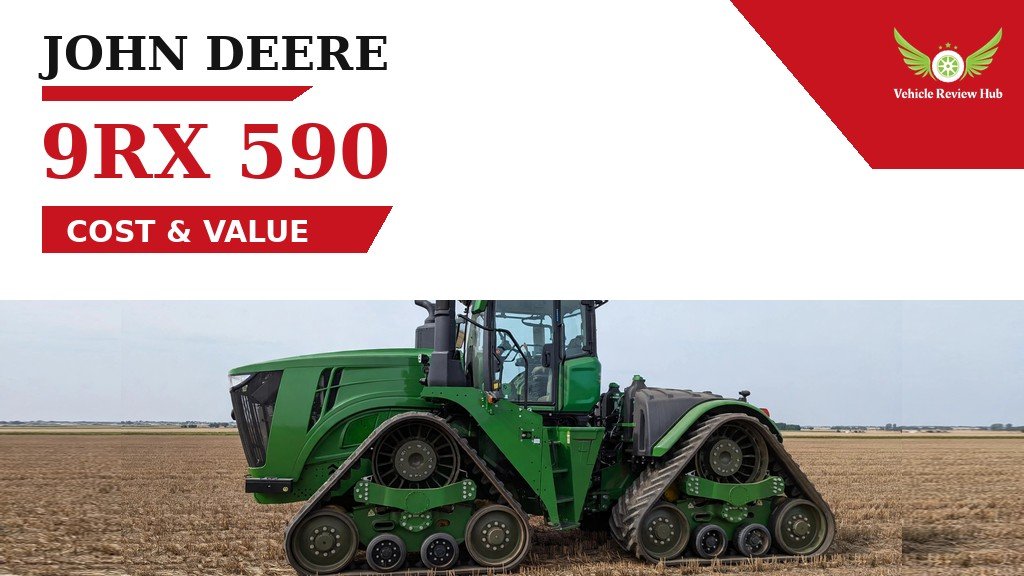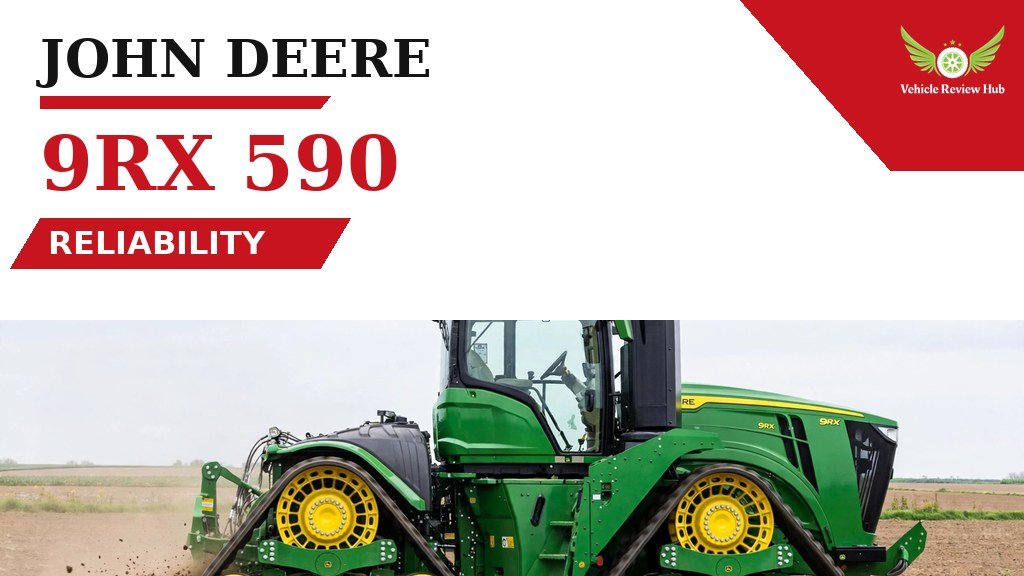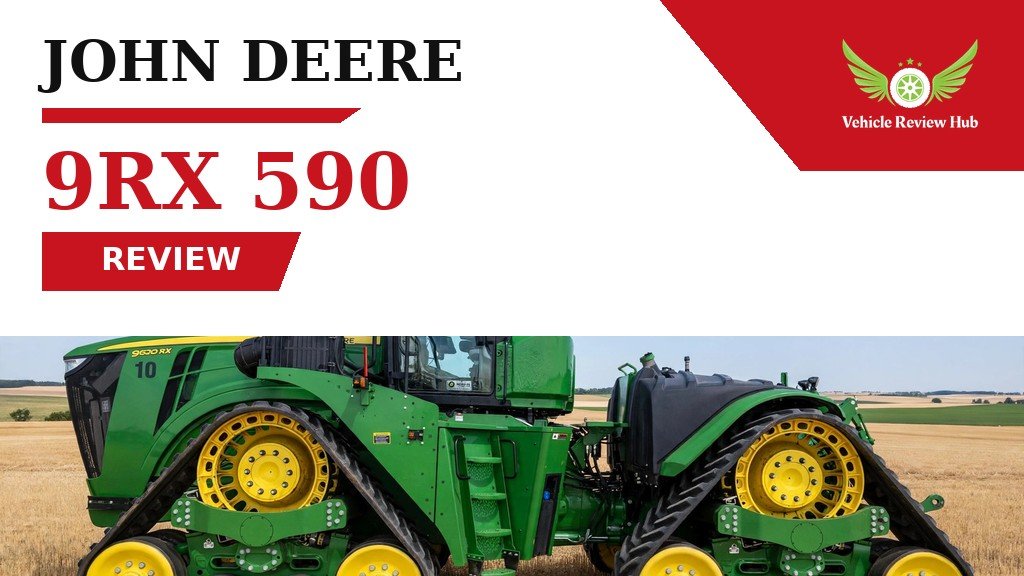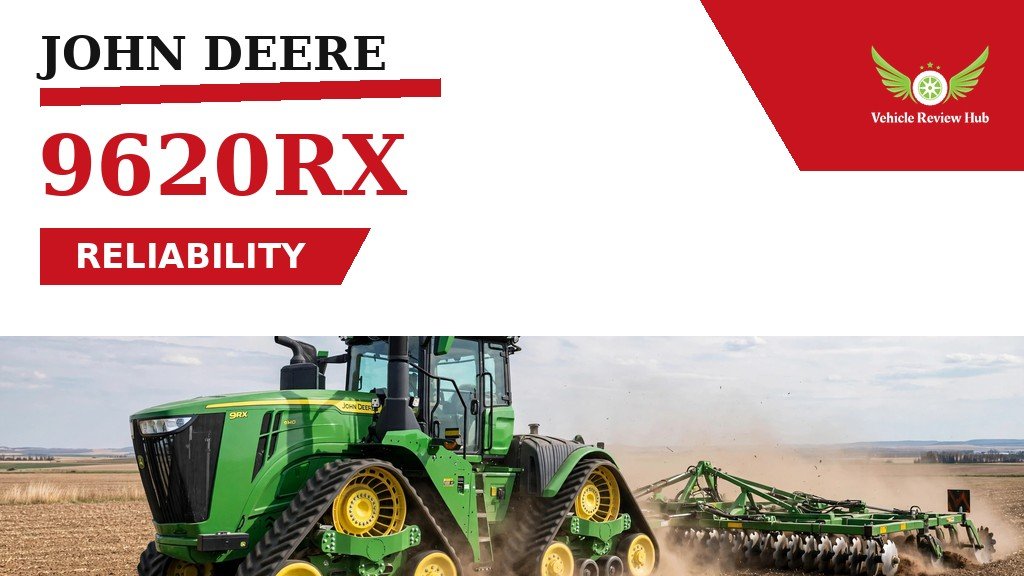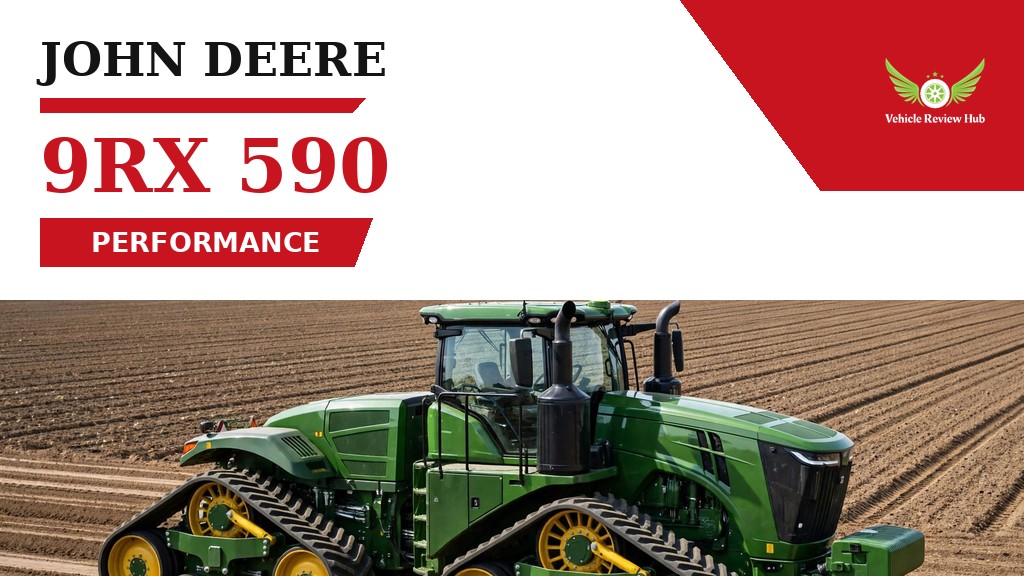
Can a 590-horsepower four-track tractor pull the widest tools on the farm, burn fuel sensibly for its size, and ride well enough for a 14-hour day? For John Deere 9RX 590 performance, the short answer is yes. The 9RX 590 pairs a 590-horsepower John Deere JD14 engine with four rubber tracks and an 18-speed e18 PowerShift, delivering enormous drawbar pull with far less slip and soil compaction than a wheeled tractor of the same power. This guide covers John Deere 9RX 590 performance in full: fuel use by job, traction, handling, and owner reports.
The 9RX 590 is a current model in Deere’s newer 9RX family, built from model year 2022 onward — not a member of the original 2015 four-track lineup. Its 590 rated horsepower, 649 maximum horsepower, 2,008 lb-ft of peak torque, and roughly 56,320-pound base weight put it in the class farms buy for primary tillage, large air seeders, and heavy grain carts. Figures below come from Deere dealer spec sheets and current October 2026 dealer listings, or are labeled estimates where no test figure exists.
John Deere 9RX 590 Fuel Consumption and Runtime
Fuel shapes the whole operating budget for John Deere 9RX 590 performance, because a 590-horsepower tractor burns at a scale few farms are used to. One genuine efficiency gain helps here: Deere’s JD14 engine runs without a diesel particulate filter, and Deere claims about 3 percent lower fuel consumption than the 13.5-liter engine it replaced, alongside 14 percent more power and 11 percent more torque.
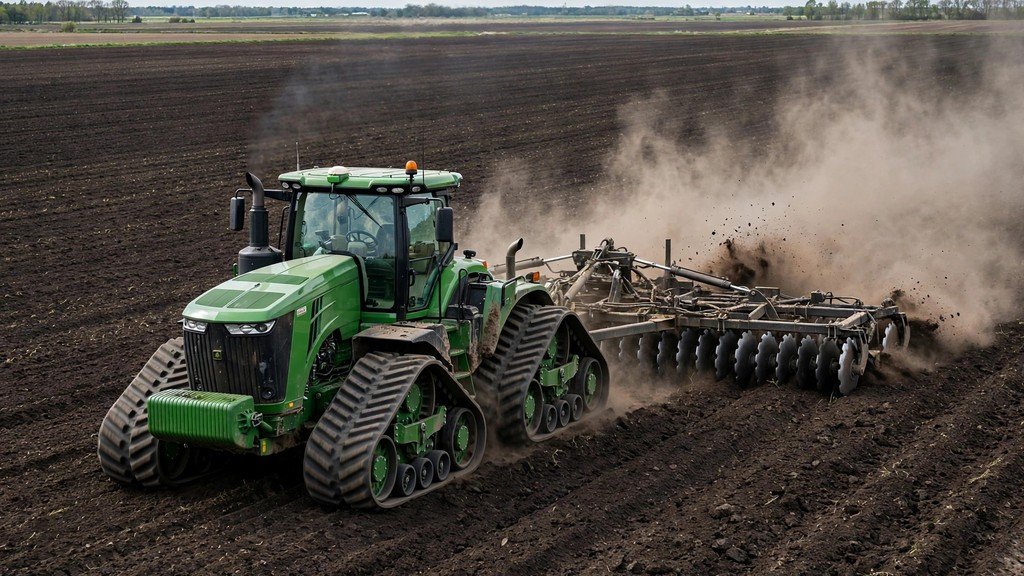
Fuel Use During Heavy Tillage, PTO Work and Transport
Under sustained heavy tillage — deep ripping, large discs, heavy vertical tillage — fuel burn runs roughly 20 to 26 gallons per hour (estimate, based on owner reports for comparable four-track machines). Drawbar work at moderate load, such as pulling a grain cart or field cultivator, typically runs 18 to 24 gallons per hour (estimate), while seeding with a large air seeder and cart runs 20 to 25 gallons per hour (estimate). PTO work at full load sits in a similar band, roughly 18 to 24 gallons per hour (estimate). Transport drops to roughly 8 to 12 gph (estimate) and light work to 10 to 14 gph (estimate).
Those John Deere 9RX 590 performance estimates sit below the older 620-horsepower flagship because the JD14 is a smaller, newer engine tuned for efficiency, and the no-DPF aftertreatment removes regeneration fuel penalties. Before budgeting a season, check the EIA’s weekly diesel prices, since diesel price moves swing a 1,000-hour season by thousands of dollars on a machine this thirsty. At the EIA weekly average of $6.276 per gallon in the week of October 19, 2026, a 1,000-hour season at a 20-gallon average costs roughly $125,000 in diesel alone.
| Job type | Fuel use (est.) | Hours per 400-gal tank (est.) |
|---|---|---|
| Heavy tillage (ripping, large discs) | 20–26 gph | 15–20 |
| Drawbar work (carts, cultivators) | 18–24 gph | 17–22 |
| Seeding (air seeder + cart) | 20–25 gph | 16–20 |
| PTO work (full load) | 18–24 gph | 17–22 |
| Road transport (25 mph) | 8–12 gph | 33–50 |
| Light work / idle-heavy days | 10–14 gph | 29–40 |
How Workload, Engine Load and Field Conditions Affect Fuel Economy
Three things move John Deere 9RX 590 performance fuel numbers most: how hard the implement pulls, which transmission mode you run, and what the ground is doing under the tracks. A ripper in wet clay pushes burn toward the top of the range; the same implement in dry, mellow soil sits several gallons per hour lower. Ballast matters too: a 9RX 590 worked at heavy ballast grips better and slips less, improving fuel per acre because more of each gallon becomes forward work.
The e18 transmission is the other big lever for John Deere 9RX 590 performance. In Full AUTO mode, the transmission manages shifts and engine rpm to hold your target ground speed at the lowest efficient rpm, and Efficiency Manager keeps the engine in its sweet spot rather than letting it rev. Custom mode’s Eco setting suits transport and light work; in heavy draft work, most operators switch Eco off. Intelligent Power Management (IPM) adds a further wrinkle: on high-demand applications like air seeding up hills, IPM provides additional engine and hydraulic power on demand, which costs fuel in the moment but saves passes across the field.
John Deere 9RX 590 Performance for Large-Scale Farming
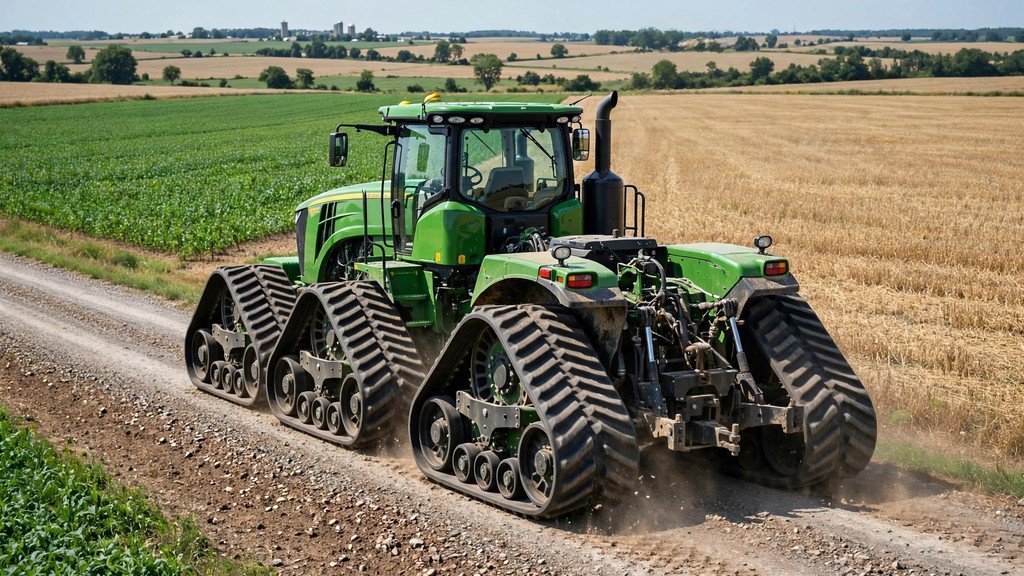
Large-scale farming is where John Deere 9RX 590 performance earns its price: farms where the implement sets the schedule — 60-foot air seeders, 40-foot discs, deep rippers, and grain carts over 1,000 bushels. With 590 rated horsepower, a 649-horsepower maximum, and four tracks spreading roughly 56,320 pounds over a huge contact patch, it pulls tools that would stop a smaller tractor, with less compaction than dual wheels.
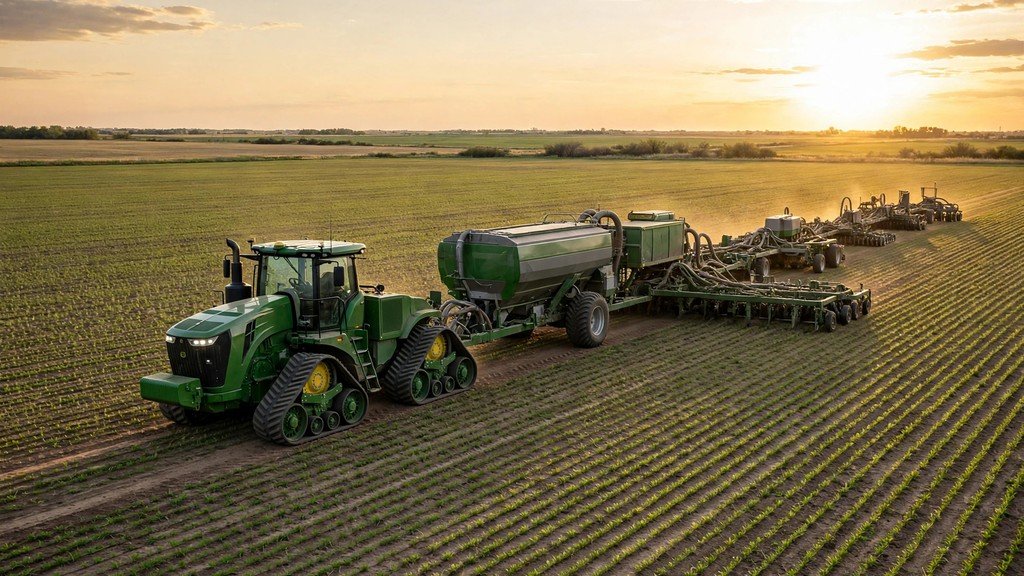
Tillage, Seeding and Heavy Implement Operation
In primary tillage, John Deere 9RX 590 performance is defined by torque and traction working together. The JD14 peaks at 2,008 lb-ft (2,723 Nm) at 1,550 rpm with 38 percent PTO torque rise, which means when a ripper hits a hard patch, torque rises as rpm falls, holding the implement at depth instead of forcing a downshift. For seeding, hydraulic capacity matters as much as power: the optional 110-gpm pump and up to eight rear SCVs run large air seeders and bulk-fill planters.
The video below shows a John Deere 9RX at work in fall tillage — a good look at how the tracks and power delivery behave under a heavy load:
Heavy implement operation also means paying attention to the hitch. The 9RX 590 offers a Category 4N/4 three-point hitch rated at 15,000 pounds standard and 20,000 pounds with the heavy-duty option, plus a Category 5 drawbar for towed tools. Many used 9RX 590 tractors were ordered with PTO but no three-point hitch, so verify the setup on a used machine. The 335-horsepower PTO rating is a driveline limit, not an engine limit. Our 9RX 590 review and specs guide covers the full model lineup and every available option in detail.
Drawbar Performance, Four-Track Traction and High-Load Work
Drawbar pull is where four tracks change the equation for John Deere 9RX 590 performance. A wheeled tractor of the same weight wastes a meaningful share of its power on wheel slip, four Camso tracks put far more rubber on the ground, so slip stays low and more power reaches the drawbar. The Category 5 drawbar carries a 12,000-pound maximum vertical load.
Under sustained high load, John Deere 9RX 590 performance depends on cooling and aftertreatment as much as traction. The JD14 runs dual series turbochargers with air-to-air aftercooling and cooled exhaust gas recirculation, with DOC and SCR aftertreatment for Final Tier 4 compliance — and notably no diesel particulate filter, which Deere eliminated on this engine to cut fuel use and maintenance. A maintenance-free hydraulic fan drive replaces the older Vari-Cool system. The dealer spec sheet for the 9RX 590 confirms the JD14 engine, the 590-horsepower rating, and the hydraulic figures used here, and the 9620RX performance guide shows how the older flagship compares on fuel and pull.
| Specification | 9RX 590 figure |
|---|---|
| Engine | John Deere JD14, 13.6L inline six |
| Rated power | 590 hp at 2,100 rpm (10% power boost) |
| Maximum power | 649 hp |
| Peak torque | 2,008 lb-ft (2,723 Nm) at 1,550 rpm |
| PTO power | 335 hp (driveline limit) |
| Transmission | e18 18-speed PowerShift, 25 mph |
| Base weight | 56,320 lb (67,000 lb max ballast) |
| Fuel tank / DEF tank | 400 gal / 31.7 gal |
| Hydraulics | 55 gpm standard, 110 gpm optional |
John Deere 9RX 590 Handling, Comfort and Operating Limits
Handling and comfort decide whether John Deere 9RX 590 performance holds up for a full season or just looks good on paper. A tractor that beats up its operator will not hold productivity across a 12-hour day. The suspended cab, ActiveCommand Steering option, and articulated chassis give a tighter turning circle than the machine’s size suggests, but its length and weight still set limits.
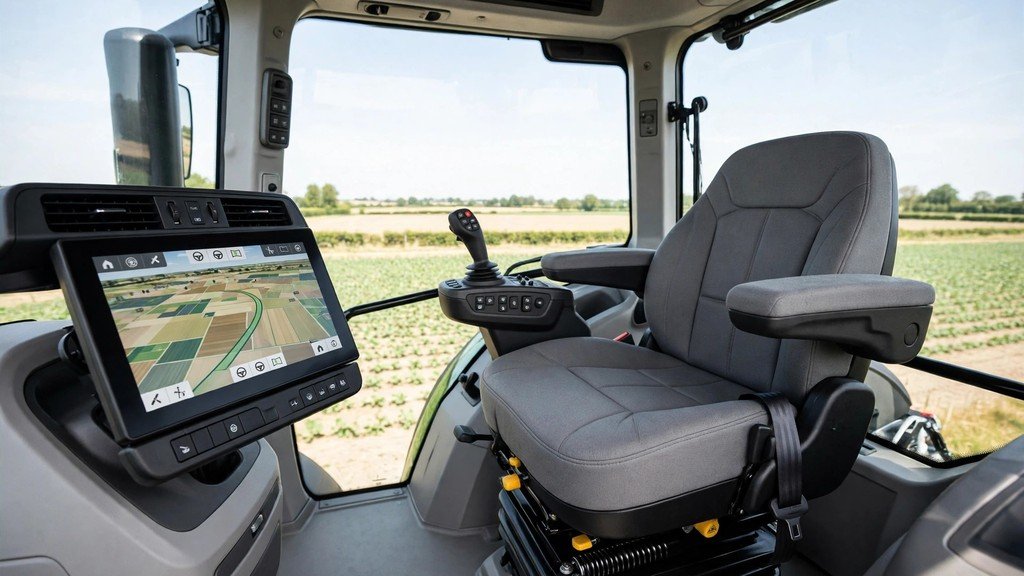
Cab Comfort, Controls and Operator Visibility
The cab is one of the strongest parts of John Deere 9RX 590 performance for the person actually driving. Cab suspension is standard, and the air-ride seat swivels 25 degrees each way. The Generation 4 4600 CommandCenter comes standard as a 10-inch display, with an extended monitor as an option, and the StarFire 6000 receiver, AutoTrac guidance, and JDLink telematics come from the factory. The CommandARM console puts critical controls within easy reach.
Visibility supports John Deere 9RX 590 performance in tight yards, with 71.47 square feet of cab glass and three Visibility packages stepping from 18 halogen work lights to 24 LED work lights plus convenience lights. The 9570RX performance guide covers the older four-track cab experience on the previous platform.
Track Setup, Soil Conditions, Turning and Field Limitations
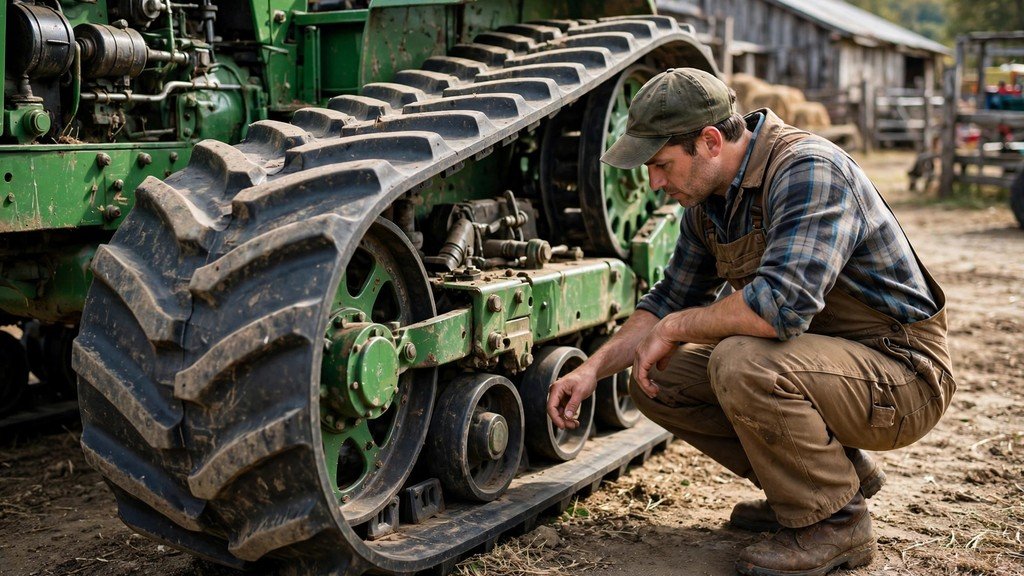
Track setup is the single biggest handling decision on a 9RX 590, and it directly shapes John Deere 9RX 590 performance in the field. Unlike the smaller 9RX models, the 590 runs 30-inch tracks as standard or 36-inch tracks as an option — no 18- or 24-inch widths — on either an 87-inch or a 120-inch tread spacing. The wide 120-inch spacing suits controlled-traffic farming and gives better undercarriage access for service, while the 87-inch spacing suits road transport and shed clearance.
Turning is better than most buyers expect, and it matters for John Deere 9RX 590 performance at the headland. The articulated chassis turns in about 21.1 feet with brakes on 30-inch tracks, without the berming and power hop wheeled articulated tractors sometimes show. With ACS, steering runs 3.5 turns lock-to-lock in the field and five turns on the road. But there are limits: tracks do not like sharp turns on hard surfaces, so minimize roading and avoid spot turns on hard ground, Overall length runs 327.1 inches without the hitch and 336.4 inches with it, so check shed doors and road-permit rules before the tractor arrives.
John Deere 9RX 590 Real-World Owner Experience
Spec sheets say what a tractor can do; owners say what it actually does after a few seasons. The owner picture for the 9RX 590 is still forming — this is a current model with a shorter used history than the older four-track flagships — but the themes are consistent: strong power delivery and cab comfort, with price and scale as the main trade-offs.
Owner-Reported Benefits, Complaints and Operating Trade-Offs
The benefits owners report most often line up with the engineering behind John Deere 9RX 590 performance. Traction and flotation come first: operators working wet springs and heavy clay consistently say the four tracks keep them moving when wheeled tractors park, and that the compaction difference shows up in the following crop. Power delivery is second — the JD14’s torque curve holds depth in variable soil without constant shifting. The no-DPF aftertreatment is third, with fewer regeneration interruptions and lower maintenance than the older two-canister systems. Used listings back up the demand story: a 2023 9RX 590 with 944 hours listed at $559,900 at Van Wall in Perry, Iowa, while 2022 machines with 821 to 1,473 hours listed between $499,900 and $525,000.
The complaints about John Deere 9RX 590 performance are equally consistent. Price tops the list — nearly-new 2024 machines still list between $662,999 and $697,900, so the used discount versus new is far thinner than on the older generation. Track replacement cost comes second: a full set of Camso belts is a five-figure job, and belt life depends heavily on roading and tension discipline. Electronics come third: guidance glitches and sensor faults are the most common surprise repairs on any current-generation machine. Our 9RX 590 maintenance and problems guide goes deeper on service intervals and the issues to check on a used machine.
Choosing the Right Implements and Workload for Your Farm
Choosing implements is where John Deere 9RX 590 performance meets your specific farm. Start with soil, not price. On soft, wet, or heavy clay ground, 36-inch tracks are the right call — flotation keeps you working where narrower setups stop, and compaction savings pay back over seasons. If your ground is firm and dry, 30-inch tracks give nearly the same pulling power with lower cost and easier transport.
Two practical checks matter more than the brochure for John Deere 9RX 590 performance over a machine’s life. First, inspect belt condition on any used machine as you would tires on a wheeled tractor — cuts, chunking, and uneven wear — and budget a track refresh if belts are past mid-life, because that cost can erase a used discount fast. Second, match tracks to road mileage: daily roading favors narrower tracks and disciplined tension. Our 9RX 590 ownership cost guide breaks down fuel, tracks, maintenance, and depreciation across five years, and TractorHouse listings for the 9RX 590 show how asking prices move with hours and equipment. A note on sourcing: the 9RX 590 engine is the John Deere JD14 13.6L — not the Cummins of the older 9620RX and not the JD18 of the newest 710, 770, and 830 — so verify the engine tag on any used machine.
Frequently Asked Questions About John Deere 9RX 590 Performance
Buyers ask the same core questions: fuel burn, pull, track costs, and farm fit. Answers below draw on Deere dealer spec sheets and current October 2026 dealer listings, with estimates labeled wherever no test figure exists.
How much horsepower does the John Deere 9RX 590 have?
John Deere 9RX 590 performance starts with 590 horsepower at 2,100 rpm from the JD14 13.6-liter six-cylinder, with a 10 percent power boost giving a maximum of 649 horsepower. Rated PTO power is 335 horsepower (a driveline limit). Peak torque is 2,008 lb-ft (2,723 Nm) at 1,550 rpm with 38 percent PTO torque rise.
What engine is in the John Deere 9RX 590?
The 9RX 590 uses the John Deere JD14, a 13.6-liter (827 cubic inch) inline six-cylinder with dual series turbochargers, air-to-air aftercooling, cooled EGR, and a high-pressure common-rail fuel system, meeting Final Tier 4 with DOC and SCR aftertreatment — and notably no diesel particulate filter, which Deere eliminated on this engine. The older 9620RX used a Cummins QSX15 and the newest 9RX 710, 770, and 830 use the JD18.
How much fuel does a John Deere 9RX 590 use per hour?
For John Deere 9RX 590 performance planning, expect roughly 20 to 26 gallons per hour in heavy tillage, 18 to 24 gallons per hour in drawbar work, 20 to 25 gallons per hour seeding with a large air seeder, and 8 to 12 gallons per hour on road transport — all estimates based on owner reports for comparable four-track machines.
What transmission does the 9RX 590 have?
The e18 18-speed PowerShift with Efficiency Manager, offering 18 forward speeds and a 25 mph top speed — a key part of John Deere 9RX 590 performance. An engine brake is available on JD14 models above 540 horsepower, which includes the 590.
How much can a 9RX 590 pull?
Deere publishes no single maximum drawbar pull figure, but 590 rated horsepower, 2,008 lb-ft of torque, and four tracks routinely pull 60-foot air seeders, large discs, and deep rippers. The Category 5 drawbar carries a 12,000-pound maximum vertical load.
Does the 9RX 590 use DEF?
Yes — John Deere 9RX 590 performance includes SCR aftertreatment, so the JD14 consumes diesel exhaust fluid from a 31.7-gallon DEF tank. Note the distinction: the newest JD18-powered 9RX models run DEF-free on cooled EGR alone, but the 9RX 590’s JD14 still uses DEF.
What is the weight of a John Deere 9RX 590?
Weight is a core part of John Deere 9RX 590 performance: base machine weight is 56,320 pounds, and maximum ballast takes it to 67,000 pounds. Length is 327.1 inches without the hitch and 336.4 inches with it; wheelbase is 162.4 inches.
What track widths does the 9RX 590 offer?
For John Deere 9RX 590 performance, the 590 runs 30-inch tracks as standard or 36-inch tracks as an option — unlike the smaller 9RX models, it offers no 18- or 24-inch widths. Tread spacing is 87 inches or 120 inches.
How fast does a 9RX 590 go on the road?
Top speed is 25 mph (40 km/h) on the e18 transmission.
What hydraulic flow does the 9RX 590 have?
John Deere 9RX 590 performance includes 55 gallons per minute from the standard single pump, or 110 gallons per minute with the optional dual-pump setup, with four to eight rear SCVs. A single SCV delivers 35 gallons per minute with half-inch couplers or 42 with three-quarter-inch couplers.
Is a used 9RX 590 a good buy?
Often yes for John Deere 9RX 590 performance buyers, if the tracks are in good shape. Used 2022 machines with around 800 to 1,500 hours have listed near $499,900 to $525,000, and 2024 machines with under 600 hours near $662,999 to $697,900 — a smaller discount from new than the older generation, Inspect belt condition, verify hours against electronic records, and check guidance software currency.
What is the difference between the 9RX 590 and the 9RX 540?
Mainly power: the 9RX 540 makes 540 rated horsepower and the 9RX 590 makes 590 rated horsepower, both from the JD14 13.6-liter platform with the e18 transmission and 400-gallon fuel tank. The choice comes down to how much power your implements need.
What implements pair best with the 9RX 590?
The best matches for John Deere 9RX 590 performance are large drawbar tools: 60-foot air seeders with carts, heavy discs and rippers, field cultivators, and grain carts over 1,000 bushels. The optional 110-gpm hydraulics and up to eight SCVs support the biggest air seeders and planters.
How long do 9RX 590 tracks last?
John Deere 9RX 590 performance budgeting should assume owner-reported belt life of 3,000 to 5,000-plus hours for 9RX track belts generally, depending on roading, ballast, and tension discipline. Camso backs its agricultural belts with a 4-year/2,000-hour warranty.