The Suzuki GSX-S1000GT is a fast bike that is honest about what it is. Its 999cc inline-four claims 150 hp globally, puts about 135.5 hp to the rear wheel on Cycle World’s Dynojet, and returns a tested 35.5 mpg in Rider’s hands — about 178 miles from its 5.0-gallon tank. There is no US instrumented top-speed run for the GT, so this Suzuki GSX-S1000GT performance guide prints no tested top speed and no 0–60 time. What the numbers do prove is a broad, flat torque curve, a chassis that stays calm at full lean, and an engine that won Rider’s 2022 Motorcycle of the Year. Read on for dyno figures by outlet, real mileage, and how the GT stacks up against the GX.
Suzuki GSX-S1000GT Engine Performance and Power Delivery
The engine is the reason this Suzuki GSX-S1000GT performance guide exists. It is a 999cc liquid-cooled inline-four, 73.4 by 59.0 mm, 12.2:1 compression, derived from the 2005–2008 K5 GSX-R1000 and retuned for Euro 5. Suzuki USA publishes no horsepower or torque figures for the GT, so every number below is either a global claim or a named-outlet dyno result. Suzuki GSX-S1000GT performance starts with that distinction, because the gap between a 150 hp claim and a 135 hp dyno run is where most write-ups go wrong.

Cycle World Dyno: 135.53 HP at 10,360 RPM
On Cycle World’s Dynojet 250i, the GT put down 135.53 hp at 10,360 rpm and 73.15 lb-ft at 9,190 rpm, with more than 60 lb-ft from 4,750 to 10,000 rpm. That flat spread is the defining trait of Suzuki GSX-S1000GT performance: the bike feels fast everywhere, not just near the redline. The Cycle World dyno test is the cleanest single Suzuki GSX-S1000GT performance number, measured on the GT itself in the USA. The claimed figures stay global: 150 hp at 11,000 rpm and 106 Nm at 9,250 rpm, or 78.2 lb-ft. Some US tables print 79.6 lb-ft instead of 78; this Suzuki GSX-S1000GT performance guide uses 78. Power delivery is smooth and linear with no dips — Rider called the engine “a gem with no rough edges” — strong from 3,000 rpm with a rush above 6,000 rpm. All three ride modes give full power; they change delivery only.
The video to watch first in this Suzuki GSX-S1000GT performance guide is Visordown’s 2022 road test of the GT — a UK bike, but the same specification as the US bike.
Rider Measured 136 HP on Its Dynojet Too
Rider’s figure for the same engine is 136 hp at 10,200 rpm and 73 lb-ft at 9,300 rpm, measured on Jett Tuning’s dyno — and the label matters. Rider’s 2023 announcement says the GT “is powered by the same 999cc in-line Four as the GSX-S1000, which churned out 136 hp at 10,200 rpm and 73 lb-ft of torque at 9,300 rpm on Jett Tuning’s rear-wheel dyno.” The 136 hp run was made on the naked GSX-S1000’s engine and cited in the GT road test; it is not a separate GT-only dyno run. Roadracing World ran the same engine on two more Dynojets: the naked at 133.09 bhp at Mickey Cohen Motorsports in Placentia, California, and the GT itself at 133.69 bhp at ChaChaCha Motorsports in Riverside, California — less than 0.5 percent apart. These figures must not be ranked against each other: different dynos, different days. The one true head-to-head for Suzuki GSX-S1000GT performance is motorcycle.com’s Showdown, which ran the GT+ and the Kawasaki Ninja 1000SX on the same dyno on the same day: the GT+ made 125.4 hp at 10,400 rpm and 65.0 lb-ft at 9,700 rpm against the Ninja’s 120.5 hp at 9,900 rpm and 70.8 lb-ft at 8,600 rpm. The motorcycle.com Showdown is the only same-day comparison in this Suzuki GSX-S1000GT performance guide, and the only dyno comparison that is fair to rank.
| Outlet and dyno | Rear-wheel hp | Rear-wheel torque | Note |
|---|---|---|---|
| Cycle World, Dynojet 250i | 135.53 hp @ 10,360 rpm | 73.15 lb-ft @ 9,190 rpm | GT itself, USA |
| Rider, Jett Tuning Dynojet | 136 hp @ 10,200 rpm | 73 lb-ft @ 9,300 rpm | Naked GSX-S1000 engine, cited in GT test |
| motorcycle.com Showdown, same dyno same day | 125.4 hp @ 10,400 rpm | 65.0 lb-ft @ 9,700 rpm | GT+ vs Ninja 1000SX, same day |
The takeaway for Suzuki GSX-S1000GT performance is consistent across all three: roughly 125 to 136 hp at the wheel and 65 to 73 lb-ft, with torque above 60 lb-ft from the midrange to the top end.
Suzuki GSX-S1000GT Top Speed and Acceleration
Top speed is where Suzuki GSX-S1000GT performance gets careful: no American outlet has published an instrumented top-speed or 0–60 test, and this guide will not invent one. What exists is a UK measured figure, a gearing reference, and a restricted sibling that must not be confused with the GT.

No US Instrumented Run Exists for the GT
No US outlet has published an instrumented top-speed or 0–60 test for the GT. That is the honest state of Suzuki GSX-S1000GT performance data, and it is why this guide prints no 0–60 time anywhere: none has been verified from a named test, and aggregator estimates — about 158 mph top speed and 0–100 km/h in 3.1 seconds — are estimates, not measurements, and are never printed here as facts. The closest verified number comes from MCN in the UK, which lists the GT at 145 mph and notes a true 146.22 mph in previous tests. Gearing gives a second reference: RevZilla notes 6,000 rpm in sixth is an indicated 85 mph, and zabikers reports 250 km/h on the speedometer, stable even with the panniers fitted. The GT is geared for the motorway, and its acceleration story is the midrange rush above 6,000 rpm.
The GPS Top-Speed Figure Belongs to the GX
The one GPS top-speed figure that circulates for this family — 132.92 mph — belongs to the GX, not the GT. MCN’s GX+ deep-dive measured the GX at a GPS-verified 132.92 mph, electronically restricted, with an indicated 139 mph on the clock. The MCN GX deep-dive is explicit about the restriction, and the comparison site Flies on the Visor puts it plainly: “The GX’s top speed is capped at 133 MPH (compared to the GT’s 145 MPH).” Suzuki GSX-S1000GT performance is the unrestricted half of this pair: the GT is the lower, sportier, lighter traditional sport-tourer, and its roughly 145 mph UK figure stands apart from the GX’s capped 133 mph. The top-speed line is simple — 132.92 mph is the GX’s number, never the GT’s.
Suzuki GSX-S1000GT Mileage and Fuel Economy
Fuel economy is the GT’s weakest number, and Suzuki GSX-S1000GT performance on a tank is a short story: about 175 to 180 miles before the fuel light demands attention. The 5.0-gallon tank is small for a touring bike, and the litre-four drinks in the mid-30s in real use. Every figure below is a named test in this Suzuki GSX-S1000GT performance guide, and the US and UK numbers are kept apart because the gallons are not the same.
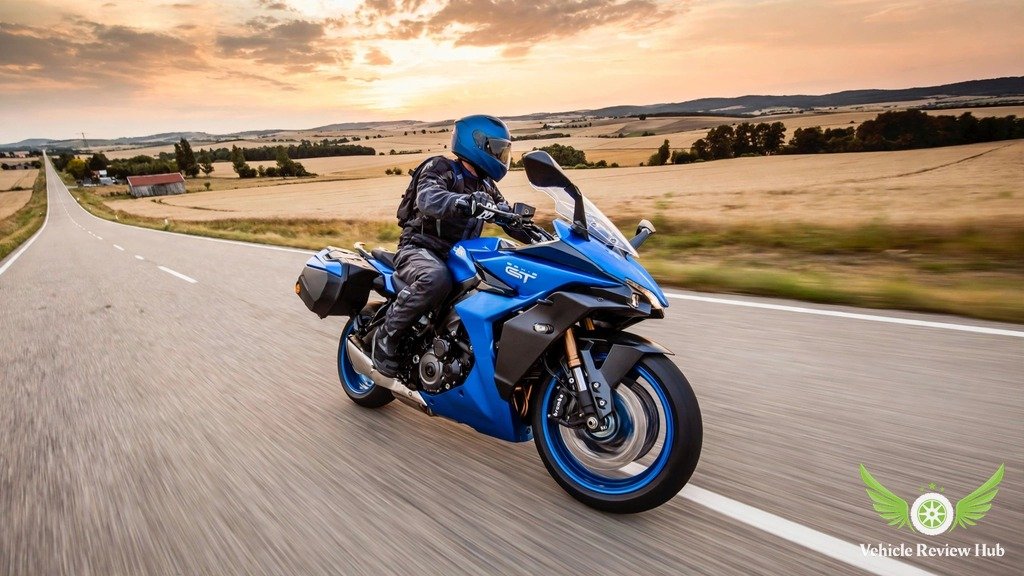
Rider Tested 35.5 MPG, About 178 Miles of Range
Rider tested the GT at 35.5 mpg, or about 178 miles of range from the 5.0-gallon tank — 35.5 times 5.0 is 177.5. That is the headline Suzuki GSX-S1000GT performance mileage figure for US riders, because it is a US test on US gallons. Suzuki’s own estimate is about 35 mpg, and motorcycle.com’s first ride saw a consistent 35 mpg “even riding like a goon.” The motorcycle.com first ride matches Rider almost exactly: two US outlets, same mid-30s answer. The UK numbers look better but are not comparable — Suzuki’s UK claim is 46.3 mpg on imperial gallons, or 193 to 194 miles in theory. Bennetts saw about 45 mpg ridden normally for 180 miles to a tank. MCN’s fleet bike averaged 40 mpg for 171 miles brim-to-empty, and Visordown measured 43 mpg brim-to-brim. Fuel is 90 octane (R+M)/2 or higher.
RevZilla Also Saw Mid-30s in Real Use
RevZilla’s first ride put the GT’s “estimated mileage in the mid-30s,” and its longer-term view was “mid or upper 30s.” That matches the US picture in this Suzuki GSX-S1000GT performance guide: no US outlet has seen 40 mpg from the GT in real riding, and the 200-mile tank is not on the table. The RevZilla first ride is the third US voice saying the same thing, after Rider and motorcycle.com. For context, zabikers measured 6 litres per 100 km over 600 km, or 39.2 mpg US — the most generous real-world Suzuki GSX-S1000GT performance figure here, and still short of 200 miles. The short range is a real trade-off, and it is the one Suzuki GSX-S1000GT performance weakness owners feel on every long day: plan fuel stops at 150 miles and the bike never embarrasses you.
| Source | MPG | Range per tank |
|---|---|---|
| Rider (US test) | 35.5 mpg | About 178 miles |
| motorcycle.com first ride (US) | 35 mpg | About 175 miles |
| MCN fleet (UK) | 40 mpg | 171 miles brim-to-empty |
| Visordown (UK) | 43 mpg | 120–130 usable miles + 20 emergency |
Suzuki GSX-S1000GT Real-World Riding Experience
Numbers only go so far, and Suzuki GSX-S1000GT performance in the real world is where the bike earned its awards: a strong, smooth engine, a stable chassis, and a few comfort quirks owners learn to live with. This section gathers what testers and owners said after riding the bike, not what the spec sheet promises.

Motorcycle of the Year for Rider in 2022
Rider named the Suzuki GSX-S1000GT+ its 2022 Motorcycle of the Year, picking it from more than 60 eligible contenders narrowed to 10 finalists. The award text praised the engine as “a gem with no rough edges,” and the bike won on its motor, its price and its standard equipment rather than on electronics it does not have. motorcycle.com named the GT+ its Best Sport-Touring Motorcycle of 2022. Two awards in the launch year is the strongest single endorsement in this Suzuki GSX-S1000GT performance guide, and it came from testers who rode the whole class. The full launch story, prices and GT versus GT+ split are in the GT review guide. What the awards do not say matters too: neither was given for rider aids, because the GT’s electronics are a generation behind its rivals — no IMU, no cornering ABS, no semi-active suspension. The bike won on engine character and value.
Buzz at 5,000 RPM: UK Owners vs US Testers
The GT’s one real-world complaint is vibration, and the sources disagree about how much it matters — which is why this Suzuki GSX-S1000GT performance guide attributes every claim instead of stating a single figure. MCN’s long-term fleet bike, ridden about 7,000 miles by Emma Franklin, found the bars and pegs calm thanks to rubber mounts and dampers, but the seat “uncomfortably buzzy” at high rpm, “a feeling which is magnified by its short gearing.” RevZilla found “a little buzz through the footpegs and control levers, but not enough to bother me, even on a 300-mile ride.” MCN owner Dan G reported the bars vibrating “at certain revs… not major but enough to get numbness” on long runs. No source pins the buzz to exactly 5,000 rpm — the doc’s figure is a framing, not a measured fact. The context helps: 6,000 rpm in sixth is an indicated 85 mph, so motorway cruising sits in the 5,000 to 6,000 rpm band, exactly where the seat buzz shows up. For Suzuki GSX-S1000GT performance on long days, the buzz is a comfort note, not a mechanical fault.
Suzuki GSX-S1000GT Handling, Braking and Stability
Handling is the GT’s quiet strength. The chassis is conventional — aluminium twin-spar frame, fully adjustable KYB 43 mm fork, KYB rear shock with preload and rebound only — and it works. Suzuki GSX-S1000GT performance in corners is stable and unflappable at full lean, with a stiff, connected feel testers trust. The brakes and the luggage decide how the bike feels day to day, so this section covers both.

Most Full-Face Helmets Fit, One Per Case
The GT+ side cases are the touring test that matters most for Suzuki GSX-S1000GT performance, and the helmet test is consistent across sources: most full-face helmets fit, one per case. Roadracing World and motorcycle.com both confirm an Arai fits — motorcycle.com names the Arai Defiant-X — and Rider agrees. The case-capacity figures conflict: the technical briefing says 25.7 litres per bag, Cycle World and motorcycle.com round that to 26 litres, Cycle News and MotorcycleDB print 27.5 litres, and Suzuki’s marketing material, quoted by Rider, says 36 litres per side. The two figures have never been reconciled in print, so the helmet test is the honest answer: one full-face helmet per case, and the cases are keyed to the ignition. Retrofitting the cases to a base GT costs over $1,000 in parts alone. Suzuki GSX-S1000GT performance braking is powerful but slightly wooden: Brembo four-piston calipers on 310 mm discs, with initial bite testers found lacking and ABS that robs some feel. The Dunlop Roadsport 2 tyres are acceptable and widely replaced early. The service schedule — oil every 3,750 miles under the US manual, valve check at 15,000 — is in the reliability guide.
Cruise Control Settable From 18 to 110 MPH
Cruise control is standard on the GT, and the verified lower bound is 18 mph: it works from 30 km/h in second gear, and at 120 km/h on the clock — about 5,700 rpm — the rider can set it and adjust in 1 km/h increments. The upper limit needs care. The doc heading prints 110 mph, but that figure could not be verified from a Suzuki source — it matches the common 180 km/h ceiling seen in other manufacturers’ cruise systems, but no Suzuki GT owner’s manual passage confirmed it. So this guide prints the 18 mph lower bound as verified and the 110 mph upper limit only as the doc’s claim. What is verified is that the cruise works, the quickshifter is bi-directional and standard, and the package includes three ride modes, five-level traction control plus off, Easy Start and Low RPM Assist. For Suzuki GSX-S1000GT performance on the motorway, cruise control turns the 178-mile tank into a comfortable 178 miles, and it is standard where rivals charge extra.
Suzuki GSX-S1000GT Performance Compared With Other Sport-Touring Bikes
The GT does not ride alone, and Suzuki GSX-S1000GT performance only makes sense against the class. Its closest rival inside Suzuki is the GX crossover, and outside are the Kawasaki Ninja 1100SX, the BMW S 1000 XR and the Yamaha Tracer 9. This section compares the GT with the GX in detail, with the figures the brief verified and nothing it did not.

Suzuki GSX-S1000GT vs the GX and Its Semi-Active Kit
The GX — the GSX-S1000GX, on sale since 2024 — is the GT’s crossover sibling on the same 999cc K5-derived engine and platform, and the difference is electronics and stance. The GX carries Suzuki Advanced Electronic Suspension, a semi-active system, plus Suzuki Road Adaptive Stabilization; the GT has neither. The GX is taller and more upright, an adventure-crossover stance, while the GT is the lower, sportier traditional sport-tourer. The GX is also the restricted one: GPS-measured 132.92 mph, electronically capped, against the GT’s roughly 145 mph UK figure. The GX performance guide covers the crossover’s numbers in full. For Suzuki GSX-S1000GT performance, the comparison is a trade: the GX buys semi-active suspension and a taller riding position with a capped top speed, while the GT buys a lower seat, a sportier chassis and an unrestricted top end for less money. The full rival picture — Ninja 1100SX at $13,999 plus $840, Tracer 9 at $12,599 plus $700, and S 1000 XR at $18,825 plus $995 — is in the comparison guide; rival MPG and service intervals were not verified from named US tests and are not printed here.
Is the Suzuki GSX-S1000GT Suitable for Beginner Riders? No
No — and this Suzuki GSX-S1000GT performance guide says so plainly. The GT claims 150 hp, puts about 136 hp to the wheel, weighs 498 lb as a base GT and 518 lb as a GT+, and answers the throttle sharply in A mode. That is a litre-class sport-tourer, and every review frames it as an experienced-rider bike. A beginner has no business learning on a bike that rushes hard above 6,000 rpm and carries no lean-sensitive rider aids to catch a mistake — no IMU means no cornering ABS and no lean-sensitive traction control. The sensible first big bike is a middleweight sport-tourer with far less power and weight. The GT rewards experience: buy it after you already know how to ride fast, not before.
Suzuki GSX-S1000GT Performance: Frequently Asked Questions
Direct answers to the questions riders ask about Suzuki GSX-S1000GT performance. Every figure is labelled as claimed or tested.
How much horsepower does the Suzuki GSX-S1000GT make on a dyno?
On Cycle World’s Dynojet the GT made 135.53 hp at 10,360 rpm and 73.15 lb-ft at 9,190 rpm. Rider measured 136 hp at 10,200 rpm on Jett Tuning’s dyno — that run was on the naked GSX-S1000’s engine, cited in the GT road test. The global claim for Suzuki GSX-S1000GT performance is 150 hp; Suzuki USA publishes no figures.
What is the top speed of the Suzuki GSX-S1000GT?
MCN in the UK lists the GT at 145 mph and measured a true 146.22 mph in previous tests. No US outlet has published an instrumented top-speed run, so this Suzuki GSX-S1000GT performance guide prints no US tested figure.
Is the GSX-S1000GT top speed restricted like the GX?
No. The GX is electronically capped at a GPS-measured 132.92 mph, but the GT is not restricted — its UK figure is about 145 mph. The 132.92 mph number belongs to the GX and must never be quoted as the GT’s in any Suzuki GSX-S1000GT performance comparison.
What is the 0-60 time of the GSX-S1000GT?
There is no verified 0–60 time for the GT from any named test, so this Suzuki GSX-S1000GT performance guide prints none. No US outlet has published an instrumented acceleration run, and aggregator figures are estimates, not facts.
What MPG does the GSX-S1000GT get in real riding?
Rider tested 35.5 mpg in the US, motorcycle.com saw a consistent 35 mpg, and RevZilla saw mid-30s. UK tests look better — 40 to 45 mpg — but those are imperial gallons, not US gallons.
How far can the GSX-S1000GT go on a full tank?
About 178 miles on Rider’s tested 35.5 mpg from the 5.0-gallon tank, or about 175 miles on motorcycle.com’s 35 mpg. For Suzuki GSX-S1000GT performance on tour, plan fuel stops at 150 miles.
Why does the GSX-S1000GT only get about 175 miles per tank?
Because the tank is only 5.0 gallons and the litre-four drinks in the mid-30s in real use — the short range is the one Suzuki GSX-S1000GT performance trade-off every owner feels. Suzuki’s UK claim of 46.3 mpg is on imperial gallons, but no US test has matched it. The small tank, not the engine, is the limit.
Does the GSX-S1000GT vibrate at highway speed?
Some buzz comes through the seat at high rpm, according to MCN’s long-term fleet bike, and through the pegs and bars at certain revs, according to RevZilla and one MCN owner. No source pins it to exactly 5,000 rpm.
What is the GSX-S1000GT cruise control speed range?
The verified lower bound is 18 mph — cruise works from 30 km/h in second gear. The doc’s 110 mph upper limit could not be verified from a Suzuki source, so this guide prints it only as the doc’s claim.
How fast is the GSX-S1000GT in top gear at 6,000 rpm?
An indicated 85 mph in sixth gear at 6,000 rpm, according to RevZilla — a useful Suzuki GSX-S1000GT performance reference for motorway cruising. At 120 km/h the engine sits at about 5,700 rpm, which puts motorway cruising in the 5,000 to 6,000 rpm band.
How does the GSX-S1000GT compare to the GX for performance?
The GX has semi-active suspension and a taller crossover stance but is capped at 132.92 mph GPS. The GT has conventional suspension, a lower and sportier chassis, and an unrestricted top end of about 145 mph, which is where Suzuki GSX-S1000GT performance wins.
Is the GSX-S1000GT good for beginners?
No. With a claimed 150 hp, about 136 hp at the wheel, 498 lb of weight and no lean-sensitive rider aids, Suzuki GSX-S1000GT performance is for experienced riders. A middleweight sport-tourer is the sensible first big bike.