The short answer in this Suzuki GSX-S1000GX review is that Suzuki’s first sport crossover is the most interesting bike the company has built in years: a GSX-S1000GT with a taller stance, semi-active suspension and a six-axis IMU, priced from $18,499 for the 2024 GX+ and $18,949 for the 2027 model. This Suzuki GSX-S1000GX review covers the prices, the specs, the SAES suspension, the riding experience and the verdict, so you can decide whether the crossover formula is worth the premium over the GT.
Suzuki GSX-S1000GX Overview and Model-Year Updates
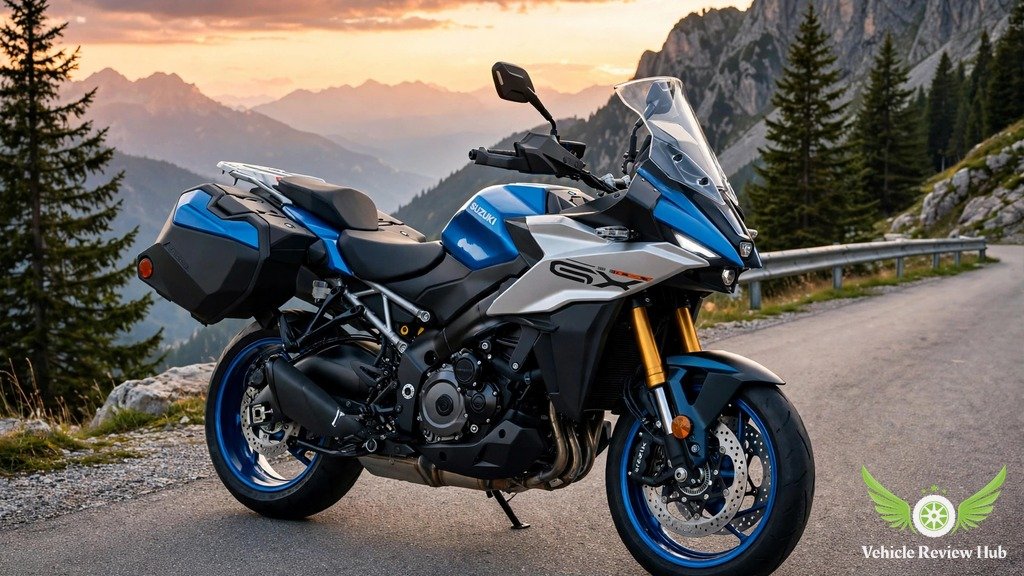
The GX arrived at a world launch in Portugal in November 2023 and went on sale for the 2024 model year. Suzuki calls it a sport crossover: it sits between the GSX-S1000GT sport-tourer and the V-Strom adventure line, using the GT’s engine and main frame in a taller chassis with 5.9 inches of travel at both ends. This part of the Suzuki GSX-S1000GX review looks at which model years reached the United States and what makes the GX the first of its kind for Suzuki — the bike at the centre of this Suzuki GSX-S1000GX review.
Latest US Year Is 2027: GX+ Only, Every Year
The latest US model year is 2027, and the GX+ is the only version sold in America — every year, from the 2024 launch to today. The base GX was never sold in the United States. American buyers get the fully equipped GX+ only, with the color-matched side cases, the centrestand and the full electronics package included as standard. The base GX exists in the UK and Europe from £14,499, but that bike is not the one in this Suzuki GSX-S1000GX review. The GX+ was a finalist for Rider’s 2024 Motorcycle of the Year.
First Suzuki With SAES and a GSX-S IMU
The GX is the first production Suzuki with semi-active suspension, and the first GSX-S with a six-axis IMU. The system is called SAES, Suzuki Advanced Electronic Suspension: a Showa Electronically Equipped Ride Adjustment inverted fork and a Balance Free Rear Cushion shock. Damping adjusts automatically up to 1,000 times per second from wheel sensors and IMU input, with Soft, Medium and Hard modes plus a User mode, and automatic rear preload with three manual positions. A second system, SRAS or Suzuki Road Adaptive Stabilization, adapts the damping to the road surface. The six-axis IMU also feeds cornering traction control, cornering ABS and slope-dependent control. None of this exists on the GT, which runs conventional KYB suspension, standard ABS only and no IMU at all.
Suzuki GSX-S1000GX Engine and Specifications
The GX uses the same 999cc liquid-cooled inline-four as the GT, derived from the 2005–2008 K5 GSX-R1000, an engine Suzuki has built more than 180,000 of over 18 years. Suzuki says the tune is exactly the same as the GT, with only the throttle response changed slightly on the GX. This Suzuki GSX-S1000GX review covers the engine and the dimensions that make the GX taller and heavier than the GT.

999cc Liquid-Cooled Inline-Four at 73.4 by 59.0mm
The engine displaces 999.8cc from a 73.4 by 59.0mm bore and stroke, with a 12.2:1 compression ratio, a six-speed gearbox, chain final drive and a slipper/assist clutch. It is a long-stroke K5 architecture, not the current short-stroke GSX-R1000R engine. Claimed output is 150 horsepower at 11,000 rpm and 106 Nm of torque at 9,250 rpm, which works out to 78 lb-ft. The 152 PS figure you will see in some sources is the same 150 horsepower expressed in metric units, not a different number. Suzuki USA does not publish horsepower or torque for the GX, so the claimed numbers come from Suzuki’s global specifications; some American tables print 79.6 lb-ft instead of 78. The motorcycle.com first ride describes the power as smooth as butter from below 2,000 rpm, and gave the engine 19 out of 20 in its scoring. MCN dynoed the GX itself at 143.2 bhp and 77.3 lb-ft at the rear wheel — the only named GX dyno figure, and the one this Suzuki GSX-S1000GX review carries into the GX performance guide.
Seat 33.3 Inches, Weight 511 Pounds Without Cases
The GX seat sits at 33.3 inches, 1.4 inches higher than the GT’s 31.9-inch seat, and that height is the first thing most riders notice. The handlebars are 50mm wider and 48mm higher than the GT’s, opening the position out toward an adventure bike. Curb weight is 511 pounds without the cases fitted, and the GX+ ships with its cases standard in the US. MCN measured 234.2 kg with a full tank, which is 516 pounds. The fuel tank holds 5.0 US gallons, the same as the GT. The wheels are 17 inches at both ends — 120/70ZR17 front and 190/50ZR17 rear on Dunlop Roadsport 2 tyres — not a 19-inch front, which belongs to adventure bikes like the Multistrada V4 S.
| Specification | Suzuki GSX-S1000GX+ |
|---|---|
| Engine | 999cc liquid-cooled inline-four, 73.4 x 59.0mm, 12.2:1 |
| Claimed power / torque | 150 hp @ 11,000 rpm / 78 lb-ft @ 9,250 rpm (global) |
| Seat height | 33.3 inches |
| Curb weight | 511 lb without cases; 516 lb full of fuel (MCN measured) |
| Suspension travel | 5.9 inches front and rear, SAES semi-active |
| Wheels / tyres | 17 in both ends; 120/70ZR17 front, 190/50ZR17 rear |
| Fuel tank | 5.0 US gallons |
| Electronics | 6-axis IMU, cornering ABS, SAES, SRAS, quickshifter, cruise control |
Suzuki GSX-S1000GX Price and Market Availability
Price is where this Suzuki GSX-S1000GX review gets concrete. The GX+ is the most expensive Suzuki you could buy when it launched, and it still sits well above the GT in the range. Every US model year is the GX+ only, so there is no cheaper base GX to confuse the numbers with, and the price has climbed steadily from $18,499 in 2024 to $18,949 in 2027. This Suzuki GSX-S1000GX review puts the four model years side by side and clears up the price figure that gets quoted wrong.

Suzuki GSX-S1000GX Price in the USA: $18,949 for 2027
The 2027 GX+ costs $18,949 before destination, with a $750 destination charge, for a total of $19,699. That figure comes from SoCal Motorcycles, citing Suzuki’s US site as of October 2026, and from the motorcycle.com 2027 GX+ comparison page, which lists the same $18,949 MSRP and $750 destination charge, because Suzuki’s own 2027 GX+ page does not resolve at a working address. The 2027 bike comes in Glass Sparkle Black, confirmed by dealer listings, and no second US color has been verified, so this Suzuki GSX-S1000GX review prints only the one.
The $18,599 Figure Was 2025, Not 2026
The 2025 GX+ cost $18,599, and that is where the confusion starts. When motorcycle.com announced the 2026 bike in December 2025, it quoted $18,599 as unchanged from 2025, but noted the figure excluded new surcharges and destination charges introduced for 2026. The actual 2026 price is $18,749, confirmed by Rider’s preview as updated in August 2026, by TopSpeed and by dealer brochures. So $18,599 belongs to 2025, not 2026. The full ladder is $18,499 for 2024, $18,599 for 2025, $18,749 for 2026 and $18,949 for 2027. The 2026 destination charge has not been verified individually, so this Suzuki GSX-S1000GX review does not print a 2026 out-the-door total. The 2026 bike also gained aerodynamic winglets on the lower cowl, the only running change of note for that year. Colors are Pearl Matte Shadow Green for 2024, Metallic Triton Blue for 2025, Pearl Brilliant White or Metallic Triton Blue for 2026, and Glass Sparkle Black for 2027.
| Model year (US GX+) | MSRP | Destination | Total |
|---|---|---|---|
| 2024 GX+ | $18,499 | Not verified individually | — |
| 2025 GX+ | $18,599 | Not verified individually | — |
| 2026 GX+ | $18,749 | Not verified individually | — |
| 2027 GX+ | $18,949 | $750 | $19,699 |
Suzuki GSX-S1000GX Design, Features and Technology
The GX looks like a GT that has been stretched upward, and the design follows the same logic. The fairing is taller and wider, the bars are higher, the screen is adjustable, and the luggage is built in rather than added on. The SAES suspension, the IMU, the cornering ABS and the smart cruise control are all standard, and none of them exists on the GT. This part of the Suzuki GSX-S1000GX review covers the cases, the windscreen and the electronics in turn.

Cases Are 25.7 Litres Each and Hold a Helmet
The GX+ side cases hold 25.7 litres each, according to Suzuki’s technical briefing, and that figure rounds to 26 litres in Cycle World and motorcycle.com. They are color-matched, locking and keyed to the ignition, and standard on the US GX+ with a centrestand. Rider, quoting Suzuki’s press material, describes them as 36 litres per side, and TopSpeed has printed 37 litres. The honest position in this Suzuki GSX-S1000GX review is to print both: the technical briefing says 25.7 litres per bag, and Suzuki’s marketing says 36 litres per side. Either way, most full-face helmets fit, one per case, which is the practical test that matters. The centrestand is standard in the US but a £403 option in the UK. Heated grips are an accessory, priced at £419 in the UK, and there is no top box option, which is a real limitation for riders who want maximum luggage. The Rider first ride confirms the cases and centrestand are standard on the US GX+, and that the 2024 US bike came only in Pearl Matte Shadow Green.
The Windscreen Moves 50mm but Needs Bolts Undone
The windscreen adjusts through three settings with 50mm of travel, raising or lowering its height by up to 43mm — a genuine improvement over the GT’s fixed screen. The catch is that it does not adjust on the move: the rider has to undo four screws, and the toolkit has no small enough Allen key, according to MCN’s long-term test. Motorcycle.com calls this its most inexcusable complaint about the bike: a screen that needs tools and a stop to adjust is barely more useful than a fixed one. The 6.5-inch TFT dash has mySPIN connectivity and a USB socket, and hand guards and a luggage rack are standard.
Suzuki GSX-S1000GX Riding Experience and Comfort
The GX rides like a GT with the edges taken off, and that is the simplest summary in this Suzuki GSX-S1000GX review. The upright position, the longer travel and the SAES damping make it more comfortable over rough roads, and the taller stance gives a better view ahead. It is not as quick to flick from side to side as the GT, but it is hardly a slouch, and it stays stable and comfortable at speed. This Suzuki GSX-S1000GX review covers the riding position, the handling and the suspension travel.

Riding Position, Handling and Low-Speed Maneuverability
The riding position is open and upright, blending the attributes of an adventure bike with those of a sport-tourer, in Rider’s words from the Portugal launch — and the position this Suzuki GSX-S1000GX review calls the bike’s best feature. The bars sit 50mm wider and 48mm higher than the GT’s — Rider measured them 1.7 inches closer and 1.5 inches taller — which puts the rider upright with a clear view over traffic. The seat is 33.3 inches high, so shorter riders will be on tiptoes at a stop — the real cost of the taller stance. Low-speed maneuverability is good for a bike of this size, helped by the wide bars, and the GX is easy to paddle around a car park. At speed it is stable and forgiving when pushed, and the SAES keeps the chassis composed over bumps that would upset the GT’s conventional suspension. The stock seat is the weak point in this Suzuki GSX-S1000GX review: motorcycle.com found it created hotspots after only a few hours, and the $400 premium seat only staved off the pain slightly longer. Rider found it less comfortable than the GT’s seat over distance, so it is worth a long test ride before buying.
The video below is Rider’s first ride of the 2024 GX+ at the Portugal world launch, the canonical US first ride of this bike.
Travel 5.9 Inches Both Ends, Taller Than the GT
Suspension travel is 5.9 inches at both ends, against the GT’s 4.7 inches at the front and 5.1 at the rear, and that extra travel is what makes the GX a crossover rather than a taller GT. The SAES system reads the road up to 1,000 times a second and adjusts the damping on the move, with Soft, Medium and Hard modes plus a User mode, and the rear preload sets itself automatically with load detection. Motorcycle.com found the SAES took time to dial in, but the custom mode and preload adjustment fixed the feel, and the anti-dive held the front up under braking, even if it ramped up quickly. Other testers were less convinced: one 2026 GX+ owner found the SAES too firm regardless of the setting, while another found it too soft in its sportiest setting. The brakes are the other complaint: motorcycle.com found little initial bite and a vague feel at the lever, and blamed the rubber brake lines, calling them inexcusable on a flagship. MCN measured 70 mph to a stop in 58.67 metres, 2.52 metres worse than the GT, with full figures in the GX performance guide. A pad swap and steel lines would cure most of it, but they should not be needed at this price.
Suzuki GSX-S1000GX Review: Pros, Cons and Verdict
The verdict in this Suzuki GSX-S1000GX review is that the GX is a genuinely good motorcycle with a price problem. The SAES suspension, the IMU, the cornering ABS and the upright ergonomics make it the most capable and comfortable bike in Suzuki’s sport-touring range, and the engine has nearly two decades of service behind it. The price, though, puts it against the BMW S 1000 XR and within reach of the Ducati Multistrada V4 S. This final part of the Suzuki GSX-S1000GX review weighs the advantages against the limitations.
Main Advantages and Limitations of the Suzuki GSX-S1000GX
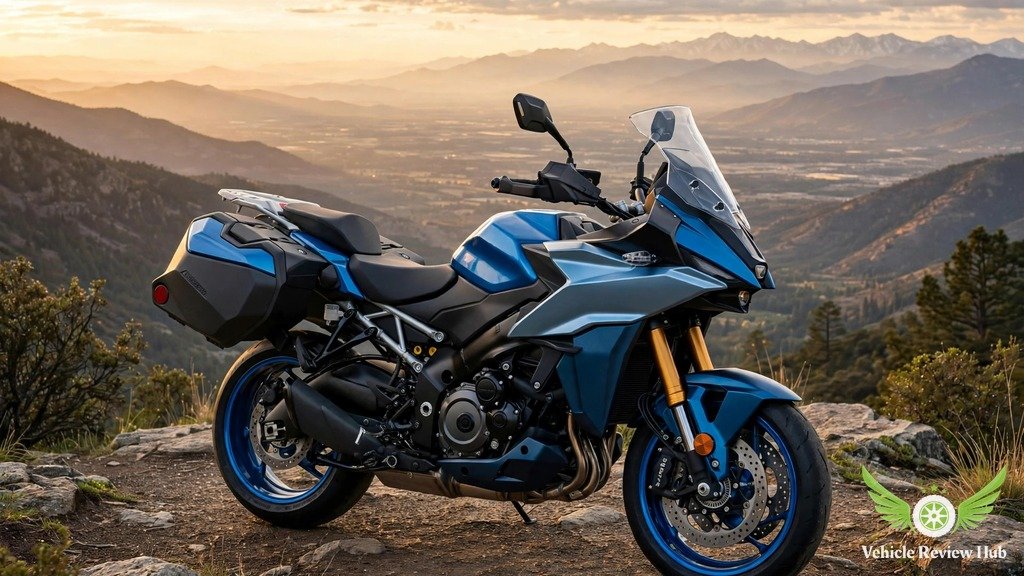
The SAES semi-active suspension is the first on a production Suzuki, and it works, adjusting damping up to 1,000 times a second for a ride quality the GT cannot match. The six-axis IMU brings cornering traction control and cornering ABS, which the GT does not have at any price. The upright position is comfortable and commanding, the 5.9 inches of travel soak up rough roads, and the cases and centrestand come standard on the US GX+. The engine is smooth from below 2,000 rpm, makes 150 horsepower, and has a long reliability record. The limitations are just as clear. The stock seat creates hotspots after a few hours, the front brake feels vague because of the rubber lines, and the windscreen needs tools to adjust. The engine buzzes at motorway speed, enough to blur the mirrors, according to MCN and two owner-testers. The mySPIN app does not work well, and there is no radar cruise control, unlike the Multistrada V4 S and the Tracer 9 GT+. The price is the biggest limitation: at $19,699 in total for 2027, the GX+ costs $4,350 more than the 2027 GT+ at $15,349, as the GT comparison guide shows. Buyers who want the SAES and the upright stance will pay it; buyers who want the engine will save thousands on the GT+.
Twelve-Month Unlimited-Mileage Warranty in the USA
The GX carries a 12-month unlimited-mileage limited warranty in the United States, the same as the GT. That is short next to the BMW S 1000 XR’s three-year, 36,000-mile warranty and the Ducati Multistrada V4 S’s 24 months, and it is the one place the GX looks thin against its rivals. The warranty covers the SAES suspension and the electronics, which matters, because a SAES fault is a dealer-level diagnosis with no owner-serviceable parts. The manual lists the forks and rear suspension as inspection items only, at 7,500 and 15,000 miles, with no fluid change or seal service for the SAES units. That is good news for running costs, but there is no verified SAES repair price to budget against if something fails after the warranty ends. The full service schedule, including the 3,750-mile oil interval and the 15,000-mile valve check, is in the GX reliability guide, and this Suzuki GSX-S1000GX review points readers there for the numbers. Twelve months passes quickly on a bike built for big miles, so the service record matters more than the warranty once it ends.
Suzuki GSX-S1000GX Review: Frequently Asked Questions
Direct answers to the questions riders ask about the Suzuki GSX-S1000GX.
What is the 2027 Suzuki GSX-S1000GX+ price in the USA?
The 2027 GX+ costs $18,949 before destination, plus a $750 destination charge, for a total of $19,699. It is the only GX+ version sold in the US, and it comes in Glass Sparkle Black, as this Suzuki GSX-S1000GX review confirms.
Is the base Suzuki GSX-S1000GX sold in the US?
No. The base GX was never sold in the United States. American buyers get the GX+ only, every year, with the side cases, the centrestand and the full electronics package included as standard — the US-only setup this Suzuki GSX-S1000GX review covers.
What is the difference between the GSX-S1000GX and the GX+?
The GX+ is the fully equipped version, with color-matched locking side cases, a centrestand and the complete electronics package. The base GX exists in the UK and Europe from £14,499, but it is not sold in the US, so the difference does not matter to American buyers reading this Suzuki GSX-S1000GX review.
How big are the GSX-S1000GX+ side cases really?
Suzuki’s technical briefing says 25.7 litres per bag, which rounds to 26 litres, while Suzuki’s marketing material says 36 litres per side. This Suzuki GSX-S1000GX review prints both figures with their sources. Either way, most full-face helmets fit, one per case.
What engine does the GSX-S1000GX use?
A 999cc liquid-cooled inline-four derived from the 2005–2008 K5 GSX-R1000, with a 73.4 by 59.0mm bore and stroke and a 12.2:1 compression ratio. It is the same engine family as the GT, with the same tune, as this Suzuki GSX-S1000GX review notes.
How much horsepower does the GSX-S1000GX make?
Suzuki claims 150 horsepower at 11,000 rpm and 78 lb-ft of torque at 9,250 rpm. MCN dynoed the GX itself in the UK and measured 143.2 bhp and 77.3 lb-ft at the rear wheel — the dyno figure this Suzuki GSX-S1000GX review uses. Suzuki USA publishes no horsepower or torque figures for the GX.
What is SAES on the GSX-S1000GX?
SAES is Suzuki Advanced Electronic Suspension, a Showa semi-active system that adjusts damping automatically up to 1,000 times per second. It offers Soft, Medium and Hard damping modes plus a User mode, with automatic rear preload. It is the first semi-active suspension on a production Suzuki, and the headline feature of this Suzuki GSX-S1000GX review.
Does the GSX-S1000GX have cornering ABS or an IMU?
Yes — and that is a headline finding of this Suzuki GSX-S1000GX review. The GX is the first GSX-S with a six-axis IMU, and it feeds cornering traction control, cornering ABS and slope-dependent control. The GT has none of these.
Does the GSX-S1000GX have radar cruise control?
No. The GX has smart cruise control, which lets the rider change gears through the quickshifter without cancelling cruise, but it has no radar — a gap this Suzuki GSX-S1000GX review flags. The Multistrada V4 S and the Tracer 9 GT+ both offer radar cruise; the GX does not.
What is the seat height of the GSX-S1000GX?
The seat sits at 33.3 inches, which is 1.4 inches higher than the GT’s 31.9-inch seat. The handlebars are also 50mm wider and 48mm higher than the GT’s, as this Suzuki GSX-S1000GX review notes.
How much does the GSX-S1000GX weigh?
Curb weight is 511 pounds without the cases fitted. MCN measured 234.2 kg with a full tank of fuel, which is 516 pounds. The GX+ ships with its cases standard in the US, so the 511-pound figure excludes them, as this Suzuki GSX-S1000GX review notes.
Is the windscreen on the GSX-S1000GX adjustable on the move?
No. The windscreen moves through three settings with 50mm of travel, but the rider has to undo four screws to change it, and the toolkit does not include a small enough Allen key. It is a setup choice, not a riding adjustment, and one of the frustrations this Suzuki GSX-S1000GX review flags.