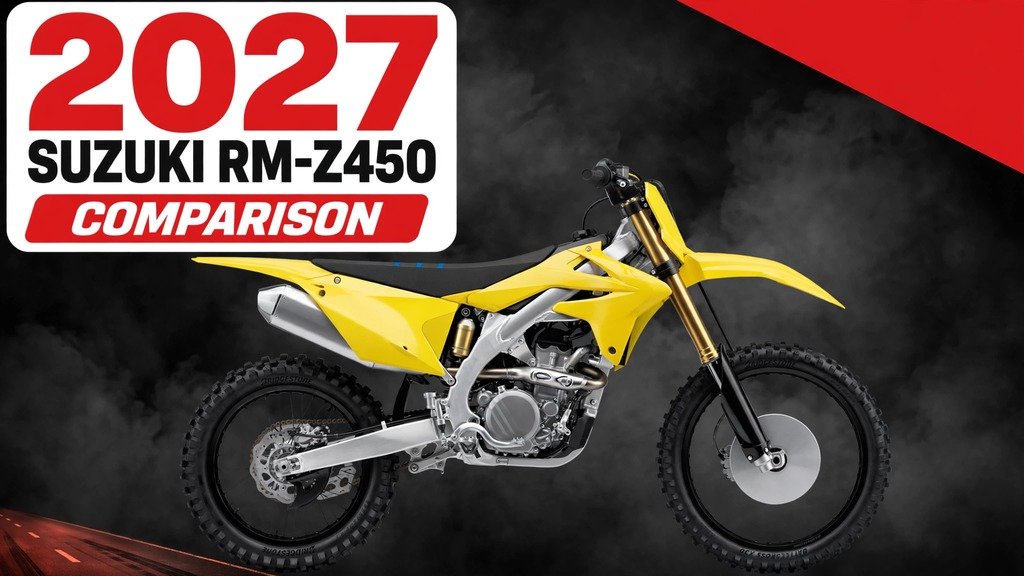
The 2027 Suzuki RM-Z450 is the cheapest 450 motocrosser in the USA at $10,349 delivered, and that single fact frames this whole Suzuki RM-Z450 comparison. Against the Honda CRF450R, Yamaha YZ450F and Kawasaki KX450, the Suzuki gives up electric start and every recent shootout placing — yet it makes 56.6 hp stock on the Dirt Bike 2026 dyno, ahead of the all-new Honda. This Suzuki RM-Z450 comparison puts the four Japanese 450s side by side on price, dyno power and starting systems.
Suzuki RM-Z450 Overview and Its Closest Rivals
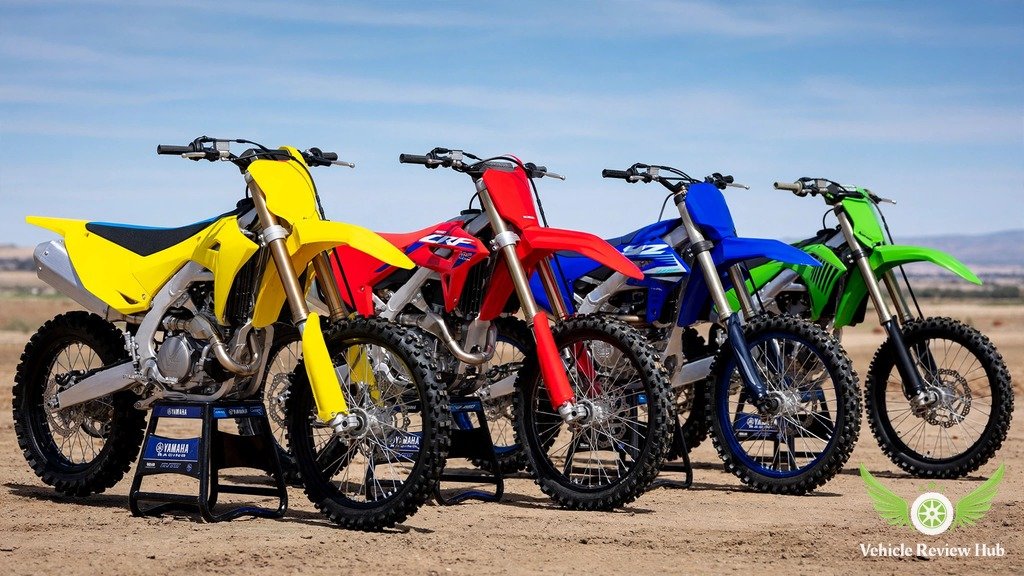
The 450 class in 2027 is a four-bike Japanese field, and the Suzuki is the outlier in it. Honda rebuilt the CRF450R, Yamaha’s YZ450F carries its 2026 update into 2027 and Kawasaki’s KX450 is a recent design — while the Suzuki runs a 2018 platform, updated for 2027 with KYB suspension front and rear. That age is the honest starting point: the Suzuki is not the newest, lightest or best-placed bike in this Suzuki RM-Z450 comparison. It is the cheapest — and the question is whether the cheapest is also a good buy.
Why These Three Rivals: the Japanese Field
The three rivals in this Suzuki RM-Z450 comparison are the three Japanese 450s a US buyer cross-shops against the Suzuki: the Honda CRF450R, the Yamaha YZ450F and the Kawasaki KX450. All four are 450cc liquid-cooled four-stroke singles built for closed-course motocross, all four are sold in the USA for 2027, and all four are priced within $625 of each other delivered. The European 450s are covered as alternatives in the verdict section.
How the Four Bikes Differ at a Glance
At a glance, the four bikes are closer than the shootout headlines suggest. The Suzuki is the only kick-start bike, the only one sharing a cable clutch with the Yamaha, and the heaviest on claimed weight — yet its stock dyno figure sits second among the four. The spec table below is the foundation of this Suzuki RM-Z450 comparison.
| Specification | Suzuki RM-Z450 | Honda CRF450R | Yamaha YZ450F | Kawasaki KX450 |
|---|---|---|---|---|
| Engine | 449cc single, liquid-cooled | 449.5cc single, liquid-cooled | 450cc single, liquid-cooled | 449cc single, liquid-cooled |
| Bore x stroke | 96.0 x 62.1 mm | 97.0 x 60.8 mm | 97.0 x 60.8 mm | 96.0 x 62.1 mm |
| Compression ratio | 12.5:1 | 13.8:1 | 13.0:1 | 12.5:1* |
| Valvetrain | DOHC, 4-valve | Unicam SOHC, 4-valve | DOHC, 4 titanium valves | DOHC, 4-valve |
| Starter | Kick start only | Electric | Electric | Electric |
| Clutch | Cable, wet multi-plate | Hydraulic | Cable, wet multi-plate | Hydraulic |
| Claimed weight | 247 lb curb | 238 lb curb | 243 lb wet | 240 lb w/o fuel |
| 2027 delivered price | $10,349 | $10,699 | $10,974 | $10,949 |
Notes for this Suzuki RM-Z450 comparison table: *Kawasaki’s own spec sheet prints 12.5:1 for the 2027 KX450; some 2027 model listings print 12.7:1. Weights are measured on different bases, so treat the weight row as a guide.
All twelve bikes in the dyno table below were run stock, on standard maps, on Dirt Bike magazine’s Pro Circuit dyno for its 2026 wrap, so the figures are directly comparable — and the Suzuki’s place in it surprises.
| Bike | Horsepower | Torque |
|---|---|---|
| Husqvarna FC450 | 60.2 hp @ 9,400 rpm | 36.5 lb-ft @ 7,100 rpm |
| KTM 450 SX-F | 59.5 hp @ 9,300 rpm | 36.3 lb-ft @ 7,600 rpm |
| Triumph TF 450-X | 58.6 hp @ 9,200 rpm | 36.0 lb-ft @ 6,700 rpm |
| GasGas MC450F | 57.9 hp @ 9,200 rpm | 35.9 lb-ft @ 6,900 rpm |
| Kawasaki KX450 | 57.7 hp @ 9,400 rpm | 34.8 lb-ft @ 6,900 rpm |
| Ducati Desmo450 MX | 57.3 hp @ 9,300 rpm | 35.5 lb-ft @ 7,500 rpm |
| Yamaha YZ450F | 56.7 hp @ 9,600 rpm | 35.1 lb-ft @ 7,500 rpm |
| Suzuki RM-Z450 | 56.6 hp @ 9,400 rpm | 35.2 lb-ft @ 8,100 rpm |
| TM MX450Fi | 55.6 hp @ 9,700 rpm | 34.4 lb-ft @ 7,200 rpm |
| Honda CRF450R | 55.3 hp @ 8,700 rpm | 36.5 lb-ft @ 7,000 rpm |
| Beta 450RX | 54.6 hp @ 10,500 rpm | 31.3 lb-ft @ 7,400 rpm |
| Kove MX450 | 50.8 hp @ 9,500 rpm | 31.6 lb-ft @ 7,300 rpm |
Notes for this Suzuki RM-Z450 comparison table: the Suzuki ranks 8th of 12 on horsepower and 7th of 12 on torque — 3.6 hp behind the Husqvarna FC450, 0.1 hp behind the Yamaha, 1.1 hp behind the Kawasaki and 1.3 hp ahead of the Honda. Dirt Rider’s 52.8 hp (with a T-6) and MXA’s 54.87 hp (with a Ti-6) are not stock figures.
The film below is Dirt Bike’s 2026 450 shootout film. The placements in this Suzuki RM-Z450 comparison come from the written shootout and dyno wrap, not from the film.
Suzuki RM-Z450 vs Honda CRF450R
The Honda is the hardest rival in this Suzuki RM-Z450 comparison, because the 2027 CRF450R is the most comprehensively rebuilt bike in the class — and yet the Suzuki beats it on the dyno. Honda rebuilt the engine, lightened the chassis by about 10 lb and raised claimed power by about 10 percent, for a 238 lb curb-weight bike with electric start and a hydraulic clutch.

Engine, Specs and Performance Side by Side
On paper the Honda’s new engine should walk away from the Suzuki’s 2018 architecture. The 2027 CRF450R runs a 449.5cc Unicam single (see the spec table above) against the Suzuki’s 449cc DOHC single. But the Dirt Bike 2026 dyno wrap puts the Suzuki ahead: 56.6 hp at 9,400 rpm against the Honda’s 55.3 hp at 8,700 rpm. The Honda answers on torque, 36.5 lb-ft at 7,000 rpm against the Suzuki’s 35.2 at 8,100 rpm, and it peaks 1,100 rpm lower. This Suzuki RM-Z450 comparison calls it a split: Suzuki wins peak horsepower, Honda wins low-end torque and weight. The Honda starts with a button, the Suzuki with a kick lever. The Suzuki RM-Z450 performance guide keeps the figures separate by dyno and exhaust state.
Price, Equipment and Which Suits Which Rider
The Honda costs $10,099 plus $600 destination, $10,699 delivered — $350 more than the Suzuki’s $10,349. For that $350 a buyer gets the all-new 2027 bike, electric start, a hydraulic clutch and a lighter chassis. The HRC Works Edition is $12,999 and the CRF450RX is $10,399; the Suzuki’s free T-6 offer expired September 30, 2026, and is not current value. The Honda suits the rider who wants the newest hardware, the button start and the strongest low-end pull in the class. The Suzuki suits the rider who wants the cheapest way into a 450 that still out-powers the Honda on the dyno, and who values the Suzuki’s best-turning chassis reputation over the Honda’s newness.
Suzuki RM-Z450 vs Yamaha YZ450F
The Yamaha is the closest contest in this Suzuki RM-Z450 comparison — on the dyno the two bikes are separated by one tenth of a horsepower. The 2027 YZ450F carries its major 2026 update into 2027, and the magazines keep putting it on the podium: third in the MXA 2025 shootout, where the Suzuki finished seventh of seven.

Engine, Specs and Performance Side by Side
The two engines are near-twins on the spec sheet and near-dead-even on the dyno. The Yamaha runs a 450cc DOHC single with four titanium valves (see the spec table above). On the Dirt Bike 2026 dyno wrap the Yamaha makes 56.7 hp at 9,600 rpm and the Suzuki 56.6 hp at 9,400 rpm — a 0.1 hp gap. Torque is just as close: Yamaha 35.1 lb-ft at 7,500 rpm, Suzuki 35.2 at 8,100 rpm. The Yamaha has electric start where the Suzuki is kick-only, and its Power Tuner app changes maps from a phone, where the Suzuki’s MX-Tuner 4.0 needs a separately bought battery and cable. Both bikes run cable clutches — the Yamaha is the only rival that shares the Suzuki’s cable actuation. Both bikes run KYB suspension for 2027. The Cycle News 2027 YZ450F review calls the Yamaha one of the top dogs in the class — but the dyno record in this Suzuki RM-Z450 comparison says the Suzuki’s engine is its equal.
Price, Equipment and Which Suits Which Rider
The Yamaha costs $10,299 plus $675 destination, $10,974 delivered — $625 more than the Suzuki, the widest delivered gap in the Japanese field. For that $625 a buyer gets the third-place MXA 2025 shootout bike, electric start and the Power Tuner app. The Yamaha suits the rider who wants proven shootout results and push-button convenience and will pay the largest premium in the field for them. The Suzuki suits the rider who looks at a 0.1 hp dyno gap, a $625 saving and the same KYB suspension brand and decides the Yamaha’s advantages are not worth six hundred dollars.
Suzuki RM-Z450 vs Kawasaki KX450
The Kawasaki is the power leader of the three rivals in this Suzuki RM-Z450 comparison, and the one that most clearly shows what the Suzuki gives up for its price. The 2027 KX450 makes 57.7 hp on the Dirt Bike dyno — 1.1 hp more than the Suzuki — and it brings electric start, a hydraulic clutch, Brembo brakes and a 49 mm Showa fork against the Suzuki’s kick lever, cable clutch and Nissin brakes.

Engine, Specs and Performance Side by Side
The two engines share a bore and stroke — 96.0 x 62.1 mm on both bikes — but the Kawasaki extracts more from it. Both engines share a 96.0 x 62.1 mm bore and stroke; Kawasaki’s spec sheet prints 12.5:1, though some 2027 listings print 12.7:1. On the Dirt Bike 2026 dyno wrap the Kawasaki makes 57.7 hp at 9,400 rpm against the Suzuki’s 56.6 at the same rpm. Torque flips the other way by a whisker: the Kawasaki makes 34.8 lb-ft at 6,900 rpm against the Suzuki’s 35.2 at 8,100 rpm. Around the engine the Kawasaki is the more modern machine: electric start, a hydraulic clutch, a 49 mm Showa fork, Brembo brakes and launch control, traction control and power modes, against the Suzuki’s S-HAC, cable clutch and Nissin brakes. The shootout record separates them more: the Kawasaki finished sixth in the MXA 2025 shootout, the Suzuki seventh. In this Suzuki RM-Z450 comparison the Kawasaki makes the Suzuki look oldest — and the Suzuki’s reply is $600 cheaper and better turning. The Suzuki RM-Z250 comparison shows the same pattern in the 250 class.
Price, Equipment and Which Suits Which Rider
The Kawasaki costs $10,299 plus $650 destination, $10,949 delivered — $600 more than the Suzuki. The cross-country KX450FX is $10,599 plus $650. For that $600 a buyer gets 1.1 hp more, electric start, a hydraulic clutch, Brembo brakes and launch control. The Kawasaki suits the rider who wants the most peak power and the most electronics in the Japanese field and will pay $600 for them. The Suzuki suits the rider who values the $600 saving and the turning chassis over the Kawasaki’s power and electronics.
Suzuki RM-Z450 Price and Value Compared
Price is where this Suzuki RM-Z450 comparison is decided, because the Suzuki wins it outright and the margin is not small. At $10,349 delivered the Suzuki undercuts every Japanese rival by $350 to $625. The question is whether the saving survives what the Suzuki lacks, and whether the bike holds its value.

Modern Rivals Sit Just $400 to $900 Above
The price table is the heart of this Suzuki RM-Z450 comparison. On MSRP the gaps are $400 to the Honda and $600 to the Yamaha and the Kawasaki; delivered, the gaps are $350 to the Honda, $625 to the Yamaha and $600 to the Kawasaki. The Europeans sit further away: the Triumph TF 450-X starts at $10,295 and the Ducati Desmo450 MX is $11,495.
| Bike | MSRP | Destination | Delivered | Gap vs Suzuki |
|---|---|---|---|---|
| Suzuki RM-Z450 | $9,699 | $650 | $10,349 | — |
| Honda CRF450R | $10,099 | $600 | $10,699 | +$350 delivered |
| Yamaha YZ450F | $10,299 | $675 | $10,974 | +$625 delivered |
| Kawasaki KX450 | $10,299 | $650 | $10,949 | +$600 delivered |
| Triumph TF 450-X | From $10,295 | Not verified | — | +$596 on MSRP |
| Ducati Desmo450 MX | $11,495 | Not verified | — | +$1,796 on MSRP |
Notes for this Suzuki RM-Z450 comparison table: all prices are 2027 US figures before tax, setup and fees. The Triumph’s destination charge was not verified, so no delivered Triumph price is printed. No KTM price appears in this Suzuki RM-Z450 comparison — its 2027 MSRP was not verified. Some dealers add a $250 tariff surcharge, so confirm the out-the-door price before signing.
Running Costs and Resale Value Compared
Running costs do not separate the four bikes the way the purchase price does. The Suzuki’s hour-based schedule — oil every 6 hours, filter only at 12 hours, piston and ring at 12 hours — is the same discipline every motocross 450 demands, and this Suzuki RM-Z450 comparison does not claim the rivals are cheaper to run: no verified dealer service price was found for any of the four bikes. What does separate them is resale. Dealers discount new Suzukis below MSRP — a $1,000 rebate ran on 2025 models — and that pressures used values. The only verified used figure is a single-source 1000PS average of $4,210 for a 2019 RM-Z450, with a suspiciously low average mileage of 1,000 km. The Suzuki is cheapest to buy and hardest to sell — and a buyer who keeps a bike for years will feel the purchase saving far more than the resale gap. The Suzuki RM-Z450 reliability guide covers the service schedule in full.
Suzuki RM-Z450 Comparison Verdict and US Alternatives
The verdict of this Suzuki RM-Z450 comparison is that the cheapest 450 in the USA is also a genuinely competitive motorcycle — just not the best one. The Suzuki wins on price by $350 to $625, ties the Yamaha on dyno power, beats the Honda on peak horsepower and turns better than all three. It loses on electric start, weight, newness and every recent shootout placing. A buyer who wants the best 450 should buy a rival. A buyer who wants the best value should buy the Suzuki — that is the bottom line of this Suzuki RM-Z450 comparison.
Every Rival Has Electric Start
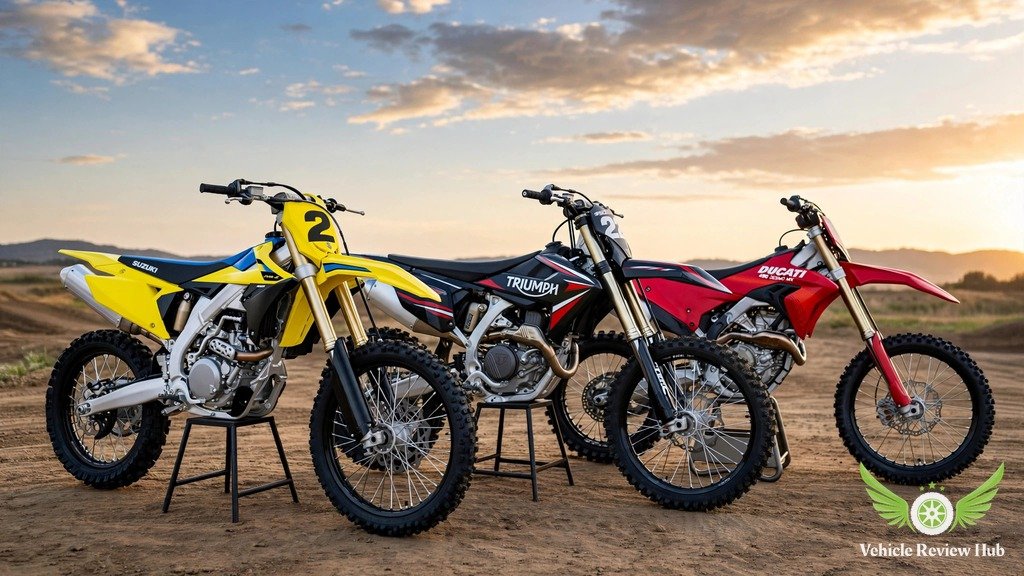
The starting system is the single biggest difference in this Suzuki RM-Z450 comparison, and it is the one the buyer will feel every single ride. The Honda, the Yamaha and the Kawasaki all start with a button. The Suzuki starts with a kick lever on every model year — primary kickstarter, automatic decompressor, no battery — and Racer X confirmed electric start is not coming for 2027. After a stall, a button-start bike is running again in a second, while a kick-start bike costs a rider positions. It is the one compromise in this Suzuki RM-Z450 comparison that no dyno figure offsets.
TF 450-X and Desmo450 MX Alternatives
Outside the Japanese field, two European 450s change the value math in this Suzuki RM-Z450 comparison without changing the recommendation. The Triumph TF 450-X starts at $10,295 for 2027 — only $596 above the Suzuki on MSRP — with a claimed 61.5 hp and a chassis developed with Ricky Carmichael. Its destination charge was not verified. The Ducati Desmo450 MX is $11,495 with a claimed 63.5 hp, 39.5 lb-ft and a 231 lb claimed weight — the most powerful and lightest claim in the class, $1,796 above the Suzuki on MSRP. Beyond them: the KTM 450 SX-F made 59.5 hp on the 2026 wrap, but its 2027 price was not verified, so no KTM price is printed in this Suzuki RM-Z450 comparison; the Husqvarna FC450 made the highest figure in the wrap at 60.2 hp, but there is no 2026 standard FC450 in the USA and the Factory Edition is $13,799. The verdict stands: the Suzuki is the value buy — and the Triumph is the one alternative a Suzuki buyer should price first.
Suzuki RM-Z450 Comparison: Frequently Asked Questions
Direct answers to the questions US buyers ask in this Suzuki RM-Z450 comparison.
Which 450 motocross bike is the cheapest in 2027?
The Suzuki RM-Z450, at $9,699 plus $650 destination — $10,349 delivered. That is $350 less than the Honda, $600 less than the Kawasaki and $625 less than the Yamaha, delivered. This Suzuki RM-Z450 comparison uses delivered prices, because destination charges differ across the four bikes.
Is the Suzuki RM-Z450 faster than the Honda CRF450R?
On peak horsepower, yes. On the Dirt Bike 2026 dyno wrap — stock bikes, standard maps, same Pro Circuit dyno — the Suzuki makes 56.6 hp at 9,400 rpm against the Honda’s 55.3 hp at 8,700 rpm. The Honda answers on torque, 36.5 lb-ft at 7,000 rpm against the Suzuki’s 35.2 at 8,100 rpm. This Suzuki RM-Z450 comparison calls it a split: Suzuki wins horsepower, Honda wins low-end pull and weight.
How does the RM-Z450 compare to the Yamaha YZ450F on power?
They are dead even: 56.7 hp for the Yamaha at 9,600 rpm, 56.6 hp for the Suzuki at 9,400 rpm on the Dirt Bike 2026 dyno wrap — a 0.1 hp gap. Torque is just as close: 35.1 against 35.2 lb-ft. The Yamaha costs $625 more delivered, has electric start and the Power Tuner app, and finished third in MXA 2025 where the Suzuki finished seventh.
Is the KX450 faster than the RM-Z450?
Yes, on peak power: 57.7 hp at 9,400 rpm on the Dirt Bike 2026 dyno wrap against the Suzuki’s 56.6 at the same rpm — a 1.1 hp gap. The Suzuki holds a small torque edge, 35.2 lb-ft against the Kawasaki’s 34.8. In this Suzuki RM-Z450 comparison the Kawasaki is the power leader of the Japanese four.
Does the RM-Z450 have electric start like its rivals?
No. The Suzuki is kick-start only on every model year, with a primary kickstarter and automatic decompressor and no battery, and Racer X confirmed electric start is not coming for 2027. Every rival in this Suzuki RM-Z450 comparison — the Honda CRF450R, the Yamaha YZ450F and the Kawasaki KX450 — has electric start.
Which 450 is the lightest?
The Honda CRF450R, at 238 lb curb for 2027 — about 10 lb lighter than the 2026 bike. The Yamaha is 243 lb wet, the Kawasaki is 240 lb without fuel and 250 lb with a full tank, and the Suzuki is 247 lb claimed, 250 lb measured wet — the heaviest in the class. Weights are manufacturer figures on different bases, so this Suzuki RM-Z450 comparison treats the ranking as a guide.
Which 450 won the 2025 MXA shootout — and where did the Suzuki finish?
The Suzuki finished seventh of seven in the MXA 2025 shootout, and seventh of seven in 2024 as well. The Yamaha finished third in 2025 and the Kawasaki sixth. Vital MX left the Suzuki out of its 2026 shootout entirely. The 2027 Honda is all-new and the 2026/2027 Yamaha is the updated bike, so those results are about the pre-2027 machines.
Is the 2027 RM-Z450 a new bike or the old one?
It is the old platform with its first real update since 2018. The 2027 bike keeps the same 449cc engine, 12.5:1 compression, 44 mm throttle body and five-speed gearbox, and replaces the 49 mm Showa fork and BFRC shock with KYB suspension front and rear. Suzuki published no 2027 KYB fork diameter, so this Suzuki RM-Z450 comparison prints none.
Should I buy the RM-Z450 or spend $600 more on a YZ450F?
Buy the Yamaha for the proven shootout bike, electric start and the Power Tuner app — third in MXA 2025 against the Suzuki’s seventh, for $625 more. Buy the Suzuki if the dyno tells you what you need to know: 56.6 hp against 56.7, the same KYB suspension, $625 kept in your pocket. That is the cleanest either-or in this Suzuki RM-Z450 comparison.
What about the Triumph TF 450-X and Ducati Desmo450 MX?
The Triumph TF 450-X starts at $10,295 for 2027 with a claimed 61.5 hp — only $596 above the Suzuki on MSRP, though no delivered price is printed in this Suzuki RM-Z450 comparison. The Ducati Desmo450 MX is $11,495 with a claimed 63.5 hp and a 231 lb claimed weight — the most powerful claim in the class, $1,796 above the Suzuki on MSRP.
Does the RM-Z450 hold its value?
Not as well as its rivals, on the evidence available. Dealers discount new Suzukis below MSRP — a $1,000 rebate ran on 2025 models and a 2027 listing showed $700 off — and that discounting pressures used values. The only verified used figure in this Suzuki RM-Z450 comparison is a single-source 1000PS average of $4,210 for a 2019 bike, with a suspiciously low average mileage of 1,000 km.
Which 450 should I buy in 2027?
Buy the Suzuki if you want the cheapest 450 in the USA and the best-turning chassis in the class, and accept the kick starter and the 12-hour piston schedule. Buy the Yamaha for the proven shootout performer, the Honda for the newest bike and strongest low-end torque, the Kawasaki for the most peak horsepower and electronics. That is the verdict of this Suzuki RM-Z450 comparison: the Suzuki is the value buy, not the best bike — and for a rider on a budget, the value buy is the right bike.